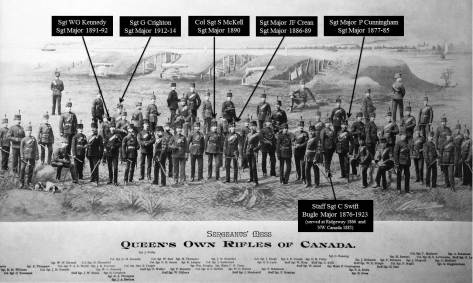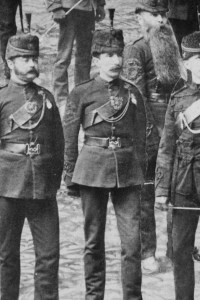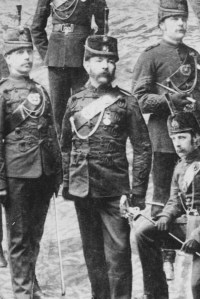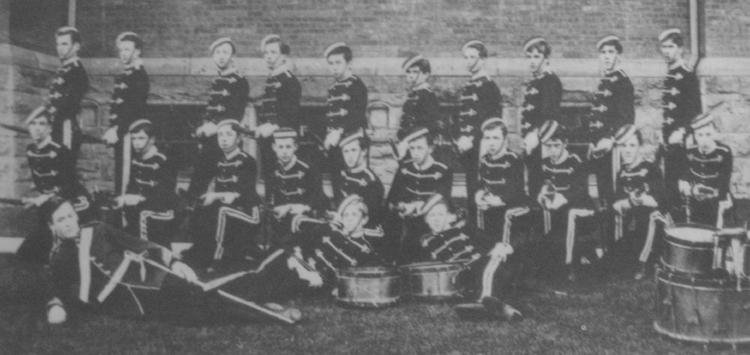
The “Rifles” returned to the ice on January 1st to defend their Rangers Cup title in the second annual tournament. Despite not losing any games, they placed third.
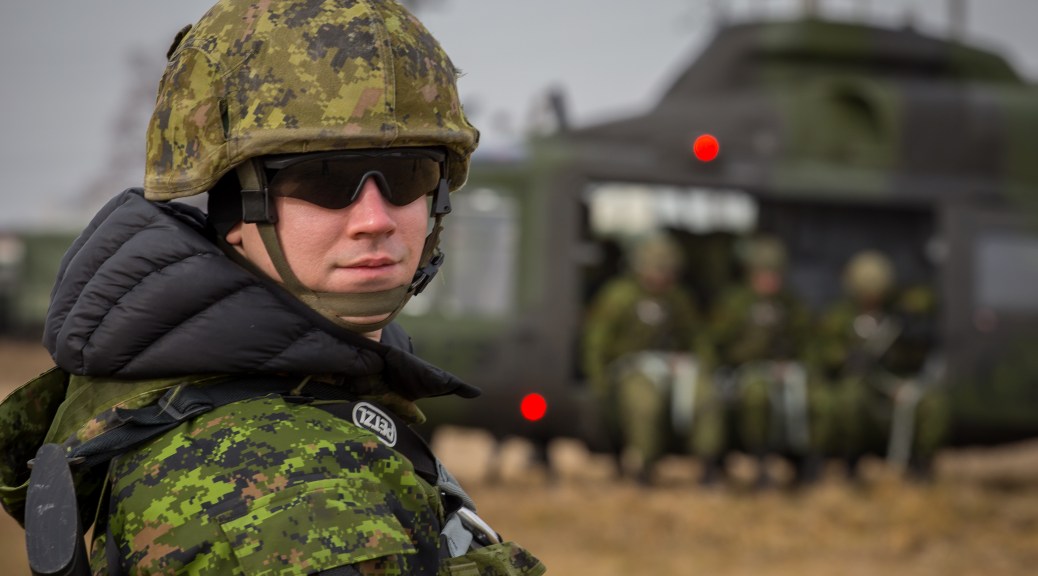
Museum volunteer Cpl Justin Dreimanis captured the action with some excellent photographs:
This is the first of an ongoing series of articles in which museum volunteers were asked to share information about an interesting artifact they have come across in our collection – some of which may be on exhibit but others may be in storage. We start with Curator John Stephens.
So what artifact have you chosen to spotlight for us today?
One of my personal favourite items in our collection is not from the museum side but from our archives. It’s a bound ledger of nominal rolls by company beginning in March 1866 – just three months before the Fenian Raids – and pretty much annually through to 1882.
Why do you find this so interesting?
The history of the regiment is usually considered in terms of battles and campaigns and weapons and uniforms and training and deployments – but ultimately at its most basic level, it’s about people. And generally when we think of people in the regiment we know the stories of commanding officers, other officers and senior NCO’s but these rolls list everyone who served from the youngest bugler to the Surgeon Major.
Over the various years, these contain a varying amount of information on each person listed but they do allow us to follow the progression through the ranks of many of our regiments earliest members.
I’m also into family history research and there is no question the March 1866 roll is probably the most valuable for genealogists as it includes country of birth, religion, age and occupation.
Obviously it would be handwritten – is it legible?
Surprisingly yes it is for the most part. The ink for the June 1866 roll is very faded but generally the handwriting is legible – there are certainly some exceptions of course.
What condition is it in?
Surprisingly good condition considering its almost 150 years old and it was actually in active use for 16 years. The cover and spine are holding up well and while there page are somewhat brittle, they really aren’t too bad.
Just recently we received a donation to cover the cost of a new metal cabinet with doors in which we are now storing our highest at-risk items. Hopefully this will provide some better protection for items like this ledger.
Anything else you’d like to share about this object?
With the 150th anniversary of the Fenian Raids and the Battle of Ridgeway coming up in June 2016, there seems to be increasing interest in the information that we have in our collection related to that period from researchers and descendants of those who fought.
We’ve digitized this ledger and posted it on our website Archives page. This provides people access to the information while still protecting the artifact itself from damage caused by handling. You can check it out here.
We’re also going to use the 1866 rolls to do some analysis of the regiment’s make up and how reflective it was or wasn’t of Toronto at that time.
Thanks to the diligent efforts of Corporal Michael McLean, an Electronics-Optronics Tech based at Canadian Forces Base Petawawa, we have now completed the transcription of Redway’s Diary.
We recently received a donation of a diary kept by Queen’s Own rifleman Edgar Henry Redway written during part of his service during the South African War. We would like to transcribe this diary to make it more accessible for research.
If you are interested in helping in this project please email museum@qormuseum.org before you start, indicating which pages you’d like to transcribe. We’d like you to transcribe in groups of 10 pages to keep the administration simple realizing that this may not cover a complete date entry.
“In progress” beside the page list below means someone is already working on that group of pages. “Completed” means its done and dusted.
Before starting please review the instructions following the page list below.
Send your transcription in text format (not tables). You can use Word or simply paste them into the text of your email.
Transcribe exactly what is written – including spelling mistakes and abbreviations or acronyms.
Do not use bold or italics.
If you are unable to determine a word or phrase, please put a simple [?] in place of the undecipherable text.
Do not worry about replicating how it is laid out – it is easier to read if we just make paragraphs on our web page.
Do not include page numbers.
Please make sure you review or better yet, have someone else review your transcription for accuracy particularly if there are sections you are unsure of. Transcribing Redway’s handwriting can be tricky and a second set of eyes can sometimes catch something you may have missed.
Thank you in advance for your assistance!! If you have any additional questions, please email us at museum@qormuseum.org
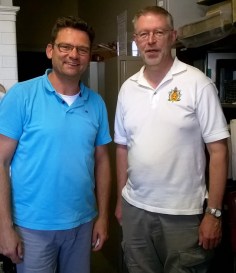
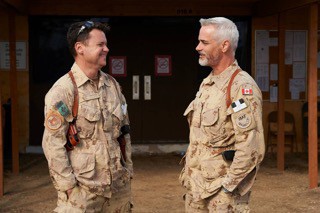
CWO (Ret’d) Shaun Kelly (at right above) has volunteered at the museum since 2012 in the much appreciated role of Assistant Curator. Through some very challenging times he’s brought his hard work ethic, positive outlook and strong organizational skills to help us keep the museum moving forward. In 2014 Shaun was presented the Commanding Officer’s Commendation for his work with the museum.
After retiring as Regimental Sergeant Major, Shaun began work as a civilian with the Department of National Defence in the position of 4th Division Safety Officer.
How did you end up volunteering at the museum?
I was recruited by Lieutenant Colonel (Ret) Rob Zeidler as part of a “team” when former Curator Captain Peter Simundson retired. After 33 years of full and part-time service I was still interested in serving the Regiment in some form and my wife said I should get out of the house a least once a week.
What background do you bring with you that you think helps you contribute in this role?
As a former RSM and a member of the Regiment for 33 years I had a good idea of its history, accomplishments, and stories. I have a particular interest in our history before 1900 as I don’t think we know or share enough about that time period considering it includes the Battle of Ridgeway, the Northwest Canada Campaign and South Africa which have been somewhat overshadowed by the huge accomplishments of WWI and WWII.
What do you enjoy most about volunteering at the museum?
I enjoy the research I have done on our Regimental Sergeant Majors since unlike the Commanding Officers, no formal records had been kept so finding names and dates has been a real challenge. This research continues when I’m not putting up pictures, building shelving units or cleaning-out storage closets.
What aspect or content of the museum are you most passionate about and why?
As above but including learning more about the soldiers who served during the first 50 years, what they did, where they lived and what may have motivated them to join the militia.
Is there one object in the collection that really excites you or that you think people should know about?
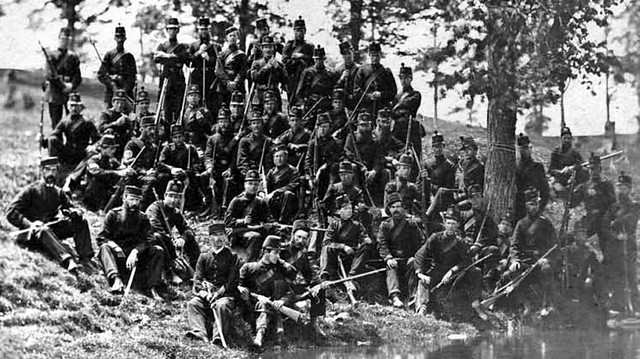
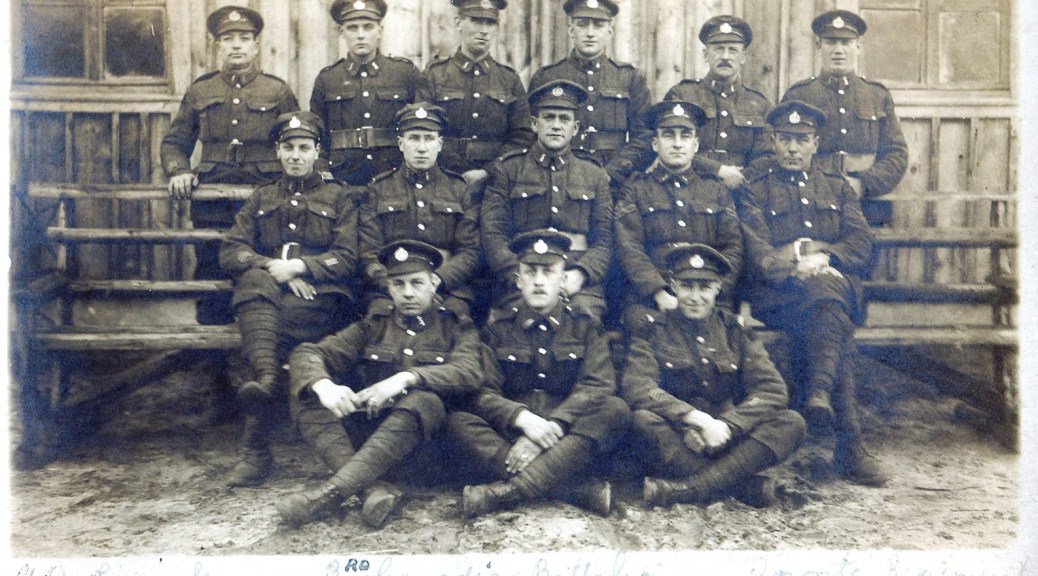
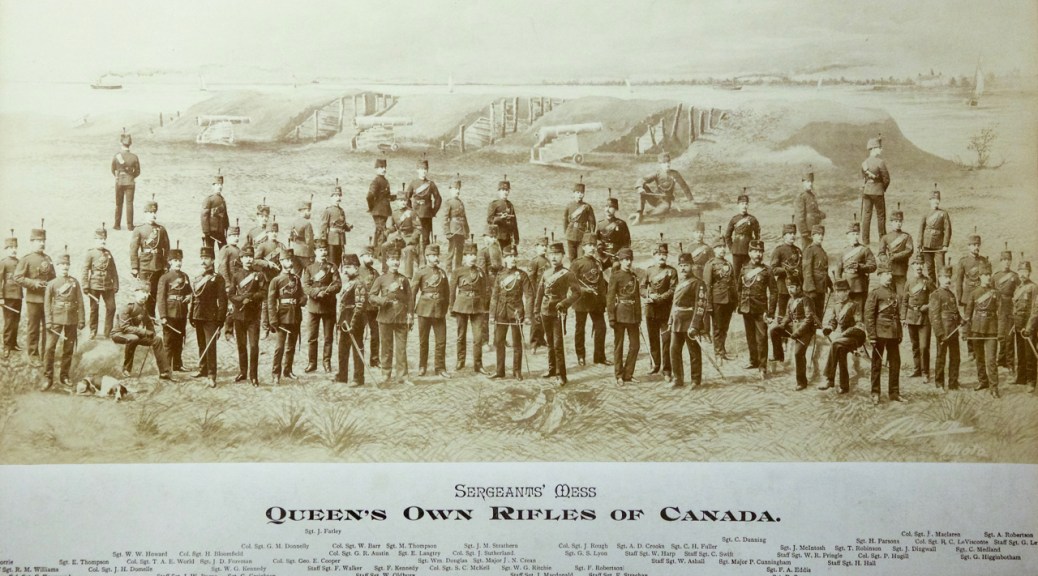
The photos of the different Companies that were taken after the Battle of Ridgway in 1866 I find fascinating. Firstly, photography was in its infancy so to take the time to carefully document who was there must have taken a good amount of effort. Secondly, you can see real character in the faces of the men, they looked like a real tough bunch that certainly could have done some damage to the Fenians had the battle gone differently and they had the chance to close with the enemy.
Number 10 (Highland) Company June 1866
Why do you think a museum like this is important?
Countless thousands of soldiers have served under the Queen’s Own Cap badge over the past 155 years, 1700 of them have died, many others have been decorated for acts of courage and bravery, we have an obligation to remember and share their stories. The museum is an important way to preserve their memory but also to share the Regiment’s history with our serving soldiers and the public in general.
Would you recommend volunteering to others and if so why?
Our volunteers are a diverse group: serving and former members of the Regt, civilians with a museum background and people with an interest in military history, some help at the museum and some help virtually via the internet, some come in every week and others only come by for specific tasks, all have one thing in common that is the betterment of our museum to become a multimedia resource to share our history and heritage, everyone has something to offer.
If you’d like to help volunteer at the museum, check out our Volunteer page for information and an application.
Our role as the Regimental Museum is to both capture and share the history of The Queen’s Own Rifles. Maintaining our physical exhibits at Casa Loma is a big part of how we share and hundreds of thousands of people come through out displays every year – many tourists from around the world. But realizing that many more people will never be able to visit our physical location, we felt it was important, like any other museum, to have an online presence and so we created this website in 2012. We followed that up with a Facebook Page, a Twitter account, and most recently our Flickr site for sharing our thousands of photographs.
Timelines
Part of our challenge with the website was how to best present historical information from 1860 to the present. We opted for timelines. Don’t get too excited – these aren’t fancy java scripted timelines with awesome graphics and pop up info boxes. They are just a chronological listing of activities and milestones for the regiment. Sometimes we can provide links to further information or biographies of those noted. Sometimes we have some relevant photos to add in as well just to keep it from getting too dry. J
So where do we get the material to include? Great question with some good news/bad news answers. Prior to 1960 we have a number of histories of the regiment to draw from including LCol W.T. Barnard’s great work produced in 1960: Queen’s Own Rifles of Canada, 1860-1960: One Hundred Years of Canada. Pdf versions of this and earlier histories of the regiment can be found on our Research page. There is a lot more to add but we certainly have covered quite a bit about the first hundred years – for the most part on timelines divided into 25 year periods.
From 1960 to 1970 the Regiment produced an annual Powerhorn – essentially a yearbook which captured a wide range of activities of the two regular force and one reserve battalion, the regimental depot, the cadet corps, the association and the Black Net. We have a dedicated volunteer (he also does our “This Day in History” or OTHDIH post on Facebook and Twitter) plodding through these volumes and adding details to the appropriate timeline.
And of course more recently, Charles McGregor has published a history of the regiment since 1960 and we’re using this to help fill out our timelines as time and resources permit. In each case we try our best to reference our source for the information we add to the timelines.
But why haven’t you included X on a timeline?!
Unless it’s your birthday, odds are we’re happy to include info you might have on our timelines, but we just haven’t got to them in our research OR we just don’t know about them. In particular we would love to have more info to include for the late 1950s and from 1970 to present. Deployments, training exercises, jumps, graduations, special postings, etc. Ideally we’d want the exact dates (so we can use in our OTDIH posts) but we could also include if you just have the month and the year. We’re not looking for full-fledged stories or even paragraphs – just a one liner.
And don’t let the idea of “history” turn you off sending in more recent information – everything that has already happened is by default, part of our history, even it was just yesterday. And the sooner we capture it, the more accurately it will be recorded. Our only exception to this is to record operational deployments only when they are completed.
If you have items to share you can post a comment below or send an email to museum@qormuseum.org.
And if you haven’t has a chance to look yet, do check out the existing information on our timelines!
So it’s almost Tuesday. Hopefully you’ve survived the Black Friday crowds or maybe you opted to splurge online instead on Cyber Monday. Or maybe you didn’t partake in either but just got bombarded with promotional emails for the past week. But now we’d like to change the channel because December 1st is not just Tuesday, its #GivingTuesday!
What is GivingTuesday?
Imagine a day dedicated to giving back … around the world, across Canada and in your own community! Just as Black Friday kicks off the holiday shopping season for many people, GivingTuesday is the opening day of the giving season. GivingTuesday is a global day of giving. GivingTuesday is a time to celebrate and encourage activities that support charities and non profits. Whether it’s making a donation, volunteering time, helping a neighbour or spreading the word, GivingTuesday is a movement for everyone who wants to give something back.
And you’re telling me this because….?
Today and frankly until the end of the year, everyone is telling you they need you to give – Santa boxes for needy children, food banks need volunteers, and many local churches and charities are preparing to receive refugees in the coming weeks. And as passionate as I am about the work we do, I’m not asking that you make support for The Queen’s Own Rifles Regimental Museum a priority over these other urgent needs.
But some of you may be in a position where you can support more than one cause – be that with your money or your time. If you can make a financial donation great – it would go to help us with projects like digitizing 16mm films in our collection before they become unplayable; or to purchase new digital display products that can make our exhibits more engaging. You can donate on our GivingTuesday page to the Queen’s Own Rifles Trust which operates the museum – just type MUSEUM FUND in the online form Message box.
Some of you may be willing to give of your time as volunteers. We have a variety of opportunities. We generally gather at the museum most Thursday evenings from 1900 to 2200 hrs to work on very hands on projects from exhibits to hanging pictures to cleaning to cataloguing. But we also have volunteers who work remotely on research or transcribing or other tasks that don’t require your physical presence. If you’re interested in volunteering with us, check out our Volunteer page and complete an application.
What if I can’t do either at the moment – can I still help?
You can always become a social ambassador and share the word on Facebook, Twitter and Instragram about #givingTuesday – just make sure you use this hashtag.
Whatever the cause, we hope you’ll consider investing your time or financial resources or become a social ambassador on #GivingTuesday!
In our museum collection we have loads and loads of photos – some in files and some in frames and some in albums and some more recent ones digitally. And in addition to those, over the past two and half years we’ve been taking more photos – of museum events, of each artifact and even photos of photos!
Much of this effort has been led by Captain (Ret’d) Larry Hicks who has been diligently photographing each artifact in our collection – a mammoth task on which he’s made amazing progress but still lots more to go. Among these have been some amazing photo albums for which Larry has painstakingly photographed each individual photo. He has been assisted by Corporal Justin Dreimanis, a serving soldier in the regiment and a recently graduate of Humber College’s photography program. And last but definitely not least, our WWII “guy” Master Corporal Graham Humphrey has scanned every WII photo in our files.
Of course the more photos we collected, the question increasingly became what do we do with them? Photos of artifacts are added to our Museum Collection Database but how could we share these to a wider audience – be they descendants or researchers or members of the regimental family?
And so I’m pleased to announce the official launch of our new QOR Museum Flickr site for sharing all these photos – almost 4,800 actually! There are some great photos from the Cold War regular force days, awesome officer photos from the late 1800s, a scrapbook of Fenian Raid newspaper clippings, a great record from the 1910 trip, and loads of WWII photos from Newfoundland, New Brunswick, England and Europe as some examples.
All these photos are organized into “albums” – 48 so far. Albums contain photos with something in common – they could be all from a real album in the museum’s collection, or they could contain photos on a certain topic – 1910 trip or band photos for example. Photos can show up in more than one album. So a band photo from the 1910 trip will be in both the band and 1910 trip albums – pretty cool if we do say so ourselves. There are special topic albums on shooting, sports and the Pellatts among others.
And all of this is still a work in progress – we’ll keep organizing and sort and uploading – and of course taking more photos so come back regularly to check them out!
But wait – we need your help!
If you’ve ever inherited your parents’ or grandparents’ or great grandparents’ photo albums – or shoeboxes – you’ll know how frustrating it is when they so often don’t have names on the back! And trust me for a museum its even more frustrating 😦
And so this is where we hope you can help 🙂 If you can identify people or places or sometimes even dates in any of our photos which don’t already have that information indicated, PLEASE take a moment to share what you know in the comments box. Before you can do that, you will need to create a Flickr account if you don’t already have one but it only takes a few moments and we would very, very, very much appreciate any help you can give us in documenting these valuable historic records of QOR history.
As a sample of what you can look forward to, here’s a gem: No 5 Company in Stratford, June 1866 (shortly after the Battle of Ridgeway)
This is the first in a series of interviews profiling our museum volunteers. We begin with Jim Lutz (at right in photo above) who has served on the museum board of governors for several years. A US veteran of the Vietnam war, Jim also served for many years as a civilian instructor with the Queen’s Own Rifles affiliated 17 Upper Canada College Rifles, 96 Trinity College School and 2881 QOR cadet corps.
How did you end up volunteering at the museum?
As a member of the QOR Trust Fund, I was involved with the City staff in transitioning Casa Loma to the Liberty Group, and I have stayed involved with the Museum because of my interest in history.
What background do you bring with you that you think helps you contribute in this role?
I have a strong background in military history, having been a graduate student of C.P.Stacey at the University of Toronto. I have been associated with the QOR for over 30 years, so I know its history well and have known many of its distinguished veterans.
What do you enjoy most about volunteering at the museum?
I enjoy helping to preserve our history, and meeting the other volunteers.
What aspect or content of the museum are you most passionate about and why?
I enjoy reading all the documents in the archives, which tell so much about the history of the QOR.
Is there one object in the collection that really excites you or that you think people should know about?
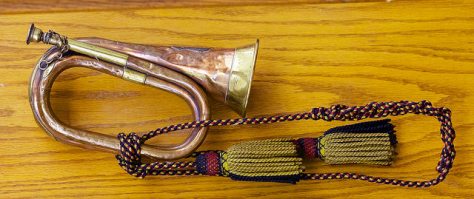
Two items: The Paardeberg bugle, and the number side panel from one of the D-Day landing craft that was preserved by the Lieutenant Colonel Elliot Dalton who commanded one of the QOR companies in the first wave on D-Day.
Douglas William’s bugle used during the South African War to sound the charge at the Battle of Paardeberg
Why do you think a museum like this is important?
The Museum shows the volunteer spirit of Torontonians who served in the QOR, and how these people participated in some of the most important events of modern history.
Would you recommend volunteering to others and if so why?
Depends upon your interests – if you love history, or if you have served in the QOR, or if you enjoy re-enactment, or if you value local history, then any of these is a good reason to volunteer. Also, you will see tangible results of your work, which will be shared with all the visitors to Casa Loma.
One of the friends of the museum WO (Ret) Bruce Walter CD, sent us a great photo of the HQ Lewis Gun section of the 3rd Canadian Battalion, Toronto Regiment taken on January 1st, 1919 “on the Rhine, Germany”. The photo includes his wife’s grandfather – James Herbert Smith.
Bruce recently wrote to us with an update and a request:
"It's been almost a year since I sent those pictures and I've even met a descendant of one of the guys who served with Leanne's grandfather! The guy on the far left of the 2nd row is Frank Adderley (mis-spelled on the back). He sits beside Leanne's grandfather, Herb Smith (2nd from left in the 2nd row). Maureen Adderley is the granddaughter of Frank and we met her (finally) this past Remembrance Day.
I'd like to initiate a search to find present day descendants of these men. I'll be using the information from the back of the picture and also information taken from their Attestation papers. From there I hope to "reach out" to localities and newspapers. I was wondering if you could initiate an item on the QOR web page in case there are any descendants still contact with the QOR (or possibly still serving)!"
So we’re doing just that. Below is the information from the back of the photograph about the soldiers.
If you have any information that you think might be able to help Bruce, you can contact him directly via email by clicking here.
We’re very excited to report that our website just exceeded over 200,000 individual page views by over 65,000 visitors since we launched in early 2012!
While most of those are from Canada, we do have visitors from over 130 other countries exploring our site.
When not take a look around at our extensive resources!
We’ve recently had three 16mm films in our collection professionally digitized and I am pleased that they have now been uploaded to our Museum’s YouTube channel and added to our Videos page on the website.
The first is a 15 minute black and white overview of the various activities that took place during the Regiment’s 100th Anniversary in 1960 including events conducted by all three battalions which existed at the time.
The second film is a 26 minute black and white “History of The Queen’s Own Rifles” produced by the CBC and featuring then museum curator Lieutenant Colonel William T. Barnard.
And lastly is a four minute silent “tour” of the of the fairly new Moss Park Armoury including the Officers’ and Sergeants’ Messes. (If anyone is able to help us nail down the date by identifying any of the soldiers in the film, we’d greatly appreciate it. Leave a comment below!)
We’d like to thank the Digital Treasury Group for their excellent and professional work on this project and helping us with the cost!
We have almost a dozen more films which we hope to digitize as the funding becomes available. Unfortunately our storage facilities are not ideal for the storage of films and frankly they are virtually inaccessible now in the 16mm format so we’re very excited to be able to make a start on this important preservation project!
We don’t often share much of the day to day goings on at the Museum so I thought perhaps I’d write briefly about three recent visitors to the museum.
Robert Catsburg
Author Robert Catsburg and Curator John Stephens in our museum office.
On September 25, I was pleased to meet Mr Robert Catsburg of Holland who is just wrapping up his third historical account of fighting which took place in Holland during WWII. POLDERFIGHTING is a detailed account of the 8th brigade near Oostburg, from 20 to 30 october 1944. It is based on the message log of the brigade, containing all radio messages and numerous other sources including many German and Dutch.The volume amounts 300 pages and will be translated and published in Canada in 2016 or 2017.
Robert shared a draft of his book which made clear the incredible amount of research he had done on the British, Canadian and Germany units involved, and on the significant impact this had on the local Dutch population.
We were happy to contribute in a small way to his project (the QOR were part of this action) and are certainly looking forward to a copy of the English translation when it is completed!
Mark Dalton
The strangest of coincidences led me to meeting Mark Dalton at the annual Upper Canada College Association Day event on September 26. While he was looking for the UCC archivist, I overhead him mention he name to another staff member and took the opportunity to introduce myself. While we’d exchanged emails in the past, we’d never actually met but Mark will be familiar to many in the QOR family as the son of Lieutenant Colonel Elliot Dalton who was among, if not THE first to step ashore as a Company Commander on Juno Beach on D-Day. Incredibly, his uncle Charles commanded the other company in the first wave.
Mark told me he had actually planned to head over to Casa LOma to see the museum again so we met there and took a tour of our new layout and exhibits plus a bit of a “Curator’s backroom tour” as well. Mark snapped a photo of the piece of a landing craft that we have on display that was brought back by his father after the war. Mark and his wife and daughter are about to head over to France this week where among other activities, they will be visiting the Juno Beach Centre.
Mark has also kindly offered to temporarily loan us some albums that belonged to his father so that we can scan the information they contain and we are certainly looking forward to tackling that project!
Arthur Manville
During the following week I was very pleased to give a tour to Mr. Arthur Manville who is the Honorary Librarian of the Royal Canadian Military Institute (RCMI). Arthur has no military background but his interest in things military began in the mid-l960s when he was living in Ottawa and became an Associate Member of The Cameron Highlanders of Ottawa Officers’ Mess. From that developed an interest in military history and he became an enthusiastic collector of British campaign medals. For many years he was a member of The Military Historical Society (London) and The Society for Army Historical Research (London), and then began writing in 1983 after a trip to India and Pakistan with the MHS visiting regimental centres. He is very much a student of military history and an amateur military historian, having had articles published in the above society journals, RCMI Year Books and for the past several years in RCMI Members’ News. He has been a member of RCMI Library Committee since 1996 and was appointed Honorary Librarian 2001. Arthur was accompanied on his tour by Mr. Jim Lutz who is a member of our Museum Board of Governors and the RCMI.
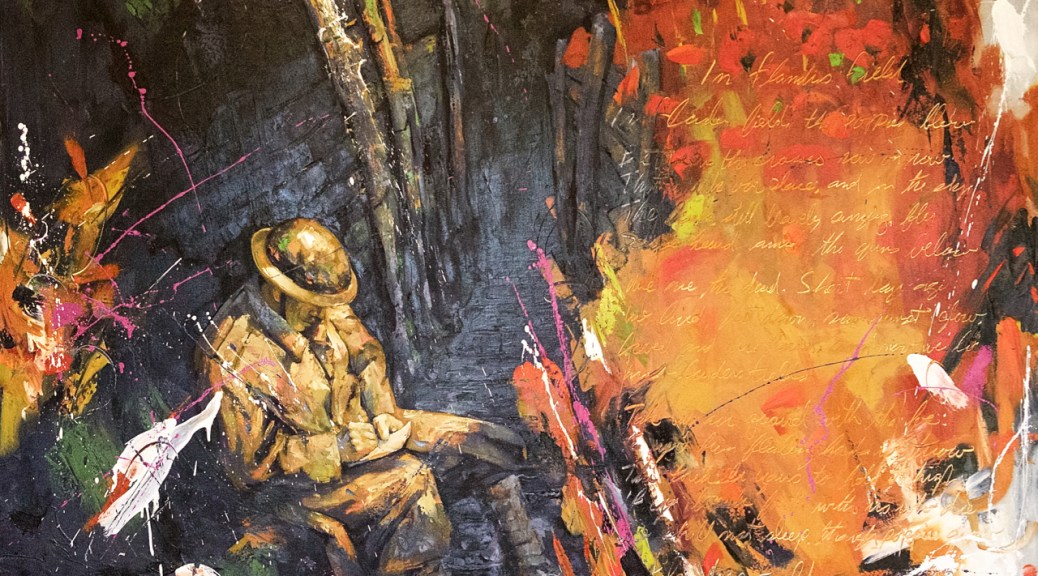
This summer we were pleased to accept a loan of the spectacular painting It is Written by Brian Lorimer. The loan was facilitated by Honorary Lieutenant Colonel Brendan Caldwell on behalf of the Caldwell Foundation which owns the 5′ x 6′ painting which now hangs in our Riflemen Room. LCol Caldwell also donated a copy of the beautiful Project Remembrance book to the museum library.
Providing a glimpse into one of the more mundane yet psychologically important aspects of a soldier’s life, It is Written represents a soldier engaged in the quiet pastime of writing a letter home.
The canvas is inscribed with one-time Rifleman John McCrae’s “In Flanders Fields”. This canonical war poem was penned from the back of an ambulance after McCrae’s friend Alexis Helmer died as the result of wounds sustained in the Second Battle of Ypres and is perhaps the most well-known English-language poem of the Great War.
Project Remembrance is a fine art collection by Canadian painter Brian Lorimer that inspires remembrance and commemorates the centenary of the onset of The First World War. The paintings are a fresh and compelling rendering of the Canadian experience of the Great War, describing moments of individual fortitude and trial. More than that, they are a call to Canadians to consider and draw inspiration from the strength of character exhibited by our soldiers.
Their mission is to preserve, promote and celebrate Canadian history and heritage through the powerful medium of art. Their goal is to raise funds to assist in the betterment of Military personnel and their families. Funds raised with the support of Project Remembrance, individual and corporate donations are provided directly to the Support Our Troops Program.
If you would like to support Project Remembrance, you can purchase copies of the work as framed or unframed on paper, reproduced on canvas, as art cards or the book, via their online store.
We are extremely grateful to the Caldwell Foundation for this loan and encourage you to view it on your next visit to the museum!
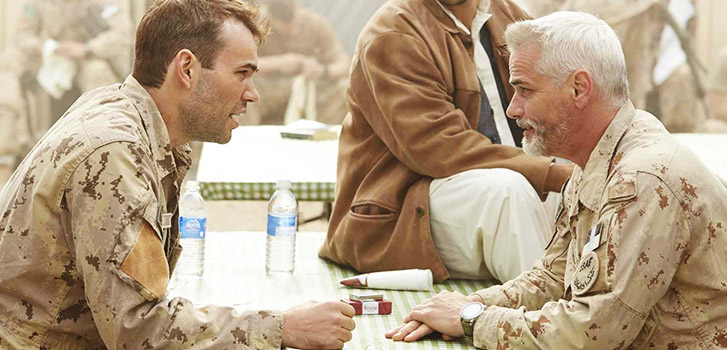
[Then Sergeant Ted Howard of The Queen’s Own Rifles of Canada, was awarded The United States of America’s President’s Gold Coin in recognition of his exemplary and outstanding service in Afghanistan in 2006. The coin was presented by U.S. Army General John Craddock, then Supreme Allied Commander Europe (SACEUR) of NATO. He served as a producer on the Paul Gross film “Hyena Road” which recently premiered at the 2015 Toronto International Film Festival.]
Lt Ted Howard, CD (L) and Paul Gross on the set of Hyena Road.
Hyena Road is an organic film that developed out of the dust of Afghanistan. Paul Gross who wrote, directed and starred in the film, has integrated actual footage he gathered when following me while I was working with Task Force Kandahar as an Effects Officer in 2011.
Although the film is not anchored in any specific period of the mission, Mr. Gross has sewn together a visceral and compelling story fictitious story based in cinematic realism that truly presents an accurate snap shot of the Canadian mission in Afghanistan since the places, people and events are based in reality. In particular it centers on the creation of an MSR that we built in partnership with the Afghan authorities. The road, nicknamed Hyena, is meant to achieve three main objectives. It is meant to legitimize the local government in the eyes of the population as representative of the people, it will improve the local economy and as the Commanding General in the film puts it, “drive a dagger into the heart of the Taliban.”
The story is set around three main characters, Master Sniper Ryan, Effects Officer Pete and a legendary Mujahedeen warrior, only known to the coalition forces as the Ghost. Paul used stories he heard from a number of snipers, who spent time in Afghanistan, to create the character Ryan. He is a good example of our contemporary combat arms soldiers who have been inserted into contemporary conflict zones. Ryan has been inserted into an environment that is completely foreign to him; facing an enemy that does not play by the same rules he must.
The character Paul plays was inspired by the work he saw me do during his visit. He believes Pete represents the type of soldier the new wars paradigm is creating. Part businessman, politician and soldier, he focuses on the non-kinetic elements in contemporary warfare that can turn the tide of support for the military mission with the local population and supports our foreign policy objectives in foreign lands.
The Ghost was actually inspired by an individual who worked with me in Kandahar and a significant figure in the war against the Soviets.
When I first met Paul I was very skeptical about letting him into our world and even more skeptical he could create a film that truly depicted what was going on in Kandahar. He grew on me however. He went on foot patrols in Mushan, rode the streets of District 9 in the city with me and even walked through the Bazaar. With time, I came to realize that Paul was a patriot and if the story of what my brothers-in-arms and their families sacrificed in Kandahar was going to be told, there was no better person then Paul. There are some Hollywood moments in the film but for the most part it holds true to the people and events the film is rooted in.
I have seen the film a few times now and I am proud of what our team achieved with Hyena Road since it is an honest and accurate portrayal of what happened in South East Afghanistan. In my opinion, a plaque or some sort of war memorial is nice to have on a wall but that is soon forgotten. Something like this movie will help ensure the memory of our fallen comrades and those families who have paid dearly for our time in Afghanistan will resonate within the Canadian cultural landscape for years to come.
_____________________________
You can read about The Queen’s Own Rifles contribution to the Afghanistan mission here.
We’ve been working hard to re-do most of our exhibits in our new locations on the third floor of Casa Loma. In addition we’ve been working hard to create an exhibit room that provides the history of the QOR since WWII. This room is still a work in progress but we hope to have ready for an official opening in the Fall.
We thought we share these photos to give you a taste of what you can see if you come to visit:
As we kick off the 2014 Winter Olympics, we thought we’d share a few snippets of sports related regimental history.
The following is an excerpt from the 1922-1923 QOR Association Annual Report.
Sports in the Regiment
A phase of development in the life of every regiment that is, perhaps, one of the most essential to its success, and perhaps one of the most neglected, it in the world of sport. “Playing the game,” win or lose, must be inculcated in the mind of any who take a part, and this last devolves upon efficient leadership. It is such an ideal that the QOR has endeavoured to induce and maintain, that its part in the development of National life may not be confined to the discipline of the parade ground but to include self-discipline in the everyday life of its members. The Queen’s Own Rifles Athletic Association, therefore, became a reality…
Major Anthony I. W. Schultz (Member & Trust Fund President)
Captain Adam A. Hermant (Member & Trust Fund Past President)
Mr. Jim Lutz (Member)
Major John Stephens (Curator & Ex-Officio Member)
Chief Warrant Officer Shaun Kelly (Assistant Curator & Ex-Officio Member)
John Fotheringham has (uniquely) served as Commanding Officer of the QOR on two separate occasions. He has been responsible on behalf of the Trust, for initiating and updating QOR memorials throughout the world, a member of the Regimental Museum Committee and is also a Director of the Juno Beach Centre in Normandy. We look forward to his leadership in this new role.
We would also like to extend our thanks to outgoing Chair, Lieutenant Colonel Rob Zeidler who has served for a number of years, and in particular for his efforts during the transition between Curators, and the transition of Casa Loma operators from the Kiwanis Club of Toronto, to the City of Toronto, to the Liberty Entertainment Group. We wish Rob the best as he undertakes some new projects for the regimental family!
Last week, for the first time in decades, citizens gathered to lay flowers on the National Volunteer Memorial which was created to remember those militiamen who served and died in the service of their country at and following the the Battle of Ridgeway (or Limeridge) on June 2, 1860.
Nine of those were members of The Queen’s Own Rifles of Canada – 7 killed in action and 2 more died shortly thereafter of wounds. Several others were wounded – two requiring amputations.
Thanks to journalist, author and educator, Peter Vronsky for organizing the ceremony. Participants included QOR Skirmishers, bugler and padre; and period soldiers from the Royal Hamilton Light Infantry who fought at Ridgeway as the 13th Battalion.
Photos below are courtesy of retired Captain Larry Hicks, CD.