Tag Archives: featured

Telling Our Stories

Telling Our Stories

“Telling Our Stories” is the theme for our Regimental Museum and Archive’s next five-year Strategic Plan which was recently approved by the Museum’s Board of Governors. It overarches the five strategic directions we’ve identified:

  1. Preserving the regiment’s history
  2. Promoting the regiment’s history and current mission to the public
  3. Serve the interests of a wider community through outreach and digital presence
  4. Support and benefit from Casa Loma’s tourist business
  5. Ensure the effective governance and management of the museum to accomplish the above

These extend directions which were identified in our 2017-2022 Plan. You can read more about our  Mandate, Mission, Vision and the newest plan (and how it was developed) here.

How are we telling our stories now?

Telling our stories isn’t new for us. Since the museum’s inception, we’ve been telling the stories of the Regiment and the Riflemen who have served in it. Here are some of the ways:

  • Our physical exhibits are the most obvious example with hundreds of artifacts helping to tell the story of the regiment’s significant events as well as stories of individual riflemen. Over 300,000 visitors are exposed to these each year as they tour Casa Loma.
  • We continue to work with Gurkha Company of our Reserve Battalion to ensure that each new recruit has an opportunity to visit the museum and learn about the history of the Regiment from our museum team.
  • Our website has almost 500 profile pages – from Riflemen to Generals – from 1860 to the present. Of course, this is only a fraction of those who have served in the past 163 years but we continue to add new profiles regularly.  Last summer we completed profiles for each of the 61 soldiers killed on D-Day.
  • We also use this blog to share stories as well as museum updates on this blog with 260 posts in the past 10 years.
  • Our Online Collections catalogue includes a searchable section called People. It includes over 4,800 entries which are crosslinked to website Profiles where appropriate but also display any objects in our collection connected to that soldier such as photos in which they are named, and any related donated medals, diaries, uniforms, trophies, shadow boxes, etc.
  • In addition, we’ve uploaded photos and information over 4,700 objects (and growing) that are available to anyone to access.
  • We have digitized various archival documents such as early nominal rolls, regiment orders, diaries, correspondence, etc. to assist family genealogists and historians (as well as preserve the originals!)
  • We have digitized and uploaded over 130 multimedia items (and created some of our own) to our museum’s YouTube Channel which has 2,500 subscribers and in 2023 has had over 133,000 views and 4,900 hours of watch time. Our most popular video is the “Evolution of the Rifleman’s Uniform 1860-1900s” which has more than 366, 200 views since being uploaded!
  • We regularly share stories and artifacts on our Facebook Page (with 6,200+ followers) and Instagram (with almost 2,000 followers.)

Moving forward, we plan to expand on these efforts and identify new ones.

2023 Museum volunteers celebrating some Christmas cheer as we wrap up for the year!

Who helps tell our stories?

All of our dedicated museum team are volunteers. First, we have a great museum Board of Governors, that meets periodically to provide governance oversight of the museum activity and financing.

  • Ms. Michele McCarthy (Chair
  • Mr. Jim Lutz (Past Chair)
  • Major Anthony S. Schultz, CD (Ret’d)
  • Captain (Adam Hermant, CD (Ret’d)
  • Ms. Jenna Zuschlag Misener
  • Ms. Lisa Holmes
  • Mr. Tristan Strathy
  • Major John M. Stephens, CD (Ret’d) (Director & Acting Archivist)
  • CWO Shaun Kelly, CD (Ret’d) (Curator)

The major operational work is done with a team of volunteers under Shaun’s direction that includes Assistant Curator Graham Humphrey, Collections Officer Briahna Bernard, and Photography Officer Anne Frazer and works at the museum most Thursday evenings cataloging, photographing and properly storing new donations, updating exhibits, clearing cabinets, and a raft of other tasks that always need doing!

How do we fund our work?

We receive a small annual grant of $1,500 from the Ontario Ministry of Tourism, Culture and Sport however the remainder of our $25-30K annual budget is provided by The Queen’s Own Rifles of Canada Trust Fund.

Actual expenses vary year to year but generally include upgrades to exhibits, labels, interpretive panels and creation of pop-up banners, website and collection management database costs, association memberships with the Ontario and Canadian Museum associations and the Organization of Military Museums in Canada (which provide training and networking opportunities), archival grade storages materials from acid-free folders and boxes to mylar clothing bags and other supplies, third party conservation work, occasional purchases of important objects, general office supplies, and annual volunteer recognition reception.

In 2024 our exhibit upgrades include raising 4 four exhibit cabinets and adding LED lighting which is the last of a three-year project. The final year’s cost is estimated at $8,000.

How is the QOR Trust Fund funded?

The Trust fund receives some grants and foundation funding but the majority of income is from individual donations which are of course eligible for a charitable tax receipt.

How can you help?

Please consider making a donation to the QOR Trust Fund and directing it to the Museum Fund. You can mail a cheque to the Trust or donate online through a recurring donation, a one-time donation, or even by donating securities or certain cryptocurrencies. You can also make a Tribute donation in honour or memory of someone. All these options are available through the Trust’s CanadaHelps page and explanations, addresses and links to donate (which are preset to the Museum Fund!) are available on our Donate page.

Please help us “Tell Our Stories” and become part of our team by making a financial donation to support our museum.

PLEASE DONATE


Reflections on a Posting with 2QOR of C

From the Summer/Fall 2008 Issue of the Powder Horn

Colonel Neville Arthur (Robbie) Robinson, CD, ADC

By Colonel Neville (Robbie) Robinson CD

Having spent three years at the Royal Canadian School of Infantry in Camp Borden wearing RCIC badges, I was glad to be interviewed by Col. Peter Bingham as to my choice of “rebadging” among the Canadian Guards, the Black Watch (RHR) and The Queen’s Own Rifles of Canada. Having started my military career in 1941 in the King’s Royal Rifle Corps (60th Rifles), I naturally opted for The Queen’s Own, which turned out to be the best choice.

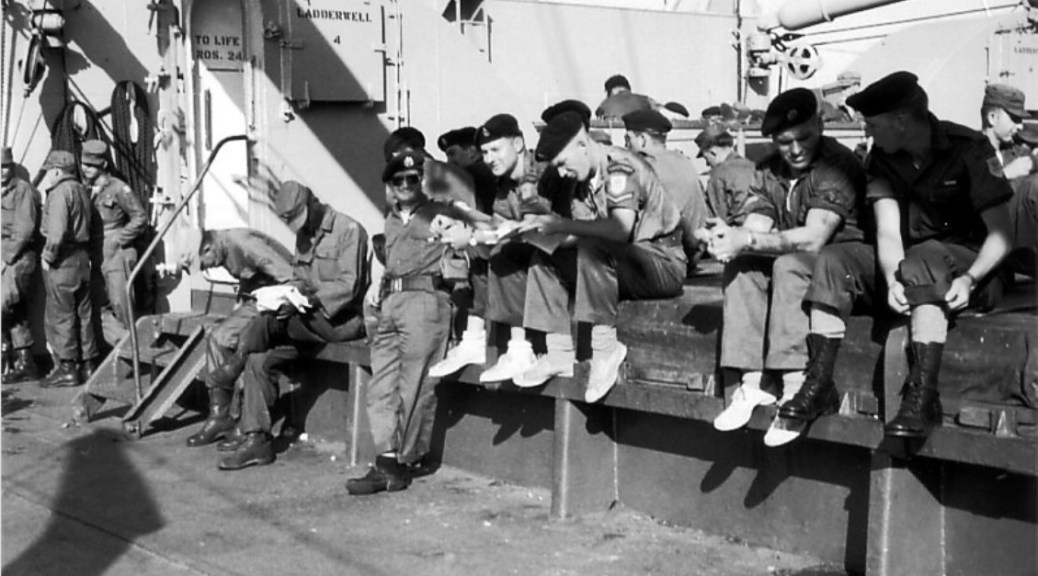
Soon after getting myself back into “Green and Black” I was posted to Korea as a replacement for Maurice Whiting, in 1954. The posting was for three months as 2QOR of C was rotating home in the spring. On arrival at the battalion, I was posted as 2 I/C D Coy. which was a large (170) company containing all the troops taking their release on return to Canada. For some reason, it was known as the “Jaggy Company’” by the other rifle and support companies. It was commanded by Maj. Larry Harrington who used hearing aids for which he had trouble obtaining batteries and was constrained to save them by switching them off whenever possible! Every morning was OC’s Orders where justice was dispensed.

As the battalion reserve, we manned the defensive positions in the Kansas Line during the numerous “Scram” Exercises, and did a large amount of repair work to the bunkers and slit trenches. Just as the Battalion was getting prepared to leave for Canada I was posted into the HQ 1 COMWEL Division to replace Capt. Erwin Fleury as Staff Captain (Canadian) and OC to KATCOM (Korean Army Attached to Commonwealth Division) Defence Coy, a standard three-platoon rifle company.

The staff work was the standard stuff and I spent a lot of time with piles of paper, one of which was 125 copies of the nominal roll of 2QOR to get the battalion aboard the troopship at Inchon. I went down to see them off and say goodbye to friends like Ron “Awful” Werry, Charlie Belzile and Peter Nixon. The tragic death of Lt. Bill Vipond was on my desk and that Board of Inquiry took a while to get to Ottawa, going back and forth. Years later, in the 90s, my wife Brenda and I visited Pusan and laid poppies on the graves of the three 2QOR casualties in the impressive UN cemetery on the hillside overlooking Pusan harbour.

The three months in Korea was extended twice to 13 months as the powers that be vacillated about who was leaving and who was staying. Before I left I was awarded a Korean medal by the Korean Army Chief of Staff and it now hangs in the QOR museum at Casa Loma as, in those days, we were not authorized to wear foreign decorations for peacekeeping duties.
_______________________________________________________

If you’d like to support the Regimental Museum and Archive with our goal of “Telling Their Stories,” you can find more information on how you can make a sustaining or one-time financial donation on our Donation page.

MWO Peter Mitchell: First Para-Qualified QOR Member?

Above: Claire Mitchell holds a photo of Canadian soldiers who participated in the tests in the Nevada desert. At the centre of the photo is her husband, Peter Mitchell, who died in 2008 of cancer.

From the Summer/Fall 2008 issue of the Powder Horn.

G Baskerville, c1995

By Lieutenant Colonel Grahame Baskerville CD

The QOR has now had an Airborne tasking for almost 25 years and is the only Militia unit able to retain this tasking. Many Regular Force QOR members qualified as parachutists and served with distinction with the Airborne Regiment. Also within the Regular Force the QOR had members who had served in WW II with the 1st Cdn Parachute Battalion as well as British Airborne Forces. As a matter of Regimental historical detail, it would be interesting to determine who was the first person wearing a QOR hat badge to qualify as a parachutist. Was it someone during WW II or was it later?

One of the earliest Regular Army paratroopers was MWO (Ret) Pete Mitchell. He enlisted (at age 17) in 1944 with the 2nd (Reserve) Bn QOR in Toronto. He joined the Regular Army in 1951 and went to Germany with the 1st Cdn Rifle Bn (QOR Coy) in 27 Bde. Sgt Mitchell, along with Sgt Fred Swan (also QOR) returned to Canada in 1952 and went to Rivers, Manitoba where they qualified as parachutists on Basic Para Course 164. They remained at Rivers as Para Instructors. Sgt Swan later re-badged to PPCLI to continue his parachuting and Pete Mitchell returned to 1 BN QOR in 1954 where he served in Calgary and Germany. He later rebadged to PPCLI and retired in 1980. Hearsay evidence indicates that these two were the first to return to Canada for parachutist training. As Mitchell is ahead of Swan alphabetically, it is highly possible that Pete Mitchell may be the first QOR person to qualify as a parachutist. Are there others?

[MUSEUM NOTE: In the summer of 1926, Colonel James (Jim) G. K. Strathy, OBE, OStJ, CD, ED (then a Lieutenant with The Queen’s Own Rifles) was training as a pilot at CFB Borden and was required to complete a parachute jump which he did – with much success obviously! Whether that means he was a “qualified parachutist” could be debatable however it seems extremely likely he was the first QOR to actually make a parachute jump.]

NOTE: In 1957 the 1st Bn QOR was selected to provide a platoon for nuclear weapons training at the United States Atomic Energy Commission Test site at Yucca Flats, Nevada. MWO Mitchell was selected to be the Platoon Sgt for this task which involved 40 members of the 1st Bn QOR working with US Army units and being subjected to six atomic blasts over a two-month period with no protective clothing or shelter other than slit trenches. They were assured repeatedly that they had not been exposed to harmful levels of radiation and they accepted these assurances in good faith.

Like many of the others, Pete Mitchell developed cancer in later life and died in early summer, after much physical distress. The Canadian Atomic Veterans Association continues to pursue the Canadian government for compensation – so far without fair results. 

[MUSEUM NOTE: in September 2008, the Canadian Government announced an ex-gratia payment of $24,000 per person for those that had had nuclear exposure. The Canadian War Museum now includes the story of the Canadian atomic veterans.]

________________________________________________________

If you’d like to support the Regimental Museum and Archive with our goal of “Telling Their Stories,” you can find more information on how you can make a sustaining or one-time financial donation on our Donation page.


Wedding of HRH Princess Alexandra

Reprinted from the Summer/Fall 2008 issue of the Powder Horn.

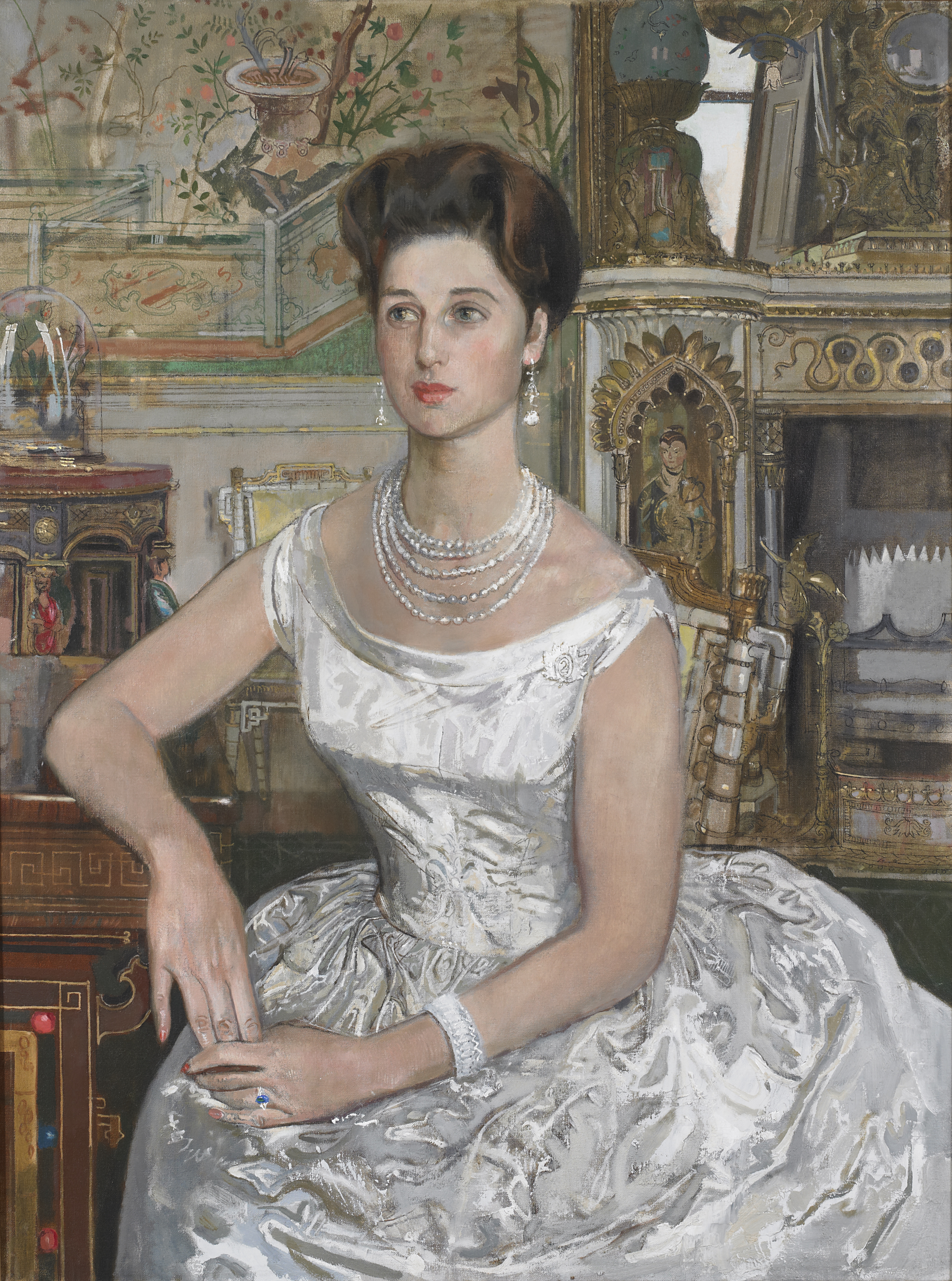
HRH Princess Alexandra, KG, GCVO – Colonel in Chief, 1960-2010. The original 40″ x 30″ oil on canvass painted by John Stanton Ward hangs in the Officers’ Mess. Portrait photo by Christopher Lawson, June 17, 2010.

The first notification, on the letterhead of Kensington Palace, W.8 (London), marked “Private and Confidential” was to Col James G.K. Strathy, OBE, ED, in March 1963. From Sir Philip Hay KCVO, the Private Secretary to HRH Princess Alexandra, Colonel-in-Chief of The Queen’s Own Rifles, it began as follows:

“My Dear Jim. Princess Alexandra has asked me to write to you, as Colonel of the Queen’s Own Rifles of Canada and to convey to you her ideas as to how her Regiments may best be represented at her wedding at Westminster Abbey on Wednesday, 24th April.

“I think I should make it clear at the outset that, while the Princess is most anxious that the maximum number of officers and other ranks from all her Regiments should take some part at her wedding, it is very well understood by Her Royal Highness that it may prove difficult, or indeed impossible for The Queen’sOwn Rifles of Canada to meet the various requirements set out below, which I repeat are only tentative suggestions and should by no means be interpreted as royal commands.

“In the case of your Regiment, the Princess is aware of the very special difficulties which are bound to arise because the whole of the Regiment is stationed outside the United Kingdom.”

The letter continued, providing details for those who might be invited, including senior officers as official representatives, plus other members of The Queen’s Own, some who would act as ushers and others to form part of an escort party lining the entranceway to Westminster Abbey’s front doors, through which the wedding party would enter and exit.

As was his custom, Col Strathy acted with swift decisiveness, nominating the Commanding Officers of the Regiment’s three battalions, along with their wives, to be The Queen’s Own’s senior representatives, along with four junior officers and two NCOs from the 1st Bn serving in Germany, to round out the official party, which would also include Col and Mrs. Strathy.

This resulted in LCol H.C.F. Elliot CD, CO of the 1st Bn stationed in Fort McLeod, at (Dellinghoffen) Germany, his wife Bessie; 2nd Bn CO LCol D.N. Osborne CD, and his wife Phyllis stationed at Currie Barracks, Calgary, and 3rd Bn CO LCol Glenn McIver CD, and his wife Jean, in Toronto, going into frantic overdrive to prepare themselves for this occasion of a lifetime for members of The Queen’sOwn, the marriage of their Colonel-in-Chief to the Hon. Angus Ogilvy, London born son of the twelfth Earl of Airlie, a Scot. The last survivor of the four senior officers present at the wedding was LCol McIver, who died in March 2008, and who was survived by his wife, who had written an interesting account of their trip to attend the wedding. The following is an extract from a lengthy hand-written document which Jean McIver had taken the time to compose as she and her husband took a short pre-wedding vacation before flying into London and “touching down on Sat. Apr 20/63 at 12:30 a.m. after a holiday of eight days on the continent.”

She wrote, following a couple of days of sightseeing in London, that “Tuesday was the day of days. We were picked up by Canadian Army cars and driven to Kensington Palace, the home of our Princess. We were met at the door by an aide to Sir Philip Hay, who is secretary to Princess Marina (Princess Alexandra’s mother) and Princess Alexandra. We entered the Dining Room and then Princess Marina’s Drawing Room. These rooms impressed me very much, not because of their grandeur, for they were not pretentious but very, very home-like, just like any other bride’s the day before the wedding, with unopened gifts in the Dining Room.

“Lady Hamilton, the Princess’Lady-in-Waiting made us all welcome and talked to each person present while we waited and drinks and canapés were served to us. There were about 20 people present, eight QOR people plus representatives from Singapore, Australia and New Zealand. The Princess was scheduled to stay for 15 minutes but stayed for 45. She arrived wearing a very chic green suit with her lovely hair done in a French roll. She was very charming and far prettier than her photos show. Angus was with her and is a very delightful person with a tremendous sense of humour and ready wit.

“When the Princess first entered the room we were presented to her singly. She spoke to us about Toronto. She has a great knowledge of the Regiment and its battalions. They both expressed delight at our coming so far and thanked us profusely. She expressed her desire to see us in the near future in Canada. We actually had the opportunity to speak to them three times for when the time came to leave they said goodbye to each one individually.

“An amusing incident occurred when Alexandra had finished saying goodbye to us. She proceeded to the next couple and walked behind us so she and Angus could get by easily. Glen moved me in front of him. This was very close to the centre of the floor and, at this point, Angus appeared and there we were alone in the centre of the room. He took my hand like one would in a French Minuet and said “Shall we dance this one alone?” And so our goodbyes ended with a laugh from all.

“London was all agog over the wedding and a great deal of fuss was made of it by the Press and Radio or TV. The day of the wedding LCol and Mrs Osborne and ourselves made quite an impression on the people in the lobby of the hotel when we came down and got into our chauffeur-driven Canadian cars.

“Westminster was a wonderful sight. The beauty of the Old Church with all of its lovely architecture cannot help but to impress us. We were ushered to our seats and were in plenty of time to see the arrival of all the dignitaries, the splendour and colour of the costumes of people from other countries as well as the beautiful fashions of the British Commonwealth people. Our spot in the Abbey was the Poet’s Corner (under Keats and Milton and on top of Hardy). This was one time when I had a desire to be seven feet tall to be able to see the whole of the Processional Aisle.

“The Abbey was equipped with closed circuit TV so it was possible to see the Royal Family and guests arriving at the Abbey and walking down the aisle. The TV showed the Princess leaving the Palace in her beautiful gown with her brother and at various points along the route. We saw the Queen, Prince Philip and Charles arrive and be received and the darling little bridesmaids and pages, who were a little impatient to be on their way, and Princess Anne trying to keep them in order. Princess Margaret smiling and happy with Anthony Armstrong Jones and Angus and the best man as they waited also.

“As Alexandra entered the Abbey there was a hush as all strained to catch a glimpse of the radiant and beautiful bride, a fairytale Princess, stately and regal, her magnolia gown so simple in design yet magnificent. The train, held by a diamond tiara and made of lace, was a true work of art. The details of the gowns of the wedding party are by now familiar to most people through press and TV coverage, although nothing can capture the excitement and grandeur of actually being there.”

_______________________________________________________

If you’d like to support the Regimental Museum and Archive with our goal of “Telling Their Stories,” you can find more information on how you can make a sustaining or one-time financial donation on our Donation page.

Remembrance

On this Remembrance Day, we encourage you to visit our Virtual Wall of Honour, which lists all the names of The Queen’s Own Rifles of Canada’s fallen since 1866.

These include many links to soldiers’ personal profile pages, which are some of over 450 that have been created by our Regimental Museum’s volunteers. These often create very touching pictures of those who gave the ultimate sacrifice in service of their country.

If you have information or photographs to add to new or existing profiles, please send an email to: museum@qormuseum.org.

We also invite you to join us on Saturday, November 11 before 11 am at the Regimental Cross of Sacrifice at St Paul’s Bloor St (227 Bloor St E, Toronto) for our short Service of Remembrance and the laying of wreaths.

________________________________________________________

If you’d like to support the Regimental Museum and Archive with our goal of “Telling Their Stories,” you can find more information on how you can make a sustaining or one-time financial donation on our Donation page.


Indigenous Veterans Day 2023

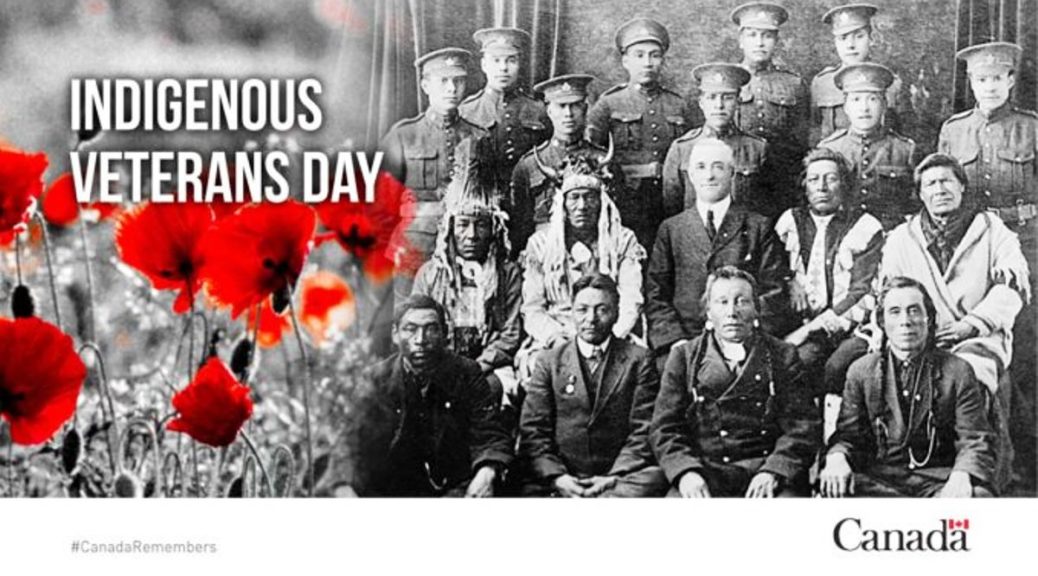
“Today, on Indigenous Veterans Day, we express our heartfelt gratitude to all First Nations, Inuit, and  Métis service members who have served in the Canadian Armed Forces. On this day, we also remember those who never made it home and those whose lives – and the lives of their families – were forever changed by conflict and war…

We all have a duty to remember and honour the sacrifices of Indigenous Peoples who have answered the call to serve. On behalf of the Government of Canada, I encourage everyone to take some time today to honour Indigenous Veterans and learn more about their past and current contributions to Canada’s proud military history.”

From the statement by Prime Minister Trudeau,
8 Nov 2023

Chief Percy Joe

On this 2023 Indigenous Veterans Day, we also want to recognize the military service of Indigenous and Métis soldiers particularly those who served in The Queen’s Own Rifles – both reserve and regular force – and in the battalions from the First World War which we perpetuate.

The latter include the 3rd Battalion, 83rd Battalion (Queen’s Own Rifles), 95th Battalion, 166th Battalion QOR, 198th Overseas Battalion Canadian Buffs, and the 255th Battalion (QOR) of the Canadian Expeditionary Force.

The museum’s research to date has identified thirty-four indigenous and four Métis who served with the above, and ten of whom gave the ultimate sacrifice.

Rifleman Charles Nahwegezhic, MM

We invite you to learn more about the soldiers listed below, several of whom include links to more extensive profiles. A † following their name indicates they died while serving.

A few of note are Rifleman Herman Stock who died on Juno Beach on D-Day, Rifleman Charles Nahwegezhic who was awarded the Military Medal before being killed in action in Holland near the end of WWII, Oronhyatekha (also known as Peter Martin) – a nineteenth-century member of the QOR who has a life story worthy of a film, and Chief Percy Joe whose profile include a recent interview with our Museum Director.

We also invite you to share any additional names or information by leaving a comment a the bottom of this post.

Lest We Forget

Indigenous:

  1. Amiskuses, Vincent – Kawacatoose First Nation – Saskatchewan (WWII/Peacekeeper)
  2. Bain, 868003 Acting Lieutenant John Faquhar – Prince Albert, Saskatchewan (182 Bn WWI with 2 1/2 yrs previous service with QOR)
  3. Beaver, Rifleman Arthur William – Alderville First Nation, Ontario (WWII) †
  4. Bressette, Lloyd Henry – Kettle and Stony Point First Nation, Ontario (WWII)
  5. Cada, Paul Senior – Sheshegwaning First Nation (WWI)
  6. Carlson, Frederick – Ojibway (Korea)
  7. Chappise (Wemaystikosh), 486620 Private Peter Rupert – Cree from Chapleau and Moose Factory, Ontario (3rd Bn WWI) †
  8. Dreaver, 886518 Corporal Joseph Sr. MM – Cree from Mistawasis First Nation – Saskatchewan. –  Band Chief post-war (107th -> 3rd Bn WWI, WWII)
  9. Eagle, Sergeant James Wilfred – Saulteaux Ojibway Valley River Reserve – Manitoba (The Memory Project interview) (Korea)
  10. Eagle, Norbert James – Ojibway from Ohskaning Reserve – Manitoba (Reg Force)
  11. Ewenin, Rony – Kawacatoose First Nation, Saskatchewan (Korea)
  12. Franklin,  201795 Private William Henry – Mississauga from the Alderville Band – Roseneath, Ontario (95th –> 4th Bn WWI) †
  13. George,  Rifleman Harold Wayne (Reg Force) †
  14. Harper, Louis – Wasagamack – Manitoba (Reg Force)
  15. Jamieson, Corporal Harold – Oshweken, Ontario – Six Nations of the Grand River First Nation (WWII) †
  16. Joe, Percy – Shackan First Nation, British Columbia (Reg Force)
  17. King, SL163037 Rod – Lucky Man Cree Nation, Saskatchewan (Reg Force)
  18. Lavelley, 788954 Private Peter – Golden Lake Band, Ontario (3rd Bn WWI) †
  19. Ledoux, Phillip
  20. McLaren, Peter Bertram Dalton – Timiskaming First Nation, Ontario (WWII)
  21. Morrison, Joseph – Anishinaabeg of Naongashiing (Big Island) First Nation
  22. Nahwegezhic, Rifleman Charles MM – Anishinaabe from Sheguindah First Nation (WWII) †
  23. Okemaysim, Napoleon – Cree-Assiniboine, Beardy’s and Okemasis First Nation – Sask. (Reg Force?)
  24. Oronhyatekha (also known as Peter Martin) – Mohawk
  25. Ross, Steven M. – Cree from Montreal Lake, Saskatchewan (Reg Force)
  26. Runns, Fredrick Sr. – Nakota from Carry the Kettle First Nation – Sintaluta, Saskatchewan (WWII & Post-war??)
  27. Ryder, Andrew – Nakota from Carry the Kettle First Nation – Sintaluta, Saskatchewan (WWII plus Germany 1949-1952)
  28. Smith, Frederick William – Chippewas of Rama First Nation, Ontario (WWII)
  29. Stock, Rifleman Herman  – Haudenosaunee from Gibson Band [Wahta Mohawk] Sahanatien, Ontario (WWII – KIA D-Day) †
  30. Thomas, 9254 Private Charles Alfred – Haudenosaunee from Six Nations First Nation, Oshweken, Ontario (QOR & 3rd Bn WWI) †
  31. Thomas, 9255 William Sherman – Mohawk from Brantford, Ontario (QOR & 3rd Bn)
  32. Wemigwans, B139461 Private Isadore – 3 Fires Confederacy from Wikwemikong – Manitoulin Island, Ontario (WWII)

Métis

  1. Duva, Alcide Joseph Alzear (Post war Germany)
  2. Ferland, Rifleman Norman Philip (Korea) †
  3. Paquette, Joseph R. (1st Bn Reg Force)
  4. Riel, Sergeant I.J. (Reg Force) Great-nephew of Louis Riel


Remembrance Resources 2023

As we approach Remembrance Day this year, we’d like to share a number of resources on our website that may help make this a meaningful time for you, your family, and your friends.

Virtual Wall of Honour

This page lists or links to lists of all those we have identified who died while “on service” – killed in action, died of wounds, died in accidents, or died of disease.  Of course, this is only a fraction of the thousands who have served with the Regiment since it was founded. Many of these have links to “Rifleman Profiles.

Rifleman Profiles

Over the past 11 years, we’ve created over 400 profiles of soldiers who have served in The QOR since 1860. They include members from the ranks of Rifleman to Lieutenant Generals and everything in between. Those with after their name died while “on service.”

Cemeteries with Rifleman

A very incomplete listing of cemeteries where QOR riflemen are buried. Not unexpectedly, the most extensive lists are in Toronto – particularly the Necropolis Cemetery, St James Cemetery, Mt Pleasant Cemetery, and Prospect Cemetery. We have created cemetery “walks” for each of these cemeteries by plotting their graves on a Google map which you can use to find their location. Most plots include a photo of the grave marker and a link to their profiles on our website.  For those who live in the Toronto area, we encourage you to make time to visit one of these cemeteries and leave a poppy at the base of these grave markers.

QOR Day at Casa Loma

A great family day event which showcases the long and dedicated military heritage of the QOR and the regiment of today!

Program includes:

  • Soldiers from the Regiment in various current uniforms that our members wear
  • Displays with tac-vests, rucksacks, winter kit, mountain ops kit, parachuting equipment
  • Displays by the Vintage Signals Team
  • Re-enactors with uniforms and equipment representing various QOR eras
  • Temporary QOR Badge tattoos
  • Members of the Regimental Band Quintet giving performances in the Great Hall

The Queen’s Own Rifles of Canada Regimental Museum program is included in your Casa Loma admission fee. You can also find directions and information on parking on the Casa Loma website.

Free admission for serving soldiers in uniform, veterans in regimental blazers, former members (with ID), and cadets in uniform.

People in Our Online Collections

Over 4,600 photographs and objects have been cataloged in our collections management system. Many of these have also been tagged or connected in the system to over 4,700 “people” records which have also been input. For example, if a group photo has names listed on the bottom, we record those names in that catalogue record. This makes it easy to research which records are “attached” to a certain person.  Click on the link above to see what we mean!

Make a Donation in Honour or Memory

If you like the work we are doing to maintain the history of The Queen’s Own Rifles of Canada and tell the stories of those who served with it, please consider making a donation to support our work. You can make a donation in memory or in honour of an individual, make a one-time donation or set up a monthly sustaining donation. You can even donate stocks, bonds, mutual funds or cryptocurrency online.

CLICK HERE to see more on your options.


WWII QOR Veteran George Beardshaw: 100th Birthday

On Sunday, September 10th, 2023 family, friends and members of the Queen’s Own regimental family (both former and currently serving members) gathered in London, Ontario to celebrate (a few days early) Second World War Corporal George Beardshaw’s 100th birthday.

George is one of two known living WWII veterans who served with The Queen’s Own Rifles.  He was posted to the QOR as a reinforcement in September 1944 and served with them until the end of the war. However, he spent the final 28 days of the war as a prisoner of the Germans.

You can read more about George on his profile page.

This slideshow requires JavaScript.

National Peacekeepers Day

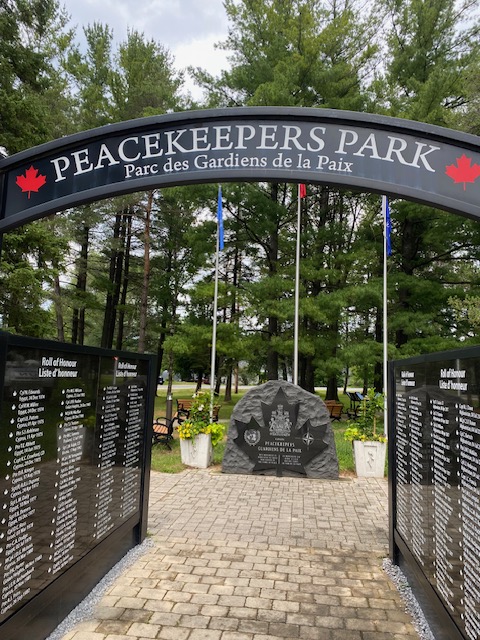
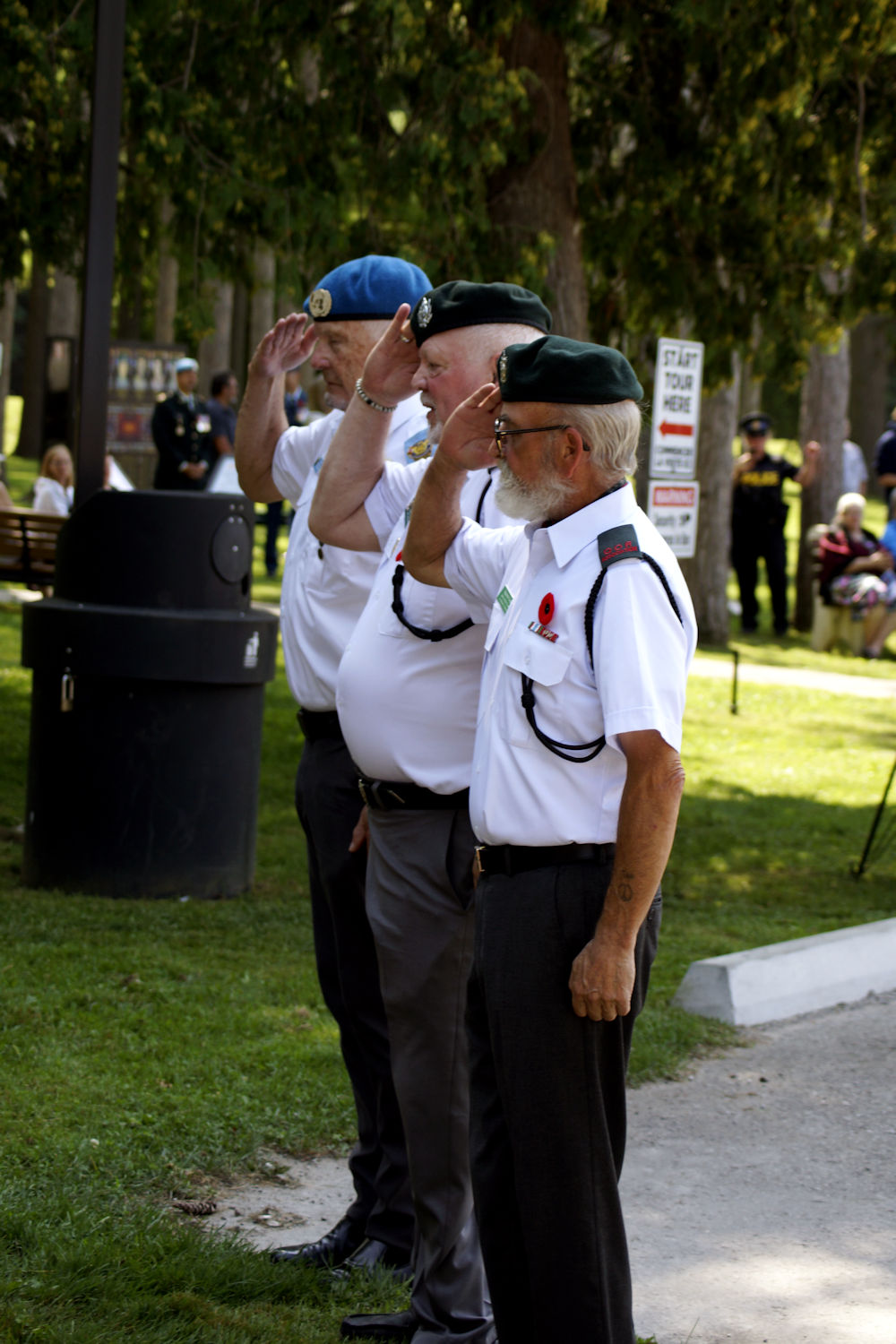
On 9 August 2023, members of the Association gathered at Peacekeepers Park in Angus.

Following the Second World War, the Regiment’s next major historic event was the 2nd Battalion’s deployment to the United Nations Korean Mission in 1954 which followed an armistice.

Some of the young soldiers who participated in the mission were Lieutenant-General Charlie Belzile, Frank Sypulski and Joe Byatt.

There were seven fatalities from the Regiment attributed to the Mission:

  1. Rifleman N.P. Ferland– 31 March 1954 – Accidentally killed by a vehicle
  2. Sergeant G.W. Koch– 4 August 1954 – Drowned during recreational swimming
  3. Lieutenant N.M. Anderson– 25 August 1954 – Accidentally killed in an airplane crash
  4. Lieutenant M.C. Vipond– 18 March 1955 – Died in barracks fire
  5. Rifleman G.P. Reid – 11 June 1955 – Killed in a car accident in Saskatchewan while on leave
  6. Major P.E. Gower– 9 December 1956 – Airplane crash in the Rocky Mountains while returning from Korea

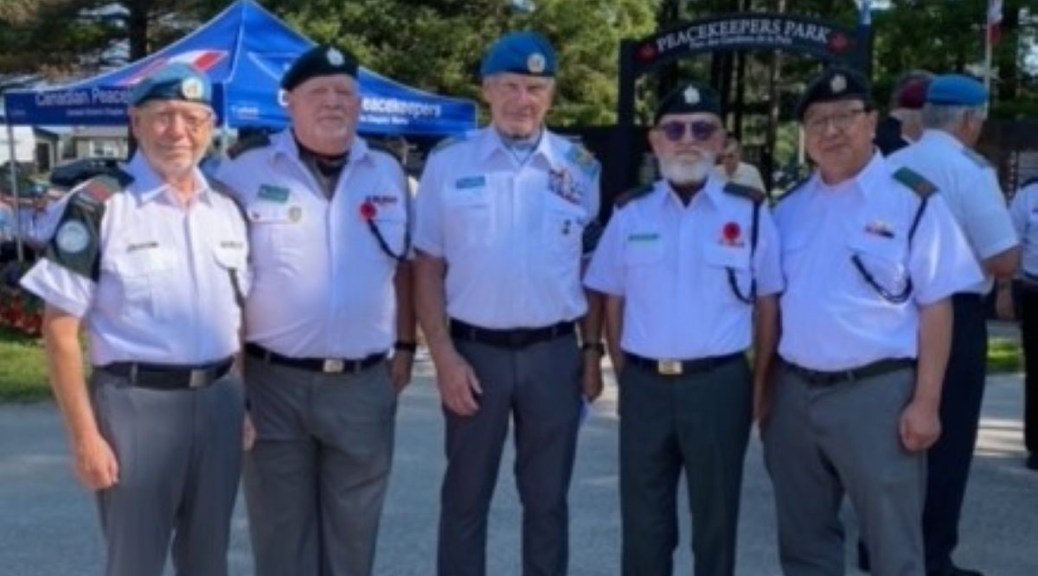
Association members at that day s event are: Peacekeeper Don Mitchell, Association Toronto Branch President Brian Budden, Major-General Lewis Mackenzie the reviewing officer, Association Padre John Howie and Robert Chan.

General Mackenzie laid a QOR wreath with the Association members at the Wall of Honour.

Access to Archival Materials

One of our goals is to provide access to archival materials that may have potential interest to researchers. We have been doing some of this through pages on this website.

In the past year, however, our collections management database has been upgraded to allow us to add documents such as pdfs which can also be made available in the Public Access view – the one any visitor can see. So where we have scanned certain documents, we can now provide the scans to researchers rather than just describe that record.

We recently scanned the seventy-three issues of the “Regimental Newsletter” (talk about monotonous!) which were published by the Regimental Depot between 25 November 1959 and 30 June 1970.  These varied in size from the first issue of 2 pages to the last which was 88 pages. They cover more than half of the cold war period when the regiment consisted of a regular force training depot, two regular force battalions, and a militia battalion. These supplemented the annual “Powder Horn” publications (1960-1970) and provided information about and often letters from officers deployed or posted externally to the battalions, various postings, promotions, obituaries, cadet corps updates, museum reports, cartoons, and a host of other tidbits.

Another example of recently scanned material is several scrapbooks of news clippings of the 1910 Trip to England which have recently proved valuable to a researcher writing a book on the trip:

From a 1910 Trip Scrapbook

In addition, we can also add URLs to the record and again make them available in the Public Access View. That means if we’ve already uploaded scans to our website, we can just link to that from the collection record. We’ll be working on updating those links in the future.

In the meantime, you can find a variety of materials on our Research and our Archives page with past issues of the annual Rifleman Magazine and the Powder Horn newsletters (not the annual publication from 1960-1970 yet), nominal rolls, 19th Century Regimental Orders, diaries and memoirs, etc.

We hope you’ll find these useful and/or at least interesting reads!

Donation of Stephen Thomas, MB, CD Portrait

Contemporary Canadian war artist Gertrude Kearns is known for her evocative portraits of senior military leaders. She was embedded with the Canadian Forces in Afghanistan in 2005-2006 but her portfolio includes earlier works on Somalia, Rwanda, and the former Yugoslavia.

Ms. Kearns eventually compiled her Afghan war art into an exhibit titled “The Art of Command: Portraits and Posters from Canada’s Afghan Mission.”
In 2008, she was commissioned to paint Tecumseh and Brock, the Shawnee Indian leader and British major-general who both fought and died in the War of 1812. In 2019 she was made a member of the Order of Canada.

In 2000 Warrant Officer Stephen Thomas joined the 7th Toronto Regiment and in 2003/04, he completed his first tour in Afghanistan. In 2005, he saw the light and transferred to The Queen’s Own Rifles of Canada, later becoming a member of the regiment’s parachute company.

Thomas’ second deployment to Afghanistan occurred between July 2006 and March 2007, where he served as force protection. On October 3, 2006, in Kandahar then Corporal Thomas with three others, saved the lives of their fellow soldiers and local Afghan civilians by unloading ammunition from a disabled burning vehicle during a suicide bomber attack. For this action, he was awarded the Canadian Forces Medal of Bravery.

I encourage you to read the full citation and some of Warrant Thomas’ own recollections of the action which are on his profile page on our museum’s website.

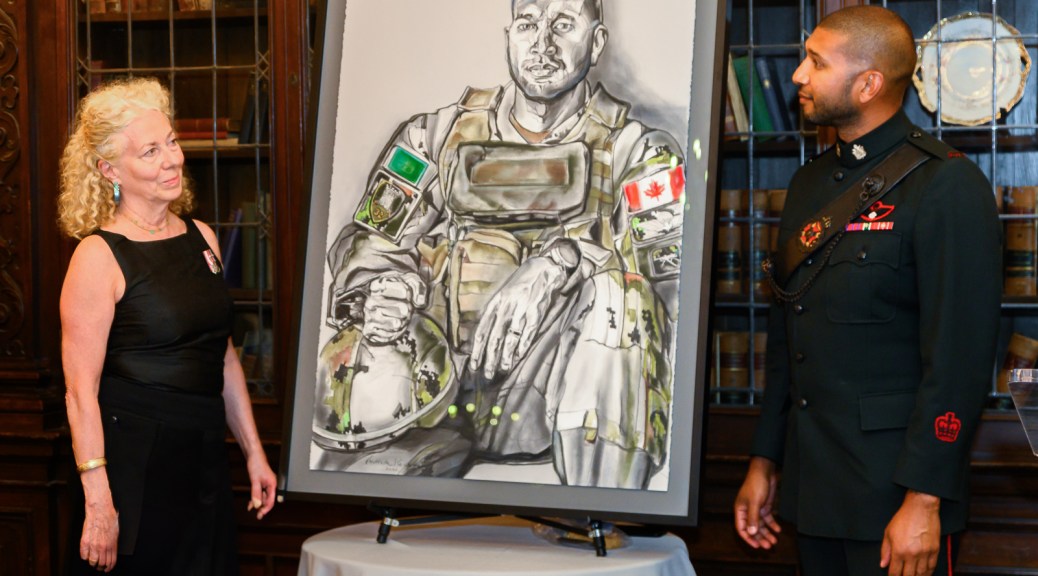
In early 2021 Ms. Kearns created a large portrait of Warrant Thomas using mixed media in her easily recognizable style. You may recall having seen an image of this on the cover of the 2020-2021 Rifleman magazine.

In the fall of 2022, the artist contacted our museum and very generously offered to donate the portrait to us. After a few delays, Curator Shaun Kelly picked up the piece earlier this year from Ms. Kearns’ studio. He then arranged to have the portrait framed and covered with museum-grade plexiglass to protect it while on exhibit. On 6 June 2023 at the D-Day Dinner at Casa Loma, Ms Kearns and Warrant Thomas unveiled the donated portrait. On the following Thursday our museum team hung the portrait for exhibit in our 1945 to Present Room.

Our very grateful thanks to Ms. Kearns for her generous donation!

D-Day+79

Today marks the 79th anniversary of D-Day and the first time we commemorate without any known living survivors of that landing.

Some of us recently attended the memorial service for Alex Adair who passed away on Christmas Eve 2022 and was our last known living D-Day veteran.

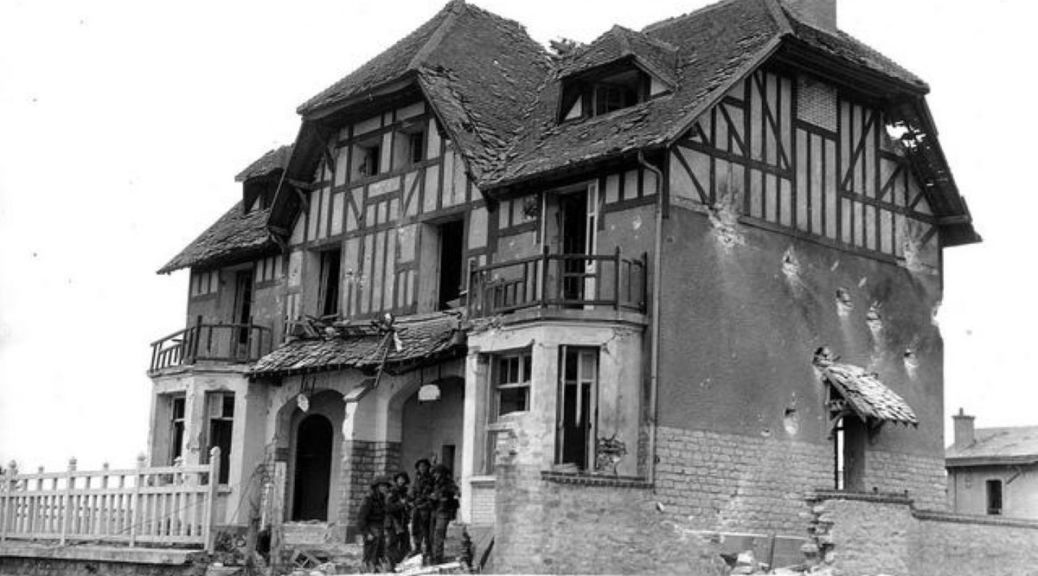
Alex was one of the four soldiers in the well-known photograph (above) of the just liberated home now known as Canada House. The other three were Jim Leslie, Norman Hore and Bob McBurney.

You can hear about how they ended up in this photo from Alex himself in this short video:


Sixty-one Queen’s Own soldiers were killed on D-Day and you can find profiles of each of them here.

Some Facts About The QOR Fallen

  • The average age of the fallen was 29.9 years old
  • The youngest was 19-year-old Rifleman Russell Adamson of Midland
  • The oldest was 40-year-old Corporal Hugh Rocks of Kirkland Lake
  • Many of these riflemen left school at the age of 14 or 15 – few completed high school
  •  Many of their fathers had served in the First World War
  • Rifleman Calbert’s brother was also QOR and was killed in Holland in February 1945.
  • Rifleman Corvec was transferred to the QOR from a reinforcement unit on 26 May 1944 – just 12 days before D-Day
  • Rifleman Hall served in the 1939-1940 Finnish-Russian War before enlisting with the QOR in England in 1942
  • Sergeant “Freddy” Harris was the only Jewish rifleman among the QOR’s D-Day fallen.
  • Rifleman Lizon has no known grave and is remembered on the Bayeux Memorial however there are several graves in Beny-sur-mer Cemetery with no known names.
  • Rifleman Martin lied about his age in order to join the QOR in Jun 1940. He was two days shy of his 22nd birthday on D-Day
  • Riflemen May and McCallum were originally drummers but would serve as stretcher bearers on D-Day
  • Lance Corporal McKechnie was married in England on 18 May 1944 – just weeks before D-Day
  • Included in this list are two brothers – Gordon and Douglas Reed
  • Rifleman Showers was AWOL (absent without leave) when his original regiment The Black Watch, left Newfoundland, and on reappearing was posted to the QOR
  • Rifleman Stock was an indigenous soldier from Gibson Reserve
  • From the QOR fallen alone, at least 17 children became fatherless on D-Day

Watch this video to learn more about The Queen’s Own on D-Day:

You can find more about the QOR and the Second World War including personal reminisces of D-Day on our Second World War Resources page.

Please consider supporting the Regiment’s Return to Normandy: 80th Anniversary of D-Day.

Finding Artifacts Connected to People

The other day a man approached me at the supermarket, he had noticed my QOR licence plate and wanted to let me know his grandfather was in the Queen’s Own during WWII.

I asked him if he had a minute to spare then was able to look up (on my phone) his grandfather on the Museum’s online catalogue using the people search function.

I was able to show him pictures of his grandfather with the Officers’ Mess in Sussex, New Brunswick, and with Queen Mary in England in 1941.

The Museum’s online catalogue is a powerful tool. It has access to thousands of artifacts and archival records that are linked to specific soldiers from the Regiment. They could be named in photographs or mentioned in documents.

Just click PEOPLE in the menu across the top and then enter the name of the person you want to search for.

Here are five premade searches to start you off:

Why not try searching for your own name!

CWO (Ret) Shaun Kelly, CD
Curator
QOR Museum and Archive

Stained Glass Windows Dedicated

On Sunday, March 5th, 2023 Trinity College School (TCS) dedicated three new stained glass windows in their Memorial Chapel in memory of TCS old boy Captain Thomas Alan Staunton.  Staunton served with The Queen’s Own Rifles of Canada during the Second World War and landed with them on D-Day. He later transferred to the Headquarters of 2 Canadian Corps after receiving an ear injury.

The Memorial Chapel, was opened in 1951 and dedicated to the memory of 185 Old Boys killed in the Boer War, World War I and World War II. The consecration of the chapel was presided over by the Reverends L.W.B. Broughall and R.J. Renison, both TCS Old Boys. Also attending were Governor General Viscount Alexander and his wife, and the Right Honourable Vincent Massey.

[Massey was also a former QOR officer, and Rev. Broughall was the uncle of Deric Broughall, also a former QOR soldier and TCS Old Boy who was killed at the 2nd Battle of Ypres while serving with the 3rd Battalion, Canadian Expeditionary Force.]

Designed by Samuel Hug, in 2022, and constructed by Proto Glass Studios in Marlborough, Wiltshire, UK, the window was given by Marion Hindley, Guy Hindley and Duncan McClaren, in memory of Captain Thomas Alan Staunton.

The dedication was led by the TCS Chaplain Rev Major Don Atchison at the school’s regular Sunday morning service, and attended by members of the family. The QOR was represented by the Regimental Museum’s Director.

Artist’s Statement

Stained glass windows in honour of Captain Thomas Alan Staunton, QOR.

Stained glass windows are dazzling explosions of jewel-like colour, sometimes across vast surfaces, telling stories with universal symbols that can easily be read by the congregation.

These windows are not made in the traditional way, where panels of coloured glass are puzzled together with lead to form a unified window. Instead, they were designed using the programme Procreate on iPad,
hand drawn with a digital stylus. These were then printed onto a transparent layer, which is sandwiched between two panes of glass, which were then cut to size.

This triptych came about as a commemoration of a former pupil Of Trinity College School, Captain Thomas Alan Staunton ’27 -`31. Like many young men of his era, as the world spiralled into war, he lent his
efforts to help his country. Like several of his friends at Trinity College School, he joined The Queen’s Own Rifles of Canada, landing at Juno Beach in Normandy, France. This successful invasion of the Normandy beaches became known as the D-Day Landings, a pivotal moment in securing eventual victory for the Allied Forces in the Second World War. He was fortunate to survive, but many did not. These panels are made in tribute to him, and the pupils of Trinity College School who fought alongside him.

The three window panels can be `read’ from left to right:

The left panel depicts the bell tower of the chapel and the crest of Trinity College School, entwined with maple leaves. The bell tower marks the march of time – it is later than you think. The maple signifies Canada, of course, but also refers to a coming of age – summer and youth are coming to an end. The leaves turning a deep red, falling from the trees as autumn and winter encroach. The bell tolls – times are changing and challenges are ahead.

The central panel is the landing on Juno Beach, which took place on the 6th of June 1944. The ships on the sunlit water are Canadian ships that actually participated. The blimp-like forms in the sky are barrage balloons, used to block air strikes. The snowflake-like forms on the beach are so-called `Czech Hedgehogs’, which the Germans used as defense against amphibious tanks as they landed on the beach. Among the rocks is the regimental badge of The Queen’s Own Rifles of Canada, and the head of the goddess Juno, who was used as the code name for the beach. Along the three panels, a line continues along the base – this is the coastline of Normandy. The wave on this central panel crashes on Juno beach.

At Juno beach, 340 people died on the Allied side, many of whom were Canadian. The Queen’s Own Rifles suffered 143 casualties, most of any battalion.

The third panel depicts what was lost, and what was won. A Normandy oak stands tall at the height of summer, echoing the curve of the maple in the first panel. A trinity of doves flies up the centre, signifying peace. Rows of graves commemorate the dead, as can be found at the Canadian War cemetery at Beny-sur-Mer, a few miles from Juno Beach. A cross stands in the foreground, wreathed with poppies for remembrance and laurel for victory.

Window designer Samuel Hug and the windows in situ.

You can find other TCS Old Boys who served with The Queen’s Own Rifles here, including three generations of Strathys, and Brigadier General Jock Spragge.

And did you know there was a QOR Cadet Corps at TCS in the late 1980’s and early 90’s?

Cabinets Upgrade Phase I Completed

The majority of our exhibit cases are beautiful oak department store counter style. While these look great, it means that many of the objects and labels are only a six inches from the floor, and you don’t have to be 6’3″ and have trifocals to find these awkward to view. So in 2022, we engaged a museum exhibit consultant to assist us in considering options (within our limited budget.)

The solution was to create 18″ ‘risers’ which would raise the cabinets enough to make the objects and labels more visible while still meeting accessibility requirements. We contracted with Holman Inc. to build four risers in 2022 and were extremely happy with the construction and their matching of colour to the existing cabinets. They also have nylon sliders which will make them easier to access for cleaning or changing exhibits without the risk of scratching the floors.

This year we ordered seven more risers to complete the upgrade for our remaining oak cabinets. These were all installed by our museum team last Thursday evening which involved removing objects and labels from each cabinet, lifting them up onto their new riser,  giving them a good clean, returning the objects and labels, and moving them back into their position. “Teamwork makes the dream work” as they say! Thanks to Curator Shaun Kelly for managing the project and to all our volunteers for pitching in.

We’ve also been installing LED lighting on timers inside each cabinet to further improve the visibility of the objects. This has been completed on several cabinets but we’re still sorting out power for some others. Despite Sir Henry bringing hydroelectricity to Toronto, Casa Loma doesn’t have many outlets – I guess there just weren’t many things to plug-in in 1911!

Thanks also to the Casa Loma staff for their help in getting the risers to the third floor!

Phase II will be determining the best option for our aluminum-framed cabinets used for the more modern era’s.

If you would like to help offset the cost of these upgrades and support all the work of the Regimental Museum and Archive, we invite you to donate to The Queen’s Own Rifles of Canada Trust Fund and apply your donation to the Museum Fund.

Donate Now Through CanadaHelps.org!

This slideshow requires JavaScript.

Thank You to Our Volunteers!

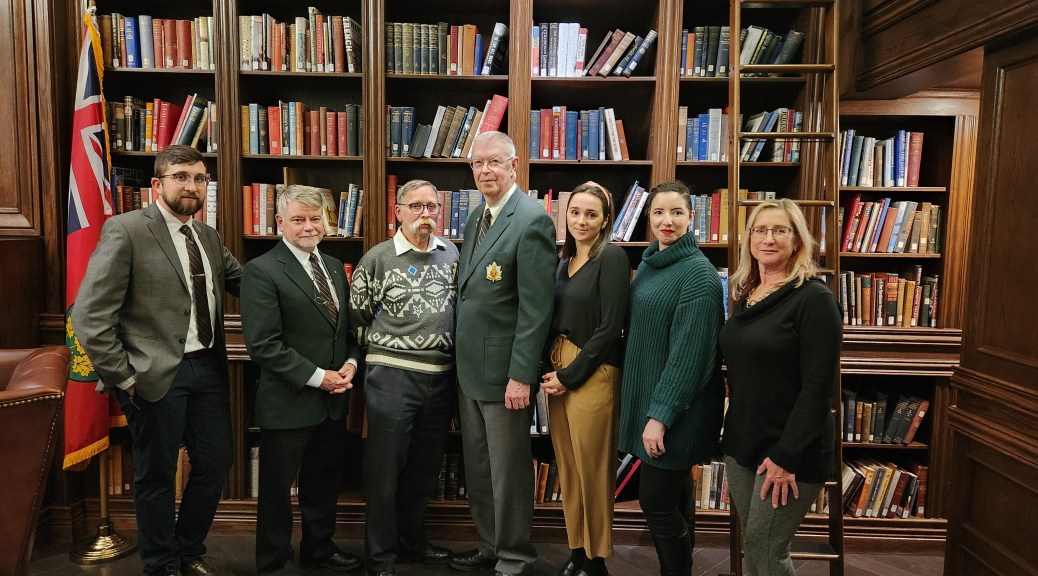
Photo above: Some of our volunteers at the recognition event.

On Thursday, February 2nd, Museum Board members and volunteers gathered in the impressive library of the Royal Canadian Military Institute for a reception to recognize service to the museum in 2022.

Volunteers racked up 1,237 hours in 2022 which contributed to our all-time total of 114,118 hours – which would equal almost $300,000 in wages if this had been paid work!

Certificates of Appreciation were presented to volunteers Briahna Bernard, Anne Frazer, Shaun Kelly, Colin Sedgewick-Pinn, and Bruce Taylor; and board members Adam Hermant, Jenna Misner-Zuschlag, and Past Chair Jim Lutz.

Unable to attend to receive their certificates were Rob Grieve, Ken Kominek, Steve Hu, Steven Ye, Matt Noel, Steven Abra, Mario Carvalho, Graham Humphrey, Olivier Laquerre, Cheryl Nairn, and Harry Patel.

Also present were new Board Chair Michele McCarthy, board member Lisa Holmes, and volunteers Morgan Ryder, Kevin Hebib, Jordan Balch, and Museum Liaison Officer, Captain Dave Pampe.

On behalf of the Commanding Officer (who was out of the country) Dave also presented the Commanding Officer’s Commendation to our new Curator Shaun Kelly on ten years of volunteering with the museum:

“For 10 years of outstanding dedication and leadership at The Queen’s Own Rifles of Canada Regimental Museum. His efforts have been paramount in bringing our museum practices into the 21st Century, and in particular in effectively preserving our museum objects that will allow us to share well into the future, the important stories of our regiment and the Riflemen that have served in it.”

If you’re interested in volunteering with us in 2023, please read our Volunteering page on our website.

National Cadet Week

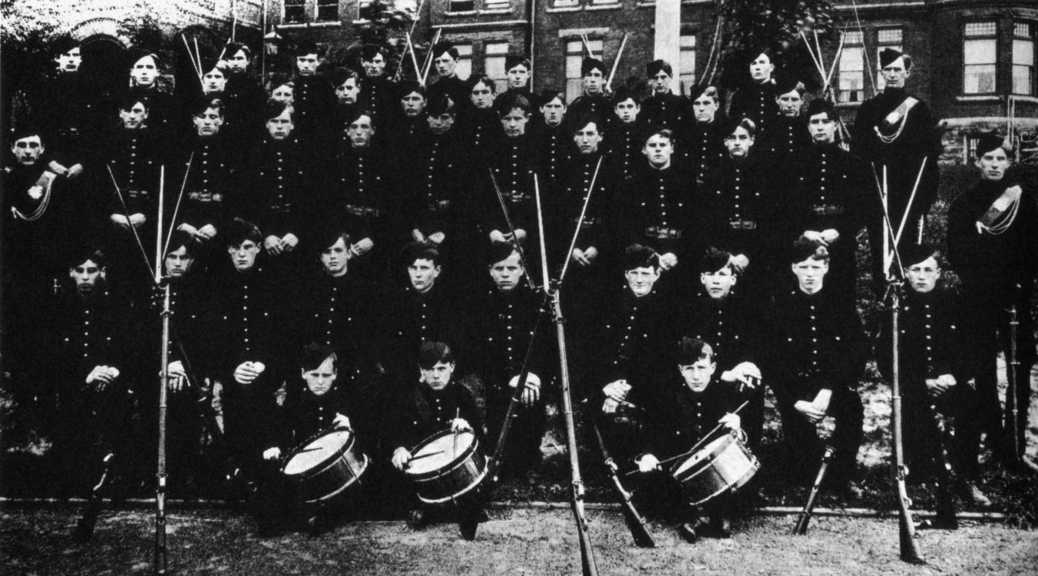
Above: Upper Canada College Cadets, 1899 – QOR Museum Collection.

Did you know this is National Cadet Week in Canada? Over the years, The Queen’s Own Rifles of Canada has had a number of affiliated army cadet corps – more than you might expect!

You can read about many of them here.

Get Out and Remember Them

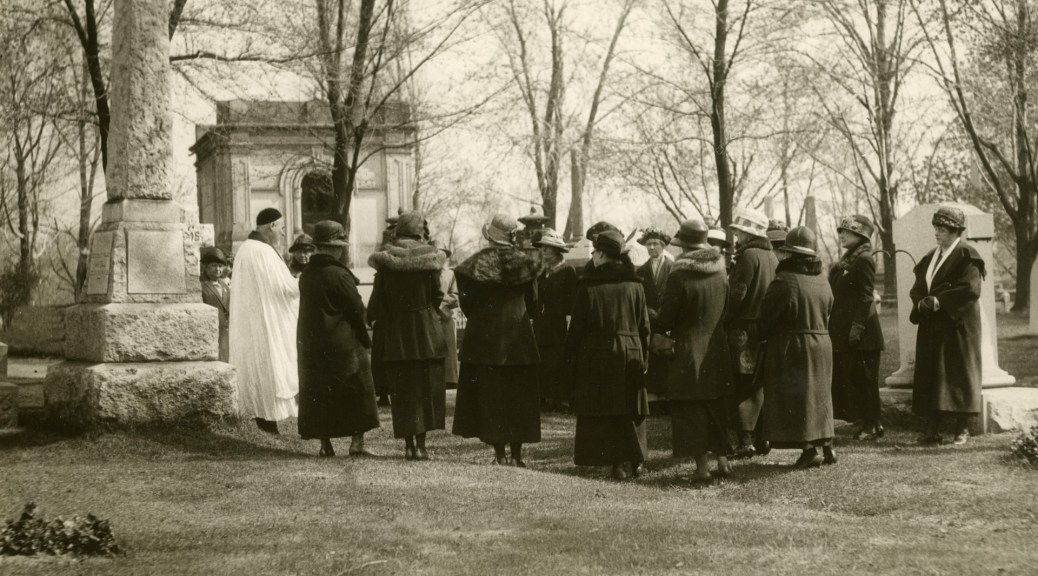
Now that the – mostly – good weather has arrived, it’s time to get out and about. As odd as it might sound, Toronto has some beautiful cemeteries. They’re a great place to get some exercise and remember those members of our regiment (and the WWI battalions that we perpetuate) who have served in the past.  These include everyone from riflemen to a full general.

The oldest and most historic cemetery in Toronto is Necropolis which was created in 1850 in the east end of Cabbagetown.  So far we’ve identified over a dozen QOR buried here including six who were killed in action, died of wounds, or died of sickness attributed to their service at the Battle of Ridgeway in 1866.

Lieutenant Colonel R.B. Hamilton’s grave had never had a marker and we are very pleased that one has just recently been installed by the Last Post Fund.

A short distance north of Necropolis is St James Cemetery at Parliament and Bloor St where we identified almost fifty QOR gravesites including the first commanding officer, Colonel Durie, and other Fenian Raid casualties.

Another almost fifty QOR graves or memorials have been identified in Mt Pleasant Cemetery (Mt Pleasant north of St Clair East) which is also considered an arboretum and extremely well maintained. Like the others, these include riflemen to commanding officers and every rank in between.

Be sure to check out our Ontario Cemeteries page for more Toronto cemeteries with QOR and maps such as Park Lawn, Pine Hills, Prospect, and a few outside of Toronto as well. And although most of these are mapped yet, we have identified a number of QOR in cemeteries outside of Ontario too.


This work is definitely “in progress” so if you have any information you can add on where QOR riflemen are buried in Canada, please share it with us in a comment below or email to museum@qormuseum.org 

Acting Curator Awarded 2021 Rifleman of the Year

I’m very pleased to announce that the QOR Association’s 2021 Rifleman of the Year Award recipient is former Regimental Sergeant Major Shaun Kelly.

As deputy curator of the QOR Museum, he has shared a wealth of knowledge and provided over 1,200 hours of service.

His service in Latvia this year for 7 months has been a credit to Canada and The Queen’s Own Rifles of Canada.

Shaun has been very involved with the Association. He stayed connected with the QOR Association group by sharing pictures and updates during his overseas posting. He also kept track of all the emails that have been shared with the Keep Connected Group since they started.

Congratulations to Shaun and well deserved.

Because of previous COVID restrictions, the award was presented to Shaun by the Commanding Officer, Lieutenant Colonel Scott Moody, at the June 6th, 2022 1860 Club Dinner held at Casa Loma.


1860 Club D-Day Dinner

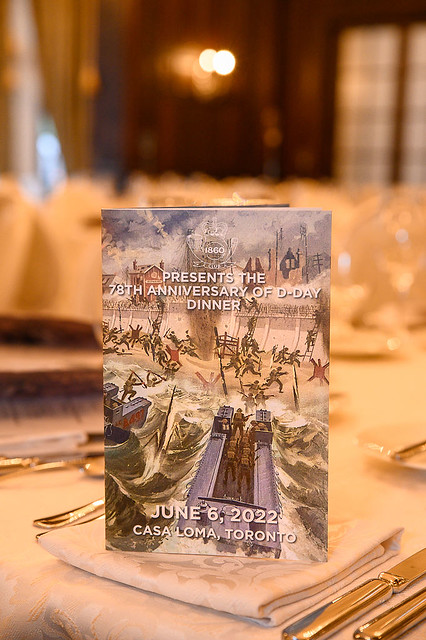
On 6 June 2022, the QOR Regiment’s 1860 Club held a formal dinner for 200 guests at Casa Loma, the home of the Regimental Museum and Archive since 1970.

Several exhibits were on display during the pre-dinner reception including the memorial banners of all our fallen since 1866, several recently acquired 1860’s era uniform pieces, banners on the QOR’s D-Day and WWII participation, and some D-Day items including the pistol carried by CSM Charlie Martin.

Throughout the dinner, several vignettes from D-Day Veterans were read by various attendees – several of which were moving descriptions of their beach landings and of losing close friends and relatives.

And once again, the museum’s Photograph Officer Anne Frazer captured the event with some amazing photographs. Click on the photo below to see them on our Museum’s Flickr site.

The QOR's 1860 Club 2022 D-Day Dinner held at Casa Loma
Click on the image above to see the photographs taken at this event by the Museum’s official photographer, Anne Frazer.