Remembrance Resources 2024

As we approach Remembrance Day this year, we’d like to share a number of resources on our website that may help make this a meaningful time for you, your family, and your friends.

Virtual Wall of Honour

This page lists or links to lists of all those we have identified who died while “on service” i.e. killed in action, died of wounds, died in accidents, or died of disease.  Of course, this is only a fraction of the thousands who have served with the Regiment since it was founded. Many of these have links to “Rifleman Profiles.

Rifleman Profiles

Over the past 11 years, we’ve created almost 500 profiles of soldiers who have served in The QOR since 1860. They include members from the ranks of Rifleman to Lieutenant Generals and everything in between. Those with after their name died while “on service.”

You can also find list of known indigenous soldiers who served with the QOR or its perpetuated battalions of WWI.

Cemeteries with Rifleman

A very incomplete listing of cemeteries where QOR riflemen are buried. Not unexpectedly, the most extensive lists are in Toronto – particularly the Necropolis Cemetery, St James Cemetery, Mt Pleasant Cemetery, and Prospect Cemetery. We have created cemetery “walks” for each of these cemeteries by plotting their graves on a Google map which you can use to find their location. Most plots include a photo of the grave marker and a link to their profiles on our website.  For those who live in the Toronto area, we encourage you to make time to visit one of these cemeteries and leave a poppy at the base of these grave markers.

QOR Day at Casa Loma

It’s a great family-day event that showcases the long and dedicated military heritage of the QOR and the regiment of today!

Program includes:

  • Soldiers from the Regiment in various current uniforms that our members wear
  • Displays with tac-vests, rucksacks, winter kit, mountain ops kit, parachuting equipment
  • Displays by the Vintage Signals Team
  • Re-enactors with uniforms and equipment representing various QOR eras
  • Temporary QOR Badge tattoos and “regimental” stickers
  • Members of the Regimental Band giving performances in the Great Hall at 1100 hrs and 1300 hours
  • Singer Tim Wilford performing songs from WWI at 1200 hrs and WWII at 1400 hrs.

The Queen’s Own Rifles of Canada Regimental Museum program is included in your Casa Loma admission fee. You can also find directions and information on parking on the Casa Loma website.

Free admission for serving soldiers in uniform, veterans in regimental blazers, former members (with ID), and cadets in uniform.

People in Our Online Collections

Over 4,800 photographs and objects have been cataloged in our collections management system. Many of these have also been tagged or connected in the system to over 6,100 “people” records which have also been input. For example, if a group photo has names listed on the bottom, we record those names in that catalogue record. This makes it easy to research which records are “attached” to a certain person.  We have also input the names of soldiers who served in the Northwest Campaign and participated in the 1910 trip to England. Click on the link above to see what we mean!

Make a Donation in Honour or Memory

If you like the work we are doing to maintain the history of The Queen’s Own Rifles of Canada and tell the stories of those who served with it, please consider donating to support our work. You can make a donation in memory or in honour of an individual, make a one-time donation or set up a monthly sustaining donation. You can even donate stocks, bonds, mutual funds or cryptocurrency online.

CLICK HERE to see more on your options.

New Student and Classroom Resources

The program is built around fact-based storytelling, focusing on authentic stories of diverse military heroes from across Canada. This approach helps ensure that students not only gain a deeper understanding of Canada’s military history but also foster empathy and respect for all of those who have served.

You can now access these resources including materials to assist with school Remembrance Day ceremonies, through the Honouring Bravery website.

The Hasty P’s RSM and a Far Away QOR Grave Memorial

In 2023 Chief Warrant Officer Dean Stokes of the Hastings and Prince Edward Regiment (Hasty P’s) was deployed to England. While there, he very kindly offered to clean the grave monument for QOR Lieutenant Roy Maurice Gzowski, who died of typhoid fever while on the QOR’s trip to England in 1910. He shares the story of what led to this below.


It all started when I asked an old friend (ex 3 Para -WO2 Tommy Simpson) who served with my Dad to do a tour of the Aldershot cemetery. Tommy joined in 1967 and left in 1990 and knew my Dad in the late ’60s. He leads a group of volunteers who travel from all over the UK to help clean and maintain the cemetery. They litter pick, polish brass plates on memorial benches and clean graves.

The cleaning all started with the Parachute Regiment graves then expanded to the Airbornes forces, but now they patrol the whole cemetery which has 17,000 graves. They cannot clean the Commonwealth war graves but they pick up litter, etc. around them. There are over 100 Canadian war graves in this cemetery. Tommy has a great knowledge of the cemetery due to many years of cleaning and research, and I joined this bunch in the monthly cleaning meets.

He gave my department (OP INTERFLEX HQ, the British-led multinational military operation to train and support the Armed Forces of Ukraine) a tour through the Cemetery in August 2023 which highlighted war graves from many allied nations as Aldershot was a main hub of treatment to soldiers from the war in Europe.

There are also graves from The Battle of Rorke’s Drift in 1879, early aviators of flight, and entrepreneurs of business which made it really interesting.

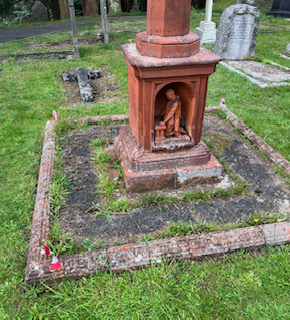
Gzowski memorial before restoration.

On my first walk around the cemetery with Tommy (on our tour with my HQ) he mentioned I would like the next one! As we walked up the pathway you could see the GZOWSKI memorial. It stood out and looked amazing but as I got closer I could see it was in ill repair. Then he mentioned it was a QOR grave and the history of it to everyone.  Straight away I had a plan in my head to clean it up. It would give me a personal project (my wife’s grandfather was in the QOR at D-Day – Rifleman Frank Carleton) and would give me extra focus outside work on this tour. I emailed the then Commanding Officer of the QOR (Lieutenant Colonel Scott Moody) for permission to restore the memorial and he was keen for me to do this.

The grave was overrun with weeds that had broken through the concrete base which had cracked away a lot of material. Additionally, there was a lot of weathering from; granular disintegration, flaking, blistering, contour weathering, pitting, and black crust, but mostly organic forms. There was significant weathering to the words on 2 sides of the memorial from the elements and I wanted to preserve what was inscribed as much as I could. I did some research on Terracotta stone and then purchased Terracotta cleaner, scrapers and a brush with Terracotta oil. I wanted to ensure I bought the right products so that I didn’t make the stone more susceptible to weathering.

For several Saturdays of weeding and cleaning, I started to see some real change. Tommy also gave me some organic cleaner spray which is specifically used for organic issues, which was applied monthly to allow the chemicals to do their work.

After some time and a pause due to freezing conditions, Captain Frazer Clarke from 2 CER and I cleaned out the soil and weeds within the monument to allow us to cement. We used 20 kgs of cement and then pushed pea stones into the fresh cement to maintain the look. Further to that I then laid 80 kgs of pea stones which I thought would make a fresher and more dynamic look but most importantly reduce the opportunity for weeds to come through.

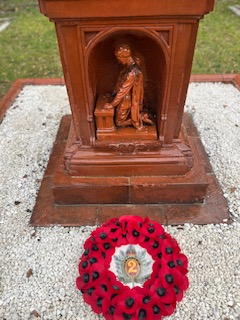
The final touch was the oil ( which acts as a preserver) which I applied one coat to the memorial to soak in over time and preserve not just the wording from the elements but the unique colouring from organic overgrowth. There is still half a tin of oil left which Captain Don Perry -2 Royal Canadian Regiment (my replacement) will apply in the summer of 2024 before he leaves from tour.

Tommy Simpson has commented on how amazing the transformation looks and he has promised to upkeep the standard for me in years to come. I hope to go to the UK this year and visit the cemetery to follow up on the cleaning and also to brass my Dad’s plate on one of the memorial benches.

On Remembrance Day I asked the OC of our Training Team in Lydd if he would allow some soldiers to come to Aldershot to help out in the cemetery and lay over 100 Canadian flags at the base of the graves of our fallen. Four soldiers arrived early on the day and laid the flags. I bought 3 wreaths (CAF, QOR and Hasty P’s.) I got Captain Toffan to lay the QOR’s wreath, a young corporal to Lay the CAF one and I laid my regiment’s wreath. There were hundreds of locals present as well as the Garrison Commander. Tommy will lay the wreaths each year for me.

Cleaning the grave and getting it to look good not just for remembrance day but for years to come, so fellow Canadians and the community can pay their respects and appreciate our freedom, has been a humbling experience.

We will remember them!

CWO Dean Stokes, C.D


Our belated but sincerest thanks to CWO Stokes for his efforts to restore Lt Gzowski’s grave monument. You can read more about the monument here.

Varsity’s Soldiers: The University of Toronto Contingent of the Canadian Officers’ Training Corps, 1914−1968

Book Review: Varsity’s Soldiers: The University of Toronto Contingent of the Canadian Officers’ Training Corps, 1914−1968

Eric McGeer holds a PhD from the Université de Montréal and teaches at St. Clement’s School in Toronto. He is the author of Words of Valediction and Remembrance: Canadian Epitaphs of the Second World War and several books on warfare and law in ancient Byzantium.


“Varsity’s Soldiers” by Dr. Eric McGeer offers a comprehensive and detailed account of the University of Toronto Contingent of the Canadian Officers’ Training Corps from 1914 to 1968. This book delves into the rich history of the university’s involvement in training officers for military service during a pivotal period in Canadian history. As background, the story begins with the history of University College’s 19th century “K” Company of The Queen’s Own Rifles of Canada.
The author skillfully weaves together historical narratives, personal accounts, and archival materials to provide a thorough examination of the University of Toronto’s role in preparing young men for leadership roles in the Canadian military. From the outbreak of World War I to the Cold War era, the book explores how the university’s Contingent evolved and adapted to the changing landscape of military training and education in Canada.

One of the strengths of this book is its meticulous research and attention to detail. The author presents a wealth of information about the organization, training methods, and experiences of the members of the University of Toronto Contingent. Readers will gain a deep understanding of the challenges and triumphs faced by these young men as they prepared for the rigours of military service.

Moreover, “Varsity’s Soldiers” sheds light on the broader social and political context in which the University of Toronto Contingent operated. By examining the impact of major events such as both World Wars and the Korean War on the Contingent, the author provides valuable insights into the role of higher education institutions in shaping Canada’s military history.

Overall, “Varsity’s Soldiers” is a compelling and enlightening read for anyone interested in military history, Canadian history, or the history of higher education. The book is well-researched, engagingly written, and offers a fresh perspective on the intersection of academia and military service. I highly recommend this book to readers looking to deepen their understanding of the University of Toronto’s contributions to Canada’s military heritage.

The book is available through the University of Toronto Press or on Amazon.ca.

Circumstances of Death

Note: The contents of this post may be triggering.

Some records provide detailed accounts of how men died.
By Pete Wytka [From “The Maple Leaf” Fall 2003]

When researching one of the 60,000 Canadian soldiers who lost their lives in the First World War, you’d likely come across a description of their fate such as “Killed In Action”, “Missing, Presumed Dead”, “Died of Wounds”, and “Died of Disease.” Such descriptions are a terse and tragic reminder that we know so little about how these men actually died. Even letters to surviving relatives are couched with euphemisms about an instant, painless, and heroic death.

But occasionally we come across stranger stories – accidents, friendly fire, even murder. This article explores the more interesting cases of the Third Battalion (Toronto Regiment) of the CEF as taken from the form M.F.W. 2643 – “Circumstances of Death.”

(Entries beyond the surname starting with the letter “S” are not available.)

Private George Abbey

9879 Pte. George Abbey – 14 June 1916
He was accidentally shot by No. 9901 Pte J. Denoon. He and Pte. Abbey were cooks in “D” Coy. Wagon. Denoon was handling a rifle which had come down from the trenches when it went off, the bullet going through Abbey’s neck. He died almost instantly. It appears that there was a cartridge in the barrel of the rifle and that the lock of the rifle was so caked with mud that it would not open, which was the reason the owner had not unloaded it.

138535 L/Cpl. Ernest George Betts – 15 November 1917
“Accidently Killed “Court of Enquiry convened in the field on 18- 11-17 to enquire into the circumstances surrounding this casualty found that this non-commissioned officer came to his death about 4 a.m. by accidentally falling into a well near a Power House in the vicinity of LENS; and that no blame could be attached therefor. His body when dragged from the water, bore a deep gash on left temple and the back of head.

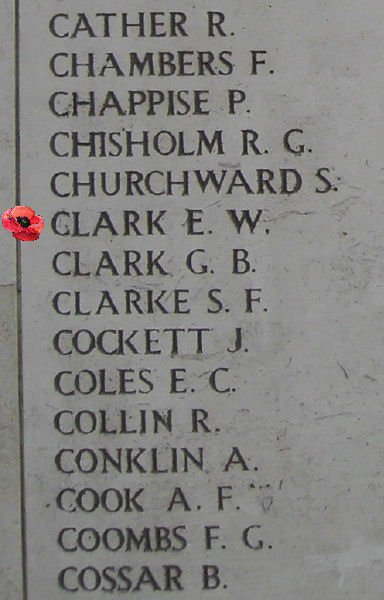
Private Ernest William Clark’s name on Menin Gate

784899 Pte. Ernest William Clark -6 November 1917
“Killed in Action” Was removing the dead body of a soldier from the top of a pill box, at Bellevue, on the right of Passchendaele, when he was instantly killed by a shell.

10189 Pte. Percy Alfred Forrest – 19 May 1918
“Killed in Action” He was instantly killed by the explosion of a bomb dropped from an enemy aeroplane on No. 1 Canadian General Hospital, Etaples.

9642 Pte. Percy Mannering Geddes – 17 November 1915
“Previously reported Missing, believed drowned (ex-Hospital Ship Anglia) Death now accepted for official purposes as having occurred.”

2393479 Pte. Herbert Charles Hemmings -30 August 1918
“Killed in action” The platoon to which he belonged was advancing to the left of Upton Wood, when three of the enemy, after pretending to be taken prisoners, suddenly dropped and opened fire with a machine gun. He, and two comrades, took shelter in a nearby shell hole, but the enemy moved round to a flank and they were all “sniped,” and killed, within a few minutes of each other.
*There is a similar entry for 1027283 Pte. Reginald Sydney Plant claiming all three men were instantly killed.
*There is a similar entry for 171576 Pte. Norman Robertson.

757789 Pte. George William Jones – 23 June 1917
“Previously reported Wounded and Missing, now Killed in Action.” While on a working party digging in an old trench near Vimy Ridge, he was instantly killed when his shovel struck and exploded a grenade.

3033103 Pte. Michael James Kenney – 12 October 1918
“Died of wounds.” During an advance from the Canal du Nord, and before the railroad was reached, he was wounded by machine gun bullets fired from an enemy aeroplane on September 27th, 1918. He was evacuated to No. 7 Canadian General Hospital, Etaples, where he died fifteen days later.

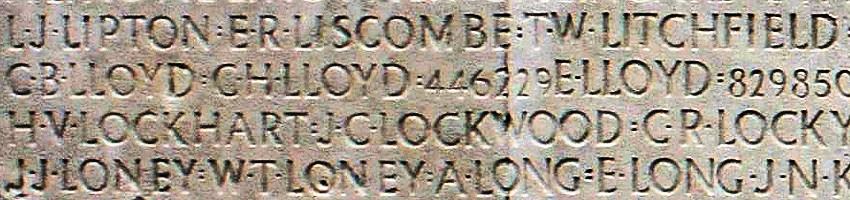
Private Cecil Barry Lloyds name on the Vimy Memorial.

3033098 Pte. Cecil Barry Lloyd – 1 October 1918
“Killed in Action.” The platoon to which he belonged had taken shelter in a shallow trench at about 10 A.M. on 1 October 1918, when an enemy high explosive shell burst on the parapet, directly in front of him, and decapitated him.

416874 Pte Come Laliberte -4 August 1916
“Shot by Order Field General Court Martial.” [See also 3rd Battalion Executions.] 

669619 Pte. Charles Aubrey Marks -30 August 1918
“Previously reported Missing, now Killed in Action” Was proceeding against the enemy trenches,  southwest of Vis-en-Artois, firing a Lewis gun, when both his legs were blown off, by a shell and he died shortly afterwards.

669305 Pte. William Charles Norman – 6 January 1017
“Killed” (Accidently) He was one of a party from his Platoon, who were being instructed in throwing hand grenades at about noon on 6 January 1917. A Mills No. 5 grenade thrown by one of the party exploded prematurely, killing Private Norman and wounding several others.

Company Sergeant Major William Pratt

9153 CSM William Pratt – 5 June 1915
“Drowned.” (Accidentally.) A court of Inquiry convened to investigate the circumstances of his death decided that he was accidentally drowned while bathing in the canal near Bethune on the afternoon of 5 June 1915.

A4174 Sgt. Charles Reginald Pakenham – 15 September 1918
“Killed in Action” While resting with the Battalion West of Cagnicourt, on the night of 15 September 1918, he was hit in the head and instantly killed by shrapnel from a bomb dropped by an enemy aeroplane.

63758 Pte. Oliver Mills Robertson – 18 November 1915
“Killed” Killed by a bomb while demonstrating its use in the trenches near WULVERGHEM.

404436 Pte. Edward James Reynolds -23 August 1916
Shot by order of Field General Court Martial. [See also 3rd Battalion Executions.] 

237520 Pte. Roy Rainey – 11 August 1918
“Died of wounds”. While acting as Signaller and advancing with the Battalion during the attack on enemy positions near Amiens on the morning of 8 August 1918, he was hit in the abdomen by shrapnel from an enemy anti-tank shell. Stretcher-bearers rendered first aid and he was carried to a dressing station and later evacuated to No.48 Casualty Clearing Station where he died three days later.

769079 Pte. Henry Edward Raines – 3 1 August 1918
“Killed in Action”. While sniping at an enemy, during the attack South of VIS-EN-ARTOIS, he was shot through the head and instantly killed by an enemy sniper’s bullet.

757842 Pte. Joseph Wilfred Seeley – 7 November 1917
“Killed in Action” – Killed instantly when a “pillbox” in which he was in, was demolished by a shell.

Pete Wytka is a researcher and collector Of all things Third Battalion, Toronto Regiment. He can be reached at Peterwytka@hotmail.com 

National Indigenous History Month 2024

June is National Indigenous History Month in Canada, an opportunity to learn about the unique cultures, traditions and experiences of First Nations, Inuit and Métis. It’s a time to honour the stories, achievements and resilience of Indigenous Peoples, who have lived on this land since time immemorial and whose presence continues to impact the evolving Canada.

The House of Commons designated June as National Aboriginal History Month in 2009. The name was changed to National Indigenous History Month in 2017.

Many Indigenous and Métis people have served in the Canadian Military, including The Queen’s Own Rifles of Canada.

These are developing lists of Indigenous and Métis soldiers who have served with The Queen’s Own Rifles of Canada or the perpetuated battalions for the First World War Canadian Expeditionary Force († indicates killed in action or died of wounds or battle injuries. )

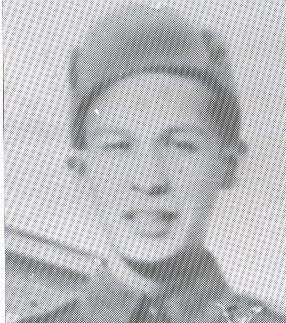
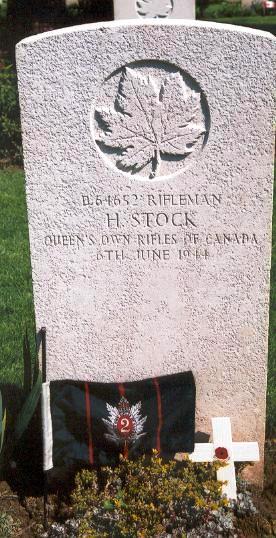
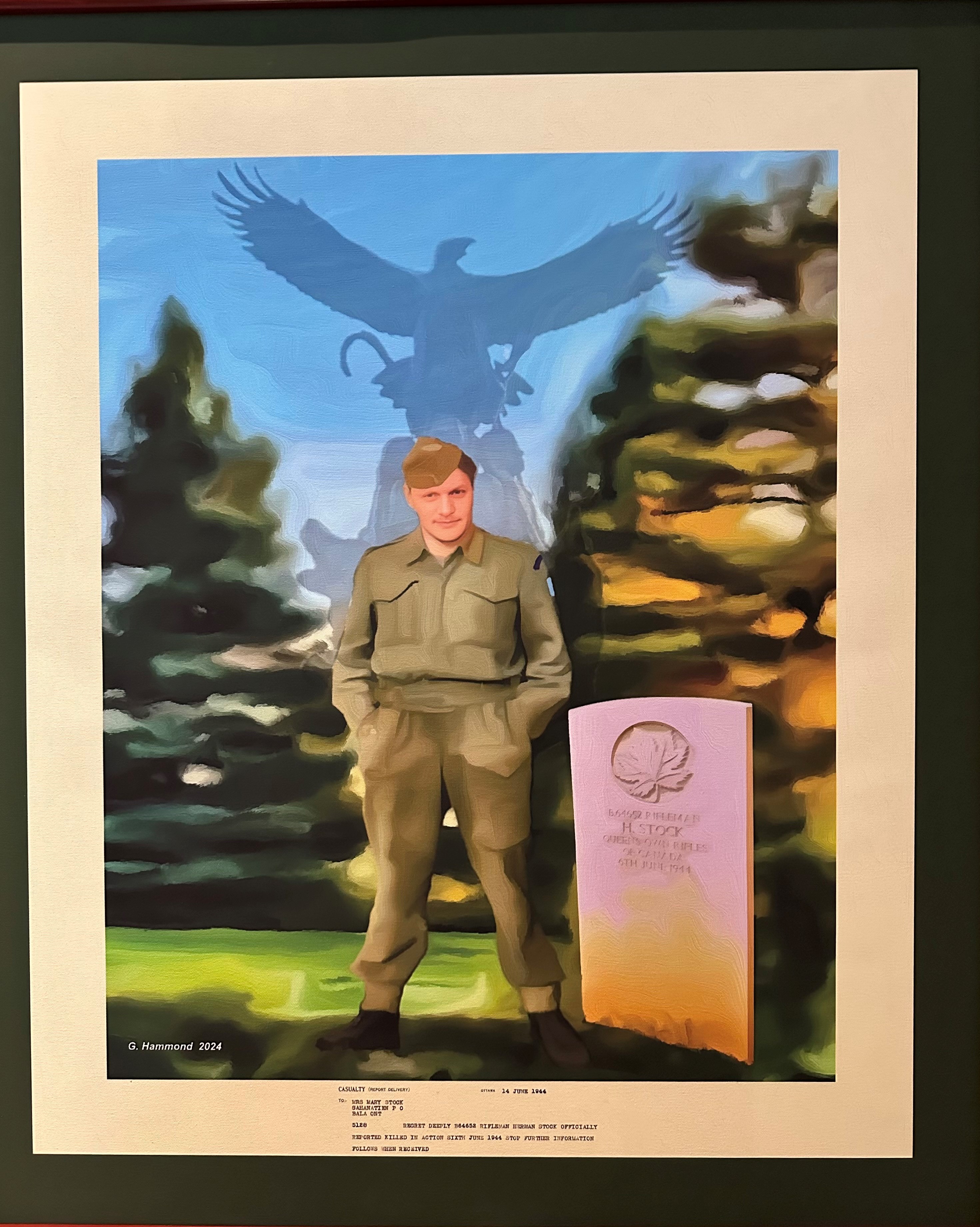
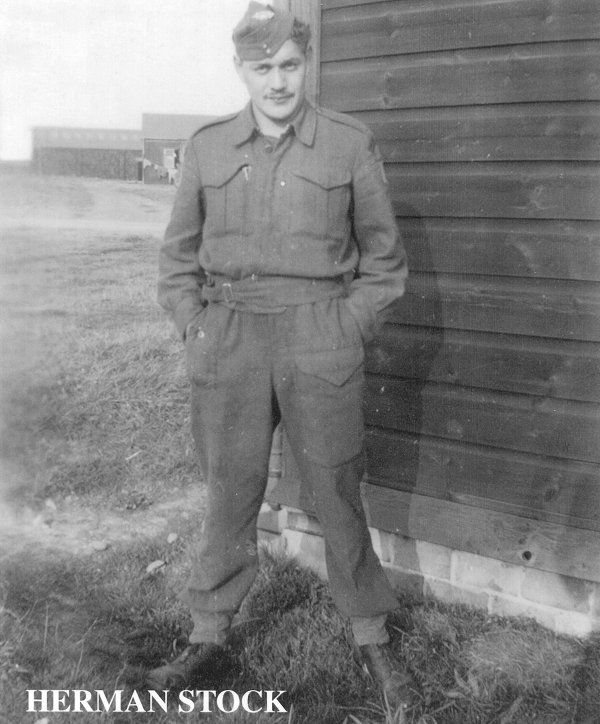
Two soldiers of particular note are B64652 Rifleman Herman Stock who was killed in action on D-Day and   B52575 Rifleman Charles Nahwegezhik, MM  who was posthumously awarded the Military Medal.

If you know of Indigenous or Métis veterans of The Queen's Own Rifles who are not listed below, please send your information to museum@qorumuseum.org 

Indigenous Veterans

  1. Amiskuses, Vincent – Kawacatoose First Nation – Saskatchewan (WWII/Peacekeeper)
  2. Bain, 868003 Acting Lieutenant John Faquhar – Prince Albert, Saskatchewan (182 Bn WWI with 2 1/2 yrs previous service with QOR)
  3. Rifleman Arthur William Beaver

    Beaver, Rifleman Arthur William – Alderville First Nation, Ontario (WWII)

  4. Bressette, Lloyd Henry – Kettle and Stony Point First Nation, Ontario (WWII)
  5. Cada, Paul Senior – Sheshegwaning First Nation (WWI)
  6. Carlson, Frederick – Ojibway (Korea)
  7. Chappise (Wemaystikosh) , 486620 Private Peter Rupert – Cree from Chapleau and Moose Factory, Ontario (3rd Bn WWI)
  8. Dreaver, 886518 Corporal Joseph Sr. MM – Cree from Mistawasis First Nation – Saskatchewan. –  Band Chief post-war (107th -> 3rd Bn WWI, WWII)
  9. Eagle, Sergeant James Wilfred – Saulteaux Ojibway Valley River Reserve – Manitoba (The Memory Project interview) (Korea)
  10. Eagle, Norbert James – Ojibway from Ohskaning Reserve – Manitoba (Reg Force)
  11. Ewenin, Rony – Kawacatoose First Nation, Saskatchewan (Korea)
  12. Franklin,  201795 Private William Henry – Mississauga from the Alderville Band – Roseneath, Ontario (95th –> 4th Bn WWI)
  13. George,  Rifleman Harold Wayne (Reg Force)
  14. Harper, Louis – Wasagamack – Manitoba (Reg Force)
  15. Jamieson, Corporal Harold – Oshweken, Ontario – Six Nations of the Grand River First Nation (WWII)
  16. Joe, Percy – Shackan First Nation, British Columbia (Reg Force)
  17. King, SL163037 Rod – Lucky Man Cree Nation, Saskatchewan (Reg Force)
  18. Lavelley, 788954 Private Peter – Golden Lake Band, Ontario (3rd Bn WWI)
  19. Ledoux, SL163853 Corporal Phillip Narcisse – Mistawasis Nêhiyawak, formerly known as Mistawasis First Nation (Reg Force)
  20. Rifleman Charles Nahwegezhik, MM

    McLaren, Peter Bertram Dalton – Timiskaming First Nation, Ontario (WWII)

  21. Morrison, Joseph – Anishinaabeg of Naongashiing (Big Island) First Nation
  22. Nahwegezhic, Rifleman Charles MM – Anishinaabe from Sheguindah First Nation (WWII)
  23. Okemaysim, Napoleon – Cree-Assiniboine, Beardy’s and Okemasis First Nation – Sask. (Reg Force?)
  24. Oronhyatekha (also known as Peter Martin) – Mohawk
  25. Ross, Steven M. – Cree from Montreal Lake, Saskatchewan (Reg Force)
  26. Runns, Fredrick Sr. – Nakota from Carry the Kettle First Nation – Sintaluta, Saskatchewan (WWII & Post-war??)
  27. Ryder, Andrew – Nakota from Carry the Kettle First Nation – Sintaluta, Saskatchewan (WWII plus Germany 1949-1952)
  28. Smith, Frederick William – Chippewas of Rama First Nation, Ontario (WWII)
  29. Stock, Rifleman Herman  – Haudenosaunee from Gibson Band [Wahta Mohawk] Sahanatien, Ontario (WWII – KIA D-Day)
  30. Thomas, 9254 Private Charles Alfred – Haudenosaunee from Six Nations First Nation, Oshweken, Ontario (QOR & 3rd Bn WWI)
  31. Thomas, 9255 William Sherman – Mohawk from Brantford, Ontario (QOR & 3rd Bn)
  32. Wemigwans, B139461 Private Isadore – 3 Fires Confederacy from Wikwemikong – Manitoulin Island, Ontario (WWII)

Some information is sourced from the Aboriginal Veterans Tribute List.

Métis

  1. Duva, Alcide Joseph Alzear (Post war Germany)
  2. Ferland, Rifleman Norman Philip (Korea)
  3. Paquette, Joseph R. (1st Bn Reg Force)
  4. Riel, Sergeant I.J. (Reg Force) Great-nephew of Louis Riel

Honouring Herman Stock

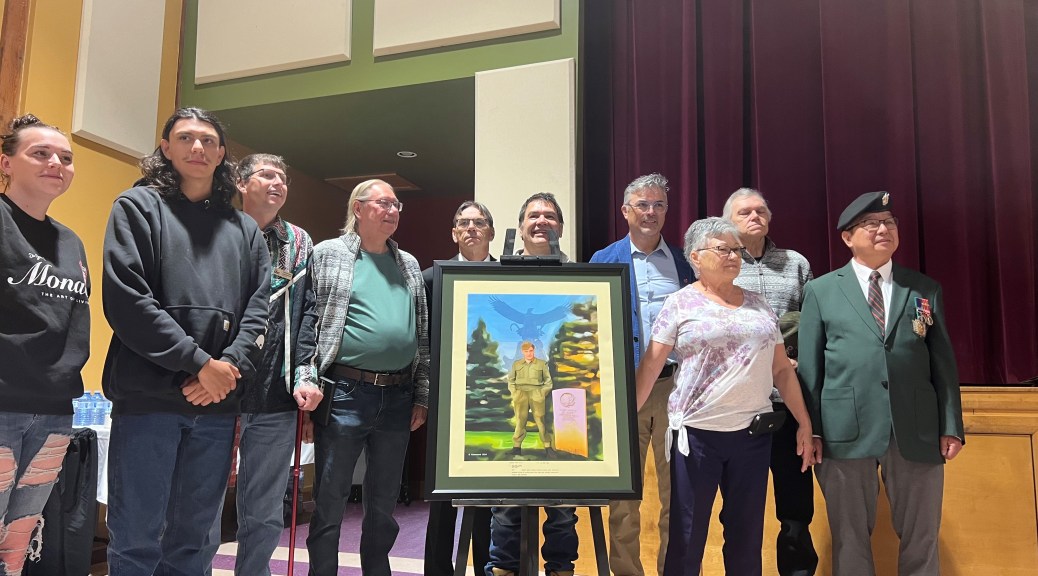
Above: Members of the Stock family with artist Greg Hammond and Captain Rob Chan, CD (Ret’d).

On Saturday, June 8th, 2024 artist Muskoka Greg Hammond presented his piece “Honouring Herman Stock” to Chief Phillip Franks of Wahta First Nation. The emotional event was attended by members of the First Nation including members of Stock’s family, and Captain Rob Chan, CD (Ret’d) on behalf of The Queen’s Own Rifles Association.

Rifleman Stock was killed in action on D-Day 6 June 1944 while serving with The Queen’s Own Rifles of Canada.

Chief Philip Franks and artist Greg Hammond.

Background: Herman Stock, An Aboriginal Soldier’s D-Day Sacrifice

Herman Stock was an Aboriginal Soldier from the Gibson Reserve in Muskoka (now Wahta First Nation) who gave his life for freedom when the Canadian Army landed on Juno Beach on D-Day, June 6, 1944.
Herman was born at Sahanatien on the Gibson Reserve on April 14, 1922, to Robert and Mary Stock. He was the second oldest of nine children in the Stock family. Early in 1941, as World War II entered its third year, Herman worked as a labourer for the Hydro Electric Power Commission on the Gibson Reserve. Aspiring to become a mechanic, he saw his plans disrupted by the war. In July 1941, 19-year-old Herman enlisted in the Canadian Army in nearby Parry Sound.

Initially, Herman trained in Canada, moving between Toronto, Newmarket, and Base Borden before officially joining the Queen’s Own Rifles of Canada regiment in December. After a brief furlough in February 1942, Herman departed Canada for the U.K. on March 20, arriving eight days later. His life in the Army involved constant training, and living in barracks. In the evenings the men visited the pubs in the little English villages near where they were stationed. Whenever possible they visited the larger towns for livelier forms of amusement. Herman was not immune to this “letting off steam”, and occasionally was “Confined to Barracks” for disciplinary reasons. Despite these hardships and occasional disciplinary actions, Herman was a strong soldier, trained as a Bren Gunner.

From July 1943 to May 1944, the Queen’s Own undertook special combined operations training in preparation for the invasion of Europe. They practiced landing assaults, obstacle scaling, and minefield clearing. By Spring 1944, the regiment was ready, confident in their ability to take on the German Army. The invasion, set for June 5, was postponed by a day due to bad weather.

On June 4, Herman and the Assault Companies boarded the HMS Monowai. The men studied maps of Bernieres-Sur-Mer, the fortified beachfront village they were to attack. In their free time, they played cards, crown and anchor, or shot craps. On June 5, the men were informed that the assault would be the following day. They made final preparations, including writing “last” letters. On the eve of battle, Herman cut his hair in the traditional Mohawk style.

D-Day, June 6, began early with reveille at 03:15 then breakfast and all who wished it were given a shot of Navy rum. The men gathered their equipment and were loaded down with 50-pound packs. Herman also carried his 20-pound Bren gun and ammo as they loaded into Assault boats (LCA’s). As the LCA’s moved towards shore, strong winds pushed them off course. Charlie Martin recalled the eerie silence before they landed on Juno Beach at 08:12. The moment the ramps dropped, they faced intense machine-gun fire and mortar shells. Herman’s A Company, slightly better off than B Company, raced down the ramps under fire. Despite heavy casualties, they crossed the beach and pushed forward. Herman, always leading the way, was killed by a sniper while crossing the tracks.

Bernieres was largely secure before 9:00 a.m. but The Queen’s Own Rifles had the roughest experience of all the Canadian D-Day battalions, losing 61 men killed and another 80 wounded.

Herman’s death initiated a series of government correspondences with his family. Mary Stock received a telegram on June 14 informing her of Herman’s death, followed by official condolences from the Canadian Government and the King. Mary was required to complete documents to obtain Herman’s pay. Herman was posthumously awarded several medals, recognizing his sacrifice for Canada and the cause of freedom.

Monument – A granite stele at lot 12, Concession 6, Muskoka Road 38, Wahta Mohawk Reserve, ON was erected by elders of the Wahta Mohawk Reserve. This memorial is dedicated to the local war dead of the First and Second World Wars.

Herman and the other men killed at Bernieres-sur-Mer were initially buried just behind the beach. Mrs. Stock was informed that her son had been buried with religious rites, his grave marked with a wooden cross. In 1946, Herman was re-interred at the Canadian Military Cemetery at Beny-sur-Mer, and Mrs. Stock received notification along with a map and photograph of the grave.

The bonds shared by soldiers like Herman Stock and their comrades-in-arms are profound. Years later, Charlie Martin, who had vowed to visit the families of his fallen comrades, visited the Stock family. Realizing Herman was not commemorated locally, Charlie helped erect a cenotaph in Bala in 1965. Charlie’s aid, through his position at the Ontario Department of Agriculture and sometimes personal funds, was instrumental in establishing the Iroquois Cranberry Bog in 1969. This provided work and revenue for the Gibson Reserve, serving as a practical memorial to Herman’s sacrifice.

Herman’s story of valour extends beyond his death, as his memory and legacy continue to be honoured through the efforts of the community he served.

Honouring Herman Stock – Elements of the Art

Honouring Herman Stock is a tribute that captures the spirit, sacrifice, and legacy of Herman Stock, a young man from the Wahta First Nation who served and died 80 years ago on D-Day, June 6, 1944. This memorial comprises several elements, each filled with symbolism and meaning.

Herman Stock at the Centre: The central figure of the memorial is Herman Stock, a powerful young man full of life, dreams, and hopes. His carefree demeanour contrasts with his battle dress uniform, capturing the essence of his youth and the gravity of his service, highlighting the personal sacrifices made by those who serve.

Herman Stock’s Gravestone: The gravestone serves as a stark reminder of the ultimate sacrifice made by Herman Stock. The Maple Leaf signifies his Canadian identity, and the date June 6, 1944, marks D-Day, a pivotal moment in the Liberation of Europe. This contrast between his youthful image and his gravestone underscores the profound loss felt by his passing.

The Forest: Representing the forests of his homeland, this element symbolizes bringing Herman back to his roots. The Commonwealth War Graves Commission Cemetery in Beny-sur-Mer though beautiful, is far from Wahta First Nation. By placing Herman in a familiar forest setting, the memorial connects him to his ancestral heritage and the land he loved.
The National Aboriginal Veterans Monument: Silhouetted in the background, this monument reflects traditional Indigenous values of honour, duty, and harmony with the environment. The Thunderbird atop the sculpture represents the Creator and embodies the spirit of Canada’s Aboriginal peoples. This connection honours Herman Stock while recognizing the broader contributions and sacrifices of all Aboriginal veterans.

Telegram to Mary Stock: This element highlights the personal and communal loss experienced by Herman’s family and community. The telegram announcing his death is a poignant reminder that his sacrifice was shared by his loved ones. It symbolizes the collective grief and the impact of his loss on the Wahta First Nation and beyond.

Together, these elements create a memorial that honours Herman Stock’s memory, celebrates his heritage, and acknowledges the broader sacrifices made by Indigenous veterans and their communities.

Greg Hammond 2024

“Honouring Herman Stock” by Greg Hammond.

D-Day+80 Pilgrimage

By Major John Stephens, CD (Ret’d), Museum Director and Archivist

Today, sixty-one serving soldiers of The Queen’s Own Rifles plus various members of the Regimental Family are participating in a pilgrimage to Normandy, France in honour of the 80th Anniversary of D-Day and the sixty-one QOR soldiers killed on D-Day, 6 June 1944.

I had the privilege of sponsoring Corporal Eric Filmer on this trip and together we remember B66008 Rifleman Albert Edward Hildreth who was killed in action on D-Day aged 23. You can read more about Rfn Hildreth on his museum profile. We each received a coin engraved with his name on the reverse.


In an email yesterday Cpl Filmer shared some thoughts about the trip so far:

“The past few days have been tremendously moving to hear about, and visit the places where our soldiers made the ultimate sacrifice. What really brings it home are the people from the towns that we liberated. Canadians, specifically the QOR, are at home in many of these places. The children have been taught the importance of what happened here, and it has been made a part of their lives Our history has been tonight to them in school, and hearing them sing the Canadian national anthem, and seeing their excitement has been very heartwarming.”
Today they are marching from the landing at Juno Beach (with some stops in other villages along the way) to the Village of Anisy which was the QOR’s final objective on D-Day.
Yesterday they attended a service in Le Mesnil Patry where the battle of the town cost 50 QOR deaths – the second most in a single day of the war. The pictures above and below are from that remembrance.

We will remember them.

A Wooden Mallett and Six Sergeants

We recently catalogued a wooden tent peg mallet we’d received from the estate of the late Captain Scott “Paddy” Patterson, CD. This was however no ordinary mallet. There were some simple designs scratched into both the handle and the head. But that alone was not the most interesting find. Etched into the round wooden handle was the following:

“A” Coy 3rd Batt
1st Canadian Overseas Force
1914
Compliments of
Sergeants

Further, etched into the head of the mallet were the following names and information:

1914    1914
Sergt A.G. Eddis
Sergt R.L. Seeley
Col Sergt A.E. Thompson [sic Thomson]
Sergt H.G. Kerr
Sergt W. Pratt
Lce Sergt G.B. Roberts
Salisbury Plain, England

Salisbury Plain (near Stonehenge in South West England) was where the Canadian Expeditionary Force trained in England before heading to France. Known for its heavy rains, the Canadians were housed in tents and not in the few barracks available, hence a tent peg mallet would have been an essential piece of kit, not just to erect the tents on arrival, but to re-erect them after various severe storms blew them down.

We catalogued and photographed the mallet, added it to our collections database, and then added it to one of our WWI exhibit cases – something we can’t always do because of limited space.

All the Sergeants named on the mallet formally enlisted with the 3rd Battalion, Canadian Expeditionary Force on 22nd September in Valcartier, Quebec where they were sent for equipping and preliminary training. They all had previous service in The Queen’s Own Rifles of Canada militia. As you can see below, they have consecutive service numbers.

  • 9151 Colour Sergeant Alfred Edward Thomson
  • 9152 Sergeant Herbert Gladstone Kerr
  • 9153 Sergeant William Pratt
  • 9154 Sergeant Arthur George Eddis
  • 9155 Sergeant Le Roy Launcelot Seeley
  • 9156 Lance Sergeant Guy Burland Roberts

After further training in England, the 3rd Battalion arrived in France on 14 February 1915. On 5 March they had their first experience in the trenches. Starting on the evening of 23 April, the battalion faced their first combat in the 2nd Battle of Ypres where hundreds were killed or taken prisoner of war.  After the Battle of Festubert, they were once again in the trenches from May 25-28 and subjected to a severe high-explosive bombardment which caused many casualties.

We couldn’t help but wonder how many of these “Originals” survived the war. (Click on the name links for more detailed profiles.)

9155 Sergeant L.R.L. Seeley

Roy Seeley was born in Toronto in 1889, served for five years with The Queen’s Own Rifles militia battalion, and rose to the rank of Sergeant when, on 22 September 1914, he enlisted with several of his fellow sergeants in the 3rd Battalion, Canadian Expeditionary Force (CEF). At the time he was married with two young children. A brother would later be posted to the 3rd Bn as a reinforcement.

He served through some tough battles including St Julien, the 2nd Battle of Ypres, and Festubert. After the latter, he was in a trench and knocked out by a shell but refused to go to the rear. Later that night he was shot in the lung by a sniper and died in hospital on 25 May 1915. He was the first of the six sergeants to succumb.

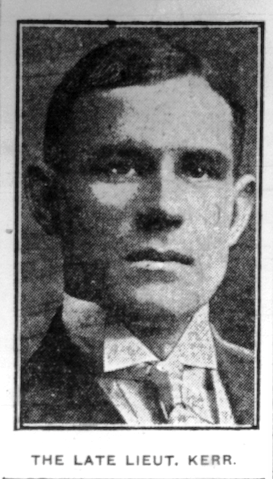
9152 Lieutenant H.G. Kerr

Herbert Kerr was born in Pickering on 16 October 1887.

He joined The Queen’s Own Rifles of Canada militia battalion around 1909 and in 1910 he participated with H Company on the trip to England.

With his fellow QOR sergeants, he enlisted with the 3rd Battalion CEF on 22 September 1914. Kerr travelled to England and France with the 3rd Bn and on 9 May 1915 he was promoted to Lieutenant.

Only a few weeks later he was killed in action at Festubert, on 25 May 1915. He has no known grave so he is memorialized on the Canadian Vimy Memorial in France.

9154 Lieutenant A.G. Eddis

Arthur Eddis was born in Toronto, Ontario on 28 January 1891. His father Francis had served with the QOR in the 1880s and participated in the North West Field Force in 1885.

An accountant, Arthur joined the QOR in 1908, was a competitive marksman and participated in the 1910 trip to England.

With his fellow sergeants, he enlisted with the 3rd Battalion, CEF on 22 September 1914. While in the field he was promoted to Lieutenant in early May 1915 and three weeks later was killed in action on 27 May 1915, the third of the sergeants to die.

His original grave was lost so he is remembered on the Canadian Vimy Memorial in France.

9153 Company Sergeant W. Pratt

William Pratt was born in England on 21 July 1891 and came to Canada around 1907.  He joined the Queen’s Own Rifles militia battalion around 1910 (and older brother Henry may already have been in the QOR that year.)

An accountant who then worked with his fellow sergeant Arthur Eddis at Wilton C. Eddie and Sons chartered accountants, Pratt enlisted on 22 September 1914 with the 3rd Battalion, CEF as a Sergeant.

He trained with the battalion in Quebec and England before heading to France and Belgium where he survived the 2nd Battle of Ypres which decimated the 3rd Bn. He was promoted to Company Sergeant Major on 4 May 1915.

Sadly, on 5 June 1915, he drowned while swimming in a canal near Bethune, France and is buried in the Bethune Town Cemetery.

The Survivors

Within just 10 days in 1915, four of the six sergeants named on the mallet had died. Two however were to survive the war.

Warrant Officer Class II (CSM) A.E. Thomson
Giessen Camp from the hospital (Imperial War Museum Q 55591)

Arthur Thomson was born in Nova Scotia on 10 December 1886 and enlisted with The Queen’s Own Rifles militia circa 1903.

In Belgium having survived the 2nd Battle of Ypres, he was reported missing on 11 May 1915 and two months later confirmed as a prisoner of war, originally in Giessen POW camp and later in Holland. Thompson was repatriated to England on 8 February 1919.

After returning to Canada, Roberts was discharged in Toronto on 23 May 1919 and in September 1919 married Florence Haskell.

It’s not clear how he was employed immediately after the war but in 1938 he moved to England and worked for the UK Ministry of Transportation. He died in Bedford, England on 9 November 1966 and is buried there.

Captain R.B. Roberts, MC

Guy Roberts was born in Toronto, Ontario on 21 March 1885. He served three years with The Queen’s Own Rifles militia battalion before enlisting in the 3rd Battalion, CEF, on 22 September 1914.

After training in England and service with the 3rd Battalion in France and Belgium, he was commissioned as a Lieutenant in November 1916, and awarded the Military Cross for actions that same month:

“For conspicuous gallantry in action. He established posts, making his reconnaissance and posting the men himself, and crossing 250 yards of fire-swept ground three times. He displayed great courage and initiative throughout.”

He was then posted to the 12th Brigade Headquarters until January 1918 when he was seconded to the War Office on a “secret mission” known as the Dunsterforce. He returned to England in 1919 and was discharged on mobilization on 26 November 1919.

He married in 1927 and had one son born in 1932. After the war, he took over the Roberts Art Gallery in Toronto from his father, and after retirement, seems to have had some success as an artist in his own right.  After moving to the west coast, Roberts died in hospital on 5 January 1969, in Port Alberni, British Columbia.

Telling Our Stories

Dedication of Fenian Raid Markers

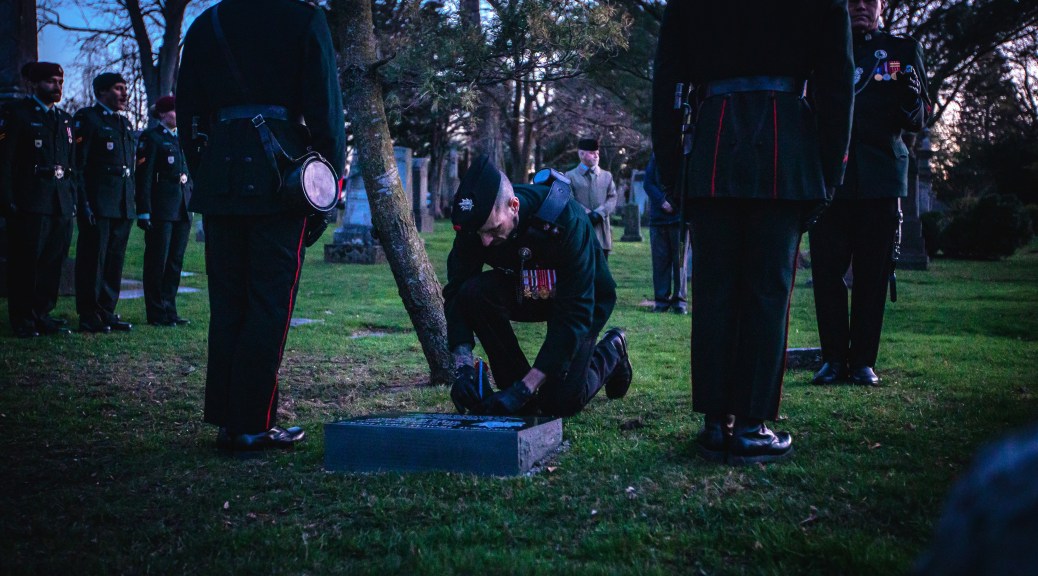
On the evening of Wednesday, April 24, 2024, the Commanding Officer Lieutenant Colonel Chris Boileau, CD, the Regimental Sergeant Major, Chief Warrant Officer Justin Thorn, CD, three skirmishers, a nine-person guard under the command of Sergeant Allan Kiss, and a drummer and bugler participated in the dedication of four new markers for Queen’s Own Rifle’s soldiers whose deaths were attributed to their service at the Battle of Ridgeway.

Also in attendance were Museum Director Major John Stephens, CD (Ret’d) and Curator CWO Shaun Kelly, CD (Ret’d) who had assisted with research on these soldiers.

The four soldiers were:

Each of these soldiers died of disease within a year and a half of the Battle of Ridgeway and their deaths were all attributed to their service on June 2nd, 1866.

Special Lockie grave marker,

In 2010 markers had been placed on the graves of the “Ridgeway Nine” (those killed in action or died of wounds) and it was felt that these additional soldiers should receive similar recognition. The QOR Trust Fund’s Memorials Chair, Lieutenant Colonel John Fotheringham, CD, worked with the cemeteries and our monument maker to create and install these markers over the past few years.

It was finally time to formally dedicate these new markers and remember our fallen during the week of the Regiment’s 164th Anniversary.

Each brief ceremony included a short biography of the soldier read by the RSM, the Last Post and Rouse by the Bugler and Drummer, the Act of Remembrance by Sgt Kiss, the placing of a QOR “desk” flag in front of the marker, and finally two of the guard members placing their poppies on the marker.

Your donation to The Queen’s Own Rifles of Canada Trust Fund directly or via the 1860 Club, funded this project.

This slideshow requires JavaScript.

Photos by Alex Brintnell.

Anisy and Brighton Approve Twinning

C65492 Rifleman Clarke Lynson Lawson was born on 8 May 1905 in Brighton, Ontario, the son of George Lynson Lawson and Sarah Elizabeth Maybee.

Clarke was educated at the Lawson Settlement School and Brighton High School and later attended Kingston Dairy School.

In November 1940 Clarke enlisted in the Active Service Army and was posted to The Queen’s Own Rifles in June 1943. He landed on D-Day, 6 June 1944 and while he served the landing on Juno Beach he was killed in action liberating the Village of Anisy – the final battle of that day. You can read more about Lawson here.

In 2017, in the presence of regiment members, the Village of Anisy named a new street in his honour “Rue Clark Lawson.”

Earlier this year the Director of our Regimental Museum and Archive  (whose family resides in Brighton!) reached out to the mayors of both Anisy and Brighton to see if they might be interested in “twinning” their respective municipalities. They both indicated enthusiasm and quickly drafted appropriate resolutions. Both the Brighton Council (on March 4, 2024) and the Anisy Council (on March 5, 2024) officially approved the twinning. The resolutions are provided below.

We look forward to seeing what steps they take in the future to build on these resolutions.

And our thanks and congratulations to both mayors and councils in making this happen so quickly!


Municipality of Brighton Meeting, March 4, 2024

Corporation of the Municipality of Brighton Council Meeting Minutes March 4, 2024, 6:30 PM

The Council of the Corporation of the Municipality of Brighton met in the Council Chambers on the above date and time.

Members present:  Mayor Brian Ostrander, Deputy Mayor Ron Anderson, Councillor Byron Faretis, Councillor Emily Rowley, Councillor Jeff Wheeldon, and Councillor Bobbi Wright

Members absent: Councillor Anne Butwell

Resolution No. COU-2024-63

Moved by Councillor Emily Rowley
Seconded by Councillor Byron Faretis

Whereas Twin City Agreements contribute to the promotion and celebration of cultural and economic ties to a community;

And Whereas 2024 marks the 80th Anniversary of the D-Day landings on Juno Beach in Normandy France;

And Whereas Rifleman Clarke Lawson of Brighton survived the D-Day landings but perished in Anisy France while fighting to liberate the village with the Queen’s Own Rifles of Canada;

And Whereas the Municipality of Anisy has recognized Rifleman Clarke Lawson by naming a street after him, Rue Clarke Lawson;

And Whereas Mayor Nicolas Delahaye has noted that twinning Brighton and Anisy would strengthen the strong bonds between the people of Anisy, the regiment and Canadians;

Now Therefore Be It Resolved that the Municipality of Brighton Council agrees to twin the Municipality of Brighton with the Municipality of Anisy,

And Further That I, Mayor Brian Ostrander does hereby proclaim that the Municipality of Brighton is twinned with the Municipality of Anisy.

Carried


Traduction française de la résolution de Brighton

Réunion de la municipalité de Brighton, 4 mars 2024

Corporation de la municipalité de Brighton Procès-verbal de la réunion du conseil du 4 mars 2024, 18h30

Le conseil de la municipalité de Brighton s’est réuni dans la salle du conseil à la date et à l’heure ci-dessus.

Membres présents : le maire Brian Ostrander, le maire adjoint Ron Anderson, le conseiller Byron Faretis, la conseillère Emily Rowley, le conseiller Jeff Wheeldon et la conseillère Bobbi Wright

Membres absents : Conseillère Anne Butwell

Personnel présent : Bob Casselman CAO (via Zoom); Gene Thompson, chef des pompiers; Leslie Whiteman, directrice des travaux publics; Paul Walsh, directeur de la planification et du développement; Ben Hagerman, Mgr. Développement économique; Jennifer Smith, responsable des ressources humaines ; Keith Puffer, trésorier adjoint ; Samantha Deck, planificateur 1 ; et Jessica Polley, greffière adjointe

Résolution n° COU-2024-63

Proposé par la conseillère Emily Rowley
Appuyé par le conseiller Byron Faretis

Attendu que les accords de villes jumelées contribuent à la promotion et à la célébration des liens culturels et économiques avec une communauté ;

Et considérant que 2024 marque le 80e anniversaire du débarquement sur la plage Juno en Normandie, en France ;

Et attendu que le carabinier Clarke Lawson de Brighton a survécu au débarquement mais a péri à Anisy en France alors qu’il combattait pour libérer le village avec les Queen’s Own Rifles of Canada ;

Et Attendu que la municipalité d’Anisy a reconnu le carabinier Clarke Lawson en donnant son nom à une rue, la rue Clarke Lawson ;

Et Attendu que le maire Nicolas Delahaye a souligné que le jumelage de Brighton et d’Anisy renforcerait les liens forts entre la population d’Anisy, le régiment et les Canadiens ;

Il est maintenant résolu que le conseil de la municipalité de Brighton accepte de jumeler la municipalité de Brighton avec la municipalité d’Anisy,

Et en outre, moi, le maire Brian Ostrander, proclame par la présente que la municipalité de Brighton est jumelée à la municipalité d’Anisy.

Adopté


Anisy Meeting, March 5, 2024

Copy of Resolution (in French)

English Translation of Anisy Resolution

NUMBER OF MEMBERS:
– relating to the Municipal Council: 15
– in exercise: 12
– who took part in the deliberation: 12

DATE OF CONVOCATION:
March 5, 2024

DATE DISPLAY:
March 5, 2024

PURPOSE OF THE DELIBERATION: 4/ Motion to combine with the municipality of Brighton, Ontario, CANADA.

SESSION OF March 14, 2024
In the year two thousand and twenty-four, on March fourteenth at 8 p.m., the Municipal Council met legally
convenes a public meeting at the ordinary place of its meetings, under the chairmanship of Mr. Nicolas
DELARAYE, Mayor.

WERE PRESENT: Mr Pierre PAUMIER, Mr Remi BANDRAC, Ms Veronique MARGUERITE, Mr Daniel DELAUNAY, Mrs Maud MAHLER, Mrs Marianne MENY, Mr. Frederic NIGEN, Mr Didier MAITREL, Mr Alain PROVOST, Mrs Valerie GUYOT.

ABSENT EXCUSES: Mr. Gerard TOUYON authorizes Mr. Remi BANDRAC.

Mr. Didier MAITREL is elected session secretary.

The minutes of the meeting of February 1, 2024 are read.

The Mayor informs the municipal council that the town of BRIGHTON (Ontario, Canada) is the town where Rifleman Clarke LAWSON was born and lived.

The Mayor was contacted by the Director of the  Queen’s Own Rifles of Canada Museum and by the Mayor of Brighton, Mr. Brian OSTANDER who learned of the tribute made by the town for this soldier with the name of a street and more generally for the regiment.

Considering that the community of BRIGHTON voted on a motion on March 4, the last laws of its council in favour of twinning between our 2 municipalities.

Considering that the twinning between our 2  communities would consolidate the strong bond between the Anisians, the regiment and the Canadians

Considering that Mayor Brian OSTANDER indicated that this was an exciting opportunity for Brighton
Considering that 2024 marks the 80th anniversary of the landing of June 6, 1944

Considering that the commune was liberated by the Queen’s Own Rifles regiment on June 6, 1944

Considering that Rifleman Clarke Lawson was killed in the town on June 6, 1944

The municipal council, after deliberating, decided unanimously:

– TO ACCEPT the twinning with the municipality of BRIGHTON, Ontario, Canada.
– TO AUTHORIZE the Mayor to sign any document necessary for the execution of this
deliberation

For certified copy.
March 22, 2024
The Mayor
Nicolas DELAHAYE

[Stamped with the Anisy municipal seal and signed by the Mayor]

Victoria Cross Transfer to Canadian War Museum

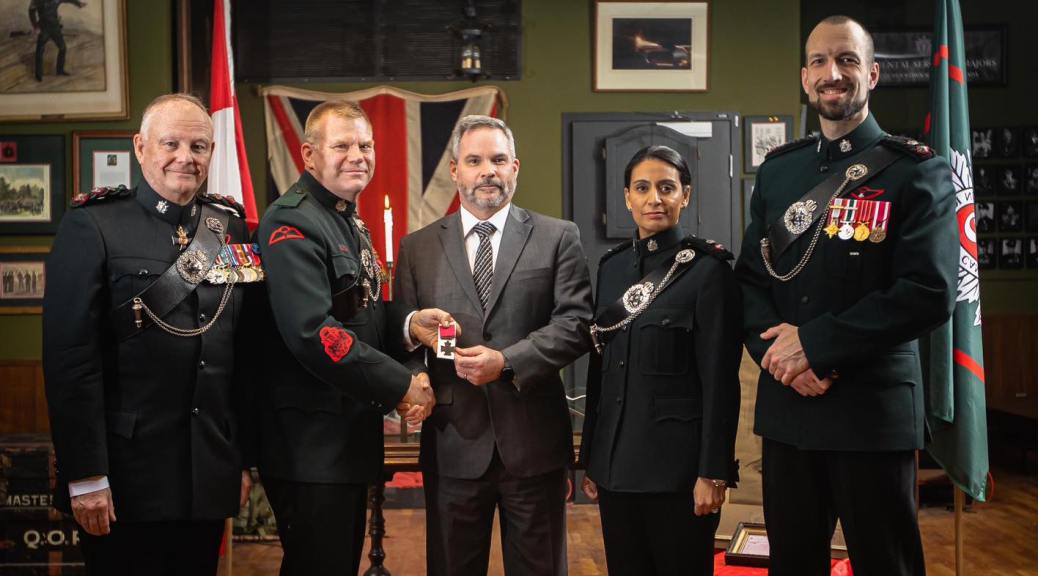
On Monday, 26 February 2024, members of the serving Regiment, the Regimental Trust, and the Regimental Museum and Archive, oversaw the transfer of Sergeant Aubrey Cosens’ Victoria Cross to the Canadian War Museum. While our museum would have been proud to exhibit this valuable piece, we have never been able to display it securely. As a result, it has been held in secure storage for many years.

This historic artifact, important not only to Regimental history but also that of the country, will finally be given the recognition and access that it truly deserves. In due course, it will be added to the Canadian War Museum’s existing Cosens exhibit.

Those in attendance were Honorary Colonel Major General David Fraser (Ret’d), Honorary Lieutenant Colonel Manjat Minas, Commanding Officer Lieutenant Colonel Chris Boileau, Regimental Sergeant Major Chief Warrant Officer Justin Thorn, Regimental Trust President Major Tony Schultz (Ret’d), Trust member Lieutenant Colonel John Fotheringham (Ret’d) and Regimental Museum Director Major John Stephens (Ret’d).

This slideshow requires JavaScript.

Learn more about Cosen’s actions in this CBC Interview:


1963 video of the 1st Battalion taking a detachment to Mooshof Farm to dedicate a plaque to Sergeant Aubrey Cosens, VC on August 29, 1963. They also visited Groesbeek Canadian War Cemetery and placed a wreath on Cosens’ grave.

Paardeberg Day February 27

“For two decades afterwards, Canadians would gather on 27 February (known in Canada as “Paardeberg Day”) around memorials to the South African War to say prayers and honour veterans.” (Wikipedia)

The Canadian participation in the South African War of 1899-1902 saw the active involvement of various Canadian military units, including The Queen’s Own Rifles of Canada. This esteemed regiment, based in Toronto, Ontario, contributed thirty-four soldiers to the conflict, playing a vital role in the war effort.

The Queen’s Own Rifles of Canada, a militia regiment with a rich history and tradition, eagerly answered the call for service during the South African War. Known for their marksmanship and tenacity, the members of this esteemed unit demonstrated exceptional bravery and skill on the battlefield.

During the war, the Queen’s Own Rifles of Canada played a crucial part in numerous engagements, including the Battle of Paardeberg (which concluded on February 27th) and the subsequent march to Pretoria. Their actions were instrumental in supporting the larger British war effort, as Canadian forces worked alongside other Commonwealth troops to achieve success in South Africa.

Three members of the regiment did not return – one killed in action and two of disease:

  1. Sergeant A Beattie – Died of Enteric Fever – 14 April 1900
  2. Rifleman W. S. Blight – Died of Enteric Fever – 15 April 1900
  3. Private Charles E.E. Jackson – Killed in Action – 18 February 1900 at Paardeberg

The experiences of the soldiers from The Queen’s Own Rifles of Canada in the South African War were pivotal in shaping the regiment’s identity and legacy. The lessons learned from this conflict contributed to the ongoing development and refinement of the unit’s training and operational capability.

In the aftermath of the war, the contributions of The Queen’s Own Rifles of Canada were celebrated and recognized as an integral part of Canada’s military history when they were awarded the battle honour “South Africa 1899-1900.” Their gallant service in South Africa served as a testament to the dedication and courage of Canadian soldiers, leaving an indelible mark on the regiment and the nation as a whole.

Read more about The Queen’s Own Rifles and Canadians in South Africa.

Read more about the uniforms and equipment used by Canadians in South Africa.


Learn about joining The Queen’s Own Rifles of Canada as a Canadian Forces reserve soldier on the Regimental website recruiting page.

He Suffered for Nothing in The Great War: The Aftermath of the Shell-Shocked Soldier in the Post-War Western World

By Cameron Telch

Cam Telch holds a Master Of Arts and a Master of Education and is a doctoral student in the Faculty of Education at Mount Saint Vincent University. Cam has also volunteered at The Queen’s Own Rifles of Canada Regimental Museum and Archive.

Originally published in the Royal Canadian Military Institute’s Sitrep January-February 2024 Volume 84, Number 1. Reprinted with the author’s permission.

Introduction

The Canadian Centre for the Great War (CCGW) in Montreal is dedicated to preserving Canada’s memory of the Great War. Creating numerous virtual and in-person exhibitions, the CCGW has covered all aspects of the war, including the confinement of enemy populations in Canada, the demobilization of the Canadian Expeditionary Force, and female nurses and medicine. At the beginning of 2023, the CCGW developed its latest online and travelling exhibition, Shell Shocked: The Long Road to Recovery.

Shell Shocked analyses the Canadian and some British narratives of shell shock. Covering the history of shell shock into five categories, they include “In the Trenches,” “Treatment,” “Malingerers,” “Armistice,” and “PTSD.” “In the Trenches” covers the connection between conflict and nervous breakdown; “Treatment” examines traditional and modern methods of psychiatry; “Malingerers” is the marginalization of shell-shocked soldiers; “Armistice,” is the aftermath of shell shock in post-war Canada; lastly, “PTSD” is the historical relationship between shell shock and PTSD. The CCGW’s exhibit argues that all soldiers and officers, regardless of social standing, were susceptible to a nervous breakdown during the war.

During the fall of 2023, the RCMI acquired Shell Shocked from the Lethbridge Military Museum in Alberta. While the exhibition covers a broad range of topics, this article will focus on the aftermath of shell shock in the post-war Western world. Shell Shocked reveals that two new schools of thought emerged during the war. The former was led by Dr. W.H.R. Rivers who argued that shell shock was a product of the war and developed treatments where shell-shocked victims were encouraged to discuss their trauma. Clarence B. Farrar, Chief Psychiatrist, the leading authority of the latter for the Department of Soldiers’ Civil Re-establishment of Canada, asserted that shell shock was a condition of a weakened character deficiency or poor genetics. While the war did lead to the great shell shock debate, and often produced revolutionary new ideas toward the foundation of psychology, the latter school of thought about shell shock emerged, unfortunately, as the dominant position in Canada and Britain and, to some extent, in the United States after the war. As a result, shell-shocked veterans became victims of prejudice. This article will argue from a larger perspective in order to demonstrate that marginalization of shell-shocked veterans was not solely a Canadian phenomenon.

 The Official View of Shell Shock After the Great War

After the war, the question of shell shock lingered in the post-war Western world. Debates continued regarding the origin, diagnosis, and treatment of shell shock. The British government investigated the nature of shell shock with the 1922 Report of the War Office Committee Enquiry into Shell-Shock to try and settle the debate. Investigated and led by Lord Southborough in April 1920, the committee, including men who maintained traditional beliefs about mental illness, called forth fifty-nine witnesses to give evidence on shell shock, including army officers, psychologists, neurologists, and army doctors who treated shell-shocked soldiers, both on the Western Front and in Britain. After two years of testimony, and with the release of the final report in 1922, the committee recognized, to an extent, the need for psychological therapies to treat nervous soldiers; that doctors must acquire some understanding of psychology, and soldiers must be granted shorter periods of frontline service including constant rotation, and be sent home frequently to prevent nervous breakdowns.

While the 1922 document certainly contained some groundbreaking conclusions, they were overshadowed by the committee’s conservative beliefs about mental illness. The British War Office recommended that the term shell shock be abolished from the official military language, that nervous casualties not be listed as combat wounds, and that soldiers should receive better training to create a high spirit of morale to combat nervousness. As Lord Southborough’s committee concluded: “The most likely type of man for ‘shellshock’ is the brooding, introspective, self-analyzing man, the type who in the last war was constantly estimating his chance of survival, and whose imagination added the terrors of the future to those of the present.” Southborough’s committee disregarded the lived combat experiences of shell-shocked soldiers and officers. It unanimously decided that shell shock was a pre-existing condition that affected men with lesser masculine qualities, including those who easily succumbed to fear. It appeared that the lessons acquired from the war, including that every soldier and officer can have a breakdown in combat, were dismissed in favour of this new interpretation of shell shock.

The results from Southborough’s committee had far-reaching implications throughout the British Empire. In Canada, some doctors echoed a similar stance to that of their British counterparts. Sir Andrew (Dr.) Macphail, Canada’s official Great War historian, said: “that shell-shock is a manifestation of childishness and femininity and that against such there is no remedy; that hysteria is the most epidemical of all diseases.” Dr. Macphail, along with other Canadian medical authorities, contended that masculinity meant the suppression of emotions, and it was born on the battlefield. As Macphail thought, shell shock reverted its victims to a child-like mentality as they broke down crying, wet the bed, screamed when left alone at night, and panicked easily. He believed that shell-shocked men became overly hysterical as they “were not fit for the hard business of war.” In reality, the average shell-shocked Canadian soldier was 27 years old. In some ways, Macphail was correct to portray grown men as children as the image of “the early twentieth-century madman was widely held to be either dangerous or ridiculous.” While it was easier to depict shell-shocked veterans as boys to generate greater public compassion, the problem that Macphail implied was that they were grown men who required motherly affection, as he believed that shell shock deprived its victims of their manhood.

Throughout the mid-1920s, other experts in the United States interpreted shell shock differently. One expert, Dr. Frederick W. Parsons, of the New York State Hospital Commission, offered a radical view on it. Parsons denied the existence of shell shock, arguing “that there is no such thing as shell shock” from a psychological perspective. Parson still interpreted shell shock as a bodily injury from the result of an artillery explosion. Fear was the underlying reason why some soldiers broke down, despite the stoic state of the “soldier veteran who never complained of shell shock [as] real soldiers, the men who went through the crucible, never made a joke of a comrade laid up with shell shock.” For the shell-shocked veteran of the 1920s, their combat experiences were again undermined by this view. Shell shock was believed to be an example of mass hysteria where some soldiers panicked easily and could undoubtedly influence the behaviour of their comrades. Explaining shell shock from a physical point of view meant that wounds were attributed to their condition; Parson’s denial of shell shock from a mental health perspective indicated that there were no visible injuries to suggest otherwise.

The Shell-Shocked Veterans’ Experience

During the early 1920s, there was heightened anxiety in Britain that shell shock led to a surge in crimes among veterans. In February 1920, The Vancouver Sun reported that a former British officer shot and killed a bank manager during a robbery in Leeds. The same paper also relayed that, in a similar case, another robbery was committed by a veteran in Newcastle. The Vancouver Sun made it apparent that shell shock might make “[a] man (…) not know what he is doing and has left men weak-willed.” The debate that emerged during this period was that shell-shocked veterans were not in control of their actions when a crime was committed. Rather, they were the unfortunate victims of their mental tendencies. This image of the shell-shocked veteran probably created uneasiness among some Britons, who feared that they might not be held accountable for their crimes and used mental illness as their justification. However, not all people believed that the shell-shocked veteran would not be held accountable in the legal system. The Gazette conveyed that a report from the commissioners of prisons and the directors of convict prisons in Britain said, “shell shock [is] an excuse for criminal acts.” As this report argued, prosecuting and convicting shell-shocked veterans would send a clear message that they were not victims of their mental symptoms but had every intention to commit the crime for their own gain, whether it was robbery or fraud. The report communicated one message to the public: the shell-shocked ex-serviceman is highly unpredictable and menacing.

With the end of hostilities, Canadian veterans expected to receive their fair share from the state in the form of a pension. But those veterans with invisible wounds were at a massive disadvantage compared to ex-servicemen with physical injuries. Several government organizations were established between 1916 and 1918 to assist returning soldiers. The first of these was the Board of Pension Commissioners (BPC), created in 1916, to assist wounded soldiers who were ineligible to return to the workforce, and which eventually administered a pension system by 1918. The Department of Soldiers’ Civil Re-establishment (DSCR) was created in 1918 to evaluate the injuries of returning servicemen and determine the kind of medical treatment and job training they required. The DSCR submitted the medical forms of returned soldiers to the BPC, which determined their pension eligibility. Canadian veterans with a missing limb or in a sling or cast were granted a pension as their injuries proved beyond doubt that their injuries were war-related. Those veterans with shell shock and other mental health disorders experienced greater struggles as there was no evidence to suggest that their mental wounds were attributable to their service. One medical officer at the Ontario Military Hospital in Cobourg, Ontario dismissed shell shock as “simply exaggerated” as a special “kind of medical evidence” was required to qualify for a pension. The challenges of shell-shocked veterans were unparalleled since it was difficult to acquire a source of income, whether pension or job, to support themselves and their families. As The Calgary Daily Herald exemplifies, “a returned man, made a physical wreck through shell shock watches the mail hopefully twice a day for the pension which never comes. Until it does come, he and his two halfstarved little boys must have enough food and warmth to sustain them.”

During the Great War, there was a stigma in the Allied medical community that shell shock caused its sufferers to go insane. That same stigma was still associated with shell shock after 1918. In Canada, there is some evidence to suggest that some shell-shocked soldiers were admitted to lunatic asylums during the war. After the war, there are scant statistics in the archives about how many Canadian veterans with shell shock were declared insane and confined to mental institutions. While the reality is not as clear in Canada, the situation of shell-shocked veterans in Britain created a fulsome image. In Britain, as many as 5,000 or 6,000 British veterans with shell shock and other mental health disorders were sent to lunatic asylums. The situation for British veterans was gloomy, it was almost as if the British government absolved itself of caring for its citizen-veterans. The circumstances concerning the families of shell-shocked veterans were more demoralizing as some families could not handle the challenges, including screaming and violent outbursts, brought upon by their shell-shocked loved ones; to preserve their sanity, some families abandoned their loved ones and admitted them to lunatic asylums, where some veterans spent the remainder of their life.

Conclusion

Historian Martin Stone argued that the Great War was a watershed moment for the development and advancement of mental health. While it is certainly true that the war led to some groundbreaking psychiatric treatment methods, including talking therapies, the need for a quiet environment, diet, and rest, it appeared that the lessons of the war were forgotten during the post-war years. With the Second World War, the mental health lessons and treatments of the First World War had to be rediscovered and relearned. Even with the Vietnam War and the wars in Iraq and Afghanistan, the cycle of rediscovery and relearning occurred yet again. With the endless pattern of violence and conflict throughout the twentieth and twenty-first centuries, soldiers and officers of Western armies must suffer psychologically for the lessons of the past to be realized.

The CCGW’s Shell Shocked showcases the Canadian experience of shell shock but also touches upon the British experience. While highlighting the many commonalities between the Canadian and British experiences of shell shock, including combat and breakdown, the stigma of mental health, and the aftermath of shell-shocked veterans at the end of the Great War, Shell Shocked also demonstrates traditional and modern attitudes about mental health. The war was a clash of thinking between old and new ideas. This article argued that mental health attitudes did not change after the war, as the old way of thinking lingered. Shell-shocked soldiers were the victims of prejudice by the medical community during the war as they were mostly perceived as cowards, malingerers, or insane. While their service might have held personal significance in 1914, the war eventually changed by December 1914 as it became one of survival and attrition. From 1915 onwards, the service of shell-shocked soldiers to the Canadian Expeditionary Force and British Expeditionary Force meant almost nothing if they were to be treated quickly by doctors, only to return to the same inhumane conditions, including mud, rain, sleet, rats, lack of sleep, and constant artillery bombardments in their trenches, all of which was responsible for their breakdown, but rejected by many medical personnel. Even in the years after the war, many shell-shocked veterans were cast aside by the Canadian and British governments, receiving the same kind of treatment they underwent during the war. Deprived of the promise that the Canadian and British governments would care for their citizen-veterans, many shell-shocked veterans were left to their own devices to cope with their broken minds. They resorted to heavy drinking, or were confined, in some cases, for decades in mental asylums. Some also committed suicide, or existed on the fringes of their respective societies. Shell-shocked veterans truly suffered for nothing during and after the war, only to become marginalized and outcast in the official historiography of the Great War.

A Comprehensive Exploration of Cyprus’ Complex Past and Fragile Future

A Museum Book Review

The Book: “Cyprus: An Ancient People, a Troubled History, and One Last Chance for Peace”

The Authors: (Former  QOR Honorary Colonel) Lawrence and historian daughter Glynnis Stevenson.


Lawrence and Glynnis Stevenson’s “Cyprus: An Ancient People, a Troubled History, and One Last Chance for Peace” is a meticulous and insightful examination of the multifaceted history and contemporary challenges faced by the island nation of Cyprus. This book not only serves as a historical account but also sheds light on the ongoing struggle for peace in a region marked by deep-rooted conflicts.

The authors delve into the ancient history of Cyprus, providing readers with a solid foundation for understanding the cultural richness that has shaped the island. From the earliest civilizations to the Ottoman and British occupations, the book meticulously traces the various influences that have left an indelible mark on Cyprus and its people. The narrative is both engaging and accessible, making it suitable for readers with varying levels of familiarity with the region.

What sets this book apart is its focus on the contemporary challenges faced by Cyprus. The authors skillfully navigate through the complex web of political, social, and cultural issues that have contributed to the ongoing tensions on the island. They provide a balanced perspective, presenting the viewpoints of all major stakeholders involved in the conflict.

The exploration of the numerous attempts at reconciliation and peace-building efforts is particularly enlightening. The authors analyze the impact of international interventions, diplomatic initiatives, and grassroots movements, offering readers a nuanced understanding of the intricate dynamics at play.

The strength of “Cyprus” lies in its ability to humanize the conflict. Through personal stories, anecdotes, and interviews, the authors bring to life the experiences of individuals affected by the troubled history of Cyprus. This approach adds a human dimension to the narrative, fostering empathy and a deeper connection with the subject matter.

Despite the challenges explored in the book, the authors leave readers with a sense of hope. The title, “One Last Chance for Peace,” suggests that the book is not merely a recounting of the past but a call to action for a more harmonious future. The concluding chapters offer thoughtful insights into potential paths forward and emphasize the importance of collective efforts in achieving lasting peace.

In conclusion, “Cyprus: An Ancient People, a Troubled History, and One Last Chance for Peace” is a commendable work that skillfully combines historical analysis with contemporary relevance. Lawrence and Glynnis Stevenson’s comprehensive and well-researched approach makes this book an essential read for anyone interested in understanding the complexities of Cyprus and the ongoing pursuit of peace in the region.


“Cyprus: An Ancient People, a Troubled History, and One Last Chance for Peace” is available in hard copy and Kindle on Amazon.ca.

You can read more about the QOR 1st Battalion’s 1965 and the 2nd Battalion’s 1967 tours in Cyprus. The latter includes a visit by the Colonel of the Regiment, Colonel J.G.K Strathy.

Rifleman Perry James Hoare was killed in a motor vehicle accident during the 1st Battalion’s deployment. [Image above of his funeral.]

Rifleman (later Chief) Percy Joe also talks about his experience in Cyprus (including a rather tense encounter) in his “Museum Conversations” interview on the Museum’s YouTube channel.

From the Archives: Regimental Christmas Cards

Our archive has plenty of Christmas cards from the Regiment and the First World War battalions we perpetuate.

What better time of year to share them than now. Merry Christmas and a Happy New Year!

This slideshow requires JavaScript.


First World War 3rd Battalion Executions

Twenty-five Canadian soldiers were executed during the First World War: twenty-two for desertion, one for cowardice, and two for murder.

In 2001, the Canadian government added the names of those executed for desertion and cowardice during the war to the Book of Remembrance at Parliament Hill. (See full speech by the Minister of Veteran Affairs below.)

In 2006, the British parliament granted an official pardon to all soldiers of the British and Dominion forces.

Two executed soldiers served with the 3rd Battalion, Canadian Expeditionary Force which The Queen’s Own Rifles of Canada perpetuates.

Pte. Côme Laliberté

Private Come Laliberté

Côme Laliberté was born on 24 March 1893 in Lotbinière Quebec, the son of Ludger Laliberté (deceased in 1907) and Eugénie Hamel, of Montréal, Québec.

He served with the 22e Battalion (service number 61703) from October 24, 1914, to March 3, 1915, and was released due to his conduct.

Three days later in March, he re-enlisted in the 41st Battalion (stating being born in Lotbinière in 1893), travelling with them to England in June 1915.

Before the end of 1915, Laliberté already had several entries on his conduct sheet.

Date Offence Punishment
29 June 1915 Drunkenness Fined 2 days’ pay
5 August 1915 Absent Without Leave (AWOL) Fined 2 days’ pay
10 September 1915 Out of barracks with a pass and improperly dressed 7 days Field Punishment No. 1

On moving up to the trenches during the Summer of 1916, as part of the 3rd Battalion’s contribution to the battles around Mount Sorrel, Laliberté left the ranks and refused to go forward. He was tried for desertion, found guilty and sentenced to death by shooting.

On 4 August 1916, Laliberté (aged 23) was executed by firing squad. His remains are now located in Poperinghe New Military Cemetery, Plot II, Row H, Grave 3.

Pte. Edward James Reynolds

Private Edward James Reynolds

Edward James Reynolds was born on 2 January 1896 in Toronto. In April 1915, Reynolds enlisted in the 35th Battalion. By November 1915, Reynolds was a member of the 3rd Battalion in the line near Ploegsteert.

On 25 July 1916, the Germans exploded a mine under a portion of the front line called “The Bluff”. The 3rd Battalion was ordered forward to plug the resulting gap in the front line. However, Reynolds fell out from his platoon only to be found 2 days later at his battalion’s transport lines. Reynolds claimed that he had been ordered back and got lost. This excuse was accepted.

During the following night (26 July 1916), Reynolds was ordered to accompany a ration party up to the front line. Again Reynolds fell out and went back to his battalion’s transport lines. This time Reynolds was arrested and charged with desertion. He was found guilty by a court-martial and sentenced to death.

At 05:27 on 23 August 1916, Reynolds (aged 20) was executed by firing squad. His remains are now located in Longuenesse Souvenir Cemetery, Plot IV, Row A, Grave 39.

It is of interest that both the Toronto Star and the Toronto Telegram reported at the time that Reynolds had been killed in action.


Speech by the Hon. Ronal Duhamel, December 11th, 2001:

Mr. Speaker, hon. colleagues, I rise in the Chamber to speak about the First World War and the fate of some Canadian soldiers, a fate that has been essentially forgotten in the pages of history.
For the young nation of Canada, the promise and optimism that infused the dawning 20th century was abruptly cut short by the First World War. No one anticipated such carnage, or that we would soon be sending young citizens into a war that would see 65 million people from 30 nations take up arms, where 10 million people would lose their lives and 29 million more would be wounded, captured or missing.

Never before had there been such a war, neither in the number of lives taken, nor in the manner of their taking. New weapons would turn fields of battle into slaughter grounds, while the rigours of life in the trenches would kill many of those who escaped bullet or bayonet.

This “war to end all wars” challenged our small country of 8 million to its limits. Almost 650,000 served in the Canadian Forces in the Great War. Over 68,000—more than one in ten who fought—did not return. Total casualties amounted to more than one third of those who were in uniform. Thousands came home broken in body, mind, and spirit.

The service of Canadians in uniform was as remarkable as it was distinguished. History records their sacrifice in places whose names resonate even to the present day. Battle names such as Ypres, The Somme, Vimy Ridge, Passchendaele and Amiens.

Those who lived then and the historians who followed would declare that Canada came of age because of its actions and ingenuity during World War I.

But where history speaks of national sacrifice and achievement, it is too often silent on the individual stories of triumph, tragedy and terror of those who fought and died on the terrible killing fields of France and Belgium.

Those who went to war at the request of their nation could not know the fate that lay in store for them. This was a war of such overwhelming sound, fury and unrelenting horror that few combatants could remain unaffected.

For the majority of the Canadians who took up arms and paid the ultimate sacrifice, we know little of their final moments, except that they died in defence of freedom.

Today I want to talk about 23 of our fallen. I would like to tell the House about these soldiers because these circumstances were quite extraordinary. These 23 soldiers of the Canadian Expeditionary Force occupy an unusual position in our military history. They were lawfully executed for military offences such as desertion and, in one case, cowardice.
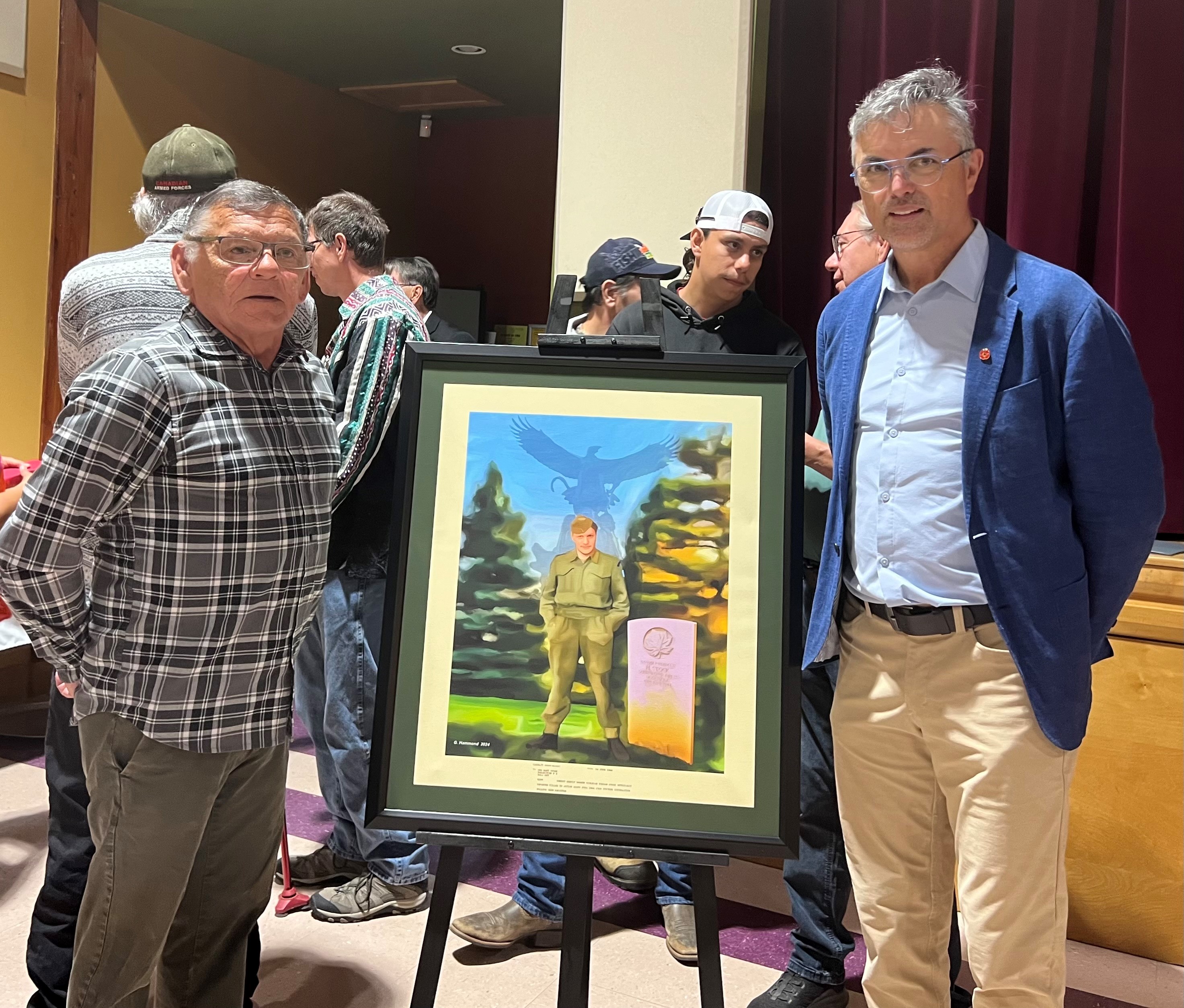
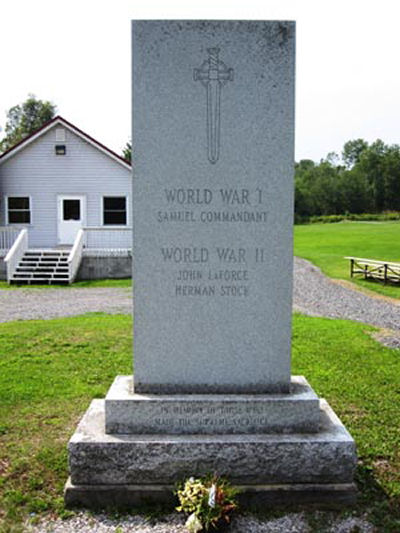
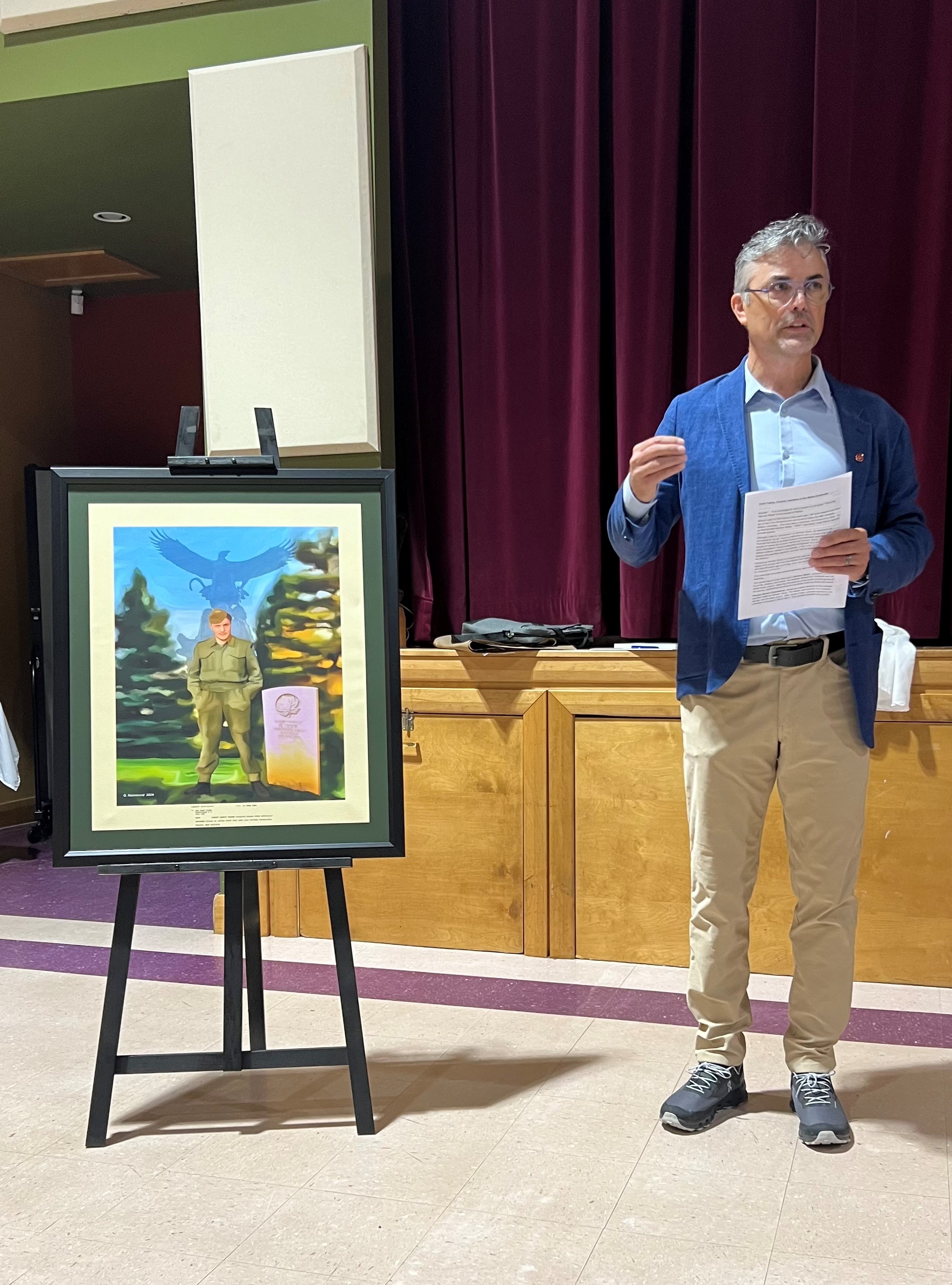
We can revisit the past but we cannot recreate it. We cannot relive those awful years of a nation at peril in total war, and the culture of that time is subsequently too distant for us to comprehend fully.

We can, however, do something in the present, in a solemn way, aware now, better than before, that people may lose control of their emotions, have a breakdown for reasons over which they have little control. For some it would have been known today perhaps as post-traumatic stress disorder.

To give these 23 soldiers a dignity that is their due and to provide a closure for their families, as the Minister of Veterans Affairs on behalf of the Government of Canada, I wish to express my deep sorrow at their loss of life, not because of what they did or did not do but because they too lie in foreign fields where poppies blow amid the crosses row on row.

While they came from different regions of Canada, they all volunteered to serve their country in its citizen-army, and that service and the hardships they endured prior to their offences will be recorded and unremembered no more.

Allow me to enter their names into the record of the House: Quartermaster Sergeant William Alexander, Bombadier Frederick Arnold, Private Fortunat Auger, Private Harold Carter, Private Gustave Comte, Private Arthur Dagesse, Private Leopold Délisle, Private Edward Fairburn, Private Stephen Fowles, Private John Higgins, Private Henry Kerr, Private Joseph La Lalancette, Private Come Laliberté, Private W. Norman Ling, Private Harold Lodge, Private Thomas Moles, Private Eugene Perry, Private Edward Reynolds, Private John Roberts, Private Dimitro Sinizki, Private Charles Welsh, Private James Wilson and Private Elsworth Young.

We remember those who have been largely forgotten. For over 80 years, they have laid side by side with their fallen comrades in the cemeteries of France and Belgium.

I am announcing today in the Chamber that the names of these 23 volunteers will be entered into The First World War Book of Remembrance along with those of their colleagues. Adding the names of these citizen soldiers to the pages of this sacred book, which lies in the Memorial Chamber not far from here, will be a fair and just testament to their service, their sacrifice and our gratitude forevermore.

Lest we forget.

With info from Wikipedia, the Canadian War Museum and OpenParliament.ca

Telling Our Stories

Telling Our Stories

“Telling Our Stories” is the theme for our Regimental Museum and Archive’s next five-year Strategic Plan which was recently approved by the Museum’s Board of Governors. It overarches the five strategic directions we’ve identified:

  1. Preserving the regiment’s history
  2. Promoting the regiment’s history and current mission to the public
  3. Serve the interests of a wider community through outreach and digital presence
  4. Support and benefit from Casa Loma’s tourist business
  5. Ensure the effective governance and management of the museum to accomplish the above

These extend directions which were identified in our 2017-2022 Plan. You can read more about our  Mandate, Mission, Vision and the newest plan (and how it was developed) here.

How are we telling our stories now?

Telling our stories isn’t new for us. Since the museum’s inception, we’ve been telling the stories of the Regiment and the Riflemen who have served in it. Here are some of the ways:

  • Our physical exhibits are the most obvious example with hundreds of artifacts helping to tell the story of the regiment’s significant events as well as stories of individual riflemen. Over 300,000 visitors are exposed to these each year as they tour Casa Loma.
  • We continue to work with Gurkha Company of our Reserve Battalion to ensure that each new recruit has an opportunity to visit the museum and learn about the history of the Regiment from our museum team.
  • Our website has almost 500 profile pages – from Riflemen to Generals – from 1860 to the present. Of course, this is only a fraction of those who have served in the past 163 years but we continue to add new profiles regularly.  Last summer we completed profiles for each of the 61 soldiers killed on D-Day.
  • We also use this blog to share stories as well as museum updates on this blog with 260 posts in the past 10 years.
  • Our Online Collections catalogue includes a searchable section called People. It includes over 4,800 entries which are crosslinked to website Profiles where appropriate but also display any objects in our collection connected to that soldier such as photos in which they are named, and any related donated medals, diaries, uniforms, trophies, shadow boxes, etc.
  • In addition, we’ve uploaded photos and information over 4,700 objects (and growing) that are available to anyone to access.
  • We have digitized various archival documents such as early nominal rolls, regiment orders, diaries, correspondence, etc. to assist family genealogists and historians (as well as preserve the originals!)
  • We have digitized and uploaded over 130 multimedia items (and created some of our own) to our museum’s YouTube Channel which has 2,500 subscribers and in 2023 has had over 133,000 views and 4,900 hours of watch time. Our most popular video is the “Evolution of the Rifleman’s Uniform 1860-1900s” which has more than 366, 200 views since being uploaded!
  • We regularly share stories and artifacts on our Facebook Page (with 6,200+ followers) and Instagram (with almost 2,000 followers.)

Moving forward, we plan to expand on these efforts and identify new ones.

2023 Museum volunteers celebrating some Christmas cheer as we wrap up for the year!

Who helps tell our stories?

All of our dedicated museum team are volunteers. First, we have a great museum Board of Governors, that meets periodically to provide governance oversight of the museum activity and financing.

  • Ms. Michele McCarthy (Chair
  • Mr. Jim Lutz (Past Chair)
  • Major Anthony S. Schultz, CD (Ret’d)
  • Captain (Adam Hermant, CD (Ret’d)
  • Ms. Jenna Zuschlag Misener
  • Ms. Lisa Holmes
  • Mr. Tristan Strathy
  • Major John M. Stephens, CD (Ret’d) (Director & Acting Archivist)
  • CWO Shaun Kelly, CD (Ret’d) (Curator)

The major operational work is done with a team of volunteers under Shaun’s direction that includes Assistant Curator Graham Humphrey, Collections Officer Briahna Bernard, and Photography Officer Anne Frazer and works at the museum most Thursday evenings cataloging, photographing and properly storing new donations, updating exhibits, clearing cabinets, and a raft of other tasks that always need doing!

How do we fund our work?

We receive a small annual grant of $1,500 from the Ontario Ministry of Tourism, Culture and Sport however the remainder of our $25-30K annual budget is provided by The Queen’s Own Rifles of Canada Trust Fund.

Actual expenses vary year to year but generally include upgrades to exhibits, labels, interpretive panels and creation of pop-up banners, website and collection management database costs, association memberships with the Ontario and Canadian Museum associations and the Organization of Military Museums in Canada (which provide training and networking opportunities), archival grade storages materials from acid-free folders and boxes to mylar clothing bags and other supplies, third party conservation work, occasional purchases of important objects, general office supplies, and annual volunteer recognition reception.

In 2024 our exhibit upgrades include raising 4 four exhibit cabinets and adding LED lighting which is the last of a three-year project. The final year’s cost is estimated at $8,000.

How is the QOR Trust Fund funded?

The Trust fund receives some grants and foundation funding but the majority of income is from individual donations which are of course eligible for a charitable tax receipt.

How can you help?

Please consider making a donation to the QOR Trust Fund and directing it to the Museum Fund. You can mail a cheque to the Trust or donate online through a recurring donation, a one-time donation, or even by donating securities or certain cryptocurrencies. You can also make a Tribute donation in honour or memory of someone. All these options are available through the Trust’s CanadaHelps page and explanations, addresses and links to donate (which are preset to the Museum Fund!) are available on our Donate page.

Please help us “Tell Our Stories” and become part of our team by making a financial donation to support our museum.

PLEASE DONATE


Reflections on a Posting with 2QOR of C

From the Summer/Fall 2008 Issue of the Powder Horn

Colonel Neville Arthur (Robbie) Robinson, CD, ADC

By Colonel Neville (Robbie) Robinson CD

Having spent three years at the Royal Canadian School of Infantry in Camp Borden wearing RCIC badges, I was glad to be interviewed by Col. Peter Bingham as to my choice of “rebadging” among the Canadian Guards, the Black Watch (RHR) and The Queen’s Own Rifles of Canada. Having started my military career in 1941 in the King’s Royal Rifle Corps (60th Rifles), I naturally opted for The Queen’s Own, which turned out to be the best choice.

Soon after getting myself back into “Green and Black” I was posted to Korea as a replacement for Maurice Whiting, in 1954. The posting was for three months as 2QOR of C was rotating home in the spring. On arrival at the battalion, I was posted as 2 I/C D Coy. which was a large (170) company containing all the troops taking their release on return to Canada. For some reason, it was known as the “Jaggy Company’” by the other rifle and support companies. It was commanded by Maj. Larry Harrington who used hearing aids for which he had trouble obtaining batteries and was constrained to save them by switching them off whenever possible! Every morning was OC’s Orders where justice was dispensed.

As the battalion reserve, we manned the defensive positions in the Kansas Line during the numerous “Scram” Exercises, and did a large amount of repair work to the bunkers and slit trenches. Just as the Battalion was getting prepared to leave for Canada I was posted into the HQ 1 COMWEL Division to replace Capt. Erwin Fleury as Staff Captain (Canadian) and OC to KATCOM (Korean Army Attached to Commonwealth Division) Defence Coy, a standard three-platoon rifle company.

The staff work was the standard stuff and I spent a lot of time with piles of paper, one of which was 125 copies of the nominal roll of 2QOR to get the battalion aboard the troopship at Inchon. I went down to see them off and say goodbye to friends like Ron “Awful” Werry, Charlie Belzile and Peter Nixon. The tragic death of Lt. Bill Vipond was on my desk and that Board of Inquiry took a while to get to Ottawa, going back and forth. Years later, in the 90s, my wife Brenda and I visited Pusan and laid poppies on the graves of the three 2QOR casualties in the impressive UN cemetery on the hillside overlooking Pusan harbour.

The three months in Korea was extended twice to 13 months as the powers that be vacillated about who was leaving and who was staying. Before I left I was awarded a Korean medal by the Korean Army Chief of Staff and it now hangs in the QOR museum at Casa Loma as, in those days, we were not authorized to wear foreign decorations for peacekeeping duties.
_______________________________________________________

If you’d like to support the Regimental Museum and Archive with our goal of “Telling Their Stories,” you can find more information on how you can make a sustaining or one-time financial donation on our Donation page.

MWO Peter Mitchell: First Para-Qualified QOR Member?

Above: Claire Mitchell holds a photo of Canadian soldiers who participated in the tests in the Nevada desert. At the centre of the photo is her husband, Peter Mitchell, who died in 2008 of cancer.

From the Summer/Fall 2008 issue of the Powder Horn.

G Baskerville, c1995

By Lieutenant Colonel Grahame Baskerville CD

The QOR has now had an Airborne tasking for almost 25 years and is the only Militia unit able to retain this tasking. Many Regular Force QOR members qualified as parachutists and served with distinction with the Airborne Regiment. Also within the Regular Force the QOR had members who had served in WW II with the 1st Cdn Parachute Battalion as well as British Airborne Forces. As a matter of Regimental historical detail, it would be interesting to determine who was the first person wearing a QOR hat badge to qualify as a parachutist. Was it someone during WW II or was it later?

One of the earliest Regular Army paratroopers was MWO (Ret) Pete Mitchell. He enlisted (at age 17) in 1944 with the 2nd (Reserve) Bn QOR in Toronto. He joined the Regular Army in 1951 and went to Germany with the 1st Cdn Rifle Bn (QOR Coy) in 27 Bde. Sgt Mitchell, along with Sgt Fred Swan (also QOR) returned to Canada in 1952 and went to Rivers, Manitoba where they qualified as parachutists on Basic Para Course 164. They remained at Rivers as Para Instructors. Sgt Swan later re-badged to PPCLI to continue his parachuting and Pete Mitchell returned to 1 BN QOR in 1954 where he served in Calgary and Germany. He later rebadged to PPCLI and retired in 1980. Hearsay evidence indicates that these two were the first to return to Canada for parachutist training. As Mitchell is ahead of Swan alphabetically, it is highly possible that Pete Mitchell may be the first QOR person to qualify as a parachutist. Are there others?

[MUSEUM NOTE: In the summer of 1926, Colonel James (Jim) G. K. Strathy, OBE, OStJ, CD, ED (then a Lieutenant with The Queen’s Own Rifles) was training as a pilot at CFB Borden and was required to complete a parachute jump which he did – with much success obviously! Whether that means he was a “qualified parachutist” could be debatable however it seems extremely likely he was the first QOR to actually make a parachute jump.]

NOTE: In 1957 the 1st Bn QOR was selected to provide a platoon for nuclear weapons training at the United States Atomic Energy Commission Test site at Yucca Flats, Nevada. MWO Mitchell was selected to be the Platoon Sgt for this task which involved 40 members of the 1st Bn QOR working with US Army units and being subjected to six atomic blasts over a two-month period with no protective clothing or shelter other than slit trenches. They were assured repeatedly that they had not been exposed to harmful levels of radiation and they accepted these assurances in good faith.

Like many of the others, Pete Mitchell developed cancer in later life and died in early summer, after much physical distress. The Canadian Atomic Veterans Association continues to pursue the Canadian government for compensation – so far without fair results. 

[MUSEUM NOTE: in September 2008, the Canadian Government announced an ex-gratia payment of $24,000 per person for those that had had nuclear exposure. The Canadian War Museum now includes the story of the Canadian atomic veterans.]

________________________________________________________

If you’d like to support the Regimental Museum and Archive with our goal of “Telling Their Stories,” you can find more information on how you can make a sustaining or one-time financial donation on our Donation page.


"In Pace Paratus – In Peace Prepared"