All posts by J.M. Stephens

Director and Curator of The Queen's Own Rifles of Canada Regimental Museum located at Casa Loma in Toronto, Ontario.

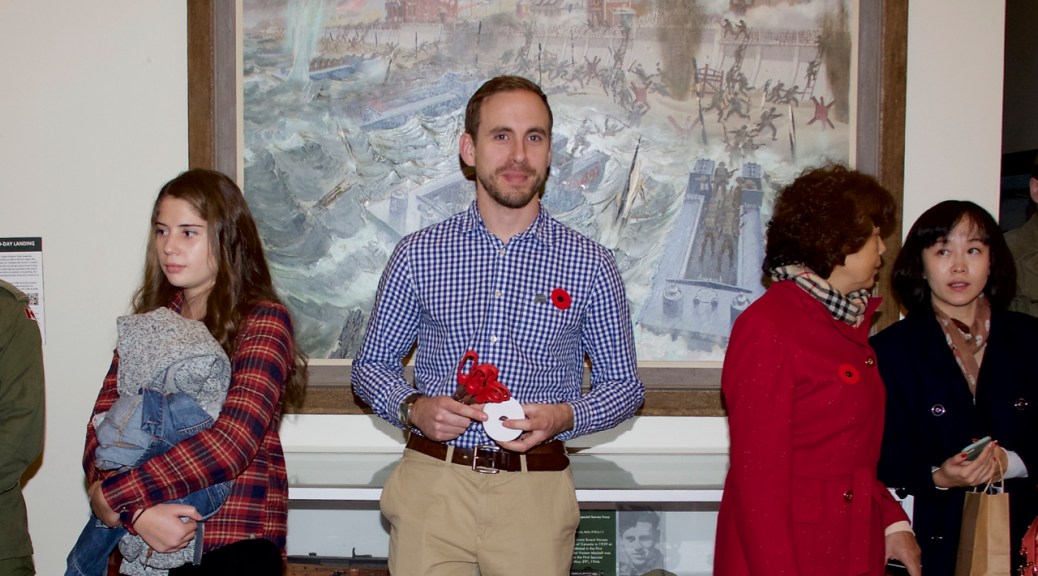
Volunteer Profile: Joe Wyatt

Joe Wyatt started volunteering at the museum in October 2014 and has put in over 75 hours responding to research questions, helping at events and generally pitching in where ever needed! More recently Joe has taken over posting our social media “on this day in history” posts.

How did you end up volunteering at the museum?

I have always had a passion for history and was intrigued by the museum when I visited Casa Loma after moving to Canada 2 years ago. The museum provided a great opportunity to contribute to something worthwhile.

What background do you bring with you that you think helps you contribute in this role?

My Bachelors degree in History has benefitted the analytical nature of the research role.  My work in the educational travel industry organising World War I & II battlefield tours to Europe also helps to connect the importance of keeping people (particularly younger generations) informed of the military history of Canada and sacrifices made by the armed forces.

What do you enjoy most about volunteering at the museum?

The satisfaction of being able to respond to research enquiries with further information on their relatives.  Finding information on Soldiers in the regiment could range from scouring through the vast quantity of photos at the museum to manually searching through a pre-WWI service roll. Generating discussion and new interest in the Queen’s Own Rifles through the Social media posts on the Museum’s Facebook and Twitter accounts is also rewarding.

What aspect or content of the museum are you most passionate about and why?

The portrait collection of the early Commanding Officers of the regiment are a great focal point when visitors come up to the 3rd floor in Casa Loma. The exhibition adds context to the chronological flow of the museum.

Tunic of Ensign Malcolm McEcheran, first casualty of the Queen's Own Rifles at the Battle of Ridgeway (or Limeridge) June, 1866
Tunic of Ensign Malcolm McEcheran, first casualty of the Queen’s Own Rifles at the Battle of Ridgeway (or Limeridge) June, 1866

Is there one object in the collection that really excites you or that you think people should know about?

The tunic of Ensign Malcolm McEachren is particularly significant, as he was the first casualty of the QOR at the Battle of Ridgeway in 1866. What makes this more fascinating is that the bullet hole is still clearly visible.  The D-Day landing craft fragment is a close second.

Why do you think a museum like this is important?

It allows visitors to get a greater understanding not only of Canada’s military role from 1860 to the present day through the oldest serving regiment but also how many local Torontonians impacted on that.

Would you recommend volunteering to others and if so why?

Absolutely, being a part of the museum is a rewarding experience and there are always a wide range of jobs and tasks to keep you interested.

If you’d like to help volunteer at the museum, check out our Volunteer page for information and an application.

Reg Force Reminiscences: “THE GLORIOUS TWO BN”

by Major Ronald R. Lilley, CD

This article was the second of two found in our collection. The date or purpose for which is was written is unknown. The first article can be found here. Lilley left the Loyal Edmonton Regiment to join the 1st Battalion QOR in March 1954.

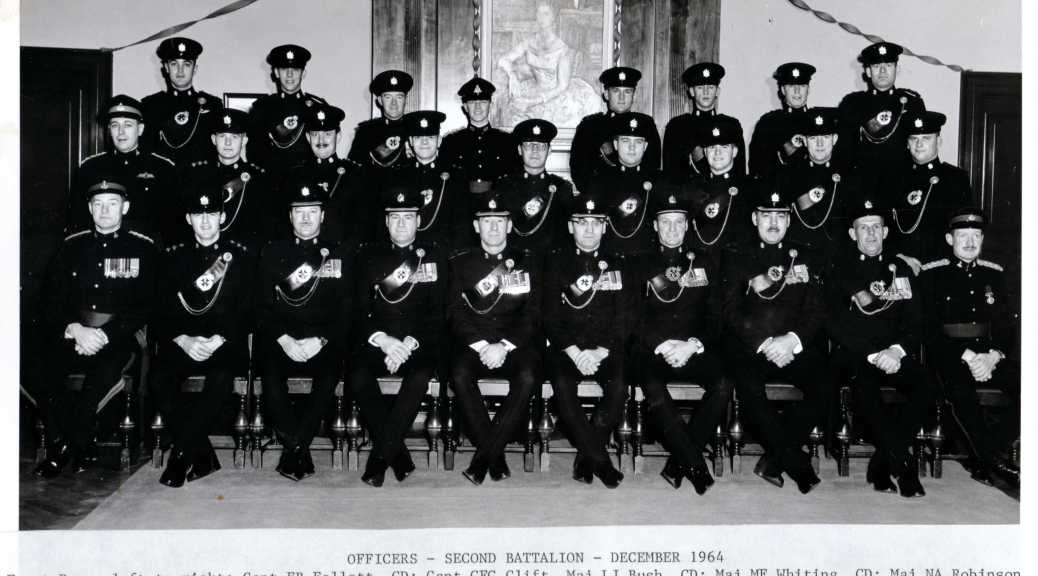
In ‘62 I returned to Regimental duty and once again was posted to a unit which had just returned from Germany – the Second Battalion, led by its gravel voiced Commanding Officer, Lieutenant Colonel Dan Osborne.

On a bright sunny spring day I found myself in command of one of the battalion’s 100 man guards, paying homage to the General Officer Commanding Western Command. I had spent most of the night writing up a bn exercise and consequently was more dazed than usual. The guard was approaching the yellow marker and I shouted out the cautionary words, “No. 2 guard will advance” (the guard number is immaterial to the event). All would have been perfect except that the executive words of command “Left, Turn” followed in rapid order. That was the day I introduced the new drill movement “left foot over right foot”, a major drill not previously practised to my knowledge. I had missed the marker by not less than 15 paces or 100 miles whichever was closer on that eventful day. The movement was carried out in the best Rifles tradition and by the time we reached the saluting base flag the guard was lined up with the lead coy. After the parade and at the dispersal area I called CSM George Stolzenberg (I believe it was Stolzenberg) forward, congratulated the guard on its excellence in the face of adversity and bought a libation to prove I was serious. Never before had I witnessed such steadiness and I only hope my successors never have the same nerve shattering experience.

The glorious day finally came when I took over command of B Coy in the Fall of 62. Captain Larry Diebel, at my instigation, started all rank Coy Mess Dinners. Sgt “The Bandit” Friedt the Officers’ Mess Sgt, and a member of B Coy, provided the candelabra, silver and wine glasses. We developed a mess dinner procedure with appropriate toasts, etc. They were very popular, as could be attested to by the attendance (smiles and attendance were both compulsory). The dress standard set for the first dinner was based on a tie and shirt. We did not alter the dress standard but with each succeeding dinner it was interesting to note the increase in subdued tone ties, blazers and sports coats and the vast improvement in the rifleman’s walking out dress.

The Coy went through its usual pre-Exercise Snow Chinthe drills during the Christmas holidays and learned to live outdoors in the cold and pull toboggans over simulated snow (gravel and grass). 2/Lt Dave Montgomery and Sgt Bill Hamburgh’s platoon learned to live with frogs and cope with soggy tent floors during an unseasonable warm spell in Wainwright prior to the exercise beginning. During the work-up training and on the actual exercise CSM Noble wee a tower of strength and on numerous occasions placed the fear of the hereafter on any idle rifleman or NCOs.

On my return from a course in England 10 days prior to leaving for Wainwright, I met the new CO, LCol Ed Price (expected). Capt Diebel, CSM Noble and many familiar NCOs and men were serving elsewhere in the bn (unexpected). The Coy’s training pace in Wainwright of a mile to two-mile run before breakfast, section tactics every morning, platoon tactics every afternoon and coy tactics every evening was slowed down when B Coy was honoured by being selected to enter the Forced March Competition on July first. This honour was duly passed on to 2/Lt Dave Montgomery and Sgt Jewel.

(For a fuller account see page 79 of the 1963 Powder Horn edition). It is now old hat that Dave’s pl won. But I’ll never forget the look of surprise on Brigadier Macdonald’s face when Dave’s pl doubled on in full battle order, then broke into quick time, advanced, halted and presented arms to the Bde Commander. This was not part of the usual ceremony but was added to show what stern stuff we riflemen are made of. In marching off Sgt Jewell’s order to the platoon was: “Run over them lads, if they don’t get out of the way!” He of course was referring to the spectators. At a suitable distance from the spectators, the plantoon was photographed with their trophy. This platoon also returned several pieces of equipment dropped by 2 PPCLI which were turned over to that unit’s CO by Colonel Ed Price.

We were soon concentrated as a Company and training started again in earnest. Dave Montgomery’s scalded feet required that I employ him as the OC of the Special Weapons elements attached to the Coy and in this capacity he assisted the Company Operations Officer, Capt Harry Williams-Freeman in the Command Post. Staff Sgt Don Wilson, as CSM, provided the spark which kept the Coy HQ on its toes. He did a tremendous job of organizing a very successful coy all ranks bash during our last days in the battalion bivouac area. Greased poles, bucking horses (45 gallon oil drums), log chopping and sawing contests were all entered into with great gusto. Cpl Miller, the Coy cook, outdid himself in providing deluxe hamburgers and Staff Lottridge ensured that an abundance of beer and soft drinks were always available. One LdSH(RC) [Lord Strathcona’s Horse] trooper was heard to say, “what a party!” “Why can’t our blank, blank squadron get organized?” A gunner from D Battery replied, “When you’re part of B Company who blank, blank cares?” and with that they rejoined the mob at the camp fire to sing their hearts out.

He operated a Company multiple radio net, an experiment which was reluctantly bIessed by the CO. It was an excellent training device and section commanders soon learned the worth of their radio, as can be testified to by LCpl Standen, whose radio ceased operating during a Brigade exercise. He claimed he knew nothing about the overall progress being made by the Company and consequently had no idea what to expect next. He felt that he and his section were completely insulated until they were committed to action by the Platoon Commander.

1964 saw the emergence of a cross country ski team, equipped with modified army skis which hampered any chances they had to win, and a Down Hill team that struck gold, or should I say silver plate, in their first Western Command Championship. Many will remember that the 1964 Exercise Snow Chinthe was almost cancelled because of the conflict with General Rockingham’s Western Command Ski Championship. In those days, channels of communication with all superior HQs were well established and woe to any individual who tried to short circuit the system. Unfortunately, Superior Headquarters did not always follow the established channels. I had been ordered to establish and direct the Command Ski Off and at one stage found myself working for General Rockingham, Brigadier Macdonald and LCol Price on conflicting requirements. As is not too unusual, the General won and my other tasks were deferred to after duty hours. Capt Dick Graham’s experience provided the necessary continuity in organizing the meet so that I could get some coy work done during normal working hours.

During the 1964 Bde Commanders Conference I was called to one side by Colonel Ed Price and told I was posted to the RCS of I [Royal Canadian School of Infantry] and would become DC Tactics Division. Once again, it was time to say farewell to Regimental life.

Volunteer Profile: Cheryl Copson

Cheryl (at right above) has been volunteering at our museum since February 2013 and has given us over 350 hours of her time. Her background in museum studies has been extremely useful to us as we’ve worked hard to bring our museum into the 21st century. And of course her cheerful and positive outlook and willingness to pitch in where ever she’s needed, are greatly appreciated!

How did you end up volunteering at the museum?

I have always had a passion for museums and history. While completing my Master’s degree, I did an internship at the Fort Erie Historical Museum. During an event for the Anniversary of the Battle of Ridgeway, I was introduced to John, who was quite interested in getting some volunteers from the Museum program. From there my interest in both history and museum lead me to start volunteering with the QOR.

What background do you bring with you that you think helps you contribute in this role?

I bring experience from working at several different museums. This has given me knowledge of best practice and techniques that assist with the proper cataloguing and storing of the objects and archives. This will help to ensure that the objects entrusted to the museum will be available to generations to come.

What do you enjoy most about volunteering at the museum?

I enjoy being a part of the transformations the museum has made. It is exciting to see the improvements to the exhibits, which are apparent to the public, and to the systems in place to protect the objects. Each week the museum takes steps to better itself, and it’s exciting to be a part of that.

What aspect or content of the museum are you most passionate about and why?

As a true “museum nerd”, I am passionate about the proper tracking of objects and their provenance. I think that this information forms the basis for creating new exhibits, and allowing members of the regiment or public to research and find information they may be interested in.

Tunic of Ensign Malcolm McEcheran, first casualty of the Queen's Own Rifles at the Battle of Ridgeway (or Limeridge) June, 1866
Tunic of Ensign Malcolm McEcheran, first casualty of the Queen’s Own Rifles at the Battle of Ridgeway (or Limeridge) June, 1866

Is there one object in the collection that really excites you or that you think people should know about?

Ensign Malcom McEachren’s Tunic. This object is one of a kind AND incredibly important in Canadian history. McEachren was the first soldier to fall during the Battle of Ridgeway on June 2, 1866. The Battle of Ridgeway (or Limeridge) was Canada’s first battle fought exclusively by Canadian soldiers and led by Canadian officers.  This made McEachren the first Canadian Soldier to fall in battle on Canadian soil. This battle was an important factor in the path towards confederation.

Why do you think a museum like this is important?

Merely the fact that the Queen’s Own Rifles of Canada is Canada’s longest continuously-serving regiment is reason enough to justify the museum’s importance. The QOR has been a part of every major war in history since its inception, which provides a unique opportunity to showcase Canadian history through the eyes of the Queen’s Own soldiers. It also means that many people are tied to the QOR and its history. Telling the story of the QOR is therefore telling the stories of many Canadians and their families.

Would you recommend volunteering to others and if so why?

YES! There are so many different aspects to the museum, and therefore many different things that need to be done to keep improving it. I think that anyone with an interest in history, research, museums, or administration would find enjoyment in volunteering with the museum.

Any other thoughts you’d like to:

Before coming to the QOR my background did not include Military history. I’ve truly enjoyed both being able to add my skills to the mix of volunteers, but I think more than that, I’ve enjoyed learning about the QOR and the military in Canada.

If you’d like to help volunteer at the museum, check out our Volunteer page for information and an application.

“The College Rifle Company”

Reprinted from “A History of Upper Canada College 1829-1892” compiled and edited by George Dickson, M.A. and G. Mercer Adam and published in Toronto in 1893. Accessed via Google Books.

———————————————————————

BY THE REV. T. F. FOTHERINGHAM[1], M.A., ST. JOHN’S, N.B.

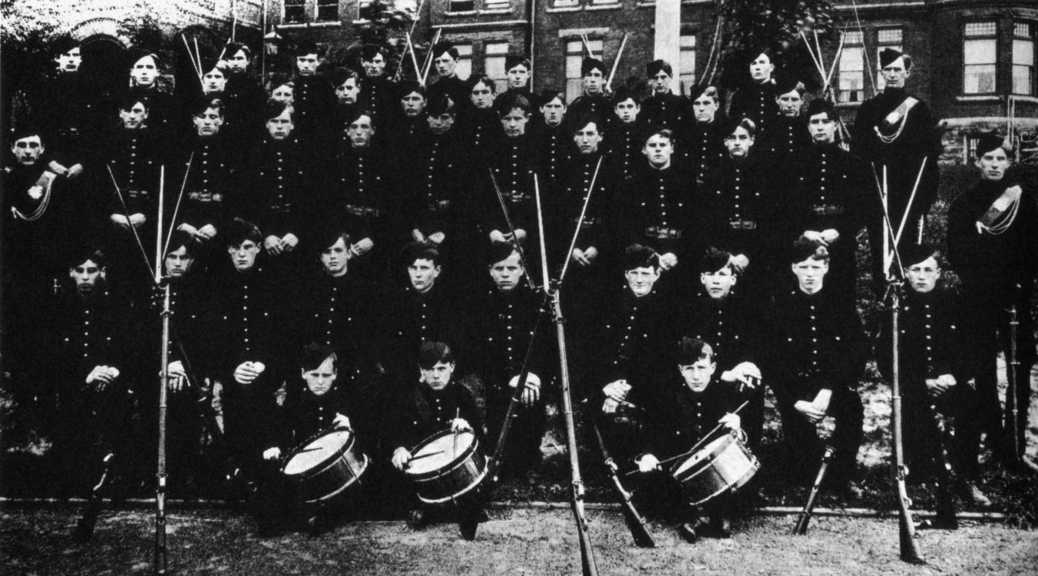
As far back as 1863, when I entered Upper Canada College, and I do not know how long before, the older boys were assembled weekly for drill under the instruction of Major Goodwin. They were supplied with rifles and bayonets, waist belts and pouches. The room next the lavatory was set apart as an armoury. Out of this drill class the Rifle Company was evolved under the influence of vitality and environment. The presiding genius under whose auspices this took place was the gallant old soldier in command. What boy of that day does not remember him with affection? A strict disciplinarian, yet liking better to silence a frolicsome private with a harmless witticism that held him up to ridicule, than to bid him “fall out.” This was the severest penalty he ever inflicted, and it was much more keenly felt as a disgrace than the hundred lines of Virgil which the Principal immediately imposed by way of ratifying the sentence. The kindhearted old Major always seemed sorry the moment after, for in the next breath he would temper his rebuke with a cheery word and good-natured apology for the offender. He was bluff* and boyish, although his shoulders stooped and his head was grey. He loved the boys with all his heart, and they fully returned his affection. His quarters in the old Bathurst Street barracks were always free to them, and his happiest moments seemed to be when reciting his favourite “Tam o’ Shanter” to an admiring crowd, who never wearied of applauding the really splendid elocution.

The activity of the Fenian brotherhood in 1865 awakened much uneasiness in Canada. Large numbers of volunteers were enrolled, and the Military Schools were crowded with cadets. As in 1837, College boys were not behind in offering their services. Three of us, Fuller, Wilson, and myself, had obtained second-class certificates, and the idea was mooted of transforming our drill association into a company of the “Queen’s Own.”  The consent of the Principal having been obtained, Major Goodwin entered heartily into our plans. The boys met in the Prayer room one afternoon in December, 1865, and amid great enthusiasm elected Frank C. Draper, an old College boy and ex-officer of the “Queen’s Own,” as Captain, Valancey E. Fuller, Lieutenant, and M. Wilson, Ensign. William M. Richards, ______ Watson, and myself, were chosen Sergeants. I cannot remember the names of the other non-commissioned officers, if there were any. Enrolment went briskly on. The cubits of our stature were measured against the wall of the Principal’s room. What heroes we were in the eyes of those whose heads could not touch the ruler held at the standard height! The company was duly gazetted in General Orders of the 12th January, 1866, and attached to the 2nd Battalion, “Queen’s Own Rifles.”

On March the 8th, some volunteers were called out, and amongst others, the “Queen’s Own.” The College Company was not mentioned in the General Order, but the boys would not be suppressed. With the consent of Major (now Lieut-Col.) Gillmor, then in command, the boys appeared at every parade and march-out, — drilling as faithfully as others, but without any pay. This latter was a consideration to which our knightly souls were utterly oblivious.  Class work was sadly interrupted. Every week there were evening drills and a Saturday afternoon march-out.  Not one of the company was twenty years old, yet all tramped through the mud with the endurance and light-heartedness of veterans. Woe to the boy who stepped around a puddle instead of marching through it, or grumbled when an unlucky step filled his boot with ice-water. He was the butt of ironical sympathy for days afterwards. Our youthful appearance won us a somewhat patronizing regard from the rest of the battalion, and, in their paternal affection, they nicknamed us “the babies.” So far from being offended, the boys shewed the genuine stuff they were made of by accepting the soubriquet, and trying to make the name an honoured one. When, at the close of that period of active service. Major Gillmor complimented the company in his address at the final parade, and three cheers were generously given for “the babies,” we felt that the respect of the other corps had been completely won.

At that time many companies had their own marching songs. The College boys, in view of the juvenile position assigned to them, adopted as theirs the nursery hymn “Joyful,” fitting to its tune nonsensical words such as —

“He that hath plenty of spondulics
And giveth his neighbour none,
He shan’t have any of my spondulics
When his spondulics are done.

Chorus : “0, that will be joyful,
Joyful, joyful,
that will be joyful, when his
Spondulics are done.”

Other verses followed ad lib, “He that hath plenty of sauerkraut, peanuts,” &c., &c., until invention was exhausted. The ethics of the song were unimpeachable, and there was not the slightest thought of irreverence towards sacred associations. Anything of that kind would have been treated with scorn as utterly “low.” It was simply a boyish response to good-natured chaffing.

Few members of the corps will forget the excitement of St. Patrick’s Day, March 17th, 1866. Some days previous a rumour spread to the effect that bodies of men, marching in military order and armed with pikes, had been seen parading the streets after midnight. A guard of citizens was organized and a night patrol instituted. Fears were expressed that the usual St. Patrick’s Day procession would be the occasion of an outbreak on one side or the other. In Montreal and Quebec these parades were abandoned, but the Toronto societies determined to display their green banners as usual. Although no one believed that local Fenians would give any trouble, yet there was then, as now, an excitable element of the opposite party who might attack a procession, and those marching in it, fearing such an interruption, might carry concealed weapons. The throwing of a single stone might start a sanguinary conflict. The “Queen’s Own ” and the *’ Tenth Royals ” were assembled at the drill shed early in the forenoon and k^t there until towards evening. The College Company was with the rest of the battalion. Rations were served about noon. Drill and frolic filled up the quickly passing hours, and not a few voted it the jolliest pic-nic they had ever attended. Yet, beneath all the merriment, there were serious thoughts, for we had ball cartridges in our pouches, and many of us remembered the standing order never to fire over the heads of a riotous crowd. It was with feelings of intense relief that the citizens saw the volunteers returning to their homes peacefully that evening.

Although relieved from active service on Good Friday, March 30th, the “Queen’s Own” continued battalion drills at least weekly, sometimes  oftener. At all of these the College Company was present. There was a lull in the excitement. The O’Mahony wing of the Fenians was making a demonstration at Eastport, Maine, and the Roberts faction was temporarily inactive. The volunteers were recalled from the frontier. A grand concert in the drillshed, which held 10,000 people comfortably, on the evening of the Queen’s Birthday, seemed a fitting mode of celebrating the re-establishment of public confidence. Meantime “General” Sweeney had succeeded in effecting a reconciliation of rival factions, and on May 30th was announced as on his way to Canada at the head of the Fenian “army.” Fuller despatches arrived next day, and that night the militia of Canada were again called to arms. In March the Government asked for 10,000 volunteers and were offered 180,000 — now the response was no less enthusiastic.

When we assembled in the Prayer room on the morning of Friday, June 1st, Mr. Cockburn announced that the Fenians had crossed the Niagara River and were in possession of Fort Erie, and that the “Queen’s Own” had been ordered to meet them. The College Company was also called out, and members would report at once in uniform at the armoury. After a few words regarding the gravity of the occasion, the Principal dismissed the school for the day. The company mustered in full strength within an hour afterwards, only to find to its chagrin that, by special orders of General Napier, it was to remain in garrison and furnish the necessary guards for the armouries and military stores. It was with difficulty that the boys could be restrained from deserting to join the battalion. Many refused to wear their uniform when off duty. The order was an eminently wise and considerate one, but the boys felt that it carried the reproach of “babyhood” a little too far. They resented such an implication of juvenility. One admires their spirit and is not surprised that they failed to appreciate the responsibility resting upon their elders. It was quite true that they were too young for the hardships of service in the field ; most of them had been sent to school to study and not to play the amateur soldier, and their parents would have justly blamed the Principal for having permitted the formation of the corps; besides this the duty laid upon .them was a necessary and honourable one, and fell most fittingly upon the junior company of the battalion.

For two days the College Rifles were the only troops in the city, and furnished the guard on the Friday and Saturday nights succeeding the departure of the volunteers. I need not describe the excitement of those days. College boys helped to swell the crowds around the bulletin boards and added their voices to the cheers that rang out to the accompaniment of the Cathedral chimes when news of the rout of the invaders arrived.  About three o’clock on Sunday morning the volunteers from the country began to arrive. They were marched up from the railway station in companies and dismissed to ‘billets for breakfast. To me, the arrival of these raw troops was a deeply interesting sight. They came evidently from the farm and the workshop. It might be that the first gun of a great war had been fired at Ridgeway, — we did not know. If it was so, every one of these men was ready. There was no noisy frolic or loud laughter among them. Every word of command was heard with painful distinctness in the quiet of that Sabbath morning. When dismissed, one group after another struck up old-fashioned Psalm tunes, and set off singing them to their new quarters. One would have thought that Cromwell’s army or a regiment of Covenanters had reappeared among us. With such defenders, we did not fear should Lundy’s Lane or Queenston Heights come to be fought over again. Few Churches held service that evening, for nearly every person crowded towards the Yonge Street Wharf to meet the “City of Toronto” with its precious freight of dead and wounded. With another member of the company, like myself just off guard duty, I joined the crowd and was near the wharf when the steamer came in. To my surprise I heard the familiar voice of Lieut. Fuller in command of an escort composed of the College Company. It accompanied the five hearses to their destinations through thronged streets, amid a silence only broken by exclamations of sympathy and sorrow. Every head was uncovered as the dead heroes passed by.

On the Tuesday following a public funeral was held, and the bodies of Ensign McEachern and Privates Defries, Smith, Alderson, and Tempest lay in state in the drill shed. The gallery erected for the concert so recently held afforded a suitable elevation for the caskets. Ranged around these, the boys of our corps stood as a guard of honour, resting on their arms reversed, from eleven a.m. to one p.m. The company took part in all the military funerals of that sad time, and on one occasion, I think the one just referred to, furnished the firing party.

During the fortnight following the raid Toronto swarmed with volunteers, most of whom remained only a few days until formed into provisional battalions. Whilst these were in town, the College Company was released from the duty of furnishing guards. But there was the possibility that a sudden order from Ottawa might remove the guard on duty, and it was accordingly agreed that should the College bell ring at any time out of class hours, the members of the company would understand it as a signal to assemble at the armoury. One night as I was just about to retire I heard the well-known sound. It took very few seconds to resume my uniform, but, before I reached the street, every bell in the city was ringing the “general alarm.” The din was enough to warrant the conclusion that the Gael was indeed at our gates. I lived about a mile from the College, and only arrived in time to take my place at the head of the company as coverer and lead the way to the drill shed, then situated between Front and Wellington Streets, at the east end of the Parliament Buildings. A dense crowd was already assembled at the corner of Simcoe and Wellington Streets, and, as we drew near, I heard some one call out: “It’s the College boys, let’s give them three cheers !” This they did with a heartiness that made us feel modestly embarrassed. Acknowledging the honour in military fashion, we entered the drill shed, discovering then the cause of the ovation with which we had just been honoured. We were the first company to report itself in obedience to the summons. It was found shortly afterwards that we were not needed. A few companies had been ordered to Prescott, but enough remained for guard duty. In about an hour we were dismissed with not undeserved compliments. On the return of the “Queen’s Own” from Stratford, after the engagement at Ridgeway, the College Rifles met the battalion at the railway station and accompanied it in its march through the streets. Although they did not hear bullets whistle, the College boys felt that they had won some slight share in the magnificent welcome the regiment received.

During the summer following the Fenian raid a military camp was formed at Thorold, and the Upper Canada College Rifles united with the University Company to form one corps. The battalion was landed at Port Dalhousie, and marched through St. Catharines to the breezy field on the top of the mountain where the Tenth Royals and the Thirteenth from Hamilton were already pitching their tents. Here the boys again distinguished themselves by their light-hearted endurance of discomforts that would have well-nigh caused a mutiny amongst regulars. The ground was rough and hard — cattle had evidently roamed freely over it when the soil was moist. One had to select carefully for his couch the precise spot whose physical geography was most nearly complementary to the angularities of the human anatomy. The last duty every evening was a field study of the relations between geology and osteology. When it rained, the clay betrayed a most tenacious attachment to boots often ill-suited to such rough usage. The camp arrangements were of the most imperfect character. Plain rations, however, were abundant. One of our number betrayed extraordinary talents in the culinary line, and no “Irish” or “Boston ” stew can ever obliterate the memory of his achievements. No coffee and butterless bread ever tasted sweeter than that partaken around our tent pole every morning. The air was pure and bracing, and the drill just enough to make us forget all our discomforts in dreamless sleep. Every one heard with regret the orders to break up camp. To this day pleasant memories linger around the old camp ground. As illustrating the spirit of the boys, I may mention that it leaked out one evening that a general alarm was to be sounded during the night in order to test the promptitude with which the volunteers could respond. We determined that, for the honour of our corps, we should be the first on parade. Not one removed his uniform that night when he lay down. The covering sergeant slept in his boots and cross-belt, with his rifle by his side. To our great astonishment and chagrin the sun was shining brightly when the bugles awoke us at reveille.

The home march was not uneventful. As we left the camp, and when we marched through the streets of St Catharines, fair faces smiled from sidewalk and windows, and the battalion sang popular songs, accompanied by the band. We had scarcely left the town behind us when a thunder-storm came on. The “Queen’s Own” had proved its ability to “stand fire,” but water was another affair and retreat was no cowardice. We quickly found refuge under the grand stand of the race course. On a break occurring in the storm we set out again and arrived betimes at Port Dalhousie, where the “City” awaited us, but alas quantum mutati ab illis[2] who one short hour before spread their plumes and tuned their manly throats before the admiring civilians of the *’ City of the Saints!” Scarcely had we left the friendly shelter of the race course when the storm burst out afresh. The mire of the road was ankle deep and the ditches were brimful of water. Some took to the fields and others picked a careful but tedious path along the fences, while the bolder tramped along as much indifferent to pouring rain and adhesive mud as plucky College boys ought to be. No company in the battalion straggled less than the beardless youths in No. 10. When we arrived at Toronto, our sergeant was the first to spring ashore in response to the bugle call for “coverers,” and none marched up Yonge Street with jauntier step than the rain-soaked and mud-bespattered veterans of the rear company.

On the 26th June, 1868, Lieut. George D. Dawson, late of H. M. 47th Regiment, and now Col. Dawson, of the “Grenadiers” was gazetted Captain, vice F. C. Draper, who retired with the rank of Brevet Major. The Company re-enlisted under the Militia Act of 1868, but its name does not appear in the General Order of 6th February, 1869, in which the corps who constitute the active militia are named. It seems to have been silently dropped, along with others, which it was not judged advisable to continue in existence. The College Rifles never formed an integral part of the “Queen’s Own” but was merely attached to the battalion for administrative purposes. During its brief existence it left a record of which it need not be ashamed, one worthy of an institution which has supplied so many able officers to the various branches of the Imperial service. General Napier did not forget to give us honourable mention in his report.

[1] Thomas Francis Fotheringham attended Upper Canada College from 1863 to 1867.

[2]changed much from them

CWO Scott F. Patterson CD

Commanding Officer’s Statement on the Death of
Chief Warrant Officer Scott F. Patterson CD

To my fellow Riflemen and friends of the Regiment:

It is with great sadness and a heavy heart that I announce the passing of a dedicated and beloved member of The Queen’s Own Rifles of Canada: Chief Warrant Officer Scott F. Patterson CD. He passed away while surrounded by family and friends at Sunnybrook Hospital on Wednesday February 10th 2016, after battling cancer over the last year.

The Queen’s Own Rifles of Canada mourns the loss of one of our own and we wish to express our deepest sympathies to his family and friends who are mourning with us today.

‘Paddy’ was well liked and respected by everyone who knew him. His dedication to the Regiment and Canadian Armed Forces was unwavering, his loyalty to his friends and family unmatched and his cheerful disposition steadfast no matter the situation. Even in his last days his dignity and wonderful sense of humour were ever present. Scott had a passion for military history and his knowledge of our traditions was incredible. He was a fount of information and support for numerous Commanding Officers’ and Regimental Sergeants Major over his 37 years of service to Canada, including his time as RSM of 32 CBG Battle School and RSM of 32 Service Battalion. He will be deeply missed.

Our attention now turns towards supporting Scott’s family, his friends and each other. Further details will be forthcoming on a service at Moss Park Armoury, in keeping with his wishes. The Queen’s Own Rifles of Canada is a united, strong and resilient family. As RSM Patterson would expect of us, we will lean on each other for comfort and support in the coming days and get through this together.

On behalf of Riflemen everywhere, RSM Martin and I would like to send our most sincere condolences to his family and friends in their hour of need. We hope it is of some comfort to know that you are not grieving alone.

Goodbye Mr. Patterson: we are better soldiers for having served with you and better people for having known you. Rest in peace.

Sandi Banerjee
Lieutenant Colonel
Commanding Officer

Scott was also a volunteer at the Regimental Museum and a font of knowledge regarding regimental history.  We will miss him very much.

QOR Padre leads UCC chapel service

Former QOR Honorary Lieutenant Colonel and UCC Old Boy Brendan Caldwell with QOR Chaplain Captain John Niles after the UCC chapel service on 3 February 2016.
Former QOR Honorary Lieutenant Colonel and UCC Old Boy Brendan Caldwell with QOR Chaplain Captain John Niles after the UCC chapel service on 3 February 2016. His sermon reflected on the 150 year connection between UCC and the QOR.

Artifact Spotlight: March 1866 Nominal Roll

QOR museum volunteer Alex Meyers recently graduated from the University of Western Ontario with a Master’s degree in Public History.  He has worked on the City of Toronto’s “Great War Attic” project, researched historical plaques for Heritage Toronto, served as a Curatorial Assistant at London’s Fanshaw Pioneer Village, and a Historical Interpreter at Toronto’s Pioneer Village. With the skills and experience Alex brings, we are very pleased to have him working on our team!

—————————————————————

In the early hours of 7 March 1866, the men of the Queen’s Own Rifles were called to arms. They enthusiastically assembled and paraded at the drill shed near Toronto Habour, and remained on active duty for the next few weeks. In winter and spring 1866, Canadians were wary of the threatening Fenian Brotherhood, a group of militant Irish nationalists, who were openly organizing in the United States. The Fenians talked about seizing part of Canada, to be used as a bargaining chip towards Irish independence from the United Kingdom. The QOR were called to active duty in anticipation of trouble around St Patrick’s Day (March 17), which was frequently a day of sectarian conflict between members of Toronto’s Protestant and Catholic Irish communities.

Toronto Globe, 10 march 1866

One particularly revealing document we have of that period is the regimental nominal rolls, a record of every man and officer in the regiment. The roll was written in a large hardcover book, the black cover is heavily worn. This particular book was used by the Queen’s Own from 1866 to 1882. Inside, there are more than 400 pages, each page number is neatly printed in the top outside corner. The pages are ruled and lined book like a school notebook.

The nominal roll as a physical artifact is quite fragile. It is at least 150 years old and was in active use for 16 years. Fortunately we don’t need to use the artifact to study its contents. The nominal rolls were manually scanned by some anonymous, but much appreciated, archivist. The whole book can be viewed as a PDF through the Archives section of this website. Being able to scroll through the nominal rolls as a PDF on my computer screen is great but to really understand it, I needed to sort and manipulate the data. If the tables of the nominal rolls were typed I could have used an Optical Character Recognition (OCR) program, which interpret scanned text and turn it into machine-readable ones and zeros. But even the best OCR programs have trouble with handwriting, so the next step was to transcribe the data for the whole regiment, nearly 600 men.

Nominal Roll, March 1866
Nominal Roll, No. 3 Company, 20 March 1866

Military clerks would take a record the regiment’s strength at regular intervals during times of peace and active-duty. This task fell to rotating cast of Non Commissioned Officers (NCO). The rolls are not without gaps though. Human error shows up from time to time. A whole page seems to be missing between No. 6 and 7 coys, so the record for both companies is incomplete. There is also a note where No. 10 coy should be, indicating that the roll of that company was never brought to the orderly room, so we lack a record for that company as well.

Each pages neatly drawn into a ledger. The data being collected changes from year to year. We chose to analyze the entry for March 1866 because it is the first entry in the book, it contains the most data, and because it marks the beginning of a particularly active period for the regiment. The nominal roll entry for March 1866 tells us a lot about the regiment at the time. This entry collects the following data: Rank, Name, Date of Service, Country, Religion, Trade or Calling, Age, and Remarks. From this data we can learn about the demographics of the regiment, and draw comparisons to Toronto of 1866 and 2016.

In some ways the QOR represented the demographics of Toronto in 1866, in other ways it did not. Like the general population of Toronto, the members of the regiment were almost exclusively born in Great Britain or a British colony. Fifty five percent of the regiment are listed as born in Canada, but in the year before Confederation that would be the Province of Canada, composed of Canada East (Quebec) and Canada West (Ontario). New Brunswick and Nova Scotia, each represented in the nominal rolls by one individual, were still distinct colonies. Finally, three soldiers were born in the United States. The soldiers born in Canada were patriotic British subjects, but there was an emerging sense of uniquely Canadian identity.

Country of Orgin
Country of Orgin

The regiment was as overwhelmingly Protestant as it was British. More than half the soldiers identified as Episcopal, another name for the Church of England and Ireland. Taken together with the Presbyterians (22%) and the Wesleyan/Methodists (17%), the three dominant Protestant denominations made up 94% of the regiment. British and Protestant identities were central to military service and feelings of loyalty. The proportion of Roman Catholics in Toronto peaked at 27% in 1861, but they are disproportionately underrepresented among the QOR, making up just 2%. Almost all of the Catholics in Toronto at the time were from Ireland. Catholics were considered outsiders by the dominant Protestant culture, but unlike the small numbers of Jews, Germans, and Italians in the city they were not considered ‘foreigners’.

Religious affiliation

British Protestants were not the only Torontonians ready to defend Canada from the Fenian menace. The Globe newspaper reported [10 March, 1866] that 120 men of the city’s “coloured population” had assembled in two companies and had offered their services to the government. Toronto had a small population of people of African descent, some of whom had come to the city along the famous Underground Railroad after escaping from slavery in the United States.

By 1866, Toronto was established as a regionally-important commercial, administrative, and educational centre. It was also valuable as a transportation hub for the export of Canadian agricultural products and the import of manufactured goods from Britain. In addition, it was becoming an important centre of industrial manufacturing. The men of the regiment represent 66 different occupations and reflect Toronto’s increasingly diverse economy. The heterogeneous occupational composition of the QOR provides an interesting contrast to its homogenous religious and ethnic origins. Several companies of the regiment were initially affiliated with particular trades or institutions and later became numbered units: Merchant’s Company, No. 5 Coy; Civil Service Company, No. 7 Coy; Trinity and University companies, No. 9 Coy. Students from the city’s colleges, universities and medical schools were the largest occupational group, making up 26% of the total; 8 and 9 coys were almost exclusively composed of students. The students were closely followed by clerks who made up 23% of the regiment, many of them concentrated in the No. 5 coy (Merchant’s Company). No other occupations were nearly as numerous as the students and clerks, but several were well represented, including merchants (17), shoemakers (13), laborers (11), and printers (9). There are also many more niche trades among the regiments, including Private R. Watson, silversmith; Private J.C. Smith, sailmaker; and Corporal J.B. Howe, dentist, age 19.

The nominal rolls for 1866 provide a glimpse into the spiritual and working lives of the Queen’s Own Rifles and of Victorian Toronto. The city retained its British Protestant identity well into the 20th century, even as it became increasingly diverse. The QOR has also evolved to reflect the cosmopolitan city.

See also The Fenian Raid 1866.

Volunteer Recognition Night 2016

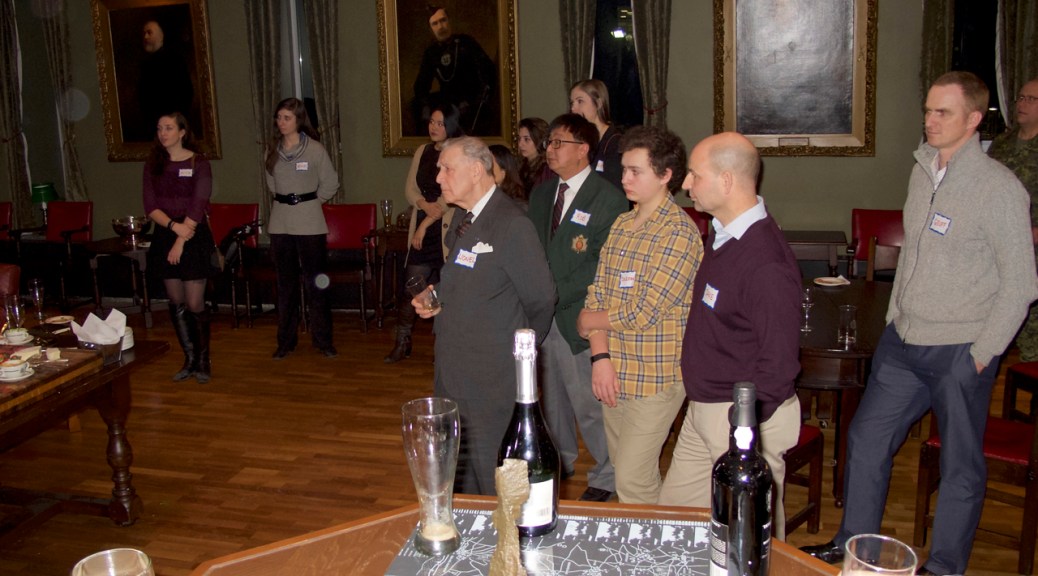
On Thursday January 28th over 30 volunteers joined us at the Officers’ Mess for a reception to recognize volunteer service to the museum in 2015. In total 93 volunteers put in over 1,600 hours!

We were pleased to be joined by Honorary Lieutenant Colonel Lionel Goffart, members of the Museum Board of Governors,  and the Deputy Commanding Officer and President of the Officers’ Mess Committee, Major Shawn Stewart.

Thanks to Adam Hermant, Rob Chan, and Pat Di Donato of the Liberty Entertainment Group, we were able to presents some gifts to our top volunteers in terms of hours of service:

  1. Larry Hicks (235 hours)
  2. Graham Humphrey (184 hours)
  3. Shaun Kelly (121 hours)
  4. Ken Kominek (88 hours)
  5. Cheryl Copson (77 hours)
  6. Joe Wyatt (76 hours)
  7. Rob Grieve (73 hours)

The presentations were followed by a tour of the various messes at Moss Park Armoury which are filled with fascinating collections of military heritage.

We’re also pleased that some of our occasional volunteers have expressed an interest in becoming more regular and we look forward to another successful year in 2016!

Reg Force Reminiscences: “WUN BUN DAZE”

by Major Ronald R. Lilley, CD

This article was the first of two found in our collection. The date or purpose for which is was written is unknown. The second article will be posted in two week. Lilley left the Loyal Edmonton Regiment to join the 1st Battalion QOR in March 1954.

Back in the Spring of 54 (1954), not 1854, as many of my more recent associates would claim, the formation of 1 QOR of C was in progress at Currie Barracks, Calgary. Major C.P. McPherson (CP), acting by authority of Lieutenant-Colonel John Delamere’s absence, was the Supreme Commander of a handful of riflemen, NCOs, WOs and officers. The term “motley” may be an unkind term to use in describing this crew, but motley it was. The Adjutant, Captain Frank Moad and RSM Rusty Rowbotham completed the Bn HQ triumvirate. Lieutenant Fred Sargent (the QM) and I, at the time of my reporting in, were the only two First Lieutenants. Our association increased in size when Lieutenants Lloyd Cornett, Herb Pitts and Bob Munson reported for duty. At that time the PPCLI still reigned supreme in the permanent Mess on the hill while the LdSH (RC) were located adjacent to them in the temporary wartime buildings. Our Mess was located in an old Air Force H-Hut located adjacent to the Northeast corner of the parade square.

“Tea” was an informal “parade” where the CO determined the progress made on the state of the union and made or rescinded his various pronounce­ments, such as “ALL officers will wear moustaches.” Parties “spontaneous or otherwise” always ended up with “Grease the Tube”. After every shot, the Mess Secretary, while he was capable of doing so, gathered up and placed in an appropriately labelled bag, mainsprings, crystals, cog wheels, etc., of the individual’s wristwatch. The equivalent of a Timex was soon worn by all officers, and issue watches were in great demand.

Inevitably, Wainwright was upon us and Major Don Creighton became acting 2IC, relinquishing the command of HQ Coy to Lieutenant Lilly. The Coy was in the best shape possible considering the paucity of equip­ment and personnel. At the time, I was corresponding with Captain “Honest John” Mitchell, who was the Sigs Officer designate. “Honest John” took over his platoon several weeks after we were in Wainwright and it he had been prone to heart seizures we would have lost him on day two of his service with the unit. CO’s briefings were held daily, with the officers assembled around a campfire pit. Young 2/Lt Mike Newell ([later] Deputy Commander 12 RBC – Valcartier) commanding one of the sp wpns pls, was scorched by the CO’s wrath when, after receiving a direct order for events to take place the following day, he said: “I won’t do it.” Mike was suffering from an abscessed tooth, as I recall, and had a dental appoint­ment for the next day. CP’s fury provided an unexpected anaesthetic. Incidentally, Mike did have the tooth extracted and not by CP.

My turn came at the end of one of the Bde exercises. The Bn was granted 24 hours in the built-up area for R&R. I had checked over the officers’ quarters and had allocated the rooms by placing the officer’s name on the appropriate door. Unfortunately for me, I had to return to the Men’s area because their quarters allocation had been halved and I had to make up a new plan. In my absence the Straths advance party over­ruled our representatives and re-allocated the CO’s suite and most of the choice rooms to their CO and officers. On my return to the Officers’ Mess I felt righteous indignation for the treatment to which I was subjected.

By this time, we had all learned to keep our mouths shut and not to raise the subject of our undoing until another officer fell into the excreta, or for at least 48 hours. My saviour had already been earmarked by fate, Lt Ivor MacLeod by name. Those were the days of “NO shortages.” A smouldering mattress heaved from a second storey window (still open) was discovered the next day by CP. Poor Ivor had fallen asleep with a lit cigarette; feeling extremely warm, he had taken the aforementioned action which caused the inevitable chain reaction.

That same summer, then, in an effort to increase the mobility, started the first post-war experiment which eventually led to the procuring of the M113A1 APC. 2/Lt Spike Vanier, with a fleet of tired bren gun carriers, streaked around the training area on a preconceived battle plan. Experiments the next summer included transporting troops in 3/4 ton trucks and trailers. We must have been blessed by either CP or the Almighty, because we never lost a man.

Individual training began once again after the leave period and we were soon introduced to a new Capt Adjutant in the personage of George Hall. George, the nemesis of CP, was noted for using his Christian name on part one orders, green tinted glasses, a moustache and his wife Bunty. George and Bunty were also noted for their after-duty escapades. George continually tried to widen the entrance to Currie Barracks, was usually successful, much to the chagrin of the Garrison Commander. Bunty became infamous at a Strath Mess Dinner involving CP, Kurt Greenleaf (CO LdSH (RC) and General Vokes (GOC Western Command) . I eventually replaced George as adjutant and Lloyd Cornett in time replaced me . By accident or design, all the adjutants (Frank Moad, myself and Lloyd Cornett) with the exception of George Hall, were to meet Rod MacKay, the former Bn 2IC, in Vietnam.

After a sojourn in Vietnam, I returned to the unit in Sep 56 and after a relatively short but peaceful existence. “Rapid Step” was upon the unit in its full fury. I was relegated to be OC Rear Party and missed out on all the fun in Halifax, much to my dismay but to the eternal joy of my wife. Rehearsals for the Feu de Joie were held on the RCAF tarmac at Lincoln Park. This always caused a minor problem because the Air Force stenos had tender ears and objected profusely to their Station Commander about the air pollution which followed the unit in the form of a blue haze. Needless to say that RSM Rusty Rowbotham was the main contributor with minor contributions being made by various CSMs. Officers received sword drill from CSM Ken MacLeod in Scott Hall. We in those days carried the famous Wilkinson Sword made in Japan. Trying to balance it was like holding a 6-pounder Atk gun in the vertical position by the muzzle. Young Ken using the best techniques of instruction of that day, continued to practise us in sword drill by numbers and by numerous demonstrations to inculcate the finer points in our rather erratic movements. In due course, we were able to do the whole drill. Wishing to sharpen us up, he prepared to give us one more demonstration using his own words of command. “Draw Swords”, shouted CSM MacLeod, and with a flourish, his hand went through the motions. To his dismay and to our amusement, the blade never left the scabbard and momentarily basket, sword knot and handle were held in a gloved hand with the blade parallel to the ground, elbow at the side, then in slow motion the basket, complete with knot, did a barrel roll to the concrete floor. Sword drill was suspended for the rest of that day in a gale of laughter.

Wainwright 57 saw the unit in bivouac at Border Lake and once again I was casting covetous glances at our mates in our rifle coys and at those officers in the rifle coys of the ad hoc bn formed under Major Ron Wilkinson, our Bn 21C. We went through the various rounds of inspections of the HQ Coy Bivouac area. On one occasion, LCol Chuck Lithgow accompanied by the Comd MO and Food Services Officer, commented on the completeness of amenities in our area and jokingly said “Where’s your deep freeze?” To his amazement, I said to Staff “Zump the Pump” Zumprelle, “Show them our deep freeze.” Zump showed them our ice cream cooler suitably concealed in a bush near the kitchen.

The next summer saw us located in the Westgate area. That was the summer I learned to tactically employ helicopters. My most important task, brought on by the introduction of helicopters, was to race around the whole bn area ensuring that crapper lids were closed. The Bde Commander, Brigadier Wrinch, had a fetish for hovering over bivouac areas and peering into open crappers.

The incident I remember best and will undoubtedly be reported on more adequately by others, involved the OC and 2IC of a rifle coy which shall remain nameless. On a dark and probably stormy night the 21C Capt John Probyn (1 had to use a web belt on the old grouch to make him human when he was adjutant) was returning from a recce of a coy crossing site. The coy was to launch an attack across the Battle River. Time being of the essence, the coy Comd Major Hank Elliot had decided to move the coy forward. In ground mist obscured depression, the 2IC and Coy Comd encountered each other and locked radiators.

Pte McAteer, the outstanding batman in the unit, was ordered during an emergency move of HQ Coy to look after our stock of ammunition (blank of course) by CSM George Collings. While establishing our new position the CSM yelled several times for McAteer to bring forward the ammuni­tion for redistribution. McAteer had disposed of the ammo by burying it in the old location.

Artifact Spotlight: Sergeants’ Mess Composite Photo c.1886

Today’s artifact spotlight is by former Regimental Sergeant Major and Chief Warrant Officer (Ret’d) Shaun Kelly, Assistant Curator.

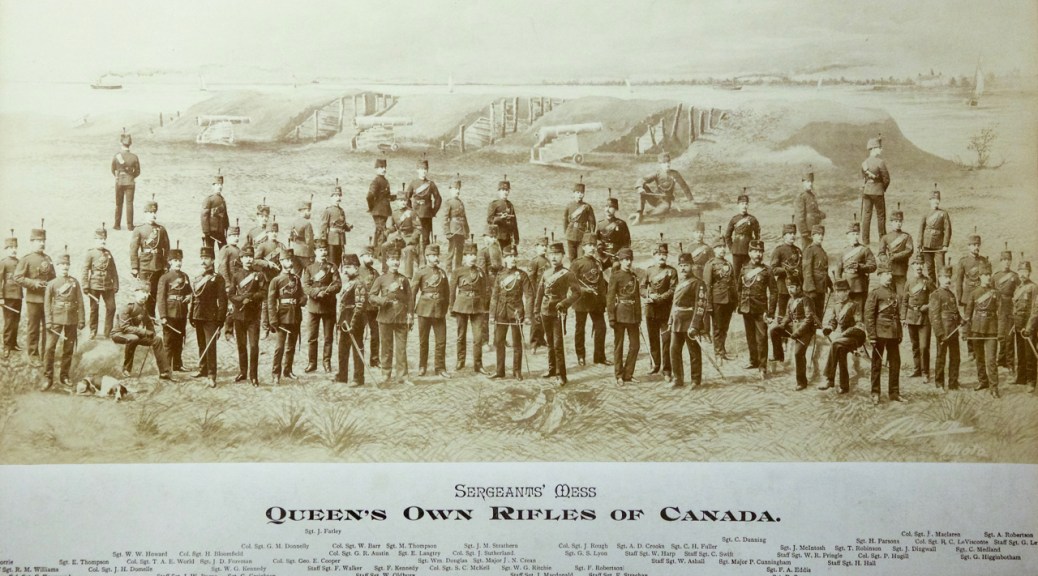
The object I have chosen as an artifact of interest is this photo (above) of the Sergeants’ Mess in 1886. It is a composite photo meaning photos of individuals are cut-out and stuck on a watercolour or charcoal sketched background and then re-photographed (much like Photoshop).

Sergeant Major Waring G. Kennedy
Sergeant Major George Crighton

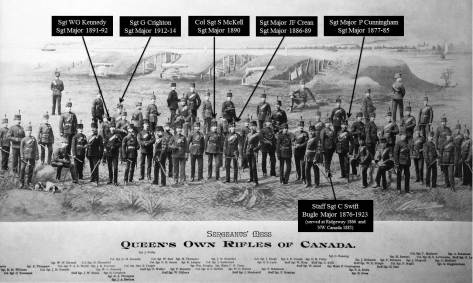
It was chosen because it shows the sergeants at a time when at least 30 of them had just recently returned from the rigours of the North West Rebellion 1885, (NW Canada campaign), it has five serving or future Sergeant Majors and a number of other interesting details. The date is likely 1886 as both Sgt Major Cunningham and Sgt Major Crean are present and the sergeants are wearing their North-West Rebellion medals.

Members of the Sergeants' Mess circa 1886
Members of the Sergeants’ Mess circa 1886 (click to see larger version)

From left to right the Sergeant Majors are:

  1. Warring G. Kennedy was Sergeant Major from 1891-92 and served as a corporal during the NW Canada campaign.
  2. George Creighton served as Sergeant Major from at least 1912-15 and served as a Pte during the NW Canada campaign.
  3. Samuel Corrigan McKell served as Color Sergeant during the NW Canada Campaign and was mentioned for saving a wounded soldier while under fire. He was appointed as Sergeant Major in 1889 but unfortunately died the next year. He is buried in St James Cemetery in Toronto and has a large tombstone erected by his comrades.
  4. John F.M. Crean was Sergeant Major from 1886-89 and served as Color Sgt during the NW Canada campaign. After his time as Sgt Major he received his commission, then left the QOR and joined the West Africa Frontier Force.  He died in Toronto at 47 years of age after 6 years in Africa.
  5. Patrick Cunningham (formerly of the 16th Foot) was Sergeant Major from 1877 to 1885, including as Sergeant Major during the NW Canada campaign.
  6. Charles Swift was Bugle Major from 1876-1923 and is the only one in the picture that served at both Ridgeway and the NW Canada Campaign. He is the regiment’s longest serving Bugle Major.
Sergeant Major (later Captain) John F.M. Crean
Sergeant Major Samuel Corrigan McKell

Other interesting information:

  • There are 28 Sergeants, 15 Color Sergeants, 13 Staff Sergeants including 2 Sergeants Major, 1 dog, and 1 unknown Sergeant (name being cut-off in the picture);
  • Color Sergeants are what we now call Company Sergeants Major although the Companies were less than half the size of a modern day 120 soldier Company. In 1886 a Company normally had around 50 soldiers, two Officers and two or three Sergeants. The regiment at the time consisted of at least 10 companies;
  • Hospital Sergeant Staff Sergeant Hall
    Hospital Sergeant Staff Sergeant Hall

    Sergeants Major, Quarter Master Sergeants, Armoury Sergeants, Hospital Sergeants were all appointments that a Staff Sergeant could be assigned. As staff, they weren’t part of the Companies but may have paraded at their local armoury with them. Note that all the Staff Sgts are carrying swords as well as the sergeant’s cane. The Hospital Sergeant, Staff Sergeant Hall, can be seen seated in the bottom right of the shot, if you look closely you may see the red cross armband;

  • 30 sergeants have NW Canada 1885 medals;
  • 4 Sergeants fought at Ridgeway but would not be awarded medals until 1899;
  • Note the two Sergeants in the rear facing away from the camera, they are equipped with the long sword-bayonet normally worn by duty staff and are likely sentries;
  • The gun emplacements are facing the shipping channel and are quite likely at the south end of Fort York, as the water was much further in-land in those days;
  • It is unknown who owned the dog in the lower left of the photo however, the menu from the reunion dinner for the veterans of the North-West Field Force that took place in October 1885 had a picture of a similar dog and its name was “Poundmaker”.
Sergeant Major Patrick Cunningham
Bugle Major Charles Swift

See an almost complete list of Sergeant Majors here.

QOR and Upper Canada College: 150th Anniversary of Affiliation

Major Francis Collier Draper

On 12 January 1866 No 11 Company “Upper Canada College” of The Queen’s Own Rifles of Canada (QOR) was formed under the command of Captain Frank C. Draper.

Draper seems like an excellent choice to fill this role as he was both a UCC Old Boy (1844-52) and had been a QOR officer since 1863. In 1874 he would resign his commission and become Toronto’s Chief Constable (i.e. Police Chief).

Creation of Upper Canada College Company of the Queen's Own Rifles of Canada (Gazette)
Creation of Upper Canada College Company of the Queen’s Own Rifles of Canada (Gazette)

The following article is excerpted from “COLBORNE’S LEGACY: Upper Canada College 1829-1979″ by Richard B. Howard

“It is Difficult to Establish a Date on which the College Rifle  Company, alias the Rifle Corps, later the Cadet Battalion, held its first official parade…..

The first hint of any military enthusiasm at UCC is mentioned earlier, when during the 1837 Rebellion, a troop of boys offered their services to the Lieutenant-Governor. …..

Early in Principal Cockburn’s regime, military drill was the subject of much attention in schools in England, Canada, and the United States. Ways were sought to promote what was thought of as a patriotic  spirit. The aim was to foster love of country along with a disposition to defend it, and to develop obedience and discipline. The important habit of prompt obedience could then be carried over into the classroom. By 1865 drill had been introduced into schools in many Ontario centres, including Toronto, London, and Port Hope. The College was probably one of the earliest participants; it is known that in 1863 the older boys paraded weekly under a Major [Henry] Goodwin, a strict disciplinarian but “kind-hearted” and “cheery.”

In 1865 Fenian troubles were creating much unease in Canada, and several Upper Canada College students asked Principal Cockburn’s permission to transform the recently formed cadets into a company of the Queen’s Own Rifles.

In December of that year an unknown number of pupils were enrolled, and in January 1866 the company was attached to the 2nd Battalion, Queen’s Own Rifles.

Thus , Upper Canada College was possibly the second Canadian school to have an “official” cadet corps, following Bishop’s College School in Lennoxville, Quebec, whose corps was organized in 1861.
……………….

The Queen’s Own were called out on March 8, 1866 , and though the College boys were not specifically mentioned, they appeared at every parade and march anyway (they even had their own marching song).

On St. Patrick’s Day the company waited for any trouble arising
out of the parade, but nothing happened . When the Fenians actually struck at Fort Erie on June 1 , the Queen’s Own were ordered out to meet them.  School was dismissed for the day and the College company reported for duty only to find that, by orders of General Napier, they must “…. remain in garrison to guard the armouries and official stores. Some students wanted to “desert” to join the battalion at the front, but evidently no one did.

“They performed the duty which was given them. ” After the raid there were plenty of volunteers in Toronto, and so the College company was released; but, just in case, it was “agreed that should the College bell ring at any time out of class hours, the members of the Company would . . . assemble at the Armoury.” The bell did, in fact, ring once, and the College boys were the first to report to the armoury, but it was a false alarm. A dense crowd gave them three cheers.

It has been thought that the Upper Canada College Rifle Company received “battle honours” for its passive though honourable role in the Raid. Not so. The Queen’s Own Rifles did not receive such honour; neither did the College. However, General Napier did give them honourable mention in his report, and it is true that they were called out for service (along with Bishop’s College School) — apparently the only time in Canadian military history this has happened.

Over thirty years later, the government decided to present medals to those who were engaged on active service in the Fenian Raid: the College Rifle Company, though denied the privilege of fighting, had performed some important functions, and all the members of the company still living received a medal.”

As of October 22, 1886, the Rifle Company officially became a Cadet Corps (#17) affiliated with The Queen’s Own Rifles of Canada. During the First World War, the Cadets’ association with the Queen’s Own had lapsed, and by 1923 two regiments, the Toronto Regiment (now the Royal Regiment of Canada) and QOR were requesting that the Corps affiliate itself with them. After some dispute between the three parties, the College settled on the Queen’s Own again by 1927.

In 1976 the compulsory “Battalion” was disbanded to be replaced the following year by a voluntary Cadet Corps. This lasted until 1988 when it was officially disbanded as of April 15th.

Over most of these 144 years, the connection between UCC and the QOR remained very strong. Many Old Boys went on to serve with the QOR – some even becoming Commanding Officer. Even today, the Regiment values this long and distinguished relationship between one of Canada’s oldest continuously operating schools and Canada’s longest continuously serving infantry regiment.

You can read more:

04271

QOR Band at Casa Loma November 2015

We were very pleased to once again have the Regimental Band and Bugles perform on Saturday November 7th, as part of the QOR Day at Casa Loma 2015.

Check out these videos of their performance (taken by Corporal Justin Dreimanis):

7 November 2015 QOR Day at Casa Loma performance #1

7 November 2015 QOR Day at Casa Loma performance #2

7 November 2015 QOR Day at Casa Loma performance #3

7 November 2015 QOR Day at Casa Loma performance #4

7 November 2015 QOR Day at Casa Loma performance #5

7 November 2015 QOR Day at Casa Loma performance #6

7 November 2015 QOR Day at Casa Loma performance #7

7 November 2015 QOR Day at Casa Loma performance #8

Volunteer Profile: Larry Hicks

Captain (Ret’d) Larry Hicks (in centre above with wife Lee) served for over 40 years with The Queen’s Own Rifles of Canada and was also employed with the Toronto Police Services. Retirement from both gave him time to volunteer at the Regimental Museum and since then he has been photographing literally thousands of artifacts for our collection database, creating images for our exhibits, and capturing museum events. His sense of humour, willingness to pitch in where ever needed, and plethora of QOR memories, make him a much appreciated member of the team!

How did you end up volunteering at the museum?

I was at the annual Officers’ Mess Christmas Luncheon when I struck up a conversation with John Stephens. I knew him socially from past mess functions. He asked me what I was doing since I retired and I replied that I was pursuing hobbies that I never had time for, photography in particular. That’s what retired people do.

He paused for a sec, his expression changed and he smiled. He knew he had me. He needed a photographer at the museum, and I wanted a way to stay involved with the regiment.. And, who doesn’t like castles!

So, for the past 3 years, I’ve been photographing, copying and displaying the many exhibits we have at the museum.

What background do you bring with you that you think helps you contribute in this role?

My last 15 years with the Toronto Police Service were spent as a crime scene Detective. It was a challenging job, and a rewarding way to cap a 37 year police career. My job was to collect evidence at major crime scenes, but I also had to present that evidence in a courtroom and reproduce the scene for judges, juries and the media. TV only shows half the job.

The camera was my main tool and I loved that I was getting paid to practice my hobby.

It was an easy transition to museum photography. Similar product but a different audience, and a lot less stress.

What do you enjoy most about volunteering at the museum?

I have a pleasant time with the people I work with. Only half have a military background, but we all love history and we all care about the regiment. We go to the pub for a pint and a chat after work.

Casa Loma is a cool place. Every time I go there I find something else that fascinates me. The summer concerts. The movie shoots. Christmas music on the Wurlitzer. It’s good that they don’t pay me, sometimes I don’t get much work done.

What aspect or content of the museum are you most passionate about and why?

Take a look at our product. The displays. This website. Facebook. We have over 5,000 photos on Flickr alone. Then look at other museum sites. We put on a good show and were proud of it.

South African Ration tin (lead)

Is there one object in the collection that really excites you or that you think people should know about?

Some people are into uniforms. Others are into weapons. I want to tell the story of the grunt, the guy who put his butt on the line for his country, and what he had to endure.

There is a can of field rations in the South Africa exhibit. Something all soldiers can relate to. It’s a can of mystery meat sealed with lead. LEAD! No wonder they’re all smiling in the old photos.

Why do you think a museum like this is important?

A nasty little word I kept hearing throughout my military career was “restructuring”. Regiments come and go. No one knows what the army will look like in another 155 years, but we can show the world what it looked like 155 years ago.

Would you recommend volunteering to others and if so why?

Absolutely. It’s a way to give back. If not to the regiment, do it for history. And, it’s a good group of people to hang out with.

Update: In February 2018 Larry was presented with the Commanding Officer Certificate of Commendation and a Command Team Coin in recognition of over 800 hours of service to the museum, and to his efforts on behalf of RHQ in photographing regimental events. Sadly Larry passed away 23 March 2018. You can read more of his service on his profile page.


If you’d like to help volunteer at the museum, check out our Volunteer page for information and an application.

32nd Brigade “Rangers Cup” Tournament 2016

The “Rifles” returned to the ice on January 1st to defend their Rangers Cup title in the second annual tournament. Despite not losing any games, they placed third.

Museum volunteer Cpl Justin Dreimanis captured the action with some excellent photographs:

Artifact Spotlight: Nominal Rolls 1866 to 1882

This is the first of an ongoing series of articles in which museum volunteers were asked to share information about an interesting artifact they have come across in our collection – some of which may be on exhibit but others may be in storage. We start with Curator John Stephens.

So what artifact have you chosen to spotlight for us today?

One of my personal favourite items in our collection is not from the museum side  but from our archives. It’s a bound ledger of nominal rolls by company beginning in March 1866 – just three months before the Fenian Raids – and pretty much annually through to 1882.

Why do you find this so interesting?

The history of the regiment is usually considered in terms of battles and campaigns and weapons and uniforms and training and deployments – but ultimately at its most basic level, it’s about people. And generally when we think of people in the regiment we know the stories of commanding officers, other officers and senior NCO’s but these rolls list everyone who served from the youngest bugler to the Surgeon Major.

Over the various years, these contain a varying amount of information on each person listed but they do allow us to follow the progression through the ranks of many of our regiments earliest members.

I’m also into family history research and there is no question the March 1866 roll is probably the most valuable for genealogists as it includes country of birth, religion, age and occupation.

Obviously it would be handwritten – is it legible?

Surprisingly yes it is for the most part. The ink for the June 1866 roll is very faded but generally the handwriting is legible – there are certainly some exceptions of course.

What condition is it in?

Surprisingly good condition considering its almost 150 years old and it was actually in active use for 16 years. The cover and spine are holding up well and while there page are somewhat brittle, they really aren’t too bad.

Just recently we received a donation to cover the cost of a new metal cabinet with doors in which we are now storing our highest at-risk items. Hopefully this will provide some better protection for items like this ledger.

Anything  else you’d like to share about this object?

With the 150th anniversary of the Fenian Raids and the Battle of Ridgeway coming up in June 2016, there seems to be increasing interest in the information that we have in our collection related to that period from researchers and descendants of those who fought.

We’ve digitized this ledger and posted it on our website Archives page. This provides people access to the information while still protecting the artifact itself from damage caused by handling. You can check it out here.

We’re also going to use the 1866 rolls to do some analysis of the regiment’s make up and how reflective it was or wasn’t of Toronto at that time.

Helicopter Insertion Training

Members of the regiment were recently spotted in Downsview doing some helicopter rappel training. Photos by Cpl Justin Dreimanis.

Help needed transcribing South African War Diary of Edgar Henry Redway

Edgar Redway
Edgar Redway

UPDATE:

Thanks to the diligent efforts of Corporal Michael McLean, an Electronics-Optronics Tech based at Canadian Forces Base Petawawa, we have now completed the transcription of Redway’s Diary.

You can read it here.

———————————-

We recently received a donation of a diary kept by Queen’s Own rifleman Edgar Henry Redway written during part of his service during the South African War. We would like to transcribe this diary to make it more accessible for research.

If you are interested in helping in this project please email museum@qormuseum.org before you start, indicating which pages you’d like to transcribe. We’d like you to transcribe in groups of 10 pages to keep the administration simple realizing that this may not cover a complete date entry.

“In progress” beside the page list below means someone is already working on that group of pages. “Completed” means its done and dusted.

Before starting please review the instructions following the page list below.

  • Page 1-10 – Completed
  • Page 11-20 -Completed
  • Page 21-30 – Completed
  • Page 31-40 – Completed
  • Page 41-50 – Completed
  • Page 51-60 – Completed
  • Page 61-70 – Completed
  • Page 71-80 – Completed
  • Page 81-90 – Completed
  • Page 91-100 – Completed
  • Page 101-110 – Completed
  • Page 111-121 – Completed

The pdf of the diary can be found on here on our website.

Transcribing Guidelines

  1. Send your transcription in text format (not tables). You can use Word or simply paste them into the text of your email.
  2. Transcribe exactly what is written – including spelling mistakes and abbreviations or acronyms.
  3. Do not use bold or italics.
  4. If you are unable to determine a word or phrase, please put a simple [?] in place of the undecipherable text.
  5. Do not worry about replicating how it is laid out – it is easier to read if we just make paragraphs on our web page.
  6. Do not include page numbers.
  7. Please make sure you review or better yet, have someone else review your transcription for accuracy particularly if there are sections you are unsure of. Transcribing Redway’s handwriting can be tricky and a second set of eyes can sometimes catch something you may have missed.

Thank you in advance for your assistance!! If you have any additional questions, please email us at museum@qormuseum.org

Thanks!

John
Curator

Volunteer Profile: Shaun Kelly

CWO (Ret’d) Shaun Kelly (at right above) has volunteered at the museum since 2012 in the much appreciated role of Assistant Curator. Through some very challenging times he’s brought his hard work ethic, positive outlook and strong organizational skills to help us keep the museum moving forward. In 2014 Shaun was presented the Commanding Officer’s Commendation for his work with the museum.

After retiring as Regimental Sergeant Major, Shaun began work as a civilian with the Department of National Defence in the position of 4th Division Safety Officer.

How did you end up volunteering at the museum?

I was recruited by Lieutenant Colonel (Ret) Rob Zeidler as part of a “team” when former Curator Captain Peter Simundson retired. After 33 years of full and part-time service I was still interested in serving the Regiment in some form and my wife said I should get out of the house a least once a week.

What background do you bring with you that you think helps you contribute in this role?

As a former RSM and a member of the Regiment for 33 years I had a good idea of its history, accomplishments, and stories. I have a particular interest in our history before 1900 as I don’t think we know or share enough about that time period considering it includes the Battle of Ridgeway, the Northwest Canada Campaign and South Africa which have been somewhat overshadowed by the huge accomplishments of WWI and WWII.

What do you enjoy most about volunteering at the museum?

I enjoy the research I have done on our Regimental Sergeant Majors since unlike the Commanding Officers, no formal records had been kept so finding names and dates has been a real challenge. This research continues when I’m not putting up pictures, building shelving units or cleaning-out storage closets.

What aspect or content of the museum are you most passionate about and why?

As above but including learning more about the soldiers who served during the first 50 years, what they did, where they lived and what may have motivated them to join the militia.

Is there one object in the collection that really excites you or that you think people should know about?

The photos of the different Companies that were taken after the Battle of Ridgway in 1866 I find fascinating. Firstly, photography was in its infancy so to take the time to carefully document who was there must have taken a good amount of effort. Secondly, you can see real character in the faces of the men, they looked like a real tough bunch that certainly could have done some damage to the Fenians had the battle gone differently and they had the chance to close with the enemy.

Number 10 Company June 1866
Number 10 (Highland) Company June 1866

Why do you think a museum like this is important?

Countless thousands of soldiers have served under the Queen’s Own Cap badge over the past 155 years, 1700 of them have died, many others have been decorated for acts of courage and bravery, we have an obligation to remember and share their stories. The museum is an important way to preserve their memory but also to share the Regiment’s history with our serving soldiers and the public in general.

Would you recommend volunteering to others and if so why?

Our volunteers are a diverse group: serving and former members of the Regt, civilians  with a museum background and people with an interest in military history, some help at the museum and some help virtually via the internet, some come in every week and others only come by for specific tasks, all have one thing in common that is the betterment of our museum to become a multimedia resource to share our history and heritage, everyone has something to offer.

If you’d like to help volunteer at the museum, check out our Volunteer page for information and an application.

Timelines, timelines and more timelines

Our role as the Regimental Museum is to both capture and share the history of The Queen’s Own Rifles. Maintaining our physical exhibits at Casa Loma is a big part of how we share and hundreds of thousands of people come through out displays every year – many tourists from around the world. But realizing that many more people will never be able to visit our physical location, we felt it was important, like any other museum, to have an online presence and so we created this website in 2012. We followed that up with a Facebook Page, a Twitter account, and most recently our Flickr site for sharing our thousands of photographs.

Timelines

Part of our challenge with the website was how to best present historical information from 1860 to the present. We opted for timelines. Don’t get too excited – these aren’t fancy java scripted timelines with awesome graphics and pop up info boxes. They are just a chronological listing of activities and milestones for the regiment. Sometimes we can provide links to further information or biographies of those noted. Sometimes we have some relevant photos to add in as well just to keep it from getting too dry. J

So where do we get the material to include? Great question with some good news/bad news answers. Prior to 1960 we have a number of histories of the regiment to draw from including LCol W.T. Barnard’s great work produced in 1960: Queen’s Own Rifles of Canada, 1860-1960: One Hundred Years of Canada. Pdf versions of this and earlier histories of the regiment can be found on our Research page. There is a lot more to add but we certainly have covered quite a bit about the first hundred years – for the most part on timelines divided into 25 year periods.

From 1960 to 1970 the Regiment produced an annual Powerhorn – essentially a yearbook which captured a wide range of activities of the two regular force and one reserve battalion, the regimental depot, the cadet corps, the association and the Black Net. We have a dedicated volunteer (he also does our “This Day in History” or OTHDIH post on Facebook and Twitter) plodding through these volumes and adding details to the appropriate timeline.

And of course more recently, Charles McGregor has published a history of the regiment since 1960 and we’re using this to help fill out our timelines as time and resources permit. In each case we try our best to reference our source for the information we add to the timelines.

But why haven’t you included X on a timeline?!

Unless it’s your birthday, odds are we’re happy to include info you might have on our timelines, but we just haven’t got to them in our research OR we just don’t know about them. In particular we would love to have more info to include for the late 1950s and from 1970 to present. Deployments, training exercises, jumps, graduations, special postings, etc. Ideally we’d want the exact dates (so we can use in our OTDIH posts) but we could also include if you just have the month and the year. We’re not looking for full-fledged stories or even paragraphs – just a one liner.

And don’t let the idea of “history” turn you off sending in more recent information – everything that has already happened is by default, part of our history, even it was just yesterday. And the sooner we capture it, the more accurately it will be recorded. Our only exception to this is to record operational deployments only when they are completed.

If you have items to share you can post a comment below or send an email to museum@qormuseum.org.

And if you haven’t has a chance to look yet, do check out the existing information on our timelines!

#GivingTuesday?

So it’s almost Tuesday. Hopefully you’ve survived the Black Friday crowds or maybe you opted to splurge online instead on Cyber Monday. Or maybe you didn’t partake in either but just got bombarded with promotional emails for the past week. But now we’d like to change the channel because December 1st is not just Tuesday, its #GivingTuesday!

What is GivingTuesday?

Imagine a day dedicated to giving back … around the world, across Canada and in your own community! Just as Black Friday kicks off the holiday shopping season for many people, GivingTuesday is the opening day of the giving season. GivingTuesday is a global day of giving. GivingTuesday is a time to celebrate and encourage activities that support charities and non profits. Whether it’s making a donation, volunteering time, helping a neighbour or spreading the word, GivingTuesday is a movement for everyone who wants to give something back.

And you’re telling me this because….?

Today and frankly until the end of the year, everyone is telling you they need you to give – Santa boxes for needy children, food banks need volunteers, and many local churches and charities are preparing to receive refugees in the coming weeks. And as passionate as I am about the work we do, I’m not asking that you make support for The Queen’s Own Rifles Regimental Museum a priority over these other urgent needs.

But some of you may be in a position where you can support more than one cause – be that with your money or your time. If you can make a financial donation great – it would go to help us with projects like digitizing 16mm films in our collection before they become unplayable; or to purchase new digital display products that can make our exhibits more engaging. You can donate on our GivingTuesday page to the Queen’s Own Rifles Trust which operates the museum – just type MUSEUM FUND in the online form Message box.

Some of you may be willing to give of your time as volunteers. We have a variety of opportunities. We generally gather at the museum most Thursday evenings from 1900 to 2200 hrs to work on very hands on projects from exhibits to hanging pictures to cleaning to cataloguing. But we also have volunteers who work remotely on research or transcribing or other tasks that don’t require your physical presence. If you’re interested in volunteering with us, check out our Volunteer page and complete an application.

What if I can’t do either at the moment – can I still help?

Giving-Tuesday-2015_250x250_greyYou can always become a social ambassador and share the word on Facebook, Twitter and Instragram about #givingTuesday – just make sure you use this hashtag.

Whatever the cause, we hope you’ll consider investing your time or financial resources or become a social ambassador on #GivingTuesday!