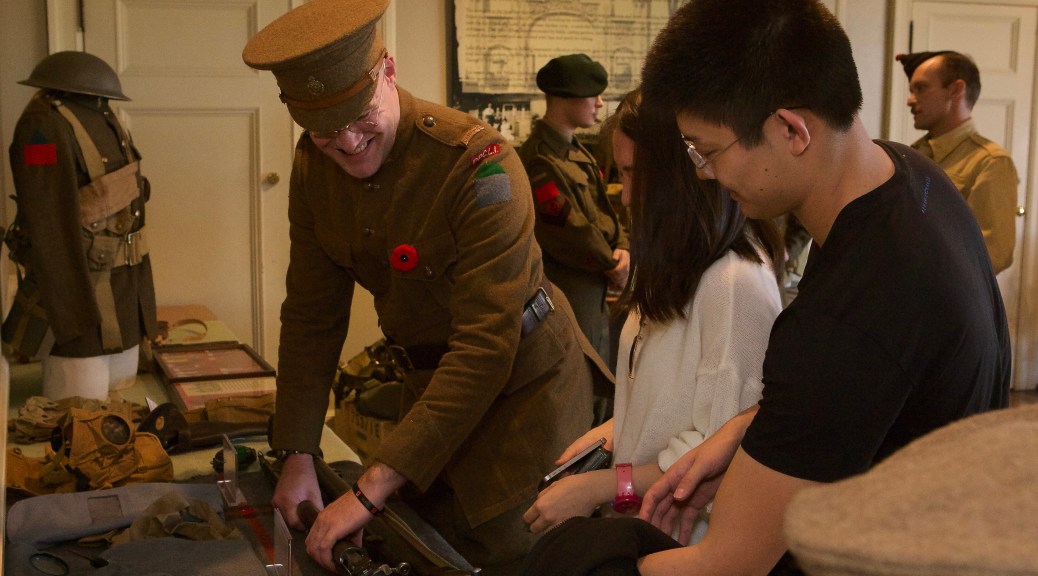
QOR Auction will be held on April 25th in the Officers’ Mess at Moss Park Armoury, in support of the Regimental Museum and the soldiers’ trip to D-Day+75 in June 2019.
Below is a link to the catalogue of items – some really interesting pieces!
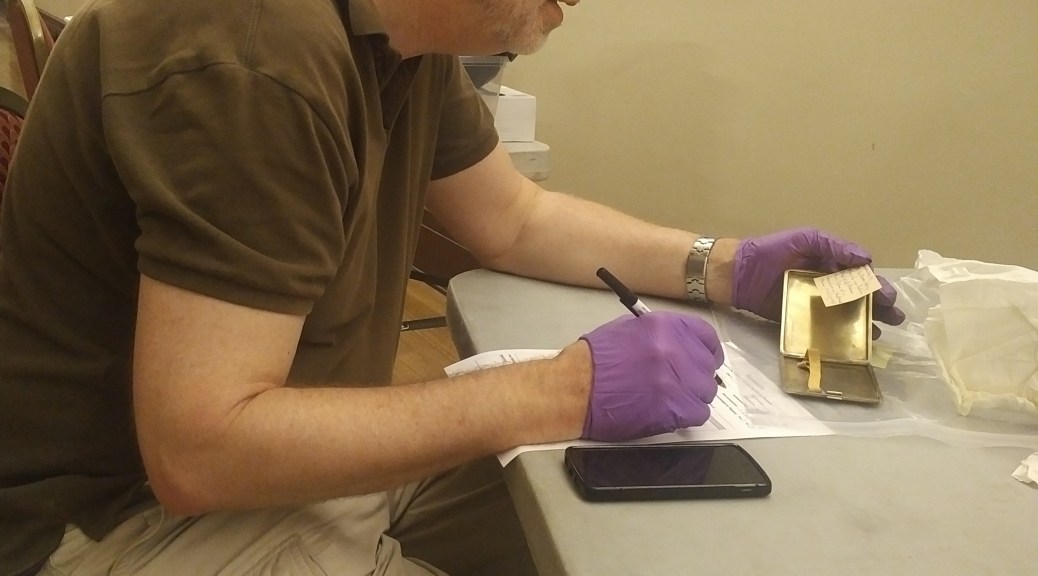
Our museum is extremely lucky in having original copies (i.e. one of three copies made when then were first typed) of the World War II war diaries for what would become the 1st Battalion, The Queen’s Own Rifles of Canada (CASF).
These documents provide a wealth of information about the regiment’s participation and progress throughout the war – from the efforts to form the battalion in June 1940, through duties in Newfoundland, training in New Brunswick and England, the successful but devastating landing on D-Day, the continued fight through Europe, to finally to the German surrender on 8 May 1945.
We are also very lucky to have most of the Routine Orders issued during the war and while often administrative in nature, they help to fill in some of the gaps left by the war diaries – particularly in regards to personnel postings and casualties within the battalion.
Unfortunately the original documents are fragile and not particularly user friendly as there is no way to easily search through them. So in order to protect them, and at the same time make them more accessible, we have undertake to transcribe and post on our website all these war diaries. We’ve also scanned all of the routine orders and posted them into the war diaries at the appropriate places.
And if that wasn’t enough, we added maps to help illustrate where the battalion was at various times and where it was headed, and inserted photos from our collection into the appropriate location in the timelines. These photos add some amazing sense of place and time. Lastly we added links to more detailed profiles on our website for many of the key soldiers mentioned in the diaries by name.
Now when I say we, I really mean one of our curatorial assistants, Sgt Graham Humphrey and more recently, with the help of Kate Becker. Graham and Kate have spent literally hundredsof hours on this project over the past three and a half years – scanning, transcribing, creating maps, and inserting photos. The result though is a spectacular resource that serves to both protect our archival documents while sharing them with the world. Even without any official announcements, these page have been viewed over 16,000 times to date.
And the importance of making this information available today is even more critical as fewer and fewer WWII soldiers are left to share their stories first hand.
Bravo Zulu to Graham and Kate on their outstanding work to see this project through to the end, and I strongly encourage you to take some time read through this important story of some of our regiment’s finest hours:
I would presume that most people working in museums inherently believe that preserving history is important – I would certainly hope so at least. And while preservation can be a monumental task all on its own, it’s really only half of the challenge. The real value comes in being able to share this history – to make it accessible in some ways.
When we think of museums, the first method of achieving this that usually comes to mind is through exhibits. Visitors can see – and in some cases touch – real artefacts and are provided with additional background, context and perspectives to better understand the history we present.
This might be considered the ideal approach and while over 350,000 people visit our museum’s exhibits each year, we also know that many people around the world with some link with our Regiment, may never get that opportunity. With that in mind, we’ve tried to digitize much of our collection and make it available online, here on our website, on our Flickr site (over 10,000 photos currently), Facebook, Instagram, and Twitter. And we’ve also made our collection catalogue available online as well with images and descriptions of almost 2,000 objects entered to date.
All of this takes an incredible amount of work and coordination, and most of our volunteer team have contributed to this effort in some way or another. But I’d be lying if I didn’t admit to occasionally wondering if anyone actually accesses any of this information, and if all this work is worth it. The stats tell us that our Flickr site has had over 1,000,000 views and our website gets about 80,000 page views annually which is very exciting but still somewhat impersonal.
Occasionally though we get comments on our website about how the information helped them connect with a relative or letting us know they have more information to share – even objects to donate, and those always seem to make our efforts worthwhile.
Last month though, we received an email that couldn’t help but recharge the whole museum team:
“My name is Liz Grogan and I am the granddaughter of Sgt. J. Lutton 6164.
A couple of weeks ago, I was sitting with my 95 year old mom, John’s middle and only surviving daughter, Kathleen ( Kae) Smith who was browsing through a book I was reading for my book club called “The War that Ended Peace, The Road to 1914” by Margaret MacMillan.
Knowing that her father, my grandfather had been in WW1, I decided to google his name, and you can imagine my surprise and excitement to discover this:
I had researched his name prior to Remembrance Day on other occasions , but I had not seen this letter before!
So Mom and I sat together and I read the letter out loud as mom watched the screen. I had not scrolled through to see how long it was, so my thanks to WO Emily Kenny for her hard work!
I can’t express how magical this moment was, that I will never forget. We laughed, we cried and we were simply in awe of having this amazing opportunity to have a personal peek at the life and love between mom’s future mom and dad and my future grandmother and grandfather.
And to reflect that this letter is 100 years old is beyond magical!!”
When I read this email, I couldn’t help but smile and was clearly reminded that our efforts are definitely worthwhile!
Of course Liz was interested in how we came to have the letter. In June a stamp collector in Nova Scotia contacted us because he had this letter in his collection and had found online that we perpetuated the 198th Battalion, Canadian Expeditionary Force. We quickly accepted his offer and the letter was soon in our collection. WO Kenny just happened to be directing staff on a music course at CFB Borden for the summer and offered to transcribe the letter in her spare time so we could put it online. The letter is long and rather rambling, and proper punctuation was not Sgt Lutton’s strong point but she soon had it done and we posted it to our website.
While this was happening we also researched Sgt Lutton’s life and service. While training in England he contacted meningitis and was hospitalized for 6 months before being found unfit for overseas service and returned to Canada where he was hospitalized for another three months. Though he never made it to the trenches of France or Belgium, his story does illustrate the other dangers many soldiers faced from diseases and poor health conditions they faced just getting to the front.
Lutton was lucky enough to recover from his meningitis and married Annie in 1919. He died in 1948 and is buried in Park Lawn Cemetery.
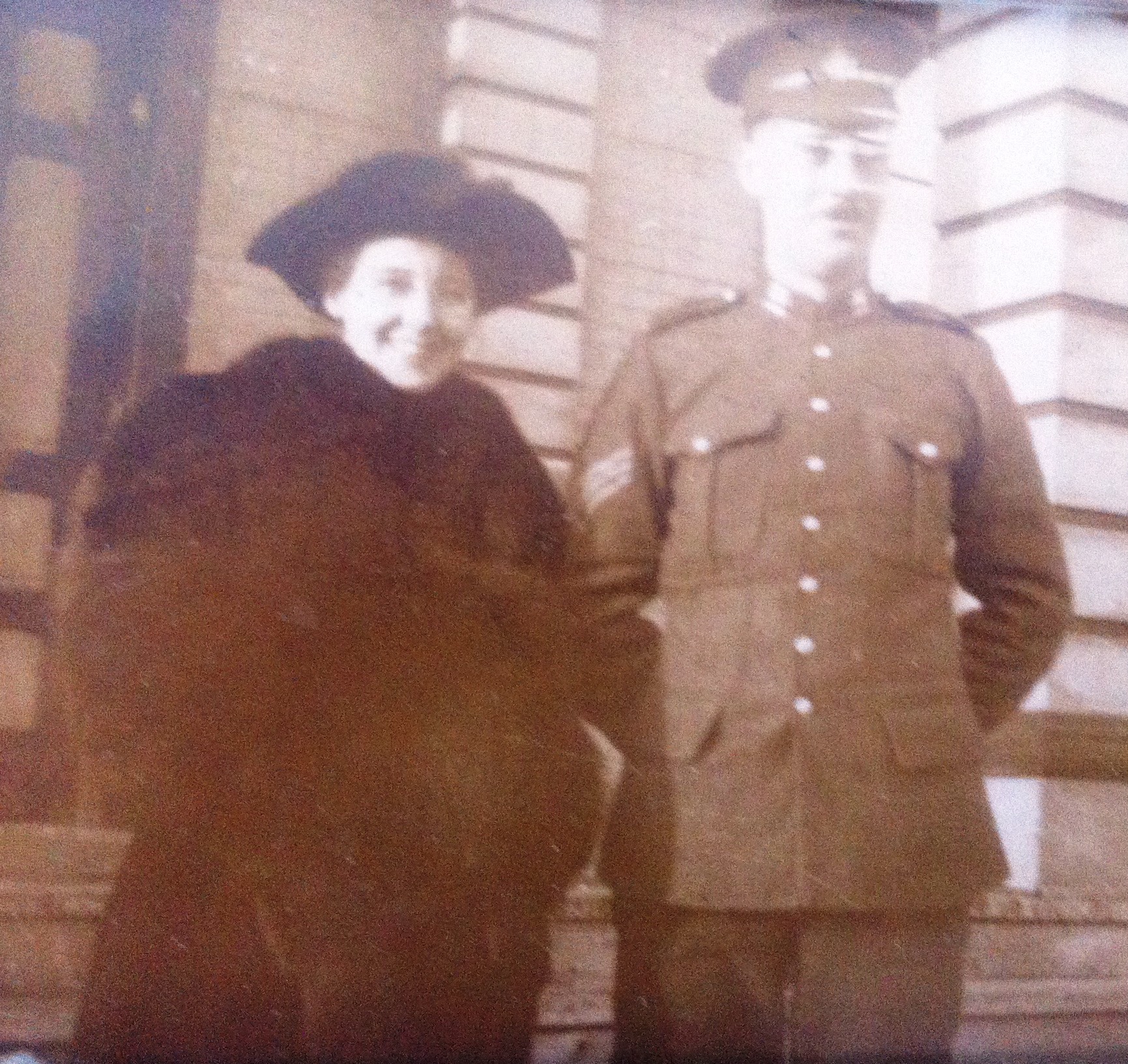
We’re very thankful that Liz took the time to share their experience and to send us the delightful family photo below of Annie and John.
After along time researching and searching Sergeant Graham Humphrey has finally found the evolution of the Queen’s Own Rifles officer’s tunics from 1860 – today. Enjoy!
For the last several years, a dedicated team of volunteers has revolutionized the Queen’s Own Rifles Museum by preserving its treasures, recording its inventory on film, and developing dramatic displays that tell the regiment’s story to the thousands of Casa Loma visitors each year. While much good work has been done, much more can still be done. Towards that end, the Museum’s Board of Governors commissioned a strategic planning process to identify the objectives of the Museum and the many projects we could undertake in future years.
The strategic planning process began with four research projects, designed to identify what people enjoyed in the Museum and what improvements they would like. We began with a facilitated brainstorming session with 15 Museum volunteers, who gave us enough great ideas to keep us busy for the rest of the century. We also surveyed samples of visitors to Casa Loma, key members of the regimental family, and digital visitors to our website.
Based on all this research, our strategic planning team drafted a document to serve as the Museum’s strategic plan for the next five years. This team consisted of Mr. Jim Lutz, MA (member of the Museum Board and Regimental Senate), Mr. Alex Meyers, MA (Museum volunteer), and Major (Retired) John Stephens, CD (Curator of the Museum).
The strategic plan seeks to achieve the Museum’s Vision, which is to be “a modern, historical, educational and rewarding experience to ‘all’ who visit Casa Loma, and continue to be known by peers as the best example of a volunteer organized and managed ‘specialized’ museum and archival collection”. The planning team identified five strategies that will help us achieve this Vision:
Preserving the regiment’s history
Promoting the regiment’s history and current mission to the public
Serve the interests of a wider community through outreach and digital presence
Support and benefit from Casa Loma’s tourist business
Ensure the effective governance and management of the museum to accomplish the above
You may read the approved plan, and you will see the extensive list of projects we can undertake to achieve these goals. With the help of all our volunteers, supported by the Liberty Group management of Casa Loma and our regiment, we can now focus our efforts on the most productive and valuable projects we have identified to achieve our goals for the Museum.
Bugle Major Charles Swift began his 57 years of service with the regiment as a 14 year old boy bandsman at the Battle of Ridgeway and would become the longest serving Bugle Major in our history – from 1876 to 1922 – an incredible 46 years!
During the 1885 North West Rebellion he was attached to Battalion Headquarters, but his skills as an accomplished and renowned musician resulted in leading Bugle Band trips to England in both 1902 and 1910. By now a Captain, the 70 year old Swift died of pneumonia in May of 1922 and his coffin was laid to rest by his fellow Queen’s Own officers.
Because he died unmarried and had no close family, the regiment purchased his grave marker. As you can see from the photos it hasn’t weathered the last 95 years very well and the only vaguely legible wording left is his surname Swift. Sadly his memory is at risk of being forgotten.
A very distant Swift cousin recently contacted us about replacing the marker and while that isn’t practical, The Regimental Trust Fund has agreed to add a small ground level plaque similar to those created for the Ridgeway casualties a few years ago.
The cousin will be making a contribution but we also invite members of the regimental family and friends of the regiment to help us reach our goal for the remaining $2,100. Donations of any size are appreciated and a charitable tax receipt will be issued by CanadaHelps. And if you allow CanadaHelps to share your contact info with us, we’ll be sure to invite you to the plaque dedication ceremony.
Please take a moment to support this project and help preserve the memory of one of the regiment’s most iconic members.
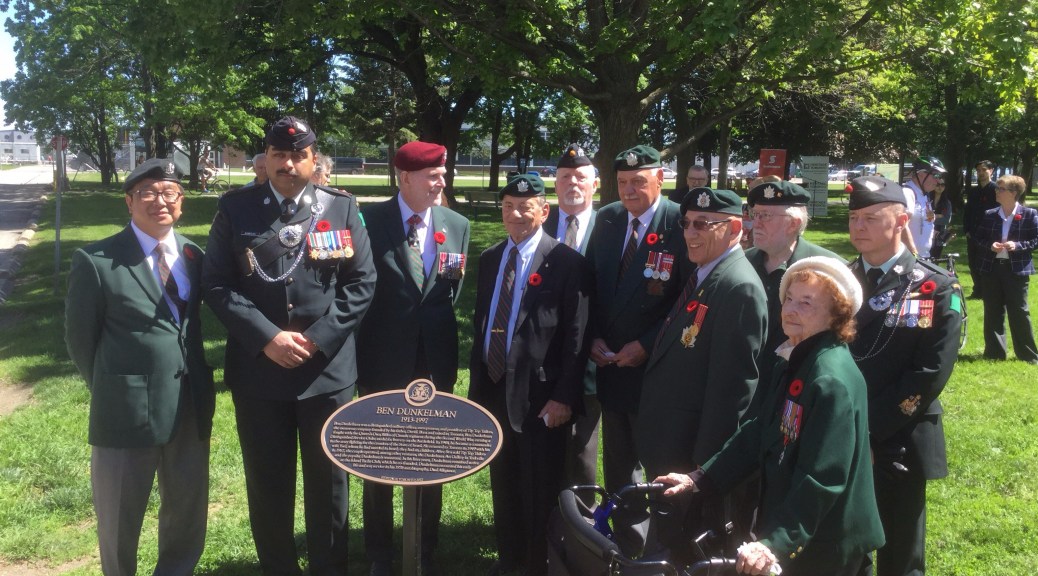
On the afternoon of Thursday June 8, 2017, a plaque was unveiled next to the site of the Tip Top Tailor building by Heritage Toronto, the Dunkelman family and the Queen’s Own Rifles of Canada, honouring the legacy of distinguished military officer and entrepreneur Ben Dunkelman.
Below are remarks given by Lieutenant Colonel Sandi Banerjee, CD, Commanding Officer of The Queen’s Own Rifles of Canada:
Major General Holmes, Member of City Counsel and Heritage Toronto, The Dunkelman Family: Rose, Lorna, Deenah, Daphna, David, Jonathan, Members of The Queen’s Own Rifles of Canada, Ladies and gentlemen.
It’s an honour for me to bring greetings from Ben’s Regiment on this historic occasion.
On the day I took command of The QOR, I received a very appropriate gift from a friend and mentor. Like Ben, this gentleman was also a warrior and Brigade Commander – he sent me a copy of Dual Allegiance, which reminded me all too well of the challenges and the conflicting demands one faces as a ‘citizen soldier’.
In his book, Ben mentions a special parade in Toronto, one to honour returning soldiers from the First World War. Thought he never glamorizes warfare, he states, “…from the moment of that Toronto Parade I have been sure of one thing: I am a Canadian, proud of Canada’s heritage and proud – if need be – to fight for it.”
Today I stand before you equally proudly of the fact that our Regiment welcomed Ben and all Canadians equally those many years ago. Without thought to religion or family background, The QOR of C has been a home to tens of thousands of proud Canadians with the same thoughts as Brigadier Dunkelman: not to seek conflict, rather to serve those who cannot protect themselves.
Toronto and Torontonians have a rich history and association with Canada’s Armed Forces. We stand in front of HMCS York, steps from Fort York Armoury and historic Old Fort York. We are standing very near the grounds where The QOR of C gathered before stepping off for Ridgeway to protect southern Ontario from invading forces 151 year ago. Though our early days, sending expeditionary forces to the Nile and Boer Wars, the World Wars, the Korean conflict, peace enforcement missions and the war in Afghanistan, or todays’ deployments in the Middle east, Africa and eastern Europe: Toronto has always supported our men and women in harm’s way.
The Regiment recently returned from two very special events overseas: the 100th Anniversary of the Battle of Vimy Ridge and just prior to that, our commemorations in Normandie, where Ben and his fellow Band of Brothers served. There we received not one but two honours: The Freedom of the City of Bernier sur Mer, where we were the only Toronto Regiment to land on D-Day, and the FotC of Anisy, where again, this Toronto Regiment was the only Allied unit to achieve their D-Day objective. These came at enormous costs, but as Ben showed by his personal example, the costs of freedom, of human dignity and decency, are borne by ordinary citizens accepting extraordinary responsibilities in times of great need.
I can also tell you that the people of Normandy, of France, have never forgotten the sacrifices of this Toronto Regiment and of the million Canadians who liberated them through two World Wars.
It is entirely appropriate then, that we gather here today to similar remember: to honour a proud Torontonian and Canadian who served twice to protect those in harm’s way. I would like to thank the City of Toronto and Heritage Toronto for bestowing this honour on a member of our Regiment and our city. May it serve as a reminder to all who come across it of a great man and our joint history together, a reminder of our City and her soldiers who have carried a part of Canada with them across the globe.
Thanks also to Captain Rob Chan and his family for their efforts in working with Heritage Toronto to make this happen.
This article first appeared in RCMI Members’ News March-April 2017, written by Ryan Goldsworthy, Curator, RCMI Museum.
Photo credits: Billy Bishop: Department of National Defence; Lewis and Vickers: Eric Morse.
“Keep it up, boys; do not let them get through!”
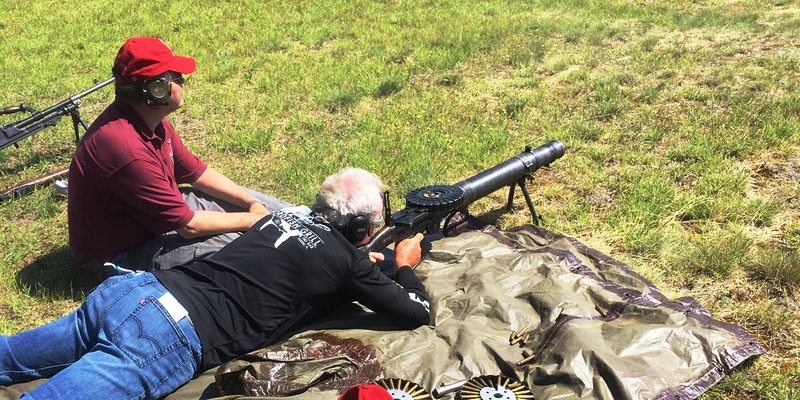
The artifacts being featured in this edition of RCMI Members’ News‘Museum Pieces’ are the Vickers Machine Gun and the Lewis Gun. Both the Vickers and Lewis were widely used by the Allies in the First World War and both proved to be extremely reliable and effective. These particular weapons are being featured in this edition as a pair, because both guns were recently installed in dynamic displays on the 3rd floor short bar of the RCMI. The examples on display at the RCMI, both dating to 1915, were originally donated to the Institute in 1966 by Captain S. G. Sigel. Though the RCMI has been in possession of these weapons for over 50 years, they have never before been on display for members and their guests.
The 1915 Vickers on display in the RCMI is exhibited as it would have been mounted on the Western Front. The Vickers display is complete with a fluted barrel, tripod, water can and hose, ammunition box, 250-round canvas belt, and an oil can and brush. The RCMI’s Vickers is a spectacular specimen of its kind and this specific artifact was originally a gift from the 5th Prime Minister of Nepal of the Rana dynasty to the British Army in 1915. The Vickers Machine Gun, with a calibre of .303, was accurate from 2,000m and fired at a rate of 400-500 rounds per minute, but it could also fire indirectly as far as 4,000m. It was preferred by Allied soldiers in the First World War, because it rarely jammed or malfunctioned, it was relatively simple to operate and it had considerable range and power. The Canadians used the Vickers to great success at Vimy Ridge, utilizing its coverage and power to “thicken” the barrages that liquefied many of the German defences in the lead up to the battle. Indeed, the Vickers established itself as one of the iconic instruments of the Great War and it was notably featured on the badge of the Canadian Expeditionary Force’s Machine Gun Corps.
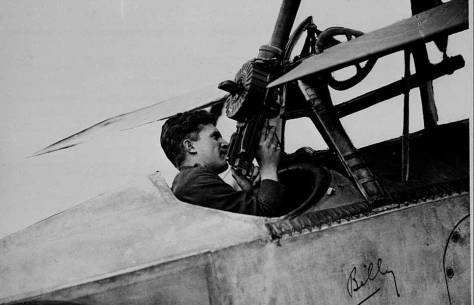
The Lewis Gun, though significantly smaller than the Vickers, fired the same calibre and had a more rapid rate of fire at 500-600 rounds per minute and was air-cooled instead of water. Though the Lewis was only accurate up to 800m, it was more portable than its larger and heavier counterpart and was used by both the army and the air force. The 1915 Lewis on display at the RCMI is suspended in a vertical case accompanied by several of its original tools, required for repair and maintenance, and a very rare anti-aircraft sight on the barrel. Unlike the belt-fed Vickers, the Lewis is instead loaded with a pan magazine on the top holding 47 rounds—which can be seen on display (the air force used 97-round magazines, pictured on Bishop’s aircraft). The Lewis was a versatile weapon that could be mounted by its bipod into nearly any terrain on the Western Front including trees and stumps. Becoming a Lewis-gunner in the CEF was equivalent to a trade and those proficient with the weapon had an “LG” patch stitched on to the arm of their tunic.
The Lewis Gun has also been featured in several citations of Canadian Victoria Cross winners during the Great War in otherworldly acts of heroism. In June 1918, Cpl. Joseph Kaeble of Saint-Moise, Quebec, repulsed or killed over 50 advancing Germans with a Lewis Gun on his hip. Despite being wounded numerous times by shrapnel and bullets, Kaeble “emptied one magazine after another into the advancing enemy” until he was mortally wounded and finally succumbed to his many wounds (his last words are the titular quote). During the Hundred Days Offensive, Pte. Thomas Ricketts of St. John’s Newfoundland, was able to save his entire platoon. When his Lewis Gun had run out of ammunition and his platoon was exposed to the advancing Germans, Ricketts ran over 100 yards and back through withering fire to procure more ammunition and then returned to his Lewis Gun to pin the Germans into a nearby farm. His platoon was then able to move forward without a single casualty and captured 4 field guns, 4 machine guns, and 8 prisoners.
In a last example, and perhaps the most famous, Capt Billy Bishop of Owen Sound, Ontario earned his VC in 1917 with a Lewis Gun affixed to his aircraft. Bishop single-handedly attacked a German aerodrome and downed several German aircraft—emptying out several drums of his ammunition. Though all three of these VC acts of “most conspicuous bravery” are rightly and roundly about the individuals who earned them, they also speak to the effectiveness of the Lewis Gun.
Ultimately, the strength of both the Vickers and the Lewis is confirmed by their longevity, both being used through WWII and well into the Twentieth Century. I would highly recommend the new exhibit of these weapons to all RCMI members, as they represent an important part of Canada’s military history.
Ryan Goldsworthy
Curator
Royal Canadian Military Institute
Last week we were pleased to hold our volunteer recognition ceremony at The Queen’s Own Rifles Sergeants’ Mess to thank many of the 86 volunteers who provide 1,731 hours during 2016.
Volunteers do a very wide range of task: painting, construction, cataloging, database entry, creating exhibits, cleaning, photography, social media, taking the museum on the road, planning, renovations, creating labels and background panels, research, transcription, digitization, re-enacting, events – I’m sure I’ve missed a lot of other activities.
Some volunteers put in a few hours each year and several a lot more but all our appreciated for the skills, expertise and commitment they bring to the museum.
Fourteen of our volunteers have put in more more than 25 hours and our top five were thanked with some gifts provided by Museum Board member Adam Hermant:
235 hours
Capt (Ret’d) Larry Hicks (the most hours again in 2016 and our indispensable photography technician.
Over 150 hours:
MCpl Graham Humphrey
CWO (Ret’d) Shaun Kelly
Over 100 hours:
Cheryl Copson
Over 75 hours:
Laura Colangelo
Alex Meyers
Over 50 hours:
Elizabeth Taugher
Nicole Lines (nee Simpson)
Over 25 hours:
WO Emily Kenney
Cpl Justin Dremanis
Cpl Dave Strachan
Coleman Weir
Rob Grieve
Jim Lutz
We also want to thank the Commanding Officer LCol Sandi Banerjee and RSM CWO Paul Martin for their outstanding support and for joining us at our reception.
Thanks also to the Sergeants’ Mess for hosting us and to our generous supporter for offsetting the costs of the reception!
If you are interested in volunteering at the Regimental Museum – whether you’re a serving or former member of the regiment or just someone who thinks this might be a cool way to spend their Thursday evenings, you can find out more information on our Volunteer page.
With the increased rate of withdrawal of British regular regiments from Canada in the 1850’s came the need to provide storage and training facilities for the volunteer militia companies and battalions that would fill the void. In 1860 the Queen’s Own were parading out of St. Lawrence Hall on Front St and a building at the north-east corner of King and Nelson (now Jarvis). The first “purpose built” drill shed was completed in June 1864 and was located on Simcoe Street just east of the old parliament buildings between Wellington and Front Streets; although no pictures or photos have been discovered, it is known to have been 400’ long by 80’ wide with a vaulted roof.
Location of Simcoe Street drill shed 1864-1877, note how close it was to the docks at the time (Goad’s Atlas of Toronto 1858)
“The drill shed, a large building with arched roof of single span (since destroyed), was situated on the west side of Simcoe Street, adjacent to the old Parliament Buildings and extended through from Wellington Street to Front Street. It was built in the hollow of the old Russells Creek, a portion of whose valley is still to be seen in the Lieutenant Governor’s garden, and the hard earth floor of the shed was far below the level of Wellington Street. From this street a stairway led down to a small entrance door at the north end and at the south end were the broad double doors by which the regiments marched out direct on the lower level to Front Street.”
[The Fenian Raid of 1866 by Barlow Cumberland]
Shortly after its construction it was the mustering point for the soldiers called-up for active duty during the Fenian Raid June of 1866;
“At 6:00 P.M. Major Charles T. Gillmor, the recently appointed commanding officer of the QOR received orders to assemble 400 men by 5:00 A.M. in the recently constructed Simcoe Street drill shed and to proceed to the Toronto docks where at 6:30 A.M. they were to board the steamer City of Toronto for a three-hour trip across Lake Ontario to Port Dalhousie.”
The Simcoe Street drill shed lasted into the 1870’s but it seems there was damage and it was replaced in 1877 by a newly built drill shed behind the City Hall, between Jarvis & Market Streets south of Front Street.
“Amongst the difficulties which the Battalion had to contend with at this time, not the least was that, the old drill shed on Simcoe street having been partially destroyed, the several companies were compelled to perform their drill in empty warehouses and halls.”
“It was not until April 4th, 1877, that a new drill shed was provided. On that date, the new drill shed, in rear of the City Hall Buildings, erected at an expense of some $16,000 by the City Council and the Government, was opened and regular and systematic work made possible.”
Location of Drill shed on Front Street (Goad’s Atlas of Toronto 1880)Drill shed on Front Street (also shown at top of page) (City of Toronto Archives)
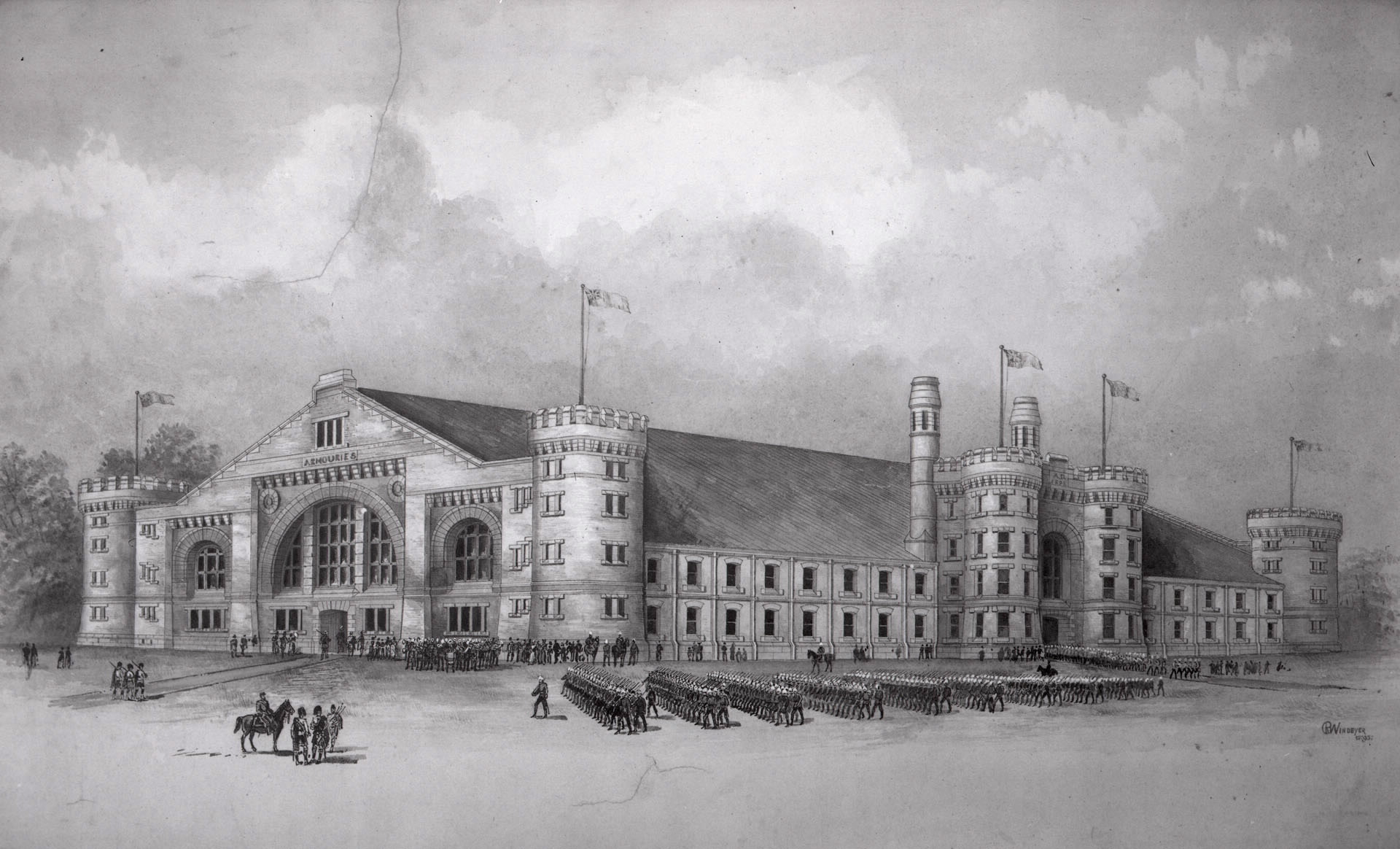
The Armouries on University Avenue, when completed in 1893, was the largest of its kind in North America. It was the longest to be used by the regiment so far, and was the starting point for thousands of Riflemen going to fight in South Africa, WWI, WWII and Korea.
University Avenue Armouries 1893 by R. C. Windeyer [Toronto reference library]“Built in 1891, the Toronto Armouries officially opened on May 17, 1894. Its inauguration was celebrated by a military tournament featuring different regiments—the Queen’s Own Rifles, 48th Highlanders, Royal Regiment, Royal Dragoons Toronto, and the Governor General’s Body Guard. The building had massively thick walls that were faced with red bricks and bonded with red mortar to create a continuously smooth appearance. Built on a solid foundation of Kingston limestone, the same type of stone was used as trim around the smaller windows and the huge arched windows on the west facade. The trim on the top of the towers, which were mediaeval in appearance, were also detailed with limestone.
In the interior of the armouries was a great drill hall measuring 280’ by 125’, with a ceiling that soared 72’ above the floor. The drill hall was sometimes used to host banquets and automobile, trade, and fashion shows. Included were offices for military staff, mess halls (dining areas), classrooms, and kit rooms (storage). In the basement there was a rifle range and a bowling alley to provide recreation for the men.
The Toronto armouries served as a training facility for troops that fought in the Boer War (1899-1902), the First World War (1914-1918), the Second World War (1939-1945), and the Korean Conflict. The Boer War was when Canadian troops first fought on foreign soil. During World War II, because of the proximity of the armouries to Osgoode Hall, judges in the courtrooms complained that the gun salutes rattled the windows of their courtrooms causing them to fear for their safety.
However, by the 1950s, high-rise buildings increasingly dominated University Avenue. Despite efforts to preserve the armouries, the need for space to expand the law courts at Osgoode Hall was given priority. On the site today there are provincial courthouses and a historic plaque stating, “On this site stood the University Avenue Armouries, the home of famous Toronto Regiments of the Canadian Army and centre of Militia activities in Toronto from 1891 until it was demolished in 1963.”
Between the destruction of University Avenue Armoury and the completion of Moss Park Armoury at Queen and Jarvis the regiment was temporarily put up in an industrial building on Richmond Street near Jarvis. Not a purpose built armoury it is said to have had many support columns making drill difficult.
Moss Park Armoury is a large, purpose-built, multiple unit armoury shared by the Queen’s Own since it opened in 1966 with the 7th Toronto Regiment (Royal Canadian Artillery), the 48th Highlanders, and 25 Medical Company and originally 2 Toronto Service Bn and the Canadian Intelligence Corps. The building is equipped with an underground “Gun Park” (for vehicles, artillery pieces and maintenance), a large parade square, multiple offices for administration, lecture rooms and messes for the various different ranks to relax in on the second floor. As of writing (2017) the regiment still parades at Moss Park Armoury.
Moss Park Armoury during a parade 2008
From 2006-2015 Buffs Company had been parading out of Dalton Armoury off of Milner avenue, between Markham Rd and McCowan in Scarborough.
At the conclusion of our QOR Day at Casa Loma 2016, Corporal (Ret’d) Romeo Daley, a Korea War Veteran, presented museum volunteer Master Corporal Graham with a quilt in recognition of his various contributions. Below is the presentation narrative.
“We have had the privilege of getting to know MCpl Graham Humphrey through our friends , Sgt Allan Kiss and his lovely wife Karen.
We have met Graham many times over the past few years, specifically at the Veteran’s Appreciation Luncheon in Oakville where he volunteers, and more recently at The Battle of Ridgeway Battle Site for the 150th Anniversary of that battle in which The Queens Own Rifles of Canada fought.
We are aware of some of what MCpl Humphrey does for the military, in particular for The Queens Own Rifles of Canada, and know that his list of achievements continues to grow.
In 2006 in Western Canada a couple of women saw Veterans who had returned from Afghanistan with limbs missing and wanted to do something to make Canadian Veterans know they are not forgotten. They were quilters and decided to make quilts to present to Veterans. It started with three soldiers receiving Quilts. The soldiers were so moved by this act of kindness that Quilts of Valour was formed. Each quilt made is unique and made up of quilter’s blocks from across Canada and are then put together for presenting. To date more that 8,000 of Canada’s military have been presented with a Quilt.
As a proud member of The Queens Own Rifles of Canada, MCpl Humphrey has thrived and will continue to do so. His hard work and volunteer service to Canada and his Regiment including volunteering for The Queens Own Rifles of Canada Museum and this is why I am proud to present MCpl Graham Humphrey with a Quilt of Valour.”
Today, we’re excited to announce that we’ve installed WordPress’ new Google Translate Widget, which allows you to instantly translate our website content into 103 languages currently supported by Google Translate. You can find the “Translate our Site” drop-down on the right side of all our pages, and just choose the language you want to read in.
We all know that Google Translate isn’t perfect but it has come a long way over the past few years and will certainly help make access to our content easier for those researchers and historians in other countries.
And a big thanks to WordPress for providing this new “widget”!
The Regimental Museum Board of Governors has undertaken a strategic planing process to guide the museum over the next five years. This survey is one of several steps being used to consult with our broader museum community and includes questions not only about the physical museum located at Casa Loma, but also about possible interactions you may have had with the museum through the website and other social media platforms such as Facebook, Twitter, Instagram and Flickr.
Even if you have not visited the museum in person or connected through the internet, we value your input. And your input is strictly anonymous.
This survey should take less than 10 minutes to complete – maybe 12 if you have a lot you want to suggest to us! 🙂
Please remember to hit the SUBMIT button at the end to record your responses.
The survey will close at end of day November 30, 2016.
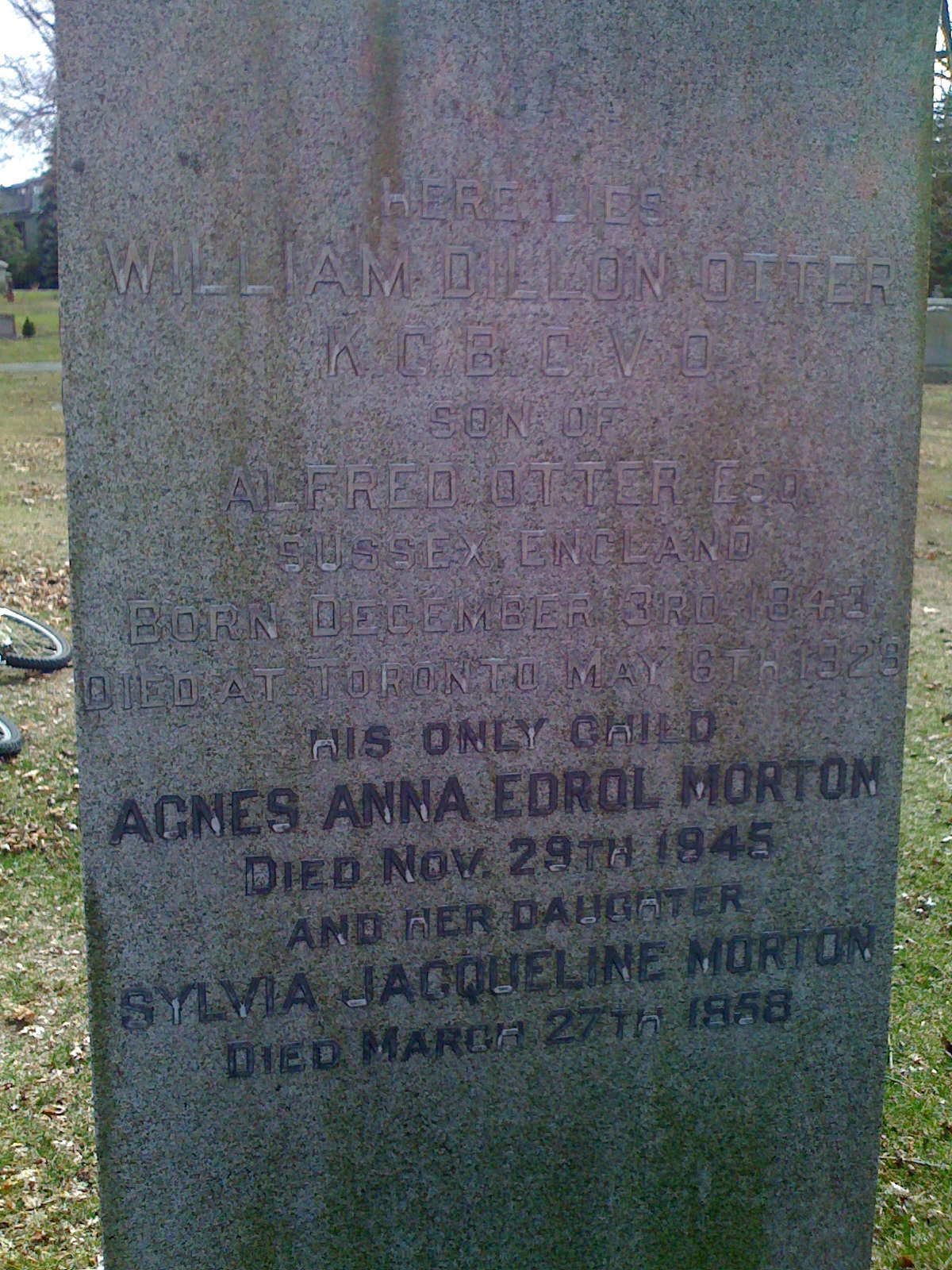
Gravestone of Major General William Dillon Otter, St James Cemetery, Toronto
In response to our last post about our exploration of St James Cemetery, Bill Paton kindly forwarded a photo of General William Dillon Otter’sgrave marker:
Lieutenant Colonel William Smith Durie Headstone
He also reminded us that the QOR’s first commanding officer, Colonel William Smith Durie was buried here as well. And while Rob, Shaun and I knew this was located here and had indeed seen it on our wanderings that day, I’d completely forgotten to mention it!
Bill also kindly included a link to the fascinating story of Colonel Durie’s son Captain William Arthur Peel Durie and who was killed in action during the First World War and the efforts of his mother to have has body returned to by buried in St James Cemetery. Link to his mother’s story here.
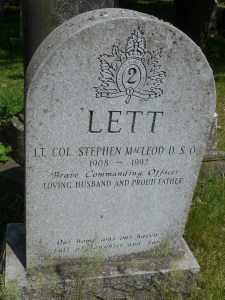
And lastly I completely forgot to include Lieutenant Colonel Stephen Lett, DSO who assumed command of The Queen’s Own Rifles in August 1944 and served until the conclusion of the Second World War. The museum was very pleased to acquire his medals in early 2015.
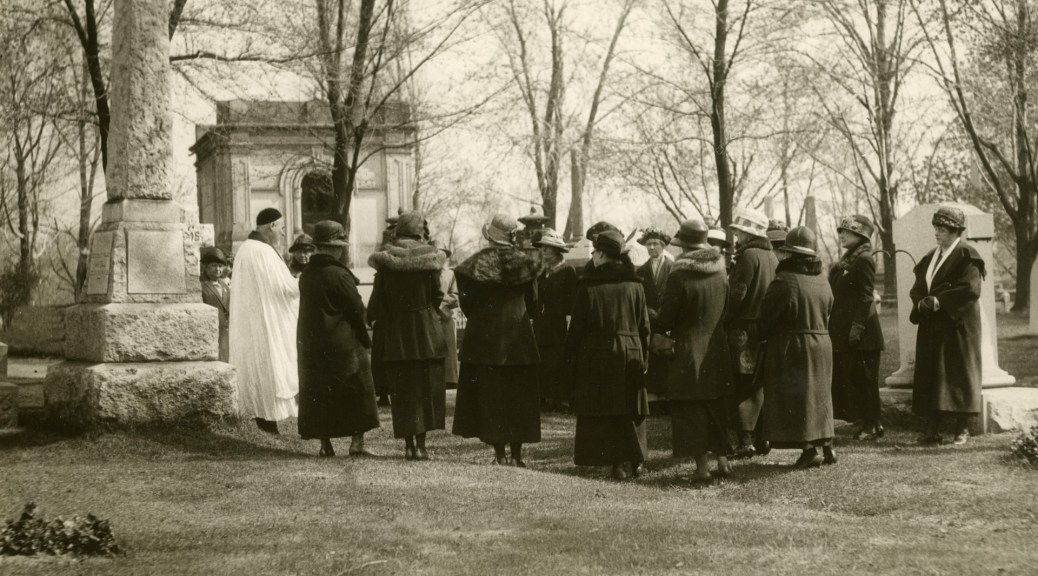
The photo above was printed in the Toronto Globe in May 1924: “Graves of departed veterans of the Queen’s Own Rifles, located in several of Toronto’s burial places, were decorated yesterday by the Q.O.R. Chapter, Imperial Order Daughters of the Empire. Rev. Canon Cody conducted the service of the Church of England suitable to the occasion.”
This year when the Regimental Church parade was finished, two former RSM’s CWO (Ret) Shaun Kelly and Captain (Ret) Rob Chan joined the museum curator at St James Cemetery. We had recently been researching information about Bugle Major Charles Swift who served as the Bugle Major of The Queen’s Own Rifles for most of his 57 years of service – service which included the Battle of Ridgeway and the North West Rebellion. We’d come across a page inserted in a Bugle Band minute book which outlined arrangements for his funeral that indicated he’d been buried at St James Cemetery.
Grave marker of Bugle Major, Captain Charles Swift
So our object on that sunny Sunday afternoon was to find his grave. Unfortunately the cemetery office was closed so we thought we’d just take a look around and see if we could spot it ourselves. Three hours later we actually found it – just as we were about to give up!
Sadly as you can see from the photo at right, the marker has not weathered well and little can be read aside from the large “SWIFT” on its base. Subsequently the cemetery office did confirm that this was indeed his gravesite. Perhaps its time for the regiment to consider placing an additional marker as we’ve done for those from the Battle of Ridgeway….
What surprised us most that afternoon, was the number of other Riflemen we came across as we crisscrossed the cemetery.
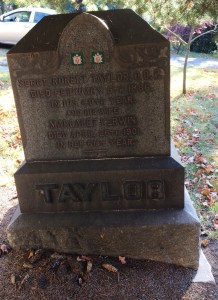
Grave marker of Sergeant Major Robert Taylor
Among one of the oldest was that of Sergeant Robert Taylor. Research by Shaun has found he was listed in the nominal rolls as the regiment’s Sergeant Major from at least 1864 to 1867 although the appointment may just have been temporary. (A note that we did NOT place the QOR stickers which are found on many of these grave markers but believe they were put there but a member of the bugle band who has since passed away.)
Sergeant Major Samuel Corrigan McKell
Another Nineteenth century Sergeant Major was Samuel Corrigan McKell who rose to that appointment in 1889 after serving in the Northwest Rebellion.
Unfortunately McKell would not be in the position long, by December of 1890 he had died from blood poisoning. The funeral service was a large one as McKell was not only popular within the regiment but also outside of it so there were scores of soldiers from the Grenadiers and the Body Guard as well as around 460 Riflemen from the Queen’s Own in attendance.
The large memorial was erected by his comrades.
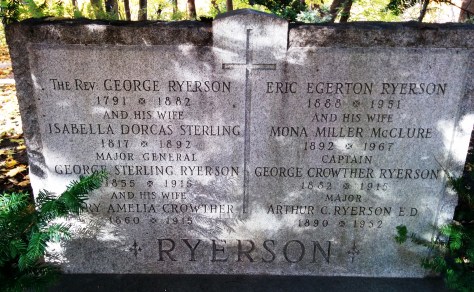
Other Riflemen buried there include the following:
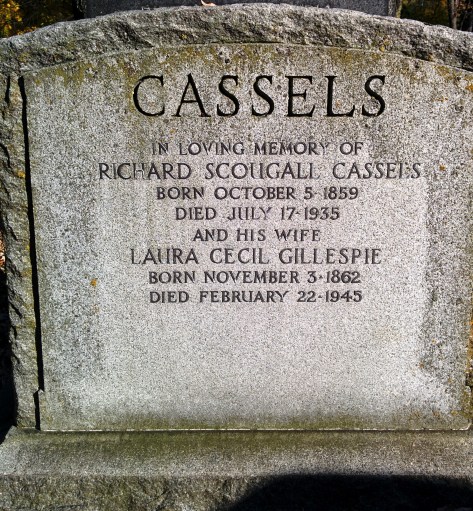
Captain Richard Scougall Cassels served with The Queen’s Own Rifles in the Northwest Rebellion (during which he kept a diary) but later became a founding officer with the 48th Highlanders. He was also a partner of the law firm Cassels Brock which still exists today.
Grave marker of Captain Richard Scougall Cassels
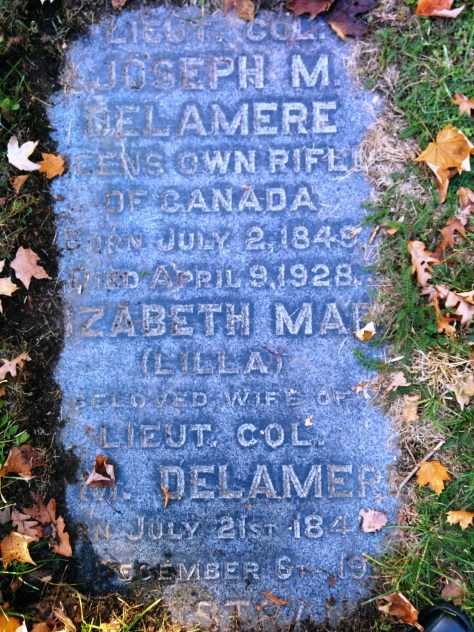
Lieutenant Colonel Joseph M. Delamere commanding The Queen’s Own Rifles from 1896 to 1900. His service included the Battle of Ridgeway, the St Patrick’s Day riots, the Belleville Riots, and the Northwest Rebellion. His son also rose to the rank of Lieutenant Colonel, and his grandson Colonel John Morison Delamere, MBE, ED, CD also commanded the QOR.
Grave marker for Lieutenant Colonel Joseph M. Delamere
The thirteenth Commanding Officer was Colonel Arthur James Ernest Kirkpatrick VD, who joined the regiment in 1893 and would command C and D companies of the 3rd Battalion, Canadian Expeditionary Force at the 2nd Battle of Ypres and after a valiant stand, was taken prisoner.
Grave marker Colonel A.E. Kirkpatrick
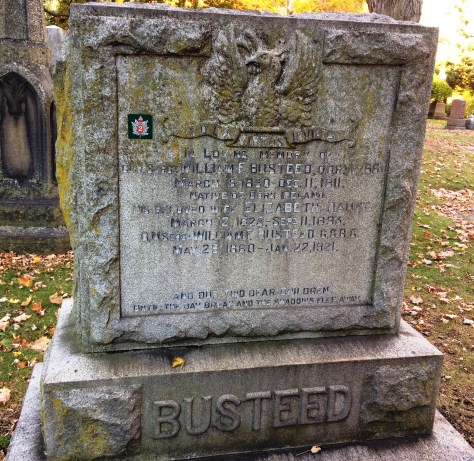
Colour Sergeant William F. Busteed was a veteran of the Fenian Raids of 1866.
Major Villiers Sankeywas also the City of Toronto chief surveyor and Villiers St in the Port Lands is named for him. His youngest son, Lieutenant Colonel Richard H. Sankey would command the 3rd Battalion (CASF) , Queen’s Own Rifles during the Second World War (May 21, 1942 to Aug 15th 1943.)
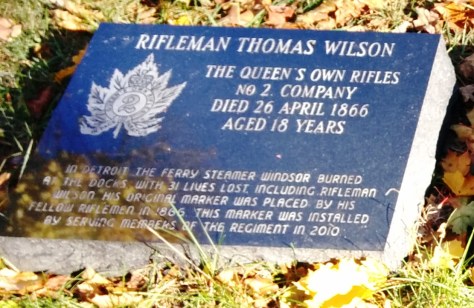
Less well know though was 18 year old Rifleman Thomas Wilson, who died in Detroit when the ferry steamer Windsor burned at the docks with 31 lives lost on 26 April 1866. The orginal marker was placed by his fellow Riflemen and a newer marker by the regiment in 2010.
Lastly we found the marker for General William Dillon Otter, adjutant at the Battle of Ridgeway, commander of a column in the Northwest Rebellion, commander of Canadian Troops in South Africa and Canada’s first Canadian born full General. Unfortunately we don’t seem to have a photo of his grave marker so it will definitely mean a trip back to St James in the future.
At the going down of the sun and in the morning We will remember them.
Even though I arrived 15 minutes before our designated “start time”, Graham had already unlocked the office, set up tables for cataloging, and tried to sort out a DVD display that wasn’t working properly; Cheryl had started sorted through and ensuring the proper documentation for a pile of new accessions; and Elizabeth was re-gluing a loose photo on our window exhibit.
Down the hallway, Rob was giving a tour of the museum – interspersed with a lot of reminiscing – to Josie who had joined the QOR at aged 18 in 1972 and one of the first women to wear the QOR cap badge and parachute with them. Later in the evening Cheryl and Emily who are working our “Women in the QOR” exhibit for next March, looked through photos Josie had brought along and made arrangements to formally interview her in the near future.
Alex arrived and got to work installing a fourth hanging rail in the uniform closet above one of the existing rails in a space with a very high ceiling. This will allow us to spread out and better organize this part of our collection but also means a lot of drilling while standing almost on the top of a step ladder.
Laura got to work cataloguing an archival collection from Professor George Henry Needler, Professor of German at the University of Toronto for 45 years, and a Queen’s Own veteran of the Northwest Field Force of 1885. During the First World War, Needler commanded UoT’s Canadian Officers’ Training Corps, and would later publish his own experiences out West in Louis Riel, The Rebellion of 1885. It should be noted that cataloging an archival collection takes a LOT of patience, attention to detail, and ability to grasp a logical organization of the material it contains.
Larry headed into his photography “studio” in the corner of the photo storage room – under the sloping eves and against an internal brick wall. There he continued his seemingly never ending task of photographing each and every artifact in our collection – which include a continuous intake of new accessions. These photographs are used for our collection database, our website, exhibits, banners and signs, shared with family researchers, and uploaded to our Flickr account (currently with over 7,700 photos).
Dave and his nephew Coleman arrived and set to work cataloging objects – photos, uniform pieces, books, equipment, insignia, and all kinds of military ephemera. Some of these were items that had been in the collection but were being cataloged in detail – a project we’d been working on since 2012 – and others were new accessions received over the past year. This cataloging includes detailed descriptions of the artifact, its provenance, size, material, dates, condition and whatever other information we might have, as well as assigning and attaching/affixing an object number. Eventually all this information will be entered into our database which already includes over 1,600 items. And the database allows us to upload our catalog online so anyone can search through our collection!
Alison was in the office working studiously on her computer creating medal description labels that will be added to walls of our “Riflemen” room. These will help visitors identify medals in the many shadows boxes and understand what they were awarded for.
Emily put her fine arts background to work again while planning how best to finish the photo “stand” we created for Ridgeway which consists of two QOR soldiers painted on a wooden sheet with cut outs to poke your heads through for that perfect selfie! Even in its 75% finished state, it was a big hit at Ridgeway in June and we hope to have it set up again for QOR Day at Casa Loma on November 5th.
Graham also was hard at work cataloging objects and finished up his initial batch just in time to receive delivery of a new acquisition – an amazing set of five photo albums which document the WWII service of a junior QOR officer from 1939 to 1946. In great condition, well mounted and almost entirely labelled, they will provide a great addition to our understanding of this period of the regiment’s service.
By now Alex and Elizabeth had also joined the catalogers and were certainly making progress on reducing our backlog!
Meanwhile, as Curator, I was assigning tasks, answering questions, recalling (more or less) information, making decisions, looking for scotch tape, and doing my best to steer the ship.
Part way through the evening I was pleased meet and provide a tour with Captain (Ret’d) Rick Towey, newly appointed Curator of the Royal Regiment of Canada’s regimental museum, located in Fort York Armoury. Rick is anxious to get some advice on how to get started with his new role – the museum (or collection of “stuff dumped in a room” as Rick described it) and some of us will be visiting the Royal’s Museum shortly and hopefully provide some helpful guidance!
As you can see, on any given night there are a wide variety of tasks, all of which are necessary to make things work like a well-oiled machine – more or less. And our volunteers are come with a variety of skills, experience and interests which are critical to creating the kind of museum team we need:
Graham, Emily, Dave and Alison are all currently serving members of the Regiment
Larry, Shaun (on sick call last night) and Nicole (also absent as she plans her wedding later this month) are all former serving members of the Regiment
Cheryl and Elizabeth are graduates of museum studies programs
Alex has a Masters in Public History
And Laura and Coleman just have an interest in history, museums and archives
A creative, cheerful, hardworking and dedicated team – what more could a curator ask for?
John
(And in case you were wondering, yes we do store bayonets in a bathtub – where else would you put them?!)
The article below is an excerpt from The 48th Highlanders of Toronto, by Alexander Fraser, M.A. which was published in 1900 as “The Origin and History of this Regiment and a short account of the Highland Regiments from time to time stationed in Canada.”
——————————————————————————
Among the things around which military memories linger in Toronto is the Company of Highland Rifles, at one time attached to the Queen’s Own Rifles. The veterans of to-day delight, as veterans only do, in reminiscences of the time when they served in its ranks, and to them it is a source of regret that no adequate account of it has been preserved.
Within the scope of this work only a brief notice is permissible; yet, as a company in which the Highland idea of soldiering was enthusiastically upheld and exemplified, a short sketch is obviously in place in this volume.
The company was raised on the 18th of September, 1856, those chiefly instrumental in its organization being: A. M. Smith, at one time in the 93rd Sutherland Highlanders; A. T. Fulton, merchant; John Gardner, at one time in the 71st Highland Light Infantry: Robert Sutherland and Mr. R. H. Ramsay. The first officers were: A. M. Smith, Captain; A. T. Fulton. Lieutenant; John Gardner, Ensign; Francis McMannus Russell, Surgeon. It was then known as No. 3 Independent Volunteer Rifle Co. of Toronto.
When the independent companies were formed into No. 2 Battalion Queen’s Own Rifles, the Highland Company was designated No. 4 (Highland). At that time Captain A. M. Smith was appointed Major in the Queen’s Own Rifles, and his place was taken in the captaincy of the Highland Company by Lieutenant Fulton. Ensign Gardner becoming Lieutenant, and John Sheddon, Ensign. This was in May. 1860. Captain Fulton is said by Mr. Chadwick to have been “a splendid drill, and aided by the natural steadiness of the Highlanders, soon obtained a reputation for his company which they ever afterwards maintained.”
In 1863 Captain Fulton retired [promoted to Major and appointed to Battalion Staff] , and Lieutenant John Gardner was, on the 21st August of that year, appointed to the command of the company, with R. H. Ramsay as Lieutenant, and Donald Gibson as Ensign. ln 1866 Captain Gardner retired from active command and was succeeded by Lieutenant Ramsay as Captain with Ensign Gibson as Lieutenant. and Mr. Henry Scott as Ensign. These were the officers of the company at the time of its dissolution.
Although No. 4 of the Queen’s Own Rifles, at first, the company was, being dressed in the kilt, always placed on the left of the line of the parade, and for this reason the number was changed from 4 to 10, the latter number being the one by which it is familiar to the survivors of those connected with it.
In 1866 Captain Gardner was associated with Captain Ramsay in the Fenian Raid expedition, and commanded at Ridgeway. It is related with pride how the Highland Rifles was the last to retire from the field. Mr. Matheson, druggist, Toronto, acted as company bugler that day, and when the “retreat” was sounded he did not interpret it as a retire call. Some one in the front ranks called out to Captain Gardner that he had heard a retire call. That officer was enraged at the idea and shouted back: “If you say it again I’ll cut you down with my sword. It’s a charge. Are you ready?” Pouches were examined and those who had three or more cartridges left had to share one or more of them with those who had only one or none. The ammunition was nearly all spent. These are said to have been Captain Gardner’s orders We are now to charge. Steady men! Go forward at the double, keeping steady as if on parade. You know how to do it, you’ve done it often at drill. Keep steady as you march on, but cheer for all you’re worth.” The company advanced about twenty paces at the double when an officer rode up and shouted Halt! where are you going with these men, sir? Can’t you see the line has retired?” The order was then given: “The shortest way to the reserve” and the company retired. Among those wounded were John Whyte and Forbes McHardy.
The company lay at Stratford for some weeks, and there a photograph was taken of the company, with its officers in front, which is a much cherished relic in many homes now scattered over Canada and the United States, for members of the Highland Rifles have followed Fortune wherever her smile beckoned.
No 10 (Highland) Company, June 1866
On the 1st of October, 1868, the company disbanded because the Government refused to grant an allowance in lieu of the ordinary uniform: or perhaps it would be more correct to say that for the sake of uniformity the military authorities insisted upon the company adopting the same uniform as the other companies of the regiment wore and as the Highlanders were not permitted to wear the kilt, they declined re-enrollment under the Militia Act of 1868. and so became extinct.
The members continued to meet at their old rendezvous, and not having now the bond of military duty to keep them together, the idea occurred to some of them that they should form themselves into a Scottish society. About that time the old Highland Society of Toronto was less active than usual, and an amalgamation was brought about between it and the members of the Highland company, the combined body being named the “Caledonian Society of Toronto,” including Highlander and Lowlander, under the Gaelic name “Caledonia,” usually derived from “CoilIe daoine.” “Woodlanders.” It is interesting to note that the society thus formed. should, twenty-three years afterwards, in 1891, have retained so lively a recollection of the experiences associated with the old Highland Rifles as to be among the most enthusiastic promoters and generous donors of the 48th Highlanders at the period of its organization.
Pipe Major Alexander M. Oliphant, Toronto 1865
The interesting list of the original members is as follows: the officers as already mentioned Quarter-Master-Sergeant George Ocil. Col.-Sergeant Robert Sutherland, Sergeants Robert Morrison and James Gray. Corporals Robert Jaffray and Wm. Ramsay. Piper Donald MacRae, Bugler Wm. Wallace, Privates Archie McFarlane, Wm. Bansley, Alexander Barrie, Henry Braid, John Calver, William Cos, Nicholas Cumming, Andrew Fleming, Peter Gardner. George Gilchrist, William Goldie. George Gratton, Alexander Gray, Allan Walker, Walter Wilson, Daniel Rose, James Mowan, John Atchison, Neil Johnston, Wm. G. Kemp. Alexander Moodie, Malcolm Morrison, Joseph McGeorge, Wm. McGeorge. Alaistair MacDonald. Thomas MacIntosh. Duncan MacKjnnon, Alistair H. Oliphant. Henry McLeod, Robert H. Ramsay, Adam Reid, David Ross, Alexander Thorburn, George Wills, James Wilson, and Sam. Hutcheson.
The uniform was the same as that of the 93rd Sutherland Highlanders, with the exception of the feather bonnet the glengarry being worn —and the tunic, which was of green material with red facings.
Another Highland company which was connected with the Queen’s Own Rifles. Toronto, was “F” or No.6 company of Whitby. It was incorporated with the Queen’s Own on the formation of the latter in 1860. It does not appear to have ever paraded with the regiment although not gazetted out until November. 1862. It is now No. 1 Company of the 34th regiment.
The morning of 2 June 1866 was hot and humid as the volunteers of the Queen’s Own and 13th Battalion marched down main street of Ridgeway, Ontario towards battle with the invading Fenian Army. 150 years later, Saturday 4 June 2016 was just as hot and humid but for the volunteers of the Queen’s Own Museum and Archives the biggest enemy was trying to assemble the army tentage as they set-up their display at the Crystal Ridge Arena in Ridgeway. The museum volunteers had been preparing since early spring when it was decided that the museum would participate in the commemoration event of the 150th anniversary of the Battle of Ridgeway.
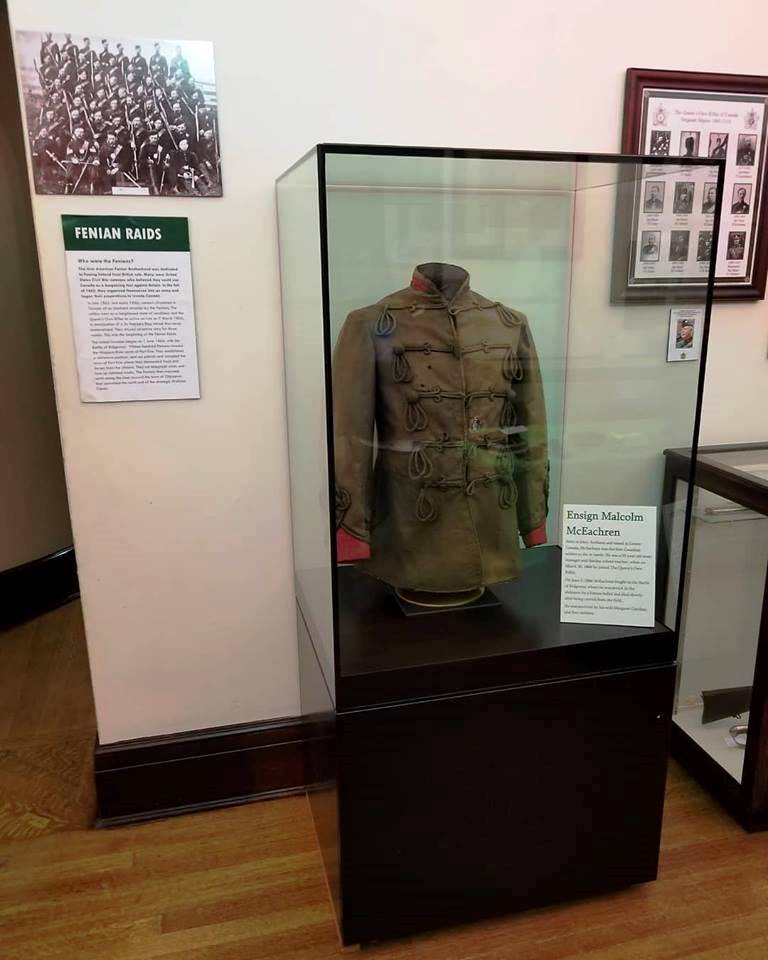
It was agreed upon that despite the risk, we would take one of our most important artifacts; the tunic belonging to Ensign Malcolm McEachren who fell in the battle that day and would become the first soldier to die in battle from the regiment. The tunic would be the centre piece of the display.
Ensign McEachern’s tunic on display
The volunteers also produced a set of pop-up signs and posters describing the battle and the part the Queen’s Own played in it.
Museum display tent
At the last minute it was determined that the Pattern 1853 Enfield rifle that was carried by Rifleman John Mewburn during the battle until he was shot would also be available to be put on display thanks to a generous and trusting owner. The rifle was taken back to the University of Toronto by his student comrades after he fell in battle. It was held by the school for many years but it is said it was sold-off after a fire in the late 1890’s.
from L-R, Rifleman Mewburn’s Snider Enfield, listing of casualties, Fenian Raid medal, trophy presented to Mrs Pring by officers of the regiment in 1866One of the most popular exhibits was a cut-out of QOR soldiers for people to pose for pictures with.
The day turned out to be a complete success; almost 500 people visited the display, the weather was perfect, the volunteers were able to to tell the story of the regiment and its soldiers, and all the artifacts were returned safely to the museum and their owners.
Once again, the Regiment has worked with its fellow regiments, The Governor General’s Horse Guards (GGHG) and The Royal Regiment of Canada to honour the 3rd Battalion (Toronto Regiment), Canadian Expeditionary Force, which each unit perpetuates.
On May 30th, the GGHG dedicated new markers in the town of Courcelette to commemorate the battle honours of Somme 1916, Pozieres, Flers-Courcelette and Ancre Heights, all costly battles for the 3rd Battalion and the 4th Canadian Mounted Rifles, which the GGHG also perpetuate.
Costs for the memorials are shared between the three regiments. Previous markers commemorate St. Julien and Passchendaele, and a marker for Mount Sorrel was dedicated in June.
On this 72nd Anniversary of D-Day, we’d like to share these interview transcripts. As part of a school project, Ryan Lutz and Andrew Brooks interviewed each veteran in his home on Sunday, November 15, 1998. The interviews were recorded on audio tape and transcribed to this document by James Lutz.
Charles Dalton (and his brother Elliot Dalton) is interviewed on the DVD “Canadians on D-Day: The Juno Beach Centre”.
Rolph Jackson is interviewed on the DVD “D-Day: Canada’s 24 Hours of Destiny” and in Lance Goddard’s related book “D-Day Juno Beach: Canada’s 24 Hours of Destiny”.
Jack Martin is interviewed on the DVD “D-Day: Canada’s 24 Hours of Destiny” and in Lance Goddard’s related book “D-Day Juno Beach: Canada’s 24 Hours of Destiny”.
Questions Asked of the Veterans:
What was your rank when you landed on D-Day?
What was your first reaction when you heard you were going to land on June 6?
What were the days like leading up to the landing on D-Day?
What was it like and what were your feelings when you were coming in on the landing craft?
How did everyone else feel?
What happened when the ramp dropped when you landed? What were your feelings at this time?
When you first got onto the beach, what were your feelings and what did you do?
What was the atmosphere like during the battle?
What did you do when you got close to the enemy? Did you feel a sense of relief or accomplishment when you got near?
What was your first reaction when you started taking prisoners?
What was your first reaction when you looked back on what you had just done, after the battle?
What did you do you after the battle?
What are your feelings at the present day?
Do you have any other comments on D-Day and your experience?
Interview with Charles Dalton
Major Charles Dalton receiving the DSO from General Montgomery
Charles Dalton joined the Cadet Corps of the Queen’s Own when he was 15. He was a 34-year-old Major when he commanded B Company. A and B Companies made up the first wave which landed at 0812 hours. B Company was on the left, and A Company, commanded by his brother Elliot Dalton, was on the right. Major Dalton was awarded the Distinguished Service Order (D.S.O.) for his leadership in the war and later served as Honorary Colonel of the QOR.
What happened when the ramp dropped when you landed? What were your feelings at this time?
When I said “Follow me!” and dashed down the ramp into 12 feet of water, I disappeared. I had an 85-pound pack on my back with ammunition and food and so on plus I had a life preserver on, so we all sank just like stones. So when people say we ran up the beach, I say “Run? I was barely crawling up the beach!” And we were full of water because the impregnated battle dress we were wearing at the time kept the water from running out.
The man next to me was hit seven times down his arm. I didn’t get touched. We scrambled up the beach and when I looked back, I was horrified to see that there was nobody following me. Now, one of the difficult things about leading is that you never can look back, because if you look back, the people behind you then get the feeling that you’re stopping and that the smart thing to do is get down out of the line of fire. When I looked back I thought they had gone to ground, but in fact they were lying at the water’s edge and Germans were firing at them as they lay wounded.
So in 10 minutes, of the 120 men I had with me, we were all either killed or wounded.
When you first got onto the beach, what were your feelings and what did you do?
Of course you’re always frightened, no question about that, but all I could think of was that our Medical Officer had said “Now look, 50% of you are going to be casualties. If you’re hit, one of two things will happen. If you’re dead, your problems will be over. If you’re wounded, you’re going to get better. So just lie there and keep quiet and wait for the medical people to catch up with us, but nobody else will stop to help you, because if they do the whole thing will stop.”
So I kept thinking, what I’m really worrying about is whether I’m going to survive, but it looks as if you don’t have much choice in this whole thing. So the important thing is that I can give the leadership that they’re expecting from me because I have their lives in my hands. If I make the wrong decision, we’ll all wind up being killed or wounded, and if I don’t make any decision, we’ll have the worst chaos of all. So I’d better just get on with the idea of doing the best job I can and forgetting about whether I’m going to be sacrificed as we land on the beach.
Maj. Dalton, Semple, Mr. Jackson, taken by Hugh Lamb
What did you do when you got close to the enemy? Did you feel a sense of relief or accomplishment when you got near?
The pillbox I was assigned to attack was supposed to have been taken out by the Engineers and the Tank Corps, but that didn’t happen because it was too rough and the tanks tended to sink right off the landing craft. So it wasn’t until later, after I had been hit, that I recognized that I wasn’t going to be able to get in this pillbox because it had a steel door and a 36 grenade wasn’t about to blow the door in. So I finally decided that if I used my Sten gun at the two machine guns that were firing, but they had a shield over their guns so that nobody could fire in. So I had a ladder that we put up the wall, and then I fired at the shield with the hope that the bullets would ricochet off them and fly around inside their pillbox. And actually they did, so the machine guns stopped firing, but we were still no closer to getting in.
Meanwhile, one of the German officers got his 9mm revolver out and fired at me and it drilled through my helmet and down the ladder I slid. One of the stretcher bearers was there and said to me, “Sir I thought you were smarter than that, to stick your head over the top of that wall”. I said, “I wasn’t trying to be smart, I was just trying to find some way to stop these people from firing, and at least I’ve accomplished that much.” So when the tanks came up, they did just that.
What did you do you after the battle?
It was about 8:30 in the morning, I guess, and I was walking along the beach trying to catch up with the rest of the company. A medical officer saw the bandage on my head and he took the dressing off and put another bigger one on. He said, “You will be back in England by tonight,” but I wasn’t back in England that night, I was lying on stretcher on the beach until 3 o’clock in the morning. People came along and put cigarettes in my mouth and gave me some rum, but after a while you realized you were terribly uncomfortable with all that sand inside your clothes.
So on the third day we were put on a tank transporter which was large landing craft, and we were stacked up three high in stretcher. By that time, cigarettes were getting pretty scarce, but here’s the kind of comradeship we had. I would light a cigarette and take two puffs and then pass it to the man above me who took two puffs. And if nobody cheated it would go all the way up to the top rack and back down and I would get the last puff. Well, most people would say “Here I am, and I don’t even know if I’m going to be alive by morning, so I’m going to take a really good drag on it,” but nobody did. And that’s what people missed when they got home, and that’s why a lot of them signed up to go to Korea.
Interview with Rolph Jackson
Rolph Jackson was a 23-year-old Lance Corporal on D-Day. He was in charge of a Bren Gun Section of B Company which was in the first wave, landing at 0812 hours.
What was your first reaction when you heard you were going to land on June 6?
We figured it was the only way we could get home. We were awfully tired of being away from home. We’d come over in ’41 in the summer and the English got used to us and we got used to the English, but it was an awful lot of training. It was a job. We knew it was going to be tough. You people are not brought up with Canadian history, but we had our forefathers, our fathers’ generation’s reputation to live up to from World War I. And we did it.
What was it like and what were your feelings when you were coming in on the landing craft?
Let’s get it over with! When we first saw the beach, it was on the dark side of dawn. It was British war time which is two hours ahead of solar time. It was double daylight, if you follow me. You could see outlines against the dark side. The beaches were under bombardment. You could see the ships at sea, a massive flotilla, the most ships I’d ever seen. We landed while part of the bombardment was still going on. Many of us that survived felt it would have been better to land without the bombardment because the beaches were manned when we got there.
We had rocket craft that had 1400 rockets. They fired them in batteries of 20, and they killed a lot of cows. Unfortunately a Yankee Thunderbolt [aircraft] was patrolling the beach and they took out one of their Thunderbolts. That was the first casualty we saw.
What happened when the ramp dropped when you landed? What were your feelings at this time?
Our landing craft had two sections of infantry, about 20 men, and a section of engineers. They were demolition engineers. We landed at the sea wall. I’ve seen the Yankee beaches and they were very shallow, but ours was very steep. I was – if you’ll pardon me – up to my balls in water.
We hit the beach and it was a slaughterhouse. They cut us to ribbons. Of the 10 men in my section, 7 were dead and 2 of us were wounded. Two of us crossed the wall. In our platoon, there were 6 men left by 2 o’clock the next morning, 6 out of 36. I was hit in the hand in the water and knocked off my feet.
I lost a lot buddies. I seen them go down. The sea was red with blood. Most of them went down in the water, and I think quite possibly drowned rather than was shot. We had to walk 25 or 30 yards in the water.
Lance Corporal Roph Jackson
When you first got onto the beach, what were your feelings and what did you do?
How did we feel when we were on the beach? Fairly angry. We were carrying a lot of assault equipment. If you were carrying anything but a rifle, you didn’t make it. Was I scared? You didn’t think about it.
We cleared one dugout. We presumed it was cleared – they didn’t come out after the 36 [hand grenade] went down there. German grenades were concussion, and ours were shrapnel. I have a piece of German grenade in my shoulder still. The doctor gave me some sulfa because I had been shot in the hand.
We did what the Americans didn’t do. We had Dieppe for training. At Dieppe the soldiers stopped to help the wounded. We learned you can’t stop under fire because a moving target is harder to hit. We were told under no circumstances to stop and help the wounded. No way. Get in behind the enemy and take him out.
Was I scared? I guess maybe we were. We didn’t think about it.
What did you do you after the battle?
That night I wasn’t looking forward to having to dig in with one hand. I saw the M.O. [Medical Officer] and he evacuates me because I have bones smashed. I spent most of the night getting back to the dressing station. I fell asleep against a stone wall and maybe got 3 hours sleep.
Interview with Jack Martin
Jack Martin was a 20-year-old Rifleman (private) on D-Day. He was from Toronto, and his father and 4 brothers had all served in the QOR. Rifleman Martin was with the mortars who landed with C Company in the second wave at 0830 hours.
What were the days like leading up to the landing on D-Day?
We were confined to barracks – that was C.B. – waterproofing the Bren Gun Carriers. We had scissors and were cutting each others’ hair. I got a beaver cut.
What was it like and what were your feelings when you were coming in on the landing craft?
I was on a Landing Craft Tank with the Bren Gun Carriers. I was lying on the gunwale looking onto the water for mines. This was all new to me . . . I was just a kid of 20!
How did everyone else feel?
I never gave any notice to anybody else. I was just looking after this guy [meaning himself].
What happened when the ramp dropped when you landed? What were your feelings at this time?
When the ramp went down, we landed on dry sand and we ran right off. There was a captain giving us directions and he had blood streaming down his face. That scared me more than anything else. We were ordered to run right up to the wall for protection. I ran like hell. One of the other landing craft had flipped in the water. I couldn’t see what happened to the men because we were told we couldn’t stop on the beach. I thought it was a great accomplishment that we had gotten that far.
What was the atmosphere like during the battle?
It was hectic! This was our first time in battle. It means something if it’s permanent when they hit you.
What did you do when you got close to the enemy? Did you feel a sense of relief or accomplishment when you got near?
We were the mortars, so we didn’t get too near the enemy. We had to support the infantry. We were near the self-propelled guns which were firing at a German 88 [88mm gun]. An SP was hit, and it was loaded with ammo, so it blew sky-high. It was the worst explosion I ever heard, and I served from D-Day through to VE Day. The gun from the SP came whizzing through the air at me and right over our heads. It sounded like a freight train.
What was your first reaction when you looked back on what you had just done, after the battle?
I was tired. I got into my slit trench and went to sleep. We were in a barnyard, and during the night a German staff car pulled into the barnyard. The men in it went to sleep. In the morning, some of our soldiers woke the Germans – there were 2 officers and an NCO – and they were really surprised when we woke them up!
What are your feelings at the present day?
It was something to have lived through. I’m one of the few left. We were all volunteers, you know. I have no regrets. I had lots of great friends.
Further Information about these Veterans
Charles Dalton died in 1999 – see below for his obituary from the Queen’s Own Rifles website (qor.com).
Rolph Jackson died in 2006 – see below for his obituary from the Queen’s Own Rifles website (qor.com).
Jack Martin died in 2016.
Charles Dalton’s obituary from the QOR website:
Colonel C.O. Charles Dalton DSO, KStJ, ED
OC ‘B’ Company
D-Day
1910 – 1999
Colonel Charles Osborne Dalton, the last surviving D-Day company commander of The Queen’s Own Rifles of Canada who was recognized for his gallantry with the Distinquished Service Order by Field Marshall Bernard Montgomery, has died aged 88.
As Company Commander of B Company, then-Major Dalton, along with his younger brother, Elliot – who commanded A Company – led the two front line assault battalions on Juno Beach for The Queen’s Own Rifles – Canada’s oldest continuously serving infantry regiment.
The brothers, who had developed a strong bond, were known in the Regiment as “Mark I and Mark II” to distinguish the elder from the younger brother.
“The Dalton brothers were legends, everybody was devoted to them and had tremendous respect for them,” said Barney Danson, chairman of the Canadian War Museum’s advisory committee and colleague of Col. Dalton. “You always had confidence in what they were doing and they always had the human touch. But they both commanded great respect.”
At his brother Elliot’s funeral service in 1994, Col. Dalton said as D-Day approached and he began to realize he may never see his brother again, he tried to come up with some parting words.
But as they parted on their respective landing crafts he said quite simply: “I’ll see you tonight.”
As the landing craft ramp dropped in front of Bernieres-sur-Mer, Major Dalton turned to his men shouting, “Follow me!”, as they plunged into two to three metres of water, trudging their way to shore.
As they made for the seawall, Maj. Dalton turned back to see his men laying on the sand.
“I thought they had gone to ground for cover, then realized they’d been hit,” he remembered.
The company had landed directly in front of a concrete strong point and were immediately met with fierce machine-gun fire. Almost half of the company was lost in the initial dash across the beach. As he and his men tried to capture a German gun emplacement, Maj. Dalton was shot in the head, the bullet ripping off his helmet and peeling off his scalp.
Despite severe wounds, Maj. Dalton continued to lead his men across the beach and was personally instrumental in knocking out one of the pillboxes.
“With blood pouring down the side of his face, he still encouraged us to continue on,” said Joe Oggy, a retired Corporal, who was under Maj. Dalton’s command at the time.
His greatest fear, he once said, was not being wounded or killed but failing to lead his men. The citation of the DSO read, in part: “By this officer’s example of leadership and bravery, and his coolness in the face of stiff opposition, the enemy fortified position was quickly overrun, and the company which followed in the landing on the beach suffered no casualties from the beach defences.
“The casualties were the heaviest suffered by any Canadian unit that day. In the end, 56 other ranks had been killed in action; seven died of wounds. Six officers and 69 other ranks had been wounded.
As Maj. Dalton was evacuated to a hospital in England, his brother Elliot was mistakenly told that Charles had been killed.
“While I was sad to hear my brother had died, I didn’t really have time to grieve, as we were still fairly busy,” Elliot Dalton recalled.
However, Elliot was wounded a few days later and sent to the same hospital as his brother. As the nurse wheeled Elliot to the bed marked Maj. Dalton, he noticed a patient lay there with the sheet pulled over his head.
When the nurse asked the patient why he was in the bed, Maj. Charles Dalton replied; “Because I’m Major Dalton.”
During his recuperation, Maj. Dalton had the honour of meeting Queen Elizabeth, now Queen Elizabeth the Queen Mother.
By August, Maj. Charles Dalton had recuperated well enough to return to combat with the Queen’s Own and served through the Channel Ports campaign as second-in-command of the Regiment during the fighting of the Scheldt in Belgium in the fall of 1944.
He was promoted to Lieutenant-Colonel, and appointed to command the Non-Commissioned Officers School at Ravenstein, Holland. He returned to Canada in March, 1945, to command the Small Arms School at Long Branch, Ont., and retired from active service in September, 1945. From 1968 – 1975 he was the Honorary Colonel of The Queen’s Own Rifles of Canada.
Born in Toronto, Col. Dalton enlisted with The Queen’s Own Rifles Cadet Company in 1925 and the 2nd Battalion Militia a year later at the age of 16.
He volunteered for active service and was sent to England in March, 1940, as an instructor to the Canadian Infantry Training Unit. In 1943, he rejoined the Regiment and was soon promoted to Major and made Officer Commanding B Company.
“He and his brother were very distinguished guys. Charlie was the archetypal dashing young officer,” said Cpl. Oggy. “He really had a lot of style. He was elegant and acted the part of a fine officer.”
“He was fantastic. He was a buddy. His brother was the same way, very down to earth. We would follow him to hell if we had to. His friendliness and rank meant nothing to him as far as we were concerned, he was a buddy and we respected him. He never talked as an officer ordering this and that, he and his brother were good leaders.” Cpl. Oggy said.
His command responsibilities followed him to civilian life. After the war he joined Canadian Breweries Ltd. as Assistant to the Vice-President of Sales and was appointed Sales Manager of the Carling Breweries Ltd. in 1946. He was made President of Carling Breweries Ltd. in 1951. He was appointed Executive Vice-President Canadian Operations, Canadian Breweries Ltd. in 1964 and Executive Vice-President of Canadian Breweries Ltd. in 1965.
He also became Vice-President of Canadian Executive Overseas from 1969 to 1971. He was a popular and much sought after-dinner speaker.
“He was a reserved person. And yet he was amazingly articulate and spoke exceedingly well and he was asked to speak a great deal because he could express and talk about the war with a light touch and good humour but didn’t treat it lightly,” said Mr. Danson, who served as a Liberal Minister of Defence.
Colonel Charles Osborne Dalton was awarded the Distinguished Service Order by Field Marshall Bernard Montgomery for “leadership and bravery, and his coolness in the face of stiff opposition.”
During his recuperation from a head wound, Colonel Charles Osborne Dalton had the honour of meeting Queen Elizabeth, now Queen Elizabeth the Queen Mother.
Rolph Jackson’s obituary from the QOR website:
Rifleman Rolph Jackson
“B” Company
D-Day
1921 – 2006
Rolph Jackson was born April 6, 1921, in Toronto, a ninth generation descendant of Loyalist settlers from the U.S. Originally, the Jackson family came from County Armagh in Northern Ireland. His mother died when he was age six and his sister Lenore, two. The family struggled as their Dad had work only occasionally, especially during the lean Depression years. Rolph was sent to live with his uncle at age nine in 1930 on a farm in Grey County, near Holland Centre. His sister went to live with an aunt in the West.
Life on the farm in the 1930’s was difficult and the harsh environment in which he was raised significantly shaped his life. Rolph moved back to Toronto in 1937 to be with his father and to look for work. Rolph joined The Queen’s Own Rifles militia in December 1939, shortly after WW11 began. When the Third Division was mobilized for overseas service, he “went active” on 5 June, 1940, at age 19, enlisting in Baker Company of the 1st Battalion. He trained with them in Newfoundland and Sussex, N.B. prior to departing for England in the summer of 1941.
During embarkation leave, Rolph came back to Toronto and had a visit with Olive Lipski and family. She wrote him faithfully and he wrote back when he could.
On D-Day, his Baker Company was especially hard-hit, only Rolph and two others (Doug Hester and Bob Nicol) in his section survived. Rolph was wounded in the hand and after recovery remained in England until the end of the war.
Following Rolph’s return, he and Olive were married on 9 October, 1945, at Redeemer Lutheran Church, Toronto. Their daughter Chrystal was born in late 1947 and they soon decided they needed more room. They bought their first house: an “ugly four room” one and lived there from 1948 to 1952. After working at a variety of temporary jobs, Rolph got work at The Toronto Star in 1950 as a pressman and he worked there until retirement.
The Jackson family moved to a larger six-room bungalow in Scarborough (Pharmacy and Eglinton-St. Clair) just one block away from a public school that Chrystal attended beginning that Fall. Olive and Rolph lived there from 1952 until 1966 when Chrystal graduated from Grade 13 and they moved to the house on Roosevelt in East York. It was reasonably close to downtown for work for Rolph and a good community to live in.
The family attended Emmanuel Lutheran for a number of years in the 1950’s and early ’60’s where Olive taught Sunday School. She was also involved with the women’s group and helped with Christmas pageants. They had a lot of fun and liked to go to dances, shows and played cards a lot. Olive and Rolph were members of RCL Branch 344 from the 1970’s, when they met in a building on Elm Street (long since demolished), before moving to its current Lakeshore Avenue location.
They also took many interesting vacations: to the eastern United States, California, Mexico, Caribbean, Hawaii and to Europe four times, including memorial trips to Normandy as well as tours to Greece and the former Yugoslavia.
Rolph loved the out-of-doors. For many years he would take a friend and go canoeing and fishing in Algonquin Park, even into his 70’s when his friends weren’t able to go any longer.
After his wife died in 2001, Rolph lived as a widower in the house with his black cat, Midnight. His health declined and he eventually sold the house at 53 Roosevelt Road in 2005. He moved into Sunnybrook Hospital, Hees Wing, where he resided at the time of his death, just three days after the 62nd anniversary of D-Day.
—————————————————————–
This document may be cited as: Lutz, Ryan and Andrew Brooks. Interviews with Three D-Day Veterans of The Queen’s Own Rifles of Canada. Toronto, 1998.