Photo for Monday, 5th May
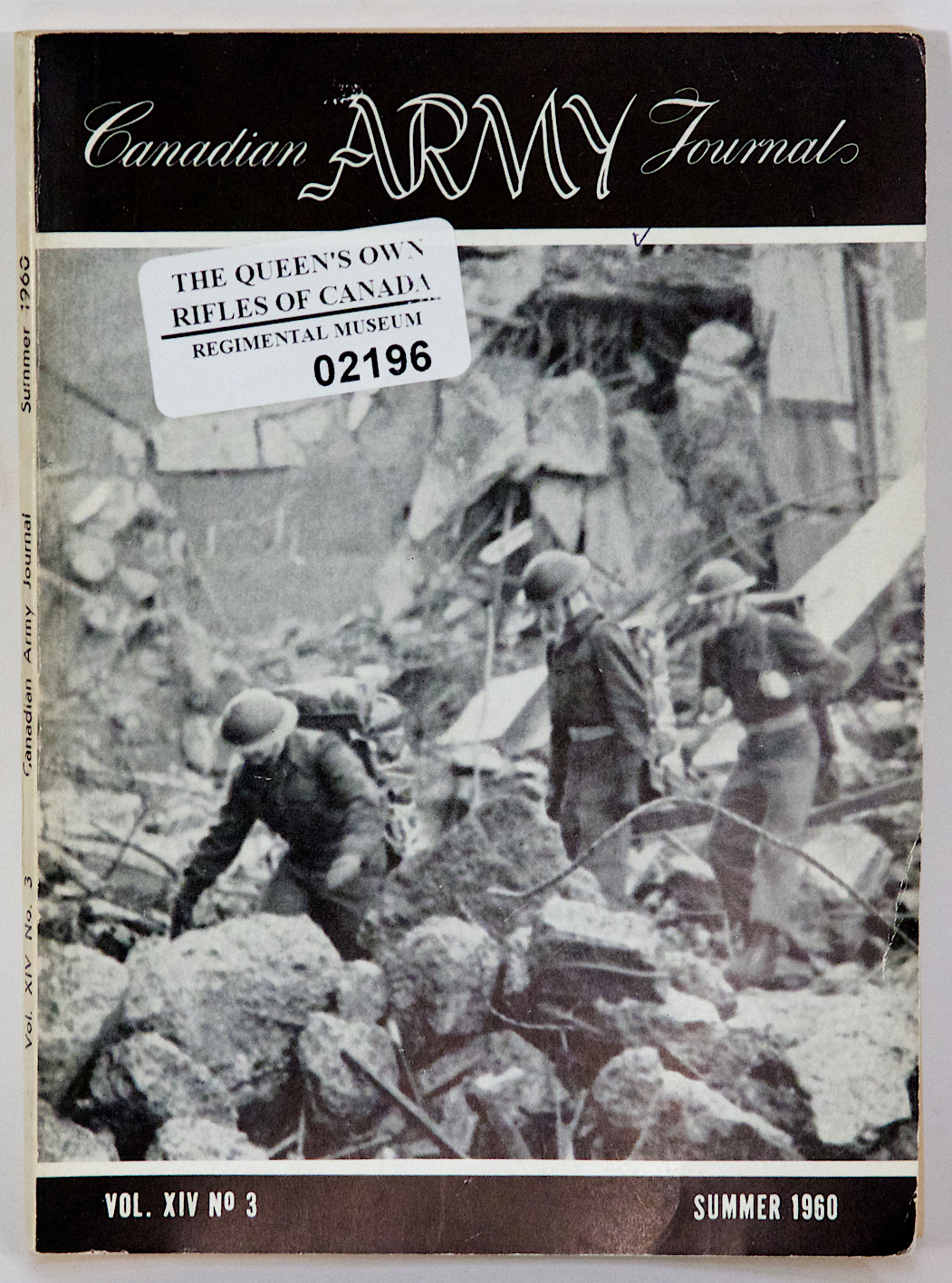
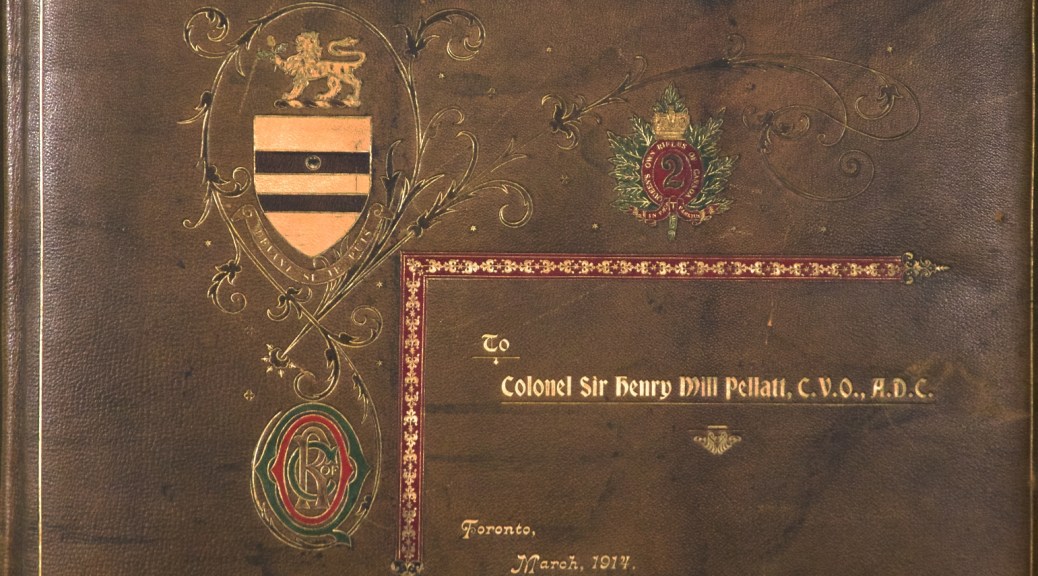
Lately we have featured a number of historic photo albums from our collection and today we have another one. In 1914 the officers of the regiment (which then consisted of two battalions and an RHQ) presented the Colonel Sir Henry Pellatt with a beautiful leather covered photograph album of officers in the regiment. Most of the 21 pages have three or four photographs on them and they are shown in order based on the date of their commission and are beautifully presented with colourful calligraphy.
Once again our volunteer photography Capt (Ret) Larry Hicks, has skillfully photographed each of the album pages but has also edited each photo individually as well.
You can find both photo galleries here.


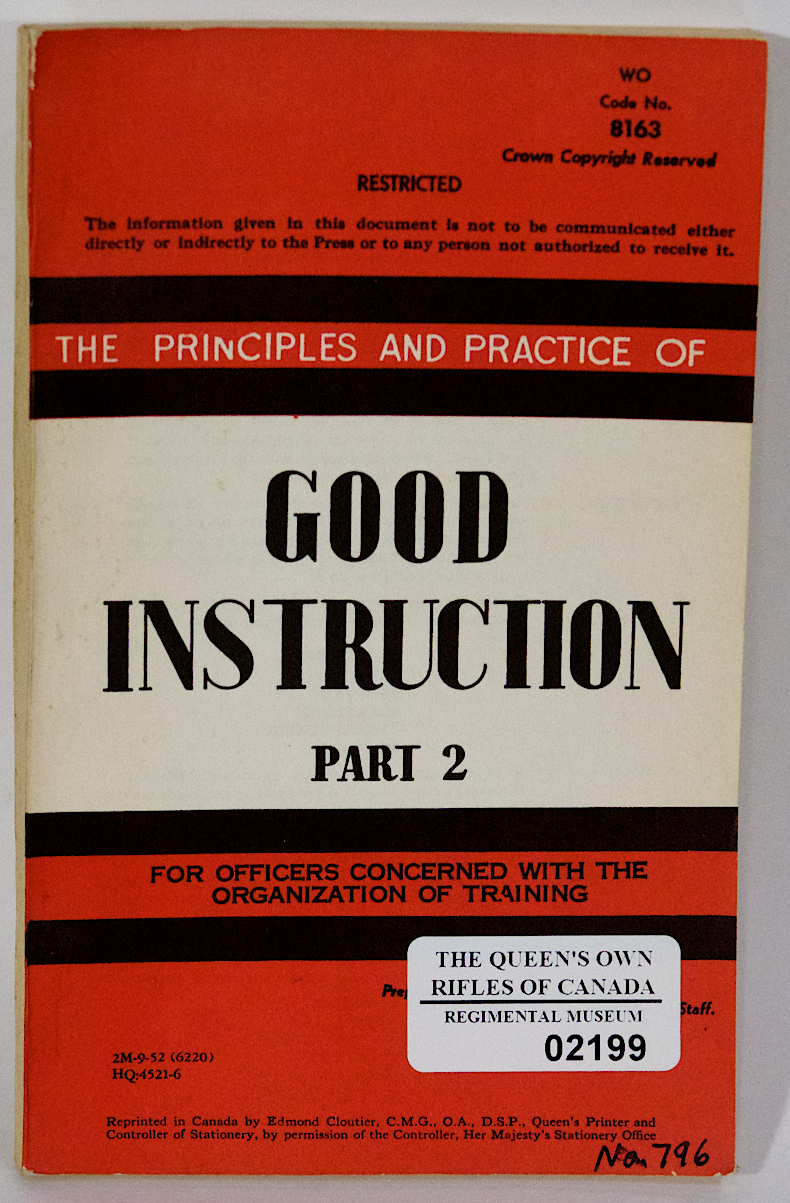
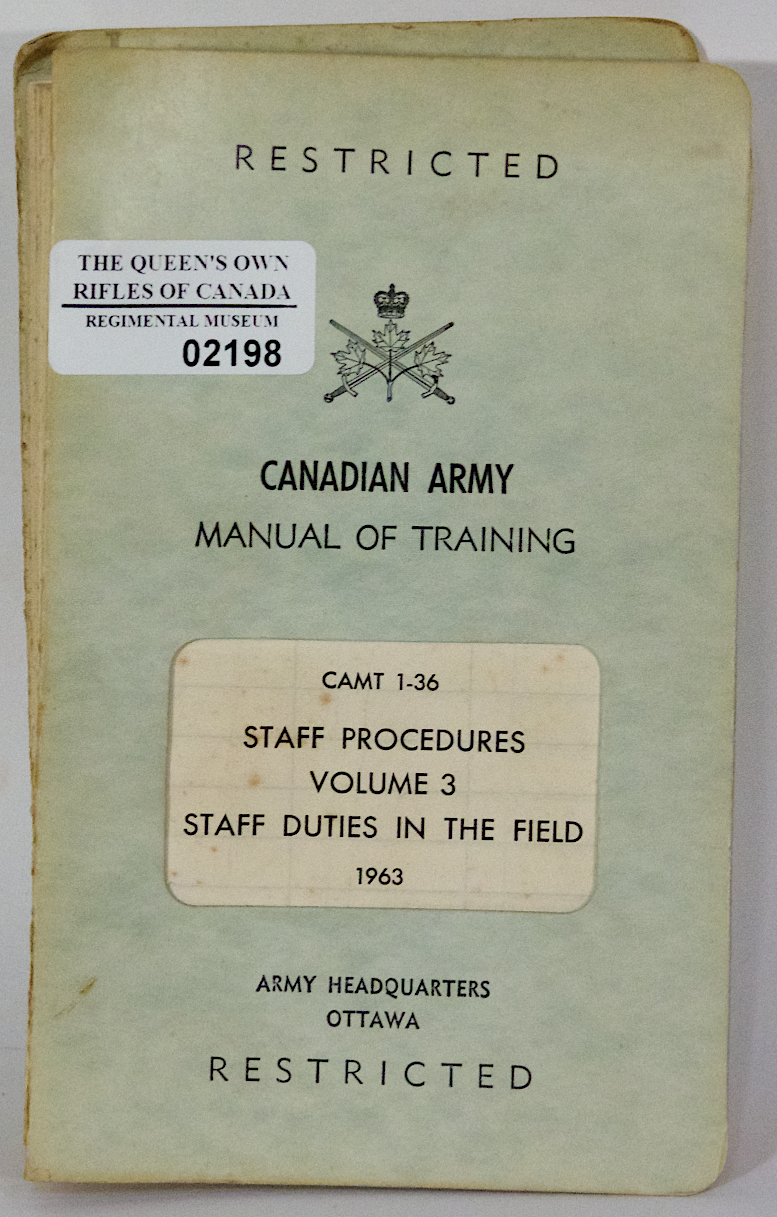
 As we continue to catalog and photograph our collection, we’d like to share three photo albums of the QOR Regular Force Battalions:
The albums have been photographed by one of our regular volunteers, Capt (Ret) Larry Hicks.
If you can help us, we strongly encourage you to comment on a specific photo to identify dates, people, places, or occasions!
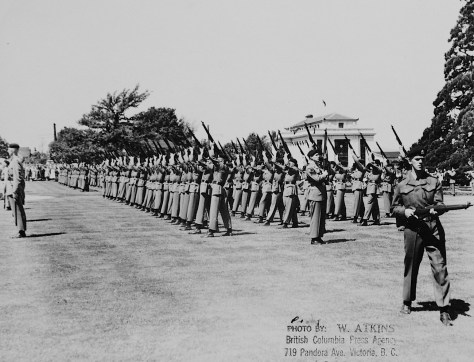

One of the joys of being the Curator (or a volunteer) is “discovering” fascinating items in our collection – particularly those interesting items that for one reason or another, are not on exhibit. One facet of our the collection is the archival material – records, manuscripts and photos – many of which date back to the 19th century. Some are in great condition and others not so much.
One which is in reasonably good condition, is a photography album entitled “Officers – Queen’s Own Rifles of Canada – 1893”. In contains 37 black and white portraits of the officers in the regiment in 1893 under the command of Lieutenant Colonel R. B. Hamilton. They include several names of those who later would command the regiment: Delamere, Pellatt, Mercer, Rennie and Royce. And as did Mercer and Rennie, others also held command roles during the First World War: Barker, Le Vesconte and Michell. Peuchen later commanded a QOR Battalion but was best known for surviving the RMS Titanic. Surgeon Lesslie and Assistant Surgeon Nattrass were long serving members of the Regiment.
Of interest to many will be the variety of regimental dress and headdress which appear in these photos which may not all have been taken in 1893 but certainly were of that period and shortly before.
As part of our ongoing cataloging project, Capt (Ret) Larry Hicks has been photographing many of our artifacts and archival materials and once again has done an excellent job of photographing these photographs so they can be added to our digital database and to our website.
I encourage you to take a moment to return to the 19th century and check out the contents of this amazing 1893 Officers’ Album on our Flickr site.
Check out this blog post on First World War swearing and slang::
http://www.warhistoryonline.com/war-articles/swearing-wwi.html
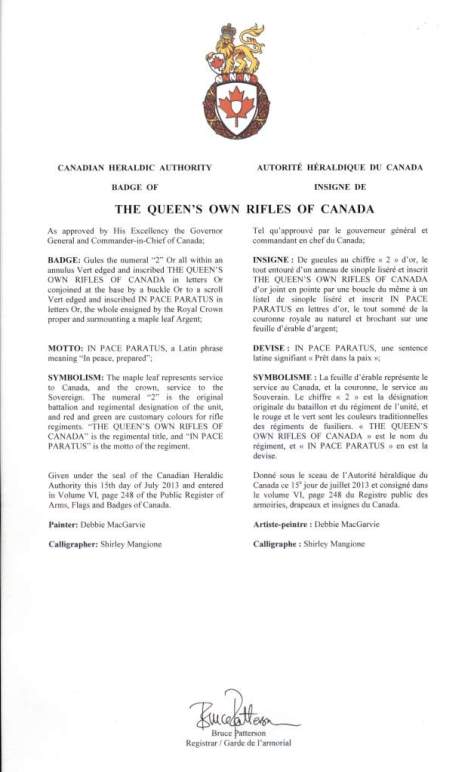
The new badge for The Queen’s Own Rifles of Canada which now includes the “The” has been officially posted in the Canada Gazette on March 22, 2014:
Le 22 mars 2014 Gazette du Canada Partie I 657 Bearings have been made, as entered in the Public Register of Arms, Flags and Badges of Canada (Volume, page): Approval of the Badge of The Queen’s Own Rifles of Canada, Toronto, Ontario, July 15, 2013 (Vol. VI, p. 248). Approval of the Badge of the Combat Training Centre, Oromocto, New Brunswick, July 15, 2013 (Vol. VI, p. 251). Approval of The Princess Royal’s Banner for the Royal Canadian Medical Service, Ottawa, Ontario, July 15, 2013 (Vol. VI, p. 264). Confirmation of the Badge of the Canadian Forces Joint Operational Support Group, Kingston, Ontario, October 15, 2013 (Vol. VI, p. 273). Approval of the Badge of the Canadian Forces Logistics Training Centre, Borden, Ontario, November 15, 2013 (Vol. VI,p. 280). STEPHEN WALLACE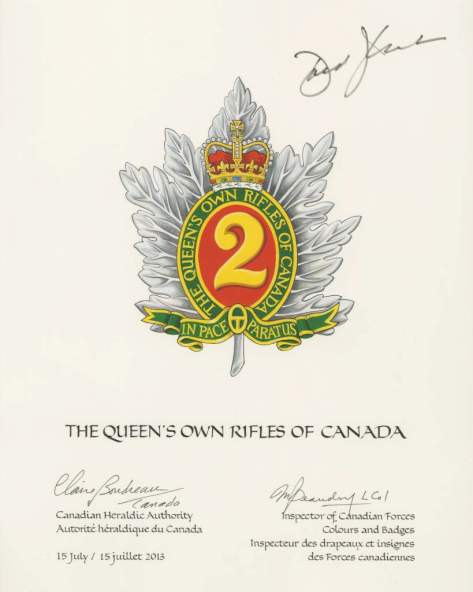
On February 13th, we held our first Museum Volunteer Recognition Night to thank those volunteers who have helped us out in the 2012 and 2013. Thirty-five volunteers and guest gathered the Queen’s Own Rifles Officers’ Mess at Moss Park Armoury for food and refreshments all courtesy of a donor who wishes to remain anonymous. We’d like to thank the President of the Mess Committee and the mess staff for a great spread!
We we’re also pleased to be joined by RSM Mark Shannon and Captain Adam Hermant, President of the Queen’s Own Rifles of Canada Trust which “owns and operates” the museum.
From October 2012 to December 31, 2013, seventy-four volunteers provided over 950 hours of service! These volunteers come from former members of the regiment and their families; serving members of the regiment; students from various museum studies programs; and friends of the regiment and museum – each bringing different talents, skills and experience. This event was also an opportunity for them to meet and get to know each other.
We have an ambitious “to-do” list for the museum and we can’t hope to make any significant progress without the help of volunteers. It was a little slow to get started with just Clay and Nancy Downes and Larry Hicks in the Fall of 2012 but as the word got out, volunteers were coming out in greater and greater numbers.
So what have they been doing? They’ve catalogued and photographed artifacts, cleaned display cases, built storage shelves, constructed exhibit walls, painted, moved display cabinets, planned our First World War commemorations and activities, and organized and support events (including members of the band) just to name a few things.
We also took this opportunity to recognize some volunteer who had put in significant hours of service:

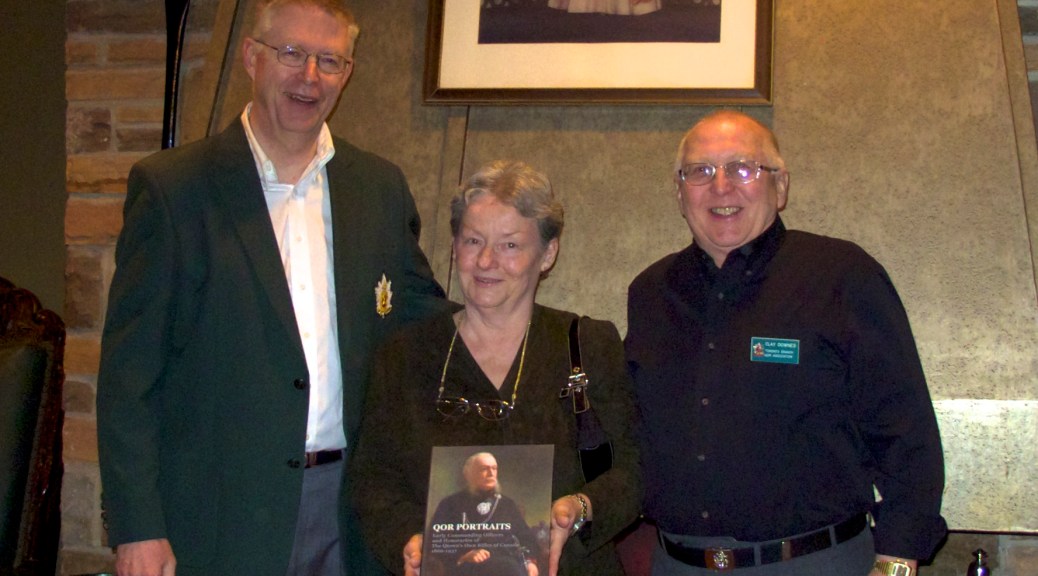
Clay and Nancy were presented with the first edition of the QOR Portraits book as a special thank you.
RSM Mark Shannon also took a moment to thank on behalf of the regiment, Curator Major (Ret) John Stephens and Assistant Curator CWO (Ret) Shaun Kelly for their service over the past eighteen months.

Thanks to all our volunteers from 2012 and 2013 even if you couldn’t make our recognition night and we look forward to another successful year in 2014!
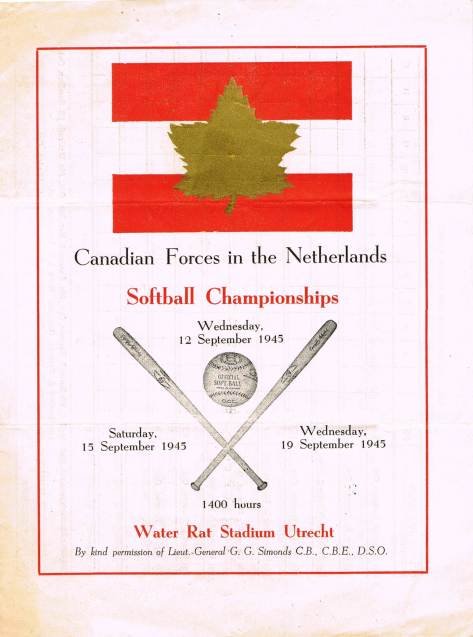
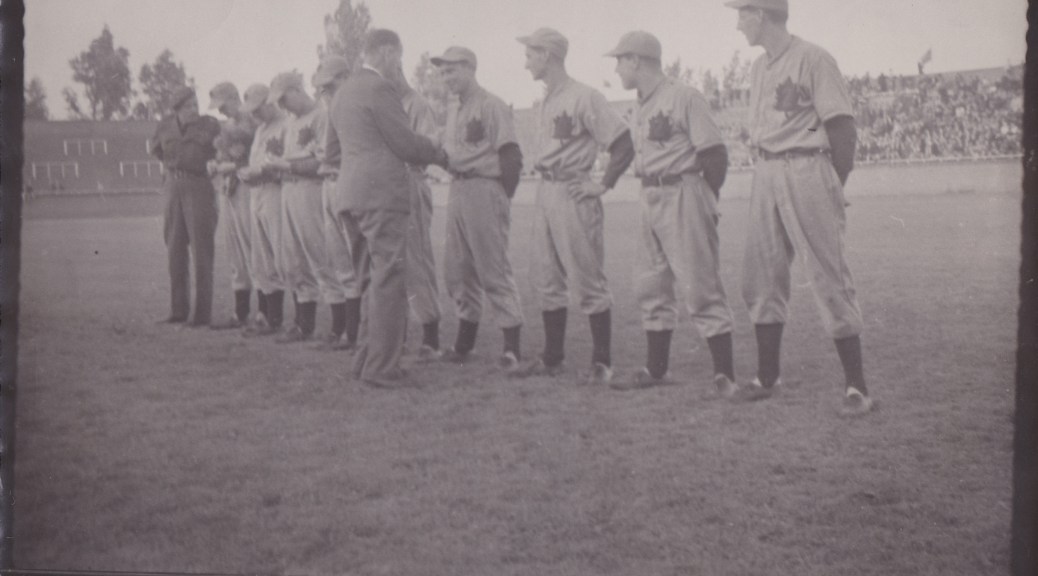
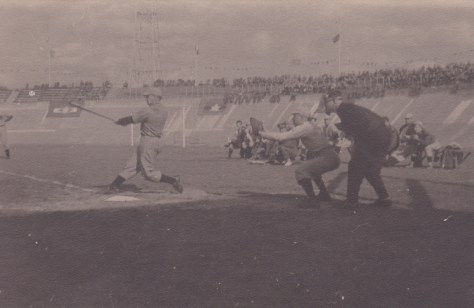
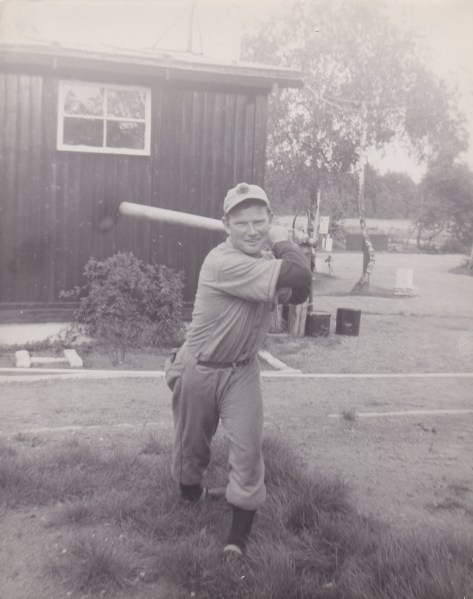
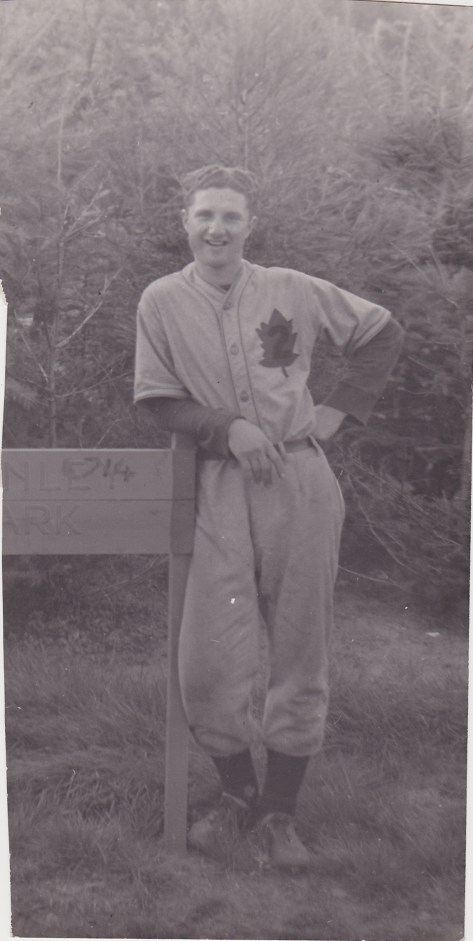
Thanks to Master Corporal Humphrey’s research, we’re able to share a program from the September 1945 Softball Championship of the Canadian Forces in the Netherlands. Inside the program we find the team lines ups for The Queen’s Own Rifles of Canada and the Perth Regiment.
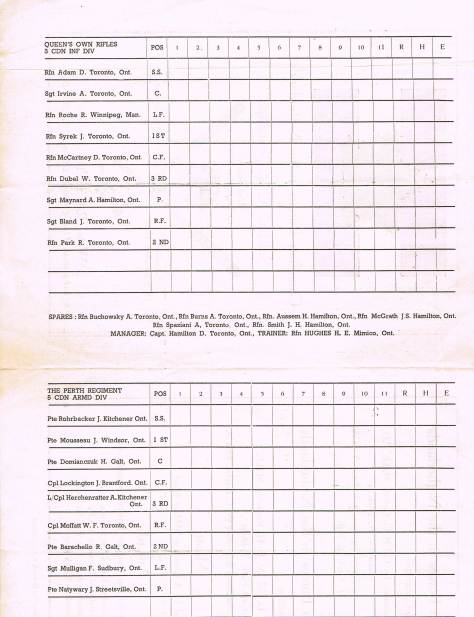
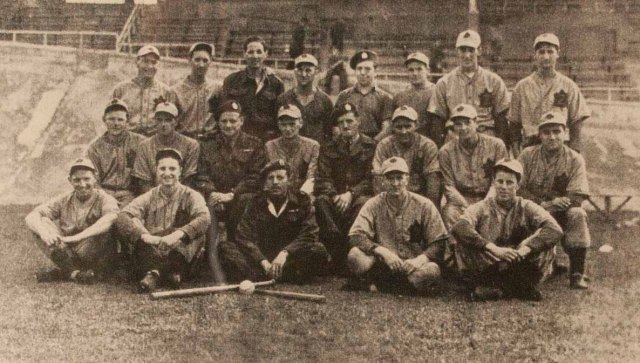
The following photo posted in our last blog includes almost all the members listed above and would suggest they won this game!

As we kick off the 2014 Winter Olympics, we thought we’d share a few snippets of sports related regimental history.
The following is an excerpt from the 1922-1923 QOR Association Annual Report.
Sports in the Regiment
A phase of development in the life of every regiment that is, perhaps, one of the most essential to its success, and perhaps one of the most neglected, it in the world of sport. “Playing the game,” win or lose, must be inculcated in the mind of any who take a part, and this last devolves upon efficient leadership. It is such an ideal that the QOR has endeavoured to induce and maintain, that its part in the development of National life may not be confined to the discipline of the parade ground but to include self-discipline in the everyday life of its members. The Queen’s Own Rifles Athletic Association, therefore, became a reality on December 9th, 1922, and took over the work that had been carried on by Maj. F.H. Wood and his Committee through the difficult period of re-organization. The officers elected were: Hon. Pres. Col. A. E. Kirkpatrick; Pres., Capt. G.G. Emsley Raley, MC; Vice-Pres,. Sgt. L. Baker; Sec’y-Treas, Lieut. T. A. Laidlaw; Executive, Lieut. A. E. Williams, Lieut. A deL. Panet, CQMS G. Alexander, Sgt. J. A. Wilson.
Indoor baseball hockey and basketball were chosen as the sports for the Winder season, and on Jan. 4th, the Regimental Indoor Ball League opened…
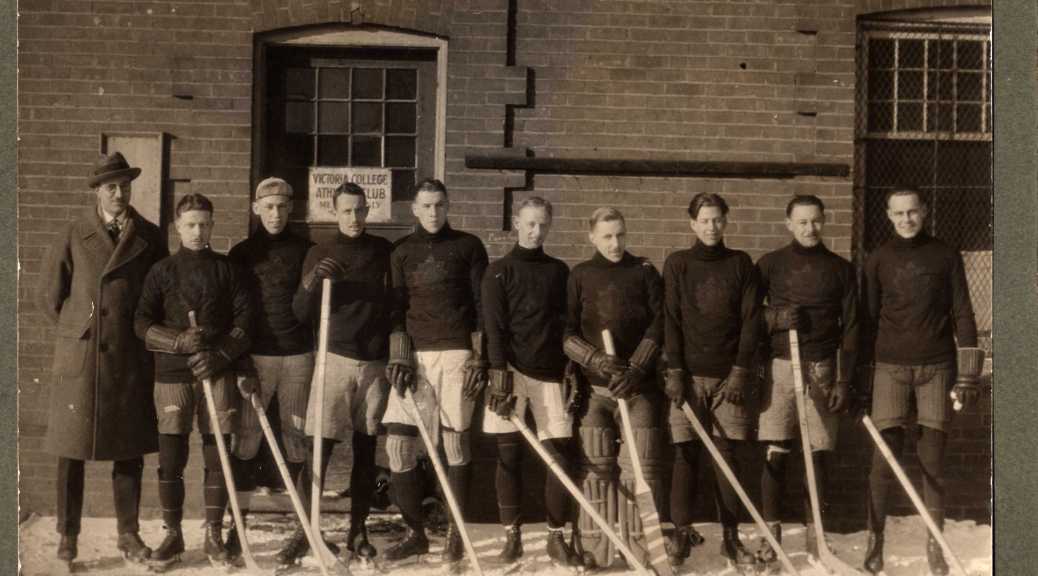
Throughout the season matches have been played at the Armouries each Wednesday evening from 7:30 to 11:00 pm, one diamond being reserved from 9:30 to 11:00 pm for Cadets and members of companies and details not entered in the League. Hockey and baseball were innovations but the interest shown was encouraging to those on whom the work really fell. About 25 to 30 men turned out for hockey practice and games at Little Vic Rink and a team of league calibre was selected to form the nuclei of the 1923-24 teams; the season closed with a win of 11-3 over the crack B.A. Life aggregation. On Feb. 28 a well attended hockey and recruiting meeting was held at the Armouries and it was decided to enter the Regimental team in a Senior City league during the season of 1923-24 (see photo below. )
The Officers’ Baseball team is an organization apart for the Association but is an invaluable agent in training candidates: Capt. J.S. Beatty, Team Captain; Major H. Pepler, M.C. Manager; Capt. Ross Walker, Secy.-Treas.


Perhaps not surprisingly, as the centenary of the First World War approaches, some of the most popular pages on our website are the transcribed war diaries of the 3rd Battalion, Canadian Expeditionary Force.
Libraries and Archives Canada had scanned several hundred pages of these diaries and posted them on to their website as jpeg photos. As valuable as this was, they were impossible to search and the way they were listed on their site made it a challenge to find a particular date quickly.
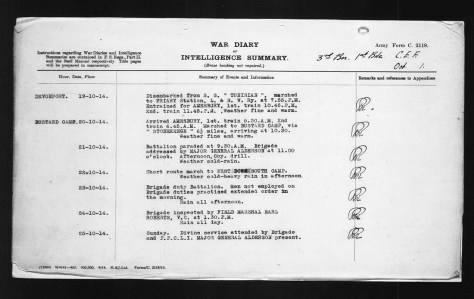
So in the Fall of 2012, we undertook to crowd-source the transcriptions of these pages and were very pleasantly surprised by the results! Within just eleven weeks, 27 volunteers all recruited online and some from the far corners of the world, had transcribed 53 months of diaries and they were posted on our website! This has also allowed us to link to other information on our website such as specific soldier profiles and to include photos of relevant artifacts. We continue to add to these pages as we can.
I highly encourage you to check them out if you have not already done so because they give, in concise military way, a chilling perspective on this horrible war.
We’ve received some positive feedback on this resource but I was particularly pleased to see the recent comment reprinted below, from a US Army Lieutenant Colonel whose Scottish grandfather crossed the border from US to join the 255th Battalion, CEF. He eventually see combat with the 3rd Battalion. His story also illustrates how the war continued to impact families long after it had ended.
Folks,
Thanks for transcribing the 3rd Bn war diaries. In August 1913, my grandfather, John Denning Wallace, immigrated from Paisley, Scotland to Kearny, New Jersey. In April 1918, he crossed the border and joined the Toronto Regiment to fight with the CEF in WWI. He served with the 3rd Bn on the front lines near Arras, France, from November 1917 until July 15, 1918, when he sustained a gunshot wound in the left arm. In February 1919, he was medically discharged for the “GSW left arm” and for “trench exposure.” A few years later, he died from the trench exposure at age 30 [1926].
On review of my grandfather’s CEF discharge certificate and military records, they did not reveal how he sustained his combat wound, and for many years I often wondered. Thankfully, the 3rd Bn war diaries provided me with some background. The 3rd Bn war diaries for July 14-16 1918, and the 3rd Bn end of month casualty report for July 1918, reveal that my grandfather, “Wallace, J.D.”, and three other 3rd Bn soldiers were wounded by machine gun fire whilst “laying wire ” near Post 7 in the Fampough sector near Arras. The next day, one had died from his wounds.
Now I know.
Thanks.
Wayne S. Wallace,
LTC, U.S. Army
Units of the Canadian Armed Forces often follow the tradition of presenting new members of the unit with a regimental coin. These coins are normally serialized, based on the member’s date of service with the unit, with a registry of coins being held by regimental headquarters.
The coin is meant to be symbol of membership within the unit, with members expected to carry their coin at all times.
During Lieutenant Colonel Fotheringham’s first term as Commanding Officer, then Company Sergeant Major Shaun Kelly created a unique initiative which incorporated the exclusive membership aspect of a regimental coin whilst also honouring the history of the Regiment. Instead of a coin which is serialized to the member based on the date of service with the unit, members of The Queen’s Own Rifles of Canada are issued a coin with the particulars of a member of the Regiment who died during one of the wars which the Regiment fought in. They were first presented to members of the regiment on Remembrance Day 2002.
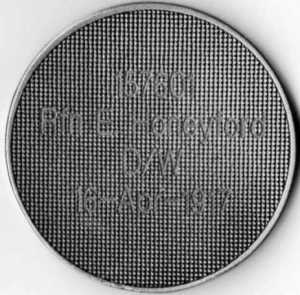
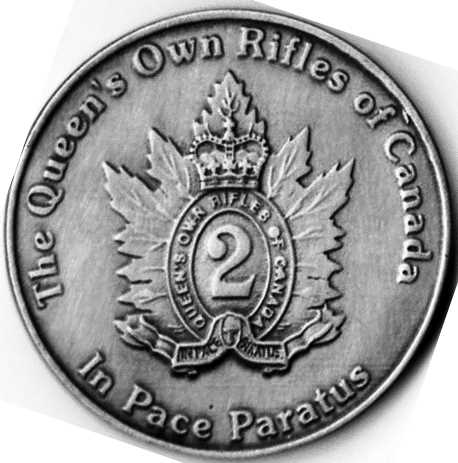
The antique pewter like coin is 39mm in diameter. The Obverse has the Primary Badge surrounded by the name of the regiment and the regimental motto “In Pace Paratus”. The Reverse has inscribed the particulars of the member whom the coin is dedicated to:
A coin is presented to each member of the Regiment by the Commanding Officer or Regimental Sergeant Major on the first Church Parade which the member participates in after having been “badged” into the Regiment.
The Names Behind the Coins
But carrying the coin is just the first step. Riflemen are strongly encouraged to research the soldier named on their coin and many do. This makes the act of remembrance much more meaningful.
On our Regimental Museum website we have a section called “Soldiers of the Queen’s Own” in which we are adding biographies of soldiers who have served in the regiment – during any period since 1860 – or in the First World War battalions that we perpetuate. To date we’ve only added a very tiny sampling.
But we want to continue to expand this depository particularly as we approach the centenary of the First World War. If you’ve researched the soldier named on your coin, we strongly encourage you to send us whatever information you have – it can be in point form – so that we can add it to our website.
Please email your information to museum@qormuseum.org and make sure you include all the details from your coin as a starting point.
Thanks,
Major (Ret) John Stephens, CD
Curator

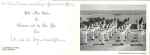
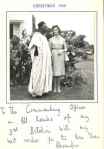
The following are some examples of Christmas Cards in our Museum Archives that were sent to The Queen’s Own Rifles of Canada or officers of the QOR.





















 The Queen's Own Rifles of Canada Regimental Museum and Archive