Category Archives: WWII

Composition of QOR on D-Day

The following was researched and written by: Capt. (N) (Ret’d) Michael Braham for the http://www.6thjuin1944.com (no longer active) in the article Operation Overlord/Neptune Force ‘J’ – Juno Beach

This will break down which Queen’s Own Rifles Rifleman landed at what time. You can see how much crossloading of equipment and men there was with other Regiments and support formations:

HMS Monowai Assaulting companies – J30, Ex Armed Merchant Cruiser Razmak. A large and fast cargo liner built in 1925. She was 10,852 tons, 519 feet long and could make 20 knots. She carried ten LCA from 554 Flotilla, nine LCA from 556 Flotilla and a LCA(OC).(1)

Serials 1428 to 1432 are 5 LCA’s from LSI(L) J30 HMS Monowai:

  • 129 men from The Queen’s Own Rifles of Canada plus 20 stores spaces
  • 3 men from 14th Canadian Field Regiment, RCA – Forward Observation Officer
  • 6 men from 16th Canadian Field Company, RCE plus 3 stores spaces – Demolition Team
    Serials 1433 to 1437 are 5 LCA’s from LSI(L) J30 HMS Monowai:
  • 129 men from The Queen’s Own Rifles of Canada plus 20 stores spaces
  • 3 men from 14th Canadian Field Regiment, RCA – Forward Observation Officer
  • 6 men from 16th Canadian Field Company, RCE plus 3 stores spaces = Demolition Team(1)

Terrain
The coastline on which Nan White and Nan Red were situated was low-lying. From Courseulles to Bernieres-sur-Mer, there was a sandy beach with short groynes to prevent lateral movement of sand by the current. From Bernieres-sur-Mer to St Aubin-sur-Mer the coast continued to be low lying and sandy, but here there were many summer houses and villas. From St Aubin-sur-Mer eastwards, there were low cliffs for a mile and a half, with a sea wall along most of it. Offshore, all the way along the coast eastwards of Bernieres-sur-Mer, there were rocky outcrops, parts of which were exposed at low tide. Inland, the country was gently rolling countryside and plains with large fields.(1)

QOR
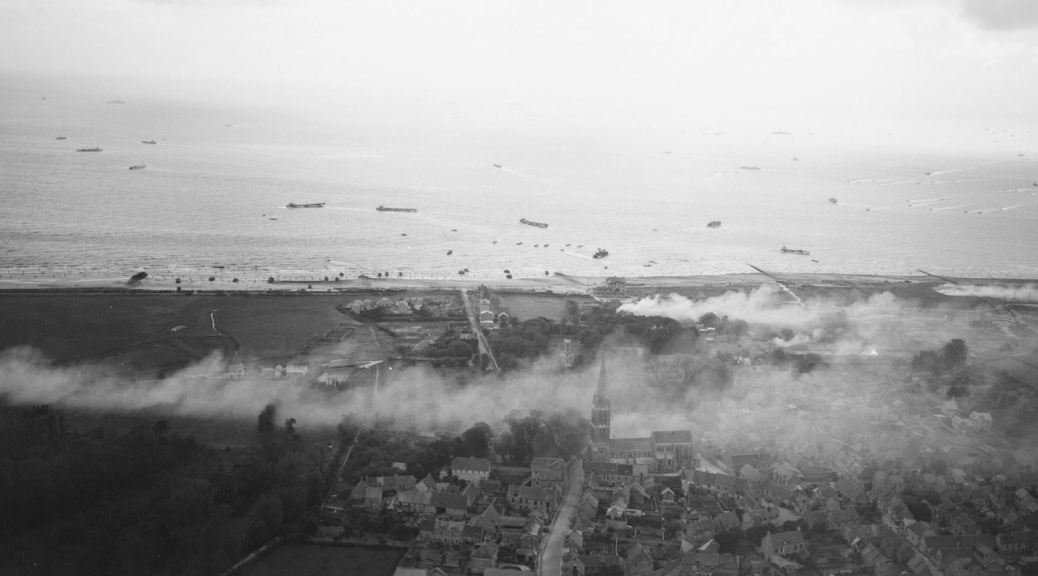
The Queen’s Own Rifles of Canada received the order to make the final run in to the beach at 0805 hours, although there was no sign of the LCTs carrying DD tanks and specialist armour. They landed on Nan White at 0815 hours with ‘A’ Company to the west of Bernieres and ‘B’ in front of the Bernieres strongpoint. ‘A’ Company got off the beach quickly and reached the railway line before being pinned down by mortar fire. They eventually moved inland.

‘B’ Company landed in front of the strongpoint, which had 8 machine guns in concrete emplacements, two 50mm guns on the sea wall and two 80mm mortar posts inland. The company suffered heavy casualties, including three officers, a CSM and two sergeants. The company scaled the sea wall and outflanked the position.

‘C’ and ‘D’ Companies together with Battalion Headquarters, came ashore at 0830 hours. The companies passed through the village and, together with ‘A’ Company, prepared to move forward to the next task. ‘B’ Company remained on the beach to reorganize.(1),

Nan White and Nan Red H+20 minutes
Queens Own Rifles of Canada – Lt-Col J.G. Spragge Nan White ‘A’ Company (Major H. E. Dalton) ‘B’ Company (Major C. O. Dalton) ‘C’ Company (Major Nickson) ‘D’ Company (Major Gordon)(1)

Serials 1451 to 1456 are 6 LCA’s from J32 HMS Duke of Wellington:

  • 134 men from Queens Own Rifles of Canada plus 23 stores spaces – Includes alternative Battalion Headquarters
  • 1 man from Headquarters 8th Canadian Infantry Brigade – Chaplain for Queens Own Rifles of Canada – H/Capt JC Clough, C.C.S.
  • 3 men and a handcart from ‘K’, Section (8 CIB), 3rd Canadian Infantry Division Signals plus 3 stores spaces
    • 7 men from 16th Canadian Field Company, RCE
  • 7 men from 14th Canadian Field Regiment, RCA
  • 9 men from 22nd Canadian Field Ambulance, RCAMC
  • 4 men from La Regiment de la Chaudiere – Unit Landing Officer party
  • 1 man from North Nova Scotia Regiment (9 CIB)
  • 11 men from 184 Field Company, RE
  • 2 men from 19 Beach Signals Section(1)

Serials 1457 to 1462 are 6 LCA’s from J33 SS Isle of Guernsey:

  • 137 men from Queens Own Rifles of Canada plus 18 stores spaces
  • 2 men from 10th Canadian Armoured Regiment (The Fort Garry Horse) – Liaison Officer
  • 7 men from 14th Canadian Field Regiment, RCA
  • 6 men from 16th Canadian Field Company, RCE plus 3 stores spaces
  • 10 men from 22nd Canadian Field Ambulance, RCAMC
  • 7 men from 184 Field Company, RE
  • 2 men from 19 Beach Signals Section
  • 2 men from 244 Provost Company
  • 7 men from 5 Royal Berkshire Regiment – Beach Group
  • 3 men from RN Beach Signals Section
  • 2 men from RN Beach Commando – Assistant Beach Master party(1)

Serial 1463 was an LCH carrying Headquarters Queens Own Rifles of Canada. Personnel are taken ashore by LCA Serial 1482 from J36 HMCS Prince David:

  • 8 men from Queens Own Rifles of Canada – Battalion Command Group
  • 3 men from Contact Detachment • 4 men from 14th Field Regiment, RCA
  • 4 men from Detachment ‘A’ Troop, 3 Bombardment Unit J
  • 1 man from ‘K’ Section (8 CIB), 3rd Canadian Infantry Division Signals
  • 7 men and 3 handcarts from 19 Beach Signals
  • 12 men from RN Beach Commando
  • 10 men from RN Beach Signals.(1)

SS St. Helier Supporting companies – J35, A Channel Island ferry. She was 1,952 tons, 292 foot long and could manage 18 knots. She carried six LCA from 515 Flotilla. She had accommodation for 180 troops and was armed with six 20mm.

Serials 1470 to 1475 are 6 LCAs from J35 SS St. Helier:

  • 135 men from Queens Own Rifles of Canada – Includes Unit Landing Officer plus 21 stores spaces
  • 1 man from 3rd Canadian Reconnaissance Regiment (The Governor Generals Horse Guards)
  • 7 men from 19th Canadian Field Regiment, RCA
  • 13 men from 16th Canadian Field Company, RCE plus 3 stores spaces
  • 10 men from 22nd Canadian Field Ambulance, RCAMC
  • 2 men from 19 Beach Signals Section
  • 14 men from 5 Royal Berkshire Regiment – Beach Group(1)

Serial 1463 was LCH 239:

  • 8 men from Queens Own Rifles of Canada – Battalion Command Group
  • 3 men from Contact Detachment
  • 4 men from 19th Field Regiment, RCA
  • 4 men from Detachment ‘A’ Troop, 3 Bombardment Unit J.
  • 1 man from ‘K’ Section (8 CIB), 3rd Canadian Division Signals
  • 7 men and 3 handcarts from 19 Beach Signals.
  • 12 men from RN Beach Commando
  • 11 men from RN Beach Signals(1)

The first troops landed on Nan White at 0850 hours. The lack of exits and the enemy resistance at Bernieres meant that the battalion had to wait on the beach for an hour, under mortar and shell fire. They moved to an assembly area inland and waited a further two hours before setting off for its objectives around Beny sur Mer. They were supported by ‘A’ Squadron 10th Canadian Armoured Regiment (The Fort Garry Horse)(1)

Nan White and Nan Red H + 60 Minutes
Nan White
A flight of LCT4 beach with ‘A’ Squadron, 10th Canadian Armoured Regiment (The Fort Garry Horse) plus priority vehicles for 8th Canadian Infantry Brigade:(1)

Serial 1511 is an LCT4 541 carrying: SEE APPENDIX D ‘A’ Squadron, 10th Canadian Armoured Regiment (The Fort Garry Horse)

  • 1 x Sherman Vc Firefly with 4 crew (Sgt Strawn, MM)
  • 4 x Sherman III with 20 crew towing Porpoises – For Regimental and Squadron Commands (LCol Morton, Maj Blanchard, Capt Fraser, Capt Goodman)
  • 1 x Jeep with Padre FGH (Capt Harrison) La Regiment de la Chaudiere
  • 2 x Carrier Mortar
  • 1 x Carrier Towing and 6 pdr Anti Tank gun
  • 3 x Carrier Universal with 9 crew
  • 22 men Queen’s Own Rifles of Canada
  • 1 x Carrier towing 6 pdr Anti Tank gun
  • 3 x Carrier Universal • 14 men
    Plus
  • 2 x 15 cwt FFW with 2 crew from 375/114 LAA Regiment – Battery Command Reconnaissance
  • 1 X Jeep with Tank Unit Landing Officer, 27th Canadian Armoured Regiment (Capt Baldwin)
  • 5 men from 375/114 LAA Regiment – Battery Command Reconnaissance
  • 2 men from ‘C’ Section 4 Canadian Provost Company
  • 2 men with a balloon from 52 Beach Balloon Unit, RAF(1)

Serial 1512 is LCT4 932 carrying: 10th Canadian Armoured Regiment (The Fort Garry Horse)

  • 3 x Sherman III with 15 crew towing Porpoises
  • 3 x Stuart Light Tank with 12 crew La Regiment de la Chaudiere
  • 2 x Carrier Mortar
  • 1 x Carrier towing 6 pdr Anti Tank gun
  • 3 x Carrier • 22 men Plus
  • 1 x Armoured Bulldozer Class II towing a Freuhauf trailer with 2 men vehicle party from 3rd Canadian Field Park Company, RCE
  • 1 x Carrier Mortar with 4 crew from Queens Own Rifles of Canada
    Page 84
  • 1 x Jeep with 2 crew from 321/93 LAA Regiment, RA. ‘E’ Troop reconnaissance
  • 4 men from 321/93 LAA Regiment, RA. ‘E’ Troop reconnaissance
  • 1 x Jeep with 3 crew from 16th Canadian Field Company, RCE
  • 4 men from 16th Canadian Field Company, RCE
  • 2 men from ‘C’ Section, 4 Canadian Provost Company
  • 2 men with a balloon from 52 Beach Balloon Unit, RAF(1)

Serial 1513 is LCT4 934 carrying: 10th Canadian Armoured Regiment (The Fort Garry Horse)

  • 1 x Valentine Bridgelayer • 2 x Sherman Vc Firefly
  • 2 x Jeep • 2 x Sherman III towing Porpoises
  • 44 men Queens Own Rifles of Canada
  • 2 x Carrier Towing 6 pdr Anti Tank gun
  • 3 x Carrier Mortar
  • 3 x Carrier Universal
  • 21 men Plus
  • 1 x Jeep with 2 crew from 375/114 LAA Regiment, RA
  • 4 men from 375/114 LAA Regiment, RA
  • 1 x Carrier MMG with 4 crew from ‘B’ Company, Cameron Highlanders of Ottawa (MG)
  • 7 men from 16th Canadian Field Company, RCE
  • 2 men with a balloon from 52 Beach Balloon Unit, RAF(1)

Nan White and Nan Red H + 75 Minutes
The Field Artillery lands
Nan White
A Flotilla of eight LCT4 arrive carrying 14th Canadian Field Regiment, RCA and priority vehicles for 8th Canadian Infantry Brigade.(1)

Serial 1522 is LCT4 637 carrying priority vehicles for 8th Canadian Infantry Brigade:

  • 3 x M14 Halftrack with 3 crew from 14th Canadian Field Regiment, RCA
  • 1 x Sherman III with 5 crew from 10th Canadian Armoured Regiment (The Fort Garry Horse)
  • 1 x Carrier MMG with 5 crew from ‘B’ Company, Cameron Highlanders of Ontario (MG)
  • 4 men from ‘B’ Company, Cameron Highlanders of Ontario (MG)
  • 1 x 15 cwt from Queens Own Rifles of Canada
  • 2 x Carrier Towing with 6 pdr Anti Tank guns from Queens Own Rifles of Canada
  • 12 men from Queens Own Rifles of Canada
  • 2 x Carrier Towing with 6 pdr Anti Tank guns from La Regiment de la Chaudiere
  • 1 x Jeep with 2 crew 155 Anti Aircraft Operations Room, RA
  • 2 men from 155 Anti Aircraft Operations Room, RA • 1 x M14 Halftrack with 2 crew from ‘K’ (8 CIB) Signal Section, 3rd Canadian Infantry Division Signals
  • 1 x BARV with 6 crew 23 Beach Recovery Section, REME
  • 1 x 3 ton GS with 2 crew from 184 Field Company, RE
  • 18 men with 3 handcarts from 184 Field Company, RE
  • 6 men 375/114 LAA Regiment, RA • 2 men and a balloon from 52 Balloon Unit, RAF(1)

Serial 1524 is LCT4 885 carrying: 14th Canadian Field Regiment, RCA.

  • 4 x M7 Priest 105mm SP, each towing a Porpoise MkII which has 125 rounds of ammunition stowed loose (“F” Troop, 81st Bty)
  • 1 x Sherman OP
  • 2 x Carrier OP
  • 1 x M14 Halftrack
  • 52 men
    Plus
  • 1 x Carrier Mortar with 4 crew from Queens Own Rifles of Canada
  • 3 x Carrier with 9 crew from La Regiment de la Chaudiere
  • 1 x White Scout Car with 6 crew from 72 Field Company, RE – Reconnaissance party.
  • 3 men from Canadian Press Relations Service(1)

Serial 1525 is LCT4 530 carrying: 14th Canadian Field Regiment, RCA.

  • 4 x M7 Priest 105mm SP, each towing a Porpoise MkII which has 125 rounds of ammunition stowed loose (“C” Troop, 66th Bty)
  • 2 x Sherman OP (“C” Troop, GPO, 66th Bty & Troop Commander, 66th Bty)
  • 1 x Carrier OP
  • 1 x M14 Halftrack
  • 48 men Plus
  • 1 x Carrier Mortar with 4 crew from La Regiment de la Chaudiere
  • 3 x Carrier with 9 crew Queens Own Rifles of Canada
  • 3 x men from Canadian Press Relations Service
  • 1 x Amphibious Jeep with 2 crew from RN Commando(1)

Serial 1526 is LCT4 524 carrying: 14th Canadian Field Regiment, RCA.

  • 4 x M7 Priest 105mm SP, each towing a Porpoise MkII which has 125 rounds of ammunition stowed loose
  • 2 x Sherman OP
  • 1 x Carrier OP
  • 1 x M14 Halftrack
    • 49 men Plus
  • 1 x Carrier Towing and 6 pdr Anti Tank gun from Queens Own Rifles of Canada
  • 3 x Carrier from Queens Own Rifles of Canada
  • 14 men from Queens Own Rifles of Canada
    14th Cdn Field Regiment, RCA on board LCT 4 Serial 1524
  • 1 x Carrier Loyd with 3 crew from 5 Royal Berkshire Regiment. Beach Group. Carries 1 man from 244 Provost Company and 1 man from 21 Army Group Movement Control Pool (Military Landing Officer) – Reconnaissance party for Commander 8 Beach Group and Military Landing Officer. Note: this vehicle may have been replaced by a Weasel(1)

Serial 1527 is LCT4 516 carrying: 14th Canadian Field Regiment, RCA.

Serial 1528 is LCT4 525 carrying: 14th Canadian Field Regiment, RCA

  • 4 x M7 Priest 105mm SP, each towing a Porpoise MkII which has 125 rounds of ammunition stowed loose
  • 2 x Sherman OP
  • 1 x Carrier OP
    • 1 x M14 Halftrack
  • 49 men Plus
  • 3 x Carrier with 9 crew from La Regiment de la Chaudiere
  • 1 x Carrier with 3 crew from Queens Own Rifles of Canada
  • 1 x Carrier MMG with 5 crew from ‘B’ Company, Cameron Highlanders of Ontario (MG)
  • 1 x Amphibious Jeep with 4 crew from 5 Royal Berkshire Regiment and 1 man from
  • 244 Provost Company. Reconnaissance party for Commander 8 Beach Group(1)
  • 1 x M14 Halftrack
  • 4 x M7 Priest 105mm SP, each towing a Porpoise MkII which has 125 rounds of ammunition stowed loose
  • 2 x Sherman OP
  • 1 x Jeep
  • 2 x Carrier OP
    • 55 men Plus
  • 3 x Carrier with 9 crew from Queens Own Rifles of Canada.
  • 1 x Carrier MMG with 5 crew from ‘B’ Company, Cameron Highlanders of Ontario (MG)(1)

Serial 1529 is LCT4 716 carrying: 14th Canadian Field Regiment, RCA

  • 1 x M14 Halftrack
  • 4 x M7 Priest 105mm SP, each towing a Porpoise MkII which has 125 rounds of ammunition stowed loose
  • 2 x Sherman OP
  • 1 x Jeep
  • 2 x Carrier OP
  • 55 men Plus
  • 3 x Carrier with 9 crew from La Regiment de la Chaudiere
  • 1 x Carrier with 3 crew from Queens Own Rifles of Canada(1)

We hope that this information was valuable to your research and general knowledge.

(1) – Capt. (N) (Ret’d) Michael Braham for the http://www.6thjuin1944.com in the article Operation Overlord/Neptune Force ‘J’ – Juno Beach

Forged in Remembrance

Reprinted with permission of The Brighton Beacon.


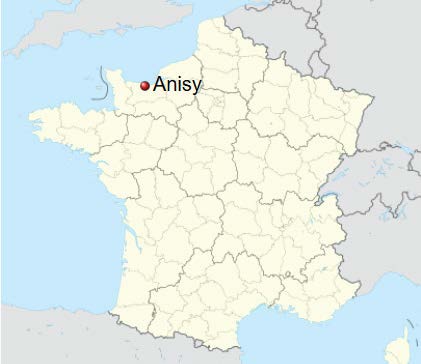
The Twinning of Brighton & Anisy, France

by Alicia Vandine

Nestled along the shores of Lake Ontario, the
Municipality of Brighton has scenic landscapes and a deeply rooted history of support for each other and service to those who pass through. Over 5,800 kilometres away, in the heart of Normandy, France, lies the picturesque village of Anisy, surrounded by its rolling fields and historic architecture. Anisy, located just a few kilometres from the historic city of Caen, boasts a population of approximately 800 residents. Its history is steeped in the legacy of the Second World War, as the village played a pivotal role during the D-Day landings and subsequent battles for liberation.

Today, Anisy combines its wartime significance with the tranquillity of rural French life, offering its residents and visitors a glimpse into its storied past and its current charm. At first glance, these two communities might seem worlds apart, but a profound and poignant connection has drawn them together: the heroic legacy of Clarke Lawson, a Brighton native and member of the Queen’s Own Rifles, who gave his life in the liberation of Anisy during World War II. This shared history has culminated in the twinning of these two towns, forging bonds of friendship and remembrance.

Clarke Lynson Lawson was born on May 8th, 1905, in Brighton, Ontario. He was the son of George Lynson Lawson and Sarah Elizabeth Maybee. Clarke was educated at the Lawson Settlement School and Brighton High School and later attended Kingston Dairy School. Following this, he took a radio course by correspondence and held a radiotrician diploma, but he mainly worked as a local farmer. On August 12th, 1936, he married Stella Peters at Wicklow, Ontario and later had a daughter named Helen Marie.

Clarke enlisted with the Midland Regiment on November 15th, 1940, in Cobourg, Ontario. He went overseas on March 22, 1943, and was posted to the Canadian Infantry Reinforcement Unit and then
transferred to The Queen’s Own Rifles of Canada on June 11th, 1943.

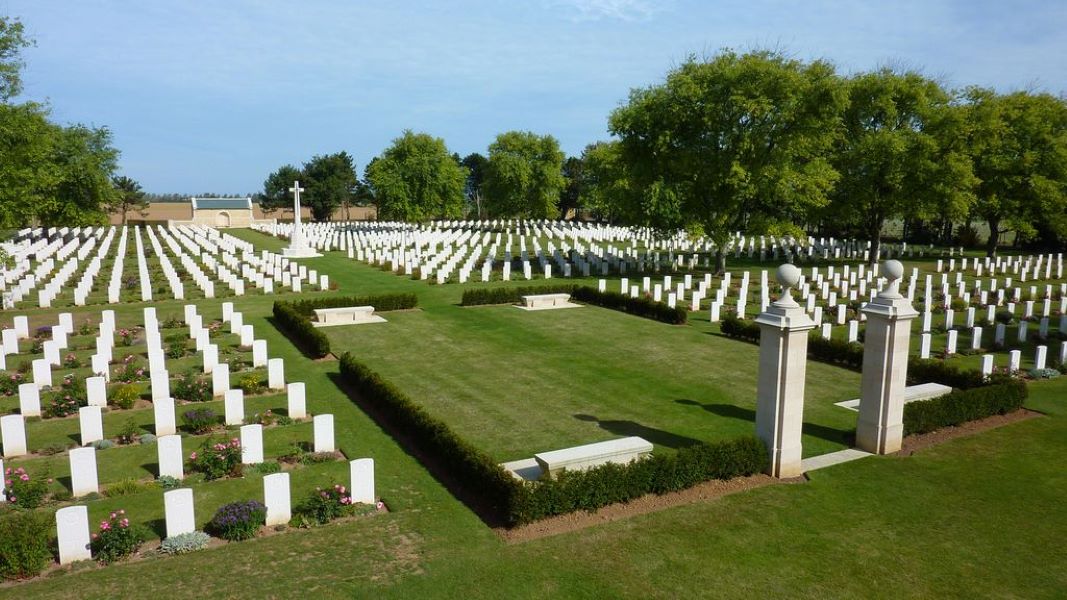
According to the military service records, he survived the landing on Juno Beach on June 6th, 1944, but died later in the day while liberating the village of Anisy, the final objective for The Queen’s Own Rifles on D-Day. He was buried in Beny-sur-Mer Cemetery.
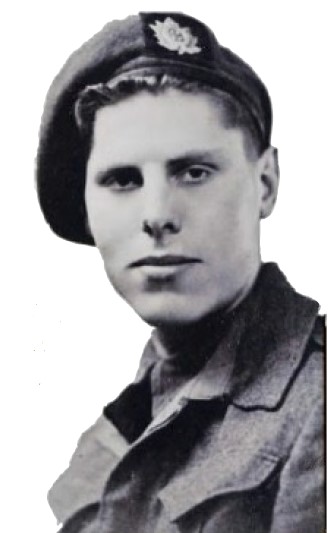
Beny-Sur-Mer Cemetery

For the people of Anisy, Clarke’s sacrifice is not a distant memory but a cherished part of their
community’s history. Each year, the village commemorates the liberation, ensuring that the contributions of soldiers like Clarke Lawson are never forgotten. Across the ocean, Brighton residents have also honoured Clarke’s memory through annual ceremonies in Memorial Park, and his name appears on the cenotaph located there. It is this shared commitment to remembrance that laid the foundation for the twinning of these two towns.

In 2017, in the presence of members of the regiment, the Village of Anisy named a new street in his honour: Rue Clarke Lawson. “I was made aware by John Stephens, descended from a long-time Brighton family and the Curator of the Queen’s Own Rifles Museum and Archive, that Anisy had honoured our very own Clarke Lawson, by naming a road after him. This led to us reaching out to Anisy’s Mayor Nicolas Delahaye, and after several conversations, in March 2024, we officially proclaimed our twin town as Anisy,” said Mayor Brian Ostrander. “It is a friendship forged in  war and is now a friendship of remembrance, strengthened by strong bonds between our two communities.”

While Clarke Lawson’s story is about courage, sacrifice, and enduring impact, his legacy is now about bringing together two communities far away from each other.

One of the most exciting aspects of twinning is the potential for cultural exchange opportunities that it creates. Perhaps schools in Brighton and Anisy can partner on educational initiatives, allowing students to learn about each other’s history, language, and way of life. Maybe virtual “pen-pal” programs, joint art projects, or even exchange visits can foster meaningful connections among young people in both communities.

Cultural events have also become a cornerstone of the twinning of other communities. Anisy could share its rich culinary and artistic traditions with Brighton, or maybe a local group could host a French-themed
festival. In return, Brighton could showcase its heritage, from Canadian music and cuisine to its renowned Applefest celebration. These potential future events not only celebrate the unique identities of each town but can highlight the common values that unite them.

Beyond cultural enrichment, the twinning also has the potential to bring tangible benefits to both towns. Increased tourism is one such advantage, as residents and visitors could be drawn to explore the history and beauty of each location. Brighton residents visiting Anisy can walk the streets where Clarke Lawson once served, while Anisy’s visitors to Brighton can experience the warmth of the town that shaped
this soldier’s character.

The twinning of Brighton, Ontario, and Anisy, France, is far more than a symbolic gesture. It is a living tribute to the memory of Clarke Lawson and the countless others who made the ultimate sacrifice during World War II. At the same time, it is a forward-looking partnership that can celebrate potential cultural exchange, foster economic growth, and continue to strengthen social bonds.

As these two towns continue to grow their relationship, they remind us of the power of connection and the importance of remembering the past while building a brighter future. The story of Brighton and Anisy’s twinning is not just about two communities; it is a testament to the enduring human spirit and the ties that bind us across continents and generations.


Today (8 June 2025), serving soldiers of the regiment will be in Anisy during the unveiling of the Brighton, Ontario, exhibition that accompanies the twinning ceremony to honour Rifleman Clarke Lawson.

The QOR and Their Heroic Role in the Liberation of Holland

The final months of the Second World War were marked by intense fighting as Allied forces pushed to liberate occupied territories and bring the conflict to an end. Among the many brave Canadian regiments that played a crucial role in these efforts, The Queen’s Own Rifles of Canada stood out for their remarkable courage and sacrifice in the liberation of Holland in 1945. Their efforts not only helped free the Dutch people from years of Nazi occupation but also cemented the strong bond between Canada and the Netherlands, a relationship that continues to this day.

A Legacy of Service

The Queen’s Own Rifles of Canada, one of Canada’s oldest infantry regiments, had already established a strong legacy of service by the time they were deployed in Europe during the Second World War. Landing in Normandy on D-Day, June 6, 1944, they were among the first Canadian troops to storm Juno Beach, demonstrating remarkable resilience and determination. Their actions in France, Belgium, and ultimately the Netherlands showcased their unwavering commitment to the fight for freedom.

The Battle for Holland

By the time the Allies reached the Netherlands in late 1944 and early 1945, the country had suffered immensely under Nazi occupation. Starvation, forced labour, and violent reprisals against resistance fighters had devastated the Dutch population. The Queen’s Own Rifles played a key role in the liberation efforts, pushing through well-fortified German defenses and enduring fierce resistance from enemy forces.

In April 1945, The Queen’s Own Rifles advanced through the eastern and northern regions of Holland. One of their most notable engagements was the assault on the town of Deventer. Fighting street by street, the regiment overcame heavily entrenched German positions, demonstrating exceptional bravery and tactical skill. Their efforts helped secure key supply routes and enabled the continued push into the heart of the Netherlands.

Sacrifice and the Cost of Freedom

The liberation of the Netherlands came at a heavy cost. The Queen’s Own Rifles suffered significant casualties during their campaign, with many young Canadian soldiers giving their lives to free a nation they had never known. Their sacrifice was not in vain. By early May 1945, Canadian forces, including The Queen’s Own Rifles, had successfully liberated large portions of the Netherlands. On May 5, Germany surrendered in the Netherlands, bringing an end to years of suffering for the Dutch people.

A Lasting Bond

The heroism of The Queen’s Own Rifles of Canada, along with other Canadian regiments, left an indelible mark on Dutch history. To this day, the people of the Netherlands express deep gratitude for Canada’s role in their liberation. Each year, Dutch citizens, young and old, honour the sacrifices of Canadian soldiers during remembrance ceremonies and by maintaining the graves of fallen soldiers in immaculate condition.

The liberation of Holland in 1945 was a defining moment in Canadian military history, and The Queen’s Own Rifles of Canada played a pivotal role in this achievement. Their bravery, sacrifice, and unwavering commitment to justice not only secured freedom for millions but also forged a bond between Canada and the Netherlands that endures to this day.

From May 3-10m 2025, 35 serving soldiers of The Queen’s Own Rifles of Canada will be on NLD80: Return to Europe for the 80th Anniversary of V-E Day and the liberation of The Netherlands.

Read More

Honouring Herman Stock

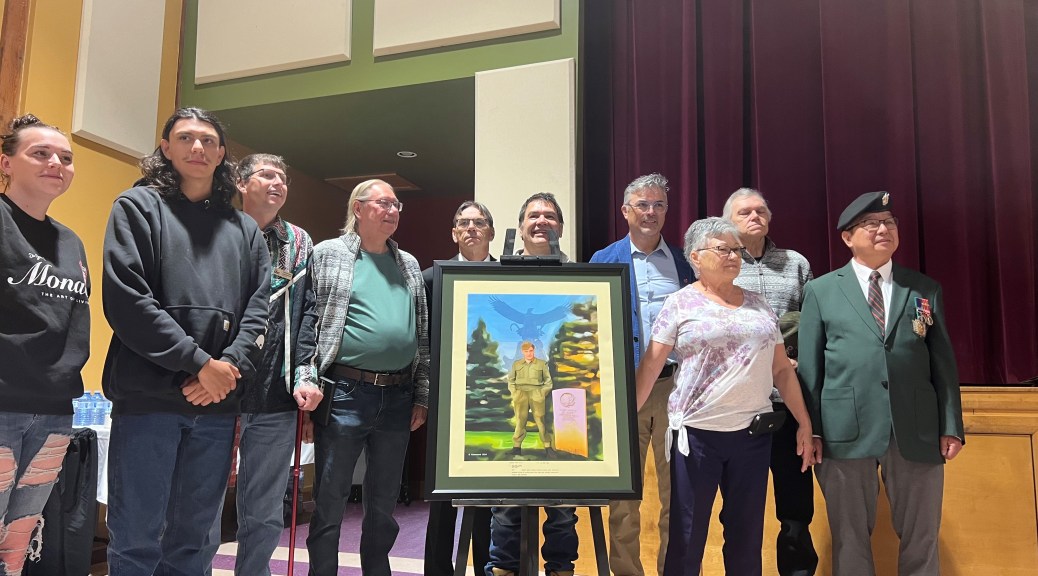
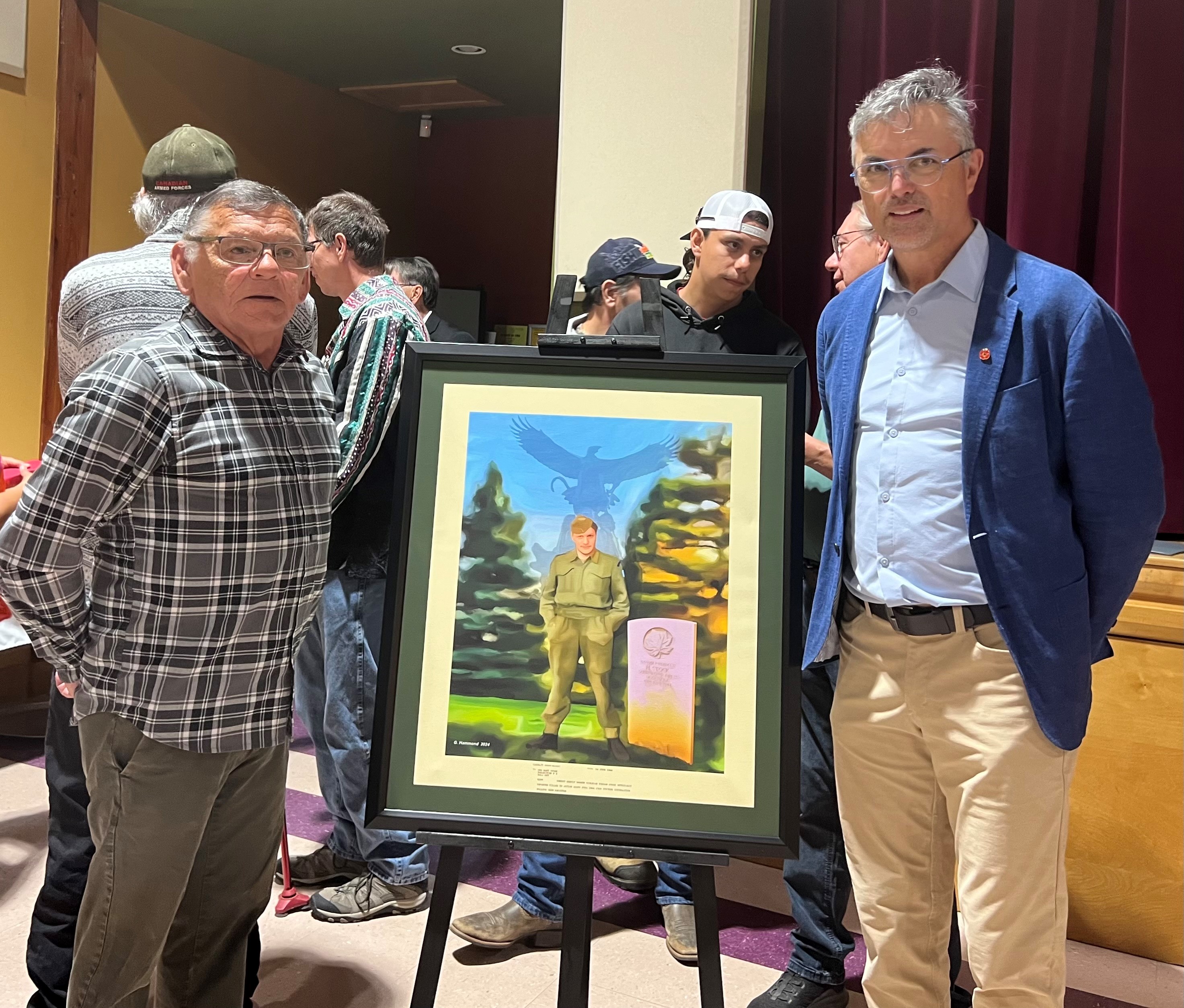
Above: Members of the Stock family with artist Greg Hammond and Captain Rob Chan, CD (Ret’d).

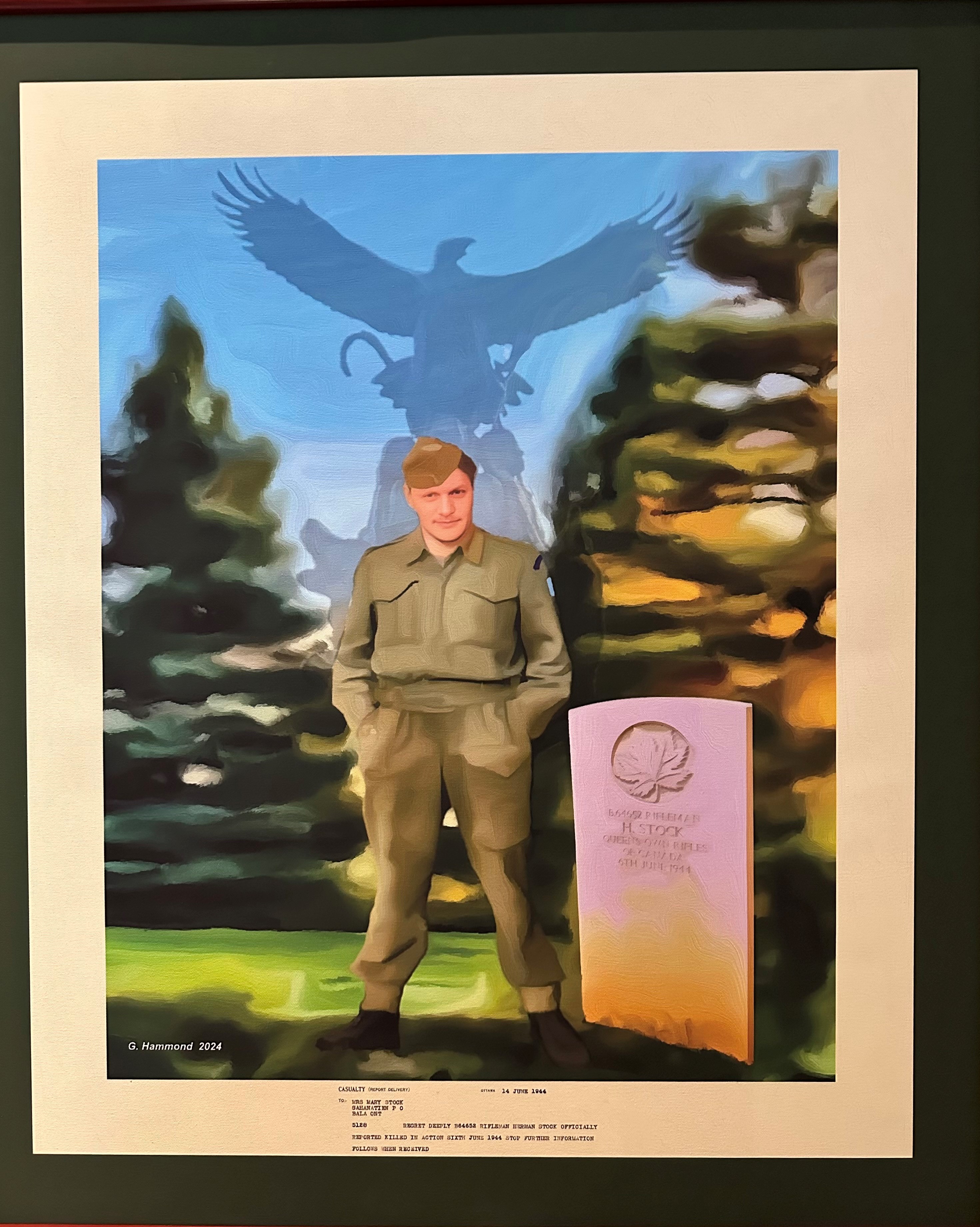
On Saturday, June 8th, 2024 artist Muskoka Greg Hammond presented his piece “Honouring Herman Stock” to Chief Phillip Franks of Wahta First Nation. The emotional event was attended by members of the First Nation including members of Stock’s family, and Captain Rob Chan, CD (Ret’d) on behalf of The Queen’s Own Rifles Association.

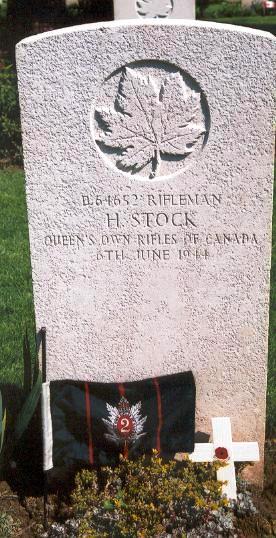
Rifleman Stock was killed in action on D-Day 6 June 1944 while serving with The Queen’s Own Rifles of Canada.

Chief Philip Franks and artist Greg Hammond.

Background: Herman Stock, An Aboriginal Soldier’s D-Day Sacrifice

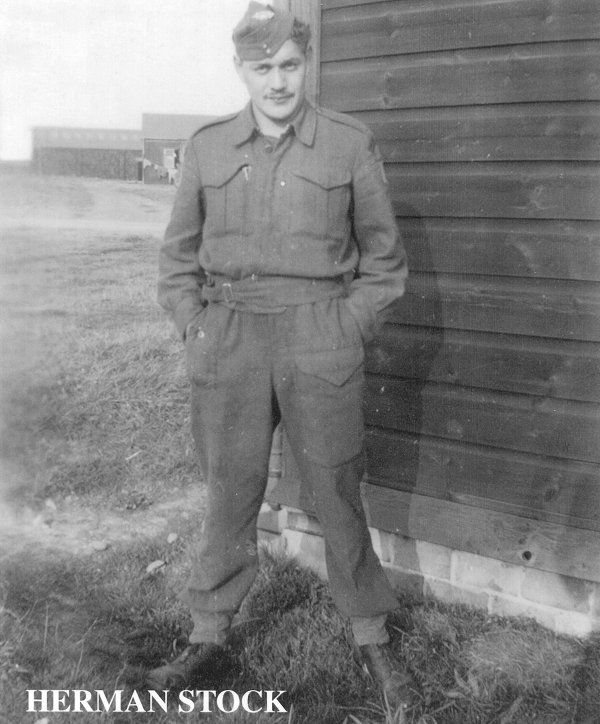
Herman Stock was an Aboriginal Soldier from the Gibson Reserve in Muskoka (now Wahta First Nation) who gave his life for freedom when the Canadian Army landed on Juno Beach on D-Day, June 6, 1944.
Herman was born at Sahanatien on the Gibson Reserve on April 14, 1922, to Robert and Mary Stock. He was the second oldest of nine children in the Stock family. Early in 1941, as World War II entered its third year, Herman worked as a labourer for the Hydro Electric Power Commission on the Gibson Reserve. Aspiring to become a mechanic, he saw his plans disrupted by the war. In July 1941, 19-year-old Herman enlisted in the Canadian Army in nearby Parry Sound.

Initially, Herman trained in Canada, moving between Toronto, Newmarket, and Base Borden before officially joining the Queen’s Own Rifles of Canada regiment in December. After a brief furlough in February 1942, Herman departed Canada for the U.K. on March 20, arriving eight days later. His life in the Army involved constant training, and living in barracks. In the evenings the men visited the pubs in the little English villages near where they were stationed. Whenever possible they visited the larger towns for livelier forms of amusement. Herman was not immune to this “letting off steam”, and occasionally was “Confined to Barracks” for disciplinary reasons. Despite these hardships and occasional disciplinary actions, Herman was a strong soldier, trained as a Bren Gunner.

From July 1943 to May 1944, the Queen’s Own undertook special combined operations training in preparation for the invasion of Europe. They practiced landing assaults, obstacle scaling, and minefield clearing. By Spring 1944, the regiment was ready, confident in their ability to take on the German Army. The invasion, set for June 5, was postponed by a day due to bad weather.

On June 4, Herman and the Assault Companies boarded the HMS Monowai. The men studied maps of Bernieres-Sur-Mer, the fortified beachfront village they were to attack. In their free time, they played cards, crown and anchor, or shot craps. On June 5, the men were informed that the assault would be the following day. They made final preparations, including writing “last” letters. On the eve of battle, Herman cut his hair in the traditional Mohawk style.

D-Day, June 6, began early with reveille at 03:15 then breakfast and all who wished it were given a shot of Navy rum. The men gathered their equipment and were loaded down with 50-pound packs. Herman also carried his 20-pound Bren gun and ammo as they loaded into Assault boats (LCA’s). As the LCA’s moved towards shore, strong winds pushed them off course. Charlie Martin recalled the eerie silence before they landed on Juno Beach at 08:12. The moment the ramps dropped, they faced intense machine-gun fire and mortar shells. Herman’s A Company, slightly better off than B Company, raced down the ramps under fire. Despite heavy casualties, they crossed the beach and pushed forward. Herman, always leading the way, was killed by a sniper while crossing the tracks.
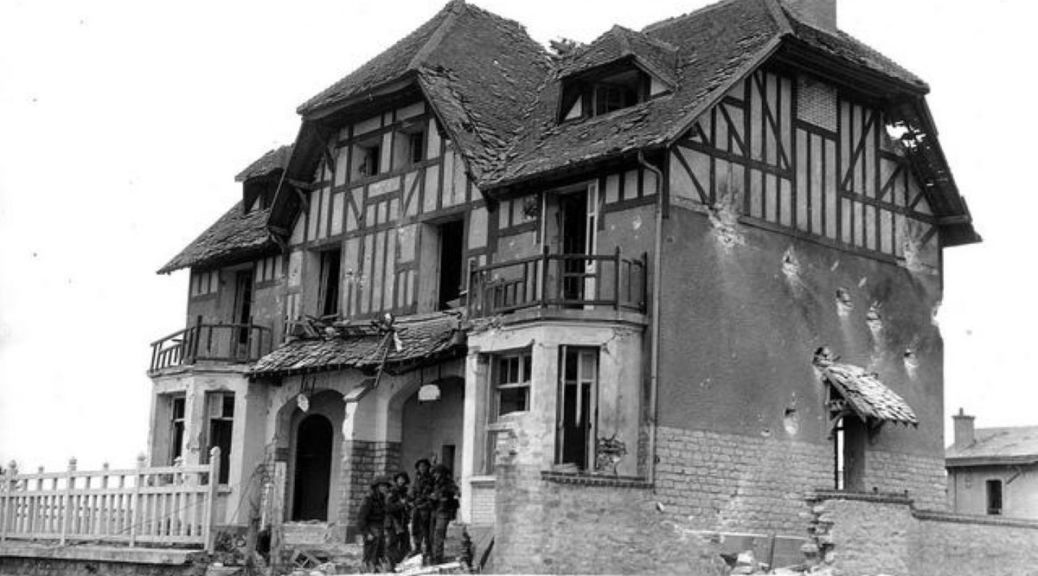
Bernieres was largely secure before 9:00 a.m. but The Queen’s Own Rifles had the roughest experience of all the Canadian D-Day battalions, losing 61 men killed and another 80 wounded.

Herman’s death initiated a series of government correspondences with his family. Mary Stock received a telegram on June 14 informing her of Herman’s death, followed by official condolences from the Canadian Government and the King. Mary was required to complete documents to obtain Herman’s pay. Herman was posthumously awarded several medals, recognizing his sacrifice for Canada and the cause of freedom.

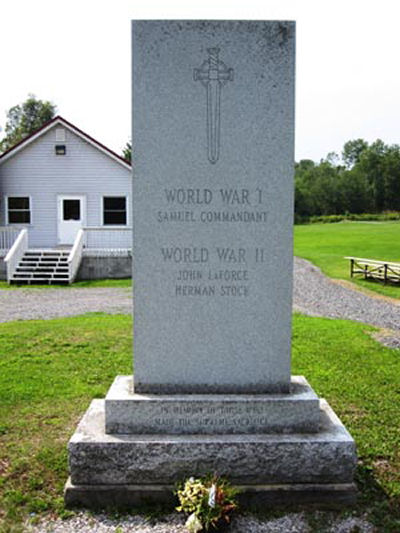
Monument – A granite stele at lot 12, Concession 6, Muskoka Road 38, Wahta Mohawk Reserve, ON was erected by elders of the Wahta Mohawk Reserve. This memorial is dedicated to the local war dead of the First and Second World Wars.

Herman and the other men killed at Bernieres-sur-Mer were initially buried just behind the beach. Mrs. Stock was informed that her son had been buried with religious rites, his grave marked with a wooden cross. In 1946, Herman was re-interred at the Canadian Military Cemetery at Beny-sur-Mer, and Mrs. Stock received notification along with a map and photograph of the grave.

The bonds shared by soldiers like Herman Stock and their comrades-in-arms are profound. Years later, Charlie Martin, who had vowed to visit the families of his fallen comrades, visited the Stock family. Realizing Herman was not commemorated locally, Charlie helped erect a cenotaph in Bala in 1965. Charlie’s aid, through his position at the Ontario Department of Agriculture and sometimes personal funds, was instrumental in establishing the Iroquois Cranberry Bog in 1969. This provided work and revenue for the Gibson Reserve, serving as a practical memorial to Herman’s sacrifice.

Herman’s story of valour extends beyond his death, as his memory and legacy continue to be honoured through the efforts of the community he served.

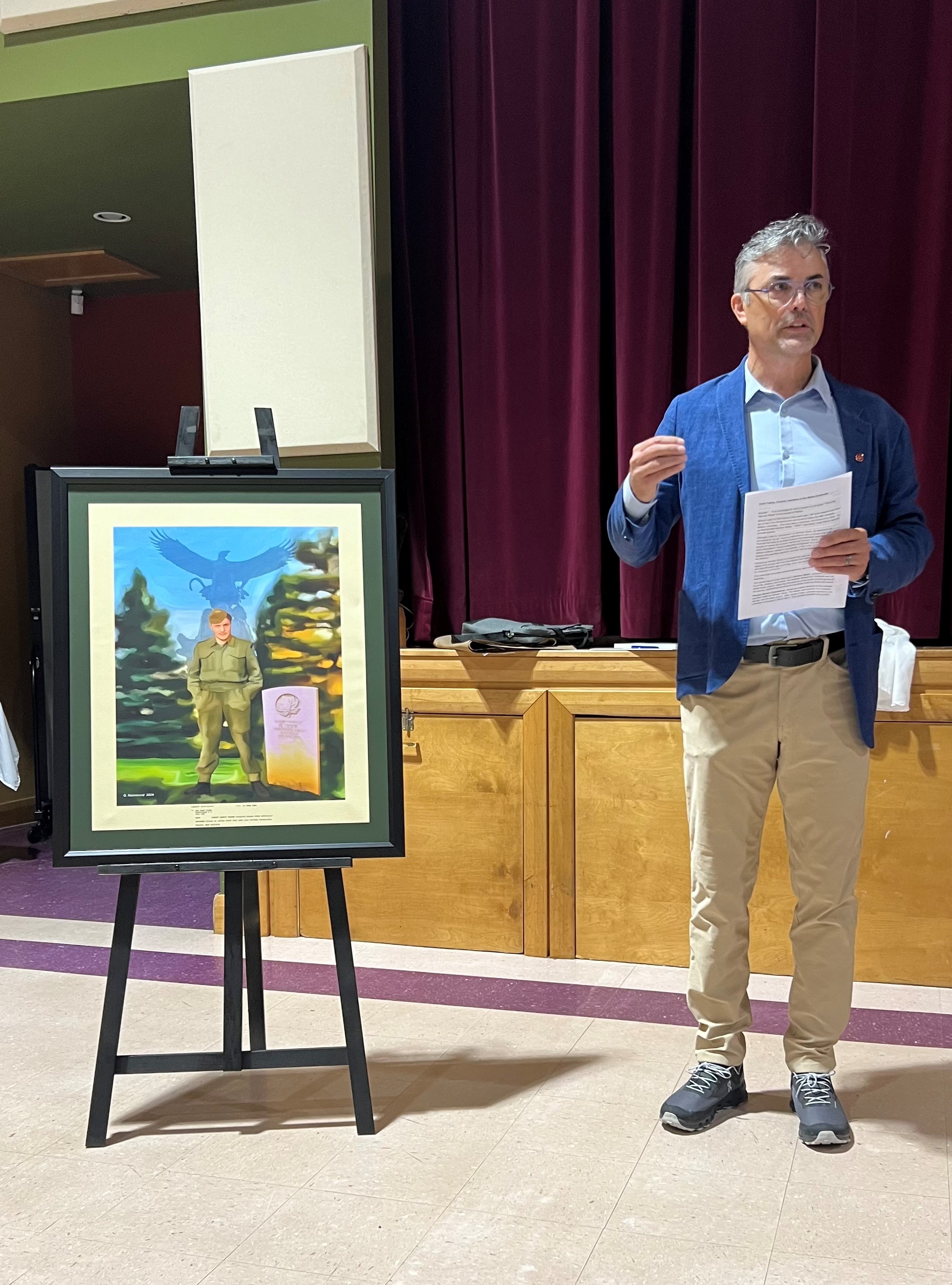
Honouring Herman Stock – Elements of the Art

Honouring Herman Stock is a tribute that captures the spirit, sacrifice, and legacy of Herman Stock, a young man from the Wahta First Nation who served and died 80 years ago on D-Day, June 6, 1944. This memorial comprises several elements, each filled with symbolism and meaning.

Herman Stock at the Centre: The central figure of the memorial is Herman Stock, a powerful young man full of life, dreams, and hopes. His carefree demeanour contrasts with his battle dress uniform, capturing the essence of his youth and the gravity of his service, highlighting the personal sacrifices made by those who serve.

Herman Stock’s Gravestone: The gravestone serves as a stark reminder of the ultimate sacrifice made by Herman Stock. The Maple Leaf signifies his Canadian identity, and the date June 6, 1944, marks D-Day, a pivotal moment in the Liberation of Europe. This contrast between his youthful image and his gravestone underscores the profound loss felt by his passing.

The Forest: Representing the forests of his homeland, this element symbolizes bringing Herman back to his roots. The Commonwealth War Graves Commission Cemetery in Beny-sur-Mer though beautiful, is far from Wahta First Nation. By placing Herman in a familiar forest setting, the memorial connects him to his ancestral heritage and the land he loved.
The National Aboriginal Veterans Monument: Silhouetted in the background, this monument reflects traditional Indigenous values of honour, duty, and harmony with the environment. The Thunderbird atop the sculpture represents the Creator and embodies the spirit of Canada’s Aboriginal peoples. This connection honours Herman Stock while recognizing the broader contributions and sacrifices of all Aboriginal veterans.

Telegram to Mary Stock: This element highlights the personal and communal loss experienced by Herman’s family and community. The telegram announcing his death is a poignant reminder that his sacrifice was shared by his loved ones. It symbolizes the collective grief and the impact of his loss on the Wahta First Nation and beyond.

Together, these elements create a memorial that honours Herman Stock’s memory, celebrates his heritage, and acknowledges the broader sacrifices made by Indigenous veterans and their communities.

Greg Hammond 2024

“Honouring Herman Stock” by Greg Hammond.

D-Day+80 Pilgrimage

By Major John Stephens, CD (Ret’d), Museum Director and Archivist

Today, sixty-one serving soldiers of The Queen’s Own Rifles plus various members of the Regimental Family are participating in a pilgrimage to Normandy, France in honour of the 80th Anniversary of D-Day and the sixty-one QOR soldiers killed on D-Day, 6 June 1944.

I had the privilege of sponsoring Corporal Eric Filmer on this trip and together we remember B66008 Rifleman Albert Edward Hildreth who was killed in action on D-Day aged 23. You can read more about Rfn Hildreth on his museum profile. We each received a coin engraved with his name on the reverse.


In an email yesterday Cpl Filmer shared some thoughts about the trip so far:

“The past few days have been tremendously moving to hear about, and visit the places where our soldiers made the ultimate sacrifice. What really brings it home are the people from the towns that we liberated. Canadians, specifically the QOR, are at home in many of these places. The children have been taught the importance of what happened here, and it has been made a part of their lives Our history has been tonight to them in school, and hearing them sing the Canadian national anthem, and seeing their excitement has been very heartwarming.”
Today they are marching from the landing at Juno Beach (with some stops in other villages along the way) to the Village of Anisy which was the QOR’s final objective on D-Day.
Yesterday they attended a service in Le Mesnil Patry where the battle of the town cost 50 QOR deaths – the second most in a single day of the war. The pictures above and below are from that remembrance.

We will remember them.

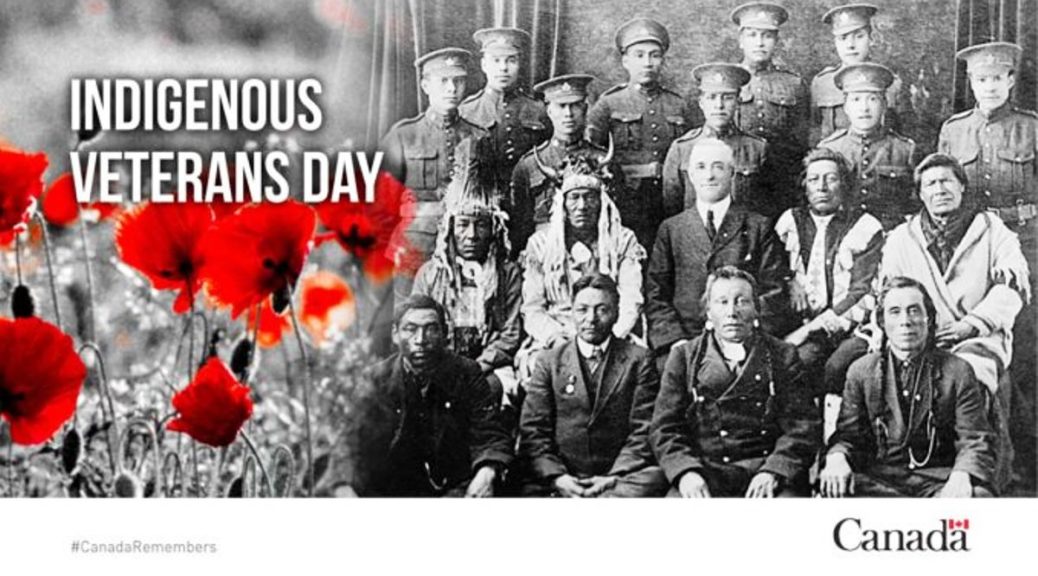
Indigenous Veterans Day 2023

“Today, on Indigenous Veterans Day, we express our heartfelt gratitude to all First Nations, Inuit, and  Métis service members who have served in the Canadian Armed Forces. On this day, we also remember those who never made it home and those whose lives – and the lives of their families – were forever changed by conflict and war…

We all have a duty to remember and honour the sacrifices of Indigenous Peoples who have answered the call to serve. On behalf of the Government of Canada, I encourage everyone to take some time today to honour Indigenous Veterans and learn more about their past and current contributions to Canada’s proud military history.”

From the statement by Prime Minister Trudeau,
8 Nov 2023

Chief Percy Joe

On this 2023 Indigenous Veterans Day, we also want to recognize the military service of Indigenous and Métis soldiers particularly those who served in The Queen’s Own Rifles – both reserve and regular force – and in the battalions from the First World War which we perpetuate.

The latter include the 3rd Battalion, 83rd Battalion (Queen’s Own Rifles), 95th Battalion, 166th Battalion QOR, 198th Overseas Battalion Canadian Buffs, and the 255th Battalion (QOR) of the Canadian Expeditionary Force.

The museum’s research to date has identified thirty-four indigenous and four Métis who served with the above, and ten of whom gave the ultimate sacrifice.

Rifleman Charles Nahwegezhic, MM

We invite you to learn more about the soldiers listed below, several of whom include links to more extensive profiles. A † following their name indicates they died while serving.

A few of note are Rifleman Herman Stock who died on Juno Beach on D-Day, Rifleman Charles Nahwegezhic who was awarded the Military Medal before being killed in action in Holland near the end of WWII, Oronhyatekha (also known as Peter Martin) – a nineteenth-century member of the QOR who has a life story worthy of a film, and Chief Percy Joe whose profile include a recent interview with our Museum Director.

We also invite you to share any additional names or information by leaving a comment a the bottom of this post.

Lest We Forget

Indigenous:

  1. Amiskuses, Vincent – Kawacatoose First Nation – Saskatchewan (WWII/Peacekeeper)
  2. Bain, 868003 Acting Lieutenant John Faquhar – Prince Albert, Saskatchewan (182 Bn WWI with 2 1/2 yrs previous service with QOR)
  3. Beaver, Rifleman Arthur William – Alderville First Nation, Ontario (WWII) †
  4. Bressette, Lloyd Henry – Kettle and Stony Point First Nation, Ontario (WWII)
  5. Cada, Paul Senior – Sheshegwaning First Nation (WWI)
  6. Carlson, Frederick – Ojibway (Korea)
  7. Chappise (Wemaystikosh), 486620 Private Peter Rupert – Cree from Chapleau and Moose Factory, Ontario (3rd Bn WWI) †
  8. Dreaver, 886518 Corporal Joseph Sr. MM – Cree from Mistawasis First Nation – Saskatchewan. –  Band Chief post-war (107th -> 3rd Bn WWI, WWII)
  9. Eagle, Sergeant James Wilfred – Saulteaux Ojibway Valley River Reserve – Manitoba (The Memory Project interview) (Korea)
  10. Eagle, Norbert James – Ojibway from Ohskaning Reserve – Manitoba (Reg Force)
  11. Ewenin, Rony – Kawacatoose First Nation, Saskatchewan (Korea)
  12. Franklin,  201795 Private William Henry – Mississauga from the Alderville Band – Roseneath, Ontario (95th –> 4th Bn WWI) †
  13. George,  Rifleman Harold Wayne (Reg Force) †
  14. Harper, Louis – Wasagamack – Manitoba (Reg Force)
  15. Jamieson, Corporal Harold – Oshweken, Ontario – Six Nations of the Grand River First Nation (WWII) †
  16. Joe, Percy – Shackan First Nation, British Columbia (Reg Force)
  17. King, SL163037 Rod – Lucky Man Cree Nation, Saskatchewan (Reg Force)
  18. Lavelley, 788954 Private Peter – Golden Lake Band, Ontario (3rd Bn WWI) †
  19. Ledoux, Phillip
  20. McLaren, Peter Bertram Dalton – Timiskaming First Nation, Ontario (WWII)
  21. Morrison, Joseph – Anishinaabeg of Naongashiing (Big Island) First Nation
  22. Nahwegezhic, Rifleman Charles MM – Anishinaabe from Sheguindah First Nation (WWII) †
  23. Okemaysim, Napoleon – Cree-Assiniboine, Beardy’s and Okemasis First Nation – Sask. (Reg Force?)
  24. Oronhyatekha (also known as Peter Martin) – Mohawk
  25. Ross, Steven M. – Cree from Montreal Lake, Saskatchewan (Reg Force)
  26. Runns, Fredrick Sr. – Nakota from Carry the Kettle First Nation – Sintaluta, Saskatchewan (WWII & Post-war??)
  27. Ryder, Andrew – Nakota from Carry the Kettle First Nation – Sintaluta, Saskatchewan (WWII plus Germany 1949-1952)
  28. Smith, Frederick William – Chippewas of Rama First Nation, Ontario (WWII)
  29. Stock, Rifleman Herman  – Haudenosaunee from Gibson Band [Wahta Mohawk] Sahanatien, Ontario (WWII – KIA D-Day) †
  30. Thomas, 9254 Private Charles Alfred – Haudenosaunee from Six Nations First Nation, Oshweken, Ontario (QOR & 3rd Bn WWI) †
  31. Thomas, 9255 William Sherman – Mohawk from Brantford, Ontario (QOR & 3rd Bn)
  32. Wemigwans, B139461 Private Isadore – 3 Fires Confederacy from Wikwemikong – Manitoulin Island, Ontario (WWII)

Métis

  1. Duva, Alcide Joseph Alzear (Post war Germany)
  2. Ferland, Rifleman Norman Philip (Korea) †
  3. Paquette, Joseph R. (1st Bn Reg Force)
  4. Riel, Sergeant I.J. (Reg Force) Great-nephew of Louis Riel


WWII QOR Veteran George Beardshaw: 100th Birthday

On Sunday, September 10th, 2023 family, friends and members of the Queen’s Own regimental family (both former and currently serving members) gathered in London, Ontario to celebrate (a few days early) Second World War Corporal George Beardshaw’s 100th birthday.

George is one of two known living WWII veterans who served with The Queen’s Own Rifles.  He was posted to the QOR as a reinforcement in September 1944 and served with them until the end of the war. However, he spent the final 28 days of the war as a prisoner of the Germans.

You can read more about George on his profile page.

This slideshow requires JavaScript.

D-Day+79

Today marks the 79th anniversary of D-Day and the first time we commemorate without any known living survivors of that landing.

Some of us recently attended the memorial service for Alex Adair who passed away on Christmas Eve 2022 and was our last known living D-Day veteran.

Alex was one of the four soldiers in the well-known photograph (above) of the just liberated home now known as Canada House. The other three were Jim Leslie, Norman Hore and Bob McBurney.

You can hear about how they ended up in this photo from Alex himself in this short video:


Sixty-one Queen’s Own soldiers were killed on D-Day and you can find profiles of each of them here.
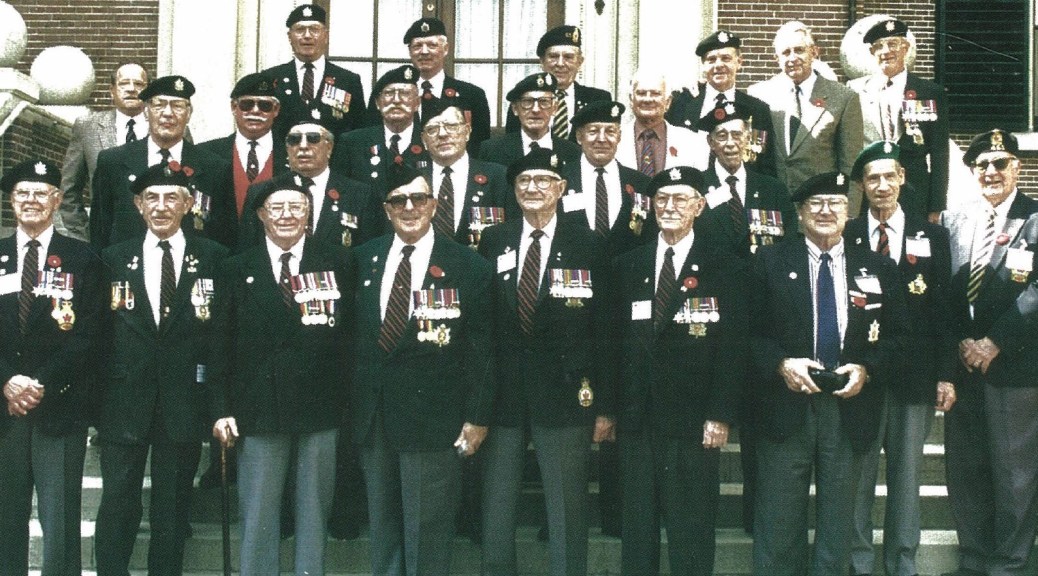
Some Facts About The QOR Fallen

  • The average age of the fallen was 29.9 years old
  • The youngest was 19-year-old Rifleman Russell Adamson of Midland
  • The oldest was 40-year-old Corporal Hugh Rocks of Kirkland Lake
  • Many of these riflemen left school at the age of 14 or 15 – few completed high school
  •  Many of their fathers had served in the First World War
  • Rifleman Calbert’s brother was also QOR and was killed in Holland in February 1945.
  • Rifleman Corvec was transferred to the QOR from a reinforcement unit on 26 May 1944 – just 12 days before D-Day
  • Rifleman Hall served in the 1939-1940 Finnish-Russian War before enlisting with the QOR in England in 1942
  • Sergeant “Freddy” Harris was the only Jewish rifleman among the QOR’s D-Day fallen.
  • Rifleman Lizon has no known grave and is remembered on the Bayeux Memorial however there are several graves in Beny-sur-mer Cemetery with no known names.
  • Rifleman Martin lied about his age in order to join the QOR in Jun 1940. He was two days shy of his 22nd birthday on D-Day
  • Riflemen May and McCallum were originally drummers but would serve as stretcher bearers on D-Day
  • Lance Corporal McKechnie was married in England on 18 May 1944 – just weeks before D-Day
  • Included in this list are two brothers – Gordon and Douglas Reed
  • Rifleman Showers was AWOL (absent without leave) when his original regiment The Black Watch, left Newfoundland, and on reappearing was posted to the QOR
  • Rifleman Stock was an indigenous soldier from Gibson Reserve
  • From the QOR fallen alone, at least 17 children became fatherless on D-Day

Watch this video to learn more about The Queen’s Own on D-Day:

You can find more about the QOR and the Second World War including personal reminisces of D-Day on our Second World War Resources page.

Please consider supporting the Regiment’s Return to Normandy: 80th Anniversary of D-Day.

1860 Club D-Day Dinner

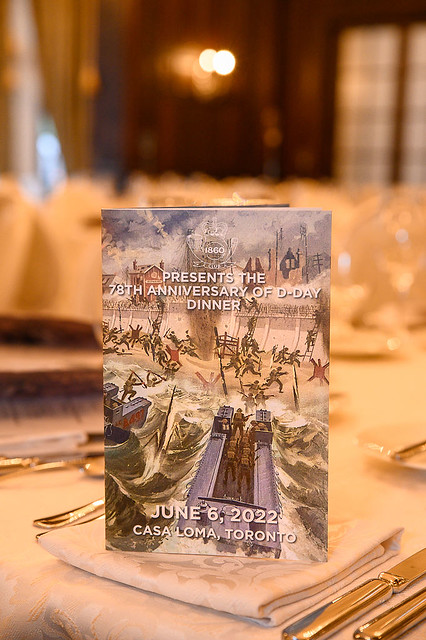
On 6 June 2022, the QOR Regiment’s 1860 Club held a formal dinner for 200 guests at Casa Loma, the home of the Regimental Museum and Archive since 1970.

Several exhibits were on display during the pre-dinner reception including the memorial banners of all our fallen since 1866, several recently acquired 1860’s era uniform pieces, banners on the QOR’s D-Day and WWII participation, and some D-Day items including the pistol carried by CSM Charlie Martin.

Throughout the dinner, several vignettes from D-Day Veterans were read by various attendees – several of which were moving descriptions of their beach landings and of losing close friends and relatives.
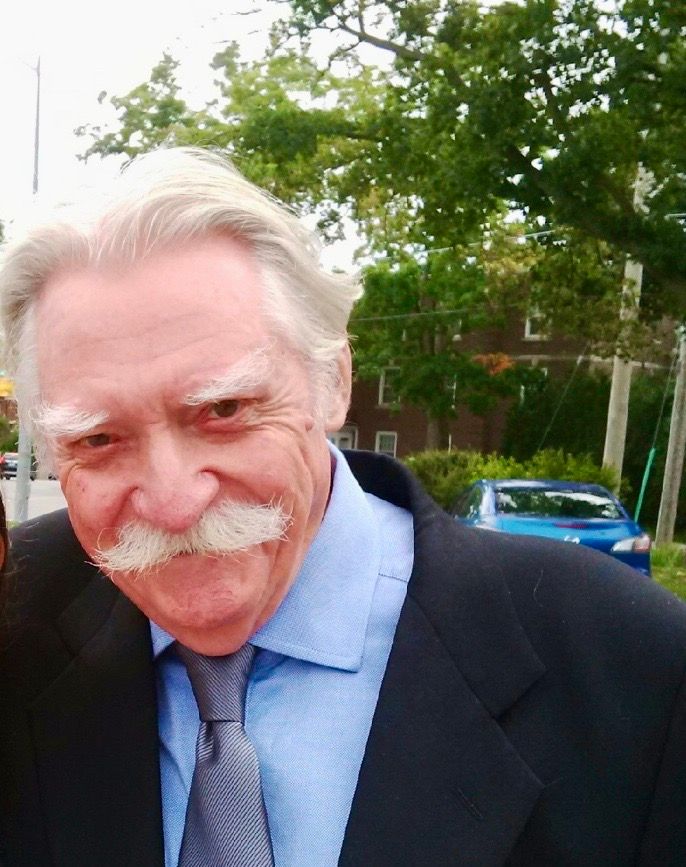
And once again, the museum’s Photograph Officer Anne Frazer captured the event with some amazing photographs. Click on the photo below to see them on our Museum’s Flickr site.

The QOR's 1860 Club 2022 D-Day Dinner held at Casa Loma
Click on the image above to see the photographs taken at this event by the Museum’s official photographer, Anne Frazer.

Looking Back: VE-Day+50 – A Day Like No Other

Charles D. McGregor

By  Charles D. McGregor

As a former member of drum and bugle bands in the 1940s and ’50s, I had done plenty of marching. From a cold wintry day leading the high school cadet band in the Santa Claus Parade, to a hot and steamy July day marching down Fifth Avenue in New York they were all memorable, in their own way.

But the one that I now remember with the most clarity took place in Appeldoorn, in Holland, on May 8th, 1995, VE-Day+50. I was there as a part of a touring group of about 20 World War Two veterans and their wives celebrating Victory in Europe Day. On this date, fifty years prior, Allied troops, mostly Canadians, had completed their liberation of Holland. This triggered the surrender by Germany of its armed forces, ending six years of war that had cost Britain and Canada more than 500,000 lives. The relatively small country of Holland had suffered 200,000 civilian deaths, many of those from starvation. Thousands more, mostly Jewish, were sent, by truck and train to Nazi concentration camps, where almost all of them –  men, women, children – had died.

Canada and Holland have a special relationship resulting from actions during   World   War   Two when Canadian Forces led the country’s liberation. This is where many members of The Queen’s Own Rifles fought their way across Holland to liberate the Dutch who had been suffering under Nazi occupation. Most of them are now dead but their part in ending the German oppression will never be forgotten.

Almost 8,000 Canadians would die in the fighting from September 1944 to April 1945. It had become urgent for the Allies to clear both banks of the River Scheldt estuary in order to open the port of Antwerp to Allied shipping, thus easing logistical burdens in their supply lines stretching hundreds of miles from Normandy eastward to the Siegfried Line. Supplies could then be delivered directly to those who needed them. Food, military vehicles and artillery, ammunition, fuel and, most important, replacement troops were needed for those fighting the ground battles. Clearance of northern and western Holland allowed food and other relief to reach millions of desperate and starving Dutch men, women and children. Its liberation triggered waves of jubilation and tears from those now free from occupation.

Wons, The Netherlands

The celebratory 50th anniversary parade was scheduled to start at noon in Appeldoorn, a medium-sized city in central Holland. We had travelled by bus from our hotel, a few miles from there, and were dropped off at mid-morning in the stadium’s parking lot where the parade would end. We were given a firm reminder that the bus would leave to return to the hotel at 5 pm SHARP. Until then, we were on our own. Fine by me and I set off alone, walking. The city streets were decorated with Dutch and Canadian flags, miles and miles of bunting and all the other trimmings that events like this require. There were all kinds of military exhibits and many happy people on the streets. I was in for a few surprises. The uniform  I was wearing and the regimental cap badge helped.

I was in the summer-weight tan uniform with The Queen’s Own Rifles shoulder flash and the Maple Leaf-shaped badge on my dress uniform wedge cap. As I headed towards a Starbucks ahead of me I noticed a throng of teenagers pretty well blocking the entranceway. They were just standing there in a group, the way teenagers do. But I wanted a coffee so I marched towards them. As I got there they made way for me and as I passed through they all clapped, in unison. I gave them a nod and a smile and continued on. They did it again when I came out, so I gave them a little wave, and said “Thank You.”

About an hour later I was walking along a side street when a man walking toward me stopped and as I got closer he stuck out his hand to shake and said “Queen’s Own Rifles.” It wasn’t a question, it was a statement. “I saw the maple leaf on your cap badge. You liberated our village in 1945. I remember you well. I was a schoolboy at the time. I was eight and my sister was 12 and one of your soldiers gave us chocolate. I asked if I could have cigarettes and he laughed and said I was too young. I told him they were for my father and he gave me a full pack of 20 Sweet Caporals. I really wanted them for myself. My father was killed by the Germans. I still have the empty pack as a remembrance of that day.” He said, “I am a school teacher now, but I always tell my students not to smoke,” and we laughed together.

I found my way to the parade route and joined the thousands who had flocked there to see the marchers and military tanks and weapons carriers, as well as to hear the many bands. At one point I was walking past a restaurant and passed a young couple sitting at the outdoor patio. The man waved me over and said “You must be a Canadian. You have a maple leaf badge. Will you join us for a drink?” By now I was ready for one, so I sat with them while he ordered for me. The waiter arrived with a bottle of Heineken and a frosted mug and already my day became a great success. So we chatted for a while until I decided to move on. We exchanged names and addresses and I thanked them both. At Christmas that year I got a card from them where they identified themselves as the ones who “bought you a ‘bear’ in Appeldoorn.”  Sadly, by then I had lost their address so was unable to respond to them.

My recollection of parades, no matter the size, is that most spectators look for the saluting base on the parade route, and they congregate there. The marchers always put on their best show there. At the startup and the end, however, the crowds are usually smaller and by parade-end, those at the finish have been greatly thinned out. Not here. Not this day. I covered much of the long parade route and found it packed five or more deep in the stadium parking lot from start line to finish. Not only that, the rooftops on both sides held hundreds more everywhere I looked. Our Queen’s Own Rifles veterans were either riding on open army trucks or flatbeds while some were rolling along in wheelchairs piloted by family members. In addition to our band and bugles, there were brass bands, pipe bands, fife bands and even one accordion band, that was having difficulty being heard due to the cheers which seemed to be non-stop. It was a moving experience for me, seeing all those veterans from the Allied countries, all of whom would have been at least in their late sixties. Many would be dead by the time the year 1995 ended.

As the parade ended, I was walking back to find the bus when my name was called. I turned to see who it was and saw about half a dozen members of the regimental band sitting with beers in front of them under an umbrella in front of a bistro. Waving me over to join them was Doug Hester, a D-Day veteran who had been a bugler in the band before the war and a medic and stretcher-bearer in Normandy. Then living in  Florida, he had been one of several veterans who had come to Holland with the band. Now close to 80, he was wearing the same uniform he had worn in 1939. As we chatted and laughed together it suddenly occurred to me that it must be close to five o’clock. It was actually five-thirty!

True to the warning we had been given, I found the bus had left without me. I went to the stadium office, explained I had missed my ride and asked if they could call me a taxicab. When I gave them the name of my hotel I was told that it would be expensive. I said I thought that might be the case but I had no alternative. At this, a man seated in the office said, “I’ll take you.” He stood up, took his jacket off the back of the chair and as he put it on I saw that he was a major in the Dutch Army. I thanked him for his kindness and he smiled and said “Call it professional courtesy. One soldier to another.” He was a very interesting man and we had a great conversation on the trip back to the hotel. When we arrived I thanked him again and shook his hand in gratitude and said goodbye. As he drove off I headed into the hotel, where I was in for another very nice surprise.

As I passed the registration desk I was waved over and told there was a  phone message for me. It was,  from my son Rob, telling me he and Dianne had another daughter, born today, on the May 8th, a sister for Catriona (Catie) That was great news and it gave me an (expensive) idea. Dinner was being served for our travel group at 7 pm and was about to begin. I checked the dining room and found only 12 seated there, with the others presumably dining out. I went back to the desk and asked to speak to the manager. When he arrived I asked if I could order four bottles of chilled champagne and champagne glasses to be brought to our tables when dinner was finished and coffee was ready to be served. No problem, he said. I then went in to join the others, apologizing for arriving late.

As the meal progressed it was apparent I wasn’t alone in thinking the afternoon’s parade had been an outstanding event. It seemed to have affected them as much as it had me. It had been something we all would remember for a long time. Finally, as the meal dishes had been removed and the coffee arrived, the manager came in, gave me a questioning look and I nodded. At that, he stood aside and in came a trolley with four bottles of champagne in coolers along with tall crystal champagne glasses. I stood up and announced that I’d like all of them to join me in a toast to the birth of my second granddaughter.

After the bottles were opened and all the glasses filled, I proposed a toast to the new baby, almost 4,000 miles away from where we were. I said “I don’t know what her name will be but I’m going to suggest to her parents that Victoria Elizabeth would be appropriate for someone born on this date. Her initials would be V.E.” That brought laughter and applause. However she was named Mary Elizabeth, which became Mary Beth for a while, but now she has settled on Mary, so that’s what it remains. But this was a very special moment for me.

I had already attended several VE-Day+50 events with members of The Queen’s Own Rifles and their families and friends. These had included a reception at la Maison du Queen’s Own Rifles on the beachfront at Bernières-sur-Mer, where the regiment landed on D-Day, as well as a service at Beny sur Mer Canadian War Cemetery. There are more than 2,000 Canadians buried there including 61 from The Queen’s Own. Another service would take place later at Groesbeck Canadian War Cemetery near Nijmegen where another 72 members of the regiment are buried, including Sgt Aubrey Cosens, VC. Sgt Cosens was awarded the Victoria Cross for outstanding bravery which cost him his life during an attack which took place across the Rhine, in Germany in March 1945.

I also visited Wageningen, the site of the surrender of Germany to Canadian General Charles Foulkes on the fifth of May  1945, officially ending the war in Holland. Here again, the town was in a festive mood, thronged with celebrating visitors. And here again, I got free beer. I was looking in the windows of a bistro and a couple were seated just inside. I saw the man get up and head outside, where he took me by the arm and said “You are Canadian?” I nodded and he pulled me inside, introduced me to his wife and told me I could have all the free drinks and food I wanted. I settled for two bottles of Heineken and something on the menu called “kroket” which is beef ragout inside a fried breaded pastry roll. Went down very well with the beer!

Other visits were made to points of interest along the route which played a major role in the movie “A Bridge Too Far” which was the bridge at Arnhem. The movie is about the planning and execution of General Montgomery’s  “Operation Market Garden.” The largest airborne assault ever staged, it cost as many as 18,000 British and Americans killed, wounded, and captured in eight days of fighting. The Hotel Hartenstein in Oosterbeek, which had been commandeered by the Germans as its HQ eventually became British Second  Army’s HQ as the battle for Holland continued. Now an Airborne Museum it contains historical artifacts about what happened there. It was there I saw something I have never been able to forget. It was a full-sized, white-painted door with a message written in large lettered charcoal. From the British officer commanding outnumbered and surrounded troops now fated to die or be taken prisoner it was his thanks for their continued bravery. He noted that they would soon be out of ammunition, “but we must fight until the last bullet is spent.” An emotional message to men whose war would soon end.

John Missons at VE Day event in 1995

It was in the Canadian Military Cemetery at Groesbeck that I saw D-Day veteran Sergeant John Missons sitting under a tree in his wheelchair. I knew him and his son, also John, who was a drummer in the regimental band, as I had once been in other bands. We had become pretty good friends and I liked them both a lot. As I walked along John waved  me over and said “Can you do me a favour?” I said sure I could. He said, “Aubrey Cosens is buried here and I’d like to visit his grave.” Sergeant Aubrey Cosens VC and John Missons were both in B Company and Missons remembered him well. He said “We were friends and the news he had been killed spread quickly. He was one of close to 100 killed or wounded in that fighting but he was one I knew better than the others. Some were replacements who had only been with us a few days.” Sgt Cosens was awarded the VC for his bravery Mooshof, in Germany, in February 1945, “but we didn’t find out about that until after VE-Day.”

John Missons at 18 years of age circa 1940 likely in Newfoundland.

It was as I was wheeling him back to find his son that I passed a row of 17 headstones, all of soldiers from the Lincoln and Welland Regiment, all killed on the same day. The Canadians had been tasked to clear the German occupiers from both sides of the Scheldt, resulting in many losses among both armies. The “Links and Winks” had their headquarters in St. Catharines, where I lived in the late ’40s and early ’50s.  I had played drums in their band on several occasions, and as I looked at those headstones I wondered whether any of my high school friends were sons of those who died in Holland. At the Telegram, I worked with a photographer named Jim Kennedy, who had been with the regiment there and was in a Jeep which was blown into the river by a shell explosion and, as far as he knew, he said he was the only survivor of the incident. He woke up in the hospital and was soon on his way home.

When my trip ended, we flew back to Canada from Schiphol Airport in Amsterdam, changing planes at Heathrow. We were due back sometime in the late afternoon, as I recall. Rob had offered to meet me there but a storm developed which diverted our aircraft to Ottawa. We were told we’d have to wait there until the storm, which was centred over north Toronto, had cleared. Also, we were not allowed off the aircraft because we were at Uplands Airport, which had no customs or immigration personnel. What I didn’t know was that Rob had brought Catie to the airport. The delay went on for several hours and I felt badly for both Rob and Catie, because she was only four years old at the time, and sitting and waiting is not what little girls want to do. However, we eventually got into Toronto Airport and my trip to celebrate VE-Day+50 was done.  I was certainly happy to see Rob and Catie, who had waited a very long time for me to get back on Canadian soil.

POSTSCRIPT (1) Holland vs The Netherlands: While the use of the name “Holland” has now been officially replaced by “The Netherlands,” World War Two veterans of The Queen’s Own Rifles of Canada, who paid a steep price for their efforts in liberating the country, always spoke of it as Holland. And what’s good for the veterans is good enough for me in these memoirs. Although the names were once used interchangeably, the Dutch government has decided the name Holland will now be dropped and The Netherlands will replace it in reference to the country. The difference between the Netherlands and Holland is that the Netherlands is the term for the country as a whole (12 provinces). Holland refers to  North Holland and South Holland the two largest provinces.

POSTSCRIPT (2) A three-year stay in Canada. Following the German occupation of Holland, the Dutch Royal family was invited to Canada, where they lived as guests of Canadians until their homeland was liberated. Princess Margriet was born in exile while her family lived in Ottawa. The maternity ward of Ottawa Civic Hospital in which the princess was born, was temporarily declared to be extraterritorial by the Canadian government, thereby allowing her citizenship to be solely influenced by her mother’s Dutch citizenship. To commemorate the birth, the Canadian Parliament flew the Dutch flag over Peace Tower, which became the only time a foreign flag has flown over the Canadian Parliament Building. Princess Margriet was baptized in St Andrew’s Church, Ottawa, on 29 June 1943. Her godparents included President Franklin D. Roosevelt and the Dutch Merchant Navy, in honour of the role played by the latter during the Second World War. It was not until  August 1945, after Holland’s liberation,  that the princess, her parents and two sisters arrived home to a wild welcome from their citizens who had suffered so badly during the war years.

In 1945, the Dutch Royal family sent 100,000 tulip bulbs to Ottawa in gratitude for Canadians having sheltered the future Queen Juliana and her family during the preceding three years of Nazi occupation of their country. The Gift of Tulips became a yearly tradition. Every year, the Dutch Royal Family and the people of Holland each send   10,000 bulbs to Ottawa. These are planted in beds at the Ottawa Hospital in tribute to the birth of Princess Margriet. This gift gave rise to Ottawa’s annual Canadian Tulip Festival, held in May. Perhaps the world’s largest tulip festival, it displays over one million tulips and has an attendance of over 650,000 visitors. Large displays of tulips are planted throughout the city, with many thousands planted along the Rideau Canal alone. Princess Margriet continues to make regular visits to Canada, continuing strong ties between Canada and the Dutch.

The quest for Jack Kavanagh’s last resting place

The amazing story of the identification of an emblematic and bold Canadian soldier whose last resting place was lost for 75 years.

By Francis Bleeker (© FLG Bleeker)

Introduction

Lieut. Gen. Mart de Kruif speaks about Canadian sacrifices, Canadian War Museum, photo F Bleeker, 4 May 2017

In May 1992 I was seconded to the Dutch 41 Light Brigade in Germany for a major exercise. My new boss was Major Mart de Kruif, a Dutch Grenadier Guards officer, in charge of G3, the Operations section. I was his liaison officer for the duration of the exercise. Exciting times, just after the fall of the Berlin Wall. After my immigration to Canada in 1998 we continue to meet at regimental events. In 2008 he takes command of Regional Command South in Afghanistan and for a whole year works with numerous Canadian staff officers.

Grave of unknown soldier, Steenderen, photo by F Bleeker 2017

Fast forward again and in 2017 now Lieutenant General de Kruif shares a panel with LGen Marc Lessard at the Canadian War Museum to talk about Canadian-Dutch co-operation in Afghanistan and the close ties between the two countries. He then talks about the heroism and the sacrifice of Canadians during the liberation of The Netherlands from the Germans in 1945 and how soldiers of The Queen’s Own Rifles of Canada are commemorated in Rha, a village close to his home in the Eastern part of The Netherlands. One of them does not have a grave and is remembered on a wall at the Canadian War Cemetery in Groesbeek. In nearby Steenderen there is a grave of an unknown soldier. Local amateur historians think they know who he is: Lieutenant John Gordon Kavanagh of The Queen’s Own Rifles. General Mart recites what is engraved on the monument in Rha: ‘Dying for freedom is not the worst that could happen, being forgotten is.’ Afterwards I agree to delve into this story, do more research, and see what I can come up with.

Who was Jack Kavanagh?

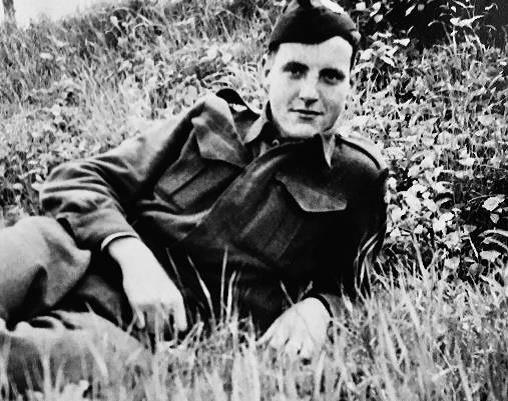
Jack Kavanagh (Photo by permission J.G. Young)

John Gordon Kavanagh, ‘Jack’ to family and friends, was born in Toronto on 20 October 1921, the son of John and Cora Kavanagh. He was the youngest of four children. His brothers and sister were a lot older, the difference with his sister was 13 years, 19 years with his oldest brother. His father was a handyman at Eaton’s and died when Jack was only seven years old. Jack grows up on Sandford Avenue and after 4 years of high school at Riverdale Collegiate, he finds a job in the athletics department at T. Eaton Co Ltd making $18 a week.

On the 10th September 1939 Canada declares war on the German Reich independently from the British Empire. Jack joins The Queen’s Own Rifles of Canada (QOR) only eight days after Canada’s declaration of war a month shy of the required age of 18. He may have fudged his date of birth by three months to get in as the date has to be amended in his paperwork later on. Initially The Queen’s Own train in ‘mufti’ because of a shortage of uniforms.

When the unit is mobilized in June 1940 he transfers from the non-permanent active militia to the regular force (CASF) and takes the oath to ‘be faithful and bear true allegiance to His Majesty’. The regiment trains in Toronto before moving to the Dominion of Newfoundland for more training. Jack is part of the regimental boxing team and they win the Divisional Boxing Tournament in May 1941.

Finally in July 1941 The Queen’s Own cross the Atlantic by ship to Scotland where training and live fire exercises resume. The battalion moves to Southern England, first Aldershot then Pippingford Park, Sussex, south-west of London. The QOR boxing team, including Jack, is doing well again and wins the brigade and subsequently the divisional championship. The battalion keeps moving around Southern England in 1942 for training and exercises and during the fall Jack receives several reprimands and forfeitures of pay for short unauthorized absences.

Wedding Jack Kavanagh and Emily Jean Haddleton, 12 June 1943, London. (photo by permission J.G. Young)

History does not tell but it is very likely that these absences had something to do with a lady interest. Now a corporal Jack has to apply a second time to marry Emily Jean Haddleton as the first application had gone missing. Jean, who is a Red Cross nurse, grew up around the corner from Jack’s home in Toronto. He was probably frustrated by the two-month bureaucratic delay so he adds a cheeky note stating that ‘proposed wife is a member of the Canadian Red Cross Corps and has been granted permission to marry by her Commandant’, so get on with it! The wedding takes place in Kensington, London, on 12th June 1943 with comrades in arms and Red Cross nurses attending.

After that it is back to more exercises until 7th October when Jack, now an Acting Sergeant, is sent back to Canada for officer training at the Officer Training Centre in Brockville, Ontario. We can only guess how Cadet Kavanagh must have felt when the invasion in Normandy started and he heard the reports of the severe losses that The Queen’s Own incurred.

Jack is commissioned and reports for duty in England on 28 December 1944. He is ready to rejoin his unit, but disaster strikes and on 25 January 1945 he is hospitalized with pneumonia. After 11 days in hospital he discharges himself but continues to kick his heels until he is fed up waiting. He takes off without orders and makes his own way to The Queen’s Own who are in Germany just across the Dutch border. It takes some representations from the commanding officer of The Queen’s Own and the brigade commander to paper over this infraction but on 18 March Jack finally has his platoon in B Company.

Jack and his sister Mabel. (photo by permission J.G. Young)

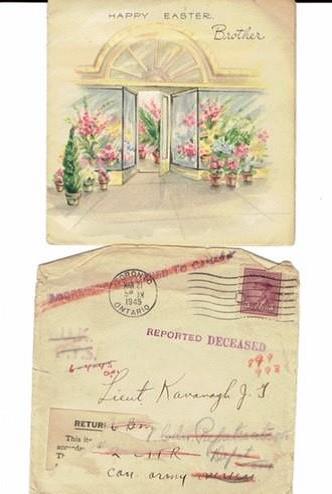
The QOR had just come through another period of heavy fighting and heavy losses against a vicious, relentless enemy that included hand to hand combat where even the ‘rifleman’s swords’ (bayonets) were used. When Jack rejoins the QOR they are recuperating briefly in the Reichswald in home-made huts and underground shelters. On 23 March he writes an upbeat letter to his sister Mabel affectionately joking about his batman ’just a kid of 19’ and sends his love to ‘the gals at the big store’ (Eaton’s). It is to be his last letter. Coincidentally Mabel sends him an Easter card on the same day.

24 March and the QORs are on the move again as part of Operation PLUNDER. By 2 April they are back in The Netherlands, they cross the Oude Ijssel river and are getting a taste of liberating the jubilant Dutch population. On 5 April B Company is tasked to capture the hamlet of Pipelure, near Rha. The enemy had used forced labour to dig deep trenches and construct tank traps. The terrain is muddy and the trenches waterlogged. In those horrendous circumstances, without cover and supporting fire, Kavanagh advances with two platoons in the late afternoon and runs in to heavy mortar and small arms fire and is pinned down. During that action Jack is killed, it is said by a Panzerfaust, an anti-tank weapon. Four others die in the same action. The reserve platoon is now deployed to allow platoons 11 and 12 to withdraw. In the dwindling light The Queen’s Own have to fight hand to hand with the enemy before they can retire taking their wounded but leaving five dead, including Jack, behind.

Mabel’s Easter card is returned to her, the envelope is stamped ‘REPORTED DECEASED’ in capitals…

Aftermath?

Ring presented by T.Eaton Ltd (photo by permission J.G. Young)

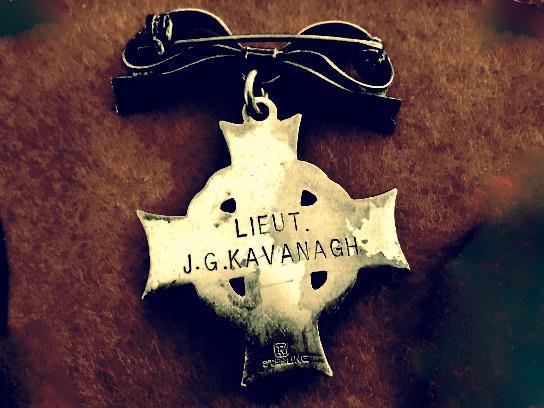
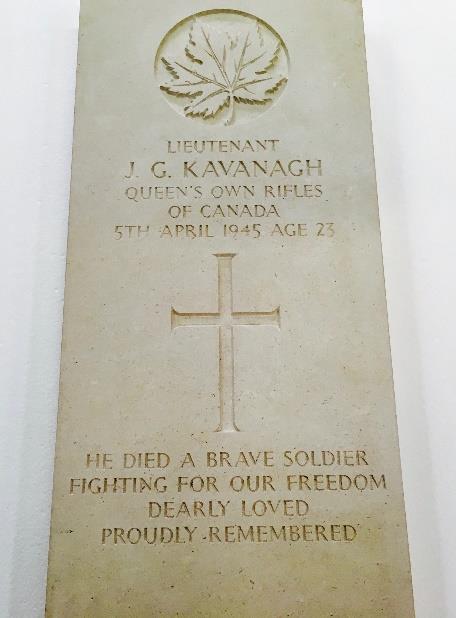
Jack’s wife Jean and his family are advised of his death. But all they are told is that he was ‘for official purposes presumed killed in action’ in Western Europe and that his body was not recovered. He is honoured on the Memorial Wall at the Canadian War Cemetery in Groesbeek. T. Eaton Ltd. gives the family a gold ring engraved with his name in memory of their employee. Jack’s name is also included on the large bronze tablet that contains all the names of the 263 Eaton employees who sacrificed their lives. The impressive memorial has found a home at the Canadian War Museum in Ottawa.

The City of Toronto presents the family with a framed scroll and a votive lamp. Both the recognition by Eaton’s and Toronto are a testament of the support that employers and local government gave to soldiers and their families.

In The Netherlands…

Granite monument dedicated to QOR soldiers, Rha (by permission T. Vanderplas)

The people in the Eastern part of The Netherlands honour the fallen for their freedom every spring a month before the rest of the country as they were liberated earlier. Villagers in Steenderen have been

putting flowers at the war graves in the General Cemetery on 6 April for decades. The cemetery contains the graves of 9 RAF, RCAF and Polish aircrew that crashed in the area during the war at different dates. The date on the 10th headstone, that of the unknown soldier, states 16 April 1945, thereby adding to the confusion.

In 2001 the villagers of nearby Rha erect a little monument in a remembrance garden in honour of 8 members of The Queen’s Own Rifles who fell there on 5 and 6 April 1945. Jack Kavanagh is listed among his comrades.

2017 my research begins

After volunteering to do more research in May 2017 I started by writing to a brigadier general at Veterans Affairs Canada (VAC). I ask the brigadier general where I can find John Gordon Kavanagh’s dental records and he refers me to another director general at VAC and the Commonwealth War Graves Commission (CWGC), Canadian Agency [1]. General Mart de Kruif had already mentioned that he had the Dutch War Grave Service standing by to assist in an exhumation. If we can match the dental records with the remains in the grave of the unknown soldier in Steenderen we will have a solution. DNA would be another option – if only we could locate any relatives. Others have gone before us though and failed to find members of Jack’s family.

Jack Kavanagh’s Silver Cross. (by permission JG Young)

I am in close contact with the Dutch defence attache and work with a good friend who is a Queen’s Own. The CWGC, Canadian Agency, gets back to me and confirms that Lt JG Kavanagh was killed by an anti tank weapon and that there are conflicting stories whether there was enough left to recover or that his remains were never recovered. I am told to prepare myself for a ‘very high burden of proof to be met before exhumation can be considered.’ He does not want to discourage me, but he has seen many cases where the identity of ‘unknowns’ have been confirmed, but even more unsuccessful attempts. His grim message is loud and clear…

In a reply to my update to General Mart and Colonel Christa, the defence attache, I receive Dutch material from a Dutch local historian, Karl Lusink. It is remarkable that some of his notes date back to 1984 when he tried to find out more from the farmer who owned the field in Rha where Jack fell. Unfortunately, the farmer has moved away to a nursing home and does not respond to letters. More importantly Karl provides me copies of official correspondence between the mayor of Steenderen and the Dutch Ministry of War: in November 1947 the mayor claimed expenses for the exhumation of remains on the land of farmer Garritsen at Pipelure on 10 April 1947, two years after the operation. Some personal items including a Canadian beret were also recovered.

Veterans Affairs Canada gets back to me with two more documents: a headstone change request and a document written by a Dutch-Canadian, Rev. Henkdrik Dykman, from Guelph. Both documents provide additional information about the other four soldiers who died in that location at the same time. The QOR War Diary is very clear about the number of soldiers that were killed in Rha: five. Four, riflemen Aiken, Crawford, McKenna and Woodruff are accounted for. They were buried in temporary graves at a neighbouring farm in Rha, according to said headstone change request. There is a photograph of the four temporary graves with the correct date on the crosses, 5 April 1945. I find that some dates used by various officials do not always match those in the War Diary, but these do. The four riflemen were re-interred in Holten Canadian War Cemetery in April 1946. Who can the remains in Steenderen belong to if not Jack Kavanagh? Karl Lusink sends more Dutch material from 1947 regarding a misunderstanding on the part of the Dutch War Ministry that the unknown soldier is English but which is quickly corrected by the mayor who replies that Steenderen was liberated by Canadians and the remains therefore cannot be English. It is now October 2017 and there is a new Dutch defence attache to brief. Colonel Christa has retired but continues to follow developments from The Netherlands.

Late November I receive another email from the CWGC Canadian Agency offering me to show Jack’s dental records but reaffirming what I had been advised before: the CWGC does not exhume for the sole purpose of identification. It also mentions that the location of Jack’s death is known but not if his remains were recovered. My QOR friend sends me a paper about relevant International Human Rights Law on war dead. This can get complicated.

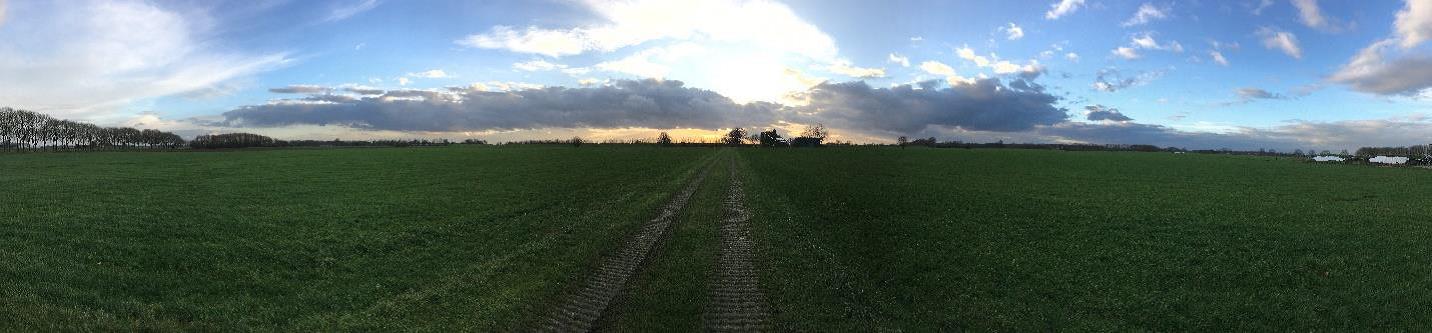
Christmas 2017 I spend in The Netherlands and I take the opportunity to visit the location where Jack fell. It is a bleak field, flat with far horizons, next to farmer Garritsen’s farmhouse that has been turned into a bed and breakfast. It will have been different in 1945 but it is still flat with no natural cover. It would have been an infantryman’s nightmare.

Pipelure, location of Jack’s death, (photo F. Bleeker 2017)

Over the following months I conduct more research but have less time as I am in a new job. All the while I am encouraged by a few friends and some senior officers whom I meet and bend their ears at the Army Officers Mess, Ottawa, for the traditional Friday lunch. I search and find more information about Jack and his family, much of which is available online: census records, the War Diary, various books and literature. I start writing my paper and limit myself to what is essential for the identification and I include my translation of the Dutch official correspondence. A good friend who is a historian offers to review it.

In May 2018 I am copied on another email from the CWGC reiterating the non-exhumation policy and attaching the email that was sent to me before. General Mart and a Dutch documentary producer had requested guidance for DNA testing. The policy has not changed so it is declined. Coincidentally my paper is finished, and I submit it to the Commonwealth War Graves Commission as I believe that is has the circumstantial evidence that will tip the balance. Days later my paper is given a reference number, ID Case No. 428. If successful, the CWGC will arrange for a new headstone but I am asked to exercise patience. I know that general Mart would like to turn a change of headstone into a major event in 2020 when the Dutch celebrate the 75th anniversary of their liberation. I inform Karl Lusink of recent developments.

Mabel Young’s Easter Card. (by permission JG Young)

In July 2018 I meet the Dutch documentary producers in the suitably solemn ambiance of the library of the Royal Canadian Military Institute in Toronto. Bart Nijpels, Ton Vanderplas and I compare notes and agree to work together. I send them documents that they did not have, and they send me an obituary of Isabel, daughter of Jack’s brother Robert, who had died in 2011. J.G. Kavanagh’s nephew Jack and family are mentioned as is their hometown Keswick. Ton spends a fruitless day there knocking on doors. My QOR friend and I start our own search and he finds that the contact person for Isabel died in 2016, another dead end. For months we scour the internet for the nephew, Jack Young, unfortunately not a unique name.

Kavanagh’s next of kin found

In November I meet a CAF major who tells me about his ambition to become a private investigator. ‘I have just the job for you!’ I say. He comes up trumps! Within days he writes to me with the contact details of a John ‘Jack’ Young. I am anxious as I dial the number and a man answers and I ask if he is indeed the nephew of John Gordon Kavanagh. When he confirms that I blurt out ’I have been looking for you!’. Coincidentally the documentary makers have found the family as well. Over the next few months we are in close contact with the family and we exchange information about their uncle. I provide them information and advice for their trip to The Netherlands as they have been invited by Bart and Ton. When I finally meet Jack Young and his wife they show an abundance of mementos of their uncle whom they never met.

General Mart, the Dutch Embassy, the Canadian Embassy in The Netherlands, and others are all keenly waiting for the next steps, 2020 is now a year away. A friend, a recently retired general, has an ‘innocuous’ chat at my request with the Directorate of History & Heritage of the Department of National Defence in Ottawa. DHH however immediately recognizes the case: without more information this case does not ‘pass the bar’. In my contacts with general Mart I raise the possibility of a QOR representation supported and complemented by our Limburgse Jagers (Rifles) Regiment at the commemoration – provided all goes well. We meet late January 2019 in The Netherlands to discuss progress and next steps.

Thrilled the Young family travels to The Netherlands in April at the invitation of the documentary makers, Ton and Bart, and visit the monument in Rha and the grave of the unknown soldier in Steenderen. It is an emotional pilgrimage as I can make out from the many messages that they send me. I put them in touch with a dear friend of mine who is a clergyman living near Steenderen and he organizes a special service for the family on the Sunday. The family is deeply touched by the attention of the locals and the fact that they have been caring for the monuments and graves for so many years.

‘The case has merit’

In May 2019 a full year after I had submitted my research paper the CWGC advises us that ‘the documentation from the local archives included in the submissions has provided an essential link between the field grave from which the casualty was exhumed and his reburial at Steenderen as well as showing the origin of the discrepancy in the date of death. Therefore, we believe that the case has merit and have forwarded the case to the Canadian Armed Forces for their review.’ The case has merit, BINGO! Once again we are asked to exercise patience. Time is running though; if we want to organize an event in April 2020, we need a determination as soon as possible. I talk or email with people and officials in my network to see what we can do to expedite the process. I also keep in touch with the Young family, Kavanagh’s next of kin and we become friends. We attend a military appreciation game of the Belleville Senators together.

Come October I am advised that the Casualty Identification Review Board (CIRB) will meet in November and I am asked to provide contact details of Kavanagh’s next of kin. In December 2019 I am told: the CIRB did meet in November but the results have to go to the chain of command. On New Year’s Day 2020 I receive another email from General Mart asking for an update. I bug DHH and they assure me they are acutely aware of the general’s and the local community’s interest. We are now less than three months away from the 75th anniversary. I email a very senior officer at DND and I am told to be patient another week: the Army will notify the family first and I will hear promptly thereafter. And so it happens! On 24 January 2020 The Queen’s Own Rifles notify Jack Young that his uncle Lt. John G Kavanagh has been identified as the unknown soldier resting in Steenderen. I receive a call from DHH with the good news and find it quite emotional. In a call next day General Mart and I immediately start firming up our plans.

The unknown soldier identified

On Saturday, 26 January, the Commanding Officer of The Queen’s Own, his Regimental Sergeant Major and an assisting officer present themselves in uniform with medals at the home of Jack Young and his wife Debbie to notify them officially their uncle has been identified. I receive a call after they leave and Jack and Debbie are deeply impressed. They are on the loudspeaker in the car and my wife can hear how touched and relieved they are – she seems to have something in her eye. It is the culmination of years of work by many people on both sides of the Atlantic.

A suitable commemoration

We change gears immediately. I have teleconferences with General Mart, the commanding officer (CO) and his deputy of The Queen’s Own, the Canadian defence attache in The Hague, Colonel Christa and others. A plan is put together: there will be a commemoration on 5 and 6 April, six family members of Kavanagh will attend as well as ten Queen’s Own. We need to raise money and see what Veterans Affairs Canada will support. My clergyman friend has been invited to conduct the Sunday service on 5 April in the church beside the General Cemetery in Steenderen. It is like divine intervention, we can have a church service conducted by a dear friend who has been close to the story and himself the son of a resistance fighter.
The Queen’s Own Rifles are responsible for the organization of the 2020 Garrison Ball at the Liberty Grand in Toronto on 8 February. Despite the short notice the commanding officer includes a stirring announcement that one of their comrades – lost for 75 years – has now been identified. The assisting officer reads out Jack’s last letter to his sister Mabel. When the colonel publicly recognizes the Young family who are in attendance the hundreds of guests rise and give the family a standing ovation that lasts many minutes.

Lt J G Kavanagh’s new headstone. (by permission T. Vanderplas)

It is like having another day job. Calls and emails to Veterans Affairs result in the department taking care of Jack and Debbie’s travel expenses. More calls and emails and people are generously offering financial support. The Queen’s Own raise money and will send a delegation of ten soldiers. A contact at a military charity puts me in touch with Air Canada who graciously offers help with the tickets for Jack’s daughters, granddaughters and the ten Queen’s Own. Strangers and friends of friends are stepping up and contributing with money, referrals and advice, it is fantastic. The municipality, that Rha belongs to, will take care of the Youngs’ stay at Garritsen’s farm, now a bed and breakfast, where their Uncle Jack had died. The Limburgse Jagers regiment is providing accommodation and transport for The Queen’s Own. They will also send a contingent to complement the Canadian delegation at the commemorative ceremony. Christa has put together a minute by minute plan with military precision. General Mart has multiple meetings with the municipality, Christa, the Canadian attache in The Hague and my friend the clergyman. The Dutch branch of the Royal Canadian Legion, Branch No. 5, is roped in and will send a colour party. The CWGC and the Canadian Government are pushing for the new headstone to be ready for the commemorations on 5 and 6 April. The documentary makers, Ton and Bart, are present and shoot footage when the new headstone is being engraved. The final chapter of Jack’s story will be filmed at Kavanagh’s grave on 5 and 6 April. Everything is in place just weeks before it will all happen!

On 13 March 2020, the Chief of Defence Staff issues a directive banning non-essential travel because of COVID-19: The Queen’s Own cannot go. Within days disappointed and frustrated we have to decide to postpone the commemoration indefinitely due to the Corona virus. Canada is in lockdown and The Netherlands follows shortly after. We will resurrect the plans the moment we can either later this year or on the 76th anniversary.

Epilogue

On 5 April my friend the clergyman organizes a moving little ceremony at the General Cemetery of Steenderen in honour of Lt J. G. ‘Jack’ Kavanagh under COVID-19 restrictions. It was captured on video and available on YouTube  . The children of farmer Garritsen visit the grave and lay flowers. Others lay flowers, what else than tulips, at all ten graves as locals have done for decades. General Mart also drops by to pay his respects.

Sadly, Ton and Bart had to finish their documentary without the closing chapter with the new headstone in place. It is a must watch though, and can be seen on Vimeo  for a small fee part of which will go to a Canadian military charity. The documentary is a worthy tribute to a young Canadian who is emblematic for his generation of young men and women who answered the call of their country to fight for the freedom of others on the far side of the world. 7600 of them died in The Netherlands.

Lest we forget…

[1] – Note the Commonwealth War Graves Commission (CWGC) is based in the UK and the CWGC, Canadian Agency in Ottawa.

QOR WWII War Diaries Now Completely Online

Our museum is extremely lucky in having original copies (i.e. one of three copies made when then were first typed) of the World War II war diaries for what would become the 1st Battalion, The Queen’s Own Rifles of Canada (CASF).

These documents provide a wealth of information about the regiment’s participation and progress throughout the war – from the efforts to form the battalion in June 1940, through duties in Newfoundland, training in New Brunswick and England, the successful but devastating landing on D-Day, the continued fight through Europe, to finally to the German surrender on 8 May 1945.

We are also very lucky to have most of the Routine Orders issued during the war and while often administrative in nature, they help to fill in some of the gaps left by the war diaries – particularly in regards to personnel postings and casualties within the battalion.

Unfortunately the original documents are fragile and not particularly user friendly as there is no way to easily search through them.  So in order to protect them, and at the same time make them more accessible, we have undertake to transcribe and post on our website all these war diaries. We’ve also scanned all of the routine orders and posted them into the war diaries at the appropriate places.

And if that wasn’t enough, we added maps to help illustrate where the battalion was at various times and where it was headed, and inserted photos from our collection into the appropriate location in the timelines. These photos add some amazing sense of place and time. Lastly we added links to more detailed profiles on our website for many of the key soldiers mentioned in the diaries by name.

Now when I say we, I really mean one of our curatorial assistants, Sgt Graham Humphrey and more recently, with the help of Kate Becker. Graham and Kate have spent literally hundreds of hours on this project over the past three and a half years – scanning, transcribing, creating maps, and inserting photos. The result though is a spectacular resource that serves to both protect our archival documents while sharing them with the world.  Even without any official announcements, these page have been viewed over 16,000 times to date.

And the importance of making this information available today is even more critical as fewer and fewer WWII soldiers are left to share their stories first hand.

Bravo Zulu to Graham and Kate on their outstanding work to see this project through to the end, and I strongly encourage you to take some time read through this important story of some of our regiment’s finest hours: