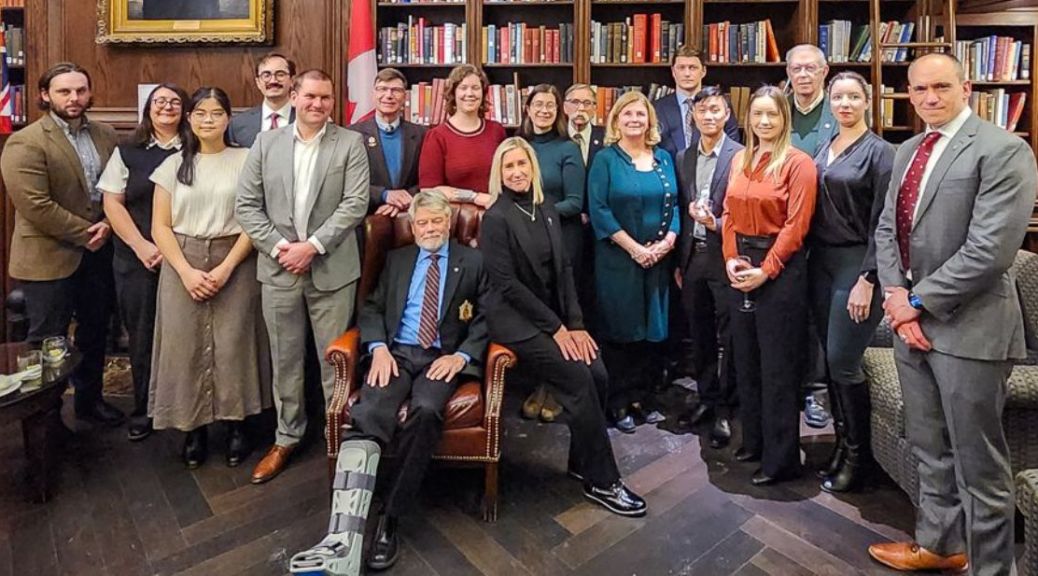
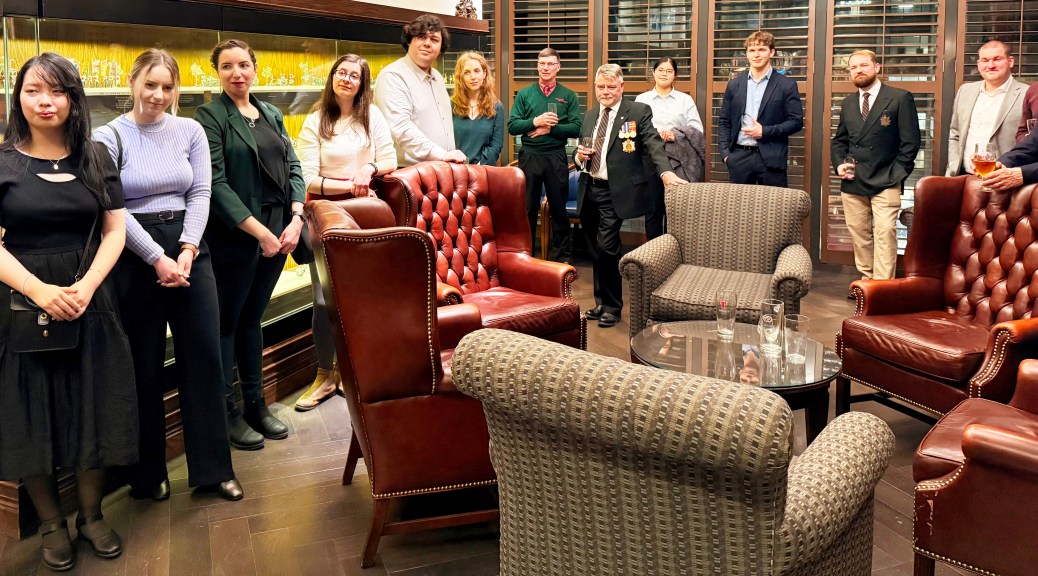
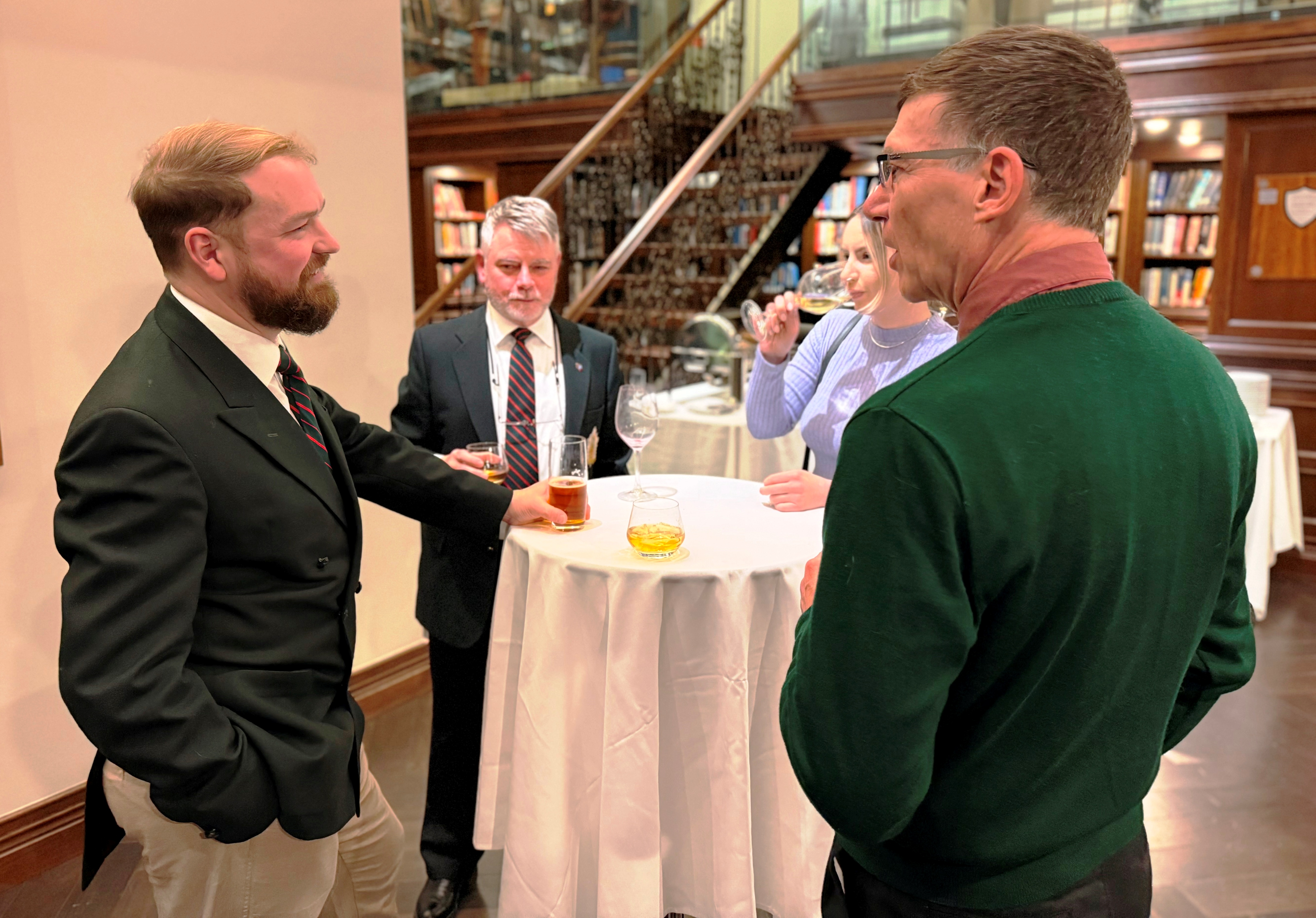
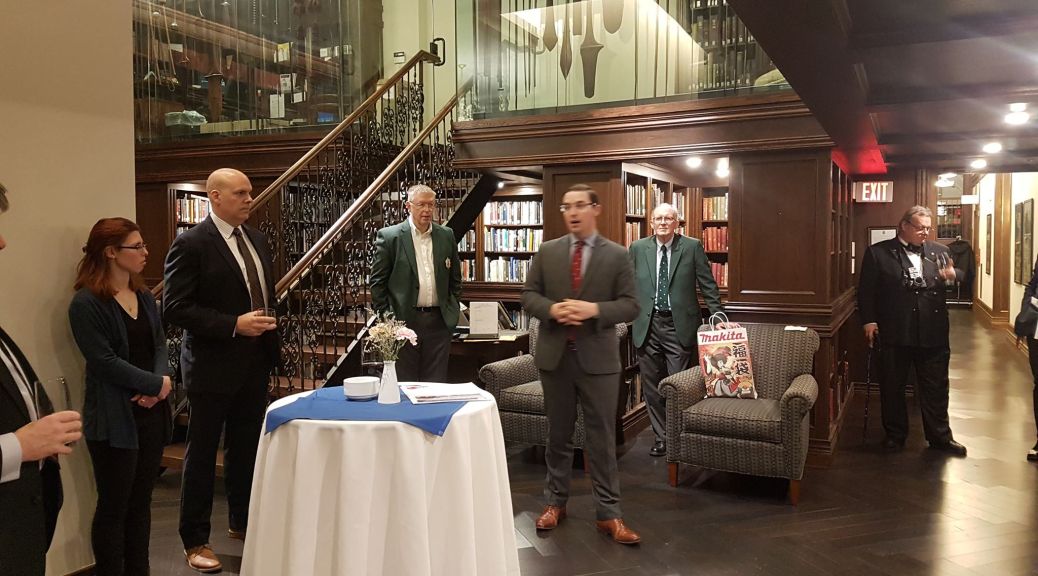
On Thursday, February 12th, The Queen’s Own Rifles museum held another successful event to recognize and thank our dedicated team of volunteers. A dozen and a half volunteers, museum board members, and representatives once again gathered in the beautiful Royal Canadian Military Institute’s library for drinks, munchies and socialization.
Our volunteers include former and serving members of the Regiment, current and former members of the Master’s in Museum Studies program at the University of Toronto, and others with an interest in history and the military. They catalogue objects, process and describe archival materials, scan archival records for our website, redesign and update exhibits, clean existing exhibits, accession new donations, update our database and our website, respond to research requests, track expenditures to our allocated budget, and liaise with other military museums in the Greater Toronto area, to name just a few tasks!
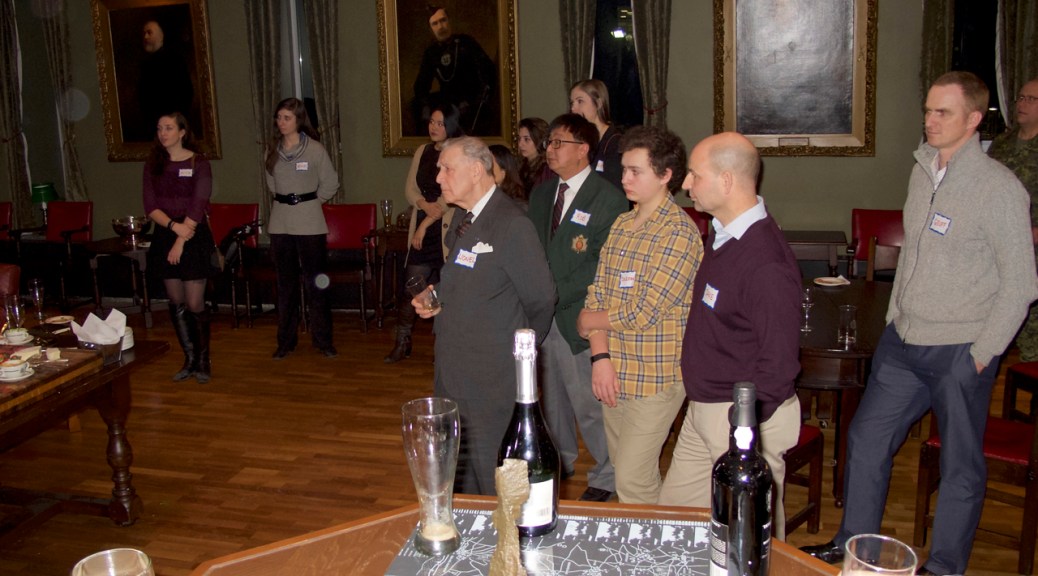
For the more formal part of the evening, we gathered near the fireplace where each attendee introduced themselves and their role at the museum. We were especially pleased to have our wounded Curator join us with multiple pins in his ankle, and on his first outing in almost two months that didn’t involve a hospital visit!
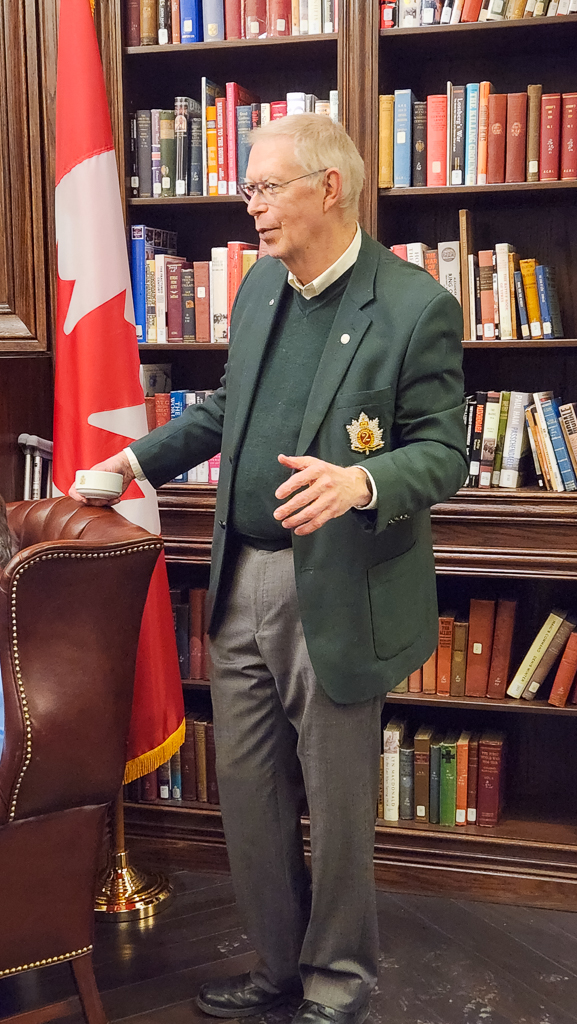
On behalf of the Command Team, Deputy Commanding Officer Sam Leibel and Regimental Quartermaster Sergeant Mike Hyde expressed the Regiment’s gratitude for our volunteers’ efforts to both physically and virtually preserve and share the QOR’s long and detailed history.
They also provided an overview of the impacts of the current Canadian army modernization on the QOR. While this has significant organizational impacts at higher levels, it is clear that this will not impact the museum in any direct way. Neither will there be any significant impact operationally on the QOR, except for the sharing of the Command Team with the Ontario Regiment starting at the end of March 2026.
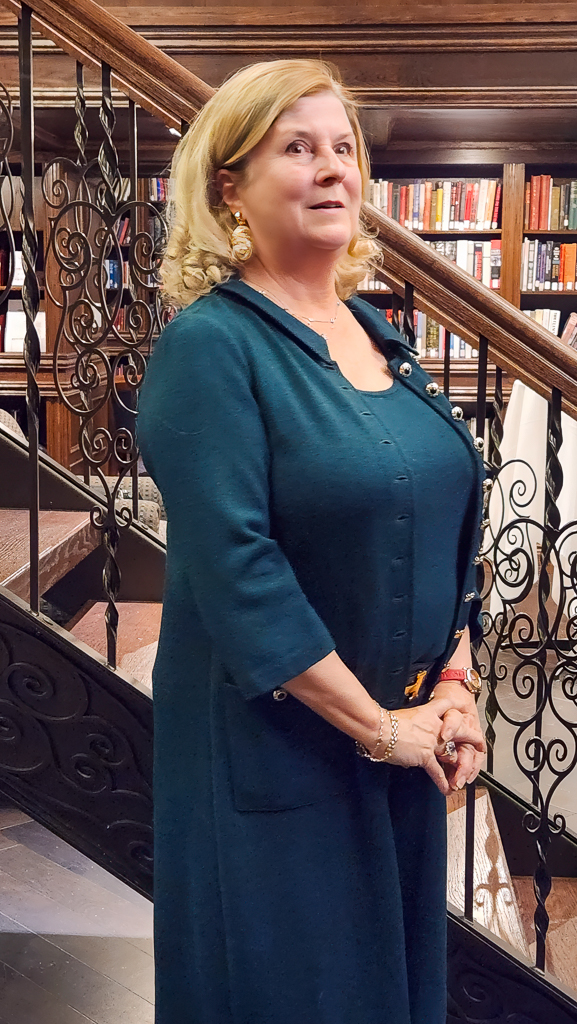
Museum Board of Governors Chair Michele McCarthy.Museum Director and Archivist Major John Stephens CD, (Ret’d)
The Museum’s Board of Governors members, Adam Hermant, Lisa Holmes, Jenna Misener and Tony Schultz, sent their regrets for the evening; however, Board Chair Michele McCarthy expressed the Board’s appreciation for the 1600+ hours of work our volunteers have given in 2025.
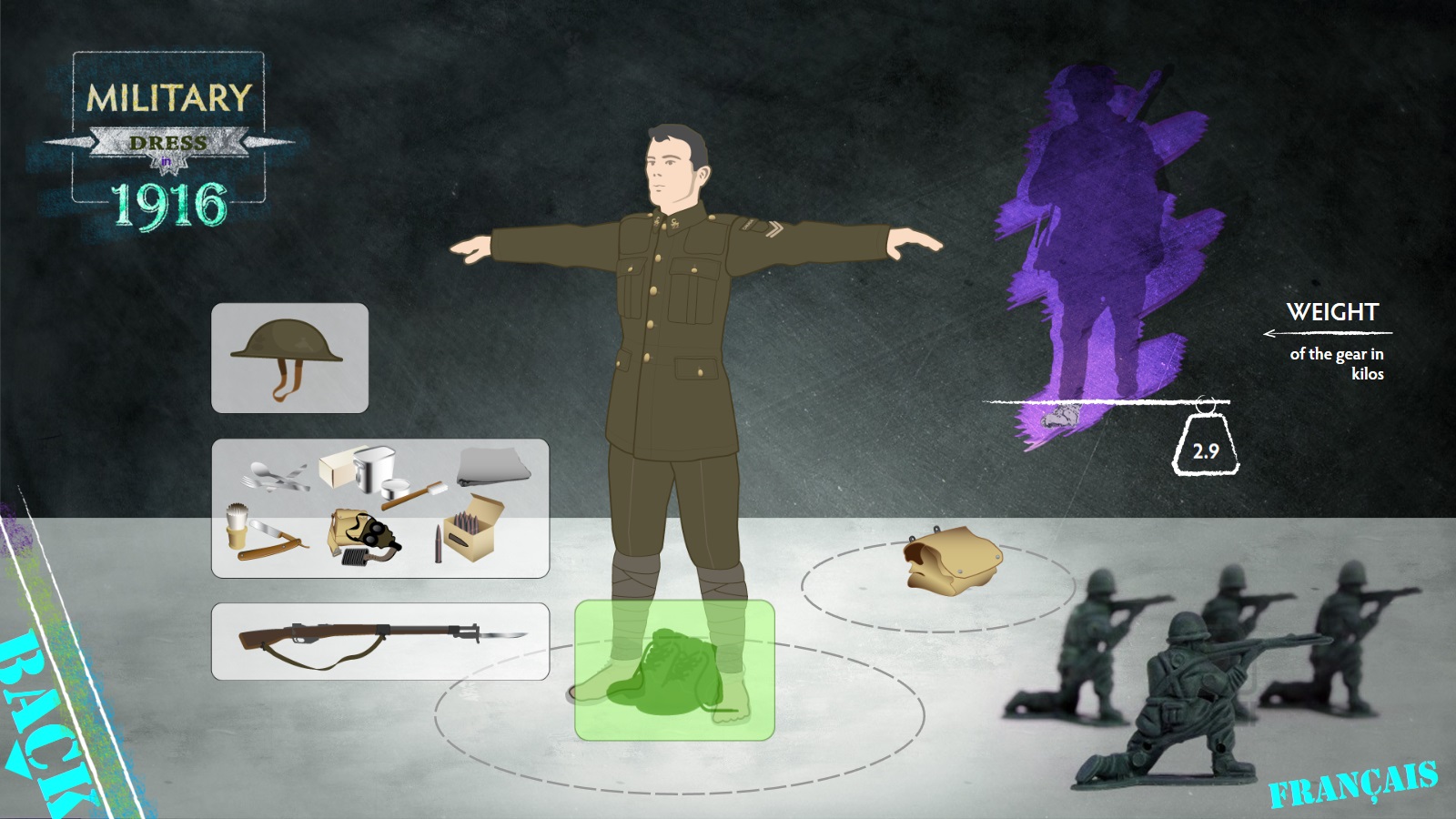
Museum Director John Stephens announced that we have just purchased our first interactive exhibit, which involves dressing a 1916 soldier in his uniform and equipment. We hope to receive and install the exhibit in mid-March.
New interactive exhibit.
With the help of the Regimental representatives, we finished the formal part of the evening with a draw for eight $50 gift certificates graciously provided by Liberty Entertainment Group for various restaurants they operate in Toronto.
If you would like to help financially support the work of our Regimental Museum, we appreciate your donation through our CanadaHelps portal.
For many years it was thought that the Queen’s Own provided about 34 Officers and Soldiers to serve with the Canadian contingents that fought alongside the British Army in the South African, or Boer, War between 1899-1902, it turns-out that this number was underestimated.
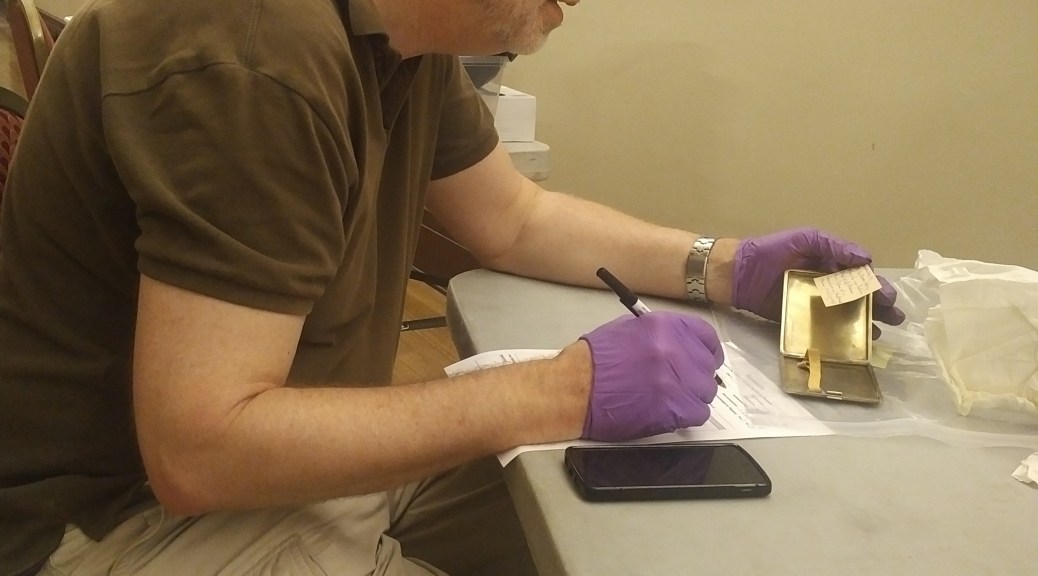
Over the past 2 years, museum volunteer Brock has been carefully scanning and recording many of the Museum’s large, fragile, handwritten Orders, Records of Service and Service Rolls. Most of these are over 100 years old and wouldn’t stand up to constant handling so they have been scanned and added to the Archives page of the museum website for all to view.
It was just recently noticed that in the 1898-1901 Regimental Orders, the names and companies of the Queen’s Own men who were authorized to volunteer for active service in South Africa were written. When research was complete and the names cross-checked with the South Africa Service Files at Library and Archives Canada, it was determined that an additional 20 QOR soldiers needed to be added to the list. This makes a total of 54 soldiers from the Queen’s Own who volunteered for active service and deployed to South Africa with various Canadian Units.
The listing, including names and units they served with, can be found on the museum website timeline under TIMELINE: 1900-1924/SOUTH AFRICAN WAR/RIFLEMEN OF THE QUEEN’S OWN WHO SERVED IN THE SOUTH AFRICA CAMPAIGN 1899-1900 or at the link here.
Our annual event to recognize our 2024 volunteers took place in the library of the Royal Canadian Military Institute on the evening of 6 February 2025.
Twenty-five attendees included our weekly volunteers, members of our museum’s Board of Governors, the Curator and Assistant Curators of Casa Loma (which hosts our museum) and Major Rhys Henderson, Deputy Commanding Officer of The Queen’s Own Rifles (on behalf of the Commanding Officer) and Master Warrant Officer Darnel Leader, Quartermaster Sergeant Major Instructor (on behalf of the Regimental Sergeant Major.)
After an hour of socializing and snacking on beef sliders and grilled cheese sandwiches and introductions, Museum Director John Stephens recognized individuals for their hours of service in the past year. From just 6 hours from our newest volunteer Eli to 270 hours by our dedicated Curator, Shaun Kelly.
Thanks to the Casa Loma operator Liberty Entertainment Group, we were pleased to present $50 gift certificates for any of Liberty’s Toronto restaurants to six volunteers with the most hours (except Shaun):
Anne (73 hours)
Sarah (75)
Patrick (77)
Brock (95)
Bruce (95)
Briahna (98)
Three volunteers were also recognized for some significant all-time hours milestones: Graham Humphrey (since 2013) and Briahna Bernard (since 2018) for surpassing 1,000 hours and Shaun Kelly (since 2012) for reaching 2,000!
Major Henderson congratulated all our volunteers for their important contribution to collecting, caring for, and sharing the long and distinguished history of The Queen’s Own Rifles of Canada and the soldiers who served in it.
We are also very grateful for the support of the members of our museum’s Board of Governors for their thoughtful oversight, the Queen’s Own Rifles Trust Fund for their funding, the Regimental Senate for recognizing the Museum as an important part of the Regiment Family, and not least the support of both the leadership and members currently serving in the regiment, particularly for their support on QOR Day at Casa Loma!
This slideshow requires JavaScript.
If you would like to provide financial support for the operation of the museum, please note that the government has put in place a temporary extension for donations made before the end of February 2025 which allows them to be used with your 2024 income tax returns.
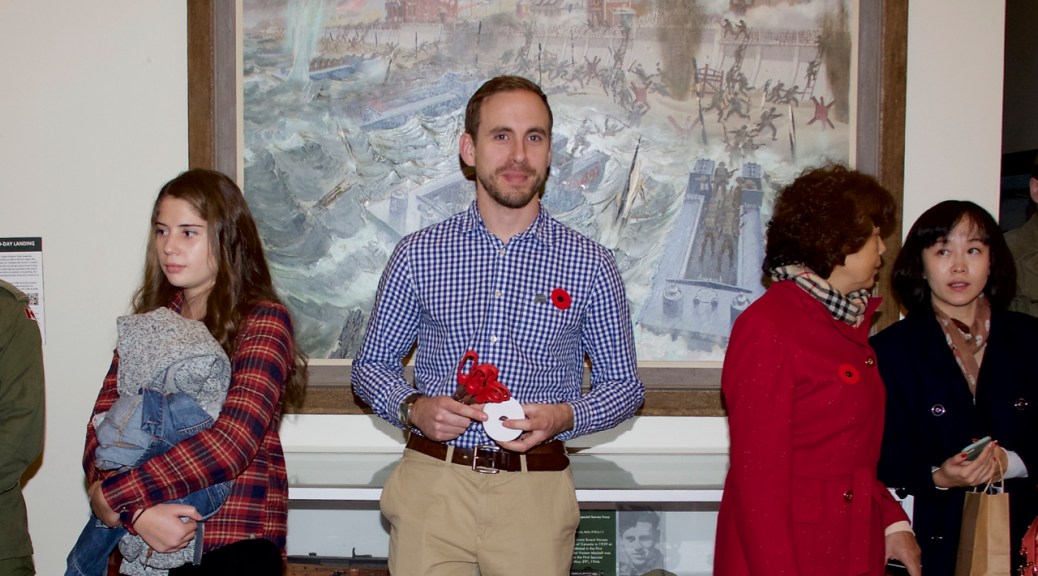
Photo above: Some of our volunteers at the recognition event.
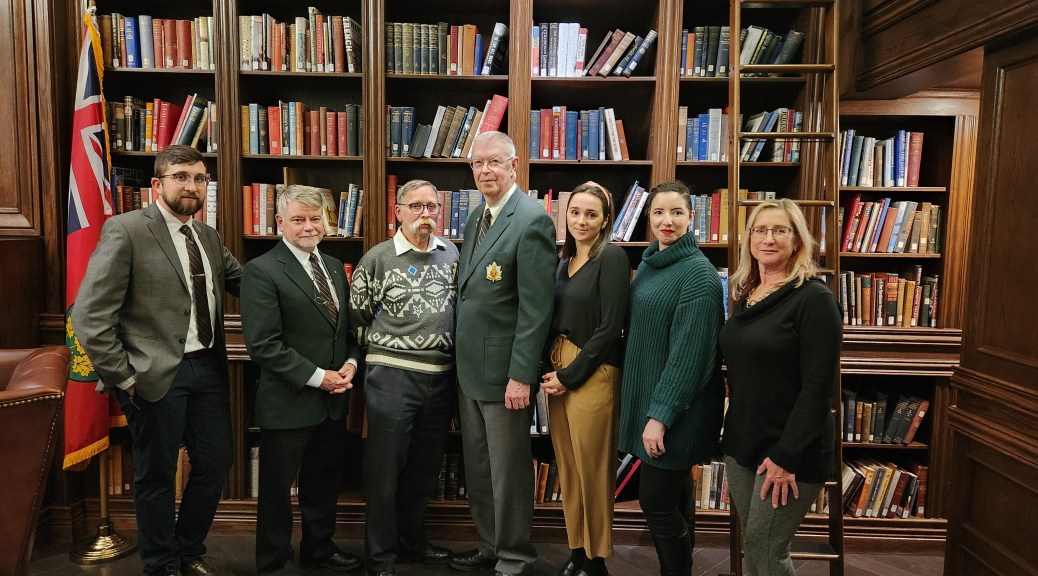
On Thursday, February 2nd, Museum Board members and volunteers gathered in the impressive library of the Royal Canadian Military Institute for a reception to recognize service to the museum in 2022.
Volunteers racked up 1,237 hours in 2022 which contributed to our all-time total of 114,118 hours – which would equal almost $300,000 in wages if this had been paid work!
Certificates of Appreciation were presented to volunteers Briahna Bernard, Anne Frazer, Shaun Kelly, Colin Sedgewick-Pinn, and Bruce Taylor; and board members Adam Hermant, Jenna Misner-Zuschlag, and Past Chair Jim Lutz.
Unable to attend to receive their certificates were Rob Grieve, Ken Kominek, Steve Hu, Steven Ye, Matt Noel, Steven Abra, Mario Carvalho, Graham Humphrey, Olivier Laquerre, Cheryl Nairn, and Harry Patel.
Also present were new Board Chair Michele McCarthy, board member Lisa Holmes, and volunteers Morgan Ryder, Kevin Hebib, Jordan Balch, and Museum Liaison Officer, Captain Dave Pampe.
On behalf of the Commanding Officer (who was out of the country) Dave also presented the Commanding Officer’s Commendation to our new Curator Shaun Kelly on ten years of volunteering with the museum:
“For 10 years of outstanding dedication and leadership at The Queen’s Own Rifles of Canada Regimental Museum. His efforts have been paramount in bringing our museum practices into the 21st Century, and in particular in effectively preserving our museum objects that will allow us to share well into the future, the important stories of our regiment and the Riflemen that have served in it.”
If you’re interested in volunteering with us in 2023, please read our Volunteering page on our website.
I’m very pleased to announce that the QOR Association’s 2021 Rifleman of the Year Award recipient is former Regimental Sergeant Major Shaun Kelly.
As deputy curator of the QOR Museum, he has shared a wealth of knowledge and provided over 1,200 hours of service.
His service in Latvia this year for 7 months has been a credit to Canada and The Queen’s Own Rifles of Canada.
Shaun has been very involved with the Association. He stayed connected with the QOR Association group by sharing pictures and updates during his overseas posting. He also kept track of all the emails that have been shared with the Keep Connected Group since they started.
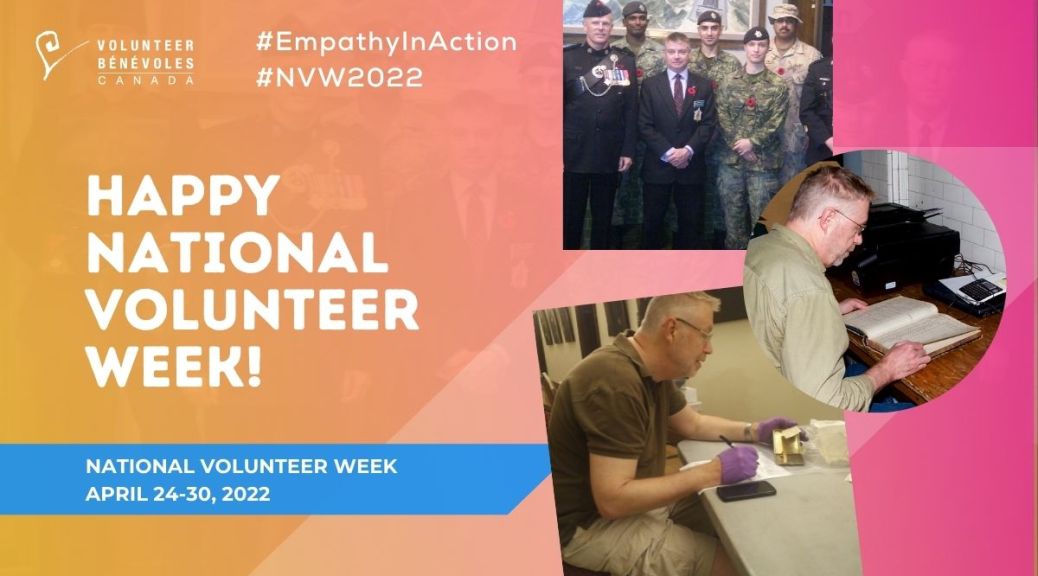
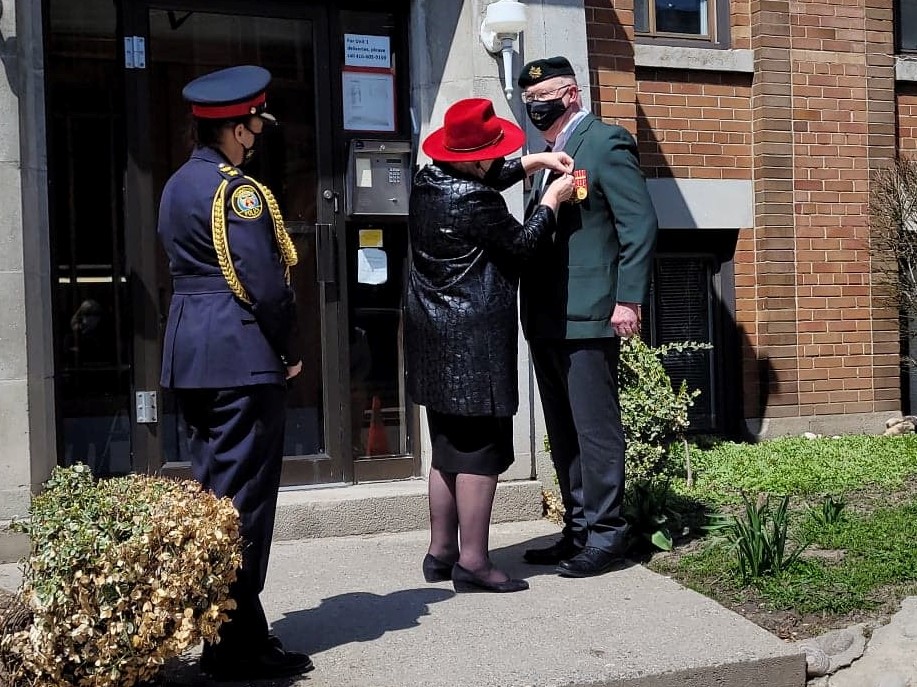
Museum Curator, Major John Stephens, CD (Ret’d) is awarded the Sovereign’s Medal for Volunteers
As many of you will know, The Queen’s Own Rifles of Canada Museum and Archive is maintained totally by volunteers, without their hard work the museum wouldn’t exist. It is fitting that, on Sunday 24 of April 2022, during National Volunteer Week, our Curator, Major John Stephens, CD (Ret’d) should be awarded the Sovereign’s Medal for Volunteers on behalf of the Governor General of Canada by the Lieutenant Governor of Ontario her Honour Elizabeth Dowdeswell, OC, O Ont.
John has, over the last decade, made incredible improvements to our beloved museum that have been praised throughout the Regimental family and the Canadian Army in general. These improvements came because of the time, effort, and attention to detail that John has invested but also because of the incredible team of volunteers he has been able to “rope-in” over the years. Our museum volunteers come from all walks of life; some serving or former soldiers in the Regiment, some through their studies at Toronto schools and others from their interest in military history. Wherever they came from and regardless of if they helped-out for a couple of months or have been with us for ten years, they have made a difference. They have logged over 13,000 volunteer hours and contributed to telling the story of our Riflemen, the Regiment, and Canada that tens of thousands of visitors to our museum at Casa Loma see every year.
Thank-you for your time and congratulations on a well-deserved award.
CWO (Ret) Shaun Kelly, CD
Acting Curator
The Queen’s Own Rifles of Canada Museum and Archive
On Thursday, February 24th the Museum held our annual event to recognize our dedicated team of volunteers for 2021. While previous in-person events took place at the Officers’ Mess and the Royal Canadian Military Institute, we opted to play it safe one more time and hold it as a Zoom call.
We were joined by members of the Museum Board and by the Commanding Officer Lieutenant Colonel Scott Moody, and the Regimental Sergeant Major Chief Warrant Officer Jeff Johnston.
Acting Curator Shaun Kelly welcomed everyone and reviewed our achievements in 2021 despite the on again – off again challenges of changing pandemic restrictions. (See Looking Back on 2021 post.) He reported that we still managed to give 1,445 hours of service to the museum, and congratulated each volunteer on their contribution.
Board Chair Jim Lutz noted that we will be updating our Five Year Strategic Plan this year and would be looking for input from all our volunteers.
The CO and RSM provided an update on the current state of the Regiment before presenting our Collections Officer Cheryl Nairn with the Commanding Officer’s Commendation.
Cheryl will be starting maternity leave shortly so we were pleased to be able to present this recognition before she leaves us.
The operation of our museum is completely dependent on volunteers and we can’t thank them enough for their perseverance and valued contribution throughout a difficult 2021!
As with every other aspect of our society, the impact of another year of pandemic challenged our operation in 2021.
The first half of the year was primarily work from home as a result of COVID restrictions which applied to Casa Loma. By summer though, we began on site work again once all our volunteers were double vaccinated, and continued through to mid-December. Despite these challenges our team of 13 volunteers (including two new volunteers) put in over 1,050 hours in person and from home. For this continued dedication I want to thank each member of this team:
Briahna Bernard (Assistant Collections Officer)
Anne Frazer (Photography)
Rob Grieve (Weapons Officer)
Steven Hu
Graham Humphrey (Assistant Curator)
Shaun Kelly (Deputy Curator)
Ken Kominek
Cheryl Nairn (Collections Officer)
Colin Sedgewick-Pinn
Bruce Taylor
Cameron Telch
Steven Ye
In February we also held a virtual “recognition night” for service undertaken in 2020. Joining us were the Honorary Colonel, the Commanding Officer and members of the Board of Governors, and concluded with a fun quiz on regimental history.
2021 Accessions
The heart of any museum is it’s collection and there are currently more than 3,750 objects entered into our internal collections database as well as accessible from our Public Access portal – and of course a small stack of data waiting to be entered.
Storage space is a challenge for every museum, but acquiring additional items though gifts or purchase, which fill gaps in our collection, is also important. Once acquired the accession process starts to document where these items came from, to establish our new ownership through deeds of gift, and sending letters of thanks where appropriate.
This past year saw forty-two accessions accepted. Some of these were one item – some however were hundreds of items. Among many others, we were pleased to receive gifts from the estates of Norm McCracken and John Bennett.
We also made some purchases to fill some collection gaps. With funding donated by the QOR Maple Leaf Rifle Club, we were able to purchase a military version of the WWI Ross Rifle as we only had a civilian version in our collection. We also purchased a late 19th century headdress and collection of rare badges, and in December with additional funding from the Regimental Trust, a late 19th set comprising of an officers’ belt, crossbelt, and (rare) sabretache. The only downside perhaps is that many of these items have now joined the growing queue to be properly documented, photographed, and cataloged!
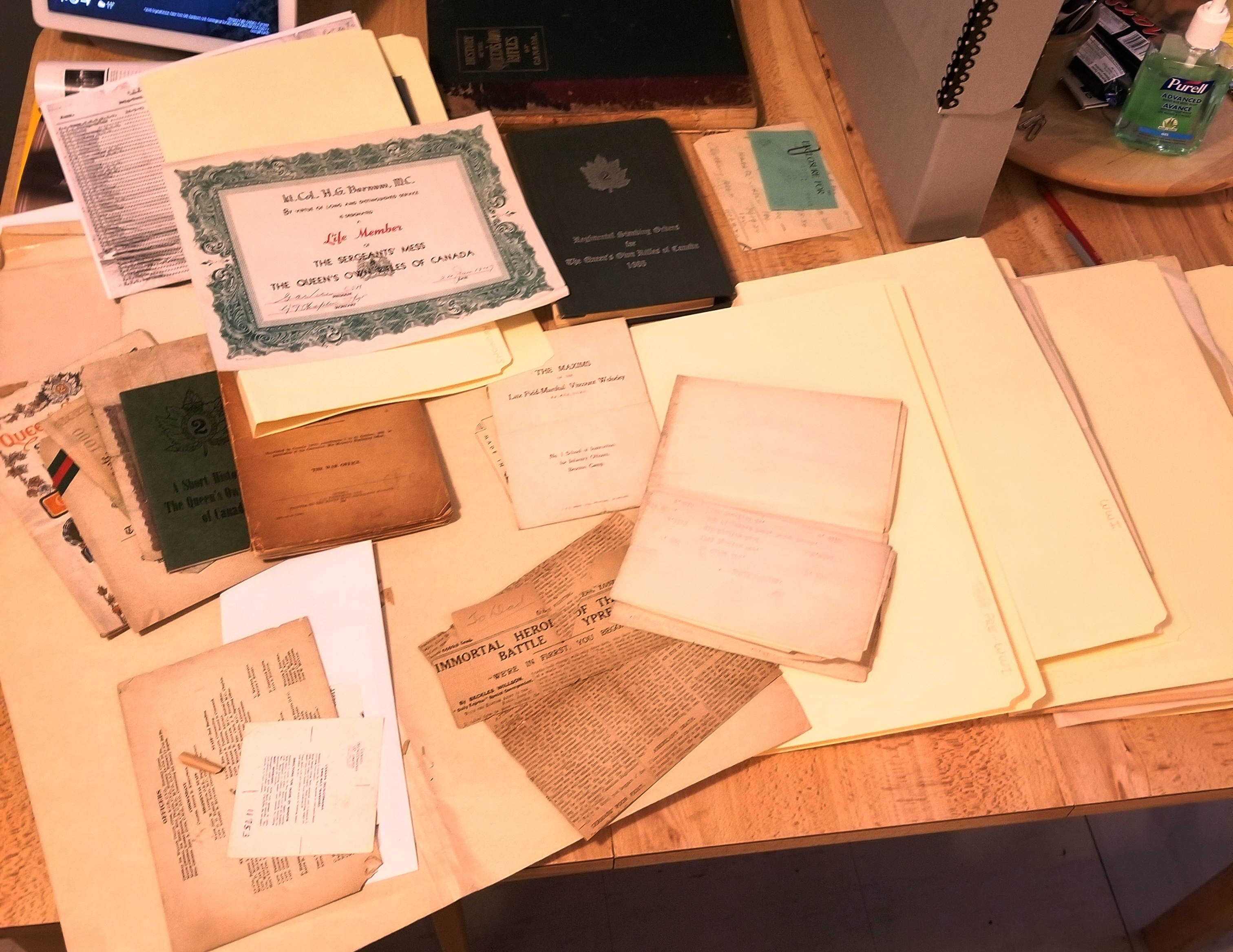
Archival Material In addition to what most people understand as museum objects (uniforms, weapons, trophies, instruments, etc.) our collection has archival material. These are generally either regimental and regimental organization records like orders books, nominal rolls, meeting minutes, official correspondence, war diaries, etc., and personal manuscript documents (called Fonds) such as letters, service records, photographs, news clippings, certificates, etc. Lastly there are special collections generally related to some specific event such as the 1910 Trip to England. We have lots of all three types of material!
The process of organizing, describing and preserving these is very different from cataloging any single museum object like a pair of boots or a cross belt. Its also difficult to make progress in a single Thursday evening volunteer night because of the need to pack everything up again at the end of the night. So these have made better work from home projects and we have been able to complete a number of them during 2021.
As is normal each year, a number of significant projects were undertaken off-site or from home:
Database Migration to Web Based
In January we completed the migration of our “PastPerfect” collections database from a single desktop version to a cloud based edition. This is actually more exciting for us than you might think. Up to 10 people can be working in the database at any given time (vs. the previous one); it absolutely facilitates work from home; and it means that in many cases, cataloging data can be entered directly rather than on cataloging sheets and then transferring the information. To allow this to work we also purchased two Chromebooks that catalogers can use as they catalog. The web edition also means that our “public access” database is immediately updated if additions or changes are made to the internal database. Geeky yes but a game changer for our collections management processes!
QOR Orders Book Digitization Partnership
Thanks to Museum Board member Tristan Strathy, it was brought to our attention that Brock University Archives have four 19th century orders books of The Queen’s Own Rifles of Canada which fill the gaps in our own collection. We contacted the Brock archivist who graciously allowed us to send a volunteer to digitize the books using their equipment. We have now both added these digitized versions to our respective websites. You can read more on this and get links to the documents in this previous blog post.
Cemetery Walking Tours Updated These tours were one of the very few things not impacted in any major way by the pandemic – in fact the outdoor nature was a good way to get some fresh air exercise and learn about our Riflemen! Besides additions to our existing tours of Necropolis and St James, we’ve added Prospect and Mt Pleasant , and are starting on one for Pine Hills Cemetery in Scarborough. You can find them all here.
Memorial Banners Another project we were able to undertake while working from home, was the creation of five pop up banners with the names of all our regiment’s fallen (including our very recent discovery of Rifleman Nussey’s training death.)
The intent is for these to be used for various outreach projects or at appropriate regimental events. They were first displayed at the November Officers’ Mess dinner held at the Royal Canadian Military Institute and we’re well received.
Social Media
We continue to use various social media platforms to both share our regimental history and museum news. If you’re not already doing so we very much encourage you to follow or subscribe as appropriate for the platforms you use!
YouTube* (285 subscribers, 45,647 views and 2,153 watch hours in 2021)
Website – with a record in 2021 of 93,300 page views by more than 41,600 unique visitors!
*At the end of the year, the video on the history of our uniforms which had been originally posted in November 2020, went somewhat “viral”. We now have over 1,430 subscribers and this video has been watched over 178,000 times!
The Museum Board of Governors
This group provides important governance and oversight as well as support, advice and guidance on specific issues like insurance. The Board held two virtual meetings on 27 May and 30 November – the latter including approval of a 2022 budget proposal to submit to the Regimental Trust Fund.
Our sincere thanks to the Board members who are ably led by Chair Mr. Jim Lutz:
Captain Adam Hermant, CD (Ret’d)
Ms. Lisa Holmes
Chief Warrant Officer Shaun Kelly, CD (Ret’d) – Deputy Curator
Ms. Michele McCarthy
Captain Dave Pampe – Battalion Liason
Major Tony Schultz, CD (Ret’d) – Regimental Trust Fund President
Major John Stephens, CD (Ret’d) – Director and Curator
Mr. Tristan Strathy
Ms. Jenna Zuschlag Misener
In a future post we’ll highlight some of our plans for 2022 despite the continuing challenges of the COVID pandemic.
On Thursday 6 February 2020 we held our annual volunteer recognition night at The Queen’s Own Rifles of Canada Officers’ Mess in Moss Park Armory.
The Regimental Museum and Archive is a completely volunteer run operation and this year the museum saw 1,444 hours of service provided by 60 volunteers. This evening is an opportunity to recognize our most regular volunteers with certificates for the total number of hours they have provided to the museum (as of December 31, 2019 and rounded to the 25 hours completed.)
Certificates of Volunteer Appreciation were presented to following by our Museum Board Chair, Mr. James Lutz:
Private Steven Hu (25 hrs)
Master Corporal Chris Thiers-Gomez (25 hrs)
*Master Corporal Mark Kusi-Appiah (35 hrs)
Corporal Mario Carvalho (50 Hrs)
Officer Cadet Steven Ye (75 hrs)
Mr. Colin Sedgwick-Pinn (100 hrs)
Photographer Ms. Anne Frazer (150 hrs)
*Ms. Meryn Winters (150 hrs)
Weapons Officer Mr. Rob Grieve (175 hrs)
*Captain Ken Kominek (200 hrs)
Collections Officer Ms. Cheryl Copson (550 hrs)
*Collections Assistant Ms. Briahna Bernard (550 hrs)
Assistant Curator Sergeant Graham Humphrey (775 hrs)
Deputy Curator CWO Shaun Kelly (Ret’d) (900 hrs)
*Unable to attend but presented later.
Those with the most “life-time” hours were also presented with $50 gift certificates for Cibo Wine Bar which were kindly donated by the Liberty Entertainment Group.
We were also pleased to present certificates of appreciation to recognize the support of the following:
Commanding Officer LCol Frank Lamie
Regimental Sergeant Major CWO Donovan O’Halloran
Casa Loma Curator Marcela Torres
Thank you to everyone who has helped support our museum in 2019 with their time and talents!
The Museum held their latest annual volunteer recognition reception in the Library at the Royal Canadian Military Institute on Thursday February 7th. The purpose of the evening was to give thanks and recognition to our dedicated and hardworking volunteers. In 2018 our team put in just over 1900 hours although we can be sure there were more hours that weren’t recorded!
Besides our weekly volunteers, three members of the museum’s Board of Governors were present. We were also pleased to have Commanding Officer, LCol Frank Lamie, and MWO Jeff Johnston on behalf of the Regimental Sergeant Major, who both expressed their appreciation for the work of our volunteers and the importance of the museum both internally and externally.
And of course being museum nerds, we were also pleased to receive a tour of new exhibits installed in the last year by the RCMI Museum Curator, Ryan Goldsworthy.
Museum board chair Jim Lutz presented appreciation certificates to the following volunteers who as of 31 December 2018, had provided at least 25 hours of service since 2012 (issued in 25 hour increments):
25 Hours – Mr Colin Sedgwick-Pinn
25 Hours – O/Cdt Steven Ye
50 Hours – Pte Ashley Patoine
50 Hours – Mr Matt Noel
75 Hours – Ms Meryn Winters
200 Hours – Capt Ken Kominek
425 Hours – Ms Cheryl Copson
700 Hours – Sgt Graham Humphrey
750 Hours – CWO (Ret’d) Shaun Kelly
Certificates will also be provided to the following who were unable to attend the reception:
200 Hours – Mr Alex Meyers
425 Hours – Ms Briahna Bernard
Our museum team has a great cross section of serving soldiers, former serving soldiers, museum professionals, and public historians. If you’d be interested in joining our team and helping at the museum on Thursday evenings, please see our volunteering info page and complete a volunteer application. Of if you have questions, you can email the Curator at museum@qormuseum.org.
If you are unable to volunteer but would like to support the work of the Regimental Museum, please consider becoming a sustaining donor!
Yesterday at the Regimental Church, we said a final farewell to Captain (Ret’d) Larry Hicks, CD who had been a valuable member of our museum team for the past five years. Below are remarks I shared as Curator, during the funeral service.
“I’m John Stephens and I first met Larry almost 40 years ago in 1979 or 80 when I was a young Cadet Instructor Cadre officer with a QOR affiliated cadet corps, and Larry was also a young officer with the regiment. I recall that for the next ten years or so (and unlike some of his colleagues who had less time for the cadet program) he was always friendly and helpful on our occasional participation in regimental events or my visits to the mess.
By the early 1990s I was working with a cadet corps affiliated with the 48th so saw less of Larry through the army. But we were both involved with Scouting and I would sometimes see him at the 5,000 acre Haliburton Scout Reserve. It was there that I first came to know of his love of the outdoors and particularly canoeing, and of his appreciation for wildlife.
Another decade would pass until I would see Larry again at the Christmas Officers’ luncheon:
“So Larry – what’s new?” (It was always easy to pick right up again with him.)
“I’ve just retired from both the Police and the Army” he said.
“Very nice! So any plans for retirement?”
His response was along the lines of “More canoeing, more time at the cottage, and more time on my photography hobby.” My ears perked up – photography hobby? Hmmmmm….
“So what are you up to these days?” he said. “Funny you should ask” I replied with a smile.
Earlier that year I’d been recruited as the Curator for the Regimental Museum – big shoes to fill in a line of very long serving and dedicated predecessors! We’ve started re-cataloging all the objects in the collection I explained, but – baiting the trap – we really need someone with a high skill level to help us photograph them as part of that process. It would only be “one night” a week – Do you think that’s something you might consider helping with?
“That sounds like it could be interesting” Larry replied. “Great” I said, slamming the trap shut. “I’ll see you on Tuesday night!”
And so began our past five years of working closely together in preserving and sharing the regiment’s history.
I don’t recall Larry ever saying anything bad about anyone – he was easy going, ALWAYS willing to share a story, and I don’t ever recall seeing him flustered. He did have some mixed feelings about finding himself in so many photos in a museum but that’s understandable.
He approached his photography tasking as a professional, bringing all the skills and expertise from his police work and applying them to our often chaotic situation. Always offering suggestions on how to improve our process and manage the massive collection of photographs we were creating. And he was always on hand at museum and regimental events to create the newest photographic record. As per the original plan, we used his photographs in our collections database but we also created a Flickr account that has over 11 THOUSAND photographs organized in about 75 albums– almost all taken and curated by Larry. He was so valuable to our team that when he had an early conflict with our work nights – we changed the night to Thursdays!
His most recent project was he was “de-framing” hundreds of photographs from frames that were damaged or had broken glass or mold starting to form. After removing them he would take them home to scan them, then put them in acid free folders, label them, and place them in archival boxes – all with a genuine concern from preserving them for the future.
And Larry was always will to pitch in whatever task – or rush to move exhibits and cabinets – was needed on any given night.
That “one night a week” turned into over 800 hours of work for the museum over the past 5 years, and I was very pleased that the CO and RSM agreed with my recommendation that Larry be presented with the CO’s Commendation and the Command team coin at our February recognition night.
You’ll be sorely missed tonight in your makeshift photo studio tucked in the back corner of our attic storage room; and you’ll be missed at our post volunteering pub visits at Mayday Malones where we’ll raise a final glass to you; and you’ll be missed by all of us as both a colleague and a friend – sleep well.”
Last week we were pleased to hold our volunteer recognition ceremony at The Queen’s Own Rifles Sergeants’ Mess to thank many of the 86 volunteers who provide 1,731 hours during 2016.
Volunteers do a very wide range of task: painting, construction, cataloging, database entry, creating exhibits, cleaning, photography, social media, taking the museum on the road, planning, renovations, creating labels and background panels, research, transcription, digitization, re-enacting, events – I’m sure I’ve missed a lot of other activities.
Some volunteers put in a few hours each year and several a lot more but all our appreciated for the skills, expertise and commitment they bring to the museum.
Fourteen of our volunteers have put in more more than 25 hours and our top five were thanked with some gifts provided by Museum Board member Adam Hermant:
235 hours
Capt (Ret’d) Larry Hicks (the most hours again in 2016 and our indispensable photography technician.
Over 150 hours:
MCpl Graham Humphrey
CWO (Ret’d) Shaun Kelly
Over 100 hours:
Cheryl Copson
Over 75 hours:
Laura Colangelo
Alex Meyers
Over 50 hours:
Elizabeth Taugher
Nicole Lines (nee Simpson)
Over 25 hours:
WO Emily Kenney
Cpl Justin Dremanis
Cpl Dave Strachan
Coleman Weir
Rob Grieve
Jim Lutz
We also want to thank the Commanding Officer LCol Sandi Banerjee and RSM CWO Paul Martin for their outstanding support and for joining us at our reception.
Thanks also to the Sergeants’ Mess for hosting us and to our generous supporter for offsetting the costs of the reception!
If you are interested in volunteering at the Regimental Museum – whether you’re a serving or former member of the regiment or just someone who thinks this might be a cool way to spend their Thursday evenings, you can find out more information on our Volunteer page.
At the conclusion of our QOR Day at Casa Loma 2016, Corporal (Ret’d) Romeo Daley, a Korea War Veteran, presented museum volunteer Master Corporal Graham with a quilt in recognition of his various contributions. Below is the presentation narrative.
“We have had the privilege of getting to know MCpl Graham Humphrey through our friends , Sgt Allan Kiss and his lovely wife Karen.
We have met Graham many times over the past few years, specifically at the Veteran’s Appreciation Luncheon in Oakville where he volunteers, and more recently at The Battle of Ridgeway Battle Site for the 150th Anniversary of that battle in which The Queens Own Rifles of Canada fought.
We are aware of some of what MCpl Humphrey does for the military, in particular for The Queens Own Rifles of Canada, and know that his list of achievements continues to grow.
In 2006 in Western Canada a couple of women saw Veterans who had returned from Afghanistan with limbs missing and wanted to do something to make Canadian Veterans know they are not forgotten. They were quilters and decided to make quilts to present to Veterans. It started with three soldiers receiving Quilts. The soldiers were so moved by this act of kindness that Quilts of Valour was formed. Each quilt made is unique and made up of quilter’s blocks from across Canada and are then put together for presenting. To date more that 8,000 of Canada’s military have been presented with a Quilt.
As a proud member of The Queens Own Rifles of Canada, MCpl Humphrey has thrived and will continue to do so. His hard work and volunteer service to Canada and his Regiment including volunteering for The Queens Own Rifles of Canada Museum and this is why I am proud to present MCpl Graham Humphrey with a Quilt of Valour.”
Even though I arrived 15 minutes before our designated “start time”, Graham had already unlocked the office, set up tables for cataloging, and tried to sort out a DVD display that wasn’t working properly; Cheryl had started sorted through and ensuring the proper documentation for a pile of new accessions; and Elizabeth was re-gluing a loose photo on our window exhibit.
Down the hallway, Rob was giving a tour of the museum – interspersed with a lot of reminiscing – to Josie who had joined the QOR at aged 18 in 1972 and one of the first women to wear the QOR cap badge and parachute with them. Later in the evening Cheryl and Emily who are working our “Women in the QOR” exhibit for next March, looked through photos Josie had brought along and made arrangements to formally interview her in the near future.
Alex arrived and got to work installing a fourth hanging rail in the uniform closet above one of the existing rails in a space with a very high ceiling. This will allow us to spread out and better organize this part of our collection but also means a lot of drilling while standing almost on the top of a step ladder.
Laura got to work cataloguing an archival collection from Professor George Henry Needler, Professor of German at the University of Toronto for 45 years, and a Queen’s Own veteran of the Northwest Field Force of 1885. During the First World War, Needler commanded UoT’s Canadian Officers’ Training Corps, and would later publish his own experiences out West in Louis Riel, The Rebellion of 1885. It should be noted that cataloging an archival collection takes a LOT of patience, attention to detail, and ability to grasp a logical organization of the material it contains.
Larry headed into his photography “studio” in the corner of the photo storage room – under the sloping eves and against an internal brick wall. There he continued his seemingly never ending task of photographing each and every artifact in our collection – which include a continuous intake of new accessions. These photographs are used for our collection database, our website, exhibits, banners and signs, shared with family researchers, and uploaded to our Flickr account (currently with over 7,700 photos).
Dave and his nephew Coleman arrived and set to work cataloging objects – photos, uniform pieces, books, equipment, insignia, and all kinds of military ephemera. Some of these were items that had been in the collection but were being cataloged in detail – a project we’d been working on since 2012 – and others were new accessions received over the past year. This cataloging includes detailed descriptions of the artifact, its provenance, size, material, dates, condition and whatever other information we might have, as well as assigning and attaching/affixing an object number. Eventually all this information will be entered into our database which already includes over 1,600 items. And the database allows us to upload our catalog online so anyone can search through our collection!
Alison was in the office working studiously on her computer creating medal description labels that will be added to walls of our “Riflemen” room. These will help visitors identify medals in the many shadows boxes and understand what they were awarded for.
Emily put her fine arts background to work again while planning how best to finish the photo “stand” we created for Ridgeway which consists of two QOR soldiers painted on a wooden sheet with cut outs to poke your heads through for that perfect selfie! Even in its 75% finished state, it was a big hit at Ridgeway in June and we hope to have it set up again for QOR Day at Casa Loma on November 5th.
Graham also was hard at work cataloging objects and finished up his initial batch just in time to receive delivery of a new acquisition – an amazing set of five photo albums which document the WWII service of a junior QOR officer from 1939 to 1946. In great condition, well mounted and almost entirely labelled, they will provide a great addition to our understanding of this period of the regiment’s service.
By now Alex and Elizabeth had also joined the catalogers and were certainly making progress on reducing our backlog!
Meanwhile, as Curator, I was assigning tasks, answering questions, recalling (more or less) information, making decisions, looking for scotch tape, and doing my best to steer the ship.
Part way through the evening I was pleased meet and provide a tour with Captain (Ret’d) Rick Towey, newly appointed Curator of the Royal Regiment of Canada’s regimental museum, located in Fort York Armoury. Rick is anxious to get some advice on how to get started with his new role – the museum (or collection of “stuff dumped in a room” as Rick described it) and some of us will be visiting the Royal’s Museum shortly and hopefully provide some helpful guidance!
As you can see, on any given night there are a wide variety of tasks, all of which are necessary to make things work like a well-oiled machine – more or less. And our volunteers are come with a variety of skills, experience and interests which are critical to creating the kind of museum team we need:
Graham, Emily, Dave and Alison are all currently serving members of the Regiment
Larry, Shaun (on sick call last night) and Nicole (also absent as she plans her wedding later this month) are all former serving members of the Regiment
Cheryl and Elizabeth are graduates of museum studies programs
Alex has a Masters in Public History
And Laura and Coleman just have an interest in history, museums and archives
A creative, cheerful, hardworking and dedicated team – what more could a curator ask for?
John
(And in case you were wondering, yes we do store bayonets in a bathtub – where else would you put them?!)
Warrant Officer Graham Humphrey rose to the rank of Cadet Regimental Sergeant Major with the 2881 Queen’s Own Cadet Corps before joining the regiment in January 2007. He started volunteering with the museum in February 2013 and since then has put in over an amazing 350 hours! His primary interest is in the Second World War and he is slowly but steadily transcribing the QOR unit war diaries for that period and posting them on the museum website. He also took the lead in designing and creating our new “1945 to Present” exhibit room. And our QOR Days at Casa Loma would not be the same without his efforts as OPI for participating current serving soldiers and re-enactors.
In December 2015 he was awarded the QOR Associations’ “Rifleman of the Year” award for his many efforts including the museum.
When he’s not working on museum “stuff” you can find this para qualified soldier jumping out of airplanes (70 jumps), participating in re-enactments or working on film sets making things go bang.
How did you end up volunteering at the museum?
I’ve always been interested in military history and I’m currently serving in the regiment so it seemed like a logical thing to do.
What background do you bring with you that you think helps you contribute in this role?
My knowledge of regimental history and historical memorabilia as well as the detail of regimental accoutrements and equipment that were used throughout the unit’s service.
What do you enjoy most about volunteering at the museum?
The surprises every volunteer night brings when finding new artifacts that were collecting dust in the back corners and bringing them to light.
What aspect or content of the museum are you most passionate about and why?
Definitely the personal stories of rifleman who served the regiment before me and then attempting to tell their stories to the best of our ability.
Is there one object in the collection that really excites you or that you think people should know about?
The one object in the collection that really excited me when it came into the museum is Rifleman Jim Wilkins uniform – in particular the invasion boots that were worn by him when he landed at Juno Beach on D-Day.
Why do you think a museum like this is important?
The museum is important for us in the regiment to tell the history of our fallen and who has served before us. As well it helps us educate our new rifleman and the public on what and where the Regiment served.
Would you recommend volunteering to others and if so why?
If you currently serve in the regiment please remember the fallen and those who are currently not with us who served the Regiment and Canada and come help us do that.
If you’d like to help volunteer at the museum, check out our Volunteer page for information and an application.
Joe Wyatt started volunteering at the museum in October 2014 and has put in over 75 hours responding to research questions, helping at events and generally pitching in where ever needed! More recently Joe has taken over posting our social media “on this day in history” posts.
How did you end up volunteering at the museum?
I have always had a passion for history and was intrigued by the museum when I visited Casa Loma after moving to Canada 2 years ago. The museum provided a great opportunity to contribute to something worthwhile.
What background do you bring with you that you think helps you contribute in this role?
My Bachelors degree in History has benefitted the analytical nature of the research role. My work in the educational travel industry organising World War I & II battlefield tours to Europe also helps to connect the importance of keeping people (particularly younger generations) informed of the military history of Canada and sacrifices made by the armed forces.
What do you enjoy most about volunteering at the museum?
The satisfaction of being able to respond to research enquiries with further information on their relatives. Finding information on Soldiers in the regiment could range from scouring through the vast quantity of photos at the museum to manually searching through a pre-WWI service roll. Generating discussion and new interest in the Queen’s Own Rifles through the Social media posts on the Museum’s Facebook and Twitter accounts is also rewarding.
What aspect or content of the museum are you most passionate about and why?
The portrait collection of the early Commanding Officers of the regiment are a great focal point when visitors come up to the 3rd floor in Casa Loma. The exhibition adds context to the chronological flow of the museum.
Tunic of Ensign Malcolm McEcheran, first casualty of the Queen’s Own Rifles at the Battle of Ridgeway (or Limeridge) June, 1866
Is there one object in the collection that really excites you or that you think people should know about?
The tunic of Ensign Malcolm McEachren is particularly significant, as he was the first casualty of the QOR at the Battle of Ridgeway in 1866. What makes this more fascinating is that the bullet hole is still clearly visible. The D-Day landing craft fragment is a close second.
Why do you think a museum like this is important?
It allows visitors to get a greater understanding not only of Canada’s military role from 1860 to the present day through the oldest serving regiment but also how many local Torontonians impacted on that.
Would you recommend volunteering to others and if so why?
Absolutely, being a part of the museum is a rewarding experience and there are always a wide range of jobs and tasks to keep you interested.
If you’d like to help volunteer at the museum, check out our Volunteer page for information and an application.
Cheryl (at right above) has been volunteering at our museum since February 2013 and has given us over 350 hours of her time. Her background in museum studies has been extremely useful to us as we’ve worked hard to bring our museum into the 21st century. And of course her cheerful and positive outlook and willingness to pitch in where ever she’s needed, are greatly appreciated!
How did you end up volunteering at the museum?
I have always had a passion for museums and history. While completing my Master’s degree, I did an internship at the Fort Erie Historical Museum. During an event for the Anniversary of the Battle of Ridgeway, I was introduced to John, who was quite interested in getting some volunteers from the Museum program. From there my interest in both history and museum lead me to start volunteering with the QOR.
What background do you bring with you that you think helps you contribute in this role?
I bring experience from working at several different museums. This has given me knowledge of best practice and techniques that assist with the proper cataloguing and storing of the objects and archives. This will help to ensure that the objects entrusted to the museum will be available to generations to come.
What do you enjoy most about volunteering at the museum?
I enjoy being a part of the transformations the museum has made. It is exciting to see the improvements to the exhibits, which are apparent to the public, and to the systems in place to protect the objects. Each week the museum takes steps to better itself, and it’s exciting to be a part of that.
What aspect or content of the museum are you most passionate about and why?
As a true “museum nerd”, I am passionate about the proper tracking of objects and their provenance. I think that this information forms the basis for creating new exhibits, and allowing members of the regiment or public to research and find information they may be interested in.
Tunic of Ensign Malcolm McEcheran, first casualty of the Queen’s Own Rifles at the Battle of Ridgeway (or Limeridge) June, 1866
Is there one object in the collection that really excites you or that you think people should know about?
Ensign Malcom McEachren’s Tunic. This object is one of a kind AND incredibly important in Canadian history. McEachren was the first soldier to fall during the Battle of Ridgeway on June 2, 1866. The Battle of Ridgeway (or Limeridge) was Canada’s first battle fought exclusively by Canadian soldiers and led by Canadian officers. This made McEachren the first Canadian Soldier to fall in battle on Canadian soil. This battle was an important factor in the path towards confederation.
Why do you think a museum like this is important?
Merely the fact that the Queen’s Own Rifles of Canada is Canada’s longest continuously-serving regiment is reason enough to justify the museum’s importance. The QOR has been a part of every major war in history since its inception, which provides a unique opportunity to showcase Canadian history through the eyes of the Queen’s Own soldiers. It also means that many people are tied to the QOR and its history. Telling the story of the QOR is therefore telling the stories of many Canadians and their families.
Would you recommend volunteering to others and if so why?
YES! There are so many different aspects to the museum, and therefore many different things that need to be done to keep improving it. I think that anyone with an interest in history, research, museums, or administration would find enjoyment in volunteering with the museum.
Any other thoughts you’d like to:
Before coming to the QOR my background did not include Military history. I’ve truly enjoyed both being able to add my skills to the mix of volunteers, but I think more than that, I’ve enjoyed learning about the QOR and the military in Canada.
If you’d like to help volunteer at the museum, check out our Volunteer page for information and an application.
To my fellow Riflemen and friends of the Regiment:
It is with great sadness and a heavy heart that I announce the passing of a dedicated and beloved member of The Queen’s Own Rifles of Canada: Chief Warrant Officer Scott F. Patterson CD. He passed away while surrounded by family and friends at Sunnybrook Hospital on Wednesday February 10th 2016, after battling cancer over the last year.
The Queen’s Own Rifles of Canada mourns the loss of one of our own and we wish to express our deepest sympathies to his family and friends who are mourning with us today.
‘Paddy’ was well liked and respected by everyone who knew him. His dedication to the Regiment and Canadian Armed Forces was unwavering, his loyalty to his friends and family unmatched and his cheerful disposition steadfast no matter the situation. Even in his last days his dignity and wonderful sense of humour were ever present. Scott had a passion for military history and his knowledge of our traditions was incredible. He was a fount of information and support for numerous Commanding Officers’ and Regimental Sergeants Major over his 37 years of service to Canada, including his time as RSM of 32 CBG Battle School and RSM of 32 Service Battalion. He will be deeply missed.
Our attention now turns towards supporting Scott’s family, his friends and each other. Further details will be forthcoming on a service at Moss Park Armoury, in keeping with his wishes. The Queen’s Own Rifles of Canada is a united, strong and resilient family. As RSM Patterson would expect of us, we will lean on each other for comfort and support in the coming days and get through this together.
On behalf of Riflemen everywhere, RSM Martin and I would like to send our most sincere condolences to his family and friends in their hour of need. We hope it is of some comfort to know that you are not grieving alone.
Goodbye Mr. Patterson: we are better soldiers for having served with you and better people for having known you. Rest in peace.
On Thursday January 28th over 30 volunteers joined us at the Officers’ Mess for a reception to recognize volunteer service to the museum in 2015. In total 93 volunteers put in over 1,600 hours!
We were pleased to be joined by Honorary Lieutenant Colonel Lionel Goffart, members of the Museum Board of Governors, and the Deputy Commanding Officer and President of the Officers’ Mess Committee, Major Shawn Stewart.
Thanks to Adam Hermant, Rob Chan, and Pat Di Donato of the Liberty Entertainment Group, we were able to presents some gifts to our top volunteers in terms of hours of service:
Larry Hicks (235 hours)
Graham Humphrey (184 hours)
Shaun Kelly (121 hours)
Ken Kominek (88 hours)
Cheryl Copson (77 hours)
Joe Wyatt (76 hours)
Rob Grieve (73 hours)
The presentations were followed by a tour of the various messes at Moss Park Armoury which are filled with fascinating collections of military heritage.
We’re also pleased that some of our occasional volunteers have expressed an interest in becoming more regular and we look forward to another successful year in 2016!
Captain (Ret’d) Larry Hicks (in centre above with wife Lee) served for over 40 years with The Queen’s Own Rifles of Canada and was also employed with the Toronto Police Services. Retirement from both gave him time to volunteer at the Regimental Museum and since then he has been photographing literally thousands of artifacts for our collection database, creating images for our exhibits, and capturing museum events. His sense of humour, willingness to pitch in where ever needed, and plethora of QOR memories, make him a much appreciated member of the team!
How did you end up volunteering at the museum?
I was at the annual Officers’ Mess Christmas Luncheon when I struck up a conversation with John Stephens. I knew him socially from past mess functions. He asked me what I was doing since I retired and I replied that I was pursuing hobbies that I never had time for, photography in particular. That’s what retired people do.
He paused for a sec, his expression changed and he smiled. He knew he had me. He needed a photographer at the museum, and I wanted a way to stay involved with the regiment.. And, who doesn’t like castles!
So, for the past 3 years, I’ve been photographing, copying and displaying the many exhibits we have at the museum.
What background do you bring with you that you think helps you contribute in this role?
My last 15 years with the Toronto Police Service were spent as a crime scene Detective. It was a challenging job, and a rewarding way to cap a 37 year police career. My job was to collect evidence at major crime scenes, but I also had to present that evidence in a courtroom and reproduce the scene for judges, juries and the media. TV only shows half the job.
The camera was my main tool and I loved that I was getting paid to practice my hobby.
It was an easy transition to museum photography. Similar product but a different audience, and a lot less stress.
What do you enjoy most about volunteering at the museum?
I have a pleasant time with the people I work with. Only half have a military background, but we all love history and we all care about the regiment. We go to the pub for a pint and a chat after work.
Casa Loma is a cool place. Every time I go there I find something else that fascinates me. The summer concerts. The movie shoots. Christmas music on the Wurlitzer. It’s good that they don’t pay me, sometimes I don’t get much work done.
What aspect or content of the museum are you most passionate about and why?
Take a look at our product. The displays. This website. Facebook. We have over 5,000 photos on Flickr alone. Then look at other museum sites. We put on a good show and were proud of it.
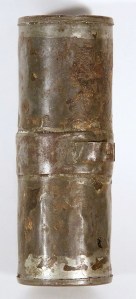
South African Ration tin (lead)
Is there one object in the collection that really excites you or that you think people should know about?
Some people are into uniforms. Others are into weapons. I want to tell the story of the grunt, the guy who put his butt on the line for his country, and what he had to endure.
There is a can of field rations in the South Africa exhibit. Something all soldiers can relate to. It’s a can of mystery meat sealed with lead. LEAD! No wonder they’re all smiling in the old photos.
Why do you think a museum like this is important?
A nasty little word I kept hearing throughout my military career was “restructuring”. Regiments come and go. No one knows what the army will look like in another 155 years, but we can show the world what it looked like 155 years ago.
Would you recommend volunteering to others and if so why?
Absolutely. It’s a way to give back. If not to the regiment, do it for history. And, it’s a good group of people to hang out with.
Update: In February 2018 Larry was presented with the Commanding Officer Certificate of Commendation and a Command Team Coin in recognition of over 800 hours of service to the museum, and to his efforts on behalf of RHQ in photographing regimental events. Sadly Larry passed away 23 March 2018. You can read more of his service on his profile page.
If you’d like to help volunteer at the museum, check out our Volunteer page for information and an application.








 Memorial Banners











 The Queen's Own Rifles of Canada Regimental Museum and Archive