
Warm wishes for the Holiday Season
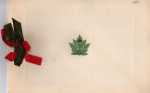
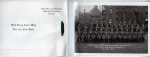
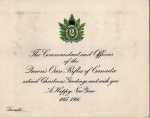
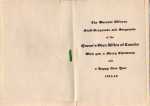
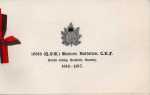
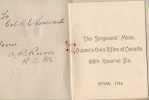
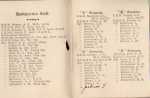
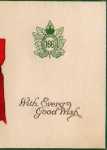
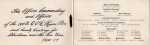
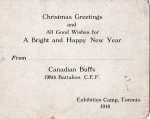
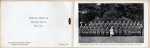
The following are some examples of Christmas Cards in our Museum Archives that were sent to The Queen’s Own Rifles of Canada or officers of the QOR.
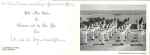


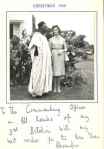

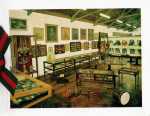
Check out this second gallery of Regimental Christmas cards since 1923, many of which will be in our temporary exhibit at the museum starting December 1st.
Click on any photo below to access the gallery.
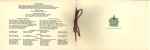


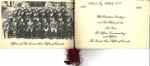
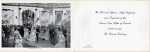


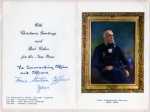
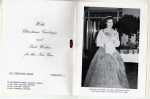

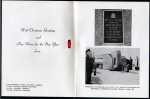

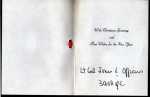
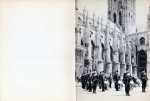

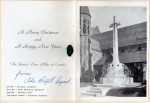


As we approach another holiday season, we’re sharing some of the Regimental Christmas Cards that will be on a temporary exhibit at the Museum starting 1 December. This first series is primarily from the First World War with one from 1941. The Queen’s Own Rifles of Canada perpetuate the 83rd, 166th and 198th Battalions represented below.
Did you know November 15 is National Philanthropy Day?
 This special day is set aside to recognize and pay tribute to the great contributions that philanthropy—and those people active in the philanthropic community—have made to our lives, our communities and our world.
What makes philanthropy so special is that no one is required to give of themselves. There are no national laws or regulations which mandate that you must volunteer or get involved. Philanthropy is so powerful and inspiring precisely because it is voluntary—that through the goodness of our hearts, through our need to connect, through our desire to see a better world, we come together to improve the quality of life for all people.
Through your generosity, billions of dollars and volunteer hours are given every year to countless nonprofits and charities around the world. Millions and millions of programs—from feeding the hungry and clothing the needy, curing the sick, saving the environment—happen every day because of you and your commitment to your favorite causes.
On National Philanthropy Day®, charities around the world thank you for your support. Your involvement—whether it’s mentoring, volunteering, giving, staffing an event or showing your support on social media—makes philanthropy possible, and makes National Philanthropy Day so special and meaningful.
Philanthropy and our Regimental Museum
In 2013 we’ve been very thankful for the many generous volunteers who have assisted us in a whole variety of ways at the Regimental Museum. So far this year we’ve seen 43 volunteers provide over 675 hours of service – from cataloging and photography to construction and painting to exhibit planning and event support! And aside from these recorded hours, are many many more where are supporters have helped connect with us and share our Museum and the history we tell, through their social media outlets.
Volunteers are really priceless but if we did chose to put a monetary value to their time and effort, even at minimum wage that amount would exceed our annual operating budget – and the year still has a month and a half to go!
We have also been the recipient of gifts in kind from four corporate donors in 2013:
The Museum’s operating funding (for day to day expenses), rent and insurance is provided by the Queen’s Own Rifles of Canada Regimental Trust Fund – to which many of your already contribute financially. Together the Trust, our dedicated volunteers and generous corporate donors form a pretty formidable combination.
But we’d also ask you to consider a special financial donation, particularly in recognition of National Philanthropy Day, to help us move closer to creating a museum of the 21st century – one that will help us tell the very important story of our Regiment and our Rifleman in the most engaging and effective manner we can.
You can mail a cheque to (note your donation is for the Museum Fund:
QORofC Trust Fund
Box 250, Unit 12A
4981 Highway 7 East
Markham, ON L3R 1N1
You can also make a donation online via our Trust Fund’s CanadaHelps page (under Fund/Designation select “Museum Fund”.)
We are most grateful for both your volunteer and financial contributions.
“Do what you can, with what you have, where you are.”Shortly many of us will be standing in front of cenotaphs, wrapped up from the biting cold wind, wearing poppies, laying wreaths and silently remembering during the silence between Last Post and Reveille.
As a Regiment, the Queen’s Own Rifles have much to remember:
Thousands of QOR soldiers have given their lives since 1866 and this November 11th we will once again honour and remember them.
However each Remembrance Day I also remember those closer to home. An ancestor who fought in the War of 1812, a grandfather and several great uncles who fought in the First World War – some came home and one didn’t. And perhaps most poignantly, my paternal grandfather who during the Second World War, left a wife and 4 young children to serve in the 5th Canadian Field Ambulance. He lies buried in a hilltop Commonwealth War Graves Commission Cemetery with all his fellow Canadians who were killed in Sicily. Mt Etna smokes in the distance and one realizes how far from home it was.
As we lead up to this November 11th when we will honour all those who have served and sacrificed, I invite you to tell us in the comment section below, who do you remember?
For Immediate Release
Tuesday, November 5, 2013
Casa Loma hosts ‘The Queen’s Own Rifles of Canada’ Day
in honour of Remembrance Day
Saturday November 9, 2013 – 10:00 am-5:00 pm
Canada (originally named 2nd Battalion, Volunteer Militia Rifles of Canada) was formed on April 26, 1860. Predating the Confederation of Canada and the country’s oldest continuously-serving infantry regiment, The Queen’s Own Rifles of Canada (QORoC) saw action at Ridgeway, South Africa, the Somme, Vimy, Passchendaele and Normandy among other battles. The Reserve unit was re-designated as The Queen’s Own Rifles of Canada on 11 February 1971 and remains an active Toronto militia unit today with the task of providing a fully trained parachute company when required. While once comprised almost exclusively of those with British heritage, today its soldiers reflect the wide ethnic diversity of our city.
The day’s activities will feature guided tours of the museum’s exhibits, an opportunity to chat with soldiers who saw service in Afghanistan and Bosnia, photo opportunities with soldiers in 19th Century uniforms, displays and demonstrations of modern day military equipment, activities for children and youth and, commencing in the afternoon, The Queen’s Own Rifles Regimental Band and Bugles will perform in the Great Hall.
“We’re excited to show the evolution of The Queen’s Own Rifles of Canada from its formation in 1860 to the regiment of today – both what’s different in terms of equipment and training, and what traditions still exist,” says museum curator and retired Major John Stephens.
Special guest speakers will be at Casa Loma throughout the day including Canadian author, filmmaker and investigative historian Peter Vronsky (Ridgeway: The American Fenian Invasion and the 1866 Battle That Made Canada) who will discuss the QORoC participation in the 1866 Battle of Ridgeway; The Western Front Association member Bob Richardson who will talk about researching your First World War army ancestors; and teacher, historian and author Eric McGeer (Words of Valediction and Remembrance: Canadian Epitaphs of the Second World War) who will talk about 3rd Battalion epitaphs of the First World War.
Soldiers and cadets with ID or in uniform, and veterans in an association blazer will be offered complimentary admission to Casa Loma on Saturday, November 9, as well as on Sunday, November 10. For program details and admission prices to Casa Loma, please visit: www.casalomo.org
For more information about The Queen’s Own Rifles of Canada activities at Casa Loma on Saturday, November 9th, please visit: https://qormuseum.org/events/november-9-2013/
Why The Queen’s Own Rifles Museum is located at Casa Loma
Casa Loma was the former estate of Major General Sir Henry Pellatt, CVO (January 6, 1859 – March 8, 1939) a prominent Toronto financier, industrialist and military man. Travels in Europe gave him the love for fine art and architecture that would spur his vision of Casa Loma, his “house on the hill,” which took three years and $3.5 million to build in the early 1900s. This romantic side was uniquely juxtaposed by his other lifelong passion: his involvement with The Queen’s Own Rifles. Sir Henry, who joined The Queen’s Own Rifles as a rifleman in 1876, was knighted in 1905 for his military service with The Regiment, upon which he spent many hundreds of thousands of dollars. The Regiment’s band was often engaged to entertain guests at the castle.
In 1910, at his own expense, to mark The Regiment’s 50th anniversary, Sir Henry took the entire 600 man regiment – including its horses – to England for military exercises from 13 August to 3 October. The museum, filled with memorabilia relating to the Regiment, dating as far back as the date of its formation in 1860 and its involvement in every military action undertaken by Canada since then, attracts thousands of visitors from around the world each year. For more information about Casa Loma, please visit: www.casaloma.org
-30-
Media Contacts:
Dorit Leo Major (Ret) John Stephens, CD
Media Relations The Queen’s Own Rifles
Casa Loma Regimental Museum Curator
647-725-1826 416-605-9159
dleo@casaloma.org museum@qormuseum.org
www.casaloma.org www.qormuseum.org
By Eric McGeer
Originally published in Canadian Military History, Spring 2013
Eric teaches at Northmount School in Toronto. He is currently working on the military history of the University of Toronto, focusing mainly on the university’s contingent of the Canadian Officers’ Training Corps. He is also serving on our Museum’s First World War Advisory Team.
This paper begins with a flight of fancy meant to put its subject in a novel perspective. Imagine archaeologists at some distant time in the future coming upon the British memorials and war cemeteries clustered along the old Western Front. Suppose, too, that although the written sources for the Great War no longer survive, the mandate of the War Graves Commission to maintain the monuments in perpetuity has ensured a good state of preservation. In the same way that archaeologists test the historicity of the Trojan War against the evidence from Bronze Age sites, or reconstruct the workings of the Roman army from its camps and fortifications, our imagined archaeologists would set about collating and interpreting the details in the commemorative monuments to form a reasonably coherent picture of the Great War. They would infer from the sheer density of the war cemeteries that it had been a very static conflict; from the dates, regiments, and nationalities incised on the headstones they could establish a chronology of events and a latter-day “Catalogue of Ships” listing the peoples drawn from all over the world into the British Empire’s order of battle. The number of nameless graves, tallying with the registers inscribed on the memorials to the missing, would induce recognition of a frighteningly destructive war that inflicted not only mass death but mass annihilation. Some explanation for this would emerge from the insignia on the headstones identifying artillerymen, machine gunners, tank crewmen, and fliers, which bear witness to the advances in military technology that made such a rigidly concentrated war so consumptive of human life. An archaeologist sensitive to the contradictory logic of human affairs might perceive the trap into which the belligerents worked themselves, that victory alone, at any price, could redeem the sacrifice that mounted with each year of the war.
The evidence responding to the basic questions of who fought the war, when and where and how it was fought, would naturally lead to more speculative inquiry. Anyone beholding these monuments would marvel at the herculean effort involved in creating them and at the scrupulous desire to commemorate every last one of the fallen by name, signs of the debt of remembrance which the survivors felt they owed to the dead. In seeking answers to the very human and very taxing questions as to how people at the time justified so costly a struggle, and how the victors rationalised the appalling price of victory, our future archaeologists would seize upon a body of evidence, unique in history, which historians of our age have been slow to exploit in their study of the memory of the Great War. Thousands of personal inscriptions, engraved on the headstones of the fallen, convey the grief of the families who suffered the loss of fathers, husbands, brothers, sons (and, lest we forget, daughters), and the consolatory themes by which they reconciled themselves to their loss. In their great abundance, cutting across all levels of society, and in their affecting simplicity, the epitaphs preserve the voice of the generation that bore the burden of the war and tried to find meaning in its terrible exactions. They invite us to explore the sources of comfort to which they turned in their distress, and – to do what our age finds it very hard to do with respect to the Great War [1] – to accord fair recognition to sensibilities and attitudes which we have long since discarded, and to beliefs and ideals which ever since the 1960s have come to have less and less meaning. “Our dear Daddy and our hero”; “Baby of the family. Mother still anxious for his return”; “Also in memory of his brother Samuel, killed at Courcelette, 16th September 1916” [2] – these are but three of countless examples reminding us of the claim of the bereaved on our sympathies and of our obligation in return to examine the epitaphs through the prism of their emotions, values, and sources of consolation. [3]
The personal inscriptions, let it be said, have not gone entirely unnoticed. The provision allowing next of kin to contribute short valedictions is duly noted in histories of the Imperial (now Commonwealth) War Graves Commission, [4] even if its significance as the first occasion in history that the general populace could add a private voice to the official commemoration of the war dead is not as emphasized as it might be. The poignancy of these inscriptions – and many truly are gems of compression – has inspired two anthologies, John Laffin’s We Will Remember Them, presenting Australian epitaphs, and Trefor Jones’s On Fame’s Eternal Camping Ground, a wider selection of British and Dominion examples. [5] Both fulfill the purpose of anthologies in providing a selection of memorable personal inscriptions; and it is not to detract from the value of these collections, particularly Laffin’s, to point out that neither ventures into the larger questions of the cultural context and provenance of the epitaphs. It is to say, however, that there has as yet been no attempt to situate the epitaphs of the Great War in the long tradition of sepulchral inscriptions originating in Antiquity, [6] to identify and elaborate upon their sources, [7] and to integrate them within the cultural history of the Great War, a subject in which myth and memory have come to occupy the high ground. Such an undertaking lies beyond the remit of this paper, which proposes instead to outline the approaches to a deeper, and potentially more revealing, study of the personal inscriptions. Although the focus is mainly on Canadian epitaphs, the sense of imperial unity and the close cultural affinity between Great Britain and the English-speaking dominions make the observations offered here broadly applicable to the corpus of epitaphs from the First World War. [8] Any discussion of the personal inscriptions must first balance their worth against their limitations as sources. Though they echo the sentiments of their time, they speak directly for only a small proportion of the dead and those who commemorated them, as some rough calculations will show. Of the 66,000 Canadians killed in the Great War, 11,000 have no known grave; of the identified graves, just under half carry a personal inscription, many of which repeat formulae (“Rest in peace,” “Gone but not forgotten,” “Son of … born in…”) of little more than fleeting interest. The number of inscriptions that offer insight into the minds of the bereaved, individually and collectively, comes to about 3,000 by my count, speaking for about five percent of Canada’s war dead. [9] Their form and realm of expression, though not without variety, adhere to the restrictions imposed by the War Graves Commission and by the conventions of the time. Here the exceptions prove useful in illustrating the rules and, more importantly, the latitude shown in their application. When scanning the collection, for instance, it becomes clear that while most inscriptions stay within the prescribed length of 66 characters (including the spaces between words), a great many do not, the most striking example being a text of over 450 characters covering the headstone of a Canadian lieutenant buried in France. [10] Similar discretion is evident in the content of the epitaphs. The Commission reserved “absolute power of rejection or acceptance” over the inscriptions submitted, yet there are several noteworthy examples giving vent to anger or resentment which demonstrate the range of acceptability. “He did his duty. My heart knoweth its own bitterness. Mother”; “A bursting bud on a slender stem, broken and wasted, our boy”; “Another life lost, hearts broken, for what”; “Sacrificed to the fallacy that only war can end war”; “Many died and there was much glory.” [11] The lengths to which the Commission was prepared to go in accommodating the wishes of next of kin stand out in one stark inscription, indescribably moving in its restoration of honour to the memory of a soldier executed for desertion: “Shot at dawn. One of the first to enlist. A worthy son of his father.” [12]
The taut, pointed simplicity of these examples proves yet again that economy of words makes for much greater impact than does prolixity, something that Rudyard Kipling and Frederic Kenyon well understood when they made their recommendations on personal inscriptions. [13] The infrequent but telling departures from the norm also bring out another point deserving of emphasis. Whatever control the Commission exercised over the personal inscriptions should be construed not as censorship but as a safeguard of propriety and dignity in the war cemeteries. The restrictions on length, and the small fee charged for an inscription, were deterrents against “the effusion of the mortuary mason, the sentimental versifier, or the crank,” and are consistent with the opposition to inappropriate epitaphs that the proponents of the cemetery reform movement of the nineteenth century had long made part of their programme. [14] They took the view that irreverent or semi-literate inscriptions undermined the moral benefits to persons visiting cemeteries to reflect on the vicissitudes of this life and the promise of the one to come. As this view took hold, collections of epitaphs judged suitable for sepulchral inscriptions proliferated throughout the second half of the 19th century. The trend in civil cemeteries towards the spiritual edification of visitors was even more pronounced in the military burial grounds, in which the common aim of the architects and horticulturalists was to create the tranquil, contemplative atmosphere of an English garden, a setting designed to inspire reflection and meditation on the sacrifice of the fallen. We must also take into account the emotional restraint bred into a generation of parents born in the 1850s and 1860s commemorating sons born in the 1880s and 1890s – in other words, people deeply rooted in the Victorian Age – which surfaces in this epitaph, “Sadly missed, silently mourned by his wife and children,”15 and many more referring to private sorrows, silent thoughts, or hidden tears – faultlessly Victorian in concealing the intensity of the grief behind the stoic façade presented to the world.
Few epitaphs represent original compostions. The Victorians preferred to select their gravestone inscriptions, and it seems to have been the assumption on the part of the Commission that next of kin contributing epitaphs would draw from venerable authorities. In the years immediately following the war, a canon of remembrance verse took shape, including such familiar pieces as Laurence Binyon’s “For the Fallen” and John McCrae’s “In Flanders Fields,” which supplied a number of apposite lines; but most of those seeking literary valedictions turned to the poets whose works they had learned in their schooldays when memory work and recitation were staples of pedagogy. A trawl through the University of Toronto’s calendars from the years before the war reveals that the poems most often quarried for epitaphs – Tennyson’s “Ode on the Death of the Duke of Wellington” (“The path of duty was the way to glory”), “Break, break, break” (“O for the touch of a vanished hand and the sound of a voice that is still”) or Shelley’s “Adonais” (“He hath outsoared the shadow of our night”) – were required reading for high school matriculants in English who, like all students of the time, went through a thoroughly Anglocentric curriculum. [16] Sunday School, following or followed by church, immersed people from an early age in the hymns and writings, particularly John Bunyan’s The Pilgrim’s Progress and John Henry Newman’s “Lead, Kindly Light,” which provided a plentiful source of spiritual comfort. But if the generation raised before the war entrusted the expression of its grief, acceptance, or hope to one book, it was to the King James Version of the Bible. It is impossible to overstate the centrality of the Bible in Victorian culture. To paraphrase one scholar, Scriptural knowledge is a prerequisite for entering into the thought-world of the generation that went through the Great War. [17] “(Assurance) What time I am afraid I will trust in Thee. Ps. 56.3”; “O Lord of hosts, blessed is the man that trusteth in Thee. Ps. 84.12”; “God hath delivered my soul from the place of hell for He shall receive me. Ps. 49. 15”; “My favourite reading, 1st bk. Cor. ch. 13”:18 these are among the epitaphs that display the family’s awareness of the passages which the soldier read each day and to which he turned in times of trial. The annotated Bible of a Canadian soldier killed in 1918 contains a list of 18 passages, all from the New Testament, connecting the teachings, experiences, and tribulations of Christ and His followers to the various aspects of a devoutly Christian soldier’s life on active service – and in two texts frequently used as epitaphs, 2 Timothy 4: 5-8 (“I have fought the good fight, I have finished the race, I have kept the faith”) and Revelation 21: 4 (“And God shall wipe away all tears from their eyes”) – to the eventuality of his death and reward. [19] If these readings formed a kind of spiritual anchor for the men in the trenches, other standard selections supplied comfort to the bereaved. The very Victorian habit of reading one’s experiences through the lens of the Bible, and making sense of this earthly pilgrimage by identifying oneself with its stories or characters, guided the next of kin who in like fashion turned to familiar consolatory passages (“Blessed are they who mourn”) or sought reassuring parallels. The mother of a Newfoundland soldier killed on 1 July 1916 chose a line from Luke 7: 12, “The only son of his mother and she was a widow,” that movingly depicts the loneliness of her grief, eased, we can only hope, by the compassion which Christ shows to the sorrowing mother in the Biblical passage. [20]
Epitaphs drawn from the Bible broadened rather than narrowed the range of expression. There are examples to suggest that families selected passages to give voice to feelings which, phrased in less authoritative tones, might have been rejected as too contentious or excessive. “Young men, ye have overcome the wicked one. I John 2.13,” represents a rare instance of triumphalism that puts paid to the Kaiser and all his works without overtly hostile reference to the enemy, a practice discouraged by the Commission.21 “By this I know Thou favourest me, that mine enemy doth not triumph against me” quotes Psalm 41.11 to imply that God had denied victory to Germany; an epitaph drawn from Psalm 68: 30, “Scatter Thou the people that delight in war,” issues a veiled call for divine retribution against a militaristic enemy held responsible for causing the war.22 Those opposed to war were aware that no one could object to the injunction against violence uttered by Christ, “They that take the sword shall perish with the sword. Matthew 26: 52,” or His promise of benediction, “Blessed are the peacemakers.” [23]
The depths of love between a wife and husband might find their most tender expression in Scripture, particularly in the oft-chosen Song of Songs (“Mine till the day break and the shadows flee away”; “Many waters cannot quench love”), or in this richly allusive passage: “My beloved is unto me as a cluster of camphire in the vineyards of En-Gedi.” [24] The great number of personal inscriptions citing the Song of Songs should also remind the present generation, no longer on instantly familiar terms with the King James Version, not to overlook the significance of epitaphs that can sometimes pall through repetition. Though often interpreted in allegorical or mystical ways, the Song of Songs was for the people who lived at the time of the Great War the most powerful expression of married love and the firmest pledge that this love was stronger than death. [25]
Where the study of Canadian epitaphs proves most fruitful, however, is in further elucidating the themes of consolation so thoughtfully explored by Jonathan Vance and in broadening our understanding of the meaning assigned to the Great War by those whose lives were blighted by loss and grief. Two inscriptions, “He gave his all for freedom, the whole wide world to save” and “I have given my life to promote peace between nations,” [26] encapsulate the general belief that this had been “the war to end all wars.” From our disillusioned perspective a century on, this idealism seems wishful and naive, but the people who had these epitaphs engraved on the headstones of their loved ones had grown up with the Victorian world view that suffering and death had purpose, all disasters had a moral, and progress came at a price. [27] They also belonged to the first generation to realise what kind of war the technically advanced armies of industrialised, fully mobilised countries could fight; and they saw in this harrowing experience a warning to the future: “If death be the price of victory, O God forbid all wars”; “Break, day of God, sweet day of peace, and bid the shout of warriors cease.” [28] The unquestionable sincerity of these pleas compels us to recognise the consoling vision of a better world which the people of Britain and the Dominions drew from the Allied victory. The losses, terrible as they were, had resulted in the triumph of one set of principles and values over another: “Right is stronger than might”; “For King and country thus he fell, a tyrant’s arrogance to quell.” [29] The defeat of autocracy and militarism which had brought on the war, and the moral obligation imposed by the horrendous cost to uphold the ideals of freedom, democracy, and concord among nations (“Justice owes them this, that what they died for not be overthrown”), [30] would ensure that such a catastrophe could never happen again. In the minds of comtemporaries the replacement of Tsarist Russia with democratic America in the Allied coalition had reinvigorated the Allied cause by transforming it into a crusade to create a better world (taking Woodrow Wilson’s Fourteen Points as its blueprint) that would abide by a just and stable peace. [31] The belief that a husband, son, or father had given his life in what was surely a divinely sanctioned cause (“Yet remember this, God and our good cause fight upon our side”) [32] found its way onto many a headstone: “He allured to a better world and led the way”; “We grudge not our life if it give larger life to them that live”; “Liberty and freedom had to be won by the willing sacrifice of life”; “He died so that life might be a sweeter thing to all. He liveth.” [33]
“Christ Jesus Who gave Himself, a ransom for all”; “By his death our life revealing, he for us the ransom paid”; “He died for others. Even so did Christ.” [34] From casting a soldier’s death as an offering towards a world made new, it was but a short step to hallowing the fallen as an elect who had died that their kin and country might live and, in the highest sense of sacrifice, laid down their lives for humanity: “Our soldier boy endured the Cross and won the crown” is one of many epitaphs assigning redemptive significance to the suffering of the soldiers who in remaining “faithful unto death” had given the ultimate proof of their devotion: “He gave his pure soul unto his captain Christ”; “Jesus died for me. I’m not afraid to die for Him.” [35] As Vance has shown, after the Somme or Passchendaele, the established churches, which had wholeheartedly supported the war, were at a loss to explain the carnage in terms of historical theology or as the operation of God’s providence. [36]
The only explanation lay in passages emphasizing the Christian virtues of suffering and sacrifice (“Thou, therefore, endure hardness as a good soldier of Jesus Christ”) which bestowed meaning and purpose on the deaths of so many soldiers whose sacrifice had led to victory (in itself confirmation of the righteousness of the Allied cause) and the prospect of a world purged of iniquity: “The blood of Christ, God’s Son, cleanseth us from all sin,” on one soldier’s headstone, could not proclaim more forthrightly the belief that the fallen had done their part to redeem mankind by shedding their blood in willing emulation of the Redeemer. [37]
“It is finished,” Christ’s dying words in the Gospel of John, is inscribed on the headstone of a young artilleryman who died four days after the Armistice. [38] The war was over, the long agony had ended, and death had been swallowed up in victory, leading many families to exalt their dead as “One of Christ’s faithful warriors,” “A volunteer for Jesus,” or “A Christian hero,” [39] as they found solace in a conviction widely shared among Canadians that the battlefields of France and Flanders had been, in the words of John Arkwright’s hymn “O Valiant Hearts,” “a lesser Calvary.” For those pondering the reward for the soldiers who had not lived to see the victory which their travails had helped to achieve, there were comforting reminders from Scripture of God’s covenant with His servants: “And I will restore to you the years the locusts have eaten”; “And their sins and their iniquities will I remember no more. Heb. 8. 12”; “If we suffer, we shall also reign with Him.” [40] But where the soldiers’ endurance and sacrifice had won them salvation and life everlasting, the mourners had to carry on along their own Via dolorosa: “I lift my cross each day and think of thee, brave heart”; “He wears a crown. I wear a cross. Mother.” [41]
“For God and right. Let not a whisper fall that our hero died in vain.” [42] Confronted by a death toll so terrible and benumbing, those left to cope with their grief were understandably inclined to embrace the idealism or religious faith that made the sacrifice meaningful and necessary. These were not the only barriers against the unwelcome – and unbearable – feeling of despair or futility at so great a loss of life. “I will give him a white stone and in the stone a new name – victory.” [43] Canadians could also take considerable pride in the exploits of their soldiers which in many cases tempered the grief of the mourners. The same impulse that led Canadians to name schools, streets, geographical features, and even their children, after famous battles is apparent in epitaphs proudly noting soldiers’ deaths in the feats of arms that made the reputation of the Canadian Corps: “Died of wounds received at Ypres”; “He fell at the Somme. It is immortal honour”; “Mort à Vimy à l’age de trente ans en combattant pour la grande cause”; “Killed near Passchendaele”; “Killed in action at Cambrai”; and one more that reflected the renown won by the Canadians in spearheading the war-winning offensive that began at Amiens on 8 August 1918 – “Tomorrow will be Canada’s day.” [44] Other epitaphs no less proudly record the soldier’s courage in the performance of his duties or the esteem in which his comrades held him: “Died for King and country while keeping line open under shell fire”; “Killed leading an attack at Regina Trench”; “Mentioned in despatches for gallant and distinguished conduct;” “Beloved by officers and men”; “His captain said ‘No braver soldier ever led men into battle’” [45] – this last being one of several examples indicating that letters of condolence to next of kin inspired the inscription on a soldier’s grave.
Just how protective Canadians were of the heroic and morally bracing legacy of the Canadian Corps can be seen on the headstone of a soldier killed in May 1917, five weeks after the United States entered the war. “I raised my boy to be a soldier” states the epitaph supplied by his mother. [46] Her choice of words, baffling to our eyes, would have met with grim approval at the time. It is a Canadian retort to the popular American song, “I Didn’t Raise My Boy to be a Soldier,” which grated on Canadian nerves when the sanctimonious Yankees stayed out of a struggle that strained Canada to the limit, and again when the Doughboys began to claim all the credit for winning the war. [47] The doyen of Canada’s military historians, Charles Stacey (1906-1989), recalled a joke passed around after the war which had the American general Pershing annoyed about the late arrival of his cab in Paris. “When it did arrive, Pershing protested to the driver, who was a female, ‘My good woman, you’re three minutes late.’ And the lady replied, ‘My good man, you’re three years late.’” [48] When borne in mind that the Dominion of Canada had lost a much greater proportion of her young manhood than had her far more populous, late-coming neighbour, both the levity and the epitaph make palpable Canadians’ resentment at the diminution of their efforts in the Great War, not simply for patriotic but for intensely personal reasons.
A new appreciation of the composition of the Canadian Expeditionary Force, and of the assorted backgrounds and loyalties of the men in its ranks, emerges from the epitaphs. If the CEF is pictured as a pyramid, the “Canadians” born in Britain would form the broad base of the structure, their origins indicated by the hundreds of inscriptions noting addresses or birthplaces in the United Kingdom, and by professions of allegiance to their native lands and empire: “A son of England – from Canada, given to the Empire”; “Mortuus est pro Scotia” (i.e. “He died for Scotland”). [49] A sprinkling of epitaphs in Welsh (“Yn eich Duw coeliwch uchw dig gelyn all alw’n iach” – “Believe in God and even your enemy will respect you”) and in Scots Gaelic (“G’un robhdiagrasmhor ohuit a mhic” – “God be gracious to you, my son”) show that English was by no means the mother tongue of all the British immigrants who made up half the CEF. [50] The next layer up would contain the men born in Canada, whose epitaphs display an increasingly self conscious national identity. Many record Canadian birthplaces; and while declarations of loyalty to Britain and Empire abound (“One of Canada’s gifts to the Empire, a life”), a swelling tide of Canadian sentiments (“Our lad is a hero, great Canada’s pride”) support the general consensus that the Great War marked the first step on the road from Dominion to nation. [51] Nor was all the patriotic phraseology penned in Britain, for we find an epitaph citing what would one day become the national anthem (“O Canada, he stood on guard for thee”) and another drawing attention to Canada’s rediscovered war poets: “In years to come when time is olden, Canada’s dream shall be of them.” [52] Within the great cross-section of Canadian society represented in the epitaphs (“From a homestead, Quantock, Sask.”; “Dearly beloved son of Maj. Gen. S.C. Mewburn C.M.G. Minister of Militia & Defence, Canada”), [53] we find faint but perceptible echoes of the trials and controversies as much a part of Canada’s experience of the Great War as the deeds of her soldiers. May we take, for instance, the many epitaphs emphasizing the soldier’s voluntary enlistment or the ready acceptance of his duty (“I am going. My country needs me”) as the last shots in the battle over conscription? [54] “Rejected four times, accepted the fifth”; “Discharged from N.Z. forces as unfit, having lost the sight of an eye. Re-enlisted at Vancouver” [55] – what do these two extraordinary examples tell us about the standards for enlistment as the need for men became ever more desperate after 1916? The paucity of epitaphs in French testifies to Quebec’s indifference to an English war, yet if few in number these adieux attest to the determination of the only French speaking battalion in the teeming hosts of the British Empire to uphold the reputation of their people on the field of battle: “O Dieu, prenez ma vie pour Votre gloire et celle du Canada-français”; “A la fleur de l’age il sacrifia héroïquement sa vie pour son pays.” [56] Also among the epitaphs that should spur interest in the groups which have until recently gained little purchase in the predominantly English-Canadian narrative of the war are the ones which commemorate native soldiers (“One of the many Canadian Indians who died for the Empire”) and the men from non-British backgrounds (“He was the first Icelander to give his life for Canada”). [57]
As we move up towards the apex of the pyramid, the CEF begins to resemble the Foreign Legion. Not surprisingly, given the geographical proximity, we come upon Americans who headed “over there” by way of Canada long before April 1917. One acted on the outrage felt by Americans at an incident that nearly brought the United States into the war in 1915: “A volunteer from the U.S.A. to avenge the Lusitania murder.” [58] Some were students (“One of American Harvard vanguard, entering Canadian service in 1916”) motivated by the desire to help not Britain but a country much dearer to American hearts: “A citizen of the United States who fought and died for France.” [59] One wonders if this young man ever crossed paths with Private Victor Hugo Sørensen, one of a surprising number of soldiers identified by their inscriptions as a “Dansk frivillig” (Danish volunteer). [60] A handful, like Sørensen and the impressively named Count Ove Krag-Juel-Vind-Frijs, [61] had immigrated to Canada, yet most were Danish citizens motivated either by the strongly Francophile tendencies shown in Private Sørensen’s given names, or, as is more likely the case, by lingering anger at Bismarck’s craftily orchestrated annexation
of Schleswig-Holstein in 1864 and concerns that the Kaiser’s Germany had the same regard for Danish neutrality as it did for Belgian. A handful of epitaphs in Dutch may hint that men from another traditionally neutral country bordering Germany shared these apprehensions. If the Danish and Dutch volunteers were 20 years ahead of their time, there were others whose motives to enlist in Canadian service had more to do with defeating Germany’s major ally. The epitaph of a Czech who died on active service with the Canadian Pioneers strikes the nationalistic note of a people longing to be free from Austro-Hungarian rule: “Lehkou ti zeme Belgie chloubo matky čechie” – “May the earth of Belgium be light upon you, pride of the Czech motherland”; [62] that of a Serbian immigrant and volunteer leads us to shake our heads yet again at the incredible interplay of events that linked Canada in common cause with a country to which few Canadians can have given much thought before 28 June 1914: “Za otatsbinu i saveznika život svoj dao” – “For his fatherland and ally he gave his life.” [63]
The study of the personal inscriptions, as this paper has attempted to show, touches on subjects ranging from the broad to the particular, casting light on national, cultural, and social history, and, above all, on the myriad experiences and stories submerged within the vast depths of the Great War. “Be ashamed to die until you have gained some victory for humanity’; “Son of my heart, live for ever. There is no death for you and me”; “It is well done, Dad” [64] – ennobling, saddening, austere, rarely bitter, never cynical, the epitaphs cannot fail to touch the hearts of sympathetic readers; however, to return to the flight of archaeological fancy with which we opened, it has been the purpose of this paper to take the reader below the layer of emotion and expose the strata where further investigations must begin if the epitaphs are to enhance our understanding of the memory of the Great War. It is no great revelation to say that the epitaphs speak with the voice of a very different time, not of artists or writers, but of a populace in mourning. It warrants saying only to point us in the direction in which further research should proceed – back into the nineteenth century, not forward into the twentieth, led by Jay Winter and other scholars who have rightly insisted on the durability of the cultural traditions which sustained the generation faced with the mass death of the Great War, and would sustain a following generation faced with the mass evil of the Great War’s sequel. [65] Only by excavating, so to speak, down to the foundation of the epitaphs, unearthing clues to the reasons behind their choice and setting them firmly in the cultural context of their time, can we hope to retain our ever attenuating link with a generation whose response to the tragedy of the war is so rich in historical and human interest.
*From the inscription on the headstone of Lance Corporal Andrew Ramage, Princess Patricia’s Canadian Light Infantry (Wimereux Communal Cemetery).
Notes
1. The contrast between the attitudes of one time and those of another struck one historian at Tyne Cot War Cemetery as he compared the inscriptions on the headstones with the comments in the visitors’ book; see Paul Reed, “Vestiges of War: Passchendaele revisited,” in Peter H. Liddle, ed., Passchendaele in Perspective. The Third Battle of Ypres (London: Leo Cooper, 1997), pp.467-78, esp. 471-72.
2. Epitaphs of Private George Brignell, 54th Battalion Canadian Infantry [CI] (Cantimpré Canadian Cemetery); Private Albert Kick, 4th Battalion CI (Sancourt British Cemetery); Private Alec Feltham, 52nd Battalion CI (Nine Elms British Cemetery).
3. Best described by David Cannadine, “War and death, grief and mourning in modern Britain,” in Joachim Whaley, ed., Mirrors of Mortality: Studies in the Social History of Death (London: The Stanhope Press, 1981), pp.187-242, esp. 212-17. See also Jonathan Vance, “Remembering Armageddon,” in David Mackenzie, ed., Canada and the First World War: Essays in Honour of Robert Craig Brown (Toronto: University of Toronto Press, 2005), pp.409-33, and Alan R. Young, “We throw the torch’: Canadian Memorials of the Great War and the Mythology of Heroic Sacrifice,” Journal of Canadian Studies 24, no.4 (Winter 1989-90), pp.5-28.
4. Philip Longworth, The Unending Vigil: A History of the Commonwealth War Graves
Commission (Reprinted Barnsley, South Yorkshire: Pen and Sword Books, 2003); Mark Quinlan, Remembrance (Hertford: Authors OnLine Ltd., 2005, pp.69-153). The cemeteries in which Canada’s Great War dead are interred are the subject of Norm Christie’s projected Sacred Places: Canadian Cemeteries of the Great War (Ottawa: CEF Books, 2011-).
5. John Laffin, We Will Remember Them: AIF Epitaphs of World War 1 (Kenthurst, New
South Wales, Australia: Kangaroo Press, 1995); Trefor Jones, On Fame’s Eternal Camping Ground: A Study of First World War Epitaphs in the British Cemeteries of 11 the Western Front (Trowbridge, Wiltshire: Cromwell Press, Ltd., 2007).
6. The study of the epitaphs and the standard themes of consolation which have endured in western culture from Antiquity down to the present day begins with Richmond Lattimore, Themes in Greek and Latin Epitaphs (Urbana: University of Illinois Press, 1962), esp. pp.215-65, and Joshua Scodel, The English Poetic Epitaph: Commemoration and Conflict from Jonson to Wordsworth (Ithaca NY: Cornell University Press, 1991).
7. This cuts both ways, since scholars writing on the epitaphic tradition have not taken the personal inscriptions of the two world wars into consideration. They have no place, for example, in Karl Guthke’s otherwise valuable study, Epitaph Culture in the West: Variations on a Theme in Cultural History (Lewiston-Queenston-Lampeter: The Edwin Mellen Press, 2003), pp.325-58.
8. British, Canadian, Newfoundland, Australian, and South African epitaphs would come together within this corpus. The New Zealand government forbade personal inscriptions on the grounds that not all families would be able to afford the cost involved. Though one can appreciate the egalitarian spirit of this decision, it must be reckoned a great loss to posterity that the families of New Zealand soldiers – so highly regarded for their performance in both world wars – could not add their voice to the commemoration and popular memory of the Kiwis.
9. Jones estimates that about 45 percent of identified graves have an inscription, noting that the percentage on officers’ graves is much higher since their families could afford the fee charged by the Commission (which was eventually made voluntary, but too late for poorer families who had declined to submit an inscription). The issue of cost did not affect Canadian families since the Canadian government covered the cost of inscription s. See On Fame’s Eternal Camping Ground, pp.11-12; Longworth, The Unending Vigil, p.44.
10. Lieutenant Alfred Evans, buried in Bailleul Communal Cemetery Extension. In full it reads: “In loving memory of Lieutenant Alfred James Lawrence Evans. B.Sc. McGill. 1st Canadian Division 7th December 1915. Aged 26 years. Born at Quebec. Died of wounds received on 23rd November 1915 while in command of 1st Bde Mining Sec. 3rd Btn. front line trenches, Belgium. Mentioned in despatches for gallant and distinguished conduct in the field. ‘The brave die never, being deathless they but change their country’s arms for more, their country’s heart.’”
11. Private Reuben haley, Duke of Wellington’s Regiment (Puchevillers British Cemetery); Private Thomas Quinlan, Royal Warwickshire Regiment (Rat ion Farm Cemet ery); Private William Rae, 20th Battalion Australian Infantry (Villers-Bretonneux Cemetery); Lieutenant Arthur Young, Royal Irish Fusiliers (Tyne Cot Cemetery); Sergeant William Clegg, Canadian Army Medical Corps (Bramshott Churchyard).
12. Private Albert Ingham, Manchester Regiment, (Bailleulmont Communal Cemetery); on his execution and his father’s insistence on having the details of his death inscribed on his headstone, see Cathryn Corns and John Hughes-Wilson, Blindfold and Alone: British Military Executions in the Great War (London: Cassell and Company, 2001), pp.256-60.
13. The recommendations on personal inscriptions were set out by Sir Frederic Kenyon, War Graves. How the Cemeteries Abroad Will Be Designed (London: His Majesty’s Stationery Office, 1918) (reprinted in Quinlan, Remembrance, pp.245-63 (the relevant passage on pp.251-52); Rudyard Kipling, The Graves of the Fallen (London: His Majesty’s Stationery Office, 1919), passim. See also Jones, On Fame’s Eternal Camping Ground, pp.8-14, and Laffin, We Will Remember Them, pp.24-27, with examples of the inscriptions suggested by the Commission.
14. See John Morley, Death, Heaven and the Victorians (London: Studio Vista, 1971), pp.42-44, 52-57; Guthke, Epitaph Culture in the West, pp.67-81; Karen Sanchez-Eppler, “Decomposing: Wordsworth’s poetry of epitaphs and English burial reform,” Nineteenth-Century Literature 42, no.4 (1988), pp.415-31.
15. Private Alfred Cogan, Canadian Army Medical Corps (Oxford Road Cemetery).
16. On the reading material in Ontario schools before and during the war, and the values it imparted, see the illuminating, well-judged new study by Susan Fisher, Boys and Girls in No Man’s Land: English-Canadian Children and the First World War (Toronto: University of Toronto Press, 2011), pp.15-27, 51-103.
17. Timothy Larsen, A People of One Book: The Bible and the Victorians (Oxford: Oxford University Press, 2011), pp.1-8, 295-98.
18. Private William Barnes, 19th Battalion CI (Warloy-Baillon Communal Cemetery
Extension); Private James MacDonald, 1st Canadian Mounted Rifles (Menin Road South Military Cemetery); Driver Charles Maxted, Canadian Engineers (Lijssenthoek Military Cemetery); Private Alfred Blackmore, 46th Battalion CI (London Cemetery and Extension).
19. Michelle Fowler, “Faith, Hope and Love: The wartime motivation of Lance Corporal Frederick Spratlin, MM and Bar, 3rd Battalion, CEF,” Canadian Military History 15, no.1 (Winter 2006), pp.45- 50. Lance Corporal Spratlin died on 8 August 1918, and lies buried in Toronto (Demuin) Cemetery. Given the strength of his character and convictions, the inscription on his headstone, “I died that truth and honour might live,” is no empty sentiment. The evidence of the epitaphs also throws light on the religious beliefs of Great War soldiers studied by Richard Schweitzer, The Cross and the Trenches: Religious Faith and Doubt among British and American Great War Soldiers (Westport, CN and London: Praeger, 2003), pp.84- 117, 129-39; see also Duff Crerar, Padres in No Man’s Land: Canadian Chaplains and the Great War (Montreal-Kingston: McGill-Queen’s University Press, 1995), pp.161-65.
20. Private Arthur Jones, Royal Newfoundland Regiment (Knightsbridge Cemetery).
21. Private William McGreer, 47th Battalion CI (Cérisy-Gailly Military Cemetery). The
Australian historian Bruce Scates gives an example of an epitaph rejected by the Commission (“His loving parents curse the Hun”) and again when resubmitted
(“With every breath we draw we curse the Germans more”); see Return to Gallipoli:
Walking the Battlefields of the Great War (Cambridge and New York: Cambridge
University Press, 2006), pp.48-53.
22. Private Vernon Earle, 27th Battalion CI (Lijssenthoek Military Cemetery).
23. Private Eugene Smith, 2nd Canadian Mounted Rifles (Bouchoir New British Cemetery); Private William Harpham, 50th Battalion CI (La Chaudière Military Cemetery).
24. Private Kenneth Neil MacDonald, 13th Battalion CI (Rue-Petillon Military Cemetery).
25. The interpretative approaches to the Song of Songs in Jewish and Christian exegesis are reviewed by Marvin H. Pope in The Anchor Bible: Song of Songs. A New Translation with Introduction and Commentary (Garden City, NY: Doubleday and Company, Inc., 1977).
26. Private Adon Smith, 87th Battalion CI (Adanac Military Cemetery); Private Emanuel Fulton, 31st Battalion CI (Passchendaele New British Cemetery).
27. It is very striking to compare reactions to the First World War with reactions to various catastrophes in the Victorian Age. To take one example, the collapse of the Tay River Bridge in 1879 was seen as a regrettable but acceptable accident in the great march of progress. As one contemporary put it, “life is not lost which is spent or sacrificed in the grand enterprises of useful industry.” See John Prebble, The High Girders (London: Pan
Books, Ltd., 1959), p.59.
28. Private John Wray, Lancashire Fusiliers (Authuille Military Cemetery); Sergeant
Wellesley Taylor, 14th Battalion CI (Chester Farm Cemetery).
29. Private Albert Boustead, 15th Battalion CI (Bruay Communal Cemetery Extension);
Private Harrison Allen, 16th Battalion CI (Villers Station Cemetery).
30. Private George Hargrave, 29th Battalion CI (Brussels Town Cemetery).
31. The ideological contest of the Great War, and the issues at stake in the minds of contemporaries, are well expounded by John Bourne, “The European and International consequences of the Armistice,” in Hugh Cecil and Peter Liddle, eds., At the Eleventh Hour. 12 Reflections, Hopes and Anxieties at the Closing of the Great War, 1918 (Barnsley, South Yorkshire: Pen and Sword Books, 1998), pp.315-326. The impetus given by American churches to the notion of a Crusade for a better world has been analysed by Richard M. Gamble, The War for Righteousness: Progressive Christianity, the Great War, and the Rise of the Messianic Nation (Wilmington, DE: ISI Books, 2003), pp.163-79, 209ff.
32. Private Sydney Turner, 2nd Battalion CI (Fosse No.10 Cemetery); Private Reginald
Aldridge, 5th Battalion CI (Bully-Grenay Communal Cemetery, British Extension).
33. Company Sergeant-Major Arthur Dunlop, 2nd Canadian Mounted Rifles (Nine Elms British Cemetery); Captain Alexander MacGregor, 28th Battalion CI (Rosières Communal Cemetery and Extension); Private William Stanley Mills, 5th Canadian Mounted Rifles (Maple Copse Cemetery); Private William Sime, 29th Battalion CI (Adanac Military Cemetery).
34. Private Mackie Stewart, 102nd Battalion CI (Lijssenthoek Military Cemetery);
Private Alexander Dunn, 78th Battalion CI (Barlin Communal Cemetery); Lieutenant
Thomas MacKinlay, 29th Battalion CI (Boulogne Eastern Cemetery).
35. Private Charles Everett Clark, 5th Battalion CI (Maroc British Cemetery); Lieutenant Guy Drummond, 13th Battalion CI (Tyne Cot Cemetery); Private Alexander McDonald, Canadian Machine Gun Corps (Bac-du-Sud British Cemetery).
36. Jonathan Vance, Death So Noble: Memory, Meaning, and the First World War
(Vancouver: UBC Press, 1997), pp.35-48.
37. Private Ernest McClelland, 1st Battalion CI (Chester Farm Cemetery).
38. Driver Alex Henderson, Canadian Field Artillery (Etaples Military Cemetery).
39. Lance Corporal Colin Broughton, 5th Battalion CI (Railway Dugouts Burial Ground); Private John Reid, 52nd Battalion CI (Nine Elms British Cemetery); Private Leslie Unthank, 18th Battalion CI (Ridge Wood Cemetery).
40. Corporal William Bowyer, 7th Battalion CI (Bailleul Communal Cemetery Extension), citing Joel 2: 25; Corporal Alfred Jones, 20th Battalion CI (Ridge Wood Cemetery); Sergeant David Hunter, 102nd Battalion CI (Givenchy Road Canadian Cemetery), citing 2 Timothy 2: 12.
41. Lieutenant William Clipperton, 8th Battalion CI (Lapugnoy Military Cemetery); Private Charles Ainslie, 8th Battalion CI (Brookwood Military Cemetery).
42. Lieutenant Lloyd Scott, 38th Battalion CI (Bourlon Wood Cemetery).
43. Private Hal Bowers, 47th Battalion CI (La Chaudière Military Cemetery).
44. Private Eusèbe Loiseau, 22nd (French Canadian) Battalion (Wimereux Communal Cemetery); Private James Stickels, Royal Canadian Regiment (Contay British Cemetery); Private Arthur Goyette, 22nd (French Canadian) Battalion (Bruay Communal Cemetery Extension); Private Edward Beldam, 2nd Canadian Mounted Rifles (Tyne Cot Cemetery); Private William Bartling, 52nd Battalion CI (Canada Cemetery); Lieutenant-Colonel Elmer Jones, DSO and Bar, 21st Battalion CI (Longeau British Cemetery). It is worth noting that references to the battles of the war set the corpus of Canadian epitaphs apart from British and Australian collections, in which one finds comparatively fewer specific mentions of the engagements where the soldier lost his life.
45. Sergeant Harold Flynn, 38th Battalion CI (Albert Communal Cemetery); Lieutenant
Willoughby Chatterton, 3rd Battalion CI (Adanac Military Cemetery); Major Edward Norsworthy, 13th Battalion CI (Tyne Cot Cemetery); Corporal George Brown, Canadian Field Artillery (Brandhoek New Military Cemetery No. 3); Lieutenant Eric Lane, 85th Battalion CI (Vis-en-Artois British Cemetery).
46. Private Mostyn Scott Sands, 28th Battalion CI (La Targette Military Cemetery).
47. Vance, Death So Noble, pp.176-80; see also Paul Litt, “Canada Invaded! The Great War, Mass Culture, and Canadian Cultural Nationalism,” in Canada in the First World War, pp.323-49, esp. 333-40.
48. C.P. Stacey, Canada in the Age of Conflict: A History of Canadian External Policies. Vol.1: 1867-1921 (Toronto: University of Toronto Press, 1984), p.234.
49. 2nd Lieutenant Francis Lawledge, Royal Flying Corps (Bailleul Road East Cemetery); Private Harry Walker, 29th Battalion CI (Wulverghem-Lindenhoek Road Military Cemetery).
50. Private Llewellyn Jones, 1st Canadian Mounted Rifles (La Targette Military Cemetery); Lance Corporal Alexander MacDonald, 72nd Battalion CI (Nine Elms British Cemetery).
51. Private William Smith, 49th Battalion CI (Raillencourt Communal Cemetery Extension); Private Wilfrid Spicer, 2nd Canadian Mounted Rifles (Caix British Cemetery).
52. Private Reginald Box, 16th Battalion CI (Sancourt British Cemetery); Gunner Donald McKinnon, Canadian Field Artillery (Aubigny Communal Cemetery Extension). The line is taken from a poem by Helena Coleman (1860-1953), “Autumn, 1917,” which appeared in her Marching Men: War Verses, first published in 1917 and republished in 2008 by Dodo Press. The themes and diction of Canadian war verse would make for an interesting comparative study with the epitaphs; see Jonathan Vance, “Battle verse: Poetry and nationalism after Vimy Ridge,” in Geoffrey Hayes, Andrew Iarocci, and Mike Bechthold, eds., Vimy Ridge: A Canadian Reassessment (Waterloo, ON: Wilfrid Laurier University Press, 2007), pp.265-77. On the resurgence of interest in Canada’s war poets, see Joel Baetz, Canadian Poetry from World War I: An Anthology (Toronto: Oxford University Press, 2009).
53. Private Ayrton Wragge, 13th Battalion CI (Puchevillers British Cemetery); Lieutenant John Mewburn, 18th Battalion CI (Courcelette British Cemetery).
54. Private Edward Panabaker, PPCLI (Nine Elms British Cemetery).
55. Private Charles Turner, 10th Battalion CI (Lijssenthoek Military Cemetery); Private Arthur Hackney, 29th Battalion CI (Rosières Communal Cemetery Extension).
56. Lieutenant Joseph Hudon, 22nd (French Canadian) Battalion (Tranchée de Mecknes Cemetery); Captain Maurice Bauset, 22nd (French Canadian) Battalion (Sunken Road Cemetery, Contalmaison). On the 22nd Battalion as the standardbearer of French Canada’s martial reputation, see Jean-Pierre Gagnon, Le 22e bataillon (canadien-français) 1914-1919 (Ottawa et Québec: Les Presses de l’Université Laval, 1986), pp.301-307.
57. Private Lawrence Marten, 52nd Battalion CI (Wimereux Communal Cemetery); Private Magdal Hermanson, 8th Battalion CI (Wimereux Communal Cemetery).
58. Driver Leland Fernald, Canadian Field Artillery (Lijssenthoek Military Cemetery).
59. Lieutenant Phillip Comfort Starr, Royal Engineers (Bedford House Cemetery); Private Roy Marshall, Canadian Army Service Corps (Lapugnoy Military Cemetery).
60. Private Sørensen, 4th Battalion CI, is buried in Quatre-Vents Military Cemetery. His name is incorrectly rendered on his Canadian attestation paper and in the Commonwealth War Graves Commission database as “Sorenson.”
61. Buried in Kemmel Chateau Military Cemetery; his inscription in Danish would read in English: “Now my eyes are closed, Father in Heaven, and I enter the care of the world above.”
62. Private Dominick Naplava, Canadian Pioneers (Tyne Cot Cemetery).
63. Private Chris Meti (Metič), Princess Patricia’s Canadian Light Infantry (Bois-Carré British Cemetery).
64. Lance Corporal George Edward Pike, Royal Newfoundland Regiment (Y Ravine Cemetery); Private Hal Sutton, 5th Battalion CI (Hinges Military Cemetery); Private Richard Boughton, 21st Battalion CI (Courcelette British Cemetery).
65. The reliance on Great War precedents in the epitaphs commemorating Canada’s
Second World War dead is discussed in my book, Words of Valediction and Remembrance: Canadian Epitaphs of the Second World War (St. Catharines: Vanwell Publishing Ltd, 2008), pp.44-54, 57-91.
You can now find the original nominal rolls for each of our perpetuated battalions of the Canadian Expeditionary Force on our Archives Page: https://qormuseum.org/archives/
These searchable nominal rolls issued with Militia Orders in 1915, includes service number, rank, name, previous military service, name of next of kin, address of next of kin, country of birth, and date and place taken on strength.
Just in case you need convincing, we’re sharing this blog post which gives you ten reasons to visit a museum – ours or any other museum!
http://colleendilen.com/2009/07/31/10-reasons-to-visit-a-museum/
 The Queen’s Own Rifles Regimental Museum recently launched our new YouTube Channel which is a great place for us to share digital versions of regimental film clips in our archives. So far we’ve uploaded eight clips from D-Day landing footage to the History of the QOR on its 140th Anniversary!
Two things:
Firstly visit our channel and check out the footage uploaded to date. If you enjoy the videos you watch, help us raise our YouTube profile by clicking the “LIKE” button (the thumbs up logo) at the bottom left of each video! And while you’re there we also encourage you to click the “SUBSCRIBE” button which means YouTube will tell you whenever we upload a new video clip.
Secondly we invite you to share any film clips you have with us so that we can include them in our museum archives and add them to our channel. Footage doesn’t have to be WWII or the 50/60’s to be part of our regimental history so please take some time to contact us if you have something that you think would be (or aren’t sure if it would be) what we’re looking for. Obviously video of training or jumps or formal parades is all pretty obviously a yes 🙂 You can contact the museum at museum@qormuseum.org and we can figure out how best to facilitate sharing your footage with us.
A Preview
If you haven’t already seen one of our most historic clips, check out this footage taken from a landing craft at Juno Beach as the QOR head on to the beach. Then check out the rest of the clips we’ve uploaded on our site – and we have more to upload over the coming weeks and months!
Please Note: This article was written by Captain Scott Moody, Officer Commanding the QOR of C Parachute Company for the 2013 issue of “The Rifleman”, Journal of the Queen’s Own Rifles of Canada. Photos taken by Major Sandi Banerjee, Captain Chris Potter, Master Corporal Dan Pop and Paul Lantz.

In 2013 The Queen’s Own Rifles of Canada celebrated 30 years of its designation as a “para-tasked” regiment. The initiative to award a parachute tasking can be traced back to the formation of the Central Militia Area Special Unit (CMASU), whose role was to be a reserve army unit that would have the potential to become an airborne one. This was an idea developed and vigorously encouraged by LCol Peter Fairclough CD, a Queen’s Own Rifles officer who had previously served in the British Army’s Special Air Service (SAS) in Malaysia.[1] LCol Fairclough’s proposal was derived from British and American Airborne and Special Operations Forces reserve units which had proven to be capable of supporting full-time counterparts. What followed is described by Queen’s Own Rifles of Canada Captain Scott Moody, who has worn paratrooper’s “jump wings” since 1992. A veteran of more than 100 parachute descents, he is also a fully-qualified jumpmaster and commands the regiment’s Para Company.
Central Militia Area Special Unit
The CMASU paraded at the Staff College in Toronto. Because it was a new unit it had several problems, a principal one being that it drew the best soldiers from many regiments, which often resulted in support from higher levels being provided only reluctantly, if at all. The solution was to have the CMASU reduced to company strength and have it bolster one of the Toronto-based units, with The Queen’s Own eventually getting the nod over The Toronto Scottish. Since a number of the original CMASU cadre had come from The Queen’s Own, then Commanding Officer Lieutenant Colonel Bill Wilson, CD, warmly greeted the return of his riflemen. He was delighted with the addition of this significant element to his regiment and showed his strong support by providing the unit with the flexibility to maintain its training schedule and customs. The CMASU was designated as The Queen’s Own’s 60th Company and Lieutenant Colonel Peter Fairclough decided to become Major Fairclough to enable him to stay with his troops.

That the CMASU was stood down did not stop the desire to have reservists involved in supporting parachute operations in Canada. The idea of such a unit was significantly enhanced when The Canadian Airborne Regiment (Cdn AB Regt) offered to augment its numbers by inviting The Queen’s Own to provide a fully-formed section. The invitation was eagerly accepted, resulting in an eight-man rifle section serving with a company of 2 (Airborne) Commando, under the command of Major Ike Kennedy. During this time they took part in Exercise Georgian Strike 2 at CFB Borden, Meaford and Petawawa, and were later commended for their capabilities. These eight riflemen were former CMASU soldiers and their accomplishment served to forward the concept of reserve support to the Canadian Airborne Regiment. At the conclusion of the exercise they were present at the ceremony held to mark the formation of 3 (Airborne) Commando, which would be commanded by the same Maj Kennedy, who had become a staunch supporter of The Queen’s Own receiving a parachute tasking.

Within higher headquarters Major General Reginald Lewis championed the tasking and vision became reality in 1982 when nine Queen’s Own soldiers were sent on the Basic Parachutist Course at the Canadian Airborne Centre (CABC) in Edmonton, Alberta, an unprecedented event. Prior to this, reservists had been given the chance to take the course only rarely, and as a “reward” for one accomplishment or another. All nine were successful graduates, among them being three future Regimental Sergeant Majors for The Queen’s Own Rifles in CWO (now Captain) John Wilmot, CWO Scott Patterson and CWO Shaun Kelly. Another graduate was LCol Robert Zeidler, who later became the regiment’s commanding officer. Additionally, BGen Don Pryer and LCols Bob Campbell, Steve Brand, Tony Welsh, John Fotheringham, Martin Delaney and Peter St. Denis, named commanding officer in 2102, were qualified as parachutists before taking command.

Augmenting the Canadian Airborne Regiment
On 23 January, 1983, the concept became official with the issuance of Operations Order 2/83 which gave The Queen’s Own Rifles of Canada the mission to provide a 27-man platoon to augment the Canadian Airborne Regiment. The Queen’s Own were given 18 months to form the platoon by qualifying paratroopers and providing them with the opportunity to gain experience with the airborne soldiers. In August, 1983, 24 members of The Queen’s Own, led by then Lt Tony Welsh, attended the Airborne Indoctrination Course (AIC) where they earned the right to wear a maroon beret, bearing the cap Badge of The Queen’s Own Rifles.
 In September, 1984, parachute tasking within the Canadian Forces burgeoned when Quebec-based Le Régiment du Saguenay and The Loyal Edmonton Regiment in Alberta were each also tasked to provide a platoon to support the airborne regiment.
The relationship between the regiments and airborne developed quickly and positively and by 1985 an operational assessment established the fact the reserve force jump platoons were now considered to be fully manned and trained. Due to the successes, the British Columbia-based Royal Westminster Regiment was awarded a 27-man jump platoon and The Queen’s Own and the Saguenays each were granted a second one, bringing the total to six reserve airborne platoons and a company HQ, which had been established by The Queen’s Own. The reserves could now form the fourth platoon in each commando, with the remaining three platoons and company HQ forming the basis of a fourth commando contingent.
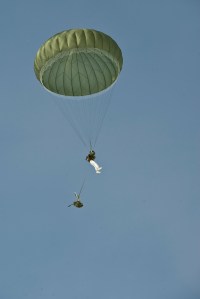 That the Queen’s Own took great pride in their tasking was evidenced by the enthusiasm exhibited in their participation on airborne courses, exercises and operational deployments. Future Queen’s Own Rifles commanding officer, then 2/Lt John Fotheringham did a six-month posting with 3 Commando and in 1992, when the Canadian Airborne Regiment deployed to Somalia, it took with it six members of The Queen’s Own, thus forming the largest contribution from a reserve unit on the operation.
Riflemen were not only qualifying as paratroopers they also started acquiring more experience in parachuting and other skill sets related to airborne operations. They had the opportunity to take courses through CABC or with the CAR such as DZ/LZ controller (Drop Zone/Landing Zone), packer/rigger, basic mountain operations, and aerial delivery. They also were presented with the chance to participate in foreign exchanges and TALEXs (Tactical Airlift Exercises). These opportunities allowed some of them to gain enough experience to start taking more advanced courses. In 1989 Sgt Chris Thompson became the first Queen’s Own Rifles NCO to qualify as jumpmaster and in 1993 WO Donovan O’Halloran became the first to qualify as parachute instructor. These individual accomplishments helped solidify the formation of The Queen’s Own as an airborne qualified- and-ready unit.
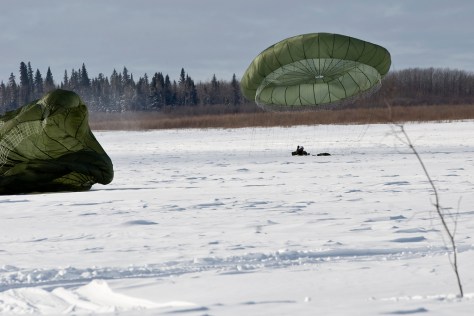
In 1994, with budget pressures being applied at National Defence Headquarters, a little more than ten years after its introduction it was announced that, with the exception of The Queen’s Own Rifles, all militia units would forfeit their parachute taskings. While this was a crushing blow to those regiments, and justifiable cause for future concern at battalion HQ at Moss Park Armoury, The Queen’s Own Rifles of Canada, once again, was the only reserve unit in Canada whose members had the chance to continue to train to become paratroopers and to become part of the regiment’s airborne cadre.
Within the year, however, the Canadian airborne community became the focus of much public attention and unrelenting harsh criticism, largely misdirected, following the death of a Somali youth at the hands of two members of The Canadian Airborne Regiment. A government enquiry into the matter ensued, military trials were held and the regiment was ordered disbanded. The outrage within the military at this draconian decision was unbridled but “orders is orders” and at CFB Petawawa, on 5 March, 1995 – a cold and windy day – The Canadian Airborne Regiment paraded for the last time. The Queen’s Own Rifles maintained its relationship with the regiment to the end, with its paratroopers participating in a final jump and attending its last parade, where The Queen’s Own’s Regimental Band and Bugles would play. The sombre event included a church parade, a ceremony of Laying up of Colours in the Canadian Airborne Forces Museum, followed by final dismissal on Nicklin Parade Square. It was a bitter irony that the parade square had been named in honour of LCol Jeff Nicklin, a former commanding office of the 1st Canadian Parachute Battalion, which had been in the D-Day assault. Nicklin had been killed in action in Germany in 1945. Meanwhile in Ottawa the Chief of the Defence Staff ordered that the regiment be struck from the order of battle of the Canadian Forces with effect that date, in accordance with Ministerial Order 95003.
 New Canadian Parachute Centre (CPC)
In June 1996, The Queen’s Own was tasked by Land Force Command (LFC) to provide 66 parachutists in support of the new Canadian Parachute Centre (CPC) that was relocated to CFB Trenton in Ontario. The Queen’s Own quickly developed a strong and important relationship with CPC, now the Canadian Land Advanced Warfare Centre (CFLAWC), one which has evolved over the years. Initially the regiment provided jumpers for CPC’s task of supporting Tactical Airlift Training Exercises (TATEX) for RCAF 8 Wing, Trenton. These allowed CC-130 helicopter crews to be qualified and to maintain efficiency in personnel and equipment drops. The exercises would take place several times a year for ten days and as time progressed Queen’s Own jumpers played increasingly larger roles by providing DZ control teams, jumpmasters and aerial delivery-qualified personnel to rig equipment for airdrops.
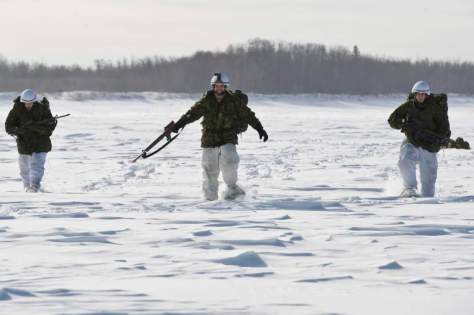 A further evolution of the relationship with CPC was the regiment providing instructors and support staff for courses. These responsibilities gradually increased in scope and frequency with Queen’s Own Rifles airborne riflemen teaching on aerial delivery, helicopter operation, DZ/LZ and advanced mountain operations. Proving their ability as instructors, Queen’s Own Rifles NCOs were soon being offered permanent instructor positions at CFLAWC.
Following disbandment of the Canadian Airborne Regiment, three parachute companies were formed in the 3rd Battalion of the three regular force infantry regiments – Princess Patricia’s Canadian Light Infantry, Royal Canadian Regiment and Royal 22nd Regiment. The Queen’s Own quickly established and maintained a close relationship with 3 RCR Para Coy. Riflemen quickly began participating on exercises with the company on a regular basis and as the relationship developed Queen’s Own Rifles jumpmasters would support 3 RCR Para Coy parachute operations. In the past, Queen’s Own airborne-qualified personnel augmented 3 RCR in Ft. Bragg, North Carolina on a joint operation exercise with U.S. troops as well as at the U.S. Marine Corps Weapons and Tactics Course in Yuma, Arizona.
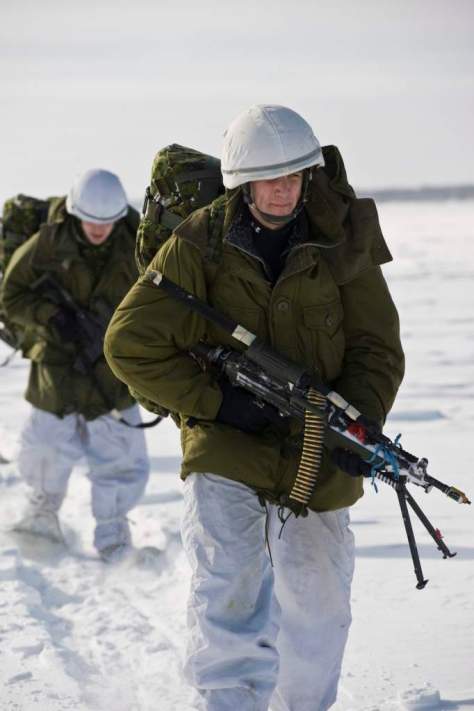 The relationship to 3 RCR has also transferred well to support on expeditionary operations. During OP PALLADIUM ROTO 3 and 8 to Bosnia-Herzegovina many members of the The Queen’s Own augmented 3 RCR Para Coy. When 3 RCR deployed to Afghanistan other personnel augmented the company during OP ATHENA in Kabul. An excellent example of the strength of this relationship occurred in 2008 when 25 members of The Queen’s Own’s airborne company deployed on OP ATHENA, Roto 6, in support of the 3 RCR Battle Group, which was the largest Queen’s Own Rifles contingent to deploy to a battle theatre since the days of the 1st and 2nd battalions of the Canadian Army’s regular force.
Planning and Executing its Own Exercises
Moving on following disbandment of The Canadian Airborne Regiment, The Queen’s Own found itself more and more involved in planning and executing its own exercises, a challenging task indeed. The training model for the reserves has changed frequently over the past 30 years, moving from individual unit training to collective training on weekends. Due to this, most exercises take place independent of regular unit training, increasing the level of commitment required from the airborne riflemen. During special events, such as summer concentrations, the regiment was often given the chance to jump into the Ex but the force employment was limited. This changed dramatically when The Queen’s Own was given the opportunity to lead a composite airborne reconnaissance platoon during the two-week-long summer concentration in 2003. The platoon was composed of 20 Queen’s Own riflemen and 20 pathfinders from the German Army in an exercise that was highlighted by tactical parachute and rappel inserts. At the following summer’s concentration, the regiment led an airborne company made of 60 paratroopers from The Queen’s Own and 30 jump-qualified from other Land Force Central Area LFCA reserve units in a variety of para-oriented tasks.
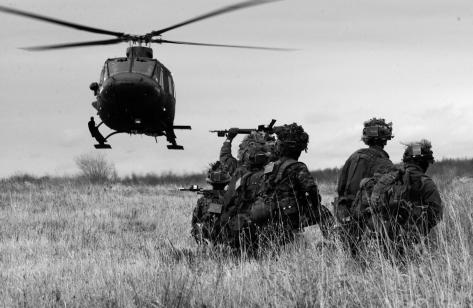
In 2013, its 30th anniversary year, The Queen’s Own Rifles of Canada’s parachute company exists as a shadow company within the unit, drawing its jumpers from the two rifle companies, 60th and Buffs, as well as Victoria company, which provides combat service support. The jumpers participate in annual parachute refresher training and physical training testing. New parachutists are also provided with internally-run indoctrination training to help them transition from parachutist to paratrooper. Training continues on weekends and jumpers have, on average, six opportunities to jump a year, weather and equipment availability always permitting. However, there is a renewed interest in having the Queen’s Own jumpers employed to support collective exercises, with a prime example of this being the platoon jumping, in well below zero weather, into a DZ on a frozen river to secure the airfield in Moosonee during area-level Exercise Trillium Response early in 2013.
The capability of The Queen’s Own Rifles of Canada to provide a self-sustaining parachute company is well established after 30 years. In its ranks as the 30th anniversary year began the regiment has six parachute instructors, eight jumpmasters and a large pool of DZ controllers and aerial delivery specialists. Because of this capability, the regiment was able to take on a basic parachute course for primary reservists from LFCA during the summer of 2012. This resulted in members of The Queen’s Own Rifles planning and executing the first ever basic parachutist course staffed only by reservists and for reservists. The end result was 40 reservists becoming jump-qualified and the secondary effect of improved retention and motivation for these members.

Over the past 30 years of its parachute tasking The Queen’s Owen Rifles has continued to evolve. Changes have taken place in the areas of structure and function of airborne forces and reserve employment in Canada during this time. However, the inherent resilience of the Riflemen has permitted them to adapt to these changes and build capacity.
[1] From 1963 to 1966, Britain successfully waged a secret war to keep the Federation of Malaya free from domination by President Sukarno's Indonesia and by Chinese Communists. At the forefront of the campaign was the British Army`s elite Special Air Service, whose essence is secrecy and whose tools are bold initiative, surprise, and skill.
Today is International Museum Day so we hope you’ll plan to visit our – or any museum today or any time this weekend!
Over the past few months we’ve received two corporate donations which we’d like to publicly acknowledge.
Paint

A conversation I was having with a colleague at work about repainting one of our exhibit rooms was overhead by another colleague which led to her father and eventually to the head office of Benjamin Moore Canada. The end result of “one thing leading to another” was some very expert advice on the most durable but also low VOC paints that would be most practical for our needs AND a donation of eight gallons of the said paint via one of their local retailers (Maples Paints on St Clair West.) Like most museums with limited operating budgets, donation of items in kind – like paint – can mean a big difference to what we can accomplish!
Mannequins
 Pretty much every historical museum uses mannequins to display costumes – historical clothing or in our case uniforms. But like many museum supplies, mannequins can be expensive – up to hundreds of dollars. The Queen’s Own Rifles Museum is no exception and although we have a large number of uniforms on display, we still have a closet full that aren’t!
Since my day job office is located at Queen and Bay (on top of the Queen Street Hudson Bay store), I arranged to have coffee about a month ago with Richard Montgomery, Chief Adventurer (a.k.a. Vice President and General Manager) of the Queen Street store. After reminiscing about my first job as a teenager at the Robert Simpson’s Queen Street Store (before it was bought by the Bay) and finding out that Robert had a degree in history, we talked mannequins. Richard said he’d be happy to help us out if he could and promised to check what they might be available. Almost four weeks later, staff delivered 2 full mannequins and 2 “busts” on stands to my office on the 18th floor!
 In the picture above, your’s truly is the one with the head, and a couple of the others have been clothed with fig leafs for modesty’s sake. We’ve also undertaken a mannequin naming contest since they may be there a while until I can arrange transportation to their new home at Casa Loma.
Thank you
Thank you to both Benjamin Moore Paints Canada and The Hudson Bay Company for their generous gift in kind donations!
We’re looking for a few work-from-home volunteers to help us prepare information for posting on our Historical Timeline. The task requires reading through Lieutenant Colonel W. T. Barnard’s The Queen’s Own Rifles of Canada, 19860-1960: One hundred years of Canada to find “significant events” that we haven’t yet posted to our timelines listed below:
Note that we have two “specialty” timelines for uniforms and weapons which we’re also trying to populate.
Information can be submitted in the body of an email or in a WORD attachment and each date/event (following the format already being used including a [2] at the end of each entry as the reference to this source). Research should be emailed to museum@qormuseum.org directly.
If you’re interested in assisting with this project, you can indicate below which time period you would like to research (it can be a portion of the periods shown above) and we’ll confirm with you before you start just some we don’t end up with any overlap. Questions can also be posted in the comments below!
Thanks in advance!
 OK well the position is actually Social Media Assistant not nerd, but you probably get the drift. We’re looking for someone comfortable with and experienced in using social media to connect and engage with visitors, friends, volunteers and financial supporters of our museum. Definitely someone who is familiar with and a regular user of Facebook and Twitter and preferably someone who understands Pinterest and WordPress as well. Experience using HootSuite or other tools for managing social media is also a plus!
You’d assist in preparing “this day in history” posts, following social media mentions of the QOR or our museum, re-posting items of interest from similar organizations, responding to comments/questions from followers and even perhaps creating some blog posts.
 You’d work with the Curator within the guidelines we are developing and would work from your own computer and/or smartphone or other device. Besides social media cred, you need have an interest in the history of the Queen’s Own Rifles (duh) and ideally a connection to the regiment (but the latter isn’t a deal breaker!)
If you think you might be interested in taking on this volunteer position, please send an email to museum@qormuseum.org (please don’t apply via the “comments” section below although we’re happy to respond to questions about the position that way.) You should include a description of your experience in relation to what we’re looking for above and links to your FB, Twitter accounts and other accounts as a kind of portfolio for us to check out!
We look forward to hearing from you soon!
April is a significant month for the Queen’s Own Rifles for a number of reasons and this week in particular. In this post we’ll take a look at a few.
2nd Battle of Ypres and the 3rd Battalion, Canadian Expeditionary Force (CEF)
When the 3rd Battalion was raised for the Canadian Expeditionary Force in September 1914, it consisted mostly of soldiers from the Queen’s Own Rifles including all three of its wartime Commanding Officers, however it also had elements from the 10th Royal Grenadiers and the Governor General’s Bodyguard. Today the 3rd Battalion, CEF is perpetuated by the Queen’s Own Rifles of Canada and the Royal Regiment of Canada (as the successor to the 10th Royal Grenadiers.)
After some training at Valcartier the 3rd Bn embarked for England On October 3rd as part of the 1st Brigade where they would spend four more months equipping, training and reorganizing. They arrived in France in mid February 1915 and were assigned to their first front line trench duties on March 5th. The first combat casualties occurred the next day with two men reported killed by shrapnel from shelling. But it was not until the April that they would see their first and perhaps most significant battle.
“On April 22nd the 2nd and 3rd Brigades were holding the line, the 2nd on the right, the 3rd on the left with the 1st Brigade in reserve about Vlamertinghe. In the afternoon the enemy launched the first gas attack of the war against the French and to a lesser extent against the Canadian left. The attack entirely broke the French, exposing the Canadian left flank which bent but held. The 2nd and 3rd Battalions, the latter commanded by Lieutenant Colonel Rennie, were rushed up in support, arriving at midnight, and were attached to the Third Brigade at Shell-trap Farm. The former at once went into the line on the exposed left flank. During the following morning “C” and “D” Companies of the 3rd Battalion were placed under command of Major Kirkpatrick and moved forward to fill in a gap on the right of the 2nd Battalion between the famous Kitchener’s Wood and the village of St. Julien. Throughout the day and night this flank held in spite of desperate German attacks, but the following day it was pushed back, “C” and “D” Companies being completely wiped out in a vain attempt to stem the tide. All this was done under heavy artillery fire and without artillery support, for the line had not been expected to hold and most artillery had been withdrawn. Meanwhile, many British battalions were being rushed up and about April 27th, the line was stabilized and the Division relieved, the 3rd Battalion being the last to be withdrawn. After several days in support, the division left the Salient and moved south.. This was the battalion’s first battle. It is known as the Second Battle of Ypres and the Canadian part of it as St. Julien sometimes Langemarck. It cost the battalion 19 officers and 460 men in casualties.”
From a “A Brief History of the 3rd Canadian Battalion Toronto Regiment”
Included in that total and what hurt the 3rd Battalion the most was the fact that 287 men taken as prisoners of war by the Germans – including Kirkpatrick – the second most of any Canadian unit during the war. Those that were not considered casualties, from the Commander on down, were all suffering from fatigue and irritable nerves.
The war dairies written during this battle are worth a read and you can find them on our website here. Note the 10 am April 24 entry which records instructions to Major Kilpatrick that “You must hang on to your position” and which would lead to his nickname of “Hang On Kirkpatrick”.
Here are two additional accounts of the battle from participants:
Corporal J.W. “Jack” Finnemore #9785 – 3rd Battalion
April 22, 1915 – 2nd Battle of Ypres
“I was wounded on the last jump over between leaving an old trench and building a new one. My brother F.A. Finnimore (Staff Sargeant Frank Finnimore #9781) was wounded there just before I was.I started to take his putee off when Captain Strait (Major John Everett Streight, Prisoner of War)said to me “.Come on Finnimore. Look after your section. Never mind, you’ll have to leave him (my brother).” A newspaper back home reported that we kissed each other goodbye on the front, but I only did his leg up.That was all!.” Jack was captured by the Germans and became a Prisoner of War. Frank survived his wounds.
Private Frank V. Ashbourne #9170 – 3rd Battalion
April 24, 1915 – 2nd Battle of Ypres
“We went into the line with a thousand and only two hundred of us came out of it. Sir John French said that it was our Battalion that stopped the advance of the Germans. “C” and “D” Companies suffered the most and were almost wiped out. I was with my brother Bert (Private Bertram Ashbourne #9171), shortly before we were separated by the gas attack at St. Julien, on April 24-25, 1915. My brother was wounded at Langemarck and taken prisoner of war. During the gas attack at St. Julien we lost the first line of trenches and had to move back to the supports. At the back of those trenches we lay down flat and covered our mouths with wet clothes, waiting for the Germans to come up. They came up slowly thinking we were all dead from their gas, but not so. It drifted slowly over us and showed the Germans about seventy-five yards away. We were suddenly ordered to rapid fire and I don’t think that about more than a dozen Germans got away alive. We advanced again and regained our front trenches with minimum losses”.
Formation
As many of you may already know, the QOR itself was formed by General Militia Order on April 26, 1860 under the name Second Battalion Volunteer Rifles of Canada. It consisted of several formerly independent rifles companies that had been raised in 1955 in the County of York and the surrounding communities. Lieutenant Colonel William Smith Durie of the Barrie Company appointed Commanding Officer.
The past 113 years, Queen’s Own Riflemen have seen service in the Battle of Ridgeway (Fenian Raids), the Red River Rebellion, the North West Field Force, the South African War, the First World War, the Second World War, peacekeeping in Korea and Cyprus, NATO service in Germany, various United Nations postings, Bosnia and most recently Afghanistan where 61 soldiers of the regiment saw active service.

This week is National Volunteer Week in Canada so we want to take this opportunity to thank and recognize our 15 volunteers who have provided 256 hours of volunteer service to the Queen’s Own Rifles of Canada’s Regimental Museum in the past 6 months:
Volunteers are critical to the successful operation of our museum and we greatly appreciate the time, the skills, the knowledge and the effort of each and every one!
John Stephens
Curator
Every wonder how they get the jeeps and tanks and trucks fueled?
Aside from our collection of artifacts our museum has an interesting archival collection of documents, records and other materials dating back to the 1860s. These were created by the Regiment, by regimental affiliates or donated by individuals or their families. The museum itself has also collected a variety of material. We hope to create a catalogue of our archives to make them more accessible to researchers.

Our lack of full time staff to respond to requests for information has led us to consider the benefits of digitizing certain records and making them available online. To this end, we contacted Anne Dondertman of the Thomas Fisher Rare Books Library, University of Toronto, who is graciously allowing us use of the library’s digital book scanner designed for use with bound volumes. This is a book2net Kiosk for those enquiring minds.
After scanning, we import the individual jpeg images from a book into a single Adobe Acrobat pdf document. We then add books marks, run optical character recognition to create a searchable document (if possible), add metadata and reduce the size of the pdf for uploading to our website.
I can now scan about 400 pages per hour if I resist the urge to read while I’m scanning. As we only have access to the library a couple of hours each week, it may take us some time to process our materials. In the meantime we’re prioritizing so that we`ll be scanning the most useful/interesting first – a rather subjective process!
To date we`ve digitized and uploaded to our new ARCHIVES page:
We’ve also linked to some previously scanned documents:
We’ll continue digitizing and uploading as documents are completed. We hope you’ll find this material both interesting and helpful!


 The Queen's Own Rifles of Canada Regimental Museum and Archive