Volunteer Recognition Night 2016

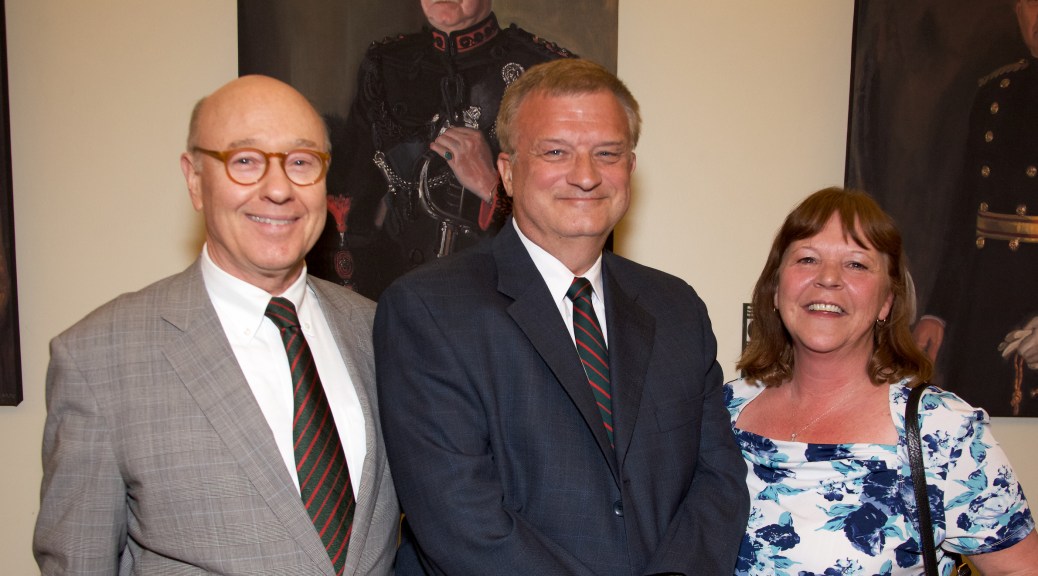
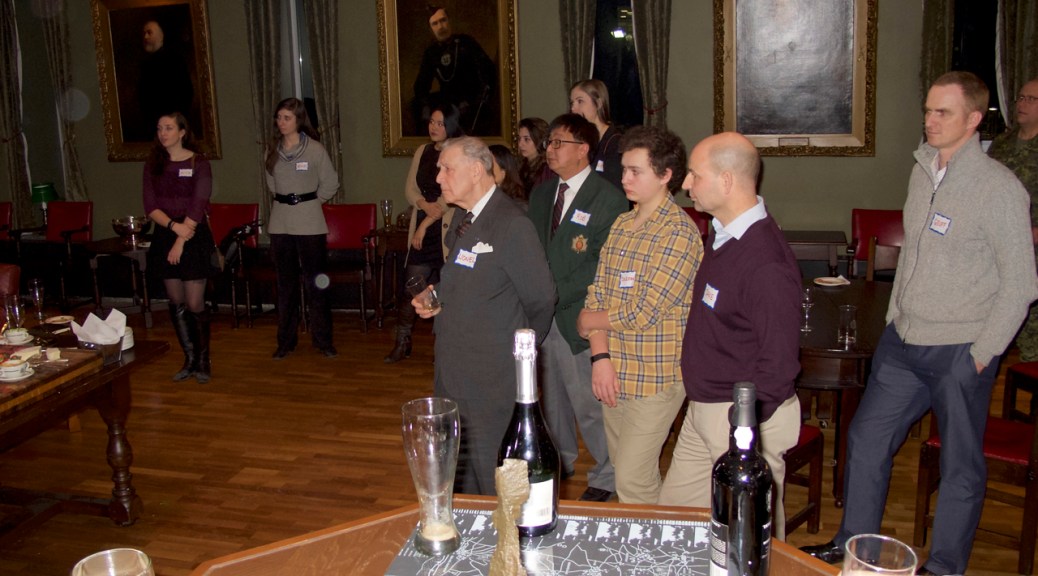
On Thursday January 28th over 30 volunteers joined us at the Officers’ Mess for a reception to recognize volunteer service to the museum in 2015. In total 93 volunteers put in over 1,600 hours!

We were pleased to be joined by Honorary Lieutenant Colonel Lionel Goffart, members of the Museum Board of Governors,  and the Deputy Commanding Officer and President of the Officers’ Mess Committee, Major Shawn Stewart.

Thanks to Adam Hermant, Rob Chan, and Pat Di Donato of the Liberty Entertainment Group, we were able to presents some gifts to our top volunteers in terms of hours of service:

  1. Larry Hicks (235 hours)
  2. Graham Humphrey (184 hours)
  3. Shaun Kelly (121 hours)
  4. Ken Kominek (88 hours)
  5. Cheryl Copson (77 hours)
  6. Joe Wyatt (76 hours)
  7. Rob Grieve (73 hours)

The presentations were followed by a tour of the various messes at Moss Park Armoury which are filled with fascinating collections of military heritage.

We’re also pleased that some of our occasional volunteers have expressed an interest in becoming more regular and we look forward to another successful year in 2016!

Reg Force Reminiscences: “WUN BUN DAZE”

by Major Ronald R. Lilley, CD

This article was the first of two found in our collection. The date or purpose for which is was written is unknown. The second article will be posted in two week. Lilley left the Loyal Edmonton Regiment to join the 1st Battalion QOR in March 1954.

Back in the Spring of 54 (1954), not 1854, as many of my more recent associates would claim, the formation of 1 QOR of C was in progress at Currie Barracks, Calgary. Major C.P. McPherson (CP), acting by authority of Lieutenant-Colonel John Delamere’s absence, was the Supreme Commander of a handful of riflemen, NCOs, WOs and officers. The term “motley” may be an unkind term to use in describing this crew, but motley it was. The Adjutant, Captain Frank Moad and RSM Rusty Rowbotham completed the Bn HQ triumvirate. Lieutenant Fred Sargent (the QM) and I, at the time of my reporting in, were the only two First Lieutenants. Our association increased in size when Lieutenants Lloyd Cornett, Herb Pitts and Bob Munson reported for duty. At that time the PPCLI still reigned supreme in the permanent Mess on the hill while the LdSH (RC) were located adjacent to them in the temporary wartime buildings. Our Mess was located in an old Air Force H-Hut located adjacent to the Northeast corner of the parade square.

“Tea” was an informal “parade” where the CO determined the progress made on the state of the union and made or rescinded his various pronounce­ments, such as “ALL officers will wear moustaches.” Parties “spontaneous or otherwise” always ended up with “Grease the Tube”. After every shot, the Mess Secretary, while he was capable of doing so, gathered up and placed in an appropriately labelled bag, mainsprings, crystals, cog wheels, etc., of the individual’s wristwatch. The equivalent of a Timex was soon worn by all officers, and issue watches were in great demand.

Inevitably, Wainwright was upon us and Major Don Creighton became acting 2IC, relinquishing the command of HQ Coy to Lieutenant Lilly. The Coy was in the best shape possible considering the paucity of equip­ment and personnel. At the time, I was corresponding with Captain “Honest John” Mitchell, who was the Sigs Officer designate. “Honest John” took over his platoon several weeks after we were in Wainwright and it he had been prone to heart seizures we would have lost him on day two of his service with the unit. CO’s briefings were held daily, with the officers assembled around a campfire pit. Young 2/Lt Mike Newell ([later] Deputy Commander 12 RBC – Valcartier) commanding one of the sp wpns pls, was scorched by the CO’s wrath when, after receiving a direct order for events to take place the following day, he said: “I won’t do it.” Mike was suffering from an abscessed tooth, as I recall, and had a dental appoint­ment for the next day. CP’s fury provided an unexpected anaesthetic. Incidentally, Mike did have the tooth extracted and not by CP.

My turn came at the end of one of the Bde exercises. The Bn was granted 24 hours in the built-up area for R&R. I had checked over the officers’ quarters and had allocated the rooms by placing the officer’s name on the appropriate door. Unfortunately for me, I had to return to the Men’s area because their quarters allocation had been halved and I had to make up a new plan. In my absence the Straths advance party over­ruled our representatives and re-allocated the CO’s suite and most of the choice rooms to their CO and officers. On my return to the Officers’ Mess I felt righteous indignation for the treatment to which I was subjected.

By this time, we had all learned to keep our mouths shut and not to raise the subject of our undoing until another officer fell into the excreta, or for at least 48 hours. My saviour had already been earmarked by fate, Lt Ivor MacLeod by name. Those were the days of “NO shortages.” A smouldering mattress heaved from a second storey window (still open) was discovered the next day by CP. Poor Ivor had fallen asleep with a lit cigarette; feeling extremely warm, he had taken the aforementioned action which caused the inevitable chain reaction.

That same summer, then, in an effort to increase the mobility, started the first post-war experiment which eventually led to the procuring of the M113A1 APC. 2/Lt Spike Vanier, with a fleet of tired bren gun carriers, streaked around the training area on a preconceived battle plan. Experiments the next summer included transporting troops in 3/4 ton trucks and trailers. We must have been blessed by either CP or the Almighty, because we never lost a man.

Individual training began once again after the leave period and we were soon introduced to a new Capt Adjutant in the personage of George Hall. George, the nemesis of CP, was noted for using his Christian name on part one orders, green tinted glasses, a moustache and his wife Bunty. George and Bunty were also noted for their after-duty escapades. George continually tried to widen the entrance to Currie Barracks, was usually successful, much to the chagrin of the Garrison Commander. Bunty became infamous at a Strath Mess Dinner involving CP, Kurt Greenleaf (CO LdSH (RC) and General Vokes (GOC Western Command) . I eventually replaced George as adjutant and Lloyd Cornett in time replaced me . By accident or design, all the adjutants (Frank Moad, myself and Lloyd Cornett) with the exception of George Hall, were to meet Rod MacKay, the former Bn 2IC, in Vietnam.

After a sojourn in Vietnam, I returned to the unit in Sep 56 and after a relatively short but peaceful existence. “Rapid Step” was upon the unit in its full fury. I was relegated to be OC Rear Party and missed out on all the fun in Halifax, much to my dismay but to the eternal joy of my wife. Rehearsals for the Feu de Joie were held on the RCAF tarmac at Lincoln Park. This always caused a minor problem because the Air Force stenos had tender ears and objected profusely to their Station Commander about the air pollution which followed the unit in the form of a blue haze. Needless to say that RSM Rusty Rowbotham was the main contributor with minor contributions being made by various CSMs. Officers received sword drill from CSM Ken MacLeod in Scott Hall. We in those days carried the famous Wilkinson Sword made in Japan. Trying to balance it was like holding a 6-pounder Atk gun in the vertical position by the muzzle. Young Ken using the best techniques of instruction of that day, continued to practise us in sword drill by numbers and by numerous demonstrations to inculcate the finer points in our rather erratic movements. In due course, we were able to do the whole drill. Wishing to sharpen us up, he prepared to give us one more demonstration using his own words of command. “Draw Swords”, shouted CSM MacLeod, and with a flourish, his hand went through the motions. To his dismay and to our amusement, the blade never left the scabbard and momentarily basket, sword knot and handle were held in a gloved hand with the blade parallel to the ground, elbow at the side, then in slow motion the basket, complete with knot, did a barrel roll to the concrete floor. Sword drill was suspended for the rest of that day in a gale of laughter.

Wainwright 57 saw the unit in bivouac at Border Lake and once again I was casting covetous glances at our mates in our rifle coys and at those officers in the rifle coys of the ad hoc bn formed under Major Ron Wilkinson, our Bn 21C. We went through the various rounds of inspections of the HQ Coy Bivouac area. On one occasion, LCol Chuck Lithgow accompanied by the Comd MO and Food Services Officer, commented on the completeness of amenities in our area and jokingly said “Where’s your deep freeze?” To his amazement, I said to Staff “Zump the Pump” Zumprelle, “Show them our deep freeze.” Zump showed them our ice cream cooler suitably concealed in a bush near the kitchen.

The next summer saw us located in the Westgate area. That was the summer I learned to tactically employ helicopters. My most important task, brought on by the introduction of helicopters, was to race around the whole bn area ensuring that crapper lids were closed. The Bde Commander, Brigadier Wrinch, had a fetish for hovering over bivouac areas and peering into open crappers.

The incident I remember best and will undoubtedly be reported on more adequately by others, involved the OC and 2IC of a rifle coy which shall remain nameless. On a dark and probably stormy night the 21C Capt John Probyn (1 had to use a web belt on the old grouch to make him human when he was adjutant) was returning from a recce of a coy crossing site. The coy was to launch an attack across the Battle River. Time being of the essence, the coy Comd Major Hank Elliot had decided to move the coy forward. In ground mist obscured depression, the 2IC and Coy Comd encountered each other and locked radiators.

Pte McAteer, the outstanding batman in the unit, was ordered during an emergency move of HQ Coy to look after our stock of ammunition (blank of course) by CSM George Collings. While establishing our new position the CSM yelled several times for McAteer to bring forward the ammuni­tion for redistribution. McAteer had disposed of the ammo by burying it in the old location.
Artifact Spotlight: Sergeants’ Mess Composite Photo c.1886

Today’s artifact spotlight is by former Regimental Sergeant Major and Chief Warrant Officer (Ret’d) Shaun Kelly, Assistant Curator.

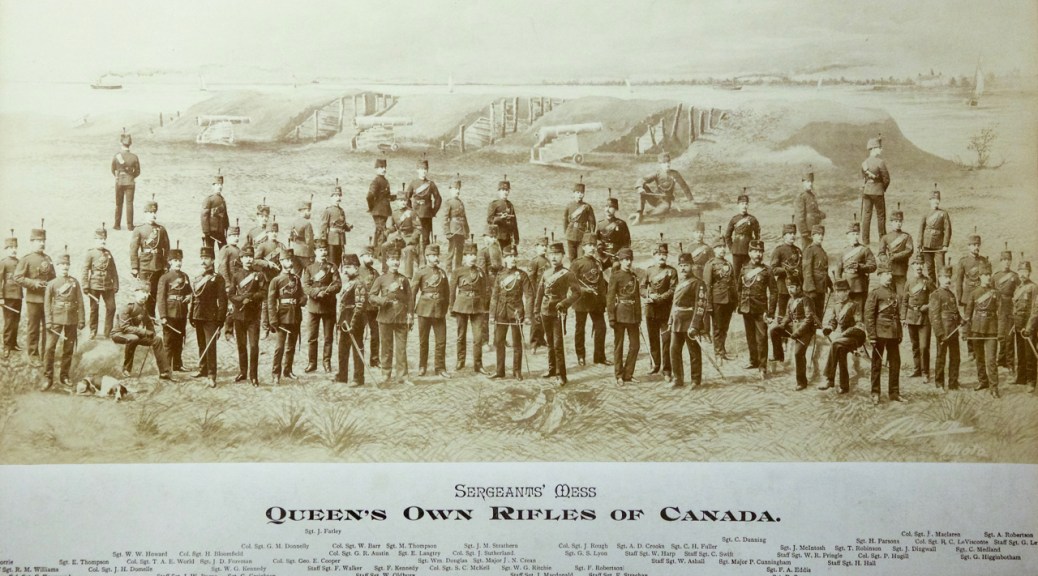
The object I have chosen as an artifact of interest is this photo (above) of the Sergeants’ Mess in 1886. It is a composite photo meaning photos of individuals are cut-out and stuck on a watercolour or charcoal sketched background and then re-photographed (much like Photoshop).

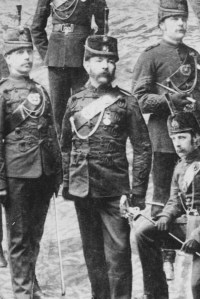
Sergeant Major Waring G. Kennedy
Sergeant Major George Crighton

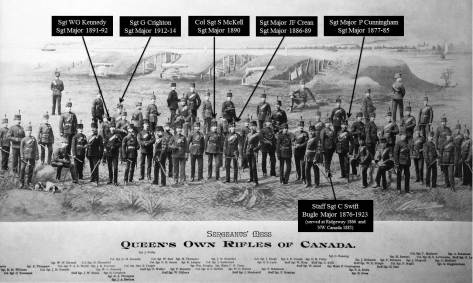
It was chosen because it shows the sergeants at a time when at least 30 of them had just recently returned from the rigours of the North West Rebellion 1885, (NW Canada campaign), it has five serving or future Sergeant Majors and a number of other interesting details. The date is likely 1886 as both Sgt Major Cunningham and Sgt Major Crean are present and the sergeants are wearing their North-West Rebellion medals.

Members of the Sergeants' Mess circa 1886
Members of the Sergeants’ Mess circa 1886 (click to see larger version)

From left to right the Sergeant Majors are:

  1. Warring G. Kennedy was Sergeant Major from 1891-92 and served as a corporal during the NW Canada campaign.
  2. George Creighton served as Sergeant Major from at least 1912-15 and served as a Pte during the NW Canada campaign.
  3. Samuel Corrigan McKell served as Color Sergeant during the NW Canada Campaign and was mentioned for saving a wounded soldier while under fire. He was appointed as Sergeant Major in 1889 but unfortunately died the next year. He is buried in St James Cemetery in Toronto and has a large tombstone erected by his comrades.
  4. John F.M. Crean was Sergeant Major from 1886-89 and served as Color Sgt during the NW Canada campaign. After his time as Sgt Major he received his commission, then left the QOR and joined the West Africa Frontier Force.  He died in Toronto at 47 years of age after 6 years in Africa.
  5. Patrick Cunningham (formerly of the 16th Foot) was Sergeant Major from 1877 to 1885, including as Sergeant Major during the NW Canada campaign.
  6. Charles Swift was Bugle Major from 1876-1923 and is the only one in the picture that served at both Ridgeway and the NW Canada Campaign. He is the regiment’s longest serving Bugle Major.
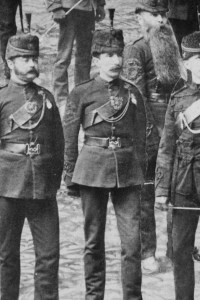
Sergeant Major (later Captain) John F.M. Crean
Sergeant Major Samuel Corrigan McKell

Other interesting information:

  • There are 28 Sergeants, 15 Color Sergeants, 13 Staff Sergeants including 2 Sergeants Major, 1 dog, and 1 unknown Sergeant (name being cut-off in the picture);
  • Color Sergeants are what we now call Company Sergeants Major although the Companies were less than half the size of a modern day 120 soldier Company. In 1886 a Company normally had around 50 soldiers, two Officers and two or three Sergeants. The regiment at the time consisted of at least 10 companies;
  • Hospital Sergeant Staff Sergeant Hall
    Hospital Sergeant Staff Sergeant Hall

    Sergeants Major, Quarter Master Sergeants, Armoury Sergeants, Hospital Sergeants were all appointments that a Staff Sergeant could be assigned. As staff, they weren’t part of the Companies but may have paraded at their local armoury with them. Note that all the Staff Sgts are carrying swords as well as the sergeant’s cane. The Hospital Sergeant, Staff Sergeant Hall, can be seen seated in the bottom right of the shot, if you look closely you may see the red cross armband;

  • 30 sergeants have NW Canada 1885 medals;
  • 4 Sergeants fought at Ridgeway but would not be awarded medals until 1899;
  • Note the two Sergeants in the rear facing away from the camera, they are equipped with the long sword-bayonet normally worn by duty staff and are likely sentries;
  • The gun emplacements are facing the shipping channel and are quite likely at the south end of Fort York, as the water was much further in-land in those days;
  • It is unknown who owned the dog in the lower left of the photo however, the menu from the reunion dinner for the veterans of the North-West Field Force that took place in October 1885 had a picture of a similar dog and its name was “Poundmaker”.
Sergeant Major Patrick Cunningham
Bugle Major Charles Swift

See an almost complete list of Sergeant Majors here.

QOR and Upper Canada College: 150th Anniversary of Affiliation

Major Francis Collier Draper

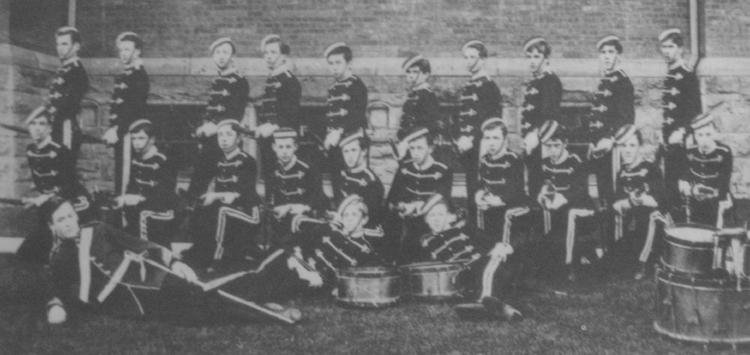
On 12 January 1866 No 11 Company “Upper Canada College” of The Queen’s Own Rifles of Canada (QOR) was formed under the command of Captain Frank C. Draper.

Draper seems like an excellent choice to fill this role as he was both a UCC Old Boy (1844-52) and had been a QOR officer since 1863. In 1874 he would resign his commission and become Toronto’s Chief Constable (i.e. Police Chief).

Creation of Upper Canada College Company of the Queen's Own Rifles of Canada (Gazette)
Creation of Upper Canada College Company of the Queen’s Own Rifles of Canada (Gazette)

The following article is excerpted from “COLBORNE’S LEGACY: Upper Canada College 1829-1979″ by Richard B. Howard

“It is Difficult to Establish a Date on which the College Rifle  Company, alias the Rifle Corps, later the Cadet Battalion, held its first official parade…..

The first hint of any military enthusiasm at UCC is mentioned earlier, when during the 1837 Rebellion, a troop of boys offered their services to the Lieutenant-Governor. …..

Early in Principal Cockburn’s regime, military drill was the subject of much attention in schools in England, Canada, and the United States. Ways were sought to promote what was thought of as a patriotic  spirit. The aim was to foster love of country along with a disposition to defend it, and to develop obedience and discipline. The important habit of prompt obedience could then be carried over into the classroom. By 1865 drill had been introduced into schools in many Ontario centres, including Toronto, London, and Port Hope. The College was probably one of the earliest participants; it is known that in 1863 the older boys paraded weekly under a Major [Henry] Goodwin, a strict disciplinarian but “kind-hearted” and “cheery.”

In 1865 Fenian troubles were creating much unease in Canada, and several Upper Canada College students asked Principal Cockburn’s permission to transform the recently formed cadets into a company of the Queen’s Own Rifles.

In December of that year an unknown number of pupils were enrolled, and in January 1866 the company was attached to the 2nd Battalion, Queen’s Own Rifles.

Thus , Upper Canada College was possibly the second Canadian school to have an “official” cadet corps, following Bishop’s College School in Lennoxville, Quebec, whose corps was organized in 1861.
……………….

The Queen’s Own were called out on March 8, 1866 , and though the College boys were not specifically mentioned, they appeared at every parade and march anyway (they even had their own marching song).

On St. Patrick’s Day the company waited for any trouble arising
out of the parade, but nothing happened . When the Fenians actually struck at Fort Erie on June 1 , the Queen’s Own were ordered out to meet them.  School was dismissed for the day and the College company reported for duty only to find that, by orders of General Napier, they must “…. remain in garrison to guard the armouries and official stores. Some students wanted to “desert” to join the battalion at the front, but evidently no one did.

“They performed the duty which was given them. ” After the raid there were plenty of volunteers in Toronto, and so the College company was released; but, just in case, it was “agreed that should the College bell ring at any time out of class hours, the members of the Company would . . . assemble at the Armoury.” The bell did, in fact, ring once, and the College boys were the first to report to the armoury, but it was a false alarm. A dense crowd gave them three cheers.

It has been thought that the Upper Canada College Rifle Company received “battle honours” for its passive though honourable role in the Raid. Not so. The Queen’s Own Rifles did not receive such honour; neither did the College. However, General Napier did give them honourable mention in his report, and it is true that they were called out for service (along with Bishop’s College School) — apparently the only time in Canadian military history this has happened.

Over thirty years later, the government decided to present medals to those who were engaged on active service in the Fenian Raid: the College Rifle Company, though denied the privilege of fighting, had performed some important functions, and all the members of the company still living received a medal.”

As of October 22, 1886, the Rifle Company officially became a Cadet Corps (#17) affiliated with The Queen’s Own Rifles of Canada. During the First World War, the Cadets’ association with the Queen’s Own had lapsed, and by 1923 two regiments, the Toronto Regiment (now the Royal Regiment of Canada) and QOR were requesting that the Corps affiliate itself with them. After some dispute between the three parties, the College settled on the Queen’s Own again by 1927.

In 1976 the compulsory “Battalion” was disbanded to be replaced the following year by a voluntary Cadet Corps. This lasted until 1988 when it was officially disbanded as of April 15th.

Over most of these 144 years, the connection between UCC and the QOR remained very strong. Many Old Boys went on to serve with the QOR – some even becoming Commanding Officer. Even today, the Regiment values this long and distinguished relationship between one of Canada’s oldest continuously operating schools and Canada’s longest continuously serving infantry regiment.

You can read more:

04271

QOR Band at Casa Loma November 2015

We were very pleased to once again have the Regimental Band and Bugles perform on Saturday November 7th, as part of the QOR Day at Casa Loma 2015.

Check out these videos of their performance (taken by Corporal Justin Dreimanis):

7 November 2015 QOR Day at Casa Loma performance #1

7 November 2015 QOR Day at Casa Loma performance #2

7 November 2015 QOR Day at Casa Loma performance #3

7 November 2015 QOR Day at Casa Loma performance #4

7 November 2015 QOR Day at Casa Loma performance #5

7 November 2015 QOR Day at Casa Loma performance #6

7 November 2015 QOR Day at Casa Loma performance #7

7 November 2015 QOR Day at Casa Loma performance #8

Volunteer Profile: Larry Hicks

Captain (Ret’d) Larry Hicks (in centre above with wife Lee) served for over 40 years with The Queen’s Own Rifles of Canada and was also employed with the Toronto Police Services. Retirement from both gave him time to volunteer at the Regimental Museum and since then he has been photographing literally thousands of artifacts for our collection database, creating images for our exhibits, and capturing museum events. His sense of humour, willingness to pitch in where ever needed, and plethora of QOR memories, make him a much appreciated member of the team!

How did you end up volunteering at the museum?

I was at the annual Officers’ Mess Christmas Luncheon when I struck up a conversation with John Stephens. I knew him socially from past mess functions. He asked me what I was doing since I retired and I replied that I was pursuing hobbies that I never had time for, photography in particular. That’s what retired people do.

He paused for a sec, his expression changed and he smiled. He knew he had me. He needed a photographer at the museum, and I wanted a way to stay involved with the regiment.. And, who doesn’t like castles!

So, for the past 3 years, I’ve been photographing, copying and displaying the many exhibits we have at the museum.

What background do you bring with you that you think helps you contribute in this role?

My last 15 years with the Toronto Police Service were spent as a crime scene Detective. It was a challenging job, and a rewarding way to cap a 37 year police career. My job was to collect evidence at major crime scenes, but I also had to present that evidence in a courtroom and reproduce the scene for judges, juries and the media. TV only shows half the job.

The camera was my main tool and I loved that I was getting paid to practice my hobby.

It was an easy transition to museum photography. Similar product but a different audience, and a lot less stress.

What do you enjoy most about volunteering at the museum?

I have a pleasant time with the people I work with. Only half have a military background, but we all love history and we all care about the regiment. We go to the pub for a pint and a chat after work.

Casa Loma is a cool place. Every time I go there I find something else that fascinates me. The summer concerts. The movie shoots. Christmas music on the Wurlitzer. It’s good that they don’t pay me, sometimes I don’t get much work done.

What aspect or content of the museum are you most passionate about and why?

Take a look at our product. The displays. This website. Facebook. We have over 5,000 photos on Flickr alone. Then look at other museum sites. We put on a good show and were proud of it.

South African Ration tin (lead)

Is there one object in the collection that really excites you or that you think people should know about?

Some people are into uniforms. Others are into weapons. I want to tell the story of the grunt, the guy who put his butt on the line for his country, and what he had to endure.

There is a can of field rations in the South Africa exhibit. Something all soldiers can relate to. It’s a can of mystery meat sealed with lead. LEAD! No wonder they’re all smiling in the old photos.

Why do you think a museum like this is important?

A nasty little word I kept hearing throughout my military career was “restructuring”. Regiments come and go. No one knows what the army will look like in another 155 years, but we can show the world what it looked like 155 years ago.

Would you recommend volunteering to others and if so why?

Absolutely. It’s a way to give back. If not to the regiment, do it for history. And, it’s a good group of people to hang out with.

Update: In February 2018 Larry was presented with the Commanding Officer Certificate of Commendation and a Command Team Coin in recognition of over 800 hours of service to the museum, and to his efforts on behalf of RHQ in photographing regimental events. Sadly Larry passed away 23 March 2018. You can read more of his service on his profile page.


If you’d like to help volunteer at the museum, check out our Volunteer page for information and an application.

32nd Brigade “Rangers Cup” Tournament 2016

The “Rifles” returned to the ice on January 1st to defend their Rangers Cup title in the second annual tournament. Despite not losing any games, they placed third.

Museum volunteer Cpl Justin Dreimanis captured the action with some excellent photographs: