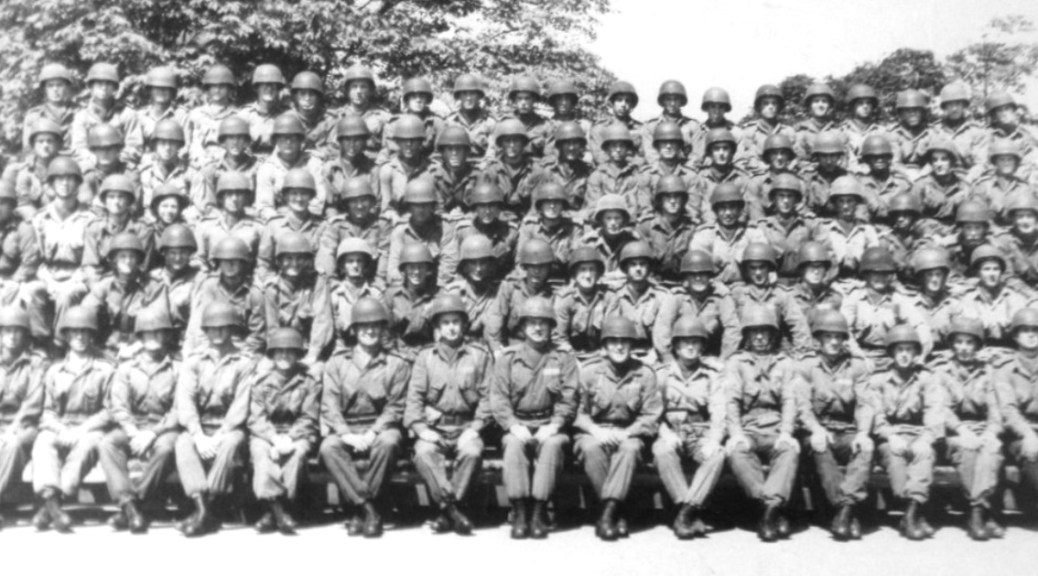
From Summer/Fall 2008 Issue of Powder Horn

(Lieutenant Colonel “Boom” Marsaw, commissioned 2/Lt in The Queen’s Own Rifles, was posted to Korea in 1954 where he commanded the Machine Gun Platoon and a platoon of ROK Army soldiers and later served as Liaison Officer to the ROK Army. He also served in Germany, Cyprus, India, Pakistan, Norway and Alaska. In April 1969, then Maj Marsaw serving with 1 Br Corps, he was recalled to take command of the 1st Battalion QOR of C, serving until it was rebadged as the 3rd Battalion PPCLI. In 1977 LCol Marsaw retired to begin his service as a Baptist pastor.)
When I first met LCol “Wild Bill” Matthews, he was sporting the badge of The Queen’s Own Rifles. He had been awarded not one but two Military Crosses, for bravery during WWII and he proved to be some CO! What an impact he was to have on my life, my career. As I see it, one of the true measures of greatness in this world is the capacity to inspire others to reach for — and achieve — excellence. That’s how Bill influenced me. It was he who launched me on the way to Regimental Command. There is just no doubt about it.
Colonel Bill was no stranger to his officers, especially junior officers. I had only been briefly at my new post before I was ushered into his office. “Where are you from, Boom?” he asked. “London, sir,” I answered. “Hey you’re practically home. (Camp Ipperwash was just an hour’s drive away.) They call this part of the province Western Ontario, don’t they? That’s great because we need some good westerners in this outfit. You’re going to command a platoon in D Company. It is made up of fellows from The Regina Rifles, a fine Regiment. They (and The Queen’s Own) were the only guys in the whole of the Allied D-Day landing force to achieve their objective. They even went beyond and had to be hauled back. They’ve got a great reputation.” He added that, “Oh, by the way we’ve got a track and field meet on this afternoon so you’d better unpack your running shoes. I’m sure the Company will be able to use you.” And they did. That afternoon I won the 100, 220, and 440. All the practice I had keeping out of Mom’s reach really paid off. It didn’t hurt either in the matter of winning the respect of those in my new command. There is something about working for the fastest guy in the Regiment. It was a great beginning for a relationship that lasted a lifetime.
From my earliest days with the Regiment it had always been my aspiration to achieve command. That opportunity came far sooner than I had anticipated when a posting to the British 1st Corps in 1970 was cut short and I was whisked back home to take over the 1st Battalion, The Queen’s Own Rifles of Canada. I was 38 years old and for a moment the youngest Battalion Commander in the Canadian Forces. Immediately after the handover parade, I had the RSM assemble the troops in the mess hall. I don’t remember much of what I said that day, hopefully all the right things, but most significantly I addressed the issue of faith. I realized that there were some who were concerned about “the old Bible thumper” taking command. I acknowledged that fact and suggested that they might be just a little concerned that there would be a church parade every Sunday. I assured them that would not happen. They all cheered. “Every other Sunday,” I said. And they all booed. With that I assured them that I wasn’t there to push my faith down their throats, but I simply hoped to prove that having the likes of me in command would make an encouraging difference.
I knew that I had very big shoes to fill. The Regiment was turning out some really fine leaders. The last two Commanding Officers were nothing short of outstanding and both went on to become Generals. (Kip Kirby and Herb Pitts MC). Not only did I inherit a fine unit, but also some really encouraging operational roles — that of the Canadian Forces Mountain Warfare and Arctic Operations Battalion. The Queen’s Own was Canada’s contribution to Ace Mobile Force Land (AMFL). In practical terms that meant we were assigned to the defence of Norway.
In WWII Norway had very quickly fallen to Hitler’s Germany. AMFL was NATO’s attempt at preventing it from happening again should the Russian war machine start to roll. The Alliance had committed itself to putting a Brigade on the ground in Norway at the first sign of a serious threat by the Warsaw Pact Nations. Canada’s role was to have a Company there in 24 hours and an entire Battle Group in seven days. The Queen’s Own were the major component of the Canadian contribution and I was in command. The overall size of the force was a Brigade Group. The other two Battalions were provided by Britain and Italy, the Germans supplied the Armoured Regiment, each Battalion brought its own Artillery and the Americans added a lot of the bits and pieces that make a force of this size work.
There were about 1200 in my command including a flight of six Huey helicopters. We had enough Skidoos to move one whole company, Armoured Personnel Carriers (M113s) sufficient for another and snowshoes for all. The choppers could do a pretty good job of moving a Rifle Company in two lifts and the better part of a battery of light guns in one. This entire Force was airlifted to Norway by the RCAF Transport Command.
It is important to realize that the Norwegian venture was only one of the many things an Infantry Battalion may face in the passing year. Life in a Regiment is an unending chain of adventures. For instance, the unit already knew it was going to Cyprus for a six-month tour of duty the following year. Preparation for that was already in the back of our minds. But, between now and then it was train, train, train.
THE END OF AN ERA
On April 26th, 1970, we celebrated our Regiment’s 110th birthday and on the next, paraded as the Third Battalion of the Princess Patricia’s Canadian Light Infantry (PPCLI), The Princess Pats. The cartoon on the local newspaper’s editorial page pictured the Officers’Mess bar with a collection of its distraught members. It was captioned, “Cut to ribbons…Wiped out…Totally annihilated…By our own side.” The only consolation was that we were exchanging membership in the most decorated Regiment in Canadian history for membership in another wonderfully storied Unit.
________________________________________________________
If you’d like to support the Regimental Museum and Archive with our goal of “Telling Their Stories,” you can find more information on how you can make a sustaining or one-time financial donation on our Donation page.




 The Queen's Own Rifles of Canada Regimental Museum and Archive