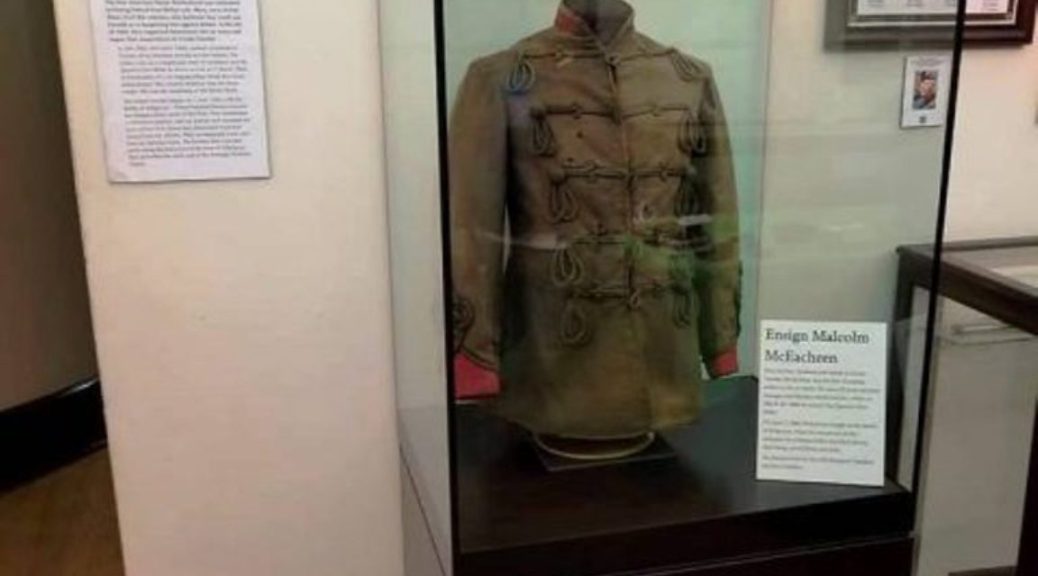
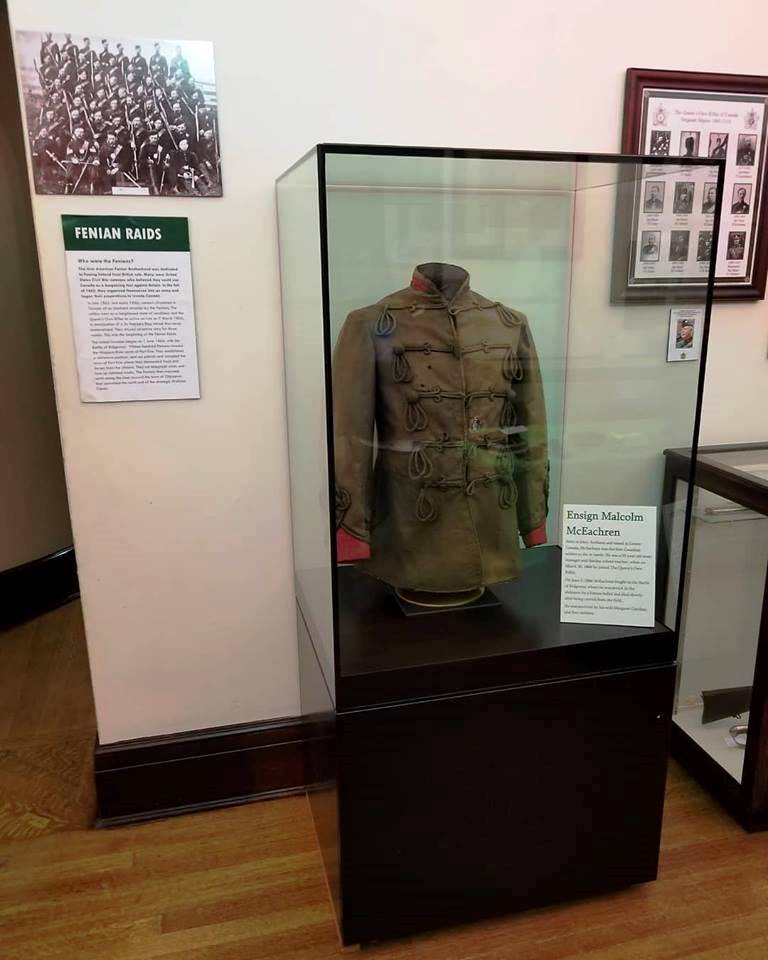
The preservation and professional conservation of the rifle-green uniform tunic worn by Ensign Malcolm McEachren represents a vital effort by The Queen’s Own Rifles of Canada Regimental Museum and Archives to safeguard an artifact of national historical significance. Commissioned just two months prior, McEachren was shot through the upper abdomen during the opening minutes of the Battle of Ridgeway on June 2, 1866, making him the first battlefield casualty of the regiment and what is considered the first combat death of the modern Canadian Army.
About Malcolm McEachren
Before marching off to face the Fenian raiders, Ensign Malcolm McEachren lived a modest, community-focused life in Toronto as a working-class family man and civic volunteer. Records preserved by The Queen’s Own Rifles of Canada Museum paint a vivid picture of his daily life in the city up until June 1866.
Profession and Income
McEachren supported his family by working as a dry goods store manager in downtown Toronto.
-
- Salary: He earned an annual salary of $900, which was a respectable middle-class income for the mid-19th century.
- Housing: His employment package included a common perk of the era: free rent for his family in a residential apartment situated directly above the store premises.
Family Life
At home, McEachren was the primary provider for a large, young family. He was married to Margaret Caroline McEachren, who was 31 years old at the time of his deployment. Together, the couple had five children under the age of 13:
-
- Two sons, aged 8 and 12.
- Three daughters, aged 2, 4, and 6.
Knowing the inherent risks of joining an active militia regiment, McEachren was organized enough to purchase a $250 life insurance policy to protect his family. While a small amount (equivalent to roughly $6,600 in modern value), it reflected his forward-thinking nature, given his limited financial means.
Faith and Community Service
Originally raised in the Presbyterian faith, McEachren underwent a personal religious transition shortly before his death. He converted and joined the Wesleyan Methodist Church, where he quickly immersed himself in the congregation by serving as a dedicated Sunday school teacher.
Military Enlistment
Motivated by a strong desire to serve his local community during a period of cross-border political tension, McEachren joined the local volunteer militia. He was officially gazetted as an Ensign on March 30, 1866, joining No. 5 Company of the Queen’s Own Rifles. Tragically, he would wear his new officer uniform for just over two months before he was killed. Following his death at Ridgeway, McEachren’s body was returned to Toronto, where he was laid to rest. Today, his final resting place is marked by a rededicated headstone in the historical Toronto Necropolis cemetery in the city’s Cabbagetown neighbourhood.
The Preservation Strategy: “Project McEachren”
Because the tunic is the most historically significant artifact in the regimental museum’s collection at Casa Loma, the museum initiated a multi-phase preservation plan to halt decades of degradation caused by light, pests, and previous amateur alterations.
-
- Phase 1: Environmental Stabilization (2018) – The museum first addressed atmospheric deterioration by purchasing a custom, museum-quality display case featuring frameless UV-filtering glass, an airtight compartment, and a desiccant tray to permanently lock in safe humidity levels.
- Phase 2: Upgrading the Mount – The tunic was carefully transferred from its old wooden mannequin to a museum-grade synthetic mount. This step was critical because historical wood off-gasses harmful chemicals that rapidly break down organic textiles within a sealed environment.
- Phase 3: Expert Textile Conservation (2026) – The final stage involved hands-on restoration. In early 2026, the tunic was hand-delivered to CRC Conservation/Restoration, an accredited specialty firm near Quebec City, to undergo a meticulous four-month stabilization process ahead of the 160th anniversary of the battle.
Conservation Challenges Addressed
The textile conservators faced several unique challenges due to the uniform’s active history and 160 years of exposure:
-
- Reversing Former Interventions: A prior handler had stitched white thread around the historic entry wound and written “Bullet Hole” directly onto the fabric with a white china marker. Conservators worked to safely mitigate these non-original markings without disturbing the surrounding wool fibres.
- Structural Losses: The treatment stabilized Areas of the tunic that had suffered from severe ultraviolet (UV) fading, textile loss from insect damage, and missing sections of the delicate black braiding and buttons.
- Lining Restoration: The team assessed the uniform’s interior liner—which was previously determined to be an inaccurate, unoriginal addition—to ensure a structurally supportive and historically appropriate interior foundation.
The completed project ensures that this tangible piece of Canada’s military birth—complete with its visible battle damage—remains preserved for future generations.
Funding the Conservation Effort
The significant expense of employing specialized, accredited textile conservators means that protecting this irreplaceable piece of Canadian history requires substantial community support. Because the delicate structural stabilization, removal of non-original markings, and precision historical restoration required such highly specialized expertise, the overall cost of the project has been significant. To date, funding has been provided through the Queen’s Own Rifles of Canada Trust Fund, a registered Canadian charity.
However, the financial needs of the project are not yet completely met. The Trust still requires approximately $6,000 to fully fund the remaining costs of this vital preservation work and push the project over the finish line.
How You Can Help
The museum relies on the generosity of the Regimental family, history enthusiasts and the public to bridge this final funding gap. Contributions of any size directly help safeguard Ensign McEachren’s tunic for future generations.
- Where to Donate: Supporters can make a secure contribution directly through the official QOR Museum Donate Page.
- Tax Receipts: Online donations are processed securely through CanadaHelps, and all contributions are eligible for immediate Canadian charitable tax receipts.
- Giving Options: The platform allows you to make a one-time payment, set up a monthly donation, or even make a tribute donation in memory of a loved one.
We extend our deepest gratitude to the generous donors who have already stepped forward to support this vital preservation effort; your contributions have been instrumental in successfully stabilizing this priceless artifact of Canadian military heritage and ensuring it remains preserved for future generations!
Photographs taken post-conservation work.




 The Queen's Own Rifles of Canada Regimental Museum and Archive