
Our archive has plenty of Christmas cards from the Regiment and the First World War battalions we perpetuate.
What better time of year to share them than now. Merry Christmas and a Happy New Year!
Our archive has plenty of Christmas cards from the Regiment and the First World War battalions we perpetuate.
What better time of year to share them than now. Merry Christmas and a Happy New Year!
Twenty-five Canadian soldiers were executed during the First World War: twenty-two for desertion, one for cowardice, and two for murder.
In 2001, the Canadian government added the names of those executed for desertion and cowardice during the war to the Book of Remembrance at Parliament Hill. (See full speech by the Minister of Veteran Affairs below.)
In 2006, the British parliament granted an official pardon to all soldiers of the British and Dominion forces.
Two executed soldiers served with the 3rd Battalion, Canadian Expeditionary Force which The Queen’s Own Rifles of Canada perpetuates.
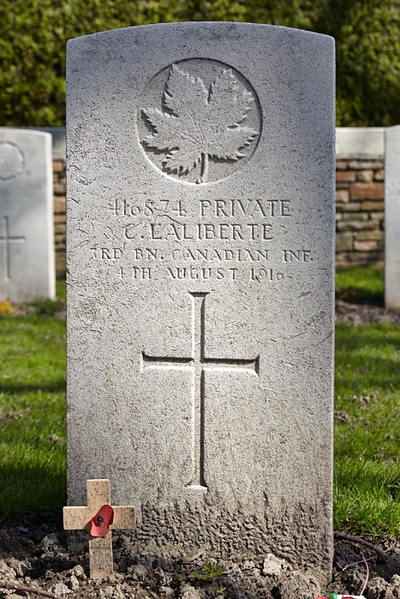
Côme Laliberté was born on 24 March 1893 in Lotbinière Quebec, the son of Ludger Laliberté (deceased in 1907) and Eugénie Hamel, of Montréal, Québec.
He served with the 22e Battalion (service number 61703) from October 24, 1914, to March 3, 1915, and was released due to his conduct.
Three days later in March, he re-enlisted in the 41st Battalion (stating being born in Lotbinière in 1893), travelling with them to England in June 1915.
Before the end of 1915, Laliberté already had several entries on his conduct sheet.
| Date | Offence | Punishment |
|---|---|---|
| 29 June 1915 | Drunkenness | Fined 2 days’ pay |
| 5 August 1915 | Absent Without Leave (AWOL) | Fined 2 days’ pay |
| 10 September 1915 | Out of barracks with a pass and improperly dressed | 7 days Field Punishment No. 1 |
On moving up to the trenches during the Summer of 1916, as part of the 3rd Battalion’s contribution to the battles around Mount Sorrel, Laliberté left the ranks and refused to go forward. He was tried for desertion, found guilty and sentenced to death by shooting.
On 4 August 1916, Laliberté (aged 23) was executed by firing squad. His remains are now located in Poperinghe New Military Cemetery, Plot II, Row H, Grave 3.
Pte. Edward James Reynolds

Edward James Reynolds was born on 2 January 1896 in Toronto. In April 1915, Reynolds enlisted in the 35th Battalion. By November 1915, Reynolds was a member of the 3rd Battalion in the line near Ploegsteert.
On 25 July 1916, the Germans exploded a mine under a portion of the front line called “The Bluff”. The 3rd Battalion was ordered forward to plug the resulting gap in the front line. However, Reynolds fell out from his platoon only to be found 2 days later at his battalion’s transport lines. Reynolds claimed that he had been ordered back and got lost. This excuse was accepted.
During the following night (26 July 1916), Reynolds was ordered to accompany a ration party up to the front line. Again Reynolds fell out and went back to his battalion’s transport lines. This time Reynolds was arrested and charged with desertion. He was found guilty by a court-martial and sentenced to death.
At 05:27 on 23 August 1916, Reynolds (aged 20) was executed by firing squad. His remains are now located in Longuenesse Souvenir Cemetery, Plot IV, Row A, Grave 39.
It is of interest that both the Toronto Star and the Toronto Telegram reported at the time that Reynolds had been killed in action.
Mr. Speaker, hon. colleagues, I rise in the Chamber to speak about the First World War and the fate of some Canadian soldiers, a fate that has been essentially forgotten in the pages of history.
For the young nation of Canada, the promise and optimism that infused the dawning 20th century was abruptly cut short by the First World War. No one anticipated such carnage, or that we would soon be sending young citizens into a war that would see 65 million people from 30 nations take up arms, where 10 million people would lose their lives and 29 million more would be wounded, captured or missing.
Never before had there been such a war, neither in the number of lives taken, nor in the manner of their taking. New weapons would turn fields of battle into slaughter grounds, while the rigours of life in the trenches would kill many of those who escaped bullet or bayonet.
This “war to end all wars” challenged our small country of 8 million to its limits. Almost 650,000 served in the Canadian Forces in the Great War. Over 68,000—more than one in ten who fought—did not return. Total casualties amounted to more than one third of those who were in uniform. Thousands came home broken in body, mind, and spirit.
The service of Canadians in uniform was as remarkable as it was distinguished. History records their sacrifice in places whose names resonate even to the present day. Battle names such as Ypres, The Somme, Vimy Ridge, Passchendaele and Amiens.
Those who lived then and the historians who followed would declare that Canada came of age because of its actions and ingenuity during World War I.
But where history speaks of national sacrifice and achievement, it is too often silent on the individual stories of triumph, tragedy and terror of those who fought and died on the terrible killing fields of France and Belgium.
Those who went to war at the request of their nation could not know the fate that lay in store for them. This was a war of such overwhelming sound, fury and unrelenting horror that few combatants could remain unaffected.
For the majority of the Canadians who took up arms and paid the ultimate sacrifice, we know little of their final moments, except that they died in defence of freedom.
Today I want to talk about 23 of our fallen. I would like to tell the House about these soldiers because these circumstances were quite extraordinary. These 23 soldiers of the Canadian Expeditionary Force occupy an unusual position in our military history. They were lawfully executed for military offences such as desertion and, in one case, cowardice.
We can revisit the past but we cannot recreate it. We cannot relive those awful years of a nation at peril in total war, and the culture of that time is subsequently too distant for us to comprehend fully.
We can, however, do something in the present, in a solemn way, aware now, better than before, that people may lose control of their emotions, have a breakdown for reasons over which they have little control. For some it would have been known today perhaps as post-traumatic stress disorder.
To give these 23 soldiers a dignity that is their due and to provide a closure for their families, as the Minister of Veterans Affairs on behalf of the Government of Canada, I wish to express my deep sorrow at their loss of life, not because of what they did or did not do but because they too lie in foreign fields where poppies blow amid the crosses row on row.
While they came from different regions of Canada, they all volunteered to serve their country in its citizen-army, and that service and the hardships they endured prior to their offences will be recorded and unremembered no more.
Allow me to enter their names into the record of the House: Quartermaster Sergeant William Alexander, Bombadier Frederick Arnold, Private Fortunat Auger, Private Harold Carter, Private Gustave Comte, Private Arthur Dagesse, Private Leopold Délisle, Private Edward Fairburn, Private Stephen Fowles, Private John Higgins, Private Henry Kerr, Private Joseph La Lalancette, Private Come Laliberté, Private W. Norman Ling, Private Harold Lodge, Private Thomas Moles, Private Eugene Perry, Private Edward Reynolds, Private John Roberts, Private Dimitro Sinizki, Private Charles Welsh, Private James Wilson and Private Elsworth Young.
We remember those who have been largely forgotten. For over 80 years, they have laid side by side with their fallen comrades in the cemeteries of France and Belgium.
I am announcing today in the Chamber that the names of these 23 volunteers will be entered into The First World War Book of Remembrance along with those of their colleagues. Adding the names of these citizen soldiers to the pages of this sacred book, which lies in the Memorial Chamber not far from here, will be a fair and just testament to their service, their sacrifice and our gratitude forevermore.
Lest we forget.
With info from Wikipedia, the Canadian War Museum and OpenParliament.ca
“Telling Our Stories” is the theme for our Regimental Museum and Archive’s next five-year Strategic Plan which was recently approved by the Museum’s Board of Governors. It overarches the five strategic directions we’ve identified:
These extend directions which were identified in our 2017-2022 Plan. You can read more about our Mandate, Mission, Vision and the newest plan (and how it was developed) here.
Telling our stories isn’t new for us. Since the museum’s inception, we’ve been telling the stories of the Regiment and the Riflemen who have served in it. Here are some of the ways:
Moving forward, we plan to expand on these efforts and identify new ones.

All of our dedicated museum team are volunteers. First, we have a great museum Board of Governors, that meets periodically to provide governance oversight of the museum activity and financing.
The major operational work is done with a team of volunteers under Shaun’s direction that includes Assistant Curator Graham Humphrey, Collections Officer Briahna Bernard, and Photography Officer Anne Frazer and works at the museum most Thursday evenings cataloging, photographing and properly storing new donations, updating exhibits, clearing cabinets, and a raft of other tasks that always need doing!
We receive a small annual grant of $1,500 from the Ontario Ministry of Tourism, Culture and Sport however the remainder of our $25-30K annual budget is provided by The Queen’s Own Rifles of Canada Trust Fund.
Actual expenses vary year to year but generally include upgrades to exhibits, labels, interpretive panels and creation of pop-up banners, website and collection management database costs, association memberships with the Ontario and Canadian Museum associations and the Organization of Military Museums in Canada (which provide training and networking opportunities), archival grade storages materials from acid-free folders and boxes to mylar clothing bags and other supplies, third party conservation work, occasional purchases of important objects, general office supplies, and annual volunteer recognition reception.
In 2024 our exhibit upgrades include raising 4 four exhibit cabinets and adding LED lighting which is the last of a three-year project. The final year’s cost is estimated at $8,000.
The Trust fund receives some grants and foundation funding but the majority of income is from individual donations which are of course eligible for a charitable tax receipt.
Please consider making a donation to the QOR Trust Fund and directing it to the Museum Fund. You can mail a cheque to the Trust or donate online through a recurring donation, a one-time donation, or even by donating securities or certain cryptocurrencies. You can also make a Tribute donation in honour or memory of someone. All these options are available through the Trust’s CanadaHelps page and explanations, addresses and links to donate (which are preset to the Museum Fund!) are available on our Donate page.
Please help us “Tell Our Stories” and become part of our team by making a financial donation to support our museum.
From the Summer/Fall 2008 Issue of the Powder Horn

By Colonel Neville (Robbie) Robinson CD
Having spent three years at the Royal Canadian School of Infantry in Camp Borden wearing RCIC badges, I was glad to be interviewed by Col. Peter Bingham as to my choice of “rebadging” among the Canadian Guards, the Black Watch (RHR) and The Queen’s Own Rifles of Canada. Having started my military career in 1941 in the King’s Royal Rifle Corps (60th Rifles), I naturally opted for The Queen’s Own, which turned out to be the best choice.
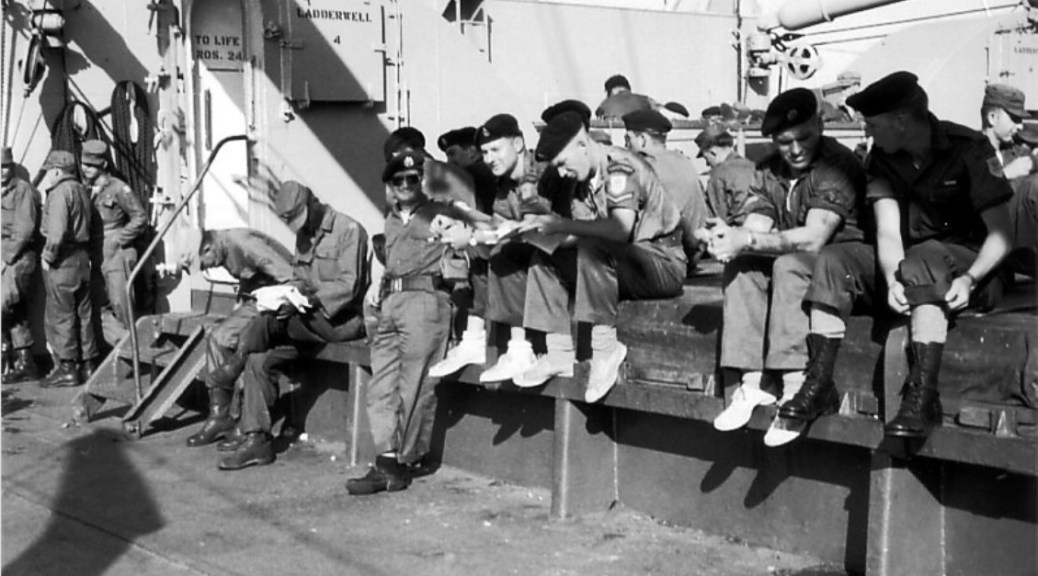
Soon after getting myself back into “Green and Black” I was posted to Korea as a replacement for Maurice Whiting, in 1954. The posting was for three months as 2QOR of C was rotating home in the spring. On arrival at the battalion, I was posted as 2 I/C D Coy. which was a large (170) company containing all the troops taking their release on return to Canada. For some reason, it was known as the “Jaggy Company’” by the other rifle and support companies. It was commanded by Maj. Larry Harrington who used hearing aids for which he had trouble obtaining batteries and was constrained to save them by switching them off whenever possible! Every morning was OC’s Orders where justice was dispensed.
As the battalion reserve, we manned the defensive positions in the Kansas Line during the numerous “Scram” Exercises, and did a large amount of repair work to the bunkers and slit trenches. Just as the Battalion was getting prepared to leave for Canada I was posted into the HQ 1 COMWEL Division to replace Capt. Erwin Fleury as Staff Captain (Canadian) and OC to KATCOM (Korean Army Attached to Commonwealth Division) Defence Coy, a standard three-platoon rifle company.
The staff work was the standard stuff and I spent a lot of time with piles of paper, one of which was 125 copies of the nominal roll of 2QOR to get the battalion aboard the troopship at Inchon. I went down to see them off and say goodbye to friends like Ron “Awful” Werry, Charlie Belzile and Peter Nixon. The tragic death of Lt. Bill Vipond was on my desk and that Board of Inquiry took a while to get to Ottawa, going back and forth. Years later, in the 90s, my wife Brenda and I visited Pusan and laid poppies on the graves of the three 2QOR casualties in the impressive UN cemetery on the hillside overlooking Pusan harbour.
The three months in Korea was extended twice to 13 months as the powers that be vacillated about who was leaving and who was staying. Before I left I was awarded a Korean medal by the Korean Army Chief of Staff and it now hangs in the QOR museum at Casa Loma as, in those days, we were not authorized to wear foreign decorations for peacekeeping duties.
_______________________________________________________
If you’d like to support the Regimental Museum and Archive with our goal of “Telling Their Stories,” you can find more information on how you can make a sustaining or one-time financial donation on our Donation page.
Above: Claire Mitchell holds a photo of Canadian soldiers who participated in the tests in the Nevada desert. At the centre of the photo is her husband, Peter Mitchell, who died in 2008 of cancer.
From the Summer/Fall 2008 issue of the Powder Horn.

By Lieutenant Colonel Grahame Baskerville CD
The QOR has now had an Airborne tasking for almost 25 years and is the only Militia unit able to retain this tasking. Many Regular Force QOR members qualified as parachutists and served with distinction with the Airborne Regiment. Also within the Regular Force the QOR had members who had served in WW II with the 1st Cdn Parachute Battalion as well as British Airborne Forces. As a matter of Regimental historical detail, it would be interesting to determine who was the first person wearing a QOR hat badge to qualify as a parachutist. Was it someone during WW II or was it later?
One of the earliest Regular Army paratroopers was MWO (Ret) Pete Mitchell. He enlisted (at age 17) in 1944 with the 2nd (Reserve) Bn QOR in Toronto. He joined the Regular Army in 1951 and went to Germany with the 1st Cdn Rifle Bn (QOR Coy) in 27 Bde. Sgt Mitchell, along with Sgt Fred Swan (also QOR) returned to Canada in 1952 and went to Rivers, Manitoba where they qualified as parachutists on Basic Para Course 164. They remained at Rivers as Para Instructors. Sgt Swan later re-badged to PPCLI to continue his parachuting and Pete Mitchell returned to 1 BN QOR in 1954 where he served in Calgary and Germany. He later rebadged to PPCLI and retired in 1980. Hearsay evidence indicates that these two were the first to return to Canada for parachutist training. As Mitchell is ahead of Swan alphabetically, it is highly possible that Pete Mitchell may be the first QOR person to qualify as a parachutist. Are there others?
[MUSEUM NOTE: In the summer of 1926, Colonel James (Jim) G. K. Strathy, OBE, OStJ, CD, ED (then a Lieutenant with The Queen’s Own Rifles) was training as a pilot at CFB Borden and was required to complete a parachute jump which he did – with much success obviously! Whether that means he was a “qualified parachutist” could be debatable however it seems extremely likely he was the first QOR to actually make a parachute jump.]
NOTE: In 1957 the 1st Bn QOR was selected to provide a platoon for nuclear weapons training at the United States Atomic Energy Commission Test site at Yucca Flats, Nevada. MWO Mitchell was selected to be the Platoon Sgt for this task which involved 40 members of the 1st Bn QOR working with US Army units and being subjected to six atomic blasts over a two-month period with no protective clothing or shelter other than slit trenches. They were assured repeatedly that they had not been exposed to harmful levels of radiation and they accepted these assurances in good faith.
Like many of the others, Pete Mitchell developed cancer in later life and died in early summer, after much physical distress. The Canadian Atomic Veterans Association continues to pursue the Canadian government for compensation – so far without fair results.
[MUSEUM NOTE: in September 2008, the Canadian Government announced an ex-gratia payment of $24,000 per person for those that had had nuclear exposure. The Canadian War Museum now includes the story of the Canadian atomic veterans.]
________________________________________________________
If you’d like to support the Regimental Museum and Archive with our goal of “Telling Their Stories,” you can find more information on how you can make a sustaining or one-time financial donation on our Donation page.
Reprinted from the Summer/Fall 2008 issue of the Powder Horn.
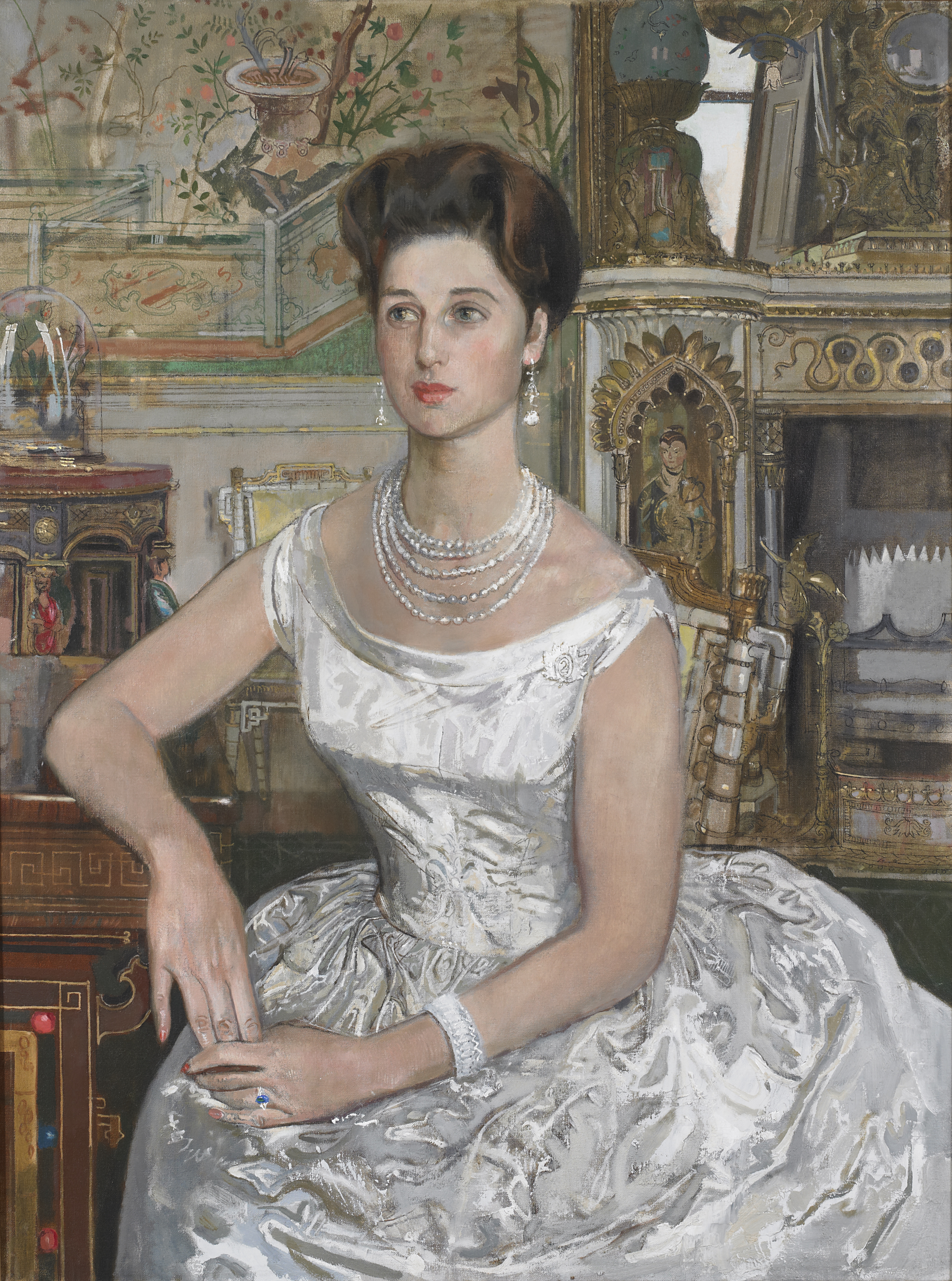
The first notification, on the letterhead of Kensington Palace, W.8 (London), marked “Private and Confidential” was to Col James G.K. Strathy, OBE, ED, in March 1963. From Sir Philip Hay KCVO, the Private Secretary to HRH Princess Alexandra, Colonel-in-Chief of The Queen’s Own Rifles, it began as follows:
“My Dear Jim. Princess Alexandra has asked me to write to you, as Colonel of the Queen’s Own Rifles of Canada and to convey to you her ideas as to how her Regiments may best be represented at her wedding at Westminster Abbey on Wednesday, 24th April.
“I think I should make it clear at the outset that, while the Princess is most anxious that the maximum number of officers and other ranks from all her Regiments should take some part at her wedding, it is very well understood by Her Royal Highness that it may prove difficult, or indeed impossible for The Queen’sOwn Rifles of Canada to meet the various requirements set out below, which I repeat are only tentative suggestions and should by no means be interpreted as royal commands.
“In the case of your Regiment, the Princess is aware of the very special difficulties which are bound to arise because the whole of the Regiment is stationed outside the United Kingdom.”
The letter continued, providing details for those who might be invited, including senior officers as official representatives, plus other members of The Queen’s Own, some who would act as ushers and others to form part of an escort party lining the entranceway to Westminster Abbey’s front doors, through which the wedding party would enter and exit.
As was his custom, Col Strathy acted with swift decisiveness, nominating the Commanding Officers of the Regiment’s three battalions, along with their wives, to be The Queen’s Own’s senior representatives, along with four junior officers and two NCOs from the 1st Bn serving in Germany, to round out the official party, which would also include Col and Mrs. Strathy.
This resulted in LCol H.C.F. Elliot CD, CO of the 1st Bn stationed in Fort McLeod, at (Dellinghoffen) Germany, his wife Bessie; 2nd Bn CO LCol D.N. Osborne CD, and his wife Phyllis stationed at Currie Barracks, Calgary, and 3rd Bn CO LCol Glenn McIver CD, and his wife Jean, in Toronto, going into frantic overdrive to prepare themselves for this occasion of a lifetime for members of The Queen’sOwn, the marriage of their Colonel-in-Chief to the Hon. Angus Ogilvy, London born son of the twelfth Earl of Airlie, a Scot. The last survivor of the four senior officers present at the wedding was LCol McIver, who died in March 2008, and who was survived by his wife, who had written an interesting account of their trip to attend the wedding. The following is an extract from a lengthy hand-written document which Jean McIver had taken the time to compose as she and her husband took a short pre-wedding vacation before flying into London and “touching down on Sat. Apr 20/63 at 12:30 a.m. after a holiday of eight days on the continent.”
She wrote, following a couple of days of sightseeing in London, that “Tuesday was the day of days. We were picked up by Canadian Army cars and driven to Kensington Palace, the home of our Princess. We were met at the door by an aide to Sir Philip Hay, who is secretary to Princess Marina (Princess Alexandra’s mother) and Princess Alexandra. We entered the Dining Room and then Princess Marina’s Drawing Room. These rooms impressed me very much, not because of their grandeur, for they were not pretentious but very, very home-like, just like any other bride’s the day before the wedding, with unopened gifts in the Dining Room.
“Lady Hamilton, the Princess’Lady-in-Waiting made us all welcome and talked to each person present while we waited and drinks and canapés were served to us. There were about 20 people present, eight QOR people plus representatives from Singapore, Australia and New Zealand. The Princess was scheduled to stay for 15 minutes but stayed for 45. She arrived wearing a very chic green suit with her lovely hair done in a French roll. She was very charming and far prettier than her photos show. Angus was with her and is a very delightful person with a tremendous sense of humour and ready wit.
“When the Princess first entered the room we were presented to her singly. She spoke to us about Toronto. She has a great knowledge of the Regiment and its battalions. They both expressed delight at our coming so far and thanked us profusely. She expressed her desire to see us in the near future in Canada. We actually had the opportunity to speak to them three times for when the time came to leave they said goodbye to each one individually.
“An amusing incident occurred when Alexandra had finished saying goodbye to us. She proceeded to the next couple and walked behind us so she and Angus could get by easily. Glen moved me in front of him. This was very close to the centre of the floor and, at this point, Angus appeared and there we were alone in the centre of the room. He took my hand like one would in a French Minuet and said “Shall we dance this one alone?” And so our goodbyes ended with a laugh from all.
“London was all agog over the wedding and a great deal of fuss was made of it by the Press and Radio or TV. The day of the wedding LCol and Mrs Osborne and ourselves made quite an impression on the people in the lobby of the hotel when we came down and got into our chauffeur-driven Canadian cars.
“Westminster was a wonderful sight. The beauty of the Old Church with all of its lovely architecture cannot help but to impress us. We were ushered to our seats and were in plenty of time to see the arrival of all the dignitaries, the splendour and colour of the costumes of people from other countries as well as the beautiful fashions of the British Commonwealth people. Our spot in the Abbey was the Poet’s Corner (under Keats and Milton and on top of Hardy). This was one time when I had a desire to be seven feet tall to be able to see the whole of the Processional Aisle.
“The Abbey was equipped with closed circuit TV so it was possible to see the Royal Family and guests arriving at the Abbey and walking down the aisle. The TV showed the Princess leaving the Palace in her beautiful gown with her brother and at various points along the route. We saw the Queen, Prince Philip and Charles arrive and be received and the darling little bridesmaids and pages, who were a little impatient to be on their way, and Princess Anne trying to keep them in order. Princess Margaret smiling and happy with Anthony Armstrong Jones and Angus and the best man as they waited also.
“As Alexandra entered the Abbey there was a hush as all strained to catch a glimpse of the radiant and beautiful bride, a fairytale Princess, stately and regal, her magnolia gown so simple in design yet magnificent. The train, held by a diamond tiara and made of lace, was a true work of art. The details of the gowns of the wedding party are by now familiar to most people through press and TV coverage, although nothing can capture the excitement and grandeur of actually being there.”
_______________________________________________________
If you’d like to support the Regimental Museum and Archive with our goal of “Telling Their Stories,” you can find more information on how you can make a sustaining or one-time financial donation on our Donation page.





 The Queen's Own Rifles of Canada Regimental Museum and Archive