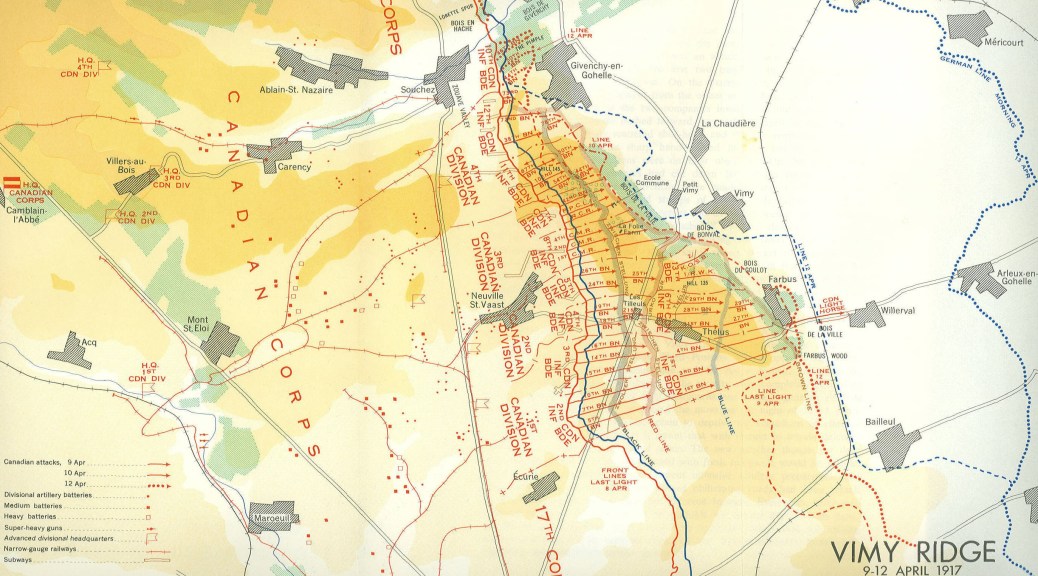
During one of the most notable battles fought by Canadians during the First World War, the 3rd Battalion, Canadian Expeditionary Force’s objective during the Battle for Vimy Ridge was to capture the Farbus Woods. From the 1960 Regimental History by Lieutenant Colonel W.T. Barnard:
“On 9 April 1917, the famous Vimy Ridge attack took place. This had been planned and practised most carefully. The 3rd Battalion was on the extreme right of the Canadian Corps and so had the longest distance to go. Nevertheless, it took its final objective on time and captured four guns, the first to be taken by Canadians. The casualties were, for World War I, light – 6 officers and 179 men. During the next few days, the gains were extended to the flat country east of the ridge.”
Below are the 3rd Battalion’s war diary entries for April 8, 9, 10 and 11, followed by a list of casualties for all of April 9 and 10, 1917.
April 8th 1917
9.00 pm: The Colonel and Adjutant arrived at Headquarters in Battalion Assembly Area A.15.d.1½.1½.
9.13 pm: Battalion commenced to move from Brigade Assembly Area at 10-minute intervals between Companies. – Units, “A”, “B”, “C”, “D”.
9.50 pm: Lieut. RUSHER, 117th Battery, 25th Brigade, R.F.A., who is our artillery liaison officer, reported at Battalion Headquarters and was instructed to report again at ZERO.
11.15 pm: 10th Canadian Battalion passing up ELBE Trench to take up position in “jumping off trench”.
11.22 pm: 7th Canadian Battalion passing up ELBE Trench past Battalion Headquarters.
11.27 pm: Signallers reported in position at Battalion Assembly Area.
11.27 pm: Brigade put in wire in the morning, but we have been out of touch ever since.
11.34 pm: Lieut. CLIFTON reported at Battalion Headquarters. Enemy shelled his section in vicinity of ARIANE DUMP, he had no casualties.
11.47 pm: Captain A.B. McCORMICK reported at Battalion Headquarters. Scouts in position, no casualties.
11.50 pm: Lieut. W.B. WOODS reported at Battalion Headquarters. Machine Gun Section in position.
11.56 pm: Received message from “D” Company, reporting all correct.
April 9th 1917
12.20 am: Lieut. GLASSFORD’s party of Stretcher Bearers reported all correct.
12.26 am: “B” Company reported all correct at midnight.
1.pm am: “A” and “C” Companies reported all correct, in position. Code word “ROGERS: sent to Brigade, timed 1.05 am. Lieut. R. BAILEY reported at Battalion Headquarters wounded in the leg, does not wish to go out but was ordered to do so.
1.07 am: Referring to entry of 11.27 pm, Brigade wire still out, there is a line, however running to the Companies which is O.K.
1.25 am: Captain R.E. PICARD (O.C. Composite Company) reported at Battalion Headquarters, reports laying of bridges not yet completed.
1.40 am: Lieut. H.K. CLIFTON returned from 2nd Brigade Signal Office, they are agreeable to take any of our messages. Our wire with Brigade still out.
2.05 am: Lieut. K.E. MICKLEBOROUGH reported at Battalion Headquarters, rather badly shaken up and slightly gassed. Returned to his company.
2.20 am: Captain PEARCE reports his two Vickers guns which are attached to us, are behind ELBE, on right of SAPPERS DUGOUTS.
3.40 am: Synchronized time received from Brigade.
3.50 am: Lieut. GARRETT reports bridging complete.
4.10 am: Lieut. NEILLONS and 8 sappers of 1st Field Company, C.E., reported at Battalion Headquarters. Their duty is to construct with “A” and “B” Companies as working parties, the Main Line of Resistance.
5.30 am: Attack commences, the volume of our artillery fire is wonderful.
5.40 am: Word received from Companies, everything O.K.
6.12 am: Attack seems to be progressing favourably, no enemy artillery fire in our area.
6.15 am: Can receive very little information from Captain McCORMICK who has established an O.P. in Fort “A”, with telephone communication with us, as the noise from our artillery is so loud that one cannot hear over the phone, however the attack seems to be going favourably.
6.22 am: 4 prisoners from 1st Bavarian Regiment passed our Headquarters and on being interrogated by Lieut. PATTERSON, state that the SWISCHEN STELLUNG is all broken in by our guns.
6.29 am: Captain A.B. McCORMICK returned from Fort “A” and reports all going well.
6.46 am: About 100 prisoners carrying stretchers are seen passing Headquarters.
6.56 am: Captain A.B. McCORMICK left for the RED Objective with 2 scouts, 5 signallers and 4 runners to establish Headquarters, as I do not think it wise to move until some definite Headquarters is ready for me. The scouts are being sent back as guides.
7.03 am: Major H.S. COOPER sent over to Battalion Assembly Area.
7.04 am: Lieut. RUSHER, R.F.A., reported for duty.
7.05 am: Brigade wire still out.
7.10 am: Word received from 2 Brigade that information received they know they have captured BLACK objective and are advancing on RED.
7.30 am: Battalion commenced to move forward in artillery formation to RED objective. All units were seen to clear the crest (old British Front Line) by 7.56 am. From the time the Battalion left the Brigade Assembly Area until they crossed over all front line, I do not think they had more than 12 casualties.
7.30 am: Captain McCORMICK arrived at Advanced Headquarters A.17.a.9.5.
7.32 am: 4th Canadian Battalion also observed moving forward on our left.
7.57 am: 2nd Canadian Battalion moved across from SUNKEN Road to vicinity of old British front line.
8.25 am: Enemy barrage slacking on old British front line he is evidently shortening his barrage to BLACK objective.
8.45 am: Battalion Headquarters moved from A.15.d.1½ .1½.
8.55 am: Enemy barrage very heavy on our old front line, he using a great many gas shells which are very irritating.
9.33 am: Arrived at Battalion Headquarters A.17.a.9.5., found all Companies O.K. and intact 120 yards in rear of RED Objective. Total casualties to date Major W.E. CURRY O.C. “A” Company, killed and 10 O.R. wounded. We are in touch with both our flanks, 4th Battalion on left and 1st Battalion on right.
10.03 am: Highlanders seen advancing on our right.
10.05 am: Our men commencing to advance on BLUE objective.
10.07 am: Lieut. NELLONS, Engineer officer, reported at Battalion Headquarters.
10.09 am: Captain McCORMICK left Battalion Headquarters with laddered line, to establish O.P. east of RED objective.
10.24 am: Enemy shelling vicinity of Battalion Headquarters and RED Objective very heavily. 2nd Canadian Division reported to be moving through THELUS by Captain McCORMICK.
10.32 am: Message received from Major REID that it is impossible to advance on account of our own barrage. The trouble seems to be that the barrage is left wheeling about A.18.a.1.5. from 166 minutes to 290 minutes (1 barrage line), so I acquainted Major REID with what I thought the trouble was.
10:50 am: Captain McCORMICK reports our troops advancing on BLUE objective. Message sent to Captain PICARD to bring up bombs.
10.54 am: Message received from Capt. McCORMICK timed 10.50 am that 2nd Division have taken THELUS and Hill 135 to East of THELUS.
10.55 am: Message received from Captain McCORMICK that we have taken BLUE objective.
11.03 am: From observations, 4th Battalion appear to have captured BLUE objective.
11.12 am: Major CUNNINGHAM, Brigade Staff, reported to Battalion Headquarters.
11.14 am: Message received from Captain McCORMICK that right flank is joined up with troops on that flank, also that ground flares are being shown at BLUE Objective.
11.17 am: Message received from Captain McCORMICK that 2nd Battalion are moving up SWISCHEN STELLUNG.
11.21 am: Major CUNNINGHAM left Battalion Headquarters.
11.30 am: Message received from O.C. “B” Company that everything is O.K. in BLUE objective, left flank being connected with 4th Battalion on right and “A” Company on left. This Company has only had 2 casualties since the commencement of the operation. Enemy artillery fire on BLUE objective is heavy.
11.47 am: Message received from O.C. “C” Company that everything is O.K. Casualties light and that he is in touch with B Company on the right and 4th Battalion on left.
12.01 pm: Left Headquarters at A.17.a.9.5. Major COOPER remaining behind to guide a carrying party up.
12.10 pm: Met Brigadier-General GRIESBACH whilst we were moving across country.
12.21 pm: Arrived at Headquarters at LEON WEG A.12.c.2.1.
12.26 pm: Our troops commence to advance on BROWN objective.
12.47 pm: TIRED Trench carried by our troops.
1.06 pm: Our artillery fire very heavy and seems to be very effective.
1.14 pm: Phoned by Brigade Major notifying us that 2nd Canadian Division are being counter-attacked in vicinity of HEROES WOOD and GOULET WOOD, also that a squadron of cavalry is being pushed through to WOLLERVAL as soon as the barrage dies down. Also informed that we are the only Battalion in the Brigade who they are in touch with.
2.05 pm: Enemy artillery forming barrage on RED objective.
2.20 pm: Definite news received of the capture of the BROWN objective from “C” Company, who are in touch with 4th Battalion on their left, have dug in and are pushing patrols forward through FARBUS WOOD.
2.27 pm: Major REID, O.C. “D” Company reports that he has pushed patrols into FARBUS WOOD, but that the 4th Gordons have not come up, so he instructed O.C. “B” Company to form a defensive flank along the SUNKEN Road running S.E. from COMMANDANTS HOUSE. I approved of Major Reid’s orders. Major REID also reports work is in progress digging Main Line of Resistance.
2.40 pm: In conversation over the phone, Major Reid informed me he had no definite reports from his platoons in the wood.
3.40 pm: Major FOSS, 1st Division Staff called at Battalion Headquarters. Situation not quite clear.
4.20 pm: Situation now clear, my “C” and “D” Companies have firmly established themselves in the wood, capturing a battery of enemy guns and 35 of the personnel, including 3 officers. “C” and “D” Companies have pushed out patrols to eastern edge of FARBUS WOOD.
5.10 pm: Major COOPER arrived at Battalion Headquarters.
5.45 pm: Battalion Headquarters moved from A.12.d.2.1., to B.7.c.2.1.
6.05 pm: From information received from wounded men it would seem as though it is going to be very difficult to get the guns out of FARBUS WOOD.
6.35 pm: Enemy shelling FARBUS WOOD with great intensity.
6.50 pm: Major REID again reports that Gordons are nowhere to be seen on right flank, the position is quite serious as our flank is left absolutely in the air.
7.10 pm: Major FOSS and Major McLAUGHLIN 2nd Canadian Battalion called, giving us dispositions of 1st Brigade. Major FOSS suggested that we use the company of the 2nd Canadian Battalion, but I do not think it is necessary to call on them, so I did not.
7.43 pm: Another scare of a counter-attack and our barrage opened up.
8.33 pm: Major COOPER reported at Battalion Headquarters with dispositions, they being exactly in accordance with O.O. 65.
12 midnight: Night fairly quiet, estimated casualties 150.

APRIL 10th 1917
5.00 am: The 4th Gordons were to recommence their attack at 5.00 am but it is very quiet and there is no sign of them.
4.45 am: Messages received from Brigade “B.M.33” and “G.554”, timed 4.45 pm April 9th, ordering us to put 2 companies on eastern edge of FARBUS WOOD
5.30 am: “C” and “D” Companies instructed to shove out 6 sentry groups of 5 men each to eastern edge of FARBUS WOOD, the orders referred to in Paragraph timed 4.45 pm being impracticable as the wood can be better held from the trench running through the centre of the wood on the slope of the hill, and also the enemy would have inflicted a great many casualties on 2 companies moving across this ground in broad daylight.
5.45 pm: Spoke to Major REID, no sign of attacking troops on our right, Enemy shelling FARBUS WOOD very heavily.
5.59 am: Received orders to push out patrols to WILLERVAL,organized parties of scouts, but to me it seems very impracticable as I have reason to believe the enemy are in large numbers in the railway cutting about half way between the wood and the cutting.
6.59 am: Major REID phoned and asked that stretcher party be sent to his company as he had a number of his own men and also some R.C.D., who were waiting to be evacuated.
7.16 am: Captain McCORMICK reports his patrols active throughout the night but says that there are still a number of Germans in FARBUS WOOD, hiding in dugouts.
7.33 am: Lieut. PATTERSON reported at Battalion Headquarters he is taking out a patrol and Sergeant GREEN is taking out another to endeavour to gain contact with the enemy.
9.00 am: The Brigade Major called at Battalion Headquarters and says the Brigade’s position is an excellent one but the whole operation is imperiled by the Gordons not coming up on our flank.
10.35 am: Lieut. PATTERSON reported back from the patrol and his information definitely fixes the German line at the Railway.
11.40 am: I called Colonel RAE up and we decided it was not possible to push any further ahead as his patrols had also run into considerable resistance from the railway.
12.30 pm: Lieut. D. COTTON, 1st Canadian Trench Mortar Battery reported.
1.05 pm: Lieut. A. GLASSFORD reported to Battalion Headquarters he has cleared all the wounded out of the Battalion area.
1.40 pm: Word was received in the morning that the 4th Gordons had established a post at B.14.a.9.3., so I sent Lieut. PATTERSON out to investigate, but he reports that the enemy occupy this point.
3.20 pm: Battery Commander, 117th Battery called at Battalion Headquarters and explained barrage.
3.43 pm: Major W.B. CROWTHER reports enemy digging in on his front in vicinity of railway from B.M. 772 south. Heavy barrage put on this line for 10 minutes.
6.07 pm: Brigade Major informed us that we would be relieved tonight by 2nd Canadian Battalion and move back to Main Resistance Line and to the BLUE Objective. All units immediately informed as the men are very much tuckered out.
6.20 pm: Ration party under Lieut. GARRETT arrived.
7.22 pm: Major REID reports that enemy are concentrating in BAILLEUL and moving up trench B.14.d.
7.26 pm: Phoned Brigade Major giving him above information, he informs me that 4th Gordons will recommence their attack very shortly.
9.00 pm: The 4th Gordons and the 7th Black Watch commenced to attack enemys line. Results not clear.
11.00 pm: Enemy shelling vicinity of COMMANDANTS HOUSE very heavily.
APRIL 11th 1917
2.00 am: O.C. 2nd Battalion arrived with his Headquarters.
4.42 am: Relief complete reported.
6.10 am: All units in position in Brigade Support Area. “A” and “B” Companies remained in the Main Resistance Line, the only difference being that “A” Company took over 250 yards more trench on account of Brigade extending its front to HEROES WOOD. “C” and “D” Companies moved back to BLUE Objective with Battalion Headquarters at Junction LOEN WEG at MUNCHEN GRABEN.
9.00 am: Colonel RAE called at our Headquarters and I went up with him to the Main Line of Resistance to absolutely determine the boundary between our two battalions, it was fixed at B.7.d.1½.8.
11.00 am: Captain A.B. McCORMICK reported missing; he was last seen reconnoitering over right flank about 7am, April 10th. He was accompanied by no one, and it is possible he may have lost his direction and walked into enemy trenches; this was very easy on account of our right flank being in the air.
11.07 am: Our own artillery shooting short, shells dropping near “C” and “D” Companies, about 2000 yards from our front line.
2.50 pm: Sergeant GREEN of Scouts reports that the Highlanders are at last advancing on our right and that they expect to be established in the BROWN objective shortly.
4.05 pm: Very heavy artillery fire on our right.
4.20 pm: Officers of 2nd Brigade called at Battalion Headquarters they expect to come in tomorrow night.
9.45 pm: Lieut. BLACKEY is reported wounded still at duty.
12 midnight: Night passed quietly
Casualties for April 9 and 10, 1917
Killed April 9
Major Curry, W. E.
23219 Sgt. Hall, T.C.
139082 B/Cpl. France, L.
766994 Pte. Bullock, A.D.
427656 Pte. Quinn, W.
183261 Pte. Henderson, T.
201648 Pte. Morrison, J.
201182 Pte. Hamilton, W.
201192 Pte. Hollingshead, R.H.
787669 Pte. Horn, H.L.
766862 Pte. Kidd, W.M.
784561 Pte. James, R.A.
201126 L/Cpl. Bullock, W.E.
63268 Pte. Davidson, G.
766406 Pte. Jennings, F.L.
39755 Pte. Macauley, W.H.
201685 Pte. Robertson, E.
405441 Pte. Taylor, M.
210490 Pte. King, E.
201907 Cpl. Smith, N.Mc.
438072 Cpl. Stingle, C.C.
Missing April 9
458050 Pte. Morrison, J. (later confirmed dead).
787613 Pte. Moston, R.
784935 Pte. Petch, L.C.
766463 Pte. O’Brien, F.J.
201148 Pte. Cowie, W.
63596 Pte. Mason, A.
201244 Pte. Patsons,
785017 Pte. Allen, J.A.
788282 Pte. Charbonneau, M.T.G. (later confirmed dead)
201533 Pte. Baker, W.A. (later confirmed dead)
201612 Pte. Hendry, R.
171661 Pte. Ware, W.L.
788511 Pte. Barlow, T.P.
Wounded April 9
785056 Pte. Axford, J.A. (Died of wounds 10 Apr 1917)
Lieut. Bailey, R. (Killed in action 8 Aug 1918)
853052 Cpl. Pretley, A.
A4148 L/Cpl. Mangham, M
138551 Pte. Coburn, W.G.
427293 L/Cpl. Hewer, F.N. (Died of wounds 9 Apr 1917)
404213 Pte. Stickley, F.C. (Died 10 Aug 1918)
201261 Pte. Ryan, R.
211211 Pte. Garr, H.H.
785313 Pte. French, S.T. (Died of wounds 13 Apr 1917)
138767 Pte. Switzer, P.E.D.
784888 Pte. VanDuzer, H.N.
183913 Pte. McIsaac, A.
210090 Pte. Brown, G.H.
175154 Pte. Flaherty, P.
139150 Pte. Hood, R.E. (Died 9 Aug 1918)
766108 Pte. Maxwell, J.
201201 Pte. Jones, C.F.
784925 Pte. Sheeler, W.W.
785056 Pte. Grime, J.
201662 Pte. Pearce, C.
139522 Pte. Bateman, R.A. (Died 6 Nov 1917)
787928 Pte. Cummings, E.B.
A4172 Pte. O’Neill, G.
785132 Pte. Armstrong, A.H.
125819 L/Sgt Josselin, F.
463280 L/Cpl. George, A.W.
172363 L/Cpl. Strong, A. (Died 22 Apr 1917)
416387 Pte. Leblanc, R.
201754 Pte. Caldwell, W.M.
9787 Cpl. Gamey, O.A.
139569 Pte. Reynolds, T.E.
201323 Pte. Byron, F.G.
460864 Pte. Taylor, F.E.
A4179 Cpl. Purser, D.E.
460864 Cpl. Stevenson, A.
201806 Pte. Grave, A.
172204 Pte. Hamilton, W.C.
210357 Pte. Shoebridge, F.T.
210267 Pte. Dobbie, T.
766836 Pte. Gurney, W. (Died 6 Nov 1917)
457418 Pte. Hughes, T.
210553 Pte. Lucy, G.B.
766519 Pte. Wilde, W.L.
139542 Pte. Murray, T.D.
485556 Pte. Marshall, H. (Died 11 Apr 1917)
785154 Pte. McConnell, R.
201092 Sgt. Roche, O.C.
172085 Pte. Adams, H.G.
171418 Pte. Tarbot, G.E.
457609 Pte. Livesey, J.
426076 Pte. Aucoin, W.L.
785104 Pte. Cooper, R.E.
201021 Pte. Cecil, C.
427845 Pte. McKay, A.
63627 Pte. McCoy, D. (Died 10 Apr 1917)
201448 Pte. Minty, C.F.
787076 Pte. Horn, A. (Died 24 Apr 1917)
669024 Pte. Begg, J.
201142 Pte. Comins, F.
767202 Pte. Meddings, J.
210932 Pte. Vizor, V.
201107 Pte. Arnold, S.C.
138684 Pte. Ricketts, H.J. (Died 14 Apr 1917)
787020 Pte. Dickson, R.J. (Died 12 Apr 1917)
Killed April 10
141750 Pte. Perrin, A.J.
138552 Pte. Couperthwaite, G.
788954 Pte. Lavelly, P.
784941 Pte. Swayze, C.W.
784922 Pte. Frost, W.W.
202183 Pte. Stevenson, J.
766525 Pte. Wright, J.E.
Missing April 10
171713 Pte. Wolfe, J.
457411 Pte. Coady, W.
486587 Pte. Stephenson, J.
A/Captain McCormick, A.B. (Confirmed dead 10 Apr 1917)
144154 Pte. Ouelette, O.
Wounded April 10
201270 Pte. Smith, J.P.
769516 Pte. Maxwell, A.C.
201259 Pte. Rose, A.H.
403298 Pte. Williams, H.
201328 Pte. Brown, J.
201304 Pte. Yates, W.
201133 Pte. Calhoun, H.G.
403311 Cpl. Tucker, A.
447895 Pte. Gatich, D. (Died 5 Nov 1917)
766852 Pte. Hutt, F.
Major Crowther, W. B. (Died 3 May 1917)
171796 Pte. Kings, J.G.
416853 Pte. Ladouceur, A.








 The Queen's Own Rifles of Canada Regimental Museum and Archive