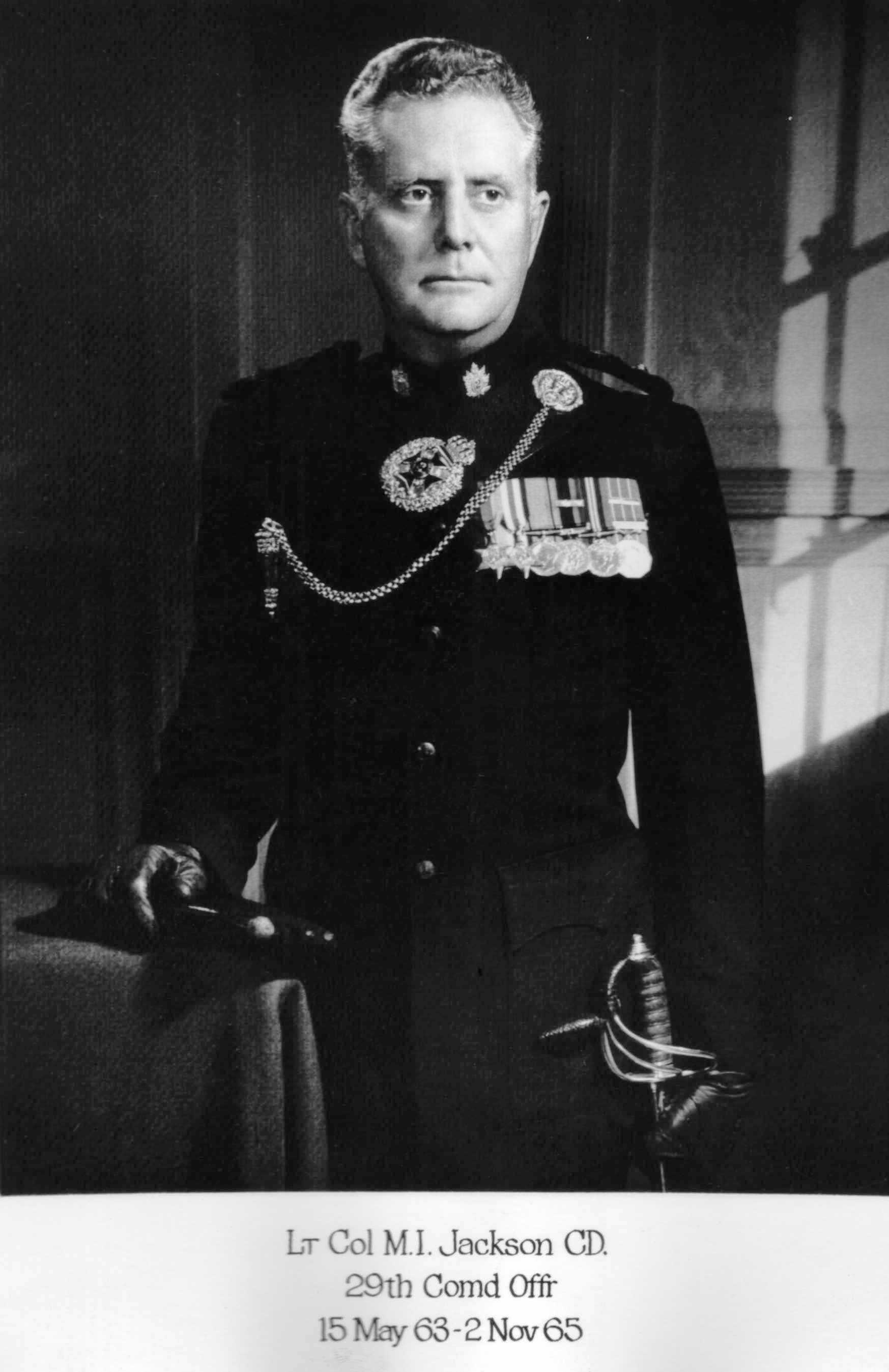
Lieutenant Colonel Moore “Moose” Ivan Jackson, CD was born in Toronto on 30 January 1921, son of Alan William Jackson and Elsie Constance Flint. His father had been in The QOR and served in the 3rd Battalion CEF during WWI where he was wounded at Vimy Ridge and had his right leg amputated. A paternal uncle Robert Moore Jackson enlisted with the 35th Battalion, CEF and died of wounds serving with the 20th Battalion in France.
His maternal great-great uncle, Robert C. Bickerstaff had been in The Queen’s Own in the 1860s including the Battle of Ridgeway (No. 3 Company), and a great-uncle had served with the Regiment in 1880.
As a teenager in 1940, Moose joined the Royal Canadian Navy. It was done more or less on a “dare” from his future wife, high school girlfriend Margaret Gibbs. However, he was rejected by the Navy, and later by the RCAF, because he was slightly colour-blind.
He then decided to join The Queen’s Own Rifles and noted in his memoirs which he wrote many years later, that “I probably should have joined this infantry unit first.” It was destiny for him to join what he called “A very wonderful and proud Toronto Regiment,” one in which he would lead men in battle during World War II and as their CO in the post-war years. Eventually promoted from Rifleman to Lieutenant he spent quite a bit of time at the front lines after D-Day.
“My time in action was quite lengthy, some 11 months,” he wrote in his memoirs, “serving through France, including Caen, Falaise Gap, Boulogne and Calais. Then through Belgium and Holland, including the Scheldt Estuary engagements (probably the most horrible conditions imaginable) up to Nijmegen, where we spent December and January in conditions and scenery like Muskoka.”
While The Queen’s Own was preparing for an attack in order to capture enemy positions on the approach to Calais, Lieutenant Moore led a successful patrol from his company’s pioneer platoon behind enemy lines to disable land mines in their path. As the 1960 Regimental History put it: “Little imagination is required to appreciate the hazards. The ground had to be prodded to locate many of the mines, then they had to be lifted and de-armed. The job called for a steady hand and nerves of steel.”
When Lieutenant Moore and The Queen’s Own fought their way across the Rhine into Germany they liberated several prisoner-of-war and slave camps. “It is impossible to describe the conditions and the complete denigration of fellow humans!” he wrote later.
Named 29th CO of the Regiment in 1963 he was in command when The Queen’s Own marched out of University Avenue Armouries for the last time as the grand 71-year-old building was doomed to be demolished and a military tradition dating back to 1895 was ended.
In the last half-century of his lifetime, he and Margaret had visited and vacationed in such places as Yugoslavia, Hong Kong, the Philippines, Thailand, Hawaii and many other U.S. states, plus all Canadian provinces as well as the islands – Bermuda, Antigua, Barbados, Bahamas, Montserrat, the UK and various countries on the Continent. The Jacksons saw a fair bit of the world, enjoying Moose’sretirement from chartered accountancy at Dunwoody, where he had worked for many years and was a partner. They also visited Paris, which Moose Jackson had already seen as a WWII soldier, and made pilgrimages to attend WWII memorial services in France, Belgium and Holland.
Lieutenant Colonel Jackson died on 1 June 2008 at Sunnybrook Hospital and was survived by his daughter Susan, son Peter, three grandchildren and three great-grandchildren. Margaret died in 1999 and he was also predeceased by sister Dorothy and brother Alan (Peter), who also served with The Queen’s Own Rifles in WW II.
Service Record:
- Aug 1940 – Joined 2nd (Reserve) Battalion as a rifleman
- Shortly after posted to the 1st Battalion and saw service in Newfoundland, New Brunswick and then overseas
- Mar 1943 – Commissioned and returned to Canada for officer training at Brockville, Ontario
- Feb 1944 – Returned overseas as a reinforcement officer
- Jul 1944 – Rejoined 1st Battalion QOR fighting in Caen
- Served and fought with 1st Bn up to VE Day
- Aug 1945 – Returned to Canada and demobilized
- 1946 – Re-joined QOR militia battalion
- 1947 – Promoted Captain
- 1954 – Promoted Major
- 1 Mar 1954 – Awarded Canada Decoration
- 1958 – Qualified for Militia Staff Course
- 16 May 1963 – Appointed Commanding Officer of 3rd Battalion and promoted to Lieutenant Colonel
- 05 Dec 1965 – Relinquished Command and retired.
With info taken from the Summer/Fall 2008 Issue of The Powder Horn.

 The Queen's Own Rifles of Canada Regimental Museum and Archive