
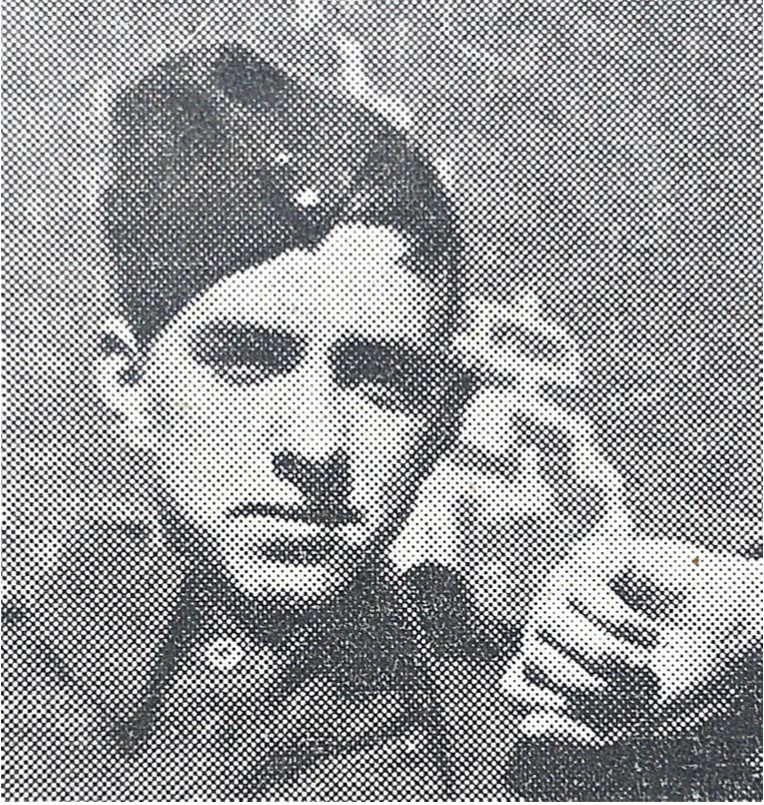
 B44572 Rifleman Richard Isaac Dyson was born in Guelph, Ontario on July 19, 1923. His parents were Thomas Reginald Dyson, a truck driver, and Mary Ellen McKinnon. They had three sons, Richard, Thomas, and William as well as two daughters, Ruth and Nancy. Dyson’s family often attended St. James Anglican Church.
Richard’s two younger brothers also served in the Second World War. Private Thomas Dyson was with the Royal Canadian Ordnance Corps while Seaman William Dyson served in the Canadian Merchant Navy.
When Richard enlisted, he was living with his parents at 78 Kathleen Street in Guelph. He attended Guelph Collegiate Vocational Institute for two years. Richard enjoyed the hobbies of chemistry and photography.
After high school, Dyson was employed by the Biltmore Hat Company. He then worked for W.C. Woods, as a machinist apprentice, a company involved in war production. According to his occupational history form, he hoped to focus on diesel engineering after the war,
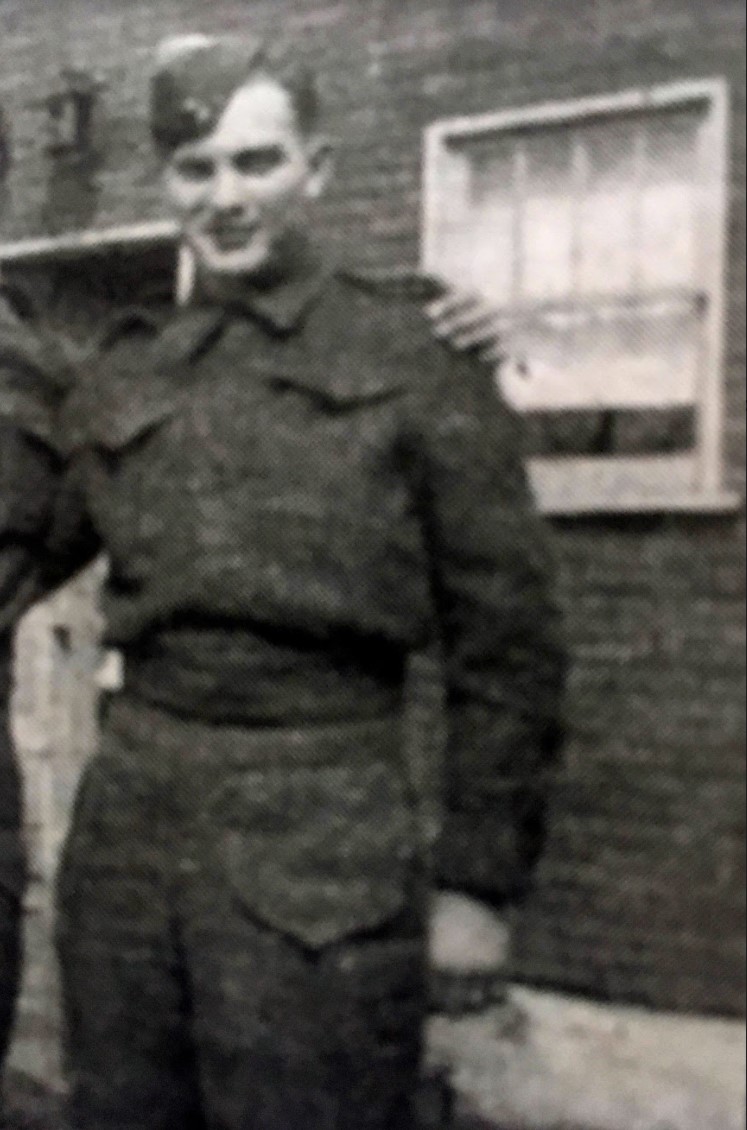
Dyson enlisted in the army on October 15, 1942, in Owen Sound, Ontario. He had just turned 19 years old. Starting on March 29, 1940, he had served in the reserves as a gunner with the 2nd Battery of the Royal Canadian Artillery reserves. According to Dyson’s medical records at enlistment, he was described as standing five feet eight and a half inches and weighing 116 pounds. Dyson had brown eyes and dark brown hair.
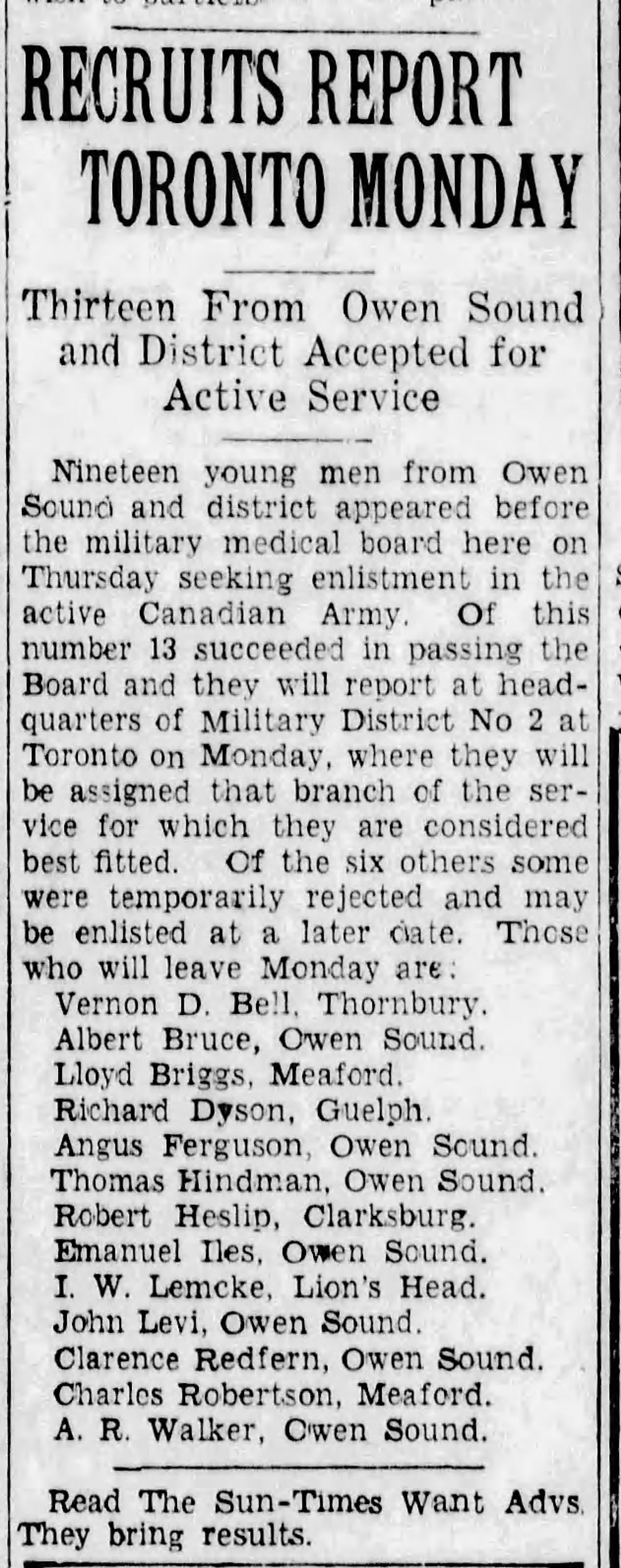
Dyson started training in Toronto, Ontario, on October 22, 1942. He was then transferred to Camrose, Alberta, to train there on November 23, 1942. He was transferred one more time to Elkins Barracks in Nova Scotia on March 2, 1943. Dyson completed eight weeks of basic training and five and a half weeks of light anti-aircraft training.
Dyson left Windsor, Nova Scotia on June 10, 1943 to travel to the United Kingdom. He arrived there on June 18, 1943. While there, he completed two more weeks of basic training in February 1944.
After being assigned to the 4th Canadian Infantry Reinforcement Unit, he was transferred to the Queen’s Own Rifles of Canada on June 5, 1944. Rifleman Richard Dyson was sent to France, arriving on June 11, 1944, which was only five days after the D-Day invasion of Normandy.
He saw action through summer, fall and winter over eight months as the Queen’s Own Rifles regiment fought across France, Belgium, the Netherlands and Germany.
His military records showed that on January 10, 1945, in the Netherlands, Rifleman Dyson was injured while cleaning ice from a recovered German weapon. It discharged with the muzzle pointed to the floor. Pieces of cement flew into the air, injuring Dyson in the face and another soldier. After his injury had healed at the hospital, Dyson went back to the battlefield on January 15, 1945, only a few days after the accident.
The Rhineland campaign in February 1945, was kicked off with Operation Veritable and Operation Blockbuster. It was at Mooshof, a tiny farming hamlet where the Queen’s Own Rifles (QOR) fought the “toughest scrap” in its journey across Northwest Europe, according to Col. William C. Ball in a QOR Museum posting.
Mooshof is also remembered as the battle where Sergeant Aubrey Cosen of D Company of the Queen’s Own, earned the Victoria Cross for his bravery in the action against the enemy. Brutal barrages from mortars and artillery devastated the ranks of D company which was repelling a counterattack by German paratroopers. Snipers also had a deadly effect in targeting soldiers, such as Sgt. Cosen, who died on the battlefield. The Queen’s Own Rifles lost 34 men in this engagement on February 26/27, 1945.
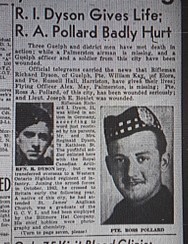
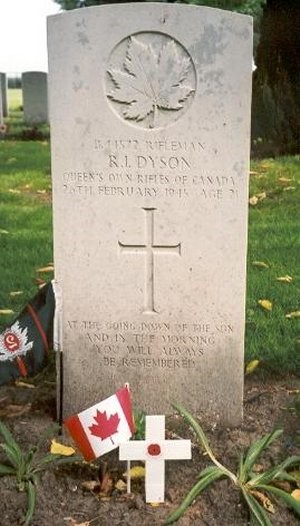
“Richard Dyson was also shot by a sniper maybe a few hours before Sergeant Cosens was killed,” said Jim Dyson of Peterborough, Ontario. His own father Bill Dyson had been told this information when he met with a comrade-at-arms who had been present with Rifleman Dyson at his death on February 26, 1945. He was 21 years old.

On the headstone are the words inscribed
AT THE GOING DOWN OF THE SUN
AND IN THE MORNING
YOU WILL ALWAYS
BE REMEMBERED
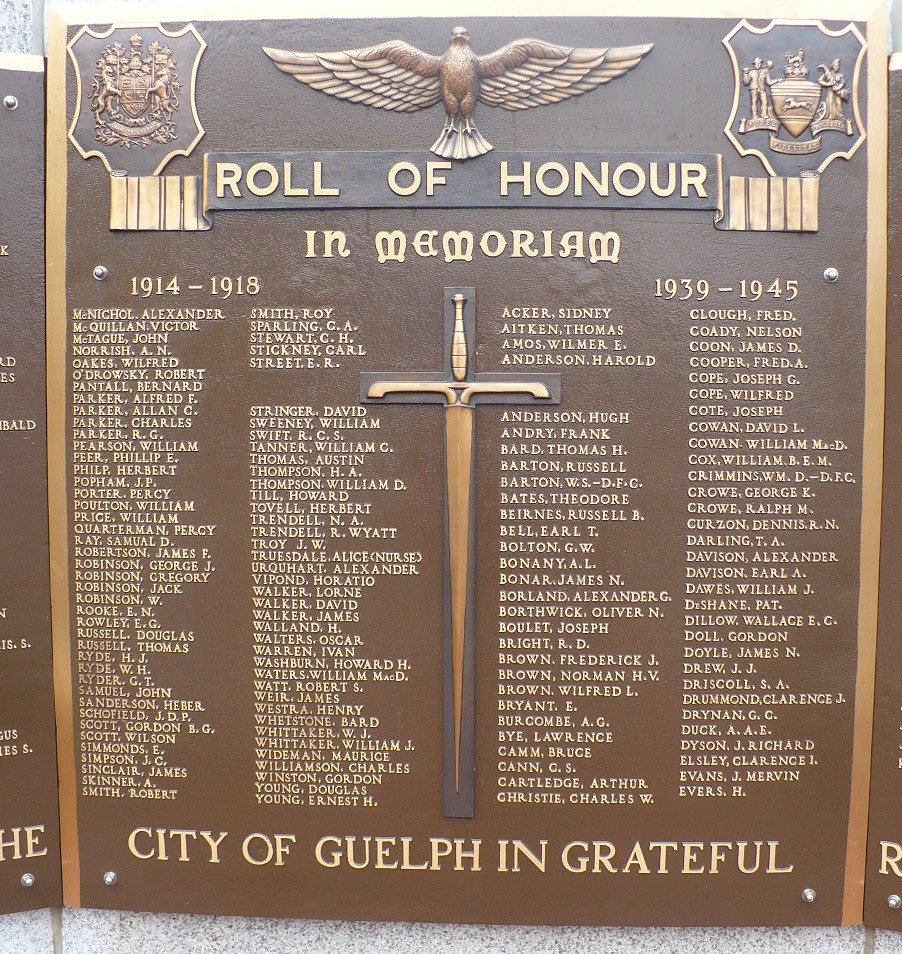
For his service to Canada, Dyson was awarded the 1939-45 Star, the France and Germany Star, the Defence Medal, the War Medal and the Canadian Volunteer Service Medal with Clasp.
Many decades after the war ended, an interesting artifact from the Battle of Normandy was discovered on the Cardonville Farm in Bretteville-L’Orgueuilleuse. A brick from a farm wall showed the name – “R Dyson” but an extensive investigation over the years confirmed it was carved by Rifleman Richard Dyson when his regiment, the Queen’s Own Rifles, was dug in there during the Battle for Normandy which ran from June 6 to July 2, 1944.
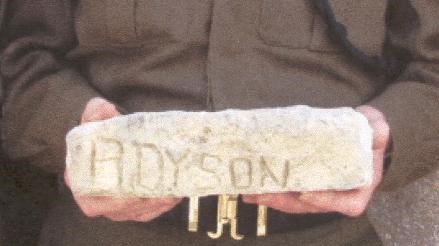
Tjarko Pot, a Dutch re-enactor with the Queen’s Own Rifles Association in the Netherlands, and Celine Garbay of the Canadian Battlefields Foundation learned about this artifact in 2002 and worked together to find a way to preserve it. The farm landowner, CMEG, a local building company, wanted to “find an appropriate home in Canada where it could be given a place of honour,” stated Ms. Garbay.
Bill Dyson, a nephew of Rifleman Dyson, and his wife, Patti Dyson, travelled to Europe in May, 2005, for the 60th Anniversary celebrations of the Liberation of the Netherlands. The couple visited France, the Netherlands and Germany.
At the Groesbeek Canadian War Cemetery where Rifleman Dyson is buried, the Queen’s Own Rifles re-enactors presented the brick to the Dyson couple at a special ceremony in 2005.
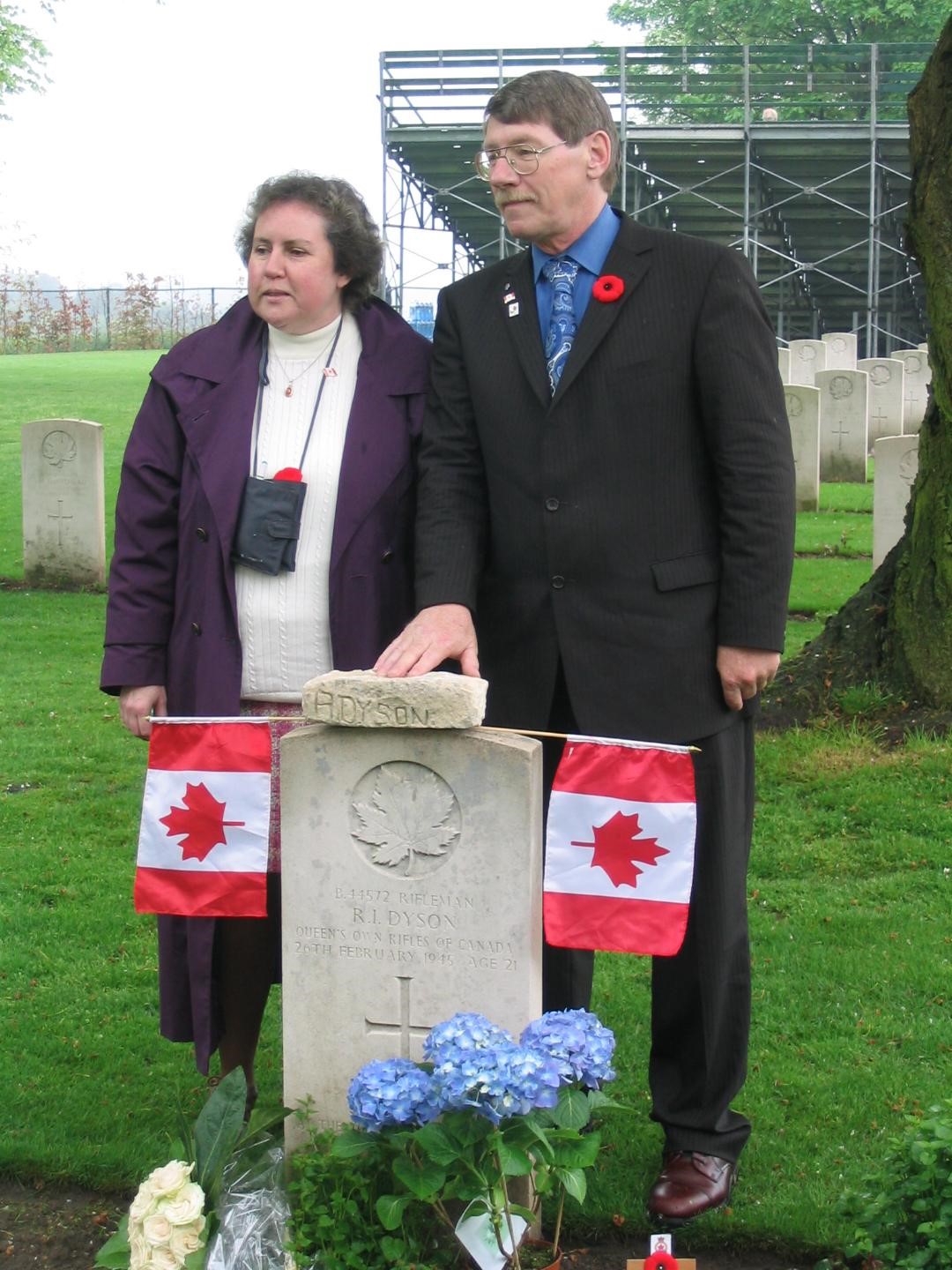
In December 2006, the couple donated the brick to the Queen’s Own Rifles Museum in Toronto, where it is now displayed.
Many members of the Dyson family have made pilgrimages to the Netherlands over the decades. In 2001, his sister-in-law Orma, took her children, Jim, Bill and Ted, on a trip to pay respects at the grave in Groesbeek Canadian War Cemetery. Bill and his wife, Patricia, had gone over twice, too, while Jim went on a day tour of the route which uncle, Rifleman Dyson, took to Mooshof, Germany.
Life Story was written by Daniel Covelli, and Kyle Cregan, students from All Saints H.S., Kanata, Canada for Faces to Graves courtesy of Vanessa Kirtz, a teacher at All Saints H.S. Additional research and editing were provided by Kurt Johnson.
Sources:
- https://www.findagrave.com/memorial/218896652/thomas-r-dyson
- Library and Archives of Canada
- Commonwealth War Graves Commission
- Canadian Virtual War Memorial
- Canada.ca
- Project ‘44
- qormuseum.org (Regimental war diaries)
- The Owen Sound Daily Sun Times
- https://warfarehistorynetwork.com/2016/12/12/the-queens-own-rifles-of-canada-in-the-rhineland-1945/
- https://qormuseum.org/wp-content/uploads/2021/04/the-regiments-toughest-scrap-by-col-ret-w-ballv2.pdf

 The Queen's Own Rifles of Canada Regimental Museum and Archive