DARE TO ADVENTURE
By: Lieutenant Colonel Gregory (Greg) James Burton CD (Retired) 17 March 2025
 In November 2015, I hung up my uniform after 4 years as a cadet and 40 years in the military, one of the last serving Cold War warriors. In all that time, I donned many cap badges including the Upper Canada College Rifles (1972-75), The Queen’s Own Rifles of Canada (1975-1979), The Light Infantry (1980 & 1981-84), The Royal Military Academy Sandhurst (1980-81), the United Nations (1990, 1993 & 1994), and Princess Patricia’s Canadian Light Infantry (1984-2015).
I was born the eldest of four children, and attended Brown Junior Public School in Toronto and Roslyn Elementary School in Montreal, before becoming a “lifer” at Upper Canada College (UCC) in Toronto from 1968-1977.
As the eldest son, I was groomed to enter the family business, The Robert Simpson Company, a department store known to most as Simpson’s. On graduation from high school, I naturally joined the company, starting in the Toy department for the 1977 Christmas season, and then moving on to Men’s Furnishings, followed by Ladies’ Shoes. My budding rise to department store celebrity came to a sudden end after the Hudson’s Bay Company won a hostile takeover of Simpson’s in 1978 and proceeded to encourage Burton family members to find alternate situations. I could see the writing on the wall and the decision to move on was easy. So was launched my Regular Army career.
I didn’t just wake up one day and exclaim, “Eureka! I think I’ll join the Army!” I had already been well and truly initiated to martial life, albeit on a part-time basis. UCC had an indoor shooting range in the basement of the Preparatory School. I joined the shooting club at the age of ten and learned to shoot straight, achieving several shooting proficiency awards over the next few years.
On moving to the Upper School in 1972, I became a cadet in the mandatory cadet corps, which was colloquially known as the “Battalion,” although the official name was the Upper Canada College Rifles. I spent three years happily doing drill and rifle shooting, practicing field craft, and marching in Remembrance Day parades. I remained a member of the volunteer Colour Party for two years, the only remnant of the Battalion still extant after it ceased to be mandatory in 1975, the year after the Vietnam War ended.
In 1975, while a student starting in Grade 12, I was introduced to the Militia and The Queen’s Own Rifles of Canada by then Corporal Llewellyn Matthews who was a year ahead of me at UCC and just starting Grade 13. I participated in several training evenings at Moss Park Armoury, learning how to read a map and use a compass, as well as shooting in the indoor range.
I was hooked and joined the “Queen’s Own” as a Rifleman in October 1975. In the Spring of 1977, I graduated from high school at UCC and then spent several weeks taking commissioning courses at Canadian Forces Base Petawawa as an Officer Cadet. The summer of ’77 brings back many memories, not just of good and hard times living in WWI bell tents on the Mattawa Plain, and being constantly covered in sand, but that was also when Canada went metric and then Elvis died!
Having passed my courses, I was commissioned Second Lieutenant in the Queen’s Own. Soon afterwards, I decided to join Simpson’s and was accompanied to the personnel office by my Queen’s Own friend, Captain Ray Descotes. By the time I was ready to leave Simpson’s at the end of 1979, I had four years as a cadet under my belt and close to five years in the Militia, and had trained as a soldier and officer in Toronto, Winona, Borden, Meaford, Petawawa and Fort Drum, New York.

By late 1978, I had started to consider my future employment options. I investigated joining the Canadian Regular Army, but basic officer training courses in Chilliwack, British Columbia, were too few for me to get a vacancy fast enough for my liking. By mid-1979, some other possible alternatives presented themselves. Another Queen’s Own friend and mentor, Major Peter Fairclough, proposed the idea of joining the British Army as he had done two decades before in the 1950s with the King’s Regiment. The Royal Green Jackets were an obvious choice as they were affiliated with the Queen’s Own. Sergeant Rob Chan had just returned from several years of soldier service with the Green Jackets and had plenty of stories to tell. Captain Adam Hermant, who was both an Old Boy of Upper Canada College and a friend in the Queen’s Own, also suggested another British regiment, the Royal Regiment of Fusiliers, who were affiliated to his wife’s family.
Additionally, my uncle, then Lieutenant Commander John Cody, a naval aviator in the Royal Canadian Navy, and a student that year at the Canadian Forces College in Toronto, introduced me to several foreign students on the command and staff course from the US, France and the UK. After meeting these fine officers, my choices now also included the United States Marine Corps, the French Foreign Legion and The Light Infantry in the British Army!
It was Major Richard Sale, who made a compelling recommendation that I join his regiment, The Light Infantry. Closely related to the Royal Green Jackets within the Light Division, Richard explained that both regiments were the best in the British Army, but that The Light Infantry didn’t need to brag about it.
Peter Fairclough arranged a meeting for me with Major Philip Hope-Johnstone 13th/18th Hussars, the British Defence Attaché in Ottawa, who gave me several forms to complete and submit directly to the Ministry of Defence in England. I soon received an invitation to report to the Recruiting Centre at Great Scotland Yard in London, England.
So, by Christmas 1979, I had given notice at the Queen’s Own and Simpson’s, sold my car and television, stored my personal effects in my parents’ basement, and seeking a new life of adventure, flew to London, England in early February 1980 where I joined The Light Infantry with the intent of taking a commission. Being “colonial,” I was required to prove my allegiance by serving in the ranks for six months on a Potential Officer (PO) “O-Type” engagement, as Private Burton at both The Light Infantry Depot (LI Depot) at Copthorne Barracks in Shrewsbury, Shropshire and with the 3rd Battalion, The Light Infantry (3LI) at Salamanca Barracks, in the Western Sovereign Base in Episkopi, on Cyprus.
There were four POs on my intake, and we were mixed in with regular soldier recruits. Besides basic training, which for us was abbreviated, the POs were subjected to several weeks of extra adventure training in the Brecon Beacons in Wales. Rock climbing, abseiling, caving, orienteering, kayaking and survival were all on the agenda.
I was the only PO to be posted to a battalion, which luckily for me was based in Cyprus. Our battalion’s role was Sovereign Base security, which included perimeter security patrols in the desert and guard duties in Episkopi, Dhekelia, Ayios Nikolaos, Troodos and Mount Olympos. Of course, there was also patrol training through cactus-filled wadis and adventure training. I took up sailing at Tunnel Beach and horse riding in Happy Valley.
To attend officer training, I was required to pass the week-long Regular Commissions Board (RCB) in Westbury, Wiltshire, which I did before heading to Cyprus. I passed RCB and was accepted for officer training, my success in part thanks to advice from Captain Howard Flood, another Queen’s Own friend who had recently served as an officer in the British Army with the Grenadier Guards. On return to England from Cyprus, I was appointed Officer Cadet, and from September 1980 to April 1981, I completed Standard Military Course (SMC) 25 in Number 2 Platoon, Alamein Company, The Royal Military Academy Sandhurst (RMAS). Sandhurst was an outstanding experience, my first exposure to all regiments and corps of the British Army.
The early days were filled with considerable drill and fitness activities as well as learning about and training in all operations of war. As we progressed, there were field exercises and more adventure training in Wales at the Sennybridge Training Area and in the Brecon Beacons. We also ended up at Dartmoor, Devon, for an unofficial Ten Tors Challenge. There was no sign of the Hound of the Baskervilles! I also have fond memories of trench digging at several bases throughout southern England, the ground chalky and filled with flint, and sparks flying with every swing of the picks and shovels.
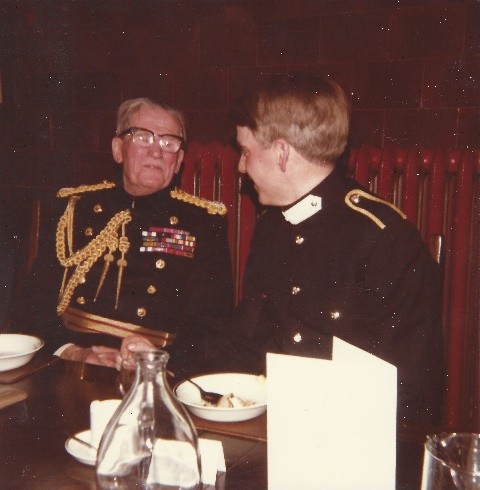
By the end of the course, I had achieved the cadet rank of Junior Under Officer (JUO), the cadet platoon commander of my platoon. During the graduation parade, I was honored to be assigned as escort to the Inspecting Officer, King Hussein of Jordan, whose son, Prince Abdullah (now King Abdullah II), was also graduating. The Light Infantry had accepted me for a Short Service Commission, and I was again honored to host the senior Light Infantry officer during the commissioning luncheon, Field Marshal Baron Harding of Petherton.
Commissioned into The LI as Second Lieutenant, I was posted to command 8 Platoon, C Company, 1st Battalion, The Light Infantry (1LI) who had just moved from Tidworth, England to Buller Barracks in Münster, West Germany, part of the 5th Field Force, 1st British (BR) Corps in the British Army of the Rhine (BAOR). My platoon was tasked as the Atomic Demolition Munition (ADM) platoon for the Force, responsible for the mother of all bridge demolition guards on a 2½ km stretch of twinned, dual-lane autobahn bridges over the river Weser.
From February to May 1982, I attended the Platoon Commanders Battle Course at the School of Infantry in Warminster, Wiltshire. As it happens, the Falklands War started, and 18 officers had to leave the course to join their units. Those of us who were left completed six weeks of Small Arms Instructor training and six weeks of Combat Team Tactics training. When not in training, we were glued to the TV news to see the latest war reports from the Falklands. Throughout my time in BAOR, we did lots of live field firing and Northern Ireland Training Advisory Team (NITAT) training on the ranges at Sennelager Training Area, and for larger Corps and Army exercises, the countryside was the training area.
Promoted to Lieutenant in 1983, I continued to command 8 Platoon for a five-month tour on Operation BANNER in West Belfast, Northern Ireland. Each platoon rotated locations within the company area during the tour. I started by commanding the patrol base at MacRory Park for two months, then the company Quick Reaction Force (QRF) at Fort Whitrock for one month, and finally the patrol base at New Barnsley for two months.
I was fortunate to lead over 100 joint patrols with the Royal Ulster Constabulary (RUC) during the five-month tour. There was always a high threat of improvised explosive devices (IEDs), riots and petrol bombs, snipers and ambushes, rocket-propelled grenades (RPGs), and we even faced a 20mm anti-tank rifle.

Back in Germany by the autumn of 1983, I took over as Second-In-Command of C Company during the 1LI re-role as an airmobile anti-tank battalion in the newly formed 24 Airmobile Brigade. For this task, we were issued with 1:1,000,000 scale maps that went all the way to Moscow. All companies were equipped with 14 Milan anti-tank guided missile launchers, and we practiced rapid deployment skills with Puma helicopters of the Royal Air Force and Jolly Green Giants from the Luftwaffe. The Army Air Corps joined the brigade with their Lynx helicopters equipped with TOW anti-tank guided missiles. It was quite an awesome force.
I knew my 3-year short service commission would end in early 1984. I chose not to extend my terms of service in the British Army, so I investigated a transfer back to the Canadian Army. In October 1983, I traveled south to Lahr, West Germany, to visit the Canadian Forces Euro-Mobile Recruiting Team, who were over from Canada to recruit the sons and daughters of Canadians living abroad. I underwent the usual recruitment tests and medicals. When asked about my choice of regiment, I requested Princess Patricia’s Canadian Light Infantry (PPCLI).
In April 1984, at the end of my Short Service Commission, I transferred to the Canadian Army, effecting a smooth transition from The LI to PPCLI. I was posted directly to 3rd Battalion, Princess Patricia’s Canadian Light Infantry (3PPCLI) in Esquimalt, British Columbia, where I served as Transport Officer, including Exercise Waincon 84, Second-In-Command Administration Company, including Exercise Rendezvous (RV) 85, and Adventure Training Officer, being promoted to Captain in 1985. In these years, I got to know Vancouver Island and Wainwright, Alberta, very well.
In the Spring of 1986, I was sent to the Nuclear Biological Chemical (NBC) School at Canadian Forces Base Borden for three months to attend the NBC Staff Officer course. Soon afterwards, I was posted to Headquarters Special Service Force (HQ SSF) in Petawawa, Ontario, to be the G3 NBC warfare staff officer and Force training officer. On arrival, I was appointed captain of the SSF Shooting Team for the Canadian Forces Small Arms Competition (CFSAC) at Connaught Range in Ottawa, a role I kept for three years. It was also my duty to organize the OSONS Challenge, a grueling two-day endurance march that exposed randomly selected junior officers from within the SSF to the perception of risk to life and limb through a series of skill and adventure activities within the Petawawa training area. Of course, my name was “randomly selected” on purpose to be a participant in my first year.

As G3 NBC, I spent considerable time organizing and participating in training throughout Ontario and across the Arctic, including Baffin Island and Alaska. Exercises RV 87 and RV 89 in Wainwright, Alberta, also provided opportunities to organize NBC field training for the units, as well as Command Post (CP) training for the HQ. I had the privilege of being in Frobisher Bay in January 1987 when it officially changed its name to Iqaluit. I acted twice as NBC warfare advisor to 4th Canadian Mechanized Brigade Group officer training in Lahr, West Germany, and was also responsible for organizing and conducting pre-deployment training for the troops tasked to Operation VAGABOND, Canada’s peacekeeping contingent into Iran and Iraq under the United Nations Iran Iraq Military Observer Group (UNIMOG).
In 1989, I was posted to 2nd Battalion, Princess Patricia’s Canadian Light Infantry (2PPCLI) at Kapyong Barracks in Winnipeg, Manitoba, but on arrival was sent back to Ontario for six months to attend “Foxhole U” at the Canadian Land Force Command and Staff College in Fort Frontenac, Kingston.
On staff qualification (plsc), I rejoined the battalion as it proceeded for United Nations peacekeeping duties on Operation SNOWGOOSE with the United Nations Force in Cyprus (UNFICYP) for the better part of 1990, where I was senior watch keeper in the Joint Operations Centre in Nicosia. Appointed Operations Officer on return to Winnipeg, I planned the mobilization of the battalion in response to the invasion of Kuwait. Everyone was disappointed when we received word from Ottawa that the battalion must stand down. We were lined up on the parade square, combat loaded, ready to depart the barracks for the rail and air heads. At least I was able to complete my tour as Operations Officer running the battalion Command Post during Exercise RV 91 in Wainwright.
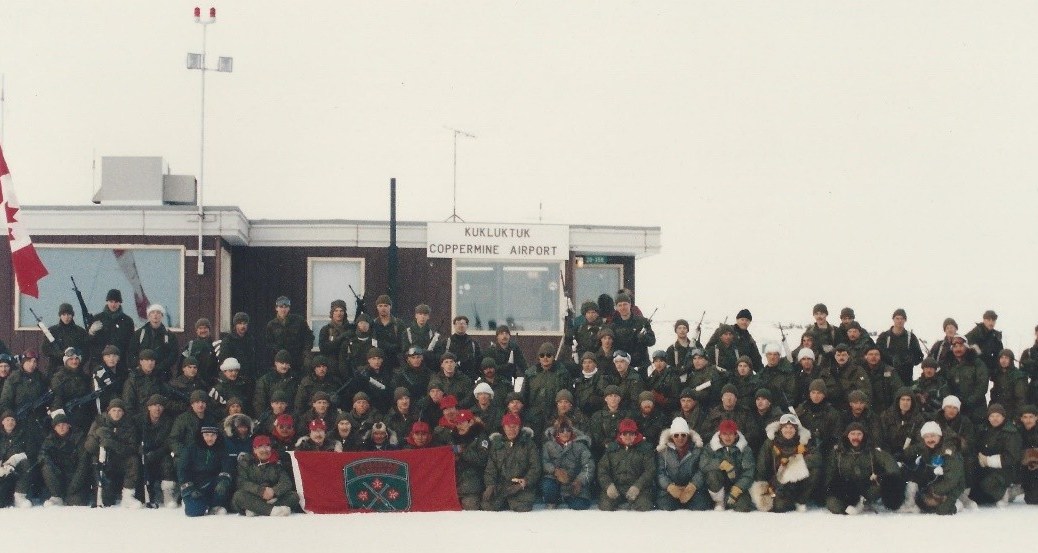
Promoted to Major in 1991, I took command of B Company for two years, during which time I was also President of the Mess Committee of the 2PPCLI Officers’ Mess. In the first year, our company training focused on Arctic sovereignty, culminating with Exercise Reliant Nordique in what was then Coppermine, Northwest Territories (now Kukluktuk) in early 1992. We learned a lot about arctic navigation, communication and survival from our attached Inuit Canadian Rangers.
That summer, we found ourselves back in Wainwright for Exercise RV 92, the last of the RV series. We were equipped with M113 Armoured Personnel Carriers (APC) and were very fortunate to spend several weeks perfecting our mechanized drills. B Company also had the honour of providing the land component of the first 12-plane airmobile assault formation, for which 10 Tactical Air Group (10 TAG) created the air component of CH-135 Twin Huey helicopters from its 408, 427 and 430 Squadrons.

Following RV 92, planning commenced for a company-level dog sled expedition from Whitehorse to Dawson City, Yukon, in the winter of 1993, but these plans were dashed when 2PPCLI was notified to replace 3PPCLI in the former Yugoslavia. Instead of the Yukon, the battalion found itself training in Fort Ord and Hunter Ligget in California, each company responsible for training and assimilating the largest ever complement of Reservists for operational deployment. B Company was also responsible for training an extra platoon of Reservists who would act as reinforcements during the upcoming tour.
The pinnacle of my regimental tour was commanding B Company for United Nations peacemaking duties on Operation HARMONY in the former Yugoslavia with the United Nations Protection Force (UNPROFOR) in Sector West of Croatia. During this tour, I had the opportunity to link up with another Queen’s Own friend, Major Rod Paddon, who was deployed as a Logistics Officer in Sector West Headquarters. Rod was able to spend a day with me and participated in an M113 armoured vehicle patrol into the Republic of Serb Krajina.

Back in Winnipeg, I completed a yearlong French course in 1994 and was posted back to UNPROFOR as a UN Military Observer (UNMO) in Bosnia and Herzegovina.
This was followed by my first and very brief tour in National Defence Headquarters as the Military Colleges operations officer in what was then the Assistant Deputy Minister (Personnel) (ADM(Per)). I was a member of the team responsible for closing Royal Roads Military College (RRMC) in Victoria, British Columbia and College Militaire Royal (CMR) in Saint Jean, Quebec at the beginning of the “decade of darkness.”
Closing myself out of a job, I was posted in 1995 as Adjutant of the Royal Military College of Canada (RMC) in Kingston. Until that point, I had been a graduate of the university of life, but the circumstances of the day (Somalia Inquiry) shone light on the need for officers to have higher education. I decided to take advantage of my time posted to Canada’s military university by becoming a founding member of the College’s Division of Continuing Studies, taking night classes towards a degree. In 1998, I was accepted to the University Training Plan for Officers to complete a degree as a full-time student for a year, and graduated in 1999 with a Bachelor degree in Military Arts and Sciences (BMASc) with Distinction.
With academics on the brain and taking further advantage of RMC, I was accepted for technical staff training, graduating from Course V of the Land Force Technical Staff Program (ltsc) in 2000. During my five years in Kingston, I volunteered as Treasurer of the Kingston Branch of the Princess Patricia’s Canadian Light Infantry Association and helped welcome young Patricia officers to the Regiment, a number of whom later went on to become Commanding Officers, Colonels and Generals.
In 2000, I was posted as a senior staff officer to the Directorate of Land Requirements (DLR) in Canadian Army Headquarters in Ottawa. I spent the first year as DLR 5 Close Combat Soldier Systems, which included appointment as Canadian Head of Delegation to North Atlantic Treaty Organization Topical Group 1 on Soldier System Interoperability. I was also Project Director of the Personal Defence Weapon and Integrated Soldier System Platform projects.
That was followed by three years in DLR 3 Armoured Vehicle Systems as the Project Director of the Weapon Effects Simulation (WES) and Urban Operations Training System (UOTS) projects, which included the creation of the Canadian Manoeuvre Training Centre (CMTC) in Wainwright, Alberta.
From 2004 to 2005, I was rewarded with the “best year of my life” as a student at the Canadian Forces College (CFC) in Toronto, where I also completed a Master’s degree in Defence Studies (MDS). My research paper on the Army’s need for an urban operations training capability was published in the peer-reviewed Canadian Army Journal.
On graduation from Staff College (pcsc), I returned to Army Headquarters as DLR Coordination 3, responsible for coordinating equipment support to operations, Army Research and Development, Modeling and Simulation, Equipment Trials and Evaluations and Chemical Biological Radiological and Nuclear (CBRN) Defence equipment. In this role, my main focus was on coordinating the fast-track procurement of equipment for Canada’s deployment from Kabul to Kandahar, Afghanistan, for then Brigadier General Dave Fraser, who had been appointed to command the Multi-National Brigade (Regional Command South).
In August 2006, after leading a technical assistance team to Kandahar, I was appointed both DLR 9 Simulation and Training Systems and DLR 11 Survivability Systems, and was promoted to Lieutenant Colonel. Thankfully, I had a great deputy to prosecute the simulation and training system projects during this time, as my focus remained on directing additional fast-track procurements of protected vehicles and protection equipment for Afghanistan.

Appointed DLR Coordination and Deputy Director in 2007, the position I held until retirement in 2015, I became the senior technical staff officer for the Army, responsible for developing and programming the Army’s $25B, twenty-year equipment program, and for creating the conditions for Army equipment projects to successfully secure approvals from the Minister of National Defence and Treasury Board. As one of the senior marketers of Army equipment requirements, I worked the bazaars in Ottawa that include the Minister’s office, the Treasury Board Secretariat, Public Works and Government Services Canada, Industry Canada and the Office of the Auditor General of Canada. I also connected directly with allies, the defence industry and the media through bilateral or multi-lateral briefings, public speaking engagements at industry conferences and defence associations, and through visits to industry and trade shows (somebody had to do it!).
The Department of Applied Military Science at RMC invited me as a regular lecturer, and I became the unofficial “godfather” of technical staff officers and Master Gunner warrant officers. This last chapter of my military career was very rewarding and enabled me to set the stage for fading away like all old soldiers do.
During my service career, I was able to find time to create a family, even though it wasn’t always easy for them. I am so grateful for their love and support and for putting up with my constant absences for long periods of time, absences often exacerbated by the anxiety of danger.
My retirement from the military in November 2015 only lasted for one month, after which I joined the ranks of the defence industry, where I continued to support the troops as Senior Director of Strategic Business Development for DEW Engineering and Development in Ottawa. My responsibilities included expanding the company’s long-term business prospects through exports and providing advice on Canadian defence procurement opportunities. I also led the DEW effort to team with SH Defence of Denmark and Vard Marine of Ottawa to become a Preferred Supplier to Team Vigilance, which aims to propose a modular ship for the RCN’s Canadian Multi-mission Corvette program.
To develop export opportunities, I traveled frequently to the United States, the United Kingdom, Belgium, Luxembourg, France, Germany, Estonia, Latvia, Lithuania, Czechia, Romania, the United Arab Emirates, and Egypt. After nine years in the defence industry, I decided to retire again at the end of 2024 so as to have more time to spend with grandchildren, and to dedicate to hobbies, charities and associations that are important to me.
I was privileged during my service to have been awarded decorations, medals and commendations, including:
- Special Service Medal with clasp “NATO”
- Canadian Peacekeeping Service Medal
- United Nations Force in Cyprus medal (Cyprus)
- United Nations Protection Force medal (Yugoslavia)
- Queen’s Diamond Jubilee Medal
- Canadian Forces’ Decoration with 1st and 2nd clasps
- British General Service Medal with clasp “Northern Ireland”
- Commander-in-Chief Unit Commendation (for operations in Yugoslavia, 1993)
- Commander Land Force Command Commendation (for support to operations in Afghanistan 2005-2007)
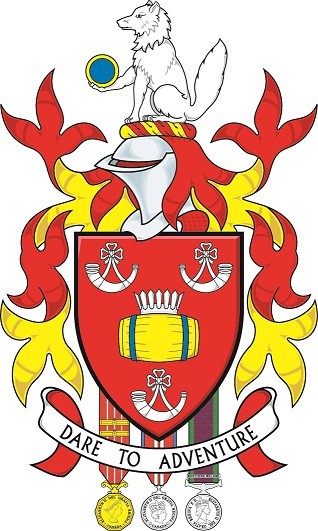
In 2021, I was honoured with Letters Patent from the Chief Herald of Canada for a Grant of Arms and heraldic emblems as follows:
- Blazon: Gules a tun Or hooped Azure ensigned by a palisado crown between three hunting horns those in chief addorsed Argent
- Crest: An Arctic fox sejant proper holding a hurt edged Or
- Badge: An Arctic fox’s mask proper jessant-de-lis Or
- Motto: DARE TO ADVENTURE

 The Queen's Own Rifles of Canada Regimental Museum and Archive