
Background

The Victoria Cross (VC) is the highest and most prestigious decoration of the British honours system. It was awarded for valour “in the presence of the enemy” to members of the British Empire (later the Commonwealth and may be awarded posthumously.
It was introduced on 29 January 1856 by Queen Victoria to honour acts of valour during the Crimean War.
Regimental Victoria Crosses
Seven Victoria Crosses were issued to those who had served in The Queen’s Own Rifles of Canada or in the First World War Canadian Expeditionary Forces battalions which The Queen’s Own Rifles perpetuate. You can read more about each soldier using the links in their names. (Ranks at the time of the action for which the VC is awarded.)
Captain Thain Wendell MacDowell, VC, DSO (10 April 1917)
“For most conspicuous bravery and indomitable resolution in the face of heavy machine gun and shell fire April 6-13, 1917, at Vimy Ridge, by his initiative and courage this officer, with the assistance of two runners, was enabled in the face of great difficulties to capture two machine guns besides two officers and seventy-five men. Although wounded in the hand, he continued for five days to hold the position gained in spite of heavy shell fire, until relieved by his battalion. By his bravery and prompt action, he undoubtedly succeeded in rounding up a very strong machine gun post,”
Corporal Colin Fraser Barron, VC (6 November 1917)
“For conspicuous bravery when in attack his unit was held up by three machine guns. Corpl. Barron opened on them from a flank at point-blank range, rushed the enemy guns single-handed, killed four of the crew, and captured the remainder. He then, with remarkable initiative and skill, turned one of the captured guns on the retiring enemy, causing them severe casualties. The remarkable dash and determination displayed by this N.C.O. in rushing the guns produced far-reaching results, and enabled the advance to be continued.”
Second Lieutenant Edmund De Wind, VC, (Killed in action on 21 March 1918)
“For most conspicuous bravery and self-sacrifice on the 21st March 1918, at the Race Course Redoubt, near Grugies. For seven hours he held this most important post, and though twice wounded and practically single-handed, he maintained his position until another section could be got to his help. On two occasions, with two N.C.O.s only, he got out on top under heavy machine gun and rifle fire, and cleared the enemy out of the trench, killing many. He continued to repel attack after attack until he was mortally wounded and collapsed. His valour, self-sacrifice and example were of the highest order.”
Lieutenant Charles Smith Rutherford, VC, MC, MM (26 August 1918)
“For most conspicuous bravery, initiative and devotion to duty. When in command of an assaulting party Lt. Rutherford found himself a considerable distance ahead of his men, and at the same moment observed a fully armed strong enemy party outside a ‘Pill Box’ ahead of him. He beckoned to them with his revolver to come to him, in return they waved to him to come to them. This he boldly did, and informed them that they were prisoners. This fact an enemy officer disputed and invited Lt. Rutherford to enter the ‘Pill Box,’ an invitation he discreetly declined. By masterly bluff, however, he persuaded the enemy that they were surrounded, and the whole party of 45, including two officers and three machine guns, surrendered to him. Subsequently, he induced the enemy officer to stop the fire of an enemy machine gun close by, and Lt. Rutherford took advantage of the opportunity to hasten the advance of his men to his support.
Lt. Rutherford then observed that the right assaulting party was held up by heavy machine-gun fire from another ‘Pill Box.’ Indicating an objective to the remainder of his party he attacked the ‘Pill Box’ with a Lewis gun section and captured a further 35 prisoners with machine guns, thus enabling the party to continue their advance. The bold and gallant action of this officer contributed very materially to the capture of the main objective and was a wonderful inspiration to all ranks in pressing home the attack on a very strong position.”
Lieutenant Wallace Lloyd Algie, VC (Killed in action on 11 October 1918)
“For most conspicuous bravery and self-sacrifice on the 11th October 1918, north-east of Cambrai, when with attacking troops which came under heavy enfilade machine-gun fire from a neighbouring village. Rushing forward with nine volunteers, he shot the crew of an enemy machine gun, and, turning it on the enemy, enabled his party to reach the village. He then rushed another machine gun, killed the crew, captured an officer and 10 enemy, and thereby cleared the end of the village. Lt. Algie, having established his party, went back for reinforcements, but was killed when leading them forward. His valour and personal initiative in the face of intense fire saved many lives and enabled the position to be held.”
Lieutenant George Fraser Kerr, VC, MC & Bar, MM (27 September 1918)
“For most conspicuous bravery and leadership during the BOURLON WOOD operations on 27th Sept. 1918, when in command of the left support company in attack. He handled his company with great skill, and gave timely support by outflanking a machine gun which was impeding the advance. Later, near the ARRAS-CAMBRAI road, the advance was again held up by a strong point. Lieutenant Kerr far in advance of his company rushed this strong point single-handedly and captured four machine guns and thirty-one prisoners. His valour throughout this engagement was an inspiring example to all.”
Sergeant Aubrey Cosens, VC (Killed in action on 25/26 February 1945)
“In Holland* on the night of 25th-26th February 1945, the 1st Battalion, The Queen’s Own Rifles of Canada launched an attack on the hamlet of Mooshof, to capture ground which was considered essential for the development of future operations.
Sergeant Cosens’ platoon, with two tanks in support, attacked enemy strong points in three farm buildings, but were twice beaten back by fanatical enemy resistance and then fiercely counter-attacked, during which time the platoon suffered heavy casualties and the platoon commander was killed.
Sergeant Cosens at once assumed command of the only other four survivors of his platoon, whom he placed in a position to give him covering fire, while he himself ran across open ground under heavy mortar and shell fire to the one remaining tank, where, regardless of the danger, he took up an exposed place in front of the turret and directed his fire.
After a further enemy counter-attack had been repulsed, Sergeant Cosens ordered the tank to attack the farm buildings, while the four survivors of his platoon followed in close support. After the tank had rammed the first building he entered it alone, killing several of the defenders and taking the rest prisoner. Single-handedly he then entered the second and third buildings, and personally killed or captured all the occupants, although under intense machine-gun and small-arms fire.
Just after the successful reduction of these important enemy strong points, Sergeant Cosens was shot through the head by an enemy sniper and died almost instantly. The outstanding gallantry, initiative and determined leadership of this brave N.C.O., who himself killed at least 20 of the enemy and took an equal number of prisoners, resulted in the capture of a position which was vital to the success of the future operations of the Brigade.”

Note: The Canadian Victoria Cross
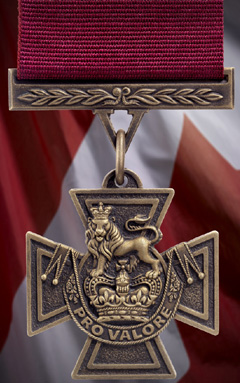
The Canadian Victoria Cross (VC) (in French: Croix de Victoria) was created in 1993, perpetuating the lineage of the British Victoria Cross, while serving as the highest award within the Canadian honours system, taking precedence over all other orders, decorations, and medals.
As of July 2024, it has not been awarded.

 The Queen's Own Rifles of Canada Regimental Museum and Archive