All posts by ghumphrey

Sergeant with Gurkha Company, QORofC

Composition of QOR on D-Day

The following was researched and written by: Capt. (N) (Ret’d) Michael Braham for the http://www.6thjuin1944.com (no longer active) in the article Operation Overlord/Neptune Force ‘J’ – Juno Beach

This will break down which Queen’s Own Rifles Rifleman landed at what time. You can see how much crossloading of equipment and men there was with other Regiments and support formations:

HMS Monowai Assaulting companies – J30, Ex Armed Merchant Cruiser Razmak. A large and fast cargo liner built in 1925. She was 10,852 tons, 519 feet long and could make 20 knots. She carried ten LCA from 554 Flotilla, nine LCA from 556 Flotilla and a LCA(OC).(1)

Serials 1428 to 1432 are 5 LCA’s from LSI(L) J30 HMS Monowai:

  • 129 men from The Queen’s Own Rifles of Canada plus 20 stores spaces
  • 3 men from 14th Canadian Field Regiment, RCA – Forward Observation Officer
  • 6 men from 16th Canadian Field Company, RCE plus 3 stores spaces – Demolition Team
    Serials 1433 to 1437 are 5 LCA’s from LSI(L) J30 HMS Monowai:
  • 129 men from The Queen’s Own Rifles of Canada plus 20 stores spaces
  • 3 men from 14th Canadian Field Regiment, RCA – Forward Observation Officer
  • 6 men from 16th Canadian Field Company, RCE plus 3 stores spaces = Demolition Team(1)

Terrain
The coastline on which Nan White and Nan Red were situated was low-lying. From Courseulles to Bernieres-sur-Mer, there was a sandy beach with short groynes to prevent lateral movement of sand by the current. From Bernieres-sur-Mer to St Aubin-sur-Mer the coast continued to be low lying and sandy, but here there were many summer houses and villas. From St Aubin-sur-Mer eastwards, there were low cliffs for a mile and a half, with a sea wall along most of it. Offshore, all the way along the coast eastwards of Bernieres-sur-Mer, there were rocky outcrops, parts of which were exposed at low tide. Inland, the country was gently rolling countryside and plains with large fields.(1)

QOR
The Queen’s Own Rifles of Canada received the order to make the final run in to the beach at 0805 hours, although there was no sign of the LCTs carrying DD tanks and specialist armour. They landed on Nan White at 0815 hours with ‘A’ Company to the west of Bernieres and ‘B’ in front of the Bernieres strongpoint. ‘A’ Company got off the beach quickly and reached the railway line before being pinned down by mortar fire. They eventually moved inland.

‘B’ Company landed in front of the strongpoint, which had 8 machine guns in concrete emplacements, two 50mm guns on the sea wall and two 80mm mortar posts inland. The company suffered heavy casualties, including three officers, a CSM and two sergeants. The company scaled the sea wall and outflanked the position.

‘C’ and ‘D’ Companies together with Battalion Headquarters, came ashore at 0830 hours. The companies passed through the village and, together with ‘A’ Company, prepared to move forward to the next task. ‘B’ Company remained on the beach to reorganize.(1),

Nan White and Nan Red H+20 minutes
Queens Own Rifles of Canada – Lt-Col J.G. Spragge Nan White ‘A’ Company (Major H. E. Dalton) ‘B’ Company (Major C. O. Dalton) ‘C’ Company (Major Nickson) ‘D’ Company (Major Gordon)(1)

Serials 1451 to 1456 are 6 LCA’s from J32 HMS Duke of Wellington:

  • 134 men from Queens Own Rifles of Canada plus 23 stores spaces – Includes alternative Battalion Headquarters
  • 1 man from Headquarters 8th Canadian Infantry Brigade – Chaplain for Queens Own Rifles of Canada – H/Capt JC Clough, C.C.S.
  • 3 men and a handcart from ‘K’, Section (8 CIB), 3rd Canadian Infantry Division Signals plus 3 stores spaces
    • 7 men from 16th Canadian Field Company, RCE
  • 7 men from 14th Canadian Field Regiment, RCA
  • 9 men from 22nd Canadian Field Ambulance, RCAMC
  • 4 men from La Regiment de la Chaudiere – Unit Landing Officer party
  • 1 man from North Nova Scotia Regiment (9 CIB)
  • 11 men from 184 Field Company, RE
  • 2 men from 19 Beach Signals Section(1)

Serials 1457 to 1462 are 6 LCA’s from J33 SS Isle of Guernsey:

  • 137 men from Queens Own Rifles of Canada plus 18 stores spaces
  • 2 men from 10th Canadian Armoured Regiment (The Fort Garry Horse) – Liaison Officer
  • 7 men from 14th Canadian Field Regiment, RCA
  • 6 men from 16th Canadian Field Company, RCE plus 3 stores spaces
  • 10 men from 22nd Canadian Field Ambulance, RCAMC
  • 7 men from 184 Field Company, RE
  • 2 men from 19 Beach Signals Section
  • 2 men from 244 Provost Company
  • 7 men from 5 Royal Berkshire Regiment – Beach Group
  • 3 men from RN Beach Signals Section
  • 2 men from RN Beach Commando – Assistant Beach Master party(1)

Serial 1463 was an LCH carrying Headquarters Queens Own Rifles of Canada. Personnel are taken ashore by LCA Serial 1482 from J36 HMCS Prince David:

  • 8 men from Queens Own Rifles of Canada – Battalion Command Group
  • 3 men from Contact Detachment • 4 men from 14th Field Regiment, RCA
  • 4 men from Detachment ‘A’ Troop, 3 Bombardment Unit J
  • 1 man from ‘K’ Section (8 CIB), 3rd Canadian Infantry Division Signals
  • 7 men and 3 handcarts from 19 Beach Signals
  • 12 men from RN Beach Commando
  • 10 men from RN Beach Signals.(1)

SS St. Helier Supporting companies – J35, A Channel Island ferry. She was 1,952 tons, 292 foot long and could manage 18 knots. She carried six LCA from 515 Flotilla. She had accommodation for 180 troops and was armed with six 20mm.

Serials 1470 to 1475 are 6 LCAs from J35 SS St. Helier:

  • 135 men from Queens Own Rifles of Canada – Includes Unit Landing Officer plus 21 stores spaces
  • 1 man from 3rd Canadian Reconnaissance Regiment (The Governor Generals Horse Guards)
  • 7 men from 19th Canadian Field Regiment, RCA
  • 13 men from 16th Canadian Field Company, RCE plus 3 stores spaces
  • 10 men from 22nd Canadian Field Ambulance, RCAMC
  • 2 men from 19 Beach Signals Section
  • 14 men from 5 Royal Berkshire Regiment – Beach Group(1)

Serial 1463 was LCH 239:

  • 8 men from Queens Own Rifles of Canada – Battalion Command Group
  • 3 men from Contact Detachment
  • 4 men from 19th Field Regiment, RCA
  • 4 men from Detachment ‘A’ Troop, 3 Bombardment Unit J.
  • 1 man from ‘K’ Section (8 CIB), 3rd Canadian Division Signals
  • 7 men and 3 handcarts from 19 Beach Signals.
  • 12 men from RN Beach Commando
  • 11 men from RN Beach Signals(1)

The first troops landed on Nan White at 0850 hours. The lack of exits and the enemy resistance at Bernieres meant that the battalion had to wait on the beach for an hour, under mortar and shell fire. They moved to an assembly area inland and waited a further two hours before setting off for its objectives around Beny sur Mer. They were supported by ‘A’ Squadron 10th Canadian Armoured Regiment (The Fort Garry Horse)(1)

Nan White and Nan Red H + 60 Minutes
Nan White
A flight of LCT4 beach with ‘A’ Squadron, 10th Canadian Armoured Regiment (The Fort Garry Horse) plus priority vehicles for 8th Canadian Infantry Brigade:(1)

Serial 1511 is an LCT4 541 carrying: SEE APPENDIX D ‘A’ Squadron, 10th Canadian Armoured Regiment (The Fort Garry Horse)

  • 1 x Sherman Vc Firefly with 4 crew (Sgt Strawn, MM)
  • 4 x Sherman III with 20 crew towing Porpoises – For Regimental and Squadron Commands (LCol Morton, Maj Blanchard, Capt Fraser, Capt Goodman)
  • 1 x Jeep with Padre FGH (Capt Harrison) La Regiment de la Chaudiere
  • 2 x Carrier Mortar
  • 1 x Carrier Towing and 6 pdr Anti Tank gun
  • 3 x Carrier Universal with 9 crew
  • 22 men Queen’s Own Rifles of Canada
  • 1 x Carrier towing 6 pdr Anti Tank gun
  • 3 x Carrier Universal • 14 men
    Plus
  • 2 x 15 cwt FFW with 2 crew from 375/114 LAA Regiment – Battery Command Reconnaissance
  • 1 X Jeep with Tank Unit Landing Officer, 27th Canadian Armoured Regiment (Capt Baldwin)
  • 5 men from 375/114 LAA Regiment – Battery Command Reconnaissance
  • 2 men from ‘C’ Section 4 Canadian Provost Company
  • 2 men with a balloon from 52 Beach Balloon Unit, RAF(1)

Serial 1512 is LCT4 932 carrying: 10th Canadian Armoured Regiment (The Fort Garry Horse)

  • 3 x Sherman III with 15 crew towing Porpoises
  • 3 x Stuart Light Tank with 12 crew La Regiment de la Chaudiere
  • 2 x Carrier Mortar
  • 1 x Carrier towing 6 pdr Anti Tank gun
  • 3 x Carrier • 22 men Plus
  • 1 x Armoured Bulldozer Class II towing a Freuhauf trailer with 2 men vehicle party from 3rd Canadian Field Park Company, RCE
  • 1 x Carrier Mortar with 4 crew from Queens Own Rifles of Canada
    Page 84
  • 1 x Jeep with 2 crew from 321/93 LAA Regiment, RA. ‘E’ Troop reconnaissance
  • 4 men from 321/93 LAA Regiment, RA. ‘E’ Troop reconnaissance
  • 1 x Jeep with 3 crew from 16th Canadian Field Company, RCE
  • 4 men from 16th Canadian Field Company, RCE
  • 2 men from ‘C’ Section, 4 Canadian Provost Company
  • 2 men with a balloon from 52 Beach Balloon Unit, RAF(1)

Serial 1513 is LCT4 934 carrying: 10th Canadian Armoured Regiment (The Fort Garry Horse)

  • 1 x Valentine Bridgelayer • 2 x Sherman Vc Firefly
  • 2 x Jeep • 2 x Sherman III towing Porpoises
  • 44 men Queens Own Rifles of Canada
  • 2 x Carrier Towing 6 pdr Anti Tank gun
  • 3 x Carrier Mortar
  • 3 x Carrier Universal
  • 21 men Plus
  • 1 x Jeep with 2 crew from 375/114 LAA Regiment, RA
  • 4 men from 375/114 LAA Regiment, RA
  • 1 x Carrier MMG with 4 crew from ‘B’ Company, Cameron Highlanders of Ottawa (MG)
  • 7 men from 16th Canadian Field Company, RCE
  • 2 men with a balloon from 52 Beach Balloon Unit, RAF(1)

Nan White and Nan Red H + 75 Minutes
The Field Artillery lands
Nan White
A Flotilla of eight LCT4 arrive carrying 14th Canadian Field Regiment, RCA and priority vehicles for 8th Canadian Infantry Brigade.(1)

Serial 1522 is LCT4 637 carrying priority vehicles for 8th Canadian Infantry Brigade:

  • 3 x M14 Halftrack with 3 crew from 14th Canadian Field Regiment, RCA
  • 1 x Sherman III with 5 crew from 10th Canadian Armoured Regiment (The Fort Garry Horse)
  • 1 x Carrier MMG with 5 crew from ‘B’ Company, Cameron Highlanders of Ontario (MG)
  • 4 men from ‘B’ Company, Cameron Highlanders of Ontario (MG)
  • 1 x 15 cwt from Queens Own Rifles of Canada
  • 2 x Carrier Towing with 6 pdr Anti Tank guns from Queens Own Rifles of Canada
  • 12 men from Queens Own Rifles of Canada
  • 2 x Carrier Towing with 6 pdr Anti Tank guns from La Regiment de la Chaudiere
  • 1 x Jeep with 2 crew 155 Anti Aircraft Operations Room, RA
  • 2 men from 155 Anti Aircraft Operations Room, RA • 1 x M14 Halftrack with 2 crew from ‘K’ (8 CIB) Signal Section, 3rd Canadian Infantry Division Signals
  • 1 x BARV with 6 crew 23 Beach Recovery Section, REME
  • 1 x 3 ton GS with 2 crew from 184 Field Company, RE
  • 18 men with 3 handcarts from 184 Field Company, RE
  • 6 men 375/114 LAA Regiment, RA • 2 men and a balloon from 52 Balloon Unit, RAF(1)

Serial 1524 is LCT4 885 carrying: 14th Canadian Field Regiment, RCA.

  • 4 x M7 Priest 105mm SP, each towing a Porpoise MkII which has 125 rounds of ammunition stowed loose (“F” Troop, 81st Bty)
  • 1 x Sherman OP
  • 2 x Carrier OP
  • 1 x M14 Halftrack
  • 52 men
    Plus
  • 1 x Carrier Mortar with 4 crew from Queens Own Rifles of Canada
  • 3 x Carrier with 9 crew from La Regiment de la Chaudiere
  • 1 x White Scout Car with 6 crew from 72 Field Company, RE – Reconnaissance party.
  • 3 men from Canadian Press Relations Service(1)

Serial 1525 is LCT4 530 carrying: 14th Canadian Field Regiment, RCA.

  • 4 x M7 Priest 105mm SP, each towing a Porpoise MkII which has 125 rounds of ammunition stowed loose (“C” Troop, 66th Bty)
  • 2 x Sherman OP (“C” Troop, GPO, 66th Bty & Troop Commander, 66th Bty)
  • 1 x Carrier OP
  • 1 x M14 Halftrack
  • 48 men Plus
  • 1 x Carrier Mortar with 4 crew from La Regiment de la Chaudiere
  • 3 x Carrier with 9 crew Queens Own Rifles of Canada
  • 3 x men from Canadian Press Relations Service
  • 1 x Amphibious Jeep with 2 crew from RN Commando(1)

Serial 1526 is LCT4 524 carrying: 14th Canadian Field Regiment, RCA.

  • 4 x M7 Priest 105mm SP, each towing a Porpoise MkII which has 125 rounds of ammunition stowed loose
  • 2 x Sherman OP
  • 1 x Carrier OP
  • 1 x M14 Halftrack
    • 49 men Plus
  • 1 x Carrier Towing and 6 pdr Anti Tank gun from Queens Own Rifles of Canada
  • 3 x Carrier from Queens Own Rifles of Canada
  • 14 men from Queens Own Rifles of Canada
    14th Cdn Field Regiment, RCA on board LCT 4 Serial 1524
  • 1 x Carrier Loyd with 3 crew from 5 Royal Berkshire Regiment. Beach Group. Carries 1 man from 244 Provost Company and 1 man from 21 Army Group Movement Control Pool (Military Landing Officer) – Reconnaissance party for Commander 8 Beach Group and Military Landing Officer. Note: this vehicle may have been replaced by a Weasel(1)

Serial 1527 is LCT4 516 carrying: 14th Canadian Field Regiment, RCA.

Serial 1528 is LCT4 525 carrying: 14th Canadian Field Regiment, RCA

  • 4 x M7 Priest 105mm SP, each towing a Porpoise MkII which has 125 rounds of ammunition stowed loose
  • 2 x Sherman OP
  • 1 x Carrier OP
    • 1 x M14 Halftrack
  • 49 men Plus
  • 3 x Carrier with 9 crew from La Regiment de la Chaudiere
  • 1 x Carrier with 3 crew from Queens Own Rifles of Canada
  • 1 x Carrier MMG with 5 crew from ‘B’ Company, Cameron Highlanders of Ontario (MG)
  • 1 x Amphibious Jeep with 4 crew from 5 Royal Berkshire Regiment and 1 man from
  • 244 Provost Company. Reconnaissance party for Commander 8 Beach Group(1)
  • 1 x M14 Halftrack
  • 4 x M7 Priest 105mm SP, each towing a Porpoise MkII which has 125 rounds of ammunition stowed loose
  • 2 x Sherman OP
  • 1 x Jeep
  • 2 x Carrier OP
    • 55 men Plus
  • 3 x Carrier with 9 crew from Queens Own Rifles of Canada.
  • 1 x Carrier MMG with 5 crew from ‘B’ Company, Cameron Highlanders of Ontario (MG)(1)

Serial 1529 is LCT4 716 carrying: 14th Canadian Field Regiment, RCA

  • 1 x M14 Halftrack
  • 4 x M7 Priest 105mm SP, each towing a Porpoise MkII which has 125 rounds of ammunition stowed loose
  • 2 x Sherman OP
  • 1 x Jeep
  • 2 x Carrier OP
  • 55 men Plus
  • 3 x Carrier with 9 crew from La Regiment de la Chaudiere
  • 1 x Carrier with 3 crew from Queens Own Rifles of Canada(1)

We hope that this information was valuable to your research and general knowledge.

(1) – Capt. (N) (Ret’d) Michael Braham for the http://www.6thjuin1944.com in the article Operation Overlord/Neptune Force ‘J’ – Juno Beach

Transition from P53 Enfield Rifled Muskets to Snider Enfield Rifles.

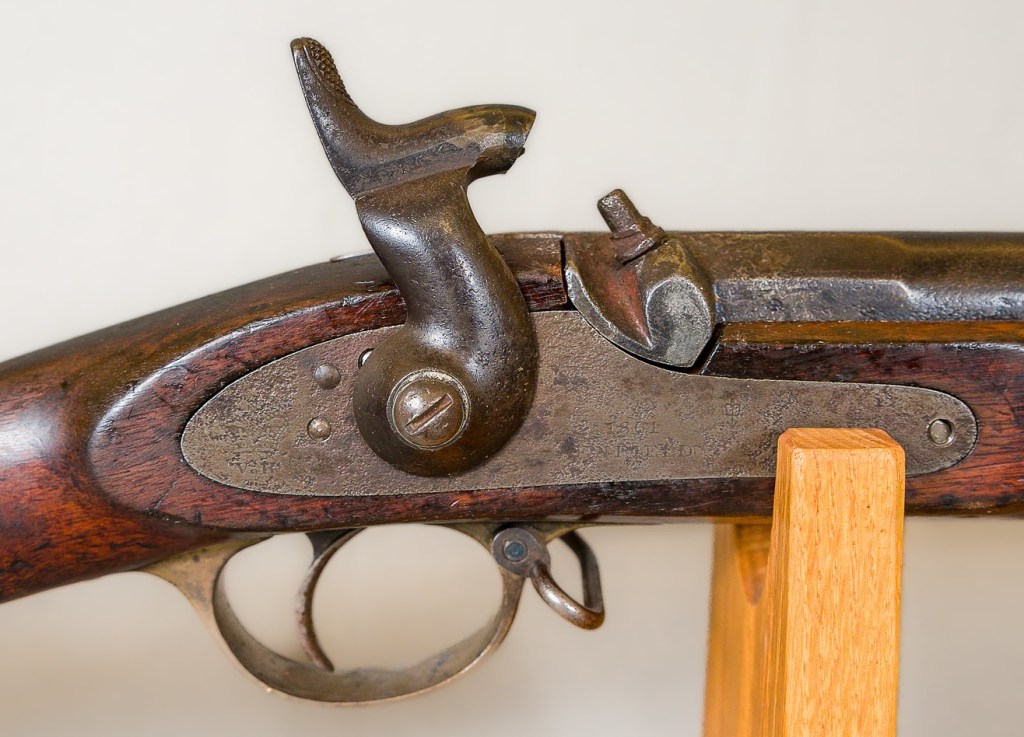
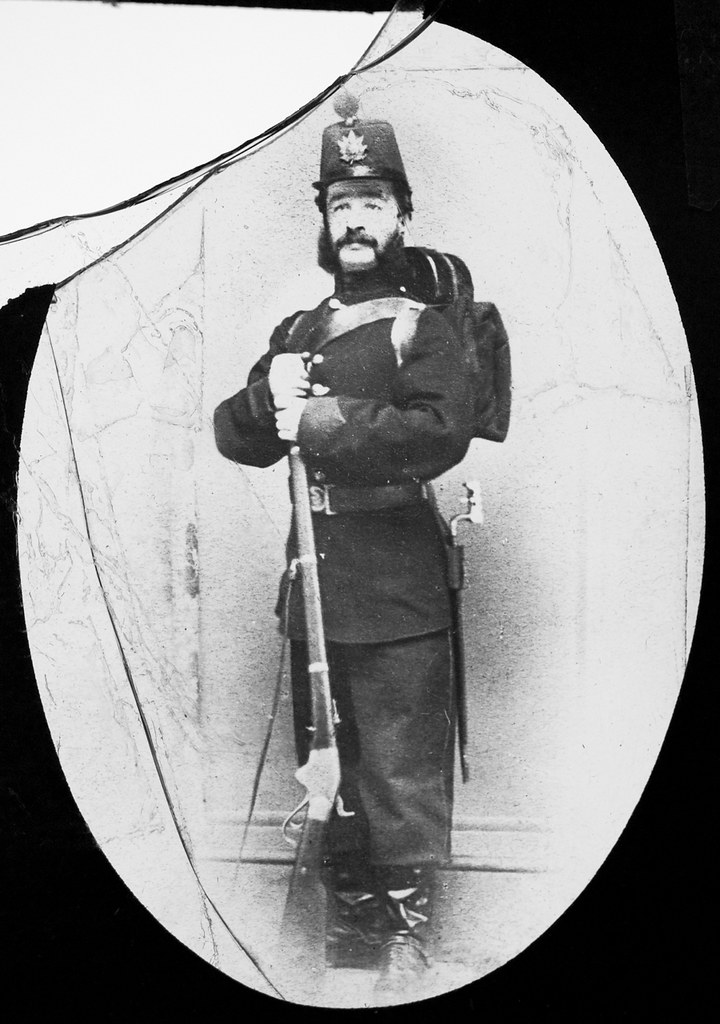
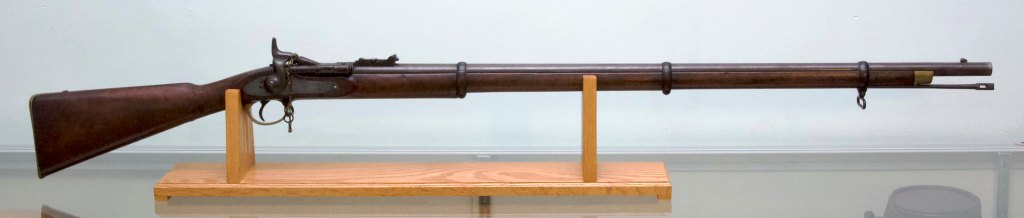
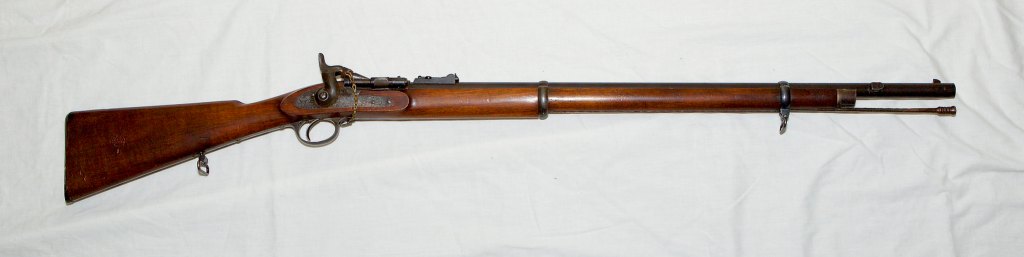
Just after the Fenian Raids, the Dominion of Canada required an upgrade to their issued firearms. With recent developments in firearm research, a breech-loaded firearm was standardized within the British military. The Dominion of Canada would follow suit with the conversion of its arsenal of Pattern 1853 Enfield rifle muskets to breech-loading Snider Enfields.

P53 Enfield Musket – QOR Museum Collection

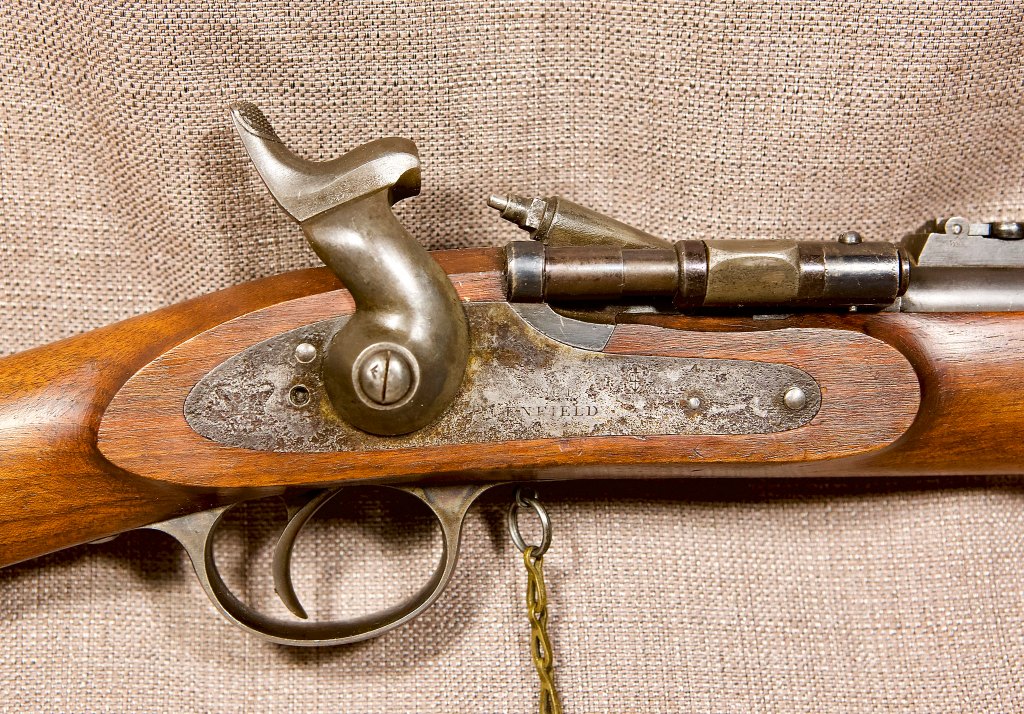
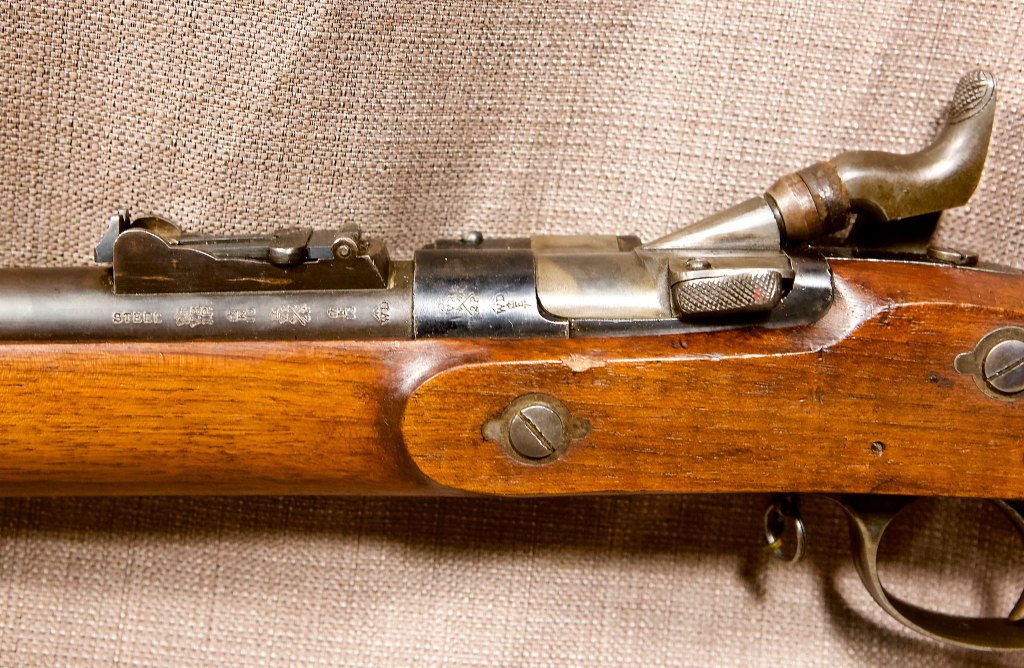
This occurred with the machining of the rear section of the barrel and adding a breach to it. This breach would lock back but also swing open like a door. With a rearward pull, the cartridge would be pulled out of the chamber and into the breach, allowing the rifleman to tip the rifle over and the cartridge to fall out onto the ground.

Snider Enfield – QOR Museum Collection
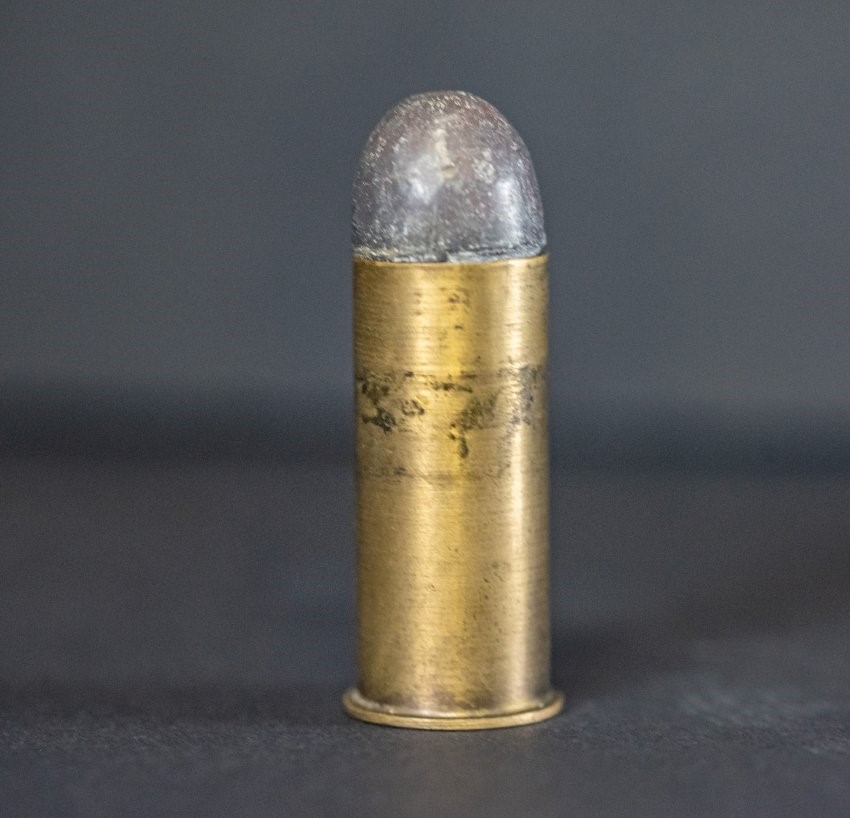
Replica .577 Snider Cartridge

With the conversion, this would be the first widely issued self-contained cartridge to be issued to the Imperial and Canadian Militia. Instead of having the charge (black powder) with the projectile and then a percussion cap (the ignition), the loading time for a Snider was increasingly shorter. Using the self-contained cartridge and only having to open the breach to insert the round, then closing the breach.
Transition Period

On February 26th, 1867, the Regiment was ordered to start exchanging their P53 Enfield muskets for Snider Enfields. For this transition period, the Regiment would be issued a transition period Firearm.

Assistant Adjutant General’s Office
Toronto 26 feb 1867
(1)

Militia District orders(1)

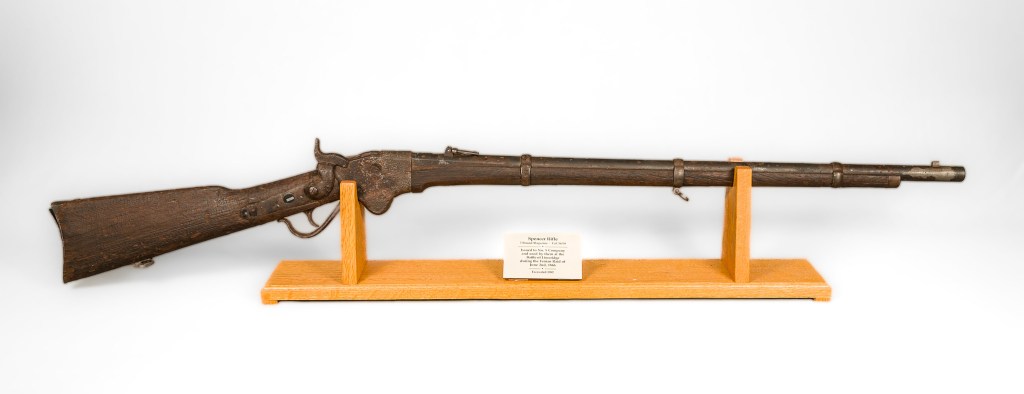
No. 1 As the issue of the Spencer rifles is only a temporary measure pending receipt of breech loaders, the imperial government would not sanction the marking of the arms.
No. 2 Unless when on service, it will not be necessary to carry more than 21 rounds of ammunition per man.
No. 3 No new description of pouches will be purchased, the issue of the Spencer rifles being only temporary.
No. 4 Application has been made to the imperial government to ascertain whether there are scabbards and slings in store; if there are not, steps will be taken to procure them.
No. 5 There is no ammunition for the use of the Spencer rifle, 21 rounds per man of the service ammunition may be needed for active service.

Headquarters
Toronto 27 Feb 1867
(1)

Regimental Orders


2 The Spencer repeating rifles will be issued Friday next, 60 to each company, and captains will be strictly held responsible that all rifles be lodged in the armoures after drill and that no man be allowed under any circumstance taking them home under further orders.

Rifleman holding a Spencer Rifle 1867 – QOR Museum Collection

Headquarters

Toronto 6 March 1867

Regimental Orders.(1)

No. 1 In addition to the Regiment’s No. on the sling of each rifle, the number to be found on the small of the rifle behind the hammer, is also to be placed on the roll in each armoury.
No. 2 The bayonets, screwdrivers and washers belonging to the Spencer Rifles will not be served out with the Rifles until further orders. Captains of Companies will see that they are put away carefully until required.
No. 3 Until the parade is formed, each company will place a sentry over its armoury to see that none but members of the company take out rifles. The doors will then be locked, and no one admitted until the parade is dismissed.

By Order
Otter
Capt & Adj

Spencer Repeater – QOR Museum Collection

Headquarters

Ottawa, June 14, 1867

General Orders(1)

No. 1 Arrangements have been made for the exchange of the rifles now in possession of the volunteers for Snider-Enfield breech-loading rifles.

No. 2 The exchange will be made with the least possible delay, and to effect which, depots of their rifles and of ammunition for the same will be found at Quebec, Montreal, Prescott, Kingston, Toronto and London from whence district staff officers may draw to supply the corps in their several districts.

No. 3 Upon receipt of these rifles by the several corps, the arms and ammunition at present in their possession are to be returned as follows.
The muzzle loading rifles and ammunition for the present, the provincial storekeeper at Quebec and the Peabody, Spencer, Westley Richards breech loaders with ammunition for the same to the provincial storekeeper at the district headquarters of the several districts to which corps in presentation of the last named arms belong.

No. 4 The arms to be returned are to be forwarded to their respective destinations by the most direct public convenience in the same boxes that contained the Snider Enfield breech loaders as received.

No. 5 The Commanding officers of each corps will be held responsible that the arms returned are clean, carefully packed, and properly addressed to their several destinations.

Headquarter
Toronto 23 Aug 1867
Regt Orders
(1)

The Snider Enfield Rifles having arrived, Officers Commanding Coys will see that the following articles are now in their respective org.

60 Spencer rifles
60 Spencer bayonets
60 spender cleaners
60 Spencer turnscrews
60 Spencer washrods.

are lodged in the different armouries by Saturday, the 24th, just at 8pm, in order that they may be at once packed up for exchange.

The bayonet scabbards must be returned to the quarter masters stores at the same time.

Slings to be retained in the armouries

by order

Otter Capt & Adj

3 Band Snider Enfield – QOR Museum Collection

Having done this transition in under 7 months is quite the accomplishment for a newly formed force. This upgrade would bring Canada to the forefront of firearm evolution and would aid the Canadian militia in the following Fenian Raids.

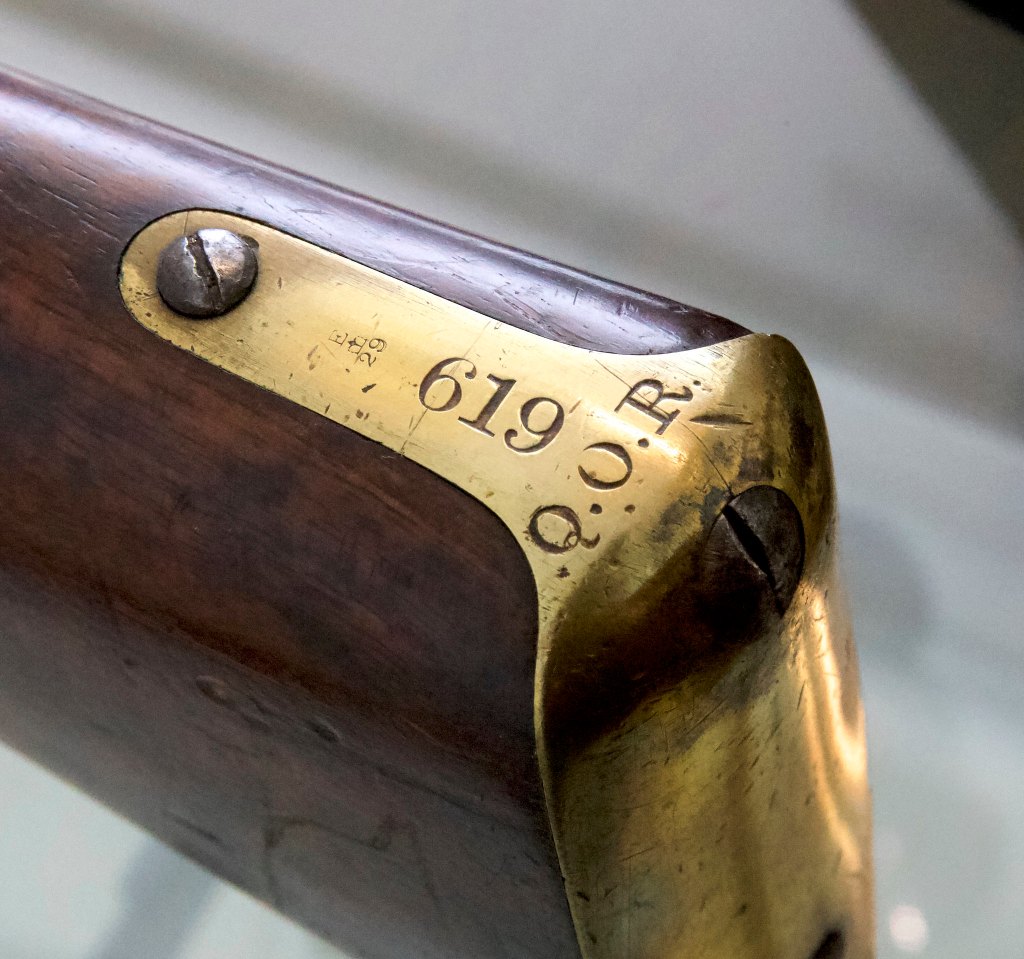
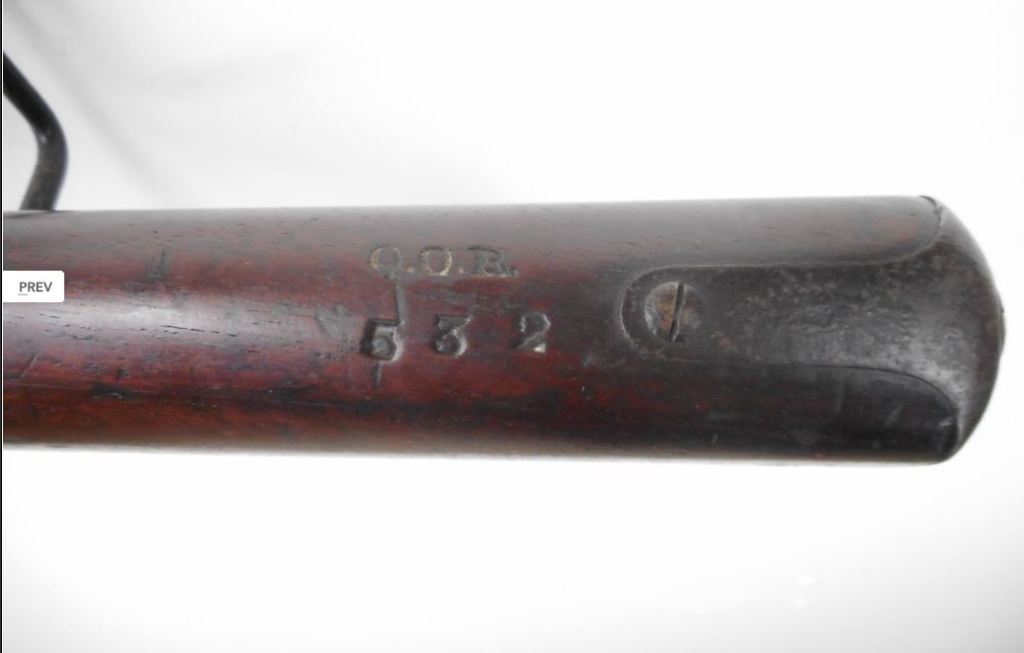
The 3 Band Snider Enfield was marked on the top of the brass butt plate “QOR” with the rack number which corresponds with a number on a rifle rack at the armouries of the Regiment.

3 Band Snider Enfield – QOR Museum Collection

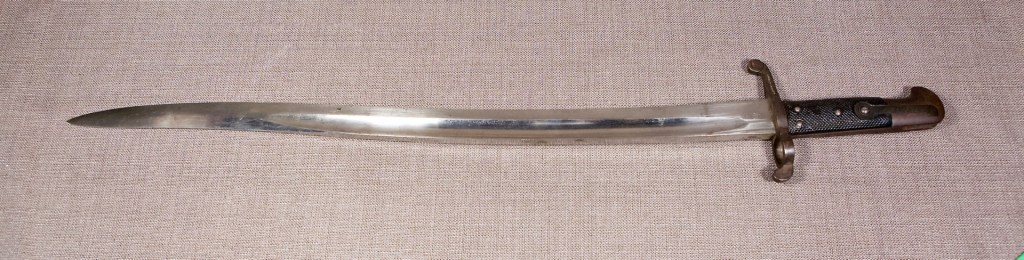
Within Rifle traditions, usually a shorter rifle was to be issued with the Baker rifle during the Napoleonic era, the Brunswick rifles being issued a sword bayonet (longer than the Flinklock Muskets of the Line Regiments). The Regiment, from its formation, was issued the 3-banded rifles (the number of barrel bands on the rifle) with a minor issue of short and long length Spencers during the Fenian raids of 1866. The Regiment’s 3-band Sniders would be replaced by a 2 Band Snider with the sword bayonet on 22nd February 1877.

22 February 1877 – An issue of 550 new Scout Snider Rifles (5 groves and steel barrels) made to the Regiment in exchange for the long Snider, also Accoutrements (Black) Second Hand, sufficient to make up the establishment in place of those condemned. (2)

2 Band Scout Snider – QOR Museum Collection
2 band Scout Snider Sword Bayonet – QOR Museum Collection

The new 2 Band Scout Snider rifles were Regimental marked “QOR” with a corresponding rifle rack number on the top of the wood buttstock. This was marked in this place due to the new rifles having a steel buttplate.

2 Band Snider Enfield – QOR Museums Collection

These New Scout Snider rifles with 2 barrel bands would serve the Regiment up to the adoption of the Long Lee Enfield/Metfords in 1897.

Thank you for reading!

Graham Humphrey CD

  1. Regimental Orders – QOR Museum Archives

2. Regimental Diary 1860-1895 – City of Toronto Archive

Evolution of Queen’s Own Officer’s Tunics

Fresh off the presses!!!

After along time researching and searching Sergeant Graham Humphrey has finally found the evolution of the Queen’s Own Rifles officer’s tunics from 1860 – today. Enjoy!

Evolution of Officer’s Tunics

History of the Lance Corporal Rank in The Queen’s Own Rifles of Canada

The practices throughout the history of the Regiment come and go, and over time you see reference to “Lance” rank but only used in the Regiment as an Acting Corporal. During the Second World War you see the use of Lance Corporal on parade states and promotion list but you will not see a photo of the wearing of a one chevron on the uniforms of any QOR Rifleman. Simply they just wore the rank of Corporal since it is an Acting Corporal rank in a Rifle Regiment. Below is a write up of a Memo that was written for the Regiment in 1942 but rewritten in 1954.


MEMO: RE: LANCE CORPORALS

ARMY HISTORICAL RESEARCH, VOLUME V, 1926

This book contains quite a lengthy and comprehensive article entitled “The Lancespessade and the History of Lance Rank” in the British Army, and covers a period of several hundred years, giving quotations from many authoritative sources on the subject.

The following are several quotations taken from the article:

“The term lance as a qualifying prefix to non-commissioned ranks, is peculiar to the British Army today, and is an interesting link with that period which the Military Organization of the Middle Ages was being transferred into that which, in its essentials, is still current: that is to say, with the end of the 15th, and the beginning of the 16th centuries. The word is derived from the italian lancia spezzata, literally a broken or shattered lance, Lance Corporal usually defined as the title of that rank which was granted to the lowest officer that “hath any commandment” and “signifies Deputie Corporal.”

“By the beginning of the 17th century, in England at least, the Lancespessade had become and Infantryman only, and almost exactly the equivalent of the Lance Corporal of present day.”

“Lance the Corporal of the Cavalry unit is to supply and do all duties of the Corporals and Lancespessades of the Foote.” The definition of a Lancespessade is given as “he that commands over ten soldiers, the lowest officer in a foot company.”

The article makes it quite clear that the rank of Lance Corporal was peculiar to the Infantry alone in the British Army, until long after the organization of Rifle Regiments, and it contains no reference to this rank ever having been introduced into Rifle Regiments.

REGULATIONS FOR RIFLE CORPS.

These Regulations were originally issued in 1800, by Colonel Coote Manningham, who is usually referred to as the originator of rifle regiments, and has become the first Commanding Officer of the Rifle Corps, now the Rifle Brigade. They are reprinted in a book bearing the same title, published in 1890, with certain amendments added.

Article 11 dealing with the Formation of the Corps, in so far as it relates to Sergeants and Corporals states as follows:

“The four Sergeants are to command a half platoon or squad each. The senior Corporal of each company is to act as Sergeant in the first squad.

The four Corporals are to be divided to the four half platoons. One soldier of peculiar merit is to act in each company as Corporals, and to belong to the third squad.

The Acting Sergeant and Acting Corporal are to be the only non-commissioned officers transferable from squad to squad.

In every half platoon one soldier of merit will be selected and upon him the charge of the squad devolves in the absence of both non-commissioned officers of it. As from these four Chosen Men (As they are called) all Corporals and Acting Corporals are to be appointed, the best men alone are to be selected for this distinction.

The graduation of rank and responsibility, from the Colonel of the Regiment to the Chosen Man of a squad, has how been detailed, and on no instance to be varied by whatever officer may command it.”

STANDING ORDERS OF THE RIFLE BRIGADE

These Standing Orders issued in 1911, make no mention of Lance rank, wither in the text or in the various sample forms of parade states, reports, etc., in the back of the book. Acting Corporals are shown.

Article 11 – Formation of the Regiment, section 18 states:

“Corporals and Acting Corporals are responsible to the Sergeants of their respective sections.”

A copy of the Standing orders referred to above was received by me from the O.C. The Rifle Brigade in 1925, and he states at that time that they were the last published Standing Orders, and that no material changes or amendments had been made since date of issue.

THE KING’S ROYAL RIFLE CORPS

In several volumes of the above covering a period of from 1820 up to some time in the 1890’s. There are a number of parade states, casualty lists, awards of various kinds such as good conduct badges, marksmen’s badges, etc., I could not find in these volumes any reference to Lance rank, but Acting Corporals are mentioned.

THE QUEEN’S OWN RIFLES OF CANADA

RE: LANCE RANK

REGIMENTAL ORDERS

Regimental Orders are complete from the first R.O. Issued in 1860 until the present date, and are on file in the records of the Regiment.

From the first R.O. Issued in April 26, 1860 until 1866, there is no mention of Lance rank in any form whatever. There were, however, appointments made as Acting Corporals.

R.O. May 19, 1865 states “The proper regulation chevrons for NCO’s of the QOR are as follows and will be worn on both arms:

For Corporals – 2 black stripes on a red ground.”

There is no mention of Lance Corporals, or the chevrons that they would wear.

In R.O. January 22, 1866, the promotion of a private to the rank of Lance Corporal appears for the first time. Further promotions to that rank appear in subsequent orders up to the year 1874, when they cease, and from that year on appointments to be Acting Corporals appear again, and continue to the present time. There has not been an appointment to Lance rank since 1874, a period of 68 years.

No R.O. Appears in 1865, 1866 or any subsequent year authorizing Lance rank, nor does any R.O. Appear in 1874 or subsequent years abolishing them.

NOMINAL ROLLS FOR ANNUAL MUSTER

The nominal rolls of all companies and units of the Regiment for the Annual Muster parade each year are complete from 1860 until the present time, and are on file in the records.

On these Muster Rolls Acting Corporals appear from 1860 until 1865 inclusive. In the years 1866 to 1874 Lance Corporals appear, and commencing with the year 1875 until the present time Acting Corporals are shown, but no Lance Corporals.

REGIMENTAL STANDING ORDERS

Regimental Standing Orders were issued only in the years 1862, 1872, 1880, 1883, and 1925. Copies of all these are on file in the records.

There is no mention in any of these Standing Orders of Lance rank, not even in those issued in 1872, a year in which some Lance Corporals existed in the Regiment. The lowest rank mentioned is that or Corporal, and the lowest rank badges provided for this is of Corporal.

CONCLUSIONS

  1. Lance rank originated in the Foot Regiments, later Infantry, of the British Army, and was peculiar to that branch of the service for several hundred years. During the 19th century it was adopted by some other red-coated regiments of other branches of the service, but not by Rifle Regiments.

  2. Lance rank was not in force in The Rifle Brigade in 1925, as will be seen by their Standing Orders issued in 1911, and the statement of the [Officer Commanding] that unit in 1925, and it is extremely unlikely that it now exists in that regiment.

  3. Lance rank was not in force in The King’s Royal Rifle Corps as will be seen from their chronicle up to the South African War.

  4. The Queen’s Own Rifles, when authorized as a rifle regiment, on organization in 1860, undoubtedly adopted the “Regulations for Rifle Corps” as was practised at the time by The Rifle Brigade and The King’s Royal Rifle Corps.

  5. The deviation from Regulations for Rifle Corps and the Standing orders of the Regiment, in The Queen’s Own Rifles from 1866 to 1874 is hard to account for now.

    It is possible that the Officer Commanding in 1866, through carelessness or otherwise, permitted this unauthorized deviation from the Regulations to creep in. It is quite clear, however, that he did not provide for the change in Regimental Orders, nor did he change the Standing Orders to provide for it.

    By 1872, another Officer Commanding was in command of the Regiment. He revised Standing Orders in 1872, but again no provision was made for Lance rank.

    By 1874, the late General Sir William Otter has assumed Command of the Regiment, and was, as is well known, a great stickler for regulations of the service and tradition. It is quite evident that it was he who abolished the unauthorized Lance rank in the Regiment no doubt to conform with the standing Orders of the Regiment which were based upon the “Regulations for Rifle Corps.”

    He did not issue an order abolishing Lance rank, probably because there had never been a regimental order authorizing it, but just let it fade out.

  6. With the exception, therefore, of the short period 1866-1874, when Lance rank was entirely unauthorized in The Queen’s Own Rifles, it has not existed in the Regiment. Nor has there been at any time during the Regiment’s 82 years of existence, and order authorizing it in the Regimental Standing orders.

  7. It is quite clear from the foregoing, that The Queen’s Own Rifles, in having Acting Corporals instead of lance Corporals, is following not only a Regimental custom, but a Rifle custom which was duly authorized on the organization of Rifle regiments in the British Service, and is still the practice in two of the best known Rifle regiments in the British Army.


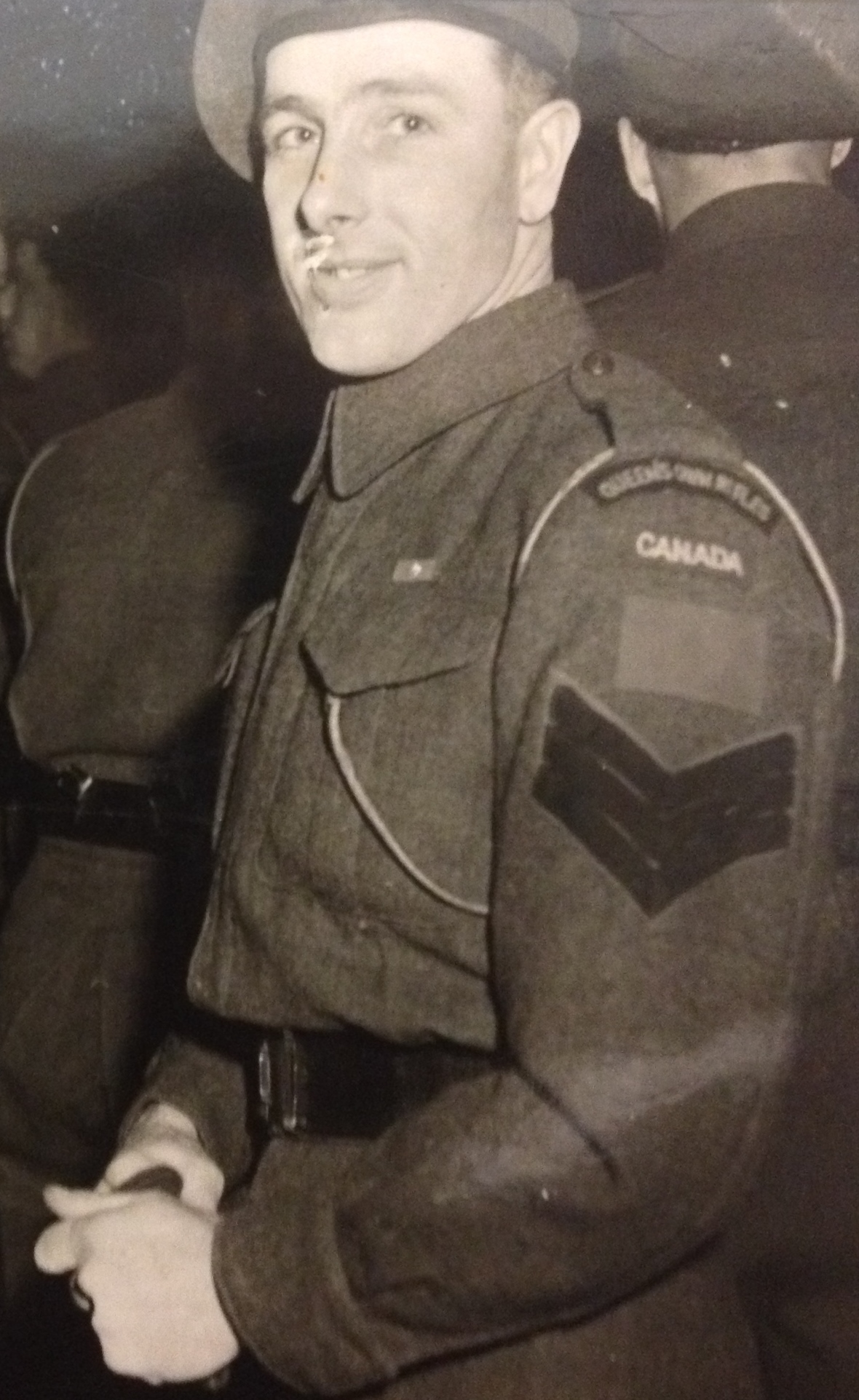
I hope you enjoyed this article as it shows reflection into the history and traditions of The Queen’s Own Rifles of Canada and our sister regiment’s in England. Throughout my research and studying of photos of The Queen’s Own Rifles throughout the history I have only found one photo (pictured below) that shows the wearing of one chevron and this photo was taken when the Regiment was deployed to Korea in 1955. After the above article was written you will see in photos the addition of a QOR Collar Dog above the Corporal Chevron (pictured below) which would be the present “Master Corporal” or meaning the Section Commander.

Sincerly,

MCpl Graham Humphrey


Seen here is an Acting Corporal during the Deployment to Korea in 1955
Seen here is an Acting Corporal during the Deployment to Korea in 1955 – QOR Museum Photo

Rifleman in line to call home - QOR Museum Photo
Rifleman in line to call home – QOR Museum Photo

D-Day Rifleman

Here is a visual of what a Rifleman would have looked like on D-Day.

output_atc4jx

Field Service Marching Order with respirator slung. Gas cape rolled on Belt. Veil camouflage around neck. Shell dressing under netting of helmet. Emergency rations in hip pocket.

A.V. Battle dress will be worn, patches, (Canada & QOR), sewn on, when other collected.

The A.V. Battle dress will be worn for a minimum of 48 hrs, as soon as possible. If any effects on body are noticed, they will be reported immediately.

HAVERSACK

  • Mess tins
  • Holdall (towel, soap, razor, etc.)
  • Knife, fork and spoon
  • 24 hour rations
  • Cardigan
  • Beret
  • Boot laces
  • 4 x 2
  • Cigarettes
  • Pair of socks
  • Brown mug

LARGE PACK

  • Leather jerkin
  • Boots (anklets if required)
  • Cap comforter
  • Towel
  • Boot brush, dubbin & polish
  • Canvas shoes
  • Shirt, Angola
  • Boot laces
  • Drawers, Celular
  • Writing kit
  • Vest, Summer
  • 3 pairs socks
  • Housewife
  • Cigarettes
  • Greatcoat packed on outside of pack, held on by kicking straps

Other

  • Respirator of Assault marching personnel only attached to pack.
  • G-1018 blanket, folded as for kit layout rolled in ground sheet, strongly lied and properly labelled. (This makes a roll about 2 ½ feet long.)
  • All packs, Haversacks, Greatcoats (inside belt), ground sheet, to be marked with Rank, Name, Number and Coy mark.
  • Assault troops are all that land on “D” day.
  • 1 suit of denim to be collected at a later date.
  • Serge suit for all assault personnel, both riding & marching, less those with coys, will be turned in when notified to coy stores. They will be marked as laid down. They will be returned after “D” day.
  • Serge suit for those on follow up vehicles will be put in their Blanket rolls.

Here are some Pre Invasion photos from our Archives:

May 1944 - QOR Museum’s Photo
May 1944 – QOR Museum’s Photo

May 1944 - QOR Museum’s Photo
May 1944 – QOR Museum’s Photo

May 1944 - QOR Museum’s Photo
May 1944 – QOR Museum’s Photo

May 1944 - QOR Museum’s Photo
May 1944 – QOR Museum’s Photo

May 1944 - QOR Museum’s Photo
May 1944 – QOR Museum’s Photo

Pioneer Cpl 1944 - QOR Museum’s Photo
Pioneer Cpl 1944 – QOR Museum’s Photo

To see the War Diaries for Pre and Invasion visit the link below

War Diaries 1944

Cheers,

MCpl Graham Humphrey

Enlisted Uniforms of the Queen`s Own Rifles of Canada in World War Two

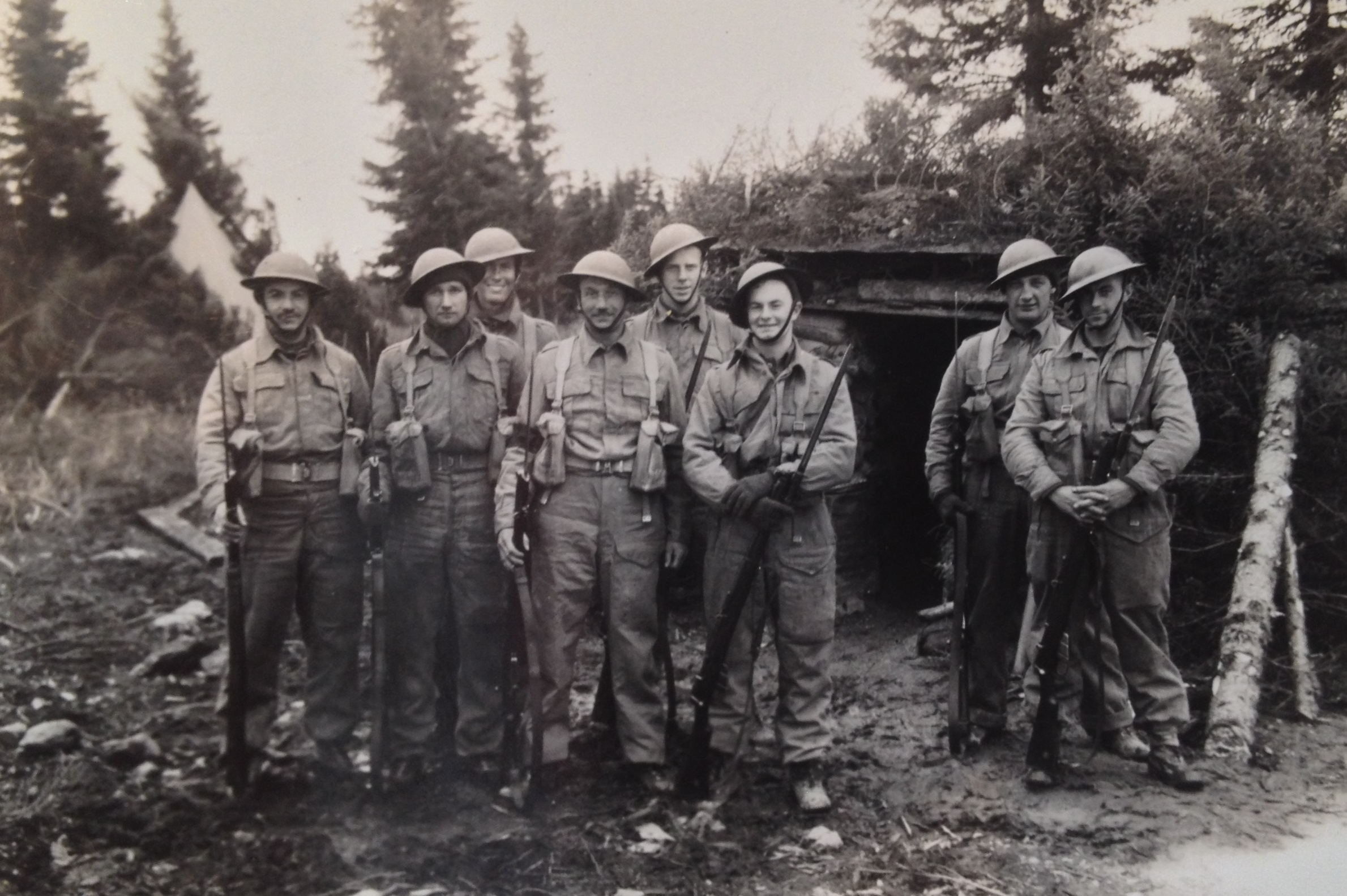
The Queen’s Own mobilized for the Second World War on 24 May 1940. The Regiment’s first assignment was the defence of the two strategic airfields of Botwood and Gander, Newfoundland then a posting to New Brunswick for additional training and integration into 8th Brigade. Eventually, the Regiment was posted to England, in July 1941, as a part of the 8th Canadian Infantry Brigade of the 3rd Canadian Division. During the Regiment’s training in the UK, the Colonel-in-Chief, Queen Mary, visited the battalion in Aldershot.

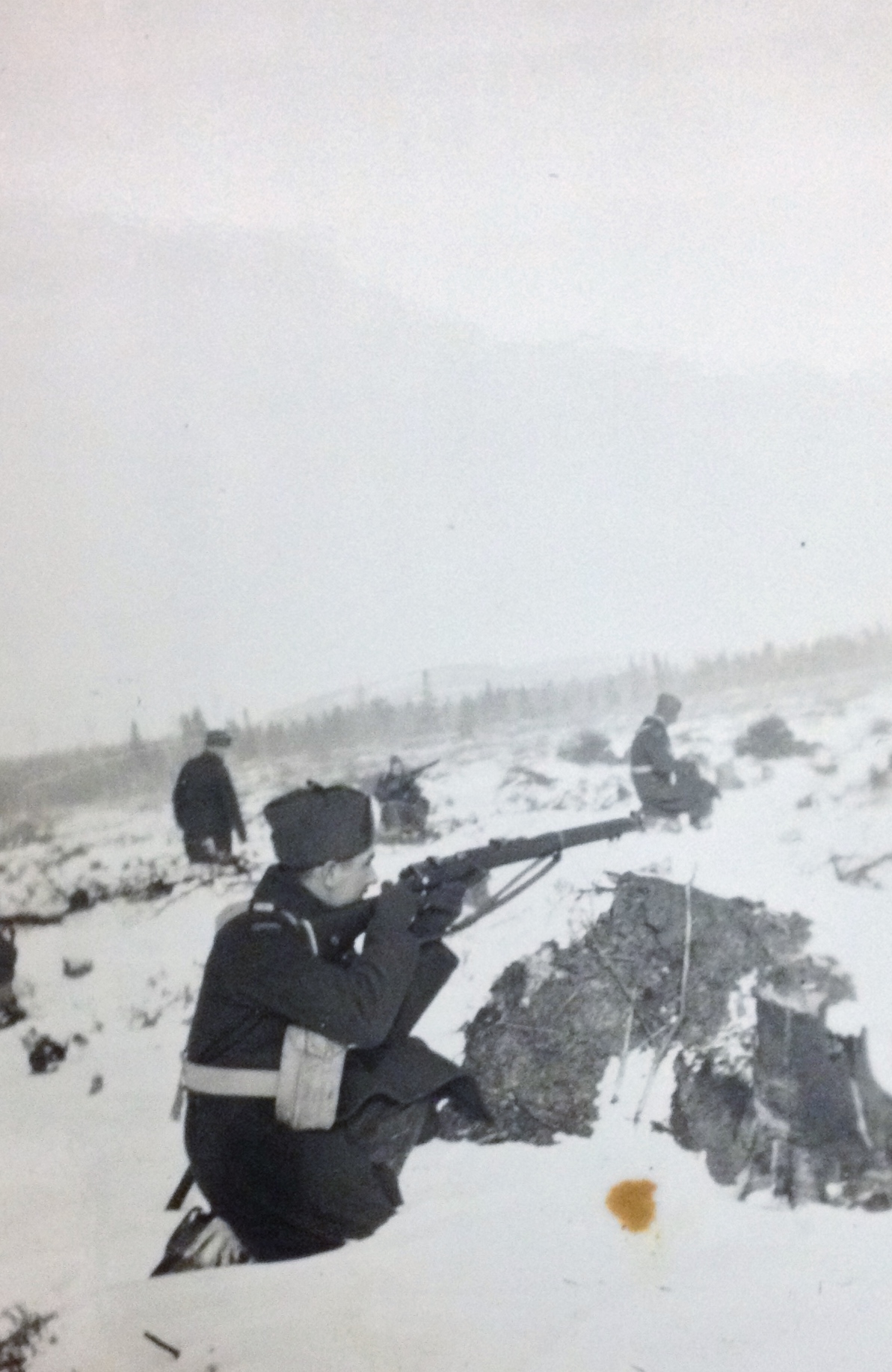
The Queen’s Own’s first action came forming part of the assault wave of the D-Day invasion, 6 June 1944. The Dalton brothers — Majors Charles O. and H. Elliott– were the assault company commanders in the landing. The Regiment hit the beach at the small Normandy seaside resort of Bernieres-sur-Mer, shortly after 0800 hours, on 6 June 1944. They fought through Normandy, Northern France, and into Belgium and Holland, where they liberated the crucial channel ports. In capturing the tiny farming hamlet of Mooshof, Germany, Sergeant Aubrey Cosens was posthumously awarded the Victoria Cross.

The last action of the war for The Queen’s Own Rifles came at 1200 hours on 4 May, when C Company attacked a cross roads just east of Ostersander, Germany. It was taken by 1500 hours, and the order came to discontinue fire on the enemy unless fired upon. Unfortunately, two members of The Queen’s Own lost their lives on this the last day of the war in Europe. The official cease-fire came at 0800 hours on 5 May 1945 followed by VE Day on 8 May. The battalion paraded to a church at Mitte Grossefehn and Major H.E. Dalton, now the acting Commanding Officer, addressed the Regiment. During the war 463 Queen’s Own were killed in action and are buried in graves in Europe and almost 900 were wounded, many two or three times. Sixty more QOR personnel were killed serving with other units in Hong Kong, Italy and Northwest Europe.

Mobilization

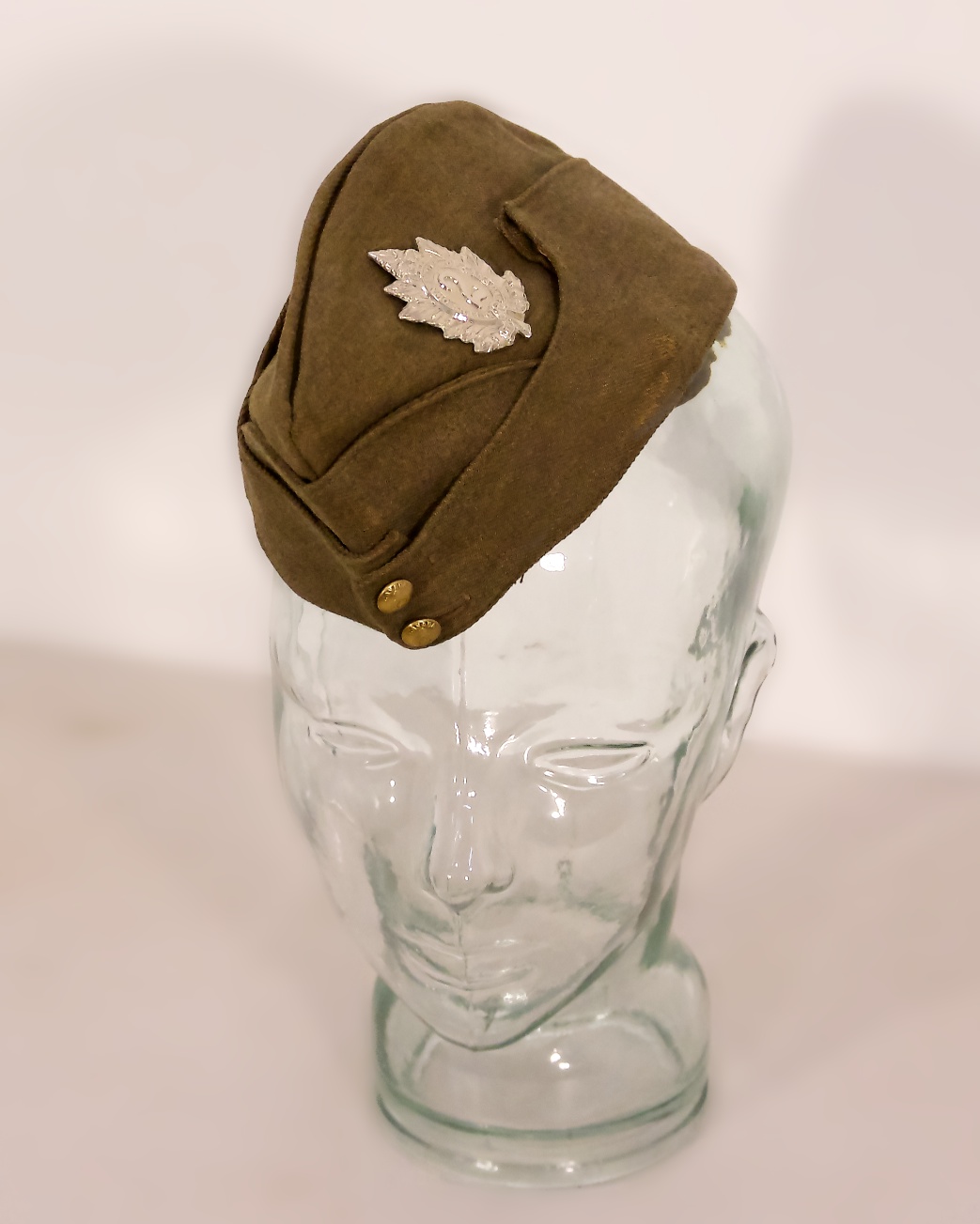
During the mobilization of the Regiment in 1940 the regiment was sent straight to Camp Borden (CFB Borden). There, the Regiment got its first issue of uniforms which consisted of; Canadian Battle Dress trousers and blouse, shirt, ammo boots, Anklets,  and the pre-war QOR wedge cap. The QOR has been using the Rifleman green wedge cap ever since roughly the 1870s. The cap is a green melton wool with a scarlet Pom-pom attached to the front as well as two Rifleman small buttons. Scarlet piping is added along the top seam of the cap as well the QOR cap badge mounted on the left side.

Wedge Cap 1 - Graham
Pre war QOR Wedge cap – QOR Museum

Request for approval of the wearing of Coloured F.S. Cap NDHQ 14 October 1940

Coloured F.S. Cap

Reg H.200-1-17 of 7 Sept.

The coloured F.S. Cap worn by this Regiment, both 1st and 2nd battalions, is described below. It has been in use for many years but it is not known whether or not details are in possession of N.D.H.Q.

The pattern of the cap is slightly different from the issue cap, being more rounded in front.

Officers

Colour of cap, flaps and crown – Black

Piping top, front and back seems – Black

No piping on flaps.

Scarlet grenade 1″ in diameter attached at front of top where two top seams meet.

Height of flap at back……………….. 2 1/4″

Height of crown seam, midway….. 4″

Height of crown seam, 1/4 way back

from front seam……………… 3 3/4″

Height of junction of top seams

at front…………………………2 1/2″

Other Ranks

Colour of cap, glaps and crown – Rifle Green.

Piping top, front and back seams – Scarlet.

No piping on flaps.

Scarlet wool ball 1″ in diameter attached at front of top where two top seams meet.

Height of flap at back……2″

Height of crown seam, midway…… 3 7/8″

Height of crown seam, 1/4 way back

from front seam………3 3/4″

Height of junction of top seams

at front…….. 2 3/4″

May the above be forwarded for approval,

Please.

Lt Col

Commanding 1st. Bn. Q.O.R. of C. (CASF).

Camp Borden – 1940 Rfn Jim Wilkins Personal Photos

Camp Borden – 1940 Rfn Jim Wilkins Personal Photos

Camp Borden – 1940 Rfn Jim Wilkins Personal Photos

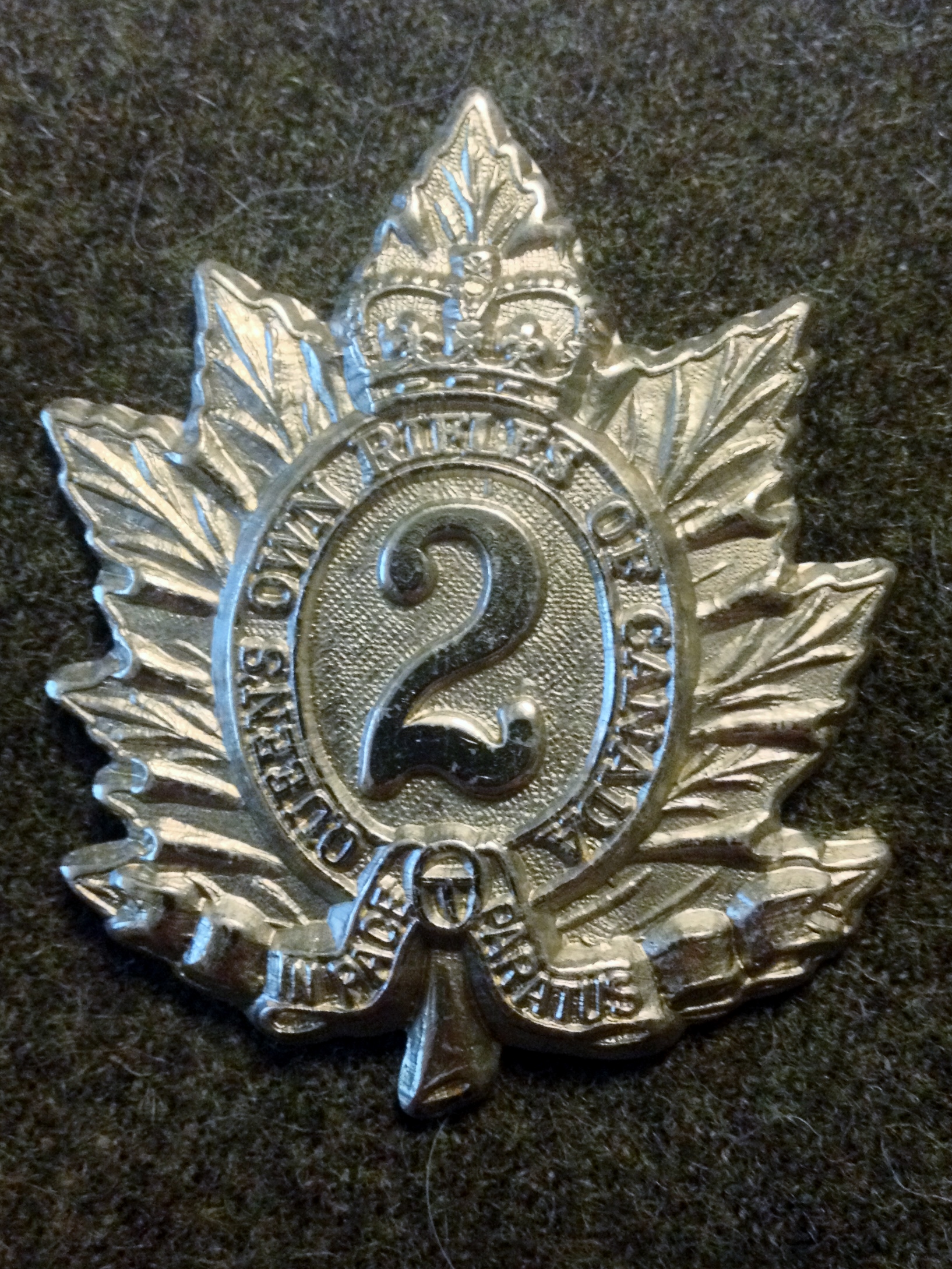
QOR cap badge 1940
QOR cap badge 1940 made of white metal – Graham Humphrey’s Collection

Regimental Orders by Major MacKendrick E.D. Comd 1st Bn QORofC

Camp Borden, Ontario 12 July 1940

Dress, Officers & Other Ranks

Extract C.A.S.F. R.O.521

  1. The collar of the battle dress may be worn open on all occasions during the summer season.
  2. The regulation Khaki shirt will be worn with battle dress. The wearing of various coloured shirts and collars is not permitted.
  3. Other ranks will not wear ties
  4. The collar of the blouse may be lined to protect the neck.
  5. The ribands of orders, decorations, and medals will be worn in undress, service dress and battle dress in the prescribed manner.

QOR in Sussex, New Brunswick 1940 – QOR Museum Photo

QOR in Sussex, New Brunswick 1940 – QOR Museum Photo

1940

7 August 1940 Botwood and Gander, Newfoundland

6 December 1940 Sessex, New Brunswick

Before leaving Borden in August 1940 the Regiments dress was fresh new stocks of the new Canadian made battle dress uniform. Consisting of ankle boots, ankle gators, wool trousers, suspenders, wool tunic, and wool greatcoat. As well, Canadian-made Pattern 37 webbing which consisted of basic front pouches, web belt, cross straps, canteen and holder, entrenching tool and sheath, bayonet frog, and the chest respirator were included. Additionally, Canadian-made denim working uniforms were adopted for use in training and work around camp.  The headdress was the QOR pre-war Rifleman green field service cap, the Mk1 helmet, or a wool winter toque. Shoulder insignia was a black pin-on QOR title or a worsted black QOR on a wool slip-on worn on the epaulette of the battledress.  The standard rifle was the Short Magazine Lee-Enfield No. 1 Mk. III* with the long bayonet (termed a ‘sword’ in Rifle regiments) which had been in use since the First World War. Transferring from Newfoundland to Sussex, New Brunswick several changes occurred with the exchange of the Mk1 helmet to the new Mk2 helmet, and the adoption of a winter wool cap. This was worn squarely on the head with the Regimental cap badge fixed centre on the front of the front flap of the cap.

Regimental Orders by Major MacKendrick E.D. Comd 1st Bn QORofC

Camp Sussex, N.B 11 mar. 1941

Wearing of Chevrons on Greatcoats; Chevrons will be worn on both arms of greatcoats in the following manner: – above the elbow, the points of the 1 bar chevrons 9 inches, the 2 bar 9 ½ inches, and the 3 bar 10 ½ inches from the top of the sleeve, point downwards.

Regimental Orders by Major MacKendrick E.D. Comd 1st Bn QORofC

Camp Sussex, N.B. 21 dec 1940

Dress – Winter Order

Attention is drawn by the Brigade Major to the following Brigade Orders.

(a) Winter caps will be brought into wear for all purposes with effect from 27 Nov. 1940

(b) Greatcoats and/or overshoes may be worn in camp and on training parades at the discretion of Officers Commanding units.

(c) Until further orders greatcoats and overshoes will be worn on all parades, both training and ceremonia,l at which more than one unit is present.

(d) Greatcoats will be worn on all occasions in “Walking-Out Order” on duty in the town of Sussex and on leave or pass until further orders. Overshoes may be worn at  discretion of Officers Commanding units in “Walking-Out Order”.

Wearing of Winter Caps; Winter caps will be worn squarely on the head. (Bde. Order 176)

Newfoundland – 1940 Rfn Jim Wilkins Personal Photos

QOR in Newfoundland 1940
QOR in Newfoundland 1940 – QOR Museum Photo

QOR in Newfoundland 1940
QOR in Newfoundland 1940 – QOR Museum photo

QOR in Sussex, New Brunswick 1940
QOR in Sussex, New Brunswick 1940 – QOR Museum photo

QOR in Sussex, New Brunswick 1940
QOR in Sussex, New Brunswick 1940 – QOR Museum photo

1941

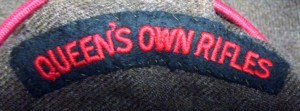
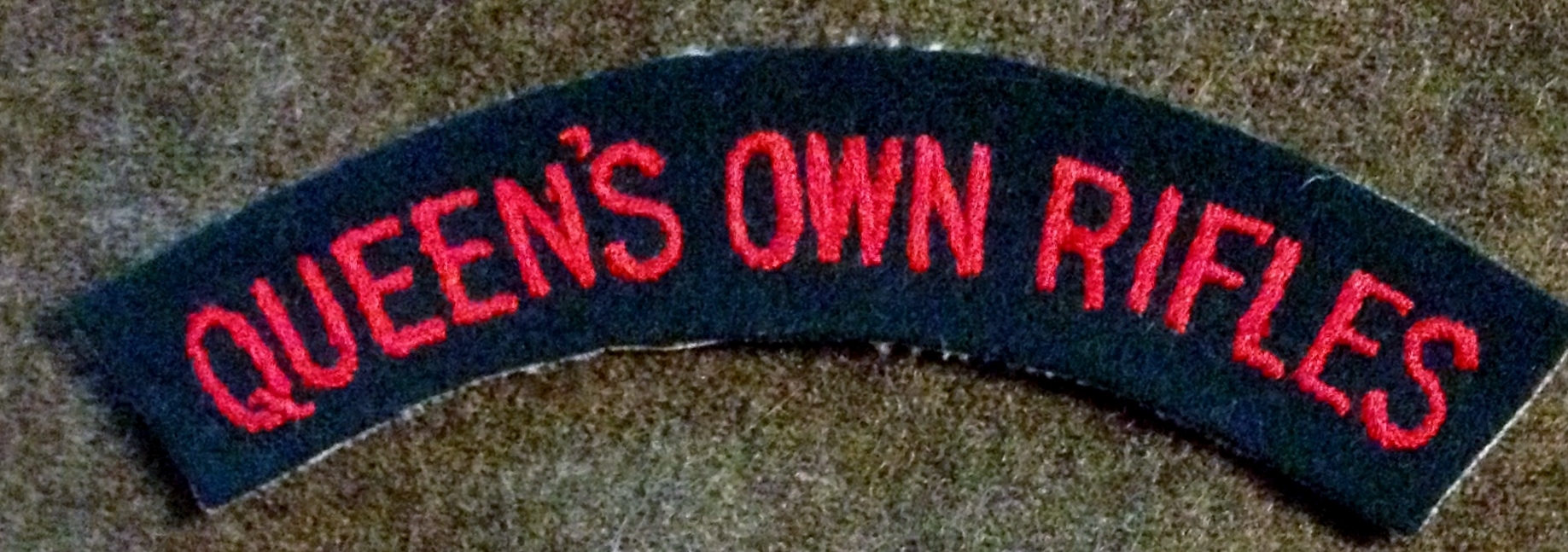
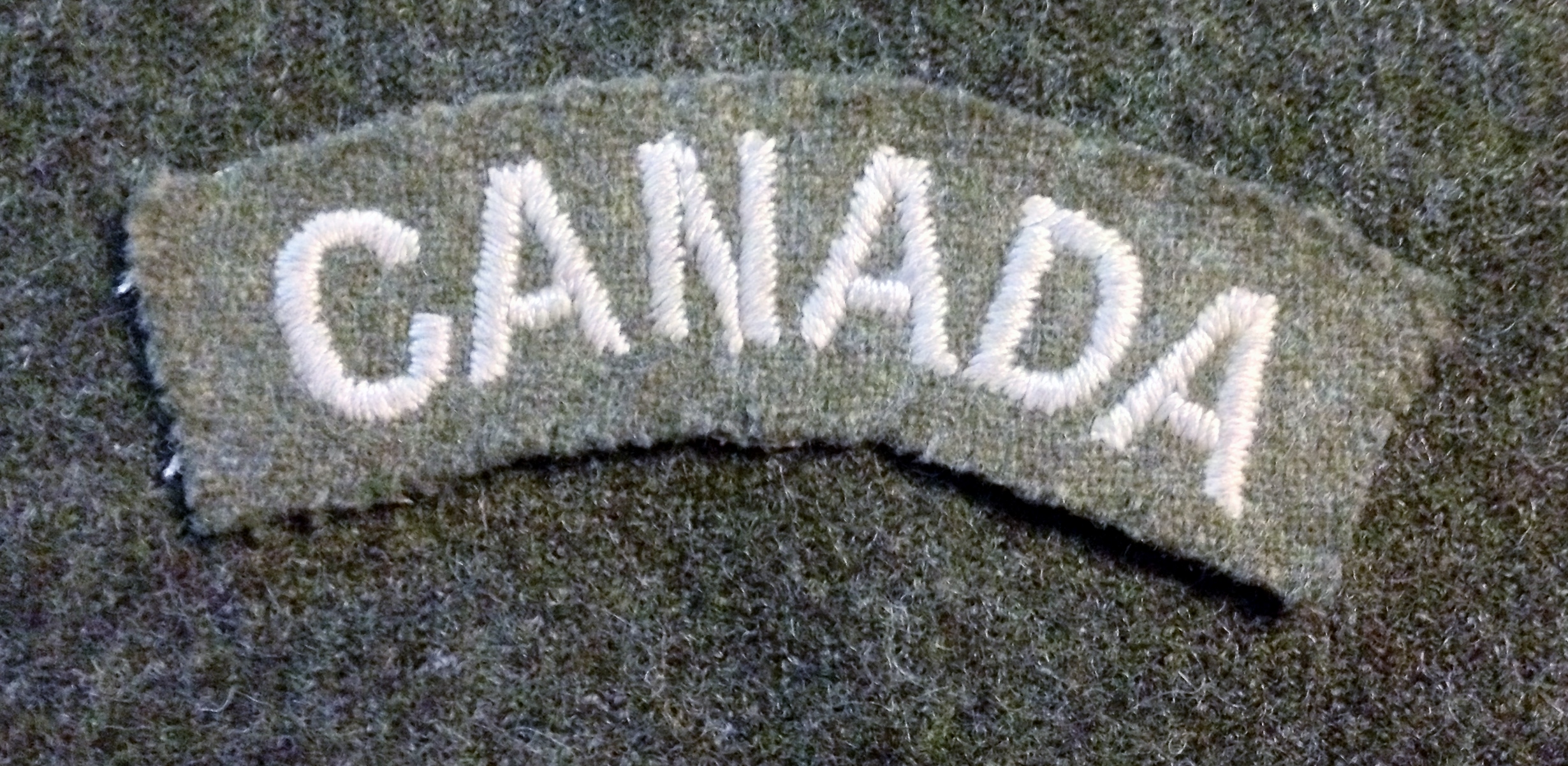
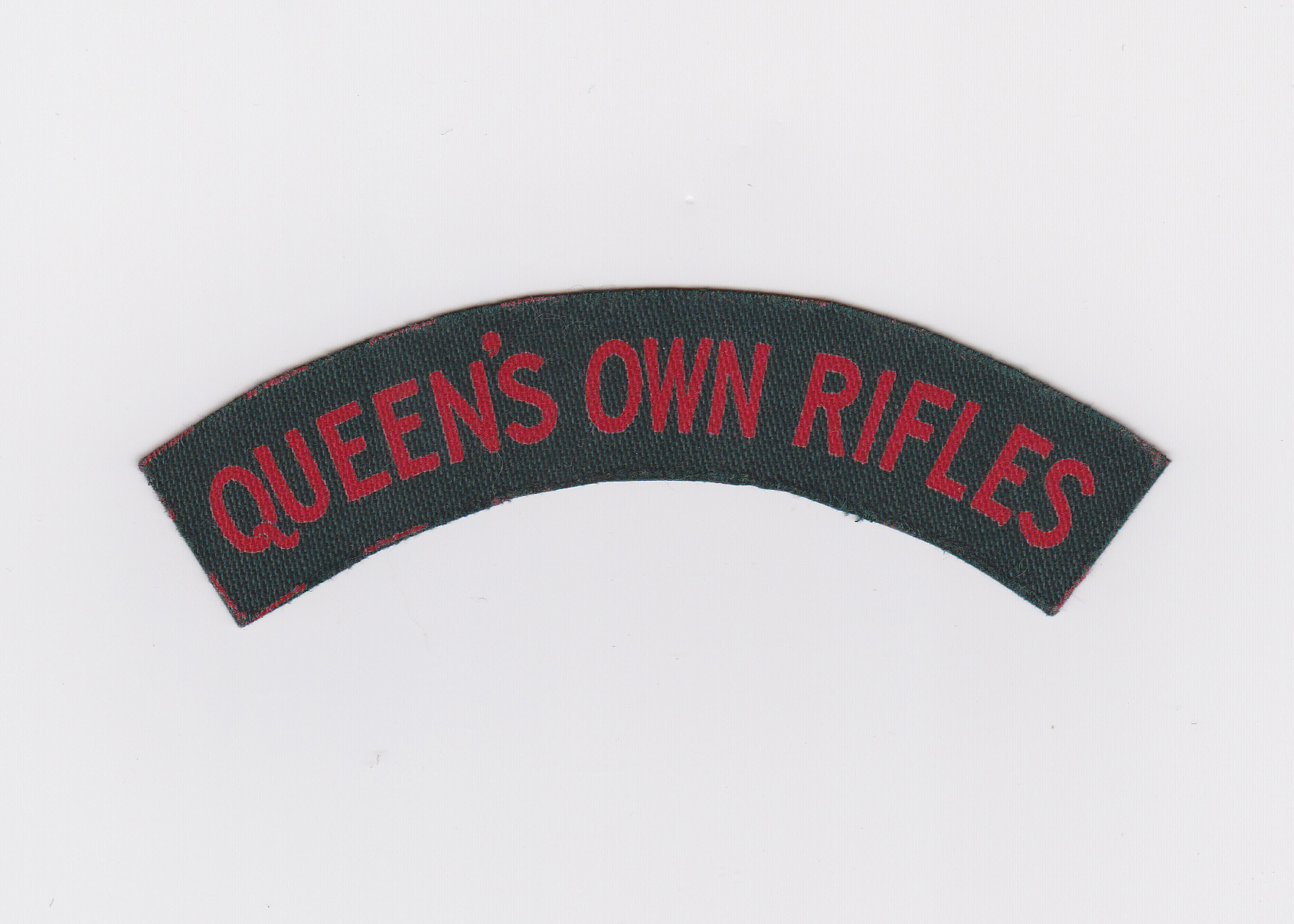
With the transfer of the Regiment to England in July 1941, a number of changes to the accoutrement of the Regiment occurred. The change from the QOR pin-on or worsted QOR slip-on to a red stitched “QUEEN’S OWN RIFLES” on a rifle green backing occurred. Since the shoulder title didn’t include “CANADA”, the QOR adopted the white-stitched “CANADA” title – either curved or straight – which was stitched below the Regimental shoulder title. Also, we see the addition of a QOR Decal on the Mk II helmet which consisted of a red, green, red, green, and red. At this time, each Regiment in the Canadian military was permitted to adopt a lanyard colour. The QOR retained their red lanyard, which differs from the the black lanyard worn by today’s Rifle regiments. This red lanyard was worn until the end of the war.

Canadian made 1940
Canadian made 1940

British made 1943
British made 1943 – Graham Humphrey’s Collection

Canada shoulder title curved made in 1940
Canada shoulder title curved made in 1940 – Graham Humphrey’s Collection

Canada shoulder title straight made in 1941
Canada shoulder title straight made in 1941 – Graham Humphrey’s Collection

QOR Helmet decal seen here in 1942
QOR Helmet decal seen here in 1942 – QOR Museum Photo

22 May 1925 Standing Orders and Instructions

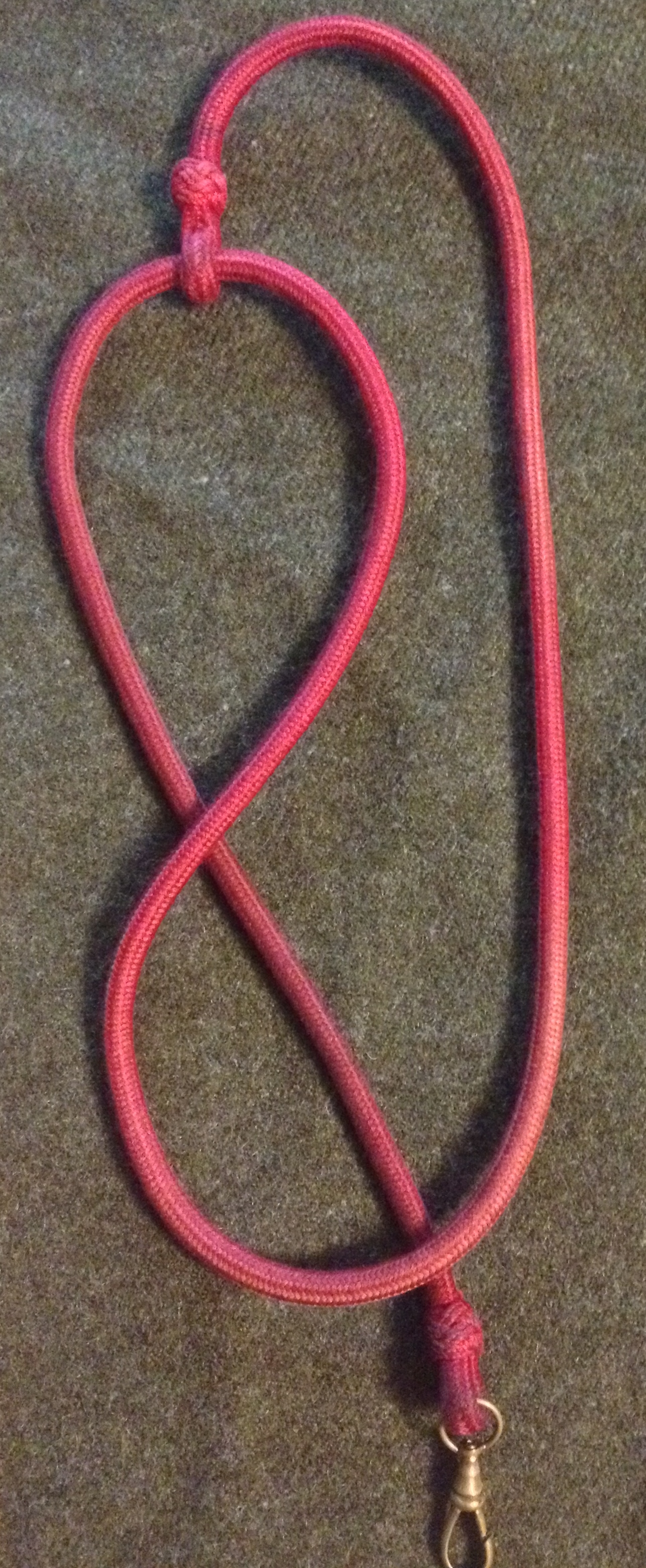
204. WHISTLE CORD shall be of red cord worn around left arm under shoulder strap.

QOR Red whistle lanyard
QOR Red whistle lanyard – Graham Humphrey’s Collection

15 Dec.  1942 Standing Orders and Instructions

  1. Dress

Officers

(b) Officers will wear black anklets and boots and black ties with battledress, in field service dress, black shoes and socks, black tie and F.S.Green.

Other ranks

(e) A red whistle cord will be worn on the left shoulder by all officers, warrant officers and sergeants.

(i) Some of the irregularities noticed in the dress of the Cdn. Corps are as follows:

The wearing of canvas shoes when walking out. The battle dress blouse undone at neck, except when marching easy. Men either without F.S. Cap or carrying it under shoulder strap.

(j) Badges – On joining the unit each man will be provided free with regt. Badges, cap, shoulder badges Q.O.R., Canada and Div. Patch also cap F.S. Green. From then on he will be held responsible that he is always in possession of these articles.

(k) The F.S. Cap green will not be worn when on duty with troops, but will be only worn off duty, church parades or when walking out.

(o) Chin straps and regimental flashes will be worn on the left side of the helmet.

(p) Good conduct Stripes are awarded after two years good service and are worn on the left arm below the elbow.

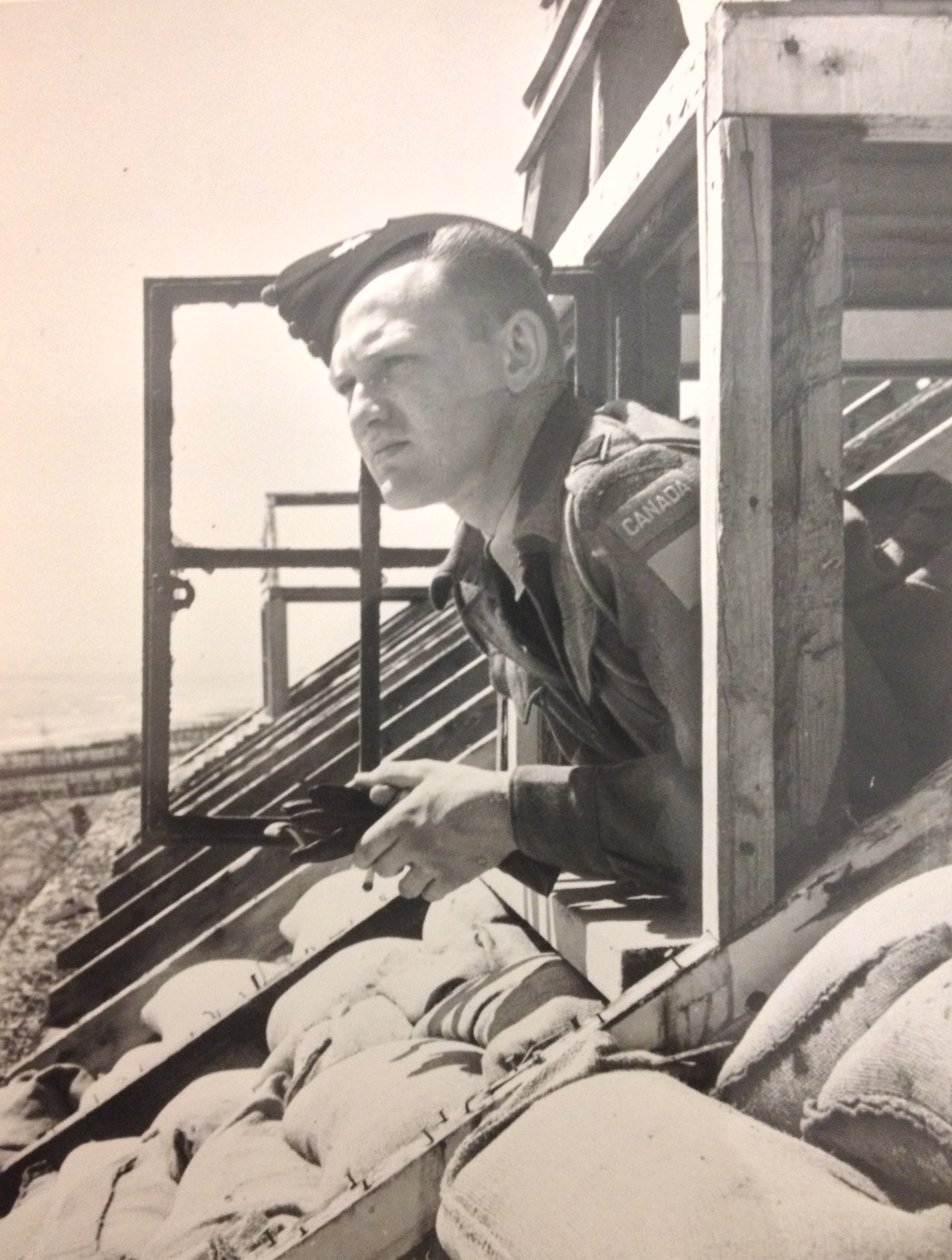
QOR Officer looking over the channel
QOR Officer looking over the channel – QOR Museum Photo

QOR Sgt in Holland 1945
QOR Sgt in Holland 1945 – QOR Museum Photo

  1. Order of dress

Uniformity of dress is to be stressed at all times.

(a) Battle Order

  • Battle Dress – anklets
  • Steel Helmet (With of without net as ordered)
  • Web Equipment (braces to be worn)
  • Respirator (slung over right shoulder under waistbelt. Mounted personnel will wear respirator at alert)
  • Water Bottle (on right side)
  • Haversack (with ground sheet or gas cape as ordered)
  • Sword under left arm
  • Gas cape (on shoulder if ordered)
  • Entrenching tool
  • G1098 ammunition.

(b) Marching Order

  • As above except – pack carried in place of haversack.
  • Haversack slung at left side.
  • Respirator at “Alert Position”.

(c) Fatigue Order

  • Battle dress, denim and boots.
  • Other equipment as ordered

(d) Church Parade Order

  • Battle Dress and anklets.
  • F.S. Green Cap.
  • Respirator and helmet (if ordered)

(e) Guard and Picket Order

  • Battle Dress and anklets
  • Steel Helmets
  • Skeleton web
  • Respirator at “alert position”
  • Gase Cape (rolled on shoulder)
  • Detector sleeves

(f) Walking Out Order

  • Battle Dress
  • F.S. Green Cap
  • Anklets – (may or may not be worn).
  • Black shoes and socks may be worn by those in possession of them in lieu of boots.

(g) Drill Order with Pouches

  • Steel Helmet
  • Web braces, belts & pouches
  • Sword at left side of the belt
  • Battledress and anklets

(h) Piquet Order

  • F.S. Khaki cap
  • Waistbelt and sidearm
  • Battledress and anklet

With the formation of the 3rd Canadian Infantry Division, the QOR was place in its 8th Brigade with Le Regiment de la Chaudiere and the North Shore (New Brunswick) Regiment. The Divisional formation patch was of French Grey Melton wool fabric which measured 3 inches by 2 inches. A number of shades of this French Grey were seen throughout the war.

Canadian made 1940 Third Division flashes
Canadian made 1940 Third Division flashes – Graham Humphrey’s Collection

British 1943 made Third Division flashes
British 1943 made Third Division flashes – Graham Humphrey’s Collection

QOR 1943 tunic
QOR Riflemans 1943 tunic – Graham Humphrey’s Collection

Starting in 1941, the headdress of the Canadians changed from the pre-war QOR Rifleman Green Wedge to a Khaki wool “Field Service Cap”. This was worn with a slight angle to the right and centred on the head. The location in which the QOR cap badge was mounted was on the left side similar to the QOR rifle green wedge cap.

Canadian made 1941 Field Service Cap
Canadian made 1941 Field Service Cap – Graham Humphrey’s Collection

QOR Rifleman England 1942
QOR Rifleman England 1942 – QOR Museum Photo

1943 In mid 1943, the headdress of the Canadians changed once again with the adoption of the beret. In keeping with rifleman tradition, the wearing of a rifle green backing behind the cap badge was authorized. The backing was of Melton Rifle Green wool and roughly measured 25cm by 25 cm with the Cap Badge centred within the patch. The wearer would have the leather band of the beret two fingers over the eye brows with the Cap badge over the middle of the left eye. The excess material was draped over the right side and pulled back.

Canadian made 1944 Beret with QOR Badge and Backing
Canadian made 1944 Beret with QOR Badge and Backing – Graham Humphrey’s Collection

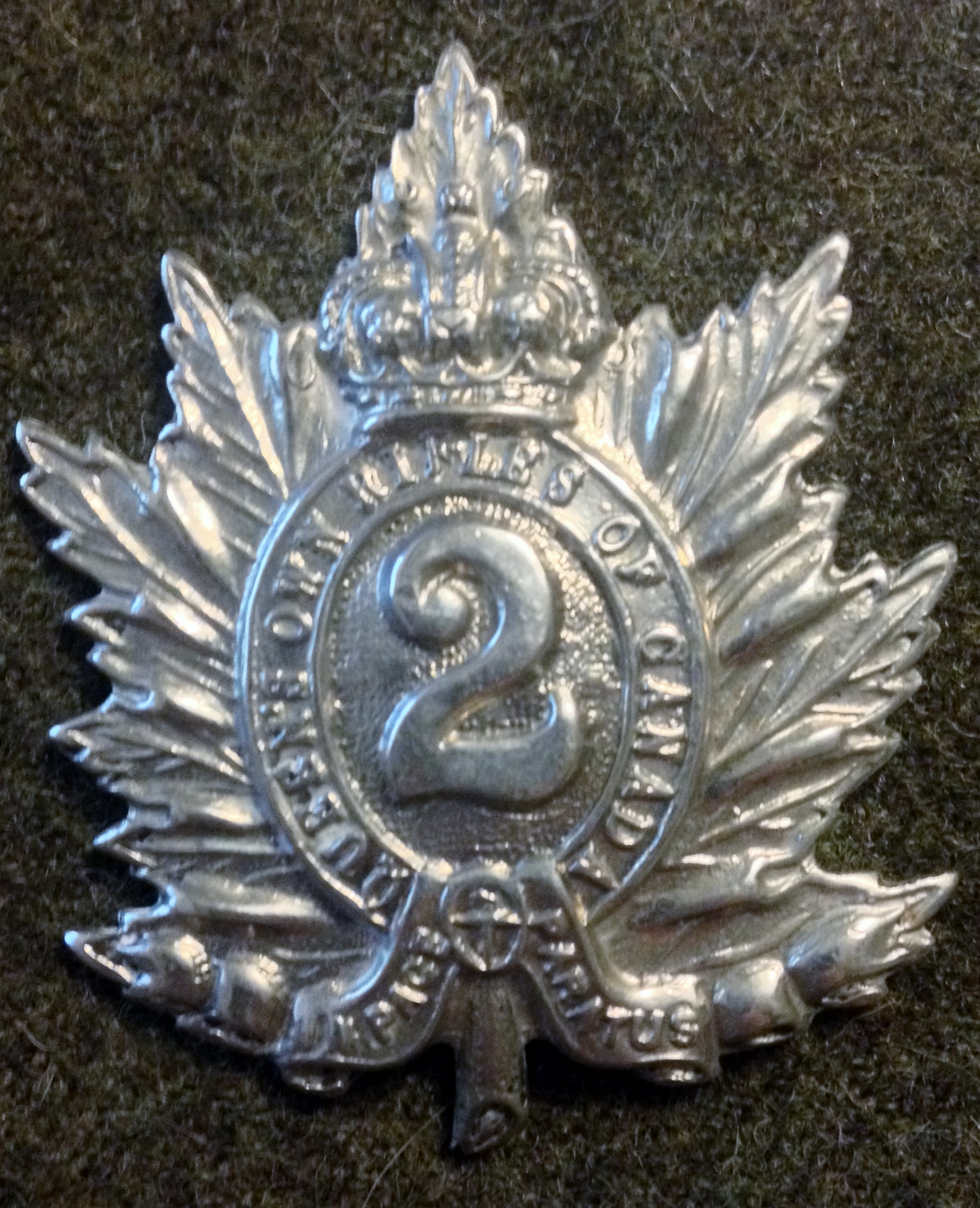
In 1943-44, a different QOR cap badge was introduced. Mainly seen on replacements of this time period, the cap badge contains less detail and the Arabic number “2” less defined.

1943-44 QORofC Cap Badge - Graham Humphrey's Collection
1943-44 QORofC Cap Badge – Graham Humphrey’s Collection

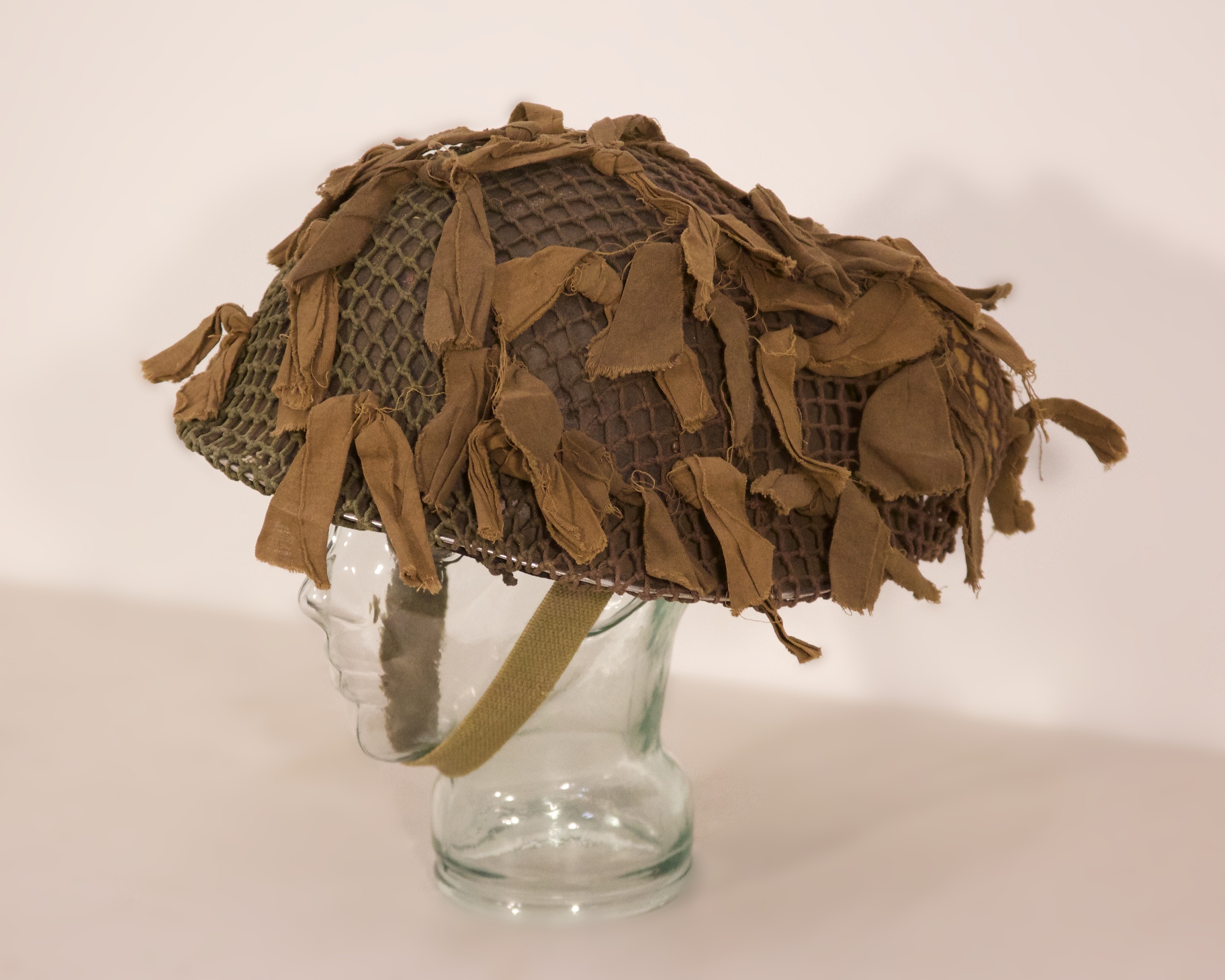
1944 With the coming invasion of France, the 3rd Division was issue additional kit and equipment. The most noticeable was the Mk III “turtle shell” helmet which offered more protection for the wearer than the Mk II helmet.

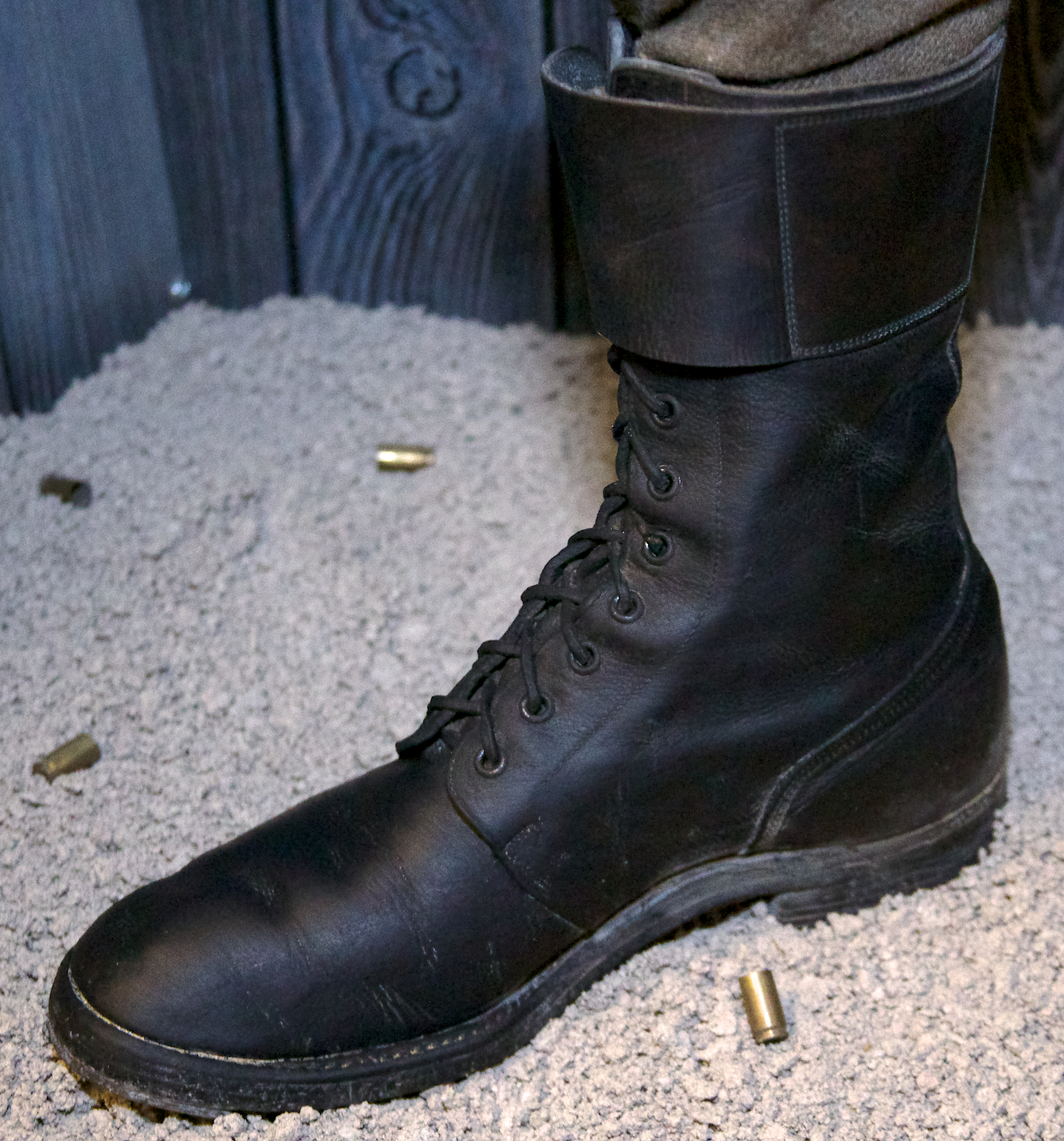
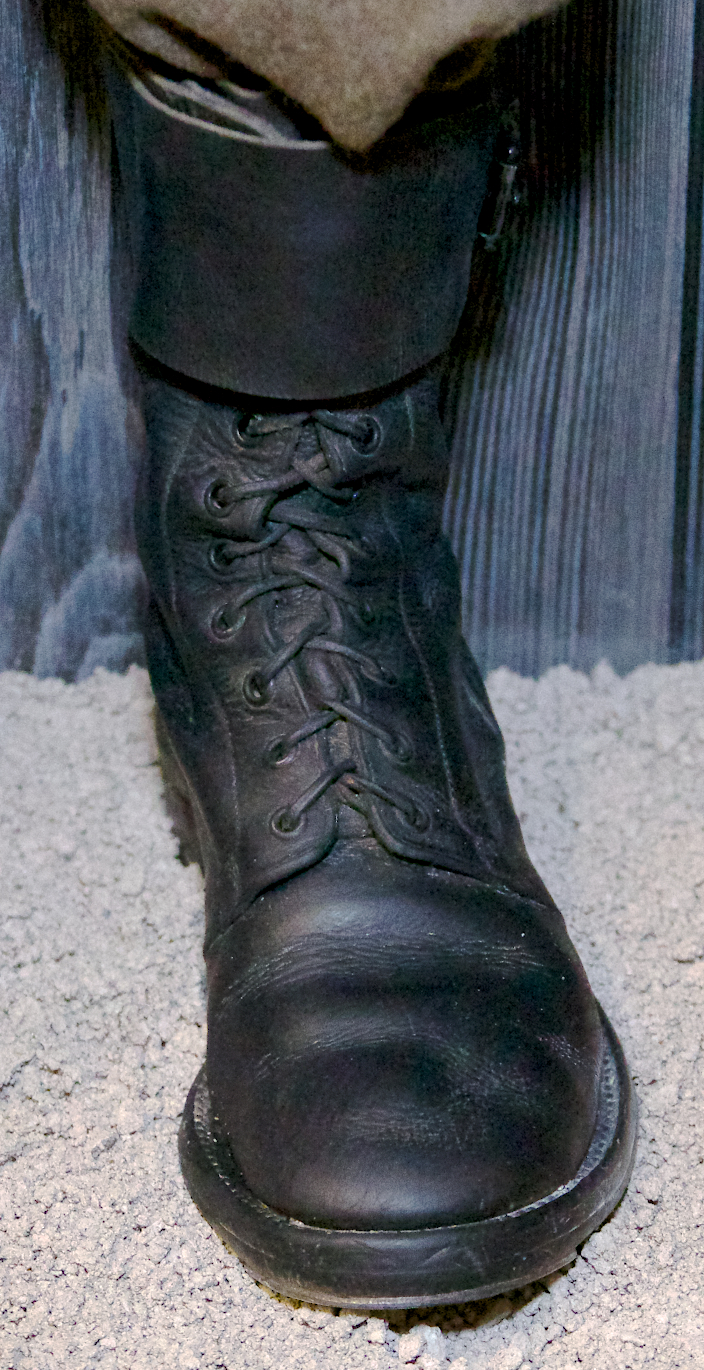
The second most noticeable change was the adoption of the high-top buckle boots which were tried in Italy and widely issued to the 3rd Division. This lead to the term “3rd Div boots” or “Invasion boots”. Constructed with 9 eyelets and a buckle at the top of the boot, these boots put on a more modern look and were sought-after boots.

British made Mk III “Turtle shell” Helmet with Canadian helmet net, scrim and Dressing
British made Mk III “Turtle shell” Helmet with Canadian helmet net, scrim and Dressing – Graham Humphrey’s Collection

Rfn Jim Wilkins “Invasion boots” – Rfn Jim Wilkins Collection

Invasion Boots or High Boots - QOR Museum's Collection Invasion Boots or High Boots - QOR Museum's Collection

“Invasion boots” – QOR Musuem’s Collection

QOR in England 1944 – QOR Museum Photo
QOR in England 1944 with “Invasion boots”  – QOR Museum Photo

QOR in England 1944 – QOR Museum Photo
QOR in England 1944 with “Invasion boots” – QOR Museum Photo

Introduced around mid-1944 was the British-made canvas insignia. Examples of this come in the 3rd Division French Grey flashes, Canada titles, and “QUEEN’S OWN RIFLES” shoulder titles. These had a tendency to fade and fray.  This characteristic was not desireable.

British made Canvas QOR title 1943
British made Canvas QOR title 1943 – QOR Museum’s Collection

1945 Introduced to all Companies of the Battalion on March 19 1945 was the “Windproof Smock” which is know as today. “Coys issued with sniper jackets which beside being good camouflage are quite serviceable and waterproof” (War Diary March 19 1945 Reichswald Forest, Germany)

IMG_6870
Windproof Smock worn by this Reenactor

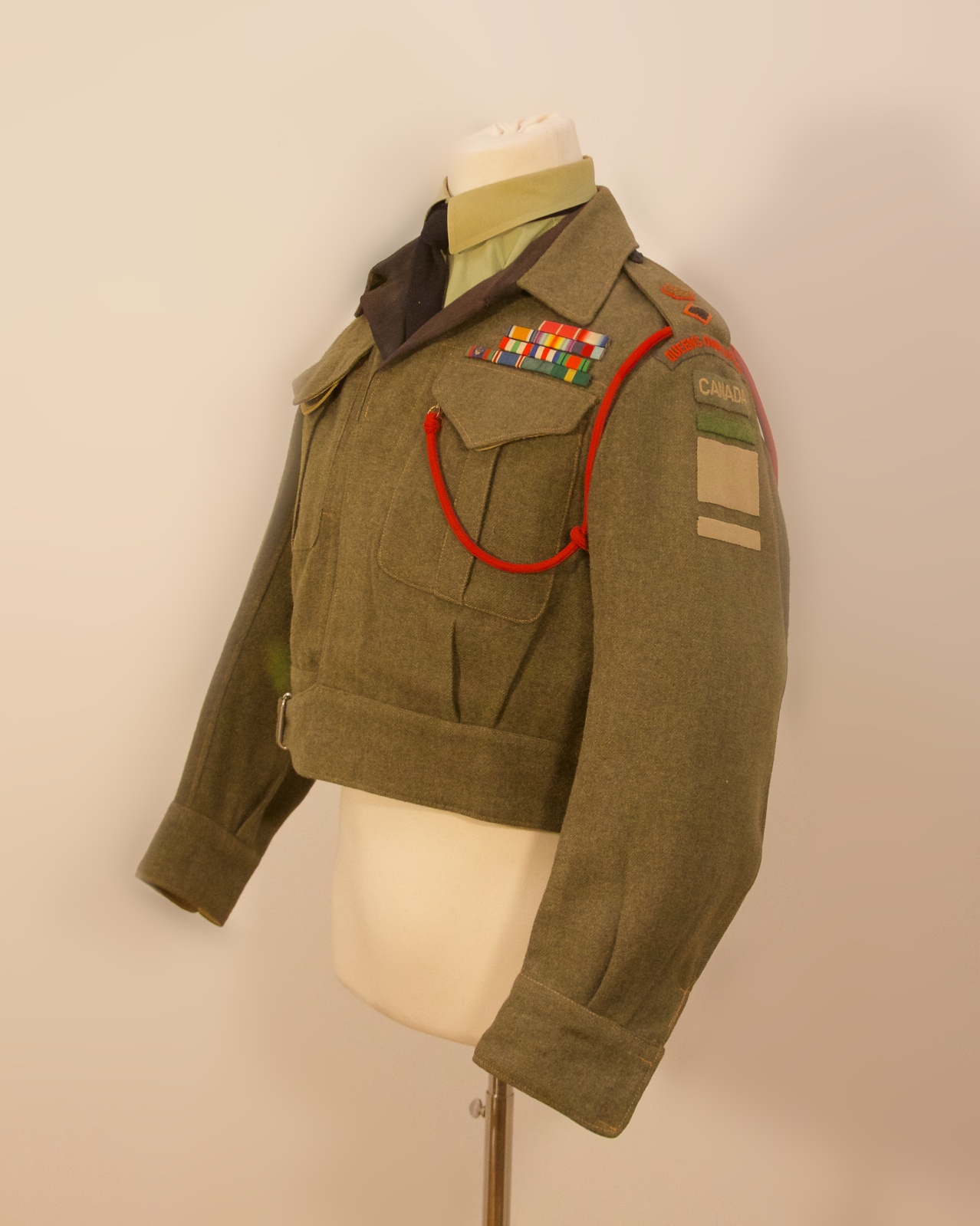
With the war coming to a close, the QOR was put onto occupation duty in 1945-46. To display that they were an occupation force, a single 2 cm wide occupation bar was added at the base of the 3rd Division patch. With the QOR being the senior Regiment in this Brigade, a green occupation bar was added on top of the 3rd Division patch as well.

Battledress number A is a 1945-46 occupation blouse. Notice the addition of the occupation stripe and the tailored collar with black cloth.

Battledress number B is the Battledress of the Commanding Officer of the Occupation force, Lt. Col. J. N. Medhurst OBE ED 4th Bn, QOR of C (CAOF) 8 June 1945 – 25 December 1945.

A
A – QOR Museum’s Collection

A
A – QOR Museum’s Collection

B
B – QOR Museum’s Collection

B
B – QOR Museum’s Collection

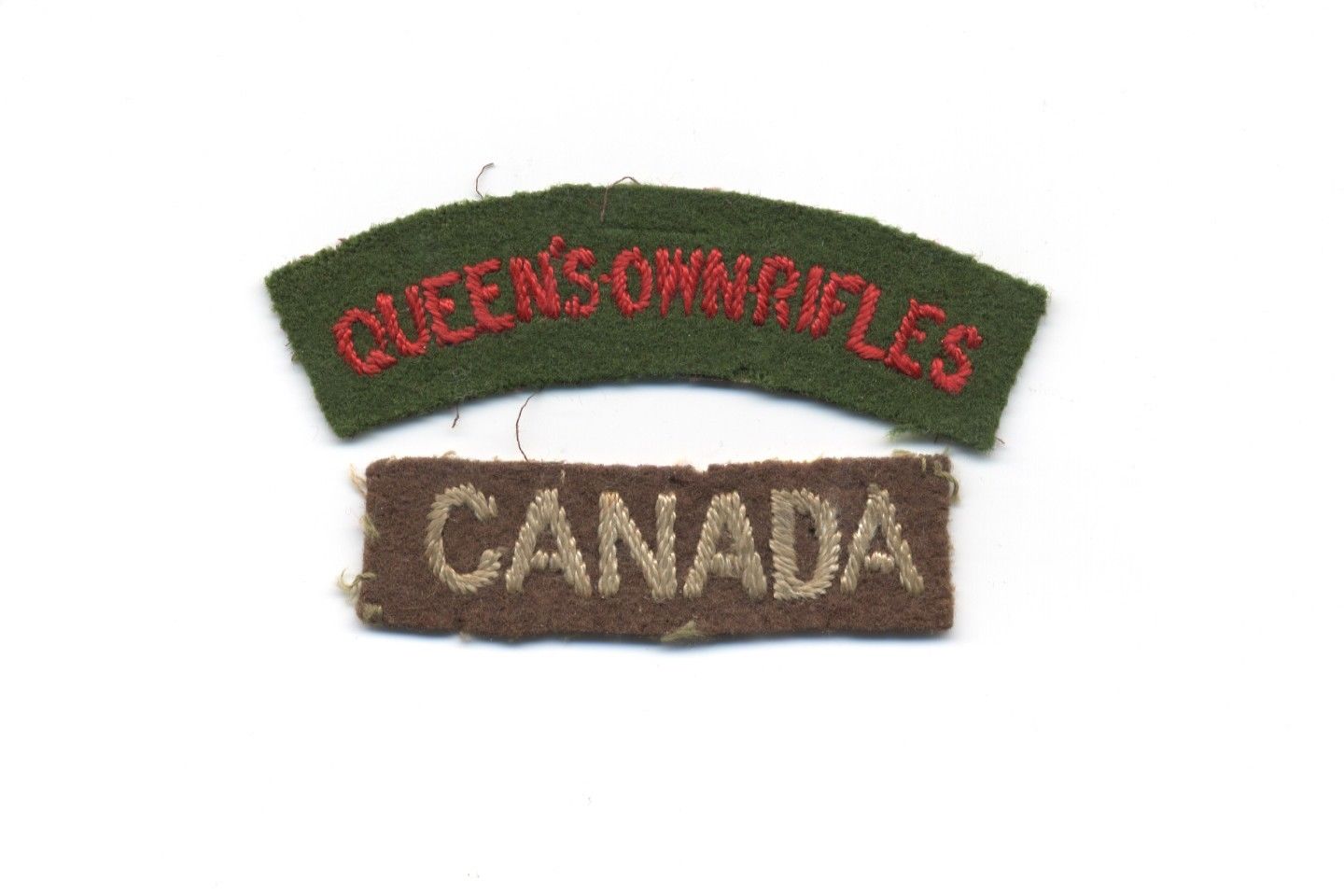
As well, a new QOR shoulder title was introduced with a more foliage green backing and hand-embroidered “QUEEN’S-OWN-RIFLES”. As well the custom of blackening web gear is seen again during 1945-46 period mainly walking out belts, pistol, pistol ammunition pouches and ankle gators.

1945 British made QOR title and Canada title
1945 British made QOR title and Canada title – Graham Humphrey’s Collection

QOR Holland 1945
QOR Holland 1945 – QOR Museum’s Photo

QOR Holland 1945
QOR Holland 1945 – QOR Museum’s Photo

Thank you for reading! Any additional information, questions or correction please send to museum@qormuseum.org

Cheers,

MCpl Graham Humphrey

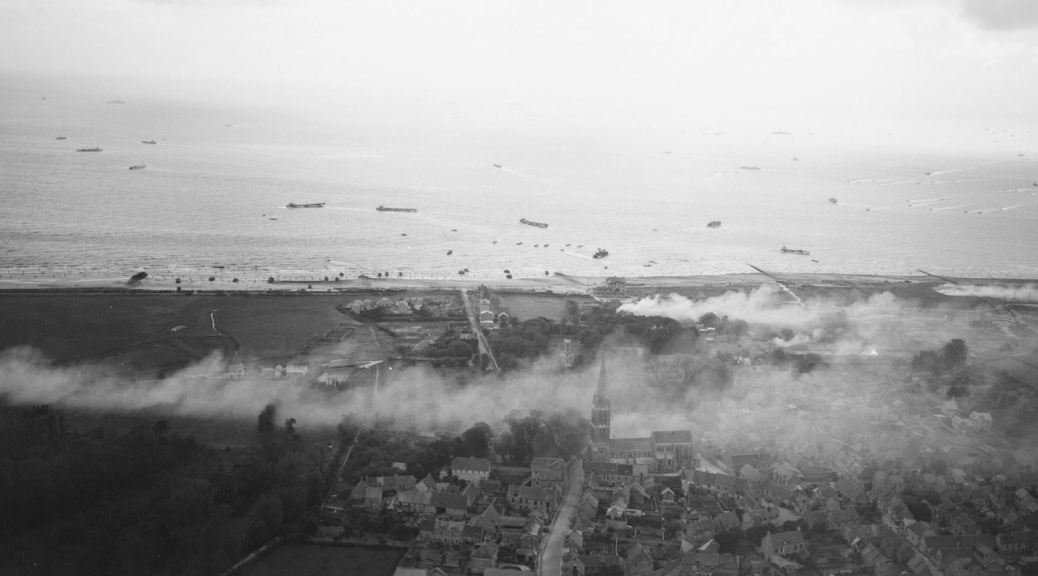
Bernières-sur-Mer

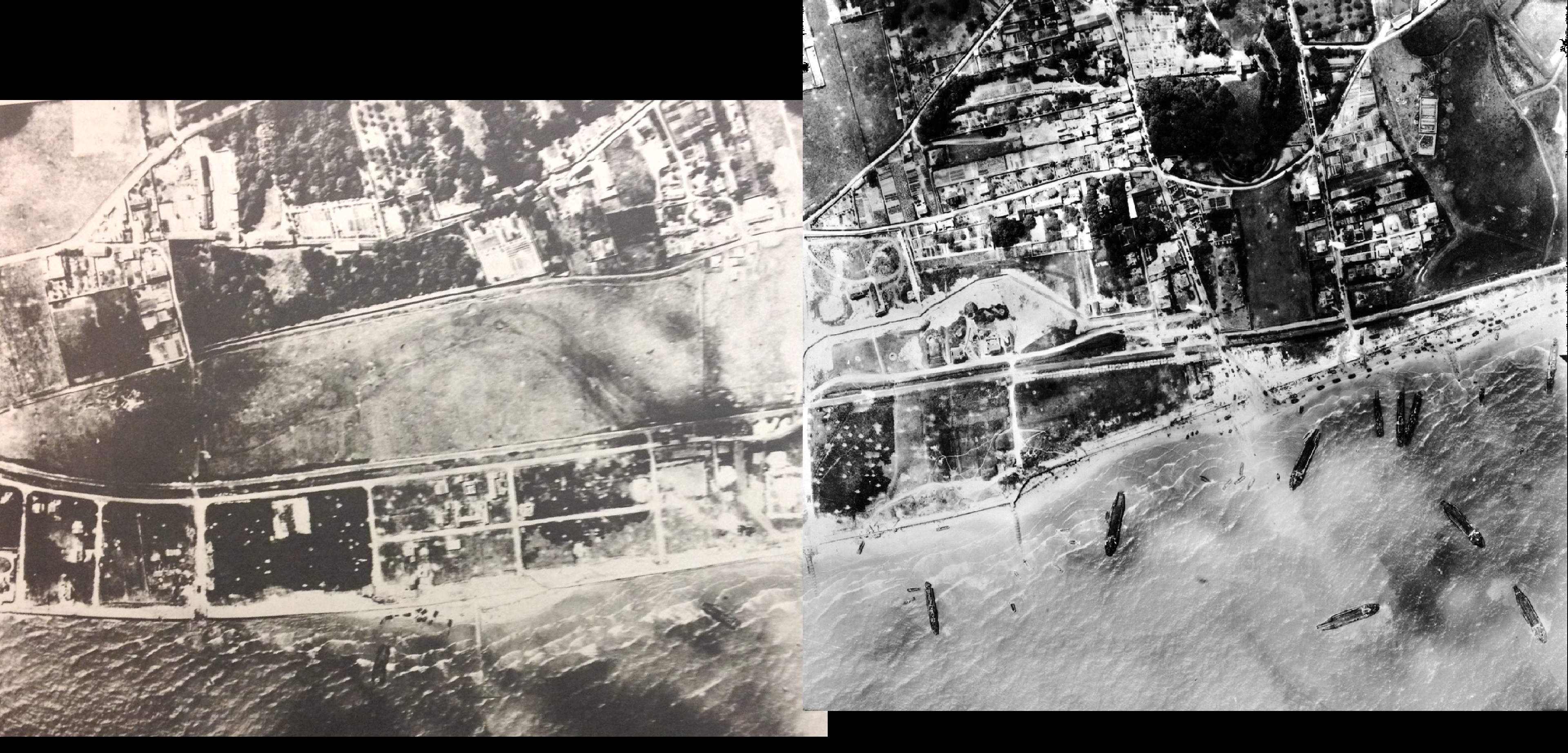
Ever wonder what Bernières-sur-Mer looked like on June 6, 1944? Well here is an Aerial photograph taken roughly around 1100hrs on June 6th.

Bernières-sur-Mer June 6th 1944 1100hrs

Cheers,

MCpl Graham Humphrey

Uniforms of the 1910 Trip to England

Interested how the Enlisted men of the Regiment looked during the trip to England in 1910? Well we have the answer for you!

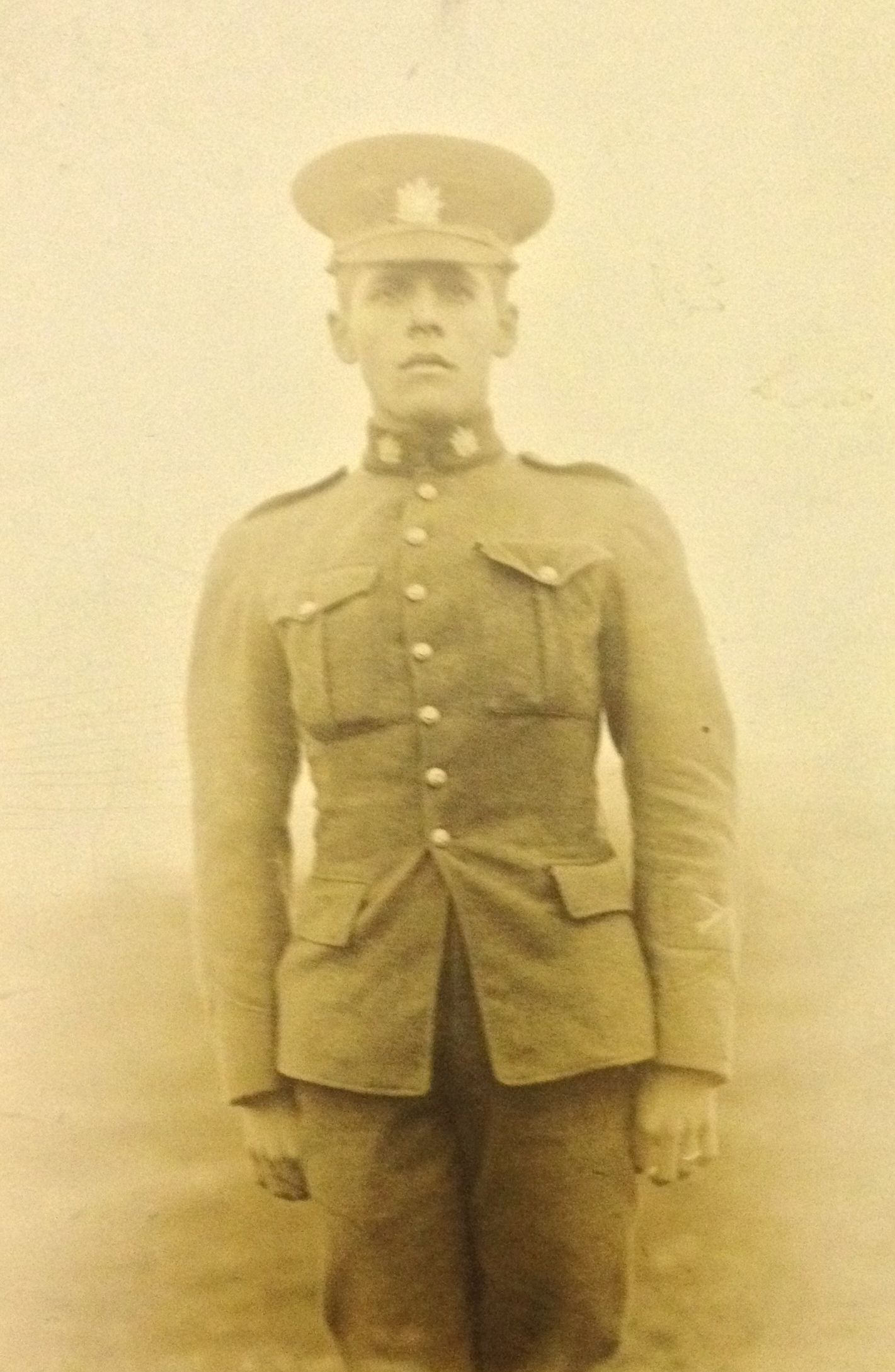
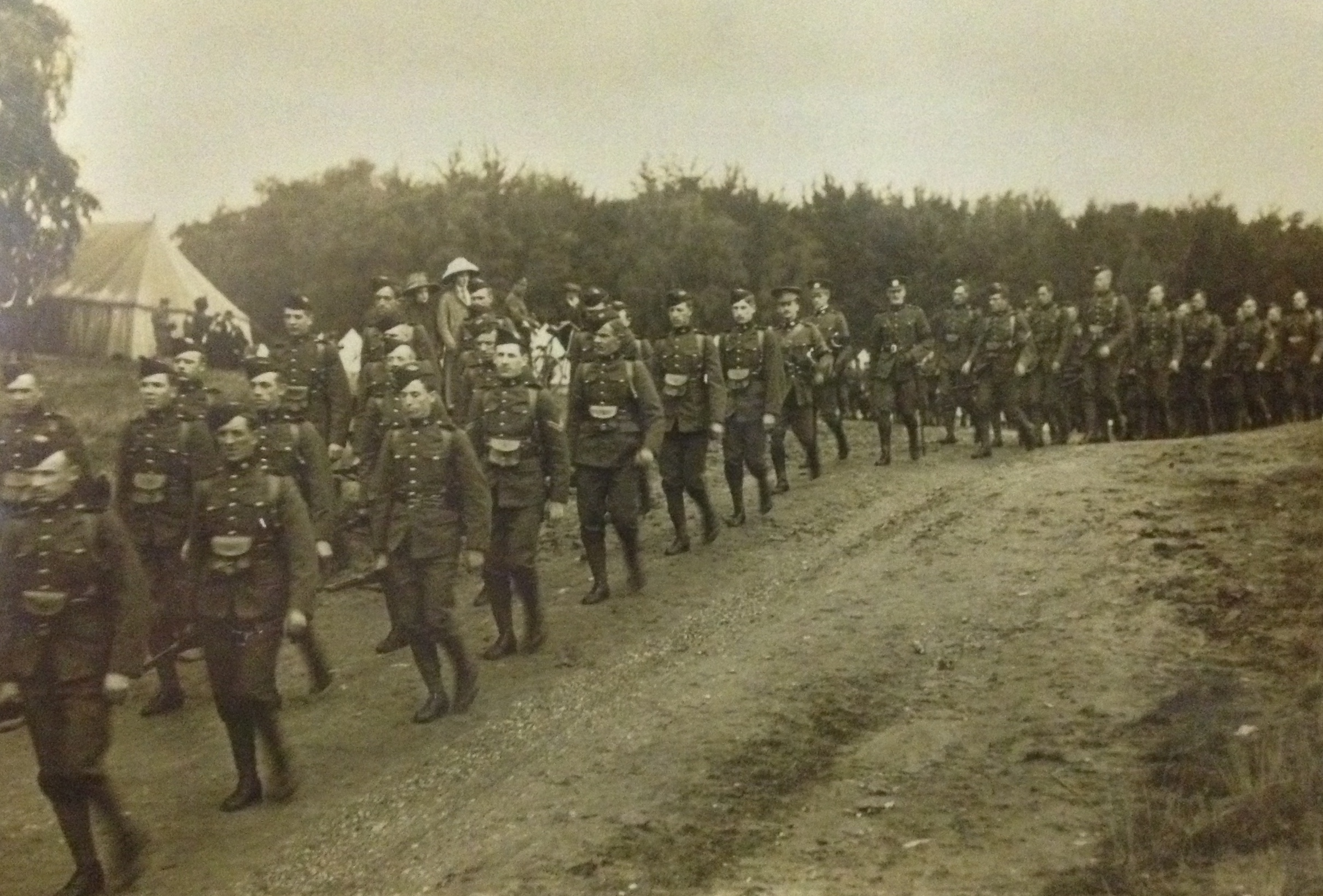
1910 Prior to the departure of the QOR contingent to England Sir Henry Pellatt outfitted the Regiment in a Khaki wool uniform. The construction of this tunic had a stiff rifle green collar, seven small silver buttons that had a blacken tinge to them, two on the upper pockets yet none on the bottom slack pockets and rifle green epaulettes that have brass/silver QOR title. The use of normal QOR rank with Black Braid on Red was not used but the regular White braid on Khaki was as well as the standard QOR collar dogs on the collar. 1905 model Khaki high waisted pants were worn with Puttees wrapped around the calf and ankles. At this time Oliver Pattern Webbing was used as well the Canadian made Ross Rifle 1905 model and bayonet. This was in use by the Regiment up until the out break of world war one which saw the uniforms used until Valcartier and replaced before shipping to England with the 3rd Battalion CEF.

England 1910
England 1910

QOR England 1910
QOR England 1910

QOR England 1910
QOR England 1910

The headdress of the time was the new model 1905 Khaki Service dress peaked cap . The overall construction of the cap is made out of a Khaki Wool including the peak. As with Rifle Regiment tradition a Wool Green band was added around the upper part of the base of the headdress. The Regimental Cap Badge would be fixed centre of the Peaked cap.

England 1910
England 1910

QOR England 1910
QOR England 1910

QOR England 1910
QOR England 1910

QOR England 1910
QOR England 1910

QOR England 1910
QOR England 1910

QOR England 1910
QOR England 1910

Any additional information or correction please send to museum@qormuseum.org

Cheers,

MCpl Graham Humphrey