
From the 1960 Regimental History by Lieutenant Colonel W.T. Barnard
LE MESNIL-PATRY
“On 10 June the battalion moved to Neuf Mer and was placed under command of the 2nd Canadian Armoured Brigade. Orders were received on 11 June, at 1100 hrs, that The Queen’s Own would attack and seize the high ground south of Cheux. First, however, it was necessary to capture Le Mesnil-Patry. This was on the front of 7 Canadian Infantry Brigade. The Regina Rifles were to form the firm base for the attack. The attack was timed to go in at 1300 hrs. This, as one company commander put it, was a plan “conceived in sin and born in iniquity”. First, no time was allowed for reconnaissance; second, no artillery preparation was provided despite the fact that it was known that the place was strongly held; and thirdly, the men were expected to go in riding on tanks through flat wheat fields, thus providing perfect targets for the defenders.
The attack on Le Mesnil-Patry was to be made by D Company under Major J. N. Gordon. A Company, under Major H. E. Dalton, on the capture of the village, would pass through and secure the road junction half a mile beyond the town. Then B Company and C Company were to be carried on tanks a distance of some five miles from the Start Line to the high ground south of Cheux – a not unambitious programme.

Despite the hurry, it was about 1430 hours before D Company, riding on the tanks of B Squadron 1st Hussars, left Norry-en-Bessin. Le Mesnil-Patry was 1,200 yards away. The intervening country was practically all flat fields of grain. About 300 yards had been covered before the storm broke. In a few minutes, half the company and half the tanks had been wiped out. The losses would probably have been worse had not Lieutenant B. Dunkelman detected tank gun fire coming from haycocks. Immediately the mortar platoon rained down bombs and set the haycocks afire. That portion of the enemy firepower did no more damage.
D Company survivors now kept to the ground and crawled doggedly forward. Despite losses the outskirts of Le Mesnil-Patry were reached. Then Major Gordon fell wounded. Lieutenant R. Fleming took over the company. C Now, in an attempt to turn the tide, Lieutenant H. G. W. Bean, already wounded in the leg, gathered together Sergeant. S. T. Scrutton, seven riflemen and two tanks. Working to a flank the little group entered the village at the eastern end. Lt. Bean and Sgt. Scrutton, covered by the riflemen, directed the fire of the tanks; and, for a time, wreaked havoc. During this interval, Lt. Bean had been wounded again. Now the tanks’ wireless failed and Lieutenant Bean fell wounded for the third time. Sergeant Scrutton gathered what was left of his, intrepid little party, ordered them on the tanks and, by a miracle, roared back safely. Four returned unscathed, two were killed, one was missing and two were wounded. This action was an epic; spine-tingling in cold courage; brilliant in initiative and execution; a magnificent attempt to resolve a hopeless situation. Lt. Bean was awarded the Military Cross and Sgt. Scrutton the Military Medal.
D Company by now was thinned to the vanishing point. B Squadron, 1st Hussars, was in the same case. Both were ordered to retire. Then further calamity struck. The Germans managed to get into our artillery wireless net and put in a call for defensive fire on The Queen’s Own area and on The Regina Rifles at Norry-en-Bessin. It was a clever move on the part of the enemy. Immediately heavy fire poured down; some twenty minutes elapsed before Brigade H.Q. could get it stopped. The havoc wrought was dreadful. Not only did The Queen’s Own suffer. The forward company of The Regina Rifles was badly shot up; the battalion’s reserve ammunition was destroyed, and the 1st Hussars lost many of their reserve tanks positioned in Norry-en-Bessin.
The 1st Hussars, who fought throughout most gallantly, lost eight officers, fifty-two other ranks and nineteen tanks. D Company, QOR of C, went in 135 strong. Initially, eleven came back but during the next twenty-four hours other survivors made their way back to the lines. That day the battalion lost one officer and fifty-three [actually 49] other ranks killed in action; one other rank died of wounds. Three officers and thirty other ranks were wounded; four other ranks received severe battle injuries. One officer and one other rank received battle injuries but remained on duty. In all eleven men were captured; five were repatriated after the war; the fate of the other six is given below. Lieutenant R. Fleming, the one officer killed, was a young and promising subaltern. He had been married but a month. Company Sergeant Major J. Forbes and Sergeant J. M. Mitchell, both first-rate soldiers, had fallen. An English newspaper summed up the whole action with the comment, “It was a modern version of The Charge of the Light Brigade”.
At first, it seemed that little had been accomplished. Later the view was taken that, viewed as a “spoiling attack”, an enemy concentration had been completely disorganized and a proposed counter-attack had been brought to naught. The next day, Lieutenant-General G. G. Simonds, G.O.C. Second Canadian Corps; stated: “While the battle yesterday seemed futile, it actually put a Panzer Division attack on skids, thereby saving 7 Canadian Infantry Brigade from being cut off and, in the broader picture, it helped 7 British Armoured Division to advance on our right flank.” The sector, previously very troublesome, gave no more bother, and on 16-17 June, after a British advance on the right, the place was occupied without a shot being fired. The British found fourteen knocked-out German tanks and over two thousand Nazi dead in the fields and ditches.”

The battle of Le Mesnil-Patry saw the second-highest number of Queen’s Own killed in action in one day. At the end of 11 June 1944, 50 soldiers of The Queen’s Own Rifles were killed in action. Three officers and thirty other ranks were wounded.
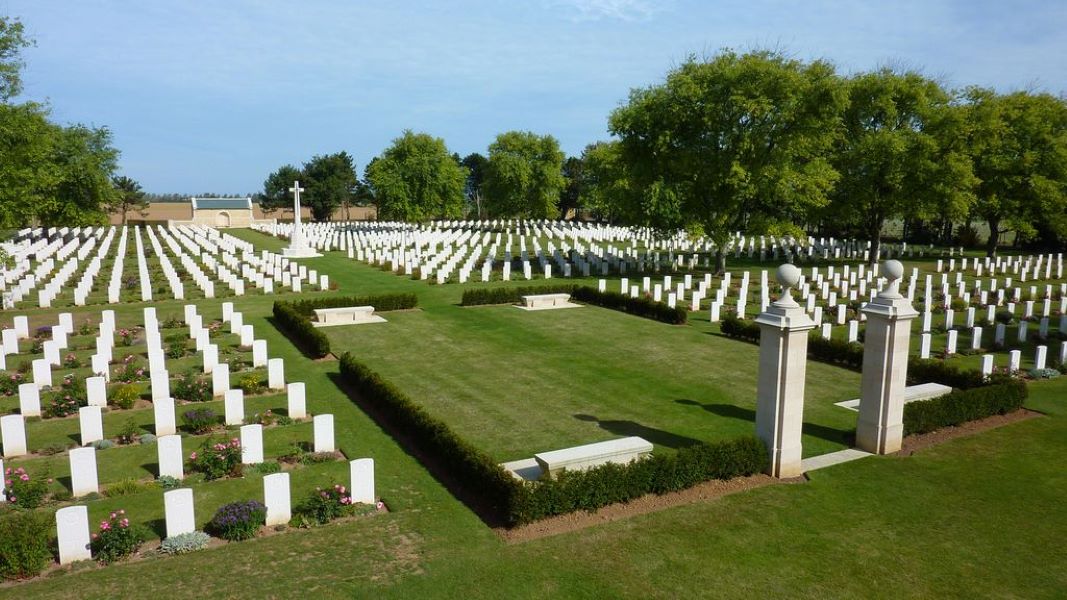
Eventually, 48 riflemen would be reburied in a cemetery beyond Bernières-sur- Mer which would be named the Bény-sur-Mer Canadian War Cemetery and two were buried in Bretteville-sur-Laize Canadian War Cemetery.
You can find the names and profiles of all those who died during this battle in a downloadable pdf: “Profiles of Our Fallen Part II: Le Mesnil Patry 11 June 1944“.
“So long as they speak your name, you shall never die.”



 The Queen's Own Rifles of Canada Regimental Museum and Archive