Bill McAndrew joined the army at age 17, was commissioned the following year and served the next eleven years as an infantry officer in Canada, Korea, Germany and Ghana. On leaving the army, a high school dropout, he attended Glendon College, York University as a mature student and gained his doctorate at the University of British Columbia. McAndrew taught at the University of Maine at Orono and directed that university’s Canadian Studies programme before joining the Directorate of History in Ottawa from which he retired in 1996. His particular interest has been in the battlefield behaviour of soldiers.
This is an excerpt of an article which originally appeared in Canadian Military History, Autumn 2013 issue and is reprinted with permission of the author.
Joining the Army
I joined the army in October 1951. My motivation was not unusual, I expect, in those days. I spent my adolescence in wartime Halifax and Charlottetown where I had been an army cadet and both a reserve soldier and sailor. But the primary drive was need; there were few opportunities for a high school drop-out on the Island short of Toronto factories or the military. Besides the Korean war was on and adventure loomed.
So after a summer as a sailor, and a voyage on HMCS Swansea to
Britain at the time of the Festival of Britain, I made my way across Canada and was lucky when I went into Vancouver’s No. 11 Personnel Depot. The recruiting sergeant, Smokey Smith whose Victoria Cross ribbon was unmistakable, asked me if I wanted to go to Officer Candidate School [OCS] . I didn’t know what that entailed but said sure and assured him that I was eighteen, really seventeen, and had grade 12, which I hadn’t. He completed the paperwork, I was sworn in and in a few days was off by train for Camp Borden. Many years later I learned the cause of the casual recruiting; each depot had a monthly OCS quota to fill and at the end of October No. 11 needed bodies.
The train took me to Toronto, then a local went north to Angus near Camp Borden and knee deep in snow. A truck met the train and dropped me and the small cardboard suitcase holding my worldly possessions at the Orderly Room where my army career began with a bang. Sergeants pounced and I was on a non-stop run for several days until the course started. Run to the quartermaster stores, run to quarters, run to meals, run to nowhere and back again.
The training programme to produce a second lieutenant was two months at OCS, three months at a corps school, three months with a regular army unit as an understudy, and a final three months back at the corps school. The initial OCS phase was to select out – the failure rate was around 70 percent – and gauge suitability. For me it was also basic army training that most of the others had not only completed but instructed. The tenor was to push us as far as possible, physically, psychologically, emotionally, to see how we reacted and if we persevered. There was only one other direct entry young guy like myself in the course the rest being veteran NCOs going for a commission. Failures could be voluntary, for example, an RCR {Royal Canadian Regiment] warrant officer who left because he preferred being a company sergeant major to a second lieutenant platoon commander, or by decree as when the other direct entry wasn’t there one morning.
I managed to survive. My roommate was Jack Hanley an RCR sergeant and tough veteran who adopted me and guided me through bad patches. It helped that I had hunted deer and rabbits and birds as a kid so was familiar with weapons and the woods. Several group leadership exercises that seemed pointless were duly noted by strange officers with notepads. For the rest I just did what seemed needed. One obstacle course I recall had three tunnels running off a covered hole in the ground. You dropped in, were told to find a way out, and the hole was covered. Two of the holes led nowhere. The third arced downhill into water that rose the further you went. There was light further on but the last few metres to the outlet were almost completely under water. I reckoned that they wouldn’t want to fish out a corpse so kept going. I imagine its purpose was to test for claustrophobia.
We were in the midst of drill training for our passing out parade towards the end of December when I was told to report to the CO’s office. This was scary as he was a godlike figure totally remote from my experience. The RSM, Mickey Austin who wore a MC ribbon from his time with the Royal Winnipeg Rifles, marched me in and the CO, Mike Dare, asked about my age and education. I told him the truth, fortunately, as he had a background check on his desk. He gave me two choices: be discharged, or revert back to the next course when I would be eighteen and of age. The thought of repeating the course was not exactly welcome but the alternative of being turned loose in the middle of a very rough winter was even less so. So I chose to repeat the course and he gave me a few days leave over Christmas.
My new roommate, Pat Paterson, had fought in Normandy with the Sherbrooke Regiment. During a Staff College battlefield study in Normandy a few incarnations later one of the veterans on the study, Syd Radley Walters, told me that Pat had commanded a Firefly 17-pounder gun Sherman tank in his squadron near Cintheaux on the road between Caen and Falaise on the morning of 8 August 1944. This was at the end of the first phase of Operation Totalize when four German Tiger tanks counter-attacked. All four were destroyed, one of which was commanded by the German ace, Michael Wittman, who earlier had single-handedly stopped a British Armoured Brigade. One claimant for the hit was a rocket-firing Typhoon, and another a British tank squadron on the east side of the road, but Rad was convinced that it was Patterson who got him.
The second course went more easily than the first. My birthday duly came, I graduated soon after and moved down the road to the School of Infantry. Why infantry I now wonder. I was strangely influenced by Charles McDonald’s, Company Commander, his memoir of the awful operations in the Huertrgan Forest and an account that should have driven anyone but a naive romantic to a safer job. In any case that two month course was a snap compared to OCS. We learned minor tactics, fired a variety of weapons, threw grenades, choked on gas, drove several types of vehicles including bren gun carriers which we jumped over high embankments making sure to keep the tracks moving quickly to ease the drops. In early May I was posted to 3 RCR in Wainwright where it was preparing to go to Korea.
Wainwright was at that time very basic, a few buildings and lots of bush. The battalion was trying to organize itself despite the chaos at that time that left hundreds of recruits unaccounted for, some coming in and leaving at will after getting clothing and a few meals. I was supposed to understudy an experienced officer but there were none around so I got my own platoon of brand new recruits. Soon after getting kitted out we joined the rest of the battalion for a lengthy exercise in the bush starting with a twenty mile march. With no NCO’s I had a Second War vet among them act as platoon sergeant. It was a rough beginning for unconditioned troops with new boots but we survived to reach a lake out there somewhere where I had the platoon strip and marched them into the water for a swim.
We scrambled through the summer, me learning an awful lot from the innumerable mistakes I was bound to make. We made one long compass march across trackless country towards another lake that felt like a real accomplishment when we made it within a couple of hundred yards of our aiming point. The CO, Ken Campbell, visited and must have been highly relieved that this novice had not killed someone or become hopelessly lost. That night we bivouacked on the shore and were awakened by a yowling that turned out to be a band of coyotes running through us. Later in the summer we went up to Jasper where a training camp had been set up in hills and mountains that resembled those in Korea. It was a valuable experience in preparing us for moving with full kit through the rough terrain we did find in Korea.
It was, for me, a productive time. I’m not as sure for the platoon. They were in the 3 RCR company that fought the last unit action in Korea when they were hit one night by a large Chinese attack. Several were killed, more wounded and others taken prisoner. I can’t help wondering about the training for which I had been responsible.
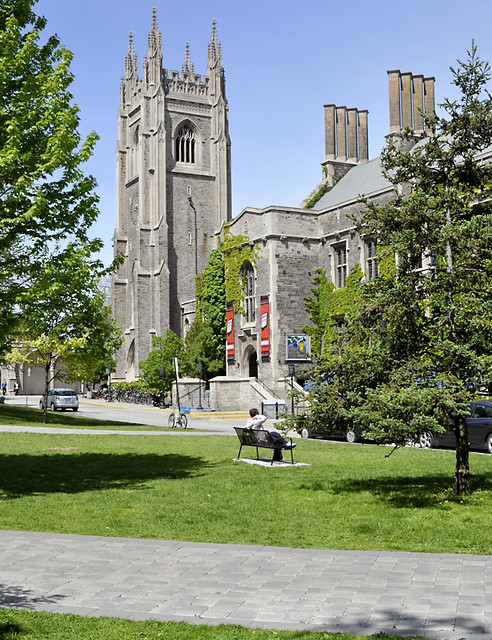
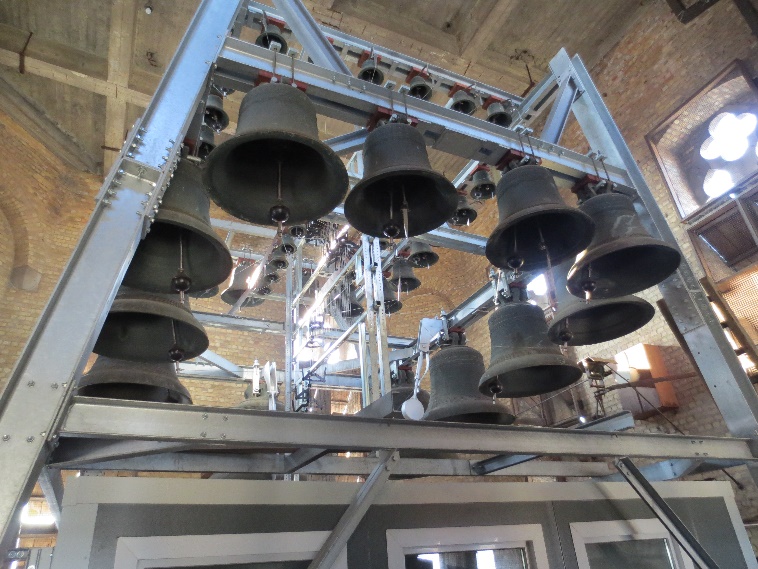
War memorials are meant to commemorate the sacrifices that have preceded their erection. Particularly for those commemorating the dead of the Great War, they address “some of the complex issues of victimhood and bereavement.[1] “Glory, the reward of virtue” is a translation of the Latin inscription on a carillon bell in the University of Toronto’s Soldiers’ Tower, which commemorates the university’s war dead,[2] and suggests a linkage between sacrifice and redemption.
The bells in Soldiers Tower, University of Toronto.
Soldiers’ Tower is evidence that government (at all its levels) and the state are not, nor should they be, the only sources of memory and mourning. The human sacrifices of war “should never be collapsed into a set of stories formed by or about the state,” and the erection of local and private war memorials helps to bring a local context to the lesions brought by total war.[3]
Other examples in Toronto of such non-public monuments include the war memorials of the Queen’s Own Rifles of Canada and the 48th Highlanders of Canada. Both units perpetuate overseas battalions of the Canadian Expeditionary Force.
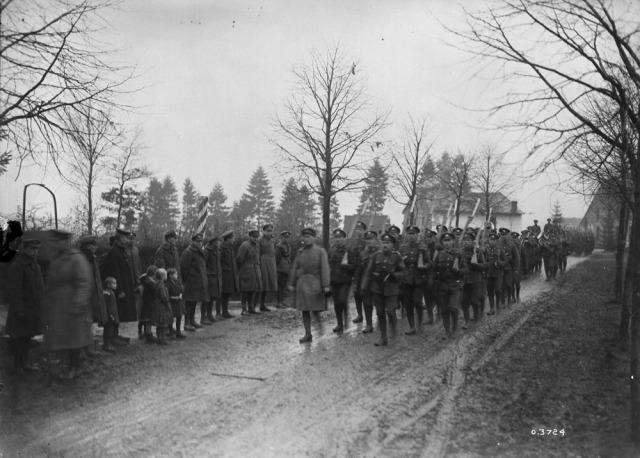
15th Battalion CEF (perpetuated by the 48th) marching out of Germany on the road between Esbach and Bensberg, 8 January, 19193rd (Toronto) Battalion, largely drawn from the Queen’s Own Rifles, crossing the border into Germany on 4 December 1918.
The Queen’s Own Rifles of Canada Memorials
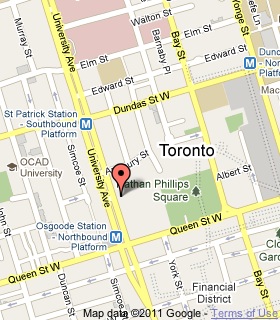
Under the chairmanship of Sir Henry Pellatt, the Q.O.R. Ex-Members’ Association was formed October 1, 1916 on his initiative with the primary purpose of sending food and clothing to men of the QOR battalions overseas who had become prisoners-of-war. It fell dormant after the war but was revived March 8, 1922 with Major General W. D. Otter acting as Chairman, and by March 1923 a Memorial Building Fund had been established. A decision was made to construct a monument in Queen’s Park instead of erecting a building. That was logical, as the regiment was headquartered just down the street at the University Avenue (Toronto) Armoury located between Armoury and Queen Streets.
University Avenue Armouries
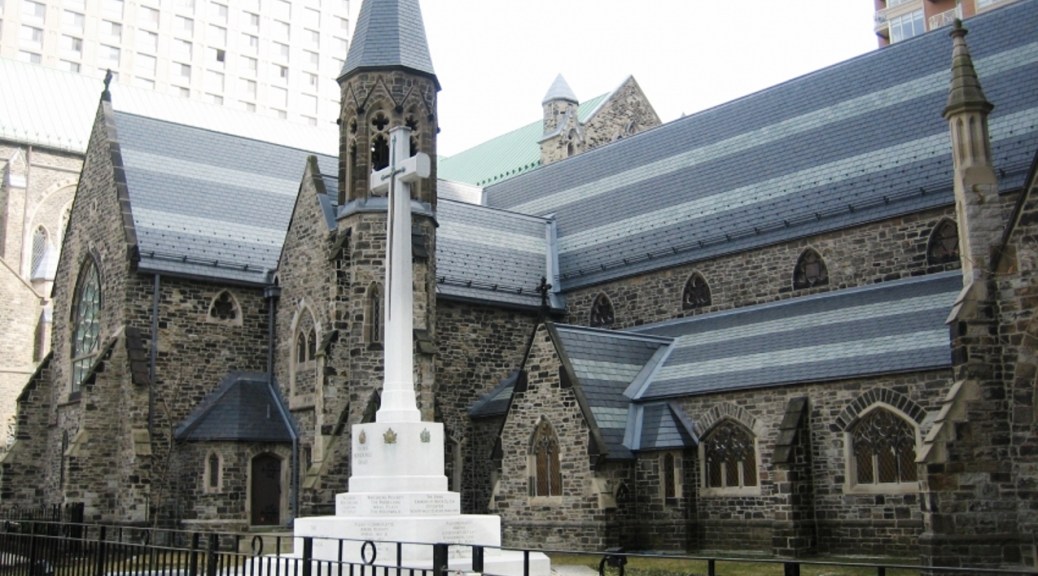
Later still, with the approval of the Rector and Wardens of St. Paul’s Anglican Church, 227 Bloor St. East, it was decided that a regimental memorial would be built at St. Paul’s, the Regimental Church.[4] That conveniently obviated the need to find a site for a suitable monument, particularly given that the 48th Highlanders already had a monument in Queen’s Park.
The regiment also perpetuates the 3rd, 83rd, 95th, 166th, 198th, and 255th Battalions, Canadian Expeditionary Force.
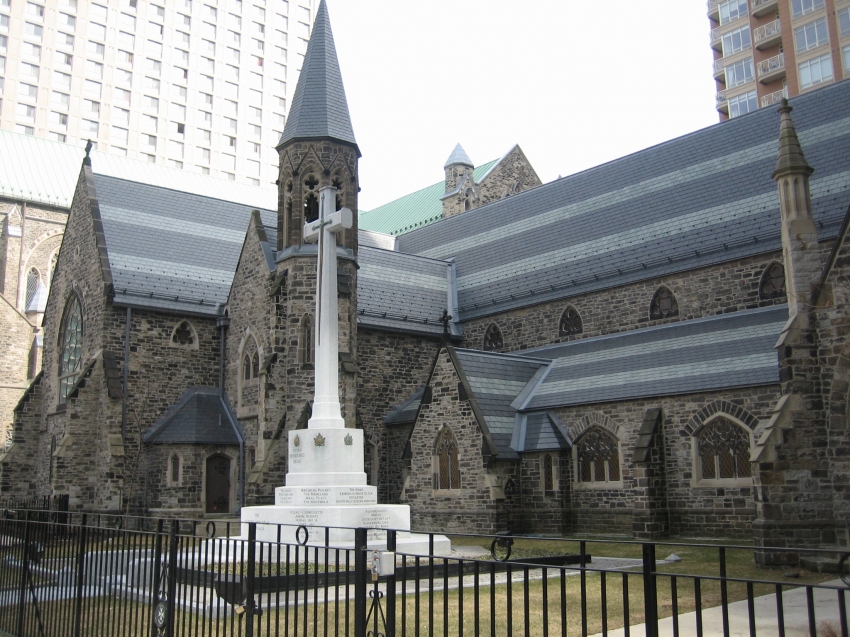
Financing was handled by The Queen’s Own Rifles Memorial Association, a special body created early in 1928 with Brigadier-General J. G. Langton as its President. The most publicly visible part of the memorial, a Cross of Remembrance, was unveiled and dedicated by the Rector of St. Paul’s, a former regimental chaplain, on October 18, 1931[5].
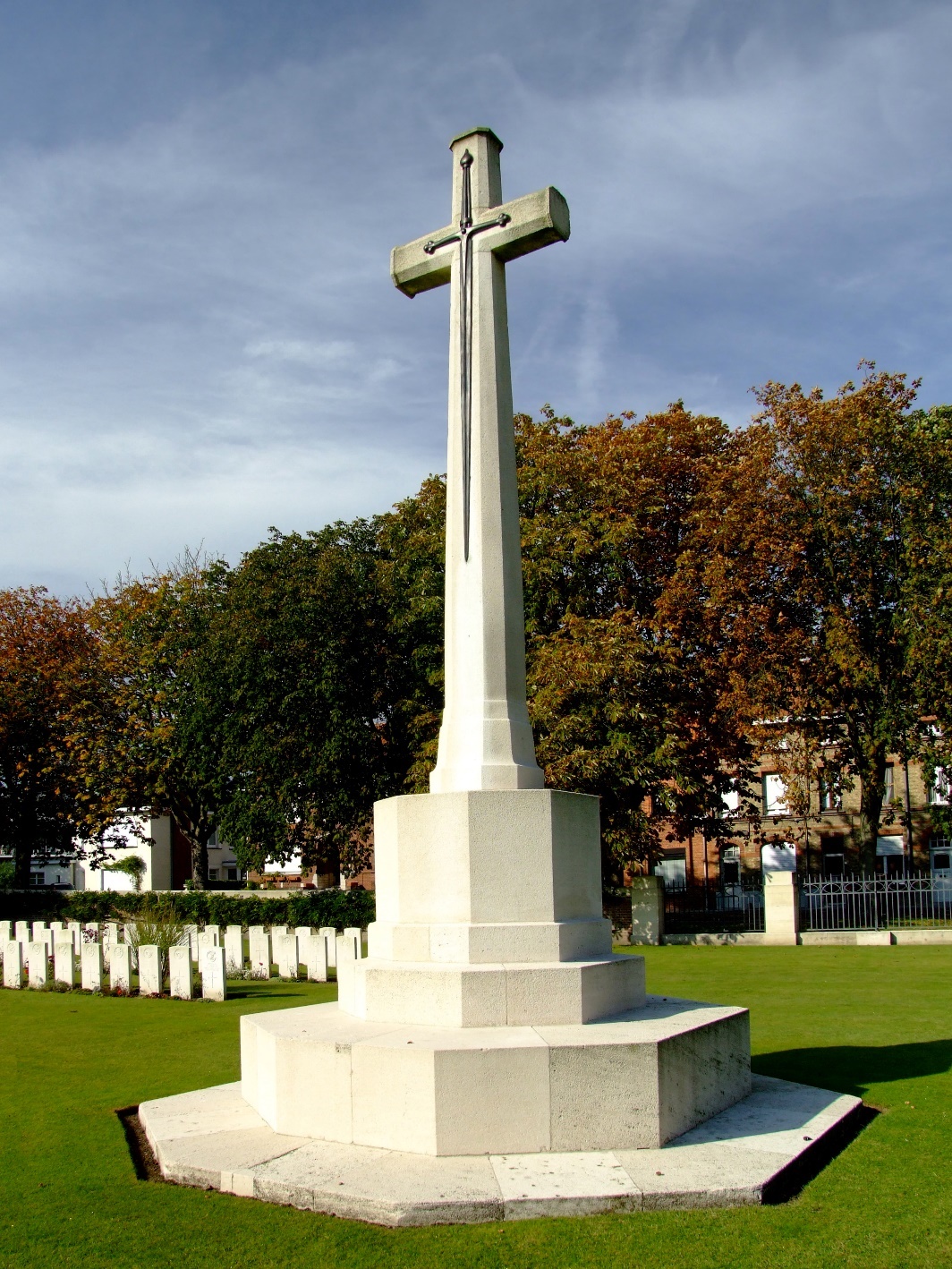
In its churchyard setting the widely recognizable regimental Cross of Sacrifice speaks for itself as a memorial to those who fought and died during the Great War (and subsequent actions).[6] The memorial cross is modelled after the Cross of Sacrifice designed by Sir Reginald Blomfield for the Imperial War Graves Commission (now Commonwealth War Graves Commission) in 1918 that is a part of Commonwealth war cemeteries containing 40 or more graves. The Cross is the most imitated symbol used on Commonwealth memorials[7] .
Base of the QOR Cross of Sacrifice.
Like the original, the QOR cross has a bronzelongsword, blade down, mounted on the front of the cross and sits atop an octagonal base. The Latin cross represents the faith of the majority of the dead and the sword indicates the military nature of the monument.[8] The Cross is constructed on granite, with reproductions of the regimental and battalion badges on the base and the battle honours from two world wars[9] represented on the plinth and sub-base[10].
A Book of Sacrifice listing members of the regiment who have been killed on service is kept at the Regimental Church, St. Paul’s Anglican.
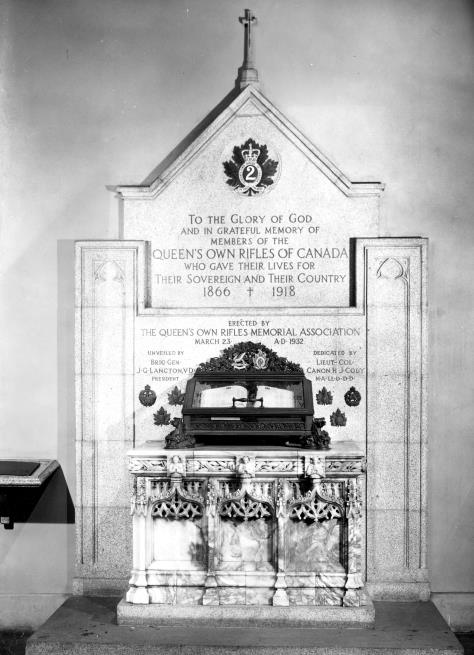
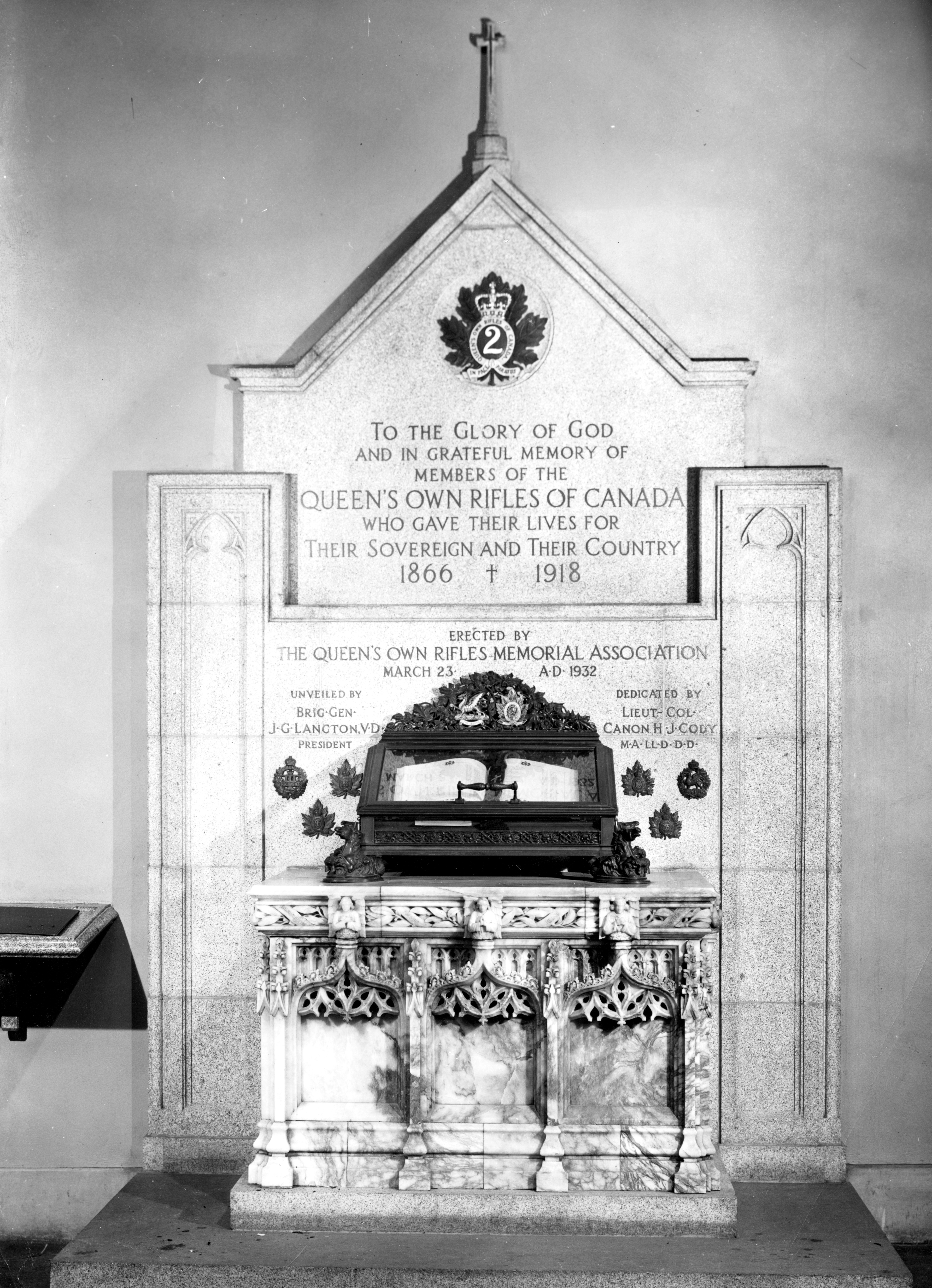
Inside the church is a small chapel to the rear of the main chancel (west side), dedicated on March 13, 1932. A carved alabaster table stands on a granite platform (Plate 8) with a glass-topped bronze casket containing the Book of Remembrance atop it. The names of all QOR soldiers who lost their lives in their country’s service from the Fenian Raid of 1866 to the Korean War are inscribed in the Book.[11]
At each church service at which the regiment is on parade a special party of officers and non-commissioned officers escorts the book to the front of the church. It is presented to the Commanding Officer, who hands it to the Rector, and it is placed on the alter during the service. The book is returned to its place of honour at the conclusion of the service.[12]
There being no colours because the QOR is a Rifle Regiment, the Book of Remembrance is the symbol of the regiment’s honour and the memory of “Fallen Comrades,”[13] held by the Church wardens for safekeeping. Parading the book before the regiment shows the Wardens have fulfilled their trust and that the care of the book and honour are in the hands of all ranks of the regiment. The Commanding Officer’s handling of the book symbolizes his personal responsibility and its return to the Wardens symbolizes their acceptance of responsibility for safekeeping.[14]
48th Highlanders of Canada Memorials
As with the Queen’s Own memorial, a general aversion toward war prevalent in the 1920s and early 1930s influenced the design of the 48th Highlanders monument and neither is suggestive of a spirit of militarism. Their inspiration was clearly mourning the dead rather than celebrating military achievements. Neither mimics Victorian battle monuments nor relies on images from archaic allegory.[15]
The 48th Highlanders perpetuate the 15th, the 92nd and 134th reinforcement battalions, CEF, and the equivalent of two more battalions sent as companies to other units.
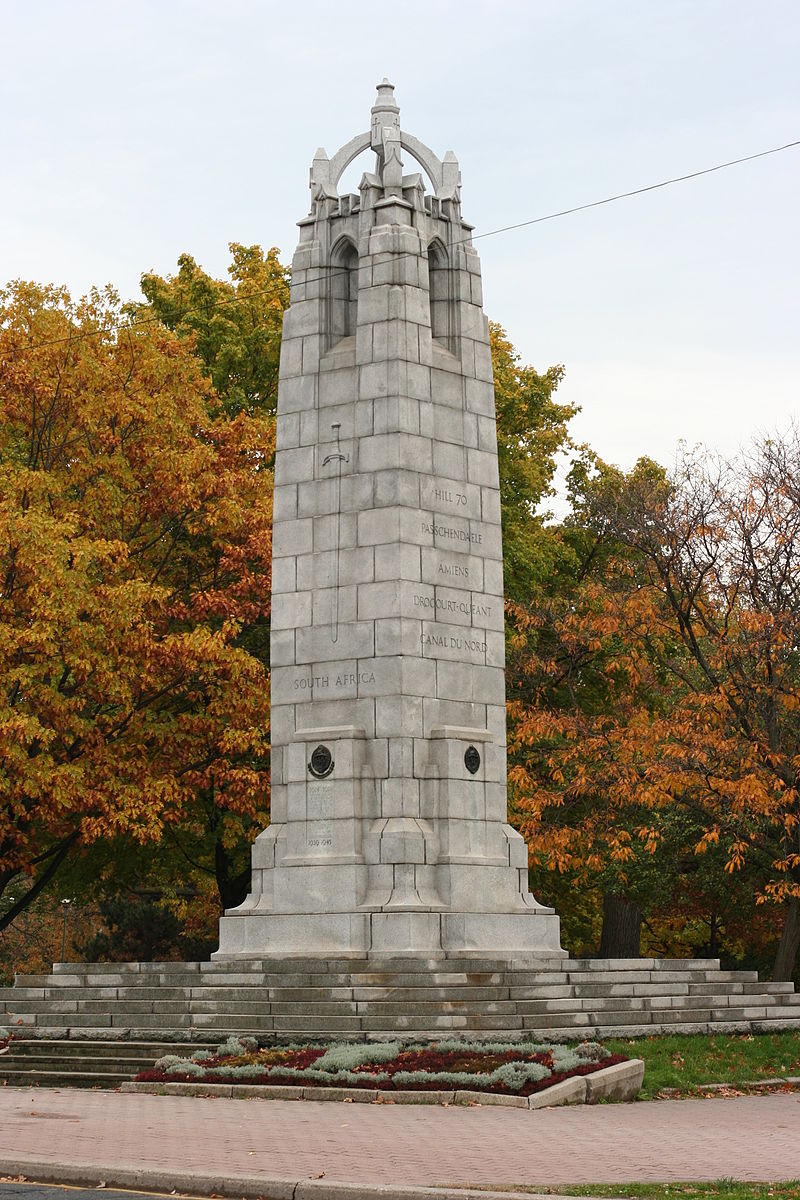
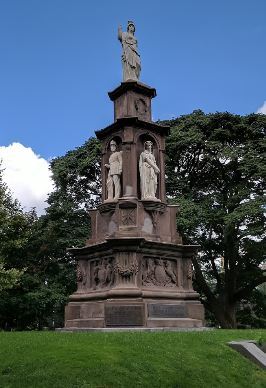
A regimental memorial designed by Capt. Eric W. Haldenby[16] was unveiled by Governor-General Baron Byng at the Armistice Day parade in 1923. The granite column which marks the deaths of 61 officers and 1,406 non-commissioned officers and men of the regiment, was funded by friends, members, and former members and raised during the previous summer. Unlike reliance on an almost universal form for Great War monuments (the Cross of Sacrifice), the 48th Highlanders memorial tried for an aesthetic that would combine a geometric abstraction and a figurative realism (Plate 9). The obelisk was also an accepted part of the funerary sculpture lexicon.[17]
The South African War Memorial, built in 1910 in remembrance of Canadian participation in the Boer War, stands in the centre of University Avenue just north of Queen Street West in Toronto. The designer, Walter Seymour Allward, is perhaps best known for his Vimy Memorial in France.
The 48th Highlanders monument stands at the north end, or head, of Queen’s Park and looks up Avenue Road.[18] That location was ideal because like the Queen’s Own, the 48th Highlanders were located in the University Avenue Armoury to the south. The boulevard opposite the armoury already had several monuments, including the Sons of England Roll of Honour, also unveiled in 1923,[19] and the South African (Boer War) Memorial at the Queen Street intersection[20].
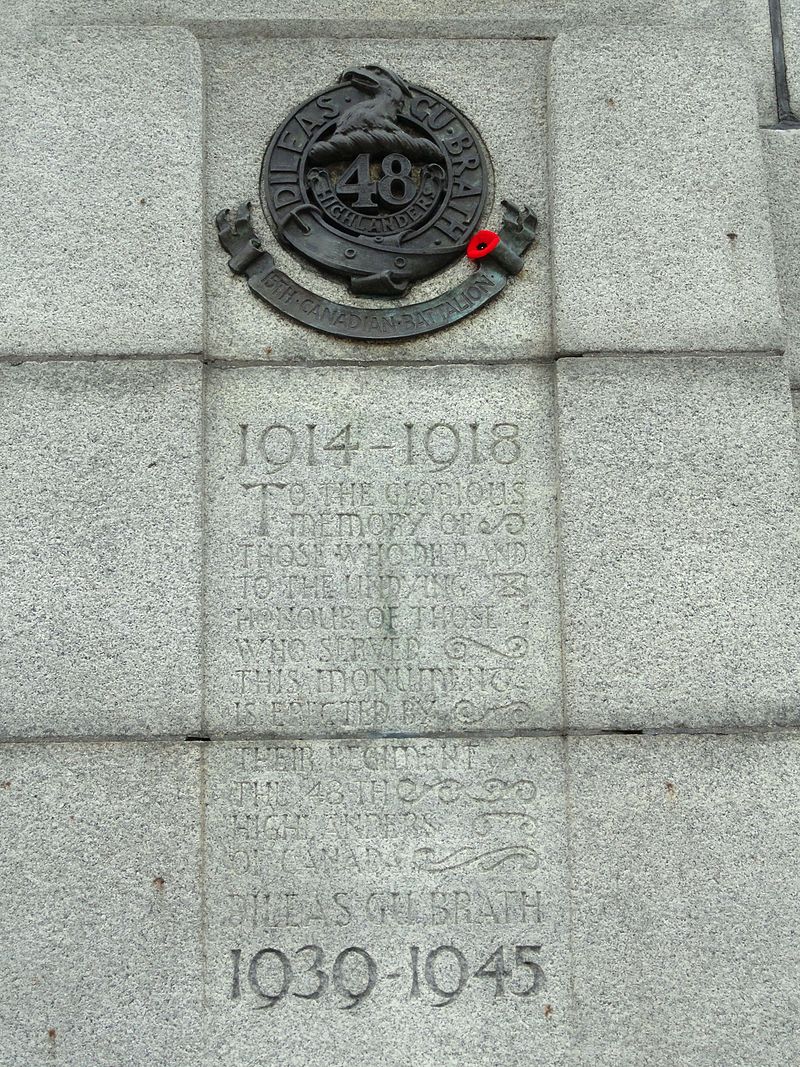
Inscription on 48th Highlanders Monument in Queen’s Park
The 48th memorial site in Queen’s Park was selected because it would be viewed by all south-bound traffic on Queen’s Park Circle as the roadway splits around the park. The monument has replicas of the Regimental crest carved on each side. These bear the words “15th Canadian Battalion,” “134 Overseas,” and “92 Overseas” on the south, east, and west sides, respectively. A carving of a Christian Cross of Sacrifice tops each side.
Some of the 48th Highlanders First World War Battle Honours on the Memorial Monument
An inscription on the (north) face reads: “DILEAS GU BRATH 1914-1918 To the glorious memory of those who died and to the undying honour of those who served—this is erected by their Regiment—the 48th Highlanders of Canada”[21] (Plate 11). A scabbarded sword is also carved into the stone. Just as with the QOR Cross of Sacrifice, the 48th Highlanders’ battle honours are inscribed around the monument’s faces[22].
Unlike the Queen’s Own Rifles’ memorial, the 48th Highlanders’ tribute to its fallen is divided between the public monument and a separate accolade in its regimental church elsewhere. Having split twice over issues in the Church of Scotland and relocating the congregation, St. Andrew’s Presbyterian remained the core of the Town of York’s first Church of Scotland congregation and has been the Highlanders’ regimental church since their founding in 1891.
St. Andrew’s follows the “reformed/ Presbyterian tradition”[23] in worship, of which chapels or shrines like those at St. Paul’s Anglican are not a big part. Consequently, the regiment’s other memorial at the regimental church is a communion table in the chancel, dedicated on November 11, 1934. The sergeants of the regiment donated the table in memory of their fallen comrades in World War I and it is now a memorial to the fallen in two world wars and used at every celebration of Holy Communion.
An oak communion table, the gift of the sergeants of the regiment, was dedicated on Remembrance Day, November 11, 1934 by Rev. Dr. Stuart Parker, chaplain of the regiment and minister of St. Andrew’s Presbyterian Church, the regimental church of the 48th Highlanders of Canada.
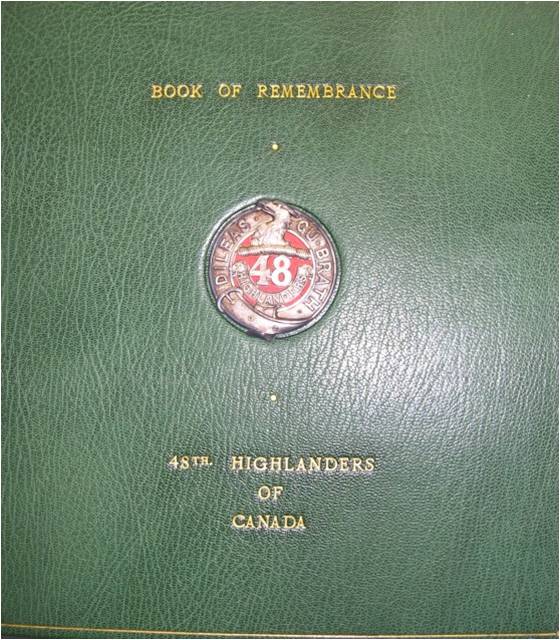
The oaken table was created by Dr. John A. Pearson,[24] a St. Andrew’s congregant. There are abutments, about six inches lower, at the ends of the table, and each has an oak top with a plate of glass set into a (lockable) hinged frame. An inner shelf is approximately 10 inches below the glass on each side, on which lie records. Like the Queen’s Own Rifles, the 48th Highlanders have a Book of Remembrance.
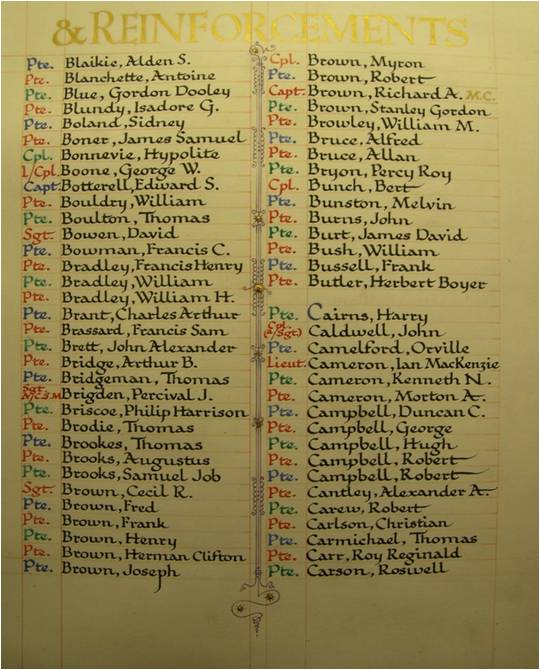
The right-hand abutment of the communion table contains 25 loose leaf pages listing the names and ranks of 1,818 48th Highlanders dead from the two world wars. Two pages, with about 120 names in block script, show when the book is open. The left-hand abutment contains the title page and dedication of the Book of Remembrance on parchment . The regimental crest and St. Paul’s words “Wherefore take unto you the whole armour of God that ye may be able to withstand in the evil day and having done all to stand” are carved on the left table abutment.
Conclusion
First World War memorials such as those of the Queen’s Own Rifles and the 48th Highlanders were built in an age of meaninglessness stemming from the recent war and serve to mark the value of individuals. They are not primarily “grand architectural monuments” (Plate 15) but continue a practice in countries of the Empire and Commonwealth of commemorating their role in 20th century conflicts, but without necessarily a sense of the waste and futility of war.[25] They stand as evidence that mourners in the postwar period would not have favoured memorial aesthetics that were pure abstraction. In a sense, they mark for us “a sense that everything is over and done with, that something long since begun is now complete.”[26]
An example of the “grand architectural monument” style favoured for many pre-First World War monuments. Another Walter Allward design, this monument on the University of Toronto campus honours nine Queen’s Own Rifles members, including three University of Toronto students, who fell at the Battle of Ridgeway in June 1866. It was sponsored and paid for by Toronto citizens, and dedicated on 1 July 1870.
References
Barnard, William T. The Queen’s Own Rifles 1860-1960. Don Mills: Ontario Publishing Company Limited, 1960.
Farrugia, Peter. “A Small Truce in a Big War: The Historial de La Grande Guerre and the Interplay of History and Memory.” Canadian Military History22, no. 2, (Spring 2013): 63-76.
Gough, Paul. “Canada, Conflict and Commemoration: An Appraisal of the New Canadian War Memorial in Green Park, London, and a Reflection on the Official Patronage of Canadian War Art.” Canadian Military History5, no. 1, (Spring 1996): 26-34.
Nora, Pierre. “General Introduction: Between Memory and History” in Realms of Memory vol. I trans. Arthur Goldhammer, New York: Columbia University Press, 1992.
Pierce, John. “Constructing Memory: The Vimy Memorial.” Canadian Military History 1, no. 1 (1992): 3-5.
Winter, Jay. “The Generation of Memory: Reflections on the ‘Memory Boom’ in Contemporary Historical Studies.” Canadian Military History10, no. 3, (2001): 57-66.
“48th Highlanders of Canada An Infantry Regiment of Canada’s Primary Reserves.” Canadian Armed Forces. Accessed June 16, 2020. http://48highlanders.com/01_00.html
Notes
[1] Jay Winter, “The Generation of Memory: Reflections on the ‘Memory Boom’ in Contemporary Historical Studies.” Canadian Military History 10, no. 3, (2001): 58.
[2] Bell VIII commemorates Lt. James E. Robertson, BA, Ll.B. Virtutis Gloria Merces is the motto of Clan Robertson (Donnachaidh).
[4] The Queen’s Own Rifles was formerly a multi-battalion regular-force regiment, with troops based as far away as Work Point Barracks, Victoria B.C. (now part of CFB Esquimalt). The regimental depot was in Calgary.
[6] Peter Farrugia, “A Small Truce in a Big War: The Historial de La Grande Guerre and the Interplay of History and Memory.” Canadian Military History 22, no. 2, (Spring 2013): 4.
[9] As with other Rifle Regiments, a regimental colour is not carried, with the battle honours being painted on regimental drums instead. It was announced on May 9, 2014 that the QOR has subsequently been awarded the “Afghanistan” battle honour because of the numbers of its members that had served in South-West Asia. Battle Honours of the Canadian Army – The Queen’s Own Rifles of Canada, accessed June 8, 2020, http://www.regimentalrogue.com/battlehonours/bathnrinf/06-qor.htm
[13] A traditional toast to Fallen Comrades is given at formal military dinners.
[14] William T. Barnard, The Queen’s Own Rifles 1860-1960 (Don Mills: Ontario Publishing Company Limited, 1960), 133.
[15] John Pierce, “Constructing Memory: The Vimy Memorial.” Canadian Military History 1, no. 1, (1992): 3-4.
Paul Gough, “Canada, Conflict and Commemoration: An Appraisal of the New Canadian War Memorial in Green Park, London, and a Reflection on the Official Patronage of Canadian War Art.” Canadian Military History5, no. 1, (Spring 1996): 30.
[16] His architectural firm, Mathers and Haldenby (1921-1991), also designed the Toronto head office buildings of Imperial Oil, Bank of Nova Scotia, and The Globe and Mail. “Haldenby, Eric Wilson,” University of Toronto Faculty of Applied Science & Engineering, accessed June 16, 2020, https://alumni.engineering.utoronto.ca/alumni-bios/haldenby-eric-wilson/
[17] Kim Beattie, 48th Highlanders of Canada 1891-1928, (Toronto: 48th Highlanders of Canada, 1932), 425.
Gough, “Canada, Conflict and Commemoration,” 7-8.
[22] After WW II 10 battle honours were added in honour of 351 dead from that conflict. Like the Queen’s Own Rifles, the 48th Highlanders have subsequently been awarded a battle honour for Afghanistan. “Battle Honours of the Canadian Army – The Queen’s Own Rifles of Canada,” accessed June 8, 2020, http://www.regimentalrogue.com/battlehonours/bathnrinf/06-qor.htm
“The 48th Highlanders Monument Queens Park,” Centre for Distance Learning and Innovation, accessed June 8, 2020, https://www.cdli.ca/monuments/on/toronto48.htm
[24] An architect, his other works included several buildings on the University of Toronto campus, the College Wing of Toronto General Hospital, and the “new” Centre Block on Ottawa’s Parliament Hill.
Janice Bradbeer, “Once Upon A City: Creating Toronto’s Skyline,” Toronto Star, March 24, 1016.
“John A. Pearson,” wikipedia.org, accessed June 8, 2020, https://en.wikipedia.org/wiki/John_A._Pearson
[25] Hew Strachan, The First World War. (New York: Penguin Books, 2013) 337.
[26] Farrugia, “A Small Truce,” 63
Gough, 33,
Pierre Nora. “General Introduction: Between Memory and History” in Realms of Memory vol. I trans. Arthur Goldhammer, (New York: Columbia University Press, 1992): 1, cited by Farrugia, 2.
Permission is hereby granted to the Queen’s Own Rifles of Canada to, with proper acknowledgement, use the following, in whole or in part, for any purpose whatsoever.
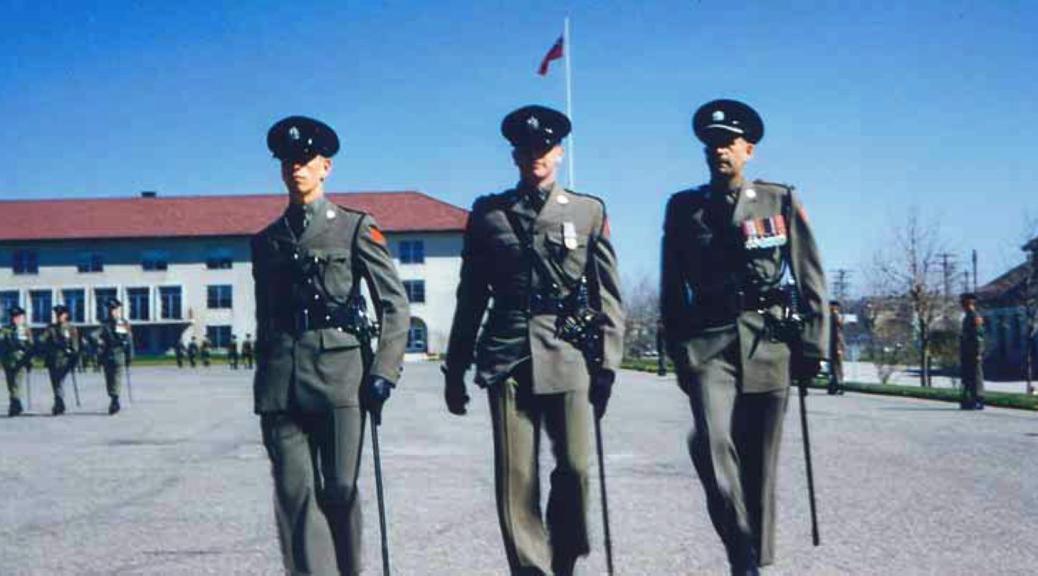
 Bill McAndrew joined the army at age 17, was commissioned the following year and served the next eleven years as an infantry officer in Canada, Korea, Germany and Ghana. On leaving the army, a high school dropout, he attended Glendon College, York University as a mature student and gained his doctorate at the University of British Columbia. McAndrew taught at the University of Maine at Orono and directed that university’s Canadian Studies programme before joining the Directorate of History in Ottawa from which he retired in 1996. His particular interest has been in the battlefield behaviour of soldiers.







 The Queen's Own Rifles of Canada Regimental Museum and Archive
#/media/File:South_African_War_Memorial_Toronto_Nov_08.jpg)