
“Acquisition and Accessioning: Taking legal ownership of objects, especially (but not always) to add to your long-term collection through the process of accessioning: the formal commitment by your governing body to care for objects over the long term.
In legal terms, acquisition involves a ‘transfer of title’ from the previous owner to you. [It] gives you proof of ownership, and it assigns a unique number that will link each object to the information you hold about it.
Accessioning has a very specific meaning: it brings with ethical responsibilities to preserve objects over the long term…”
Collections Trust UK
Many of you will be familiar with our physical exhibits at Casa Loma, and many more of you will be familiar with our social media posting on Instagram, Facebook, Twitter and of course this website. But much of what our volunteer team does is actually behind the scenes as we acquire, accession and catalogue new objects, and then either add to our exhibits or put them carefully into our collections storage so they will be safe and we know where to find them.
This post will explain our acquisition and accessioning process and Part II will explain what happens next.
Where do our objects come from?
Before we dive into the details, you might wonder where we acquire objects. The vast majority are donated to the museum as gifts – from serving soldiers, veterans, and relatives of former QOR soldiers. Occasionally they will also come from donors who have picked them up at flea markets and yard sales. From time to time we may actually purchase an item from E-Bay or online medal auction sites however our acquisition budget is extremely limited and so these are generally only very unique or rare items.
How do we decide what we want to accept?
Like most museums around the world, we have limited storage space and have to give careful consideration to what items we accept into our collection. Don’t get me wrong though – we are very grateful when people contact us with objects they think might we might want! From time to time however we have to say “thanks but no thanks.” This begs the question of how we reach those decisions.
First we have to consider the museum’s 1956 mandate:
“to encourage the study of Canadian military history and in particular the history of The Queen’s Own Rifles of Canada, to rescue from oblivion the memories of its members, to obtain and preserve narratives in print, manuscript or otherwise of their travels, adventures, labours and observations, to secure and preserve objects illustrative of the civil, literary and military history of the Regiment, and to maintain a museum and a library.”
The museum’s interest also includes the six First World War Canadian Expeditionary Force Battalions perpetuated by the Queen’s Own Rifles and soldiers who served in them.
So clearly we’re looking for items related in some way to the regiment itself (or its perpetuated battalions), or to any members who served in it. And for the latter, these would generally be related to their service with the QOR.
There are exceptions to this. For example items that might illustrate a particular period during the regiment’s service which are not already in the collection. Recently we acquired a WWII two-piece mess tin from another museum. It was not connected any in way to the regiment or anyone who served in it but it was a common WWII object that we did not have in our collection. Another was a WWI Victory Bond Flag – again not specifically related to the QOR but certainly an important part of WWI history.
Once we’ve established that the object or objects might be relevant or useful, there are still some further considerations:
Is it legitimate?
Sometimes – particularly for sale on the internet – objects are represented as something they aren’t either intentionally or from ignorance. Sometimes half-forgotten family lore just doesn’t quite fit the facts. Is this “19th century” cap badge really from the 19th century? Does the condition of a medal ribbon and other “facts” seem reasonable?

For example a recent donor claimed a bugle (2019.08.001) had been played at the Battle of Ridgeway. The bugle cord that came with it was clearly not 150+ years old but the engraving of “Captain Sherwood’s Company” made sense. It also had the makers mark engraved on it and after some research we found that particular mark was only used for a five year period that spanned 1866. None of this proved that it was actually played at the battle but it did confirm that it was from the correct time period and certainly could have been played, so we agreed to accept it. We also need to have some assurance that the person donating the objects has the right to do so – in other words is actually the owner, or perhaps the executor of an estate.
How unique is it?
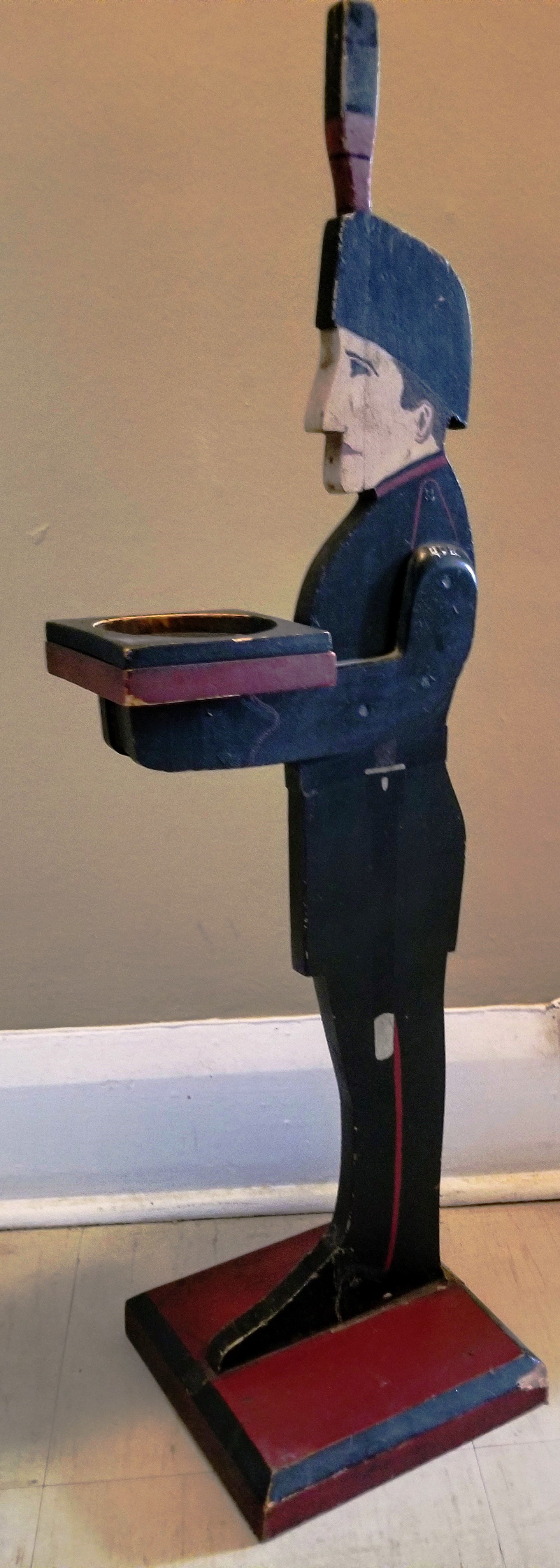
Generally we only need so many of the same items in our collection. When a wooden ash tray stand painted like a QOR soldier (2019.17.001) and used in the Sergeant’s mess was recently offered to us, it was a no brainer to say yes. However unless it was in mint condition (see below) we aren’t going to accept any more copies of Chambers 1899 history of the regiment as we already have six.
How big is it?
The practicalities of limited storage space unfortunately mean we just don’t have room to accept everything – and the larger the object, the more relevant this consideration.
What condition is it in?
Aside from storage limitations we also have a limited conservation budget so if something is in poor condition and may take considerable effort and expense to properly conserve and preserve it, then we certainly need to consider that carefully. If we already have examples of this artifact in our collection, we’ll also want to determine if the item being offered is in better or worse condition than those we already have.
Can we safely store this?
Occasionally safe storage is also a consideration. Live ammunition, or nitrate film – which has a tendency burst into flames under the wrong storage conditions – would be two examples. We recently had to find a way to safely dispose of the contents of a WWII polish tin which had become corrosive (not to mention the strong odour!) and threatened damaging other objects; however we did manage to save the tin with its paper label.
Can this still be used by the regiment?
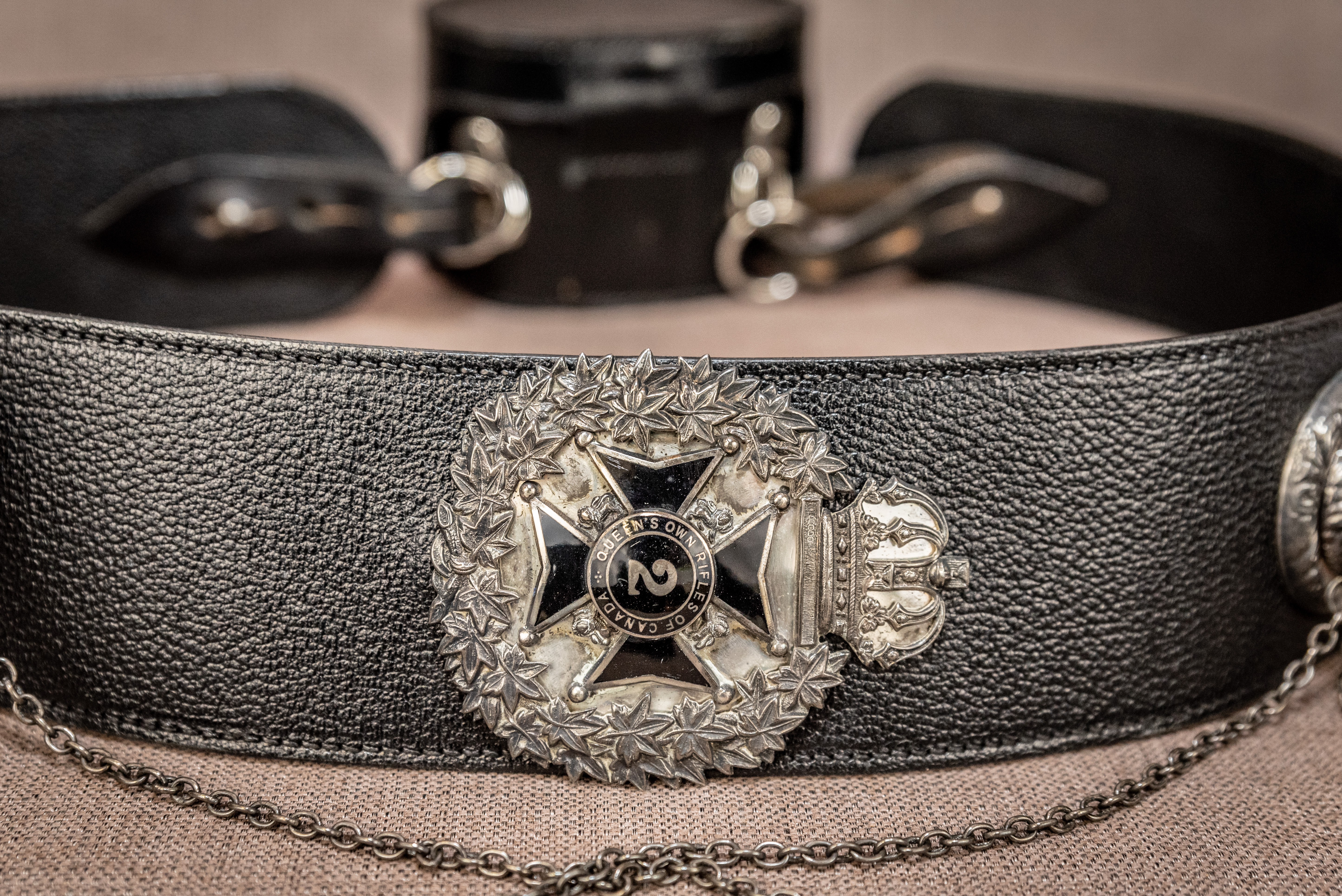
Perhaps somewhat uniquely, our acquisition policy allows for the museum to send accoutrements in useable condition to the reserve battalion if they are needed. The most common example of this would be sergeants’ and officers’ crossbelts which are expensive and hard to source these days. These would be acquired and accessioned but not catalogued in the next steps of our normal process.
We’re going to accept them – now what?
Once we’ve taken possession of the objects we’ve agreed to acquire, we enter the donor and donation information into our accession database and assign it a number. The accession number 2020.02 would represent the second accession of 2020. An accession could be one item or hundreds of items as long as they are all being donated by the same person at the same time. An item (or object – I’m pretty much using the two interchangeably) could be a uniform piece, book, artwork, photograph, weapon, or collection of archival material such as correspondence or meeting minutes.
Once that’s done, our database allows us to quickly prepare a “Deed of Gift” which lists all the items, indicates that they person donating them is the legal owner, and legally transfers ownership (and copyright if held by the owner) to the Museum, to do with as it sees fit. It is critically important establish this ownership for the future. Luckily now, much of our administration can be handled by email including sending thank you letters and deeds of gift to be signed. Once the signed deed is returned to us, we scan it and upload to our database and also file the original copy in our office files.
The process for items that are purchased is almost identical except that the receipt is used to establish the museum’s ownership instead of the deed of gift.
The database also allows us to record the provenance or history of the ownership, as far as we know it. Provenance gives value to objects. For example a pair of WWII boots is valuable – but much more valuable if we know they belonged to Rifleman X who wore then on the D-Day landing and through to the end of the war. Or to record family lore such as “grandfather said he got the epaulettes off a prisoner of war he was escorting from the trenches to the rear areas.”
The objects are now ready for cataloging and storage but our Collections Officer will explain that process in Part II.
What if we don’t want the items?
Sometimes items offered to us have no connection to our mandate or other use to us. In that case we try our best to find and connect the donor with a more appropriate museum.
Sometimes some of items are of interest and some are not and so we can decide to accept some, all, or none. An example is a donation of 10 antique rifles – several were relevant but three were not but it was an all or nothing donation. We accepted all but eventually would sell the three and use the funding to supplement our acquisition fund. This was made known to the donor before making the donation and they were fine with this arrangement.
Sometimes we’ll accept donations for our education collection particularly when we might already have several in our museum collection. These can be used or tried on (for example uniforms) by visitors or school groups – definitely not a recommended practice for items in the actual museum collection.
And if all else fails, we just have to say thank you for thinking of us, but no thanks.
What happens next?
Next comes the detailed cataloguing of each items in the accession, including labelling and photographing, and then finding safe and appropriate storage, which is recorded so we can find it again when we need it! Our Collections Officer will describe this process in Part II of this blog series coming soon!









 The Queen's Own Rifles of Canada Regimental Museum and Archive