1998 Interviews with Three QOR D-Day Veterans

On this 72nd Anniversary of D-Day, we’d like to share these interview transcripts. As part of a school project, Ryan Lutz and Andrew Brooks interviewed each veteran in his home on Sunday, November 15, 1998.  The interviews were recorded on audio tape and transcribed to this document by James Lutz

Other interviews with these three veterans:

  • Charles Dalton (and his brother Elliot Dalton) is interviewed on the DVD “Canadians on D-Day: The Juno Beach Centre”.
  • Rolph Jackson is interviewed on the DVD “D-Day: Canada’s 24 Hours of Destiny” and in Lance Goddard’s related book “D-Day Juno Beach: Canada’s 24 Hours of Destiny”.
  • Jack Martin is interviewed on the DVD “D-Day: Canada’s 24 Hours of Destiny” and in Lance Goddard’s related book “D-Day Juno Beach: Canada’s 24 Hours of Destiny”.

Questions Asked of the Veterans:

  1. What was your rank when you landed on D-Day?
  2. What was your first reaction when you heard you were going to land on June 6?
  3. What were the days like leading up to the landing on D-Day?
  4. What was it like and what were your feelings when you were coming in on the landing craft?
  5. How did everyone else feel?
  6. What happened when the ramp dropped when you landed? What were your feelings at this time?
  7. When you first got onto the beach, what were your feelings and what did you do?
  8. What was the atmosphere like during the battle?
  9. What did you do when you got close to the enemy? Did you feel a sense of relief or accomplishment when you got near?
  10. What was your first reaction when you started taking prisoners?
  11. What was your first reaction when you looked back on what you had just done, after the battle?
  12. What did you do you after the battle?
  13. What are your feelings at the present day?
  14. Do you have any other comments on D-Day and your experience?

Interview with Charles Dalton
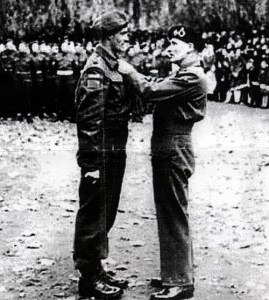
Major Charles Dalton receiving the DSO from General Montgomery

Charles Dalton joined the Cadet Corps of the Queen’s Own when he was 15.  He was a 34-year-old Major when he commanded B Company.  A and B Companies made up the first wave which landed at 0812 hours.  B Company was on the left, and A Company, commanded by his brother Elliot Dalton, was on the right.  Major Dalton was awarded the Distinguished Service Order (D.S.O.) for his leadership in the war and later served as Honorary Colonel of the QOR. 

What happened when the ramp dropped when you landed?  What were your feelings at this time?

When I said “Follow me!” and dashed down the ramp into 12 feet of water, I disappeared.  I had an 85-pound pack on my back with ammunition and food and so on plus I had a life preserver on, so we all sank just like stones.  So when people say we ran up the beach, I say “Run?  I was barely crawling up the beach!”  And we were full of water because the impregnated battle dress we were wearing at the time kept the water from running out.

The man next to me was hit seven times down his arm.  I didn’t get touched.  We scrambled up the beach and when I looked back, I was horrified to see that there was nobody following me.  Now, one of the difficult things about leading is that you never can look back, because if you look back, the people behind you then get the feeling that you’re stopping and that the smart thing to do is get down out of the line of fire.  When I looked back I thought they had gone to ground, but in fact they were lying at the water’s edge and Germans were firing at them as they lay wounded.

So in 10 minutes, of the 120 men I had with me, we were all either killed or wounded.

When you first got onto the beach, what were your feelings and what did you do?

Of course you’re always frightened, no question about that, but all I could think of was that our Medical Officer had said “Now look, 50% of you are going to be casualties.  If you’re hit, one of two things will happen.  If you’re dead, your problems will be over.  If you’re wounded, you’re going to get better.  So just lie there and keep quiet and wait for the medical people to catch up with us, but nobody else will stop to help you, because if they do the whole thing will stop.”

So I kept thinking, what I’m really worrying about is whether I’m going to survive, but it looks as if you don’t have much choice in this whole thing.  So the important thing is that I can give the leadership that they’re expecting from me because I have their lives in my hands.  If I make the wrong decision, we’ll all wind up being killed or wounded, and if I don’t make any decision, we’ll have the worst chaos of all.  So I’d better just get on with the idea of doing the best job I can and forgetting about whether I’m going to be sacrificed as we land on the beach.

Maj. Dalton, Semple, Mr. Jackson, taken by Hugh Lamb

What did you do when you got close to the enemy?  Did you feel a sense of relief or accomplishment when you got near?

The pillbox I was assigned to attack was supposed to have been taken out by the Engineers and the Tank Corps, but that didn’t happen because it was too rough and the tanks tended to sink right off the landing craft.  So it wasn’t until later, after I had been hit, that I recognized that I wasn’t going to be able to get in this pillbox because it had a steel door and a 36 grenade wasn’t about to blow the door in.  So I finally decided that if I used my Sten gun at the two machine guns that were firing, but they had a shield over their guns so that nobody could fire in.  So I had a ladder that we put up the wall, and then I fired at the shield with the hope that the bullets would ricochet off them and fly around inside their pillbox.  And actually they did, so the machine guns stopped firing, but we were still no closer to getting in.

Meanwhile, one of the German officers got his 9mm revolver out and fired at me and it drilled through my helmet and down the ladder I slid.  One of the stretcher bearers was there and said to me, “Sir I thought you were smarter than that, to stick your head over the top of that wall”.  I said, “I wasn’t trying to be smart, I was just trying to find some way to stop these people from firing, and at least I’ve accomplished that much.”  So when the tanks came up, they did just that.

What did you do you after the battle?

It was about 8:30 in the morning, I guess, and I was walking along the beach trying to catch up with the rest of the company.  A medical officer saw the bandage on my head and he took the dressing off and put another bigger one on.  He said, “You will be back in England by tonight,” but I wasn’t back in England that night, I was lying on stretcher on the beach until 3 o’clock in the morning.  People came along and put cigarettes in my mouth and gave me some rum, but after a while you realized you were terribly uncomfortable with all that sand inside your clothes.

So on the third day we were put on a tank transporter which was large landing craft, and we were stacked up three high in stretcher. By that time, cigarettes were getting pretty scarce, but here’s the kind of comradeship we had.  I would light a cigarette and take two puffs and then pass it to the man above me who took two puffs.  And if nobody cheated it would go all the way up to the top rack and back down and I would get the last puff.  Well, most people would say “Here I am, and I don’t even know if I’m going to be alive by morning, so I’m going to take a really good drag on it,” but nobody did.  And that’s what people missed when they got home, and that’s why a lot of them signed up to go to Korea.

Interview with Rolph Jackson

Rfn Jackson in Belgium Oct 1944Rolph Jackson was a 23-year-old Lance Corporal on D-Day.  He was in charge of a Bren Gun Section of B Company which was in the first wave, landing at 0812 hours.

What was your first reaction when you heard you were going to land on June 6?

We figured it was the only way we could get home.  We were awfully tired of being away from home.  We’d come over in ’41 in the summer and the English got used to us and we got used to the English, but it was an awful lot of training.  It was a job.  We knew it was going to be tough.  You people are not brought up with Canadian history, but we had our forefathers, our fathers’ generation’s reputation to live up to from World War I.  And we did it.

What was it like and what were your feelings when you were coming in on the landing craft?

Let’s get it over with!  When we first saw the beach, it was on the dark side of dawn.  It was British war time which is two hours ahead of solar time.  It was double daylight, if you follow me.  You could see outlines against the dark side.  The beaches were under bombardment.  You could see the ships at sea, a massive flotilla, the most ships I’d ever seen.  We landed while part of the bombardment was still going on.  Many of us that survived felt it would have been better to land without the bombardment because the beaches were manned when we got there.

We had rocket craft that had 1400 rockets.  They fired them in batteries of 20, and they killed a lot of cows.  Unfortunately a Yankee Thunderbolt [aircraft] was patrolling the beach and they took out one of their Thunderbolts.  That was the first casualty we saw.

What happened when the ramp dropped when you landed?  What were your feelings at this time?

Our landing craft had two sections of infantry, about 20 men, and a section of engineers.  They were demolition engineers.  We landed at the sea wall.  I’ve seen the Yankee beaches and they were very shallow, but ours was very steep.  I was – if you’ll pardon me – up to my balls in water.

We hit the beach and it was a slaughterhouse.  They cut us to ribbons.  Of the 10 men in my section, 7 were dead and 2 of us were wounded.   Two of us crossed the wall.  In our platoon, there were 6 men left by 2 o’clock the next morning, 6 out of 36.  I was hit in the hand in the water and knocked off my feet.

I lost a lot buddies.  I seen them go down.  The sea was red with blood.  Most of them went down in the water, and I think quite possibly drowned rather than was shot.  We had to walk 25 or 30 yards in the water.
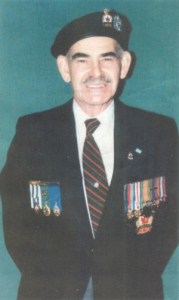
Lance Corporal Roph Jackson

When you first got onto the beach, what were your feelings and what did you do?

How did we feel when we were on the beach?  Fairly angry.  We were carrying a lot of assault equipment.  If you were carrying anything but a rifle, you didn’t make it.  Was I scared?  You didn’t think about it.

We cleared one dugout.  We presumed it was cleared – they didn’t come out after the 36 [hand grenade] went down there.  German grenades were concussion, and ours were shrapnel.  I have a piece of German grenade in my shoulder still.  The doctor gave me some sulfa because I had been shot in the hand.

We did what the Americans didn’t do.  We had Dieppe for training.  At Dieppe the soldiers stopped to help the wounded.  We learned you can’t stop under fire because a moving target is harder to hit.     We were told under no circumstances to stop and help the wounded.  No way.  Get in behind the enemy and take him out.

Was I scared?  I guess maybe we were.  We didn’t think about it.

What did you do you after the battle?

That night I wasn’t looking forward to having to dig in with one hand.  I saw the M.O. [Medical Officer] and he evacuates me because I have bones smashed.  I spent most of the night getting back to the dressing station.  I fell asleep against a stone wall and maybe got 3 hours sleep.

Interview with Jack Martin

Jack Martin was a 20-year-old Rifleman (private) on D-Day.  He was from Toronto, and his father and 4 brothers had all served in the QOR.  Rifleman Martin was with the mortars who landed with C Company in the second wave at 0830 hours.

What were the days like leading up to the landing on D-Day?

We were confined to barracks – that was C.B. – waterproofing the Bren Gun Carriers.  We had scissors and were cutting each others’ hair.  I got a beaver cut.

What was it like and what were your feelings when you were coming in on the landing craft?

I was on a Landing Craft Tank with the Bren Gun Carriers.  I was lying on the gunwale looking onto the water for mines.  This was all new to me . . . I was just a kid of 20!

How did everyone else feel?

I never gave any notice to anybody else.  I was just looking after this guy [meaning himself].

What happened when the ramp dropped when you landed?  What were your feelings at this time?

When the ramp went down, we landed on dry sand and we ran right off.  There was a captain giving us directions and he had blood streaming down his face.  That scared me more than anything else.  We were ordered to run right up to the wall for protection.  I ran like hell.  One of the other landing craft had flipped in the water.  I couldn’t see what happened to the men because we were told we couldn’t stop on the beach.  I thought it was a great accomplishment that we had gotten that far.

What was the atmosphere like during the battle?

It was hectic!  This was our first time in battle.  It means something if it’s permanent when they hit you.

What did you do when you got close to the enemy?  Did you feel a sense of relief or accomplishment when you got near?

We were the mortars, so we didn’t get too near the enemy.  We had to support the infantry.  We were near the self-propelled guns which were firing at a German 88 [88mm gun].  An SP was hit, and it was loaded with ammo, so it blew sky-high.  It was the worst explosion I ever heard, and I served from D-Day through to VE Day.  The gun from the SP came whizzing through the air at me and right over our heads.  It sounded like a freight train.

What was your first reaction when you looked back on what you had just done, after the battle?

I was tired.  I got into my slit trench and went to sleep.  We were in a barnyard, and during the night a German staff car pulled into the barnyard.  The men in it went to sleep.  In the morning, some of our soldiers woke the Germans – there were 2 officers and an NCO – and they were really surprised when we woke them up!

What are your feelings at the present day?

It was something to have lived through.  I’m one of the few left.  We were all volunteers, you know.  I have no regrets.  I had lots of great friends.

Further Information about these Veterans

Charles Dalton died in 1999 – see below for his obituary from the Queen’s Own Rifles website (qor.com).

Rolph Jackson died in 2006 – see below for his obituary from the Queen’s Own Rifles website (qor.com).

Jack Martin died in 2016.

Charles Dalton’s obituary from the QOR website:

Colonel C.O.
Charles Dalton DSO, KStJ, ED
OC ‘B’ Company
D-Day
1910 – 1999

Colonel Charles Osborne Dalton, the last surviving D-Day company commander of The Queen’s Own Rifles of Canada who was recognized for his gallantry with the Distinquished Service Order by Field Marshall Bernard Montgomery, has died aged 88.

As Company Commander of B Company, then-Major Dalton, along with his younger brother, Elliot – who commanded A Company – led the two front line assault battalions on Juno Beach for The Queen’s Own Rifles – Canada’s oldest continuously serving infantry regiment.

The brothers, who had developed a strong bond, were known in the Regiment as “Mark I and Mark II” to distinguish the elder from the younger brother.

“The Dalton brothers were legends, everybody was devoted to them and had tremendous respect for them,” said Barney Danson, chairman of the Canadian War Museum’s advisory committee and colleague of Col. Dalton. “You always had confidence in what they were doing and they always had the human touch. But they both commanded great respect.”

At his brother Elliot’s funeral service in 1994, Col. Dalton said as D-Day approached and he began to realize he may never see his brother again, he tried to come up with some parting words.

But as they parted on their respective landing crafts he said quite simply: “I’ll see you tonight.”

As the landing craft ramp dropped in front of Bernieres-sur-Mer, Major Dalton turned to his men shouting, “Follow me!”, as they plunged into two to three metres of water, trudging their way to shore.

As they made for the seawall, Maj. Dalton turned back to see his men laying on the sand.

“I thought they had gone to ground for cover, then realized they’d been hit,” he remembered.

The company had landed directly in front of a concrete strong point and were immediately met with fierce machine-gun fire. Almost half of the company was lost in the initial dash across the beach. As he and his men tried to capture a German gun emplacement, Maj. Dalton was shot in the head, the bullet ripping off his helmet and peeling off his scalp.

Despite severe wounds, Maj. Dalton continued to lead his men across the beach and was personally instrumental in knocking out one of the pillboxes.

“With blood pouring down the side of his face, he still encouraged us to continue on,” said Joe Oggy, a retired Corporal, who was under Maj. Dalton’s command at the time.

His greatest fear, he once said, was not being wounded or killed but failing to lead his men. The citation of the DSO read, in part: “By this officer’s example of leadership and bravery, and his coolness in the face of stiff opposition, the enemy fortified position was quickly overrun, and the company which followed in the landing on the beach suffered no casualties from the beach defences.

“The casualties were the heaviest suffered by any Canadian unit that day. In the end, 56 other ranks had been killed in action; seven died of wounds. Six officers and 69 other ranks had been wounded.

As Maj. Dalton was evacuated to a hospital in England, his brother Elliot was mistakenly told that Charles had been killed.

“While I was sad to hear my brother had died, I didn’t really have time to grieve, as we were still fairly busy,” Elliot Dalton recalled.

However, Elliot was wounded a few days later and sent to the same hospital as his brother. As the nurse wheeled Elliot to the bed marked Maj. Dalton, he noticed a patient lay there with the sheet pulled over his head.

When the nurse asked the patient why he was in the bed, Maj. Charles Dalton replied; “Because I’m Major Dalton.”

During his recuperation, Maj. Dalton had the honour of meeting Queen Elizabeth, now Queen Elizabeth the Queen Mother.

By August, Maj. Charles Dalton had recuperated well enough to return to combat with the Queen’s Own and served through the Channel Ports campaign as second-in-command of the Regiment during the fighting of the Scheldt in Belgium in the fall of 1944.

He was promoted to Lieutenant-Colonel, and appointed to command the Non-Commissioned Officers School at Ravenstein, Holland. He returned to Canada in March, 1945, to command the Small Arms School at Long Branch, Ont., and retired from active service in September, 1945. From 1968 – 1975 he was the Honorary Colonel of The Queen’s Own Rifles of Canada.

Born in Toronto, Col. Dalton enlisted with The Queen’s Own Rifles Cadet Company in 1925 and the 2nd Battalion Militia a year later at the age of 16.

He volunteered for active service and was sent to England in March, 1940, as an instructor to the Canadian Infantry Training Unit. In 1943, he rejoined the Regiment and was soon promoted to Major and made Officer Commanding B Company.

“He and his brother were very distinguished guys. Charlie was the archetypal dashing young officer,” said Cpl. Oggy. “He really had a lot of style. He was elegant and acted the part of a fine officer.”

“He was fantastic. He was a buddy. His brother was the same way, very down to earth. We would follow him to hell if we had to. His friendliness and rank meant nothing to him as far as we were concerned, he was a buddy and we respected him. He never talked as an officer ordering this and that, he and his brother were good leaders.” Cpl. Oggy said.

His command responsibilities followed him to civilian life. After the war he joined Canadian Breweries Ltd. as Assistant to the Vice-President of Sales and was appointed Sales Manager of the Carling Breweries Ltd. in 1946. He was made President of Carling Breweries Ltd. in 1951. He was appointed Executive Vice-President Canadian Operations, Canadian Breweries Ltd. in 1964 and Executive Vice-President of Canadian Breweries Ltd. in 1965.

He also became Vice-President of Canadian Executive Overseas from 1969 to 1971. He was a popular and much sought after-dinner speaker.

“He was a reserved person. And yet he was amazingly articulate and spoke exceedingly well and he was asked to speak a great deal because he could express and talk about the war with a light touch and good humour but didn’t treat it lightly,” said Mr. Danson, who served as a Liberal Minister of Defence.

Colonel Charles Osborne Dalton was awarded the Distinguished Service Order by Field Marshall Bernard Montgomery for “leadership and bravery, and his coolness in the face of stiff opposition.”

During his recuperation from a head wound, Colonel Charles Osborne Dalton had the honour of meeting Queen Elizabeth, now Queen Elizabeth the Queen Mother.

Rolph Jackson’s obituary from the QOR website:

Rifleman
Rolph Jackson
“B” Company
D-Day
1921 – 2006

Rolph Jackson was born April 6, 1921, in Toronto, a ninth generation descendant of Loyalist settlers from the U.S. Originally, the Jackson family came from County Armagh in Northern Ireland. His mother died when he was age six and his sister Lenore, two. The family struggled as their Dad had work only occasionally, especially during the lean Depression years. Rolph was sent to live with his uncle at age nine in 1930 on a farm in Grey County, near Holland Centre. His sister went to live with an aunt in the West.

Life on the farm in the 1930’s was difficult and the harsh environment in which he was raised significantly shaped his life. Rolph moved back to Toronto in 1937 to be with his father and to look for work. Rolph joined The Queen’s Own Rifles militia in December 1939, shortly after WW11 began. When the Third Division was mobilized for overseas service, he “went active” on 5 June, 1940, at age 19, enlisting in Baker Company of the 1st Battalion. He trained with them in Newfoundland and Sussex, N.B. prior to departing for England in the summer of 1941.

During embarkation leave, Rolph came back to Toronto and had a visit with Olive Lipski and family. She wrote him faithfully and he wrote back when he could.

On D-Day, his Baker Company was especially hard-hit, only Rolph and two others (Doug Hester and Bob Nicol) in his section survived. Rolph was wounded in the hand and after recovery remained in England until the end of the war.

Following Rolph’s return, he and Olive were married on 9 October, 1945, at Redeemer Lutheran Church, Toronto. Their daughter Chrystal was born in late 1947 and they soon decided they needed more room. They bought their first house: an “ugly four room” one and lived there from 1948 to 1952. After working at a variety of temporary jobs, Rolph got work at The Toronto Star in 1950 as a pressman and he worked there until retirement.

The Jackson family moved to a larger six-room bungalow in Scarborough (Pharmacy and Eglinton-St. Clair) just one block away from a public school that Chrystal attended beginning that Fall. Olive and Rolph lived there from 1952 until 1966 when Chrystal graduated from Grade 13 and they moved to the house on Roosevelt in East York. It was reasonably close to downtown for work for Rolph and a good community to live in.

The family attended Emmanuel Lutheran for a number of years in the 1950’s and early ’60’s where Olive taught Sunday School. She was also involved with the women’s group and helped with Christmas pageants. They had a lot of fun and liked to go to dances, shows and played cards a lot. Olive and Rolph were members of RCL Branch 344 from the 1970’s, when they met in a building on Elm Street (long since demolished), before moving to its current Lakeshore Avenue location.

They also took many interesting vacations: to the eastern United States, California, Mexico, Caribbean, Hawaii and to Europe four times, including memorial trips to Normandy as well as tours to Greece and the former Yugoslavia.

Rolph loved the out-of-doors. For many years he would take a friend and go canoeing and fishing in Algonquin Park, even into his 70’s when his friends weren’t able to go any longer.

After his wife died in 2001, Rolph lived as a widower in the house with his black cat, Midnight. His health declined and he eventually sold the house at 53 Roosevelt Road in 2005. He moved into Sunnybrook Hospital, Hees Wing, where he resided at the time of his death, just three days after the 62nd anniversary of D-Day.

—————————————————————–

This document may be cited as:  Lutz, Ryan and Andrew Brooks.  Interviews with Three D-Day Veterans of The Queen’s Own Rifles of Canada.  Toronto, 1998. 

Version of May 15, 2016

Major General Malcolm Mercer

THE HIGHEST RANKING CANADIAN OFFICER KILLED IN THE GREAT WAR BY FRIENDLY FIRE

Written by  Gordon MacKinnon and originally published in Vol 8, Issue 1 of the Canadian Military Journal.  Mercer was killed one hundred years ago today.

Deafened by a German artillery barrage, his leg broken by a stray bullet as he tried to move to safer ground, Major-General Malcolm Smith Mercer was fatally wounded by shrapnel from a British artillery counter-offensive trying to prevent the Germans from bringing up reinforcements.

The highest ranking officer of the Canadian Expeditionary Force (CEF) to be killed in action in the First World War, General Mercer succumbed to his wounds in the early hours of 3 June 1916 in No Man’s Land at the foot of Mount Sorrel near the ill-fated town of Ypres, Belgium. But for the quick thinking and perseverance of a Canadian corporal sent out to locate and bury soldiers killed in the area, Mercer’s body might have been lost forever in the quagmire churned up by the shelling.

Instead, the general was buried in Lijssenthoek Military Cemetery on 24 June 1916 in a full military funeral with all battalions of the Canadian Mounted Rifles represented. He was also posthumously Mentioned in Despatches by General Sir Douglas Haig for his valiant conduct, the third time he was so honoured.1

Except among the Mercer family and students of the Great War, General Mercer’s name is virtually forgotten today. The absence of letters and documents has meant that historians have overlooked the contribution of this hard working, amateur soldier who endeavoured to solve the problems of the new trench warfare of 1914-1916. However, the contents of a diary written by Mercer during the period 22 August 1914 to 10 November 1915 – now part of the collection of the Queen’s Own Rifles Museum – give some insight into the conscientious officer who became the first General Officer Commanding (GOC) of the CEF’s 3rd Division.

Mercer was born on the family farm in what is now north-west Toronto. Until age 25 he worked on the farm, acquiring a high school diploma and then enrolling at the University of Toronto in 1881. He must have felt embarrassed at being older than other first year students because he under-misrepresented his date of birth by three years. The Great Fire at the university in 1890 destroyed the student records, so it is not possible to know exactly when he made the change. Contrary to dates in published biographical sketches, census evidence is conclusive that he was born on 17 September 1856.2

Mercer graduated in 1885 with a bachelor’s degree in philosophy. He then studied law at Osgoode Hall and was called to the Bar in 1888. While at university, he enlisted as a private in the Queen’s Own Rifles of the Non-Permanent Active Militia, a prestigious battalion of volunteers. Mercer did not exploit the social position open to him as an officer as he nonetheless rose steadily through the ranks. However, he did excel at rifle shooting, resulting in several trips, not only to provincial and national competitions, but also to the Bisley Rifle Competition in England – as a competitor, and, in 1909, as the adjutant of the Canadian team. The Queen’s Own Rifles grew to two battalions, and, in 1911, Mercer became Lieutenant-Colonel Commandant, replacing Sir Henry Pellatt, who was promoted to command the 6th Brigade.3 All known portraits of Mercer show him in the uniform of either the Queen’s Own Rifles or the Canadian Expeditionary Force. He stood ramrod straight, six feet tall with dark brown hair and blue eyes, as well as a generous moustache that completely hid his mouth. Most observers noted that, upon first meeting, he created an impression of cool reserve.

Mercer established a comfortable law practice in 1889 with classmate S.H. Bradford that lasted until his death. The contents of his estate, auctioned in 1925, showed him to have been a collector of art, and included European and Canadian paintings, sculpture, porcelain, and antique furniture. Many of the Canadian paintings were by Carl Ahrens,4 whom Mercer had supported financially when Ahrens was a young artist.

Later, a fellow officer described Mercer as “a man who above all else took a sane view of life; quiet and reserved, with a touch of cynical humour but great kindness of heart, he impressed one as a born leader of men.”5 His “even temper, kind and open nature” continued to be noted by his friends and admirers well after his death.

painting

Moonrise Over Mametz Wood by William Thurston Topham. The painting has been described by veterans as “an eerily accurate impression of the Somme battlefield in 1916”. Beaverbrook Collection of War Art, CWM 19710261-0752

The Call to Arms

During the early part of the 20th Century, Canada’s only perceived threat by land was an expansionist United States, and the country had depended upon maintaining good relations with its American neighbours to avoid a repeat of military invasion last seen in the War of 1812, followed by some unofficial armed incursions by the Fenians in 1866. Britain, then in control of Canada’s foreign and defence policy, followed a similar course of action and withdrew its troops in 1871, except for those garrisoned at the Royal Navy base at Halifax.6 Until 1904, by law, the General Officer Commanding the Canadian Militia had to be a British Regular,7 and the few remaining British troops were withdrawn from fortresses only in 1905 when the British decided to cease using Halifax and Esquimalt as naval bases.

The Canadian defence force in 1914 was very small, consisting of 3000 Permanent Force Active Militia and 55,000 Non-Permanent Active Militia, and a navy of just two ships.

 …the total authorized establishment of the [Permanent] Force was 3110 all ranks and 684 horses. It…comprised two regiments (each of two squadrons) of cavalry – the Royal Canadian Dragoons and Lord Strathcona’s Horse; the Royal Canadian Horse Artillery with two batteries, and the Royal Canadian Garrison Artillery with five companies; one field company and two fortress companies of engineers; one infantry battalion – the Royal Canadian Regiment; together with detachments of various service and administrative corps. The Permanent Force’s main peacetime functions were to garrison fortresses on either coast and assist in training the militia.8

Entry into the widely anticipated war was never in doubt, and plans to raise quickly a force of 30,000 volunteers had been made before 4 August 1914. However, this 1911 plan to give the commanders of the existing six Military Districts of Canada responsibility for recruiting the overseas battalions was peremptorily changed by Colonel (later Lieutenant-General Sir Sam) Hughes, the Minister of Militia and Defence in Sir Robert Borden’s Conservative government. Hughes initiated matters through a night lettergram to 226 militia commanders, ordering them to recruit volunteers.9 This impractical, impromptu, chaotic methodology eventually had to be modified, but it led to the CEF being composed mainly of numbered battalions, not battalions carrying the names of existing militia units.

Because there were very few professional officers, senior militia officers who appeared to be competent and had the right political affiliations and opinions were given senior appointments within the new CEF. Lieutenant-Colonel Mercer had never seen active service, but he possessed the political and religious qualifications needed to impress the Minister of Militia. He had even accompanied Sir Sam on a pre-war military reconnaissance tour of Europe, resulting in both men concluding that war with Germany was inevitable.10

When Mercer left Toronto on 22 August 1914 for Camp Valcartier, then under construction near Quebec City, he was in charge of the soldiers from the Queen’s Own Rifles. At Valcartier, he was given command of the 1st Canadian Infantry Brigade, composed of the 1st, 2nd, 3rd and 4thBattalions recruited in Ontario.

The 1st Contingent of the CEF left Quebec City on 25 September 1914 on a fleet of passenger liners destined for England. Delays in the Gulf of St. Lawrence while waiting to rendezvous with its Royal Navy escort, followed by embarkation of the Royal Newfoundland Regiment, compounded with the slow speed of the convoy, resulted in a 20-day journey to Plymouth. One man fell overboard and another was operated on unnecessarily for appendicitis; otherwise, the voyage was undoubtedly as dull as the weather was fine.

The Canadian Contingent was under the command of Colonel V.A.S. Williams, one of the few Permanent Force officers on board. This Permanent Force officer shortage was due to the fact that the Royal Canadian Regiment had been sent to Bermuda on 6 September to release a British Regular unit, the 2nd Battalion, The Lincolnshire Regiment, for deployment in Flanders.11 Williams, a graduate of the Royal Military College, Kingston, and the Adjutant-General of the Canadian Militia, would ultimately play a role on Mercer’s last day.

Winter in the Mud and Rain

Upon arrival at Plymouth, a British Regular, Lieutenant-General E.A.H. Alderson, who had been appointed after previous Canadian government consultation, took over command before the troops disembarked.12 Mercer was placed in command of Bustard Camp on Salisbury Plain near Stonehenge. The troops resumed the routine commenced in Canada that would continue their transformation from civilians into professional soldiers: route marching and physical exercises for fitness, and entrenching, bayonet drill, musketry and other instruction to improve their military skills. The conditions were appalling. The rapid expansion of the British forces meant that there was no extra barrack accommodation. Consequently, the Canadians were housed in tents. Contractors were building huts, and hundreds of carpenters and bricklayers were seconded from the Canadian Contingent to speed up construction.13 Slowly, the troops were moved into the huts or were billeted in private homes in the small villages nearby. There was never enough space, however, and Mercer’s brigade was the only one that spent the entire winter under canvas. Several severe storms blew down most of the tents and marquees. It rained 89 out of the 123 days that they were so quartered. Surprisingly, the health of the troops remained good, and those in huts and billets suffered more illness than those in tents.14

The 1st Canadian Contingent was renamed the 1st Canadian Division, and British staff officers were added to this largely amateur army. Inspections were frequent, and Mercer must have felt satisfaction when, after a Royal Inspection on 4 November 1914 by King George V and Queen Mary, accompanied by Field Marshal Lord Roberts (who was Honorary Colonel of the Queen’s Own Rifles at the time) and Lord Kitchener, Secretary of State for War, he recorded their comments in his diary: “No finer physique in the British Army. A fine brigade. Splendid.”15

Malcolm Smith Mercer

Major-General Malcolm Smith Mercer as General Officer Commanding of the CEF’s 3rd Division. Courtesy of the Woodstock Museum NHS.

Mercer Takes Command and Learns on the Job

All three brigade commanders of the 1st Division had spent many years in the Canadian Non-Permanent Active Militia, but only Brigadier-General R.E.W. Turner, VC, DSO, had combat experience. He had won his decorations as a lieutenant in the Royal Canadian Dragoons during the South African (Boer) War. Turner was the GOC of the 3rd Brigade, and, for a brief time, was also GOC of the 2nd Division. Controversy over his eventual handling of the Battle of St. Eloi Craters (June 1916) would result in his transfer to a staff position in England. Brigadier-General Arthur W. Currie, a Vancouver real estate broker and speculator, commanded the 2nd Brigade. He would later become commander of the Canadian Corps, earning a reputation as one of the war’s outstanding allied generals. Mercer had been in the Queen’s Own Rifles (QOR) for more than 30 years, but had never led troops in battle. The brigadier-generals and their soldiers would just have to learn on the job.

Four days before the brigade embarked for France on 9 February 1915, Mercer was promoted to full colonel.16 The training routine intensified in France and Belgium, where units of Canadians were placed in the front line at Armentières, along with experienced troops of the British 4th and 6thDivisions. Then the Canadians moved into the trenches at Fleurbaix, where their role was to hold the trenches defensively while the British 1st Army attacked at Neuve Chapelle. Mercer received another promotion on 2 March, this time to temporary brigadier-general. The brigade was at the Fleurbaix front from 1 to 24 March. Rotations of four days each in the trenches interspersed with four days in reserve billets resulted in the troops enduring 16 days and nights in the trenches. As it materialized, neither side attacked. However, Mercer demonstrated that he was not a ‘château general’ – to understand fully the conditions his soldiers endured, he visited the trenches on 16 occasions and the billets on five.17 After 1 April, the 1st Canadian Division took over four kilometres of trenches north of Ypres, where the British were assuming more of the line from the French. Training and inspections continued. On 12 April, Mercer records that General Sir Horace Smith-Dorrien, commander of the 2nd British Army, under whose orders the 1st Canadian Division operated, complimented him and the troops, saying that, “for steadiness and precision this Brigade was the finest Salute he had ever seen.”18

Although fatal casualties at Fleurbaix totalled only one officer and 29 men, the Ypres Salient was to be a much more lethal introduction to war. On 22 April 1915, for the first time in warfare, an enemy attacked using clouds of poison gas. The French colonial troops on the left flank of the Canadians were hardest hit by the gas and fled in panic, but the untested 2nd and 3rd Canadian Brigades filled in the gap and held despite the lack of any better protection from the gas than urine-soaked cloths.19 Mercer’s 1st Brigade was in Divisional Reserve in Vlamertinghe. Its 2nd and 3rd Battalions were transferred to the 3rd Canadian Brigade at 2130 hours on 22 April. Early on the morning of 23 April, Mercer was ordered to march the 1st and 4th Battalions across the Yser Canal, and attack in the direction of Mauser Ridge west of Kitcheners Wood. The attack failed for several reasons: there was little time for planning and coordinating the British, French and Canadian forces involved, and the Canadian troops had never attacked before. French troops failed to advance along the canal on the Canadians’ left flank and, in the same area, Geddes’s Detachment of British battalions under Colonel A.D. Geddes, commanding officer of The Buffs, 2nd East Kent Regiment, was attached to the Canadian Division, but was not under Mercer’s command.20 Mercer, with only two battalions at this time, had a complete brigade headquarters staff. Geddes had four to seven battalions but almost no staff. Of note, Colonel A.F. Duguid, in his official history of the Canadian Expeditionary Force, infers reluctance by the British to put a Regular colonel under orders of a Canadian militia brigadier-general.

[Mercer]…could have handled several attached battalions with ease. On the other hand Colonel Geddes was a regular officer, a graduate of the Staff College, and tried in the 1914 campaign. It may be noted that no regular British battalion was in the line under a Canadian brigadier during the battle.21

There were casualties of over 400 in each battalion, and the remnants of the 1st and 4th Battalions withdrew to Wieltje on the afternoon of the 24th. The 2nd and 3rd Battalions continued to fight under General Turner’s command on 24 April when another gas attack was launched. During the evening of the 25th, the 1st and 4th Battalions marched west across the canal, and the 2nd and 3rdBattalions rejoined the brigade at night. The 3rd Battalion, partly composed of men from the QOR, reported more than 400 men captured.22 On 28 April, the entire 1st Brigade was again under Mercer’s command, guarding the canal bridges and in billets for reorganization.23 For their conduct under fire, he and the three other Canadian brigadier-generals were named Companions of the Order of the Bath (CB) by King George V in his Birthday Honours List of June 1915. The award is given for military service of the highest calibre and only 144 military CBs have ever been awarded to Canadians.24

After two weeks of refitting and adding reinforcements, Mercer’s brigade marched southeast to Festubert, where it relieved the 3rd Brigade in the front line on 22-23 May. A company of the 3rdBattalion assaulted from the Orchard on the night of the 24th. A shortage of troops caused by casualties sustained at Ypres made it necessary to use the dismounted Canadian Cavalry Brigade under Brigadier-General J.E.B. Seely as additional infantry in this attack.25 In spite of further heavy casualties, no real progress was made. By the end of the month, Mercer’s brigade was back in billets in Béthune. On 10 June at Givenchy, a short distance from Festubert, the 1st Brigade relieved the 3rd Brigade in the trenches and was to be the main Canadian formation in the attack that began on 15 June.26 For the first time in battle, they would use the Lee-Enfield rifle in place of the Canadian-made Ross rifle that had caused problems in previous engagements. The Ross was an excellent target rifle, but could not stand up to rapid fire with British-made ammunition in muddy conditions.27 While more time was available for planning the assault, a shortage of shells and strong German resistance doomed the action. On the following day, an attack by the 3rd Battalion ran into heavy machine gun fire and was forced back into its own trenches. On the 17th, the 1st Brigade was relieved, moving back into billets. Mercer had protested to General Alderson that orders for Canadian troops to man the front trenches while a mine was exploded under the German lines were both dangerous and unnecessary. He was overruled, and subsequently, there were many casualties.28 By this time, Mercer was developing a reputation as a general who frequently visited his troops in the front line trenches to assess the situation for himself, and as one who was concerned about his soldiers’ welfare.29

At the end of June, the Canadian Division was sent to a ‘quiet’ section of the line near Ploegsteert; quiet only in comparison to the active areas they were leaving. The brigade received reinforcements and continued to integrate the new men through marching and training. Mercer notes that Field Marshal Sir John French, the commander-in-chief of the British forces, inspected the brigade on 14 July and was “very eulogistic on the quality of the Canadian troops at Ypres, Festubert, and Givenchy.”30

Back in Canada, enlistment continued vigorously. More troops had arrived in Britain; a second division had been formed and sent to France at the end of September 1915. This resulted in the creation of the Canadian Corps, with Lieutenant-General Alderson as General Officer Commanding (GOC). Major-General Currie became GOC of the 1st Division, and Major-General Turner took over as GOC of the 2nd Division.31 A third division was planned, and Mercer notes in his diary that on 23 September, “Gen A called – said he had a new position in prospect for me.”32 On 19 October, Alderson told him that he was being recommended for the position of GOC of the Corps Troops from which the 3rd Canadian Division was to be formed.33 The official notice of the appointment was issued on 22 November. Mercer subsequently was struck off strength of the 1st Canadian Infantry Brigade on 4 December and appointed GOC 3rd Division with the temporary rank of major-general.34 Thus, the GOCs of the three Canadian divisions had risen from lieutenant-colonels in the Non-Permanent Active Militia to major-generals in the Canadian Corps within 14 months. They had earned quick promotions, not only because of their achievements, but also because the Canadian government insisted that Canadians be promoted to command positions in their own army.

painting

No Man’s Land by Maurice Cullen. This was the drab reality of the Western Front. It was also where General Mercer would die. Beaverbrook Collection of War Art, CWM 19710261-0134

A Last Reconnaissance in the Trenches

When the 3rd Division was formed in December 1915, “…the six regiments of Mounted Rifles [CMR] were converted into four battalions of infantry, making the 1st, 2nd, 4th and 5th Battalions of the 8thBrigade under Brigadier-General Victor A.S. Williams.”35 They were holding the line at Mount Sorrel on 1 June 1916. The 4th Canadian Mounted Rifles (CMR) held Trenches 47-53 on the brigade right, and the 1st CMR held Trenches 54-60 in the left sector up to Sanctuary Wood; while the 2nd and 5th CMR were being held in brigade reserve at Maple Copse. On 1 June, the Germans dug a trench joining the heads of the saps they had made opposite Trenches 51 and 52.36 As an aside, Lieutenant-General Sir Julian Byng had been appointed GOC of the Canadian Corps a few days before on 28 May to replace Alderson.37 Under Byng’s command, the CEF was to develop into a formidable fighting force.

On the 1st June, he [Byng] visited Major-General Mercer, who explained the situation at Mount Sorrel and Tor Top [Hill 62]. General Byng then told Major-General Mercer that he wanted him to carry out a reconnaissance with a view to a local operation to improve it. Later he went round all the headquarters in front of Ypres. Whilst he was at 8th Brigade headquarters, Major-General Mercer came to make arrangements with Br-General Williams for this reconnaissance, and asked General Byng if he would come. After a considerable pause, General Byng said. “No. You had better go yourselves tomorrow and make your own proposals. I will come around and see them on Saturday.”38

Major-General Mercer and Brigadier-General Williams met the Commanding Officer of the 4th CMR, Lieutenant-Colonel J.F.H. Ussher, in his battalion headquarters, “…in a dug-out in the immediate support trench, about twenty-five yards back of the front line”39 to evaluate the situation. Just as the generals had completed their inspection of the 4th CMR trenches, German artillery smashed the 3rd Division’s front from 0830 hours to 1300 hours with the most intense bombardment witnessed up to that time. A shell explosion deafened Mercer and seriously wounded Williams in the face and head. Mercer’s Aide de Camp, Captain Lyman Gooderham, was knocked unconscious briefly but was not wounded. Williams was taken to the dressing station in a long, narrow tunnel that had two entrances: one a shaft dug from the communication trench known as O’Grady Walk, and the other in a shelter trench called the Tube. Mercer, Ussher, and Gooderham remained in the 4th CMR headquarters.40 Ussher went to the tunnel to check on the condition of General Williams and was trapped when enemy shelling blocked both exits. The German infantry occupied Mount Sorrel above after detonating four mines.41 Gooderham attempted to move Mercer from the headquarters dugout to safety across the open stretch, since all trenches had been flattened. In the process, a random bullet broke Mercer’s leg. Gooderham bandaged the wound and the two men sheltered in a ditch. That night, British artillery fired shrapnel shells to prevent the Germans from bringing up reinforcements. Gooderham, who had stayed with the general throughout this ordeal, recorded that between 0100 hours and 0200 hours on 3 June, shrapnel from these British guns pierced the general’s heart and caused his instantaneous death.42 He was three-and-a-half months short of his 60th birthday.

Major-General Currie had learned from earlier battles that saturation artillery bombardment was essential to infantry success. Employing this technique with some innovations, his 1st Division recaptured the lost ground within one hour on 13 June 1916. “The first Canadian deliberately planned attack in any force” states the British Official History, “had resulted in an unqualified success.”43 Several German counterattacks were defeated, and the fighting ended in a stalemate typical of trench warfare.

Grave

PA 004356 The grave of Major-General Mercer. 

Recovering the Body

Corporal John Reid of the 4th Battalion was one of a group of men assigned to explore No Man’s Land at night, tasked to locate and bury soldiers who had been killed in the German attack of 2-3 June. On the night of 21 June, his party found and buried approximately 30 corpses.44 Corporal Reid’s letter describing the finding and recovery of General Mercer’s body was published subsequently in a Toronto newspaper.

… I was examining bags of stuff that had been taken off the dead the night before when I came across a pass with “General Mercer” signed on it. Just think of the excitement then, as we believed he was in the hands of the Hun. I called Pioneer Range, as we were together out searching the night before and he said that must be the spot where they opened the machine gun on us…The real excitement then started for we were spotted as soon as we left the dugout and [it is] thanks to some shell holes that we ever got there. They were not contented putting the machine guns on us. They even sent coal boxes [heavy shells] over, and some near ones too. Anyway, by six o’clock, we got the body dragged to a shell-hole about five yards from where we dug it out, where it had been buried except one boot and about four inches of a leather legging sticking out of the mud. That disinterring was really the worst part of the lot, as we had to lie face down and scratch until we got the General’s body uncovered, and then we searched the body again and saw the epaulets with crossed swords and star. I then cut off the General’s service coat and placed the body in a shell-hole till after dark.45

Williams, Ussher, and Gooderham had all been captured by the Germans and became prisoners of war.46 Sir Max Aitken (Lord Beaverbrook) wrote at the time of Mercer’s death: “It is tragic to think that such a brilliant soldier, who had risen to the command of a division by sheer force of ability, should have died just as his new command was going into its first big action and needed his services so greatly.”47

Equally tragic, perhaps, was the fact that the fatal injuries Mercer suffered in the opening bombardment in the first major battle fought by his 3rd Division makes it impossible to evaluate his tactical competence. Organizational ability and hard work were his contributions to the development of the formidable Canadian Corps. He organized the 1st Canadian Infantry Brigade out of partly trained amateur soldiers, and then trained it so that it was able to withstand the first shock of battle at Second Ypres. He took 12 battalions of partly trained troops, of whom only the Princess Patricia’s Canadian Light Infantry had much front line experience, and from them created the 3rd Canadian Division, which, under his successor, was to become one of the best combat divisions in the British forces.

Gordon MacKinnon, MA, a retired Toronto high school history teacher, served as a teacher and vice principal in Department of National Defence Schools Overseas, Metz, France, 1962-1966.

NOTES
  1. At this time, the only valour awards that could be made posthumously within the British honours system were the Victoria Cross and the Mention in Despatches.
  2. Census of 1861, District 3 Township of Etobicoke, p .37. Census of 1871, District No.13 South Oxford, Sub-District A, Township Dereham, Division No. 3.
  3. Lieutenant-Colonel W.T. Barnard, The Queen’s Own Rifles of Canada 1860-1960 (Don Mills, Ontario: The Ontario Publishing Company, 1960), p. 104.
  4. Catalogue of Highly Important old and modern Pictures and Drawings, Piranesi etchings, fine old Delft Pottery…and works of Art of the Late Maj.-Gen. Malcolm S. Mercer C.B., …under Instructions from Executors, Toronto, Jenkins Galleries, 1928. Toronto Reference Library, 708.11354 J25
  5. University of Toronto Archives, [UTA] A73 0026/318/43.
  6. Desmond Morton, Understanding Canadian Defence (Toronto: Penguin Canada, 2003), p. 32.
  7. Colonel G.W.L. Nicholson, Canadian Expeditionary Force 1914-1919 (Ottawa: Queen’s Printer, 1962), p. 8.
  8. Ibid., p. 7.
  9. Ibid., p. 6.
  10. J.E. Middleton, Municipality of Toronto: A History, Vol. 2 (Toronto & New York: Dominion Publishing Company, 1923), p. 39.
  11. Nicholson, p. 24.
  12. Colonel A.F. Duguid, Official History of The Canadian Forces in the Great War 1914-1919, Vol.1 (Ottawa: King’s Printer, 1938), p. 120.
  13. Ibid., p. 137.
  14. Ibid., p. 142.
  15. Unpublished manuscript diary of M.S. Mercer, 22 August 1914-10 November 1915, QOR Museum, Casa Loma, Toronto, 4 November 1915. Hereafter referred to as ‘Mercer’s Diary’. No diary for 11 November 1915 to his death on 3 June 1916 is known to have survived.
  16. Ibid., 5 February 1915.
  17. Ibid., March 1915, passim.
  18. Ibid., 12 April 1915.
  19. Tim Cook, No Place to Run – The Canadian Corps and Gas Warfare in the First World War(Vancouver: UBC Press, 1999), p. 25.
  20. Nicholson, p. 67.
  21. Duguid, p. 266. The Buffs had a regimental association with the QOR. Colonel Geddes was killed on 28 April 1915.
  22. Mercer’s Diary, 25 April 1915.
  23. Ibid., 28 April 1915.
  24. Veterans Affairs Canada website http://www.vac-acc.gc.ca/general/
  25. Nicholson, p. 102.
  26. Mercer’s Diary, 10 June 1915.
  27. Ibid., 13 June 1915.
  28. Ibid., 16 June 1915. On 6 July 1915, he protested orders that 200 of his exhausted men be employed as a working party. On 7 August he records his indignation when his men are kept waiting for an inspection that had been cancelled without informing them.
  29. General Mercer was in the trenches nearly every day that his troops were in the front line. During the period from 1 March 1915, when Mercer’s 1st Canadian Brigade assumed active control of front line trenches, until 10 November 1915, when his Personal Diary ends, Mercer records 57 personal visits and inspections of trenches held by troops under his command. Mercer’s Diary, passim.
  30. Ibid., 14 July 1915.
  31. Nicholson, p. 115.
  32. Mercer’s Diary, 23 September 1915.
  33. Ibid., 10 October 1915. The promotion was announced in the London Gazette, 21 December 1915.
  34. Personnel Records Envelope, LAC RG150 Box 6121-45, Casualty Form.
  35. Captain S.G. Bennett, The 4th Canadian Mounted Rifles 1914-1919 (Toronto: Murray Printing Company Limited, 1926) p. 12.
  36. War Diary 1st CMR, 2 June 1916, War Diary 2nd CMR, 1 June 1916, War Diary 4th CMR, 1-2 June 1916, War Diary, 5th CMR, 1 June 1916.
  37. Jeffrey Williams, Byng of Vimy, General and Governor-General, (London: Leo Cooper, 1983), p. 120.
  38. Brigadier-General Sir James E. Edmonds, History of the Great War Military Operations France and Belgium, 1916 (London: Macmillan & Co., Ltd., 1932) p. 231, fn.1. There is no source cited for Byng’s statement.
  39. J. Castell Hopkins, Canada at War 1914-1918 (Toronto: The Canadian Annual Review Limited, 1919) p. 146.
  40. War Diary 4th CMR, June 1916, pp. 3, 4, 5.
  41. Hopkins, p. 148.
  42. Letter from Lyman Gooderham to Professor Oswald Smith, University of Toronto Archives, UTA A73 0026-318/43.
  43. Quoted in Nicholson, p. 136.
  44. The 8th Brigade’s casualties for the battle of 2-3 June were 74 officers and 1876 ORs.
  45. The Globe, Toronto, 15 July 1916, p. 9, ‘Signed Pass Permit Finds General’s Body – Corporal Reid Tells Dramatic Story of Locating Remains of Gallant Mercer.’ There is no mention of this event in the 4th Battalion War Diary.
  46. The three officers were released in prisoner exchanges before the end of the war. Williams returned to Canada in late 1918 and was promoted to major-general in command of Military District 2 based in Toronto. The most senior Canadian to become a POW, he died in 1949 at the age of 82.
  47. Lord Beaverbrook, Canada in Flanders,Vol.II, (London: Hodder and Stoughton, 1917), p. 175.