Reprinted from “A History of Upper Canada College 1829-1892” compiled and edited by George Dickson, M.A. and G. Mercer Adam and published in Toronto in 1893. Accessed via Google Books.
———————————————————————
BY THE REV. T. F. FOTHERINGHAM[1], M.A., ST. JOHN’S, N.B.
As far back as 1863, when I entered Upper Canada College, and I do not know how long before, the older boys were assembled weekly for drill under the instruction of Major Goodwin. They were supplied with rifles and bayonets, waist belts and pouches. The room next the lavatory was set apart as an armoury. Out of this drill class the Rifle Company was evolved under the influence of vitality and environment. The presiding genius under whose auspices this took place was the gallant old soldier in command. What boy of that day does not remember him with affection? A strict disciplinarian, yet liking better to silence a frolicsome private with a harmless witticism that held him up to ridicule, than to bid him “fall out.” This was the severest penalty he ever inflicted, and it was much more keenly felt as a disgrace than the hundred lines of Virgil which the Principal immediately imposed by way of ratifying the sentence. The kindhearted old Major always seemed sorry the moment after, for in the next breath he would temper his rebuke with a cheery word and good-natured apology for the offender. He was bluff* and boyish, although his shoulders stooped and his head was grey. He loved the boys with all his heart, and they fully returned his affection. His quarters in the old Bathurst Street barracks were always free to them, and his happiest moments seemed to be when reciting his favourite “Tam o’ Shanter” to an admiring crowd, who never wearied of applauding the really splendid elocution.
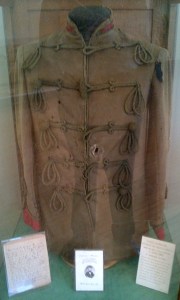
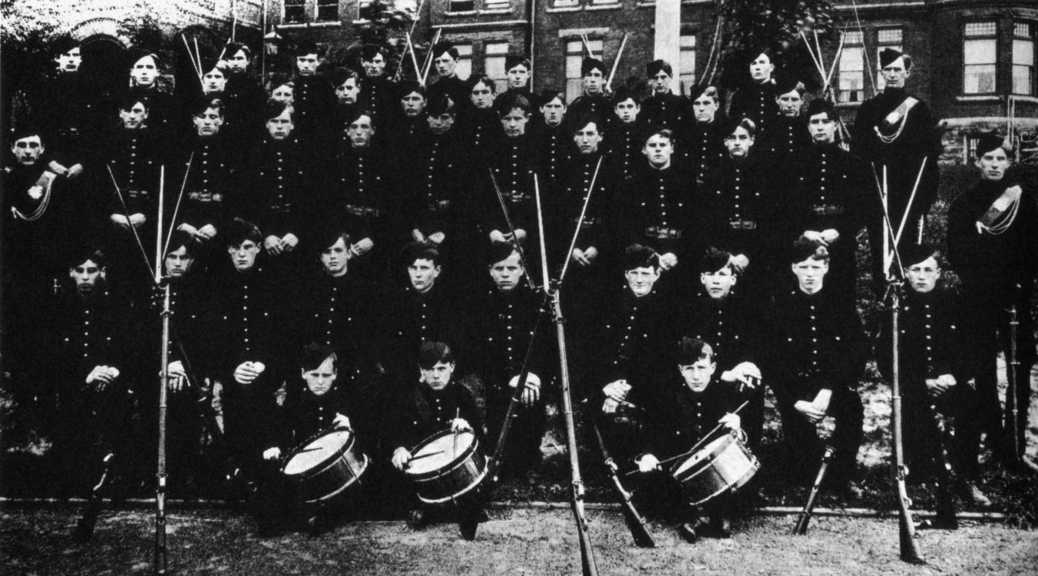
The activity of the Fenian brotherhood in 1865 awakened much uneasiness in Canada. Large numbers of volunteers were enrolled, and the Military Schools were crowded with cadets. As in 1837, College boys were not behind in offering their services. Three of us, Fuller, Wilson, and myself, had obtained second-class certificates, and the idea was mooted of transforming our drill association into a company of the “Queen’s Own.” The consent of the Principal having been obtained, Major Goodwin entered heartily into our plans. The boys met in the Prayer room one afternoon in December, 1865, and amid great enthusiasm elected Frank C. Draper, an old College boy and ex-officer of the “Queen’s Own,” as Captain, Valancey E. Fuller, Lieutenant, and M. Wilson, Ensign. William M. Richards, ______ Watson, and myself, were chosen Sergeants. I cannot remember the names of the other non-commissioned officers, if there were any. Enrolment went briskly on. The cubits of our stature were measured against the wall of the Principal’s room. What heroes we were in the eyes of those whose heads could not touch the ruler held at the standard height! The company was duly gazetted in General Orders of the 12th January, 1866, and attached to the 2nd Battalion, “Queen’s Own Rifles.”
On March the 8th, some volunteers were called out, and amongst others, the “Queen’s Own.” The College Company was not mentioned in the General Order, but the boys would not be suppressed. With the consent of Major (now Lieut-Col.) Gillmor, then in command, the boys appeared at every parade and march-out, — drilling as faithfully as others, but without any pay. This latter was a consideration to which our knightly souls were utterly oblivious. Class work was sadly interrupted. Every week there were evening drills and a Saturday afternoon march-out. Not one of the company was twenty years old, yet all tramped through the mud with the endurance and light-heartedness of veterans. Woe to the boy who stepped around a puddle instead of marching through it, or grumbled when an unlucky step filled his boot with ice-water. He was the butt of ironical sympathy for days afterwards. Our youthful appearance won us a somewhat patronizing regard from the rest of the battalion, and, in their paternal affection, they nicknamed us “the babies.” So far from being offended, the boys shewed the genuine stuff they were made of by accepting the soubriquet, and trying to make the name an honoured one. When, at the close of that period of active service. Major Gillmor complimented the company in his address at the final parade, and three cheers were generously given for “the babies,” we felt that the respect of the other corps had been completely won.
At that time many companies had their own marching songs. The College boys, in view of the juvenile position assigned to them, adopted as theirs the nursery hymn “Joyful,” fitting to its tune nonsensical words such as —
“He that hath plenty of spondulics
And giveth his neighbour none,
He shan’t have any of my spondulics
When his spondulics are done.
Chorus : “0, that will be joyful,
Joyful, joyful,
that will be joyful, when his
Spondulics are done.”
Other verses followed ad lib, “He that hath plenty of sauerkraut, peanuts,” &c., &c., until invention was exhausted. The ethics of the song were unimpeachable, and there was not the slightest thought of irreverence towards sacred associations. Anything of that kind would have been treated with scorn as utterly “low.” It was simply a boyish response to good-natured chaffing.
Few members of the corps will forget the excitement of St. Patrick’s Day, March 17th, 1866. Some days previous a rumour spread to the effect that bodies of men, marching in military order and armed with pikes, had been seen parading the streets after midnight. A guard of citizens was organized and a night patrol instituted. Fears were expressed that the usual St. Patrick’s Day procession would be the occasion of an outbreak on one side or the other. In Montreal and Quebec these parades were abandoned, but the Toronto societies determined to display their green banners as usual. Although no one believed that local Fenians would give any trouble, yet there was then, as now, an excitable element of the opposite party who might attack a procession, and those marching in it, fearing such an interruption, might carry concealed weapons. The throwing of a single stone might start a sanguinary conflict. The “Queen’s Own ” and the *’ Tenth Royals ” were assembled at the drill shed early in the forenoon and k^t there until towards evening. The College Company was with the rest of the battalion. Rations were served about noon. Drill and frolic filled up the quickly passing hours, and not a few voted it the jolliest pic-nic they had ever attended. Yet, beneath all the merriment, there were serious thoughts, for we had ball cartridges in our pouches, and many of us remembered the standing order never to fire over the heads of a riotous crowd. It was with feelings of intense relief that the citizens saw the volunteers returning to their homes peacefully that evening.
Although relieved from active service on Good Friday, March 30th, the “Queen’s Own” continued battalion drills at least weekly, sometimes oftener. At all of these the College Company was present. There was a lull in the excitement. The O’Mahony wing of the Fenians was making a demonstration at Eastport, Maine, and the Roberts faction was temporarily inactive. The volunteers were recalled from the frontier. A grand concert in the drillshed, which held 10,000 people comfortably, on the evening of the Queen’s Birthday, seemed a fitting mode of celebrating the re-establishment of public confidence. Meantime “General” Sweeney had succeeded in effecting a reconciliation of rival factions, and on May 30th was announced as on his way to Canada at the head of the Fenian “army.” Fuller despatches arrived next day, and that night the militia of Canada were again called to arms. In March the Government asked for 10,000 volunteers and were offered 180,000 — now the response was no less enthusiastic.
When we assembled in the Prayer room on the morning of Friday, June 1st, Mr. Cockburn announced that the Fenians had crossed the Niagara River and were in possession of Fort Erie, and that the “Queen’s Own” had been ordered to meet them. The College Company was also called out, and members would report at once in uniform at the armoury. After a few words regarding the gravity of the occasion, the Principal dismissed the school for the day. The company mustered in full strength within an hour afterwards, only to find to its chagrin that, by special orders of General Napier, it was to remain in garrison and furnish the necessary guards for the armouries and military stores. It was with difficulty that the boys could be restrained from deserting to join the battalion. Many refused to wear their uniform when off duty. The order was an eminently wise and considerate one, but the boys felt that it carried the reproach of “babyhood” a little too far. They resented such an implication of juvenility. One admires their spirit and is not surprised that they failed to appreciate the responsibility resting upon their elders. It was quite true that they were too young for the hardships of service in the field ; most of them had been sent to school to study and not to play the amateur soldier, and their parents would have justly blamed the Principal for having permitted the formation of the corps; besides this the duty laid upon .them was a necessary and honourable one, and fell most fittingly upon the junior company of the battalion.
For two days the College Rifles were the only troops in the city, and furnished the guard on the Friday and Saturday nights succeeding the departure of the volunteers. I need not describe the excitement of those days. College boys helped to swell the crowds around the bulletin boards and added their voices to the cheers that rang out to the accompaniment of the Cathedral chimes when news of the rout of the invaders arrived. About three o’clock on Sunday morning the volunteers from the country began to arrive. They were marched up from the railway station in companies and dismissed to ‘billets for breakfast. To me, the arrival of these raw troops was a deeply interesting sight. They came evidently from the farm and the workshop. It might be that the first gun of a great war had been fired at Ridgeway, — we did not know. If it was so, every one of these men was ready. There was no noisy frolic or loud laughter among them. Every word of command was heard with painful distinctness in the quiet of that Sabbath morning. When dismissed, one group after another struck up old-fashioned Psalm tunes, and set off singing them to their new quarters. One would have thought that Cromwell’s army or a regiment of Covenanters had reappeared among us. With such defenders, we did not fear should Lundy’s Lane or Queenston Heights come to be fought over again. Few Churches held service that evening, for nearly every person crowded towards the Yonge Street Wharf to meet the “City of Toronto” with its precious freight of dead and wounded. With another member of the company, like myself just off guard duty, I joined the crowd and was near the wharf when the steamer came in. To my surprise I heard the familiar voice of Lieut. Fuller in command of an escort composed of the College Company. It accompanied the five hearses to their destinations through thronged streets, amid a silence only broken by exclamations of sympathy and sorrow. Every head was uncovered as the dead heroes passed by.
On the Tuesday following a public funeral was held, and the bodies of Ensign McEachern and Privates Defries, Smith, Alderson, and Tempest lay in state in the drill shed. The gallery erected for the concert so recently held afforded a suitable elevation for the caskets. Ranged around these, the boys of our corps stood as a guard of honour, resting on their arms reversed, from eleven a.m. to one p.m. The company took part in all the military funerals of that sad time, and on one occasion, I think the one just referred to, furnished the firing party.
During the fortnight following the raid Toronto swarmed with volunteers, most of whom remained only a few days until formed into provisional battalions. Whilst these were in town, the College Company was released from the duty of furnishing guards. But there was the possibility that a sudden order from Ottawa might remove the guard on duty, and it was accordingly agreed that should the College bell ring at any time out of class hours, the members of the company would understand it as a signal to assemble at the armoury. One night as I was just about to retire I heard the well-known sound. It took very few seconds to resume my uniform, but, before I reached the street, every bell in the city was ringing the “general alarm.” The din was enough to warrant the conclusion that the Gael was indeed at our gates. I lived about a mile from the College, and only arrived in time to take my place at the head of the company as coverer and lead the way to the drill shed, then situated between Front and Wellington Streets, at the east end of the Parliament Buildings. A dense crowd was already assembled at the corner of Simcoe and Wellington Streets, and, as we drew near, I heard some one call out: “It’s the College boys, let’s give them three cheers !” This they did with a heartiness that made us feel modestly embarrassed. Acknowledging the honour in military fashion, we entered the drill shed, discovering then the cause of the ovation with which we had just been honoured. We were the first company to report itself in obedience to the summons. It was found shortly afterwards that we were not needed. A few companies had been ordered to Prescott, but enough remained for guard duty. In about an hour we were dismissed with not undeserved compliments. On the return of the “Queen’s Own” from Stratford, after the engagement at Ridgeway, the College Rifles met the battalion at the railway station and accompanied it in its march through the streets. Although they did not hear bullets whistle, the College boys felt that they had won some slight share in the magnificent welcome the regiment received.
During the summer following the Fenian raid a military camp was formed at Thorold, and the Upper Canada College Rifles united with the University Company to form one corps. The battalion was landed at Port Dalhousie, and marched through St. Catharines to the breezy field on the top of the mountain where the Tenth Royals and the Thirteenth from Hamilton were already pitching their tents. Here the boys again distinguished themselves by their light-hearted endurance of discomforts that would have well-nigh caused a mutiny amongst regulars. The ground was rough and hard — cattle had evidently roamed freely over it when the soil was moist. One had to select carefully for his couch the precise spot whose physical geography was most nearly complementary to the angularities of the human anatomy. The last duty every evening was a field study of the relations between geology and osteology. When it rained, the clay betrayed a most tenacious attachment to boots often ill-suited to such rough usage. The camp arrangements were of the most imperfect character. Plain rations, however, were abundant. One of our number betrayed extraordinary talents in the culinary line, and no “Irish” or “Boston ” stew can ever obliterate the memory of his achievements. No coffee and butterless bread ever tasted sweeter than that partaken around our tent pole every morning. The air was pure and bracing, and the drill just enough to make us forget all our discomforts in dreamless sleep. Every one heard with regret the orders to break up camp. To this day pleasant memories linger around the old camp ground. As illustrating the spirit of the boys, I may mention that it leaked out one evening that a general alarm was to be sounded during the night in order to test the promptitude with which the volunteers could respond. We determined that, for the honour of our corps, we should be the first on parade. Not one removed his uniform that night when he lay down. The covering sergeant slept in his boots and cross-belt, with his rifle by his side. To our great astonishment and chagrin the sun was shining brightly when the bugles awoke us at reveille.
The home march was not uneventful. As we left the camp, and when we marched through the streets of St Catharines, fair faces smiled from sidewalk and windows, and the battalion sang popular songs, accompanied by the band. We had scarcely left the town behind us when a thunder-storm came on. The “Queen’s Own” had proved its ability to “stand fire,” but water was another affair and retreat was no cowardice. We quickly found refuge under the grand stand of the race course. On a break occurring in the storm we set out again and arrived betimes at Port Dalhousie, where the “City” awaited us, but alas quantum mutati ab illis[2] who one short hour before spread their plumes and tuned their manly throats before the admiring civilians of the *’ City of the Saints!” Scarcely had we left the friendly shelter of the race course when the storm burst out afresh. The mire of the road was ankle deep and the ditches were brimful of water. Some took to the fields and others picked a careful but tedious path along the fences, while the bolder tramped along as much indifferent to pouring rain and adhesive mud as plucky College boys ought to be. No company in the battalion straggled less than the beardless youths in No. 10. When we arrived at Toronto, our sergeant was the first to spring ashore in response to the bugle call for “coverers,” and none marched up Yonge Street with jauntier step than the rain-soaked and mud-bespattered veterans of the rear company.
On the 26th June, 1868, Lieut. George D. Dawson, late of H. M. 47th Regiment, and now Col. Dawson, of the “Grenadiers” was gazetted Captain, vice F. C. Draper, who retired with the rank of Brevet Major. The Company re-enlisted under the Militia Act of 1868, but its name does not appear in the General Order of 6th February, 1869, in which the corps who constitute the active militia are named. It seems to have been silently dropped, along with others, which it was not judged advisable to continue in existence. The College Rifles never formed an integral part of the “Queen’s Own” but was merely attached to the battalion for administrative purposes. During its brief existence it left a record of which it need not be ashamed, one worthy of an institution which has supplied so many able officers to the various branches of the Imperial service. General Napier did not forget to give us honourable mention in his report.
[1] Thomas Francis Fotheringham attended Upper Canada College from 1863 to 1867.
[2] “changed much from them”




 The Queen's Own Rifles of Canada Regimental Museum and Archive