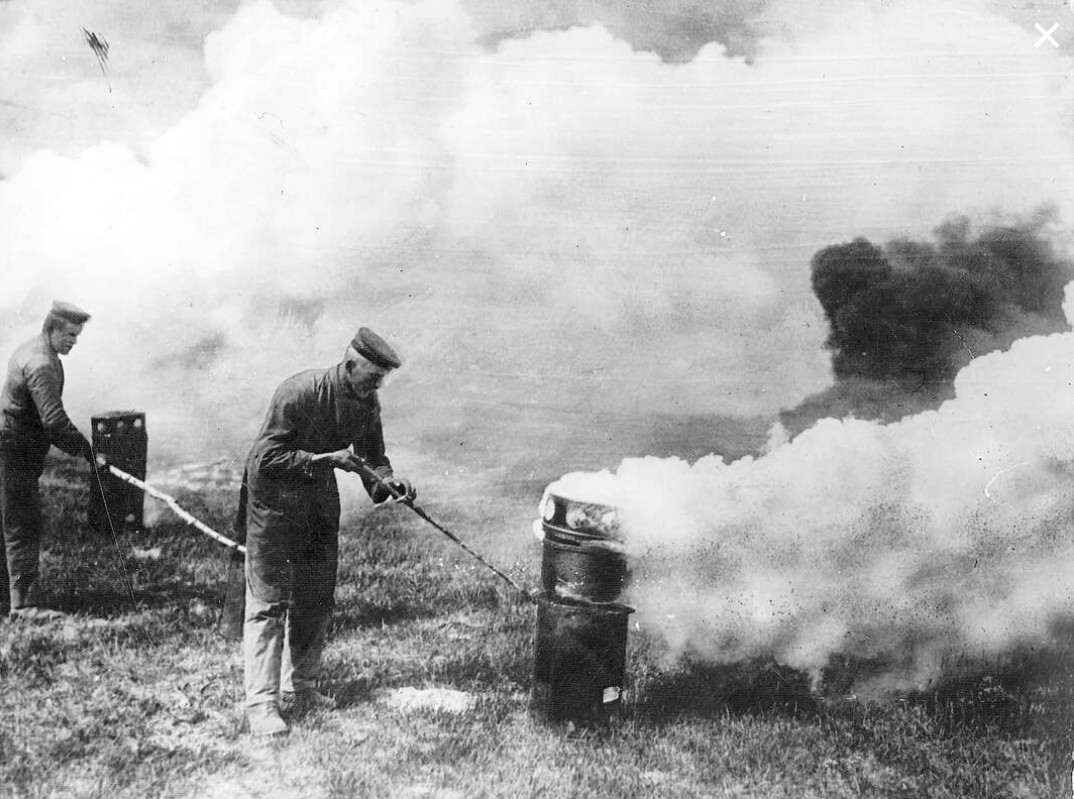
The wind shifted, carrying with it an insidious yellow-green haze. For the men of the 3rd Battalion, Canadian Expeditionary Force, dug in near St. Julien on the afternoon of April 22nd, 1915, the idyllic Flemish countryside transformed into a scene of unimaginable horror. The Second Battle of Ypres had begun, and the Canadians were about to face a weapon unlike any they had encountered before: chlorine gas.
Formed in Toronto, the 3rd Battalion, known affectionately as the “Toronto Regiment,” had arrived in the Ypres Salient with the rest of the 1st Canadian Division, eager to prove their mettle. Little did they know that their baptism of fire would be etched into the annals of Canadian military history for its sheer tenacity and sacrifice.
As the French Colonial troops on their left buckled and fled under the suffocating cloud, a gaping hole opened in the Allied line. The situation was critical. The German advance threatened to outflank the British and Canadian forces, potentially leading to a catastrophic breakthrough. It was in this desperate moment that the 3rd Battalion, alongside their comrades in the 1st Canadian Division, demonstrated extraordinary courage and resilience.
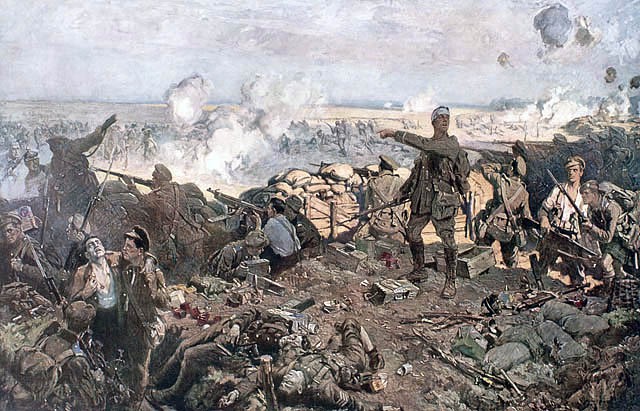
Facing the terrifying and disorienting effects of the gas – the burning eyes, the searing throat, the desperate struggle for breath – the Torontonians stood their ground. Armed with little more than their Ross rifles and unwavering determination, they poured a steady fire into the advancing German ranks. Their steadfast defence, though under relentless artillery and machine-gun fire, bought precious time for reinforcements to arrive and for the shattered Allied line to be partially reformed.
The fighting raged for days. The 3rd Battalion endured repeated gas attacks, each one a fresh wave of terror and suffering. They counter-attacked fiercely, often with bayonets fixed, pushing back the enemy inch by agonizing inch. The casualty lists mounted alarmingly, each name a testament to the brutal intensity of the battle.
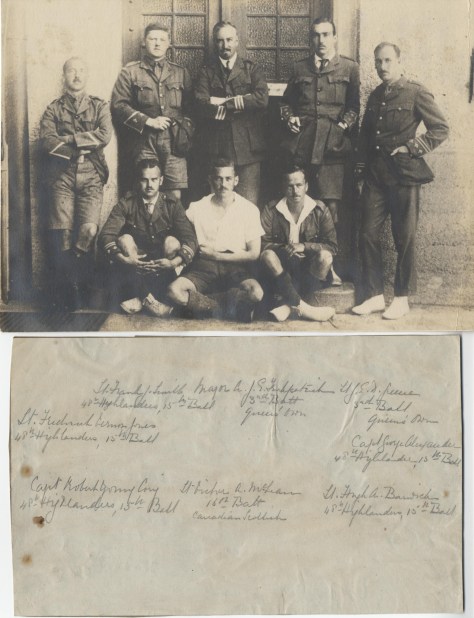
On the morning of 23 April, “C” and “D” Companies under Major A. J. E. Kirkpatrick, a Queen’s Own officer, filled in the gap existing between Kitchener’s Wood and the village of St. Julien. Throughout the day and night, the flank held. There was no artillery support. By the morning, “C” and “D” Companies had practically ceased to exist. Meanwhile, the British were rushing up support. By 27 April, the line was stabilized, the 3rd Battalion being the last to be withdrawn. St. Julien or the Second Battle of Ypres was the unit’s first battle. The “green Colonial troops” – a description used by one writer- had played a major part in preventing a German breakthrough to the Channel ports. The term was not used again. The casualties were 19 officers and 460 other ranks. These included a large number becoming prisoners of war, including Kirkpatrick, then Major Peter Anderson (who may have been the only Canadian Officer to successfully escape from a German POW camp), then Captain John Streight (D Company), and then Captain Baptist Johnson.
The Second Battle of Ypres was a brutal introduction to modern industrial warfare. The use of poison gas shocked the world and left an indelible scar on the landscape and the minds of those who fought there. While the battle ultimately resulted in a strategic withdrawal for the Allies, the unwavering courage and sacrifice of the 3rd Battalion, and the entire 1st Canadian Division, were crucial in preventing a complete German victory.
Their actions in the face of unimaginable adversity demonstrated the tenacity and fighting spirit that would come to define the Canadian soldier throughout the First World War. The story of the 3rd Battalion at Ypres serves as a powerful reminder of the human cost of conflict and the extraordinary bravery that can emerge in the darkest of times. Their sacrifice on that gas-choked battlefield will forever be remembered as a pivotal moment in Canadian military history.
Major Adam Saunders is a Queen’s Own Rifles officer currently posted to 32 Brigade Headquarters. His grandfather Thomas Cully, served in D Company, 3rd Toronto Battalion, Canadian Expeditionary Force. This article was written by Adam while in Belgium.
Most of the participants eyes were watering, as the scene at Vancouver Corner was an emotional one. The tears were from being lost in another time while listening to Belgian school children signing songs of peace and remembrance. One hundred years earlier the tears at this place were a result of the effects of the first industrial scale gas attack in history. Here we stood at the Vancouver Corner Memorial at 5 pm on April 22nd, 2015, lost in the nightmarish reflections of 5 pm on the 22nd of April 1915 when the German Army unleashed chlorine gas against the French portion of the Ypres salient. Canadians immediately felt the effects of the ensuing attack by the German ground troops. The French line had broken and the Canadian flank was ripped open.
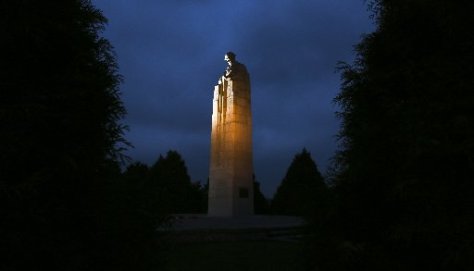
Today school children, diplomats, history books, photos, the land itself all reflect the scars from 100 years earlier. The Canadian ambassador to Belgium, together side by side with the German ambassador to Belgium, laid a wreath at the foot of the Brooding Soldier monument on the 100th Anniversary. It was a fitting union of remembrance and forgiveness. The children sang songs of forgiveness, but nothing tells the story like the tens of thousands of graves and a few massive memorials in the Ypres salient marking the final resting places of a generation efficiently mowed down by industrialized warfare.
The Canadian ‘Brooding Soldier’ memorial was unveiled in 1923 to commemorate the Second Battle of Ypres.
On April 24th 1915 the Canadians would soon have their turn to experience the full-on effects of chlorine gas. The gas was indiscriminate. It routed out mice and rats and rabbits from their homes in the ground and it strangled sheep and cattle. The gas also kills people. Our troops suffered the full effects of the chlorine gas, just as the French had two days previous. We were better prepared and managed to hold some of the challenged ground and many still hold that very ground. They are included on the lists of the missing and are more than likely in the ground in the area.
For a week previous in 1915, the Canadian 2nd and 3rd brigades had been occupying the front lines of the already infamous Ypres salient. They were tucked between the French on the left and the British on the right. Our 1st Brigade under then Brigadier General Malcolm S. Mercer (of The Queen’s Own Rifles of Canada) was held in reserve near Vlamertinghe. Finally after the Division was subjected to six months of awful weather, it was spring. It was a nice day.
Early on April 22nd it was becoming evident a German attack was imminent. The reserve brigade was put on short-notice-to-move a number of times. As pressure mounted throughout the day and that evening on our two brigades in the front line it became necessary to push the 1st brigade forward into the evolving battle. The battalions of the 1st brigade (1st, 2nd, 3rd and 4th) were sent forward in pairs. The 1st and the 4th engaged in a heroic action up Mauser Ridge to establish some kind of viable flank to protect against the rapidly advancing Germans. The French army had all but ceased to be an effective force due to the initial gas attack and the Canadians had to re-establish some semblance of a protracted defensive line.
The 2nd and 3rd battalions crossed the Yser canal at pontoon bridge number 4, in the dark moving past Essex Farm where John McCrea’s medical teams were at the ready. They marched cross country past the ongoing flanking attacks of Geddes detachment and the 1st and 4th. As the 3rd advanced towards Mousetrap Farm which was the 3rd Brigade HQ, they suffered their first casualties from German artillery fire. Those who were killed were immediately buried and those wounded were the first guests of the newly established forward medical aide stations, manned by stretchers bearers, medics and battalion Medical Officers.
As the 3rd awaited orders, 400 yards away the 10th and 16th Battalions were ordered forward into the legendary attack of Kitchener’s Wood just before midnight. The battalions formed up in line by company and advanced in the dark towards the woods, using the North Star as navigation reference. They chased the Germans out at bayonet point and recaptured the guns lost by an London Artillery unit days earlier. The 10th and 16th ceased to be effective fighting forces due to the number of casualties they sustained, yet more was expected of them over the next few hours.
C and D companies of the 3rd Battalion under QOR Major Kirkpatrick were ordered to plug a gap in the line between Kitchener’s Wood and St Julien. These men formed up in line by company, and advanced cross-country in short rushes. They came under fire and fought a pitched battle from farm house to farm house. Our men dug in under fire and under cover of darkness. Many officers and men had been killed. From first hand accounts, the officers led from the front and their men bravely followed. In the morning of the 24th it was the Canadians turn to suffer a gas attack. Artillery fire preceded the gas and followed-on after the gas, as did masses of advancing German soldiers. The Germans were flanking the Canadians so the order to retire was given. The men of C and D companies had nowhere to go. Their comrades from A and B companies, just 500 yards away heard the withering fire as they ran out of ammunition and were silenced. Six wounded men had escaped from the two forward companies. The rest were killed, wounded or taken prisoner. The Ross rifles our men were using weren’t up to the task of such a fight.
Upper Canada College First World War prisoners of war including 3rd Battalion’s Major Kirkpatrick.
On our right an equally dramatic and heroic battle was taking place with the 13th and 15th battalions. A Victoria Cross was won that day by Corporal Fred Fisher of the 13th. Both battalions faced the gas attack, full on.
For the historians in the crowd we think deeply about the exploits of this one battle and the losses of so many brave souls. It doesn’t seem to make sense now and it was on an unfathomable scale, but our thoughts return to the Belgian school children finishing songs of peace and forgiveness. I stood today for my grandfather Thomas Cully service number 10014 of D Coy. I remember all his pals and their families from the 3rd on the solemn and historical day. I shared the day at this place with a few new and old friends, many of whom were here for the same reason as I. I was here to feel, to remember, to be sad, to look for meaning and to thank goodness for all that we have as Canadians.
Sadly there remain 4 years of such commemorations. We will tire of hearing about WW1 soon enough, yet imagine how tired a generation became of fighting it 100 years ago.
Private Harold Reginald Peat (3rd Battalion), Lieutenant Colonel Pete Anderson, DSO (3rd Battalion) and Sergeant Arthur Gibbons (1st Battalion) each wrote and published first hand accounts of this battle. They are well worth a read. Peat’s “Private Peat“*, Anderson’s “I, That’s Me” and Gibbons’ “A Guest of the Kaiser” are available online at no cost.
Adam Saunders
*Perhaps also worth noting that in 1918 Peat’s book was made into a silent film in which he starred as himself:
“This propaganda picture was based on a book of the same name by Harold R. Peat, and put together inexpensively by Artcraft/Paramount with the help of newsreel footage. Peat, one of the first North Americans to enlist in World War I, was actually a Canadian, but here they make him a red-blooded American. He is alone in the world, except for his girlfriend Mary (Miriam Fouche), and he is anxious to join up when war breaks out. But the army rejects him because of his small chest. He is despondent until he and his friend, Old Bill, concoct a scheme whereby they are both accepted. After a stint in training camp, Harry bids his sweetheart Mary goodbye and accompanies Bill to France. Following several adventures at the front, Bill is killed and Harold, in trying to save a load of ammunition, is wounded. Harold spends some time in a French hospital, after which Mary comes to France to bring her heroic private home.” [from silenthollywood.com]

 As the French Colonial troops on their left buckled and fled under the suffocating cloud, a gaping hole opened in the Allied line. The situation was critical. The German advance threatened to outflank the British and Canadian forces, potentially leading to a catastrophic breakthrough. It was in this desperate moment that the 3rd Battalion, alongside their comrades in the 1st Canadian Division, demonstrated extraordinary courage and resilience.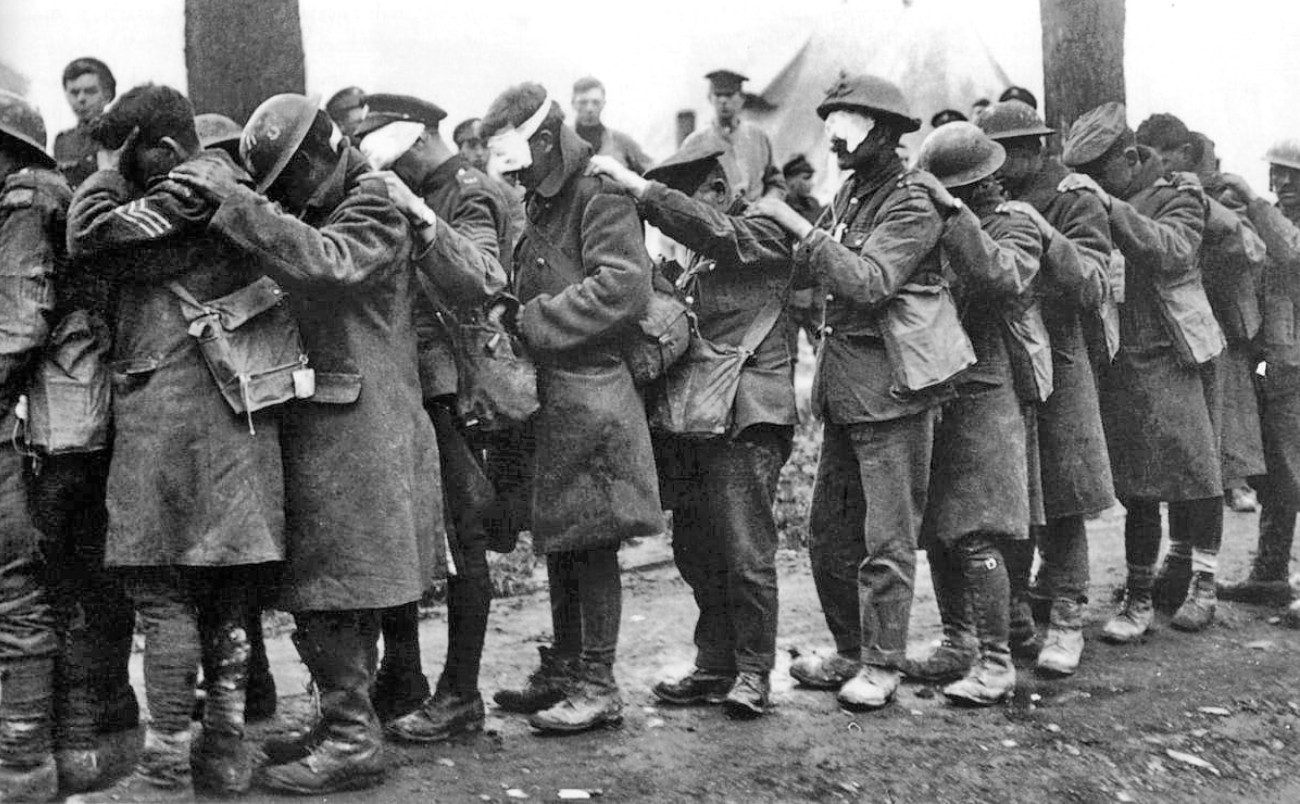


 The Queen's Own Rifles of Canada Regimental Museum and Archive