Tag Archives: Volunteer profile

Volunteer Profile: Warrant Officer Graham Humphrey

Warrant Officer Graham Humphrey rose to the rank of Cadet Regimental Sergeant Major with the 2881 Queen’s Own Cadet Corps before joining the regiment in January 2007.  He started volunteering with the museum in February 2013 and since then has put in over an amazing 350 hours! His primary interest is in the Second World War and he is slowly but steadily transcribing the QOR unit war diaries for that period and posting them on the museum website. He also took the lead in designing and creating our new “1945 to Present” exhibit room. And our QOR Days at Casa Loma would not be the same without his efforts as OPI for participating current serving soldiers and re-enactors. 

In December 2015 he was awarded the QOR Associations’ “Rifleman of the Year” award for his many efforts including the museum.

When he’s not working on museum “stuff” you can find this para qualified soldier jumping out of airplanes (70 jumps), participating in re-enactments or working on film sets making things go bang.

How did you end up volunteering at the museum?

I’ve always been interested in military history and I’m currently serving in the regiment so it seemed like a logical thing to do.

What background do you bring with you that you think helps you contribute in this role?

My knowledge of regimental history and historical memorabilia as well as the detail of regimental accoutrements and equipment that were used throughout the unit’s service.

What do you enjoy most about volunteering at the museum?

The surprises every volunteer night brings when finding new artifacts that were collecting dust in the back corners and bringing them to light.

What aspect or content of the museum are you most passionate about and why?

 Definitely the personal stories of rifleman who served the regiment before me and then attempting to tell their stories to the best of our ability.

Is there one object in the collection that really excites you or that you think people should know about?

The one object in the collection that really excited me when it came into the museum is Rifleman Jim Wilkins uniform – in particular the invasion boots that were worn by him when he landed at Juno Beach on D-Day.

Why do you think a museum like this is important?

The museum is important for us in the regiment to tell the history of our fallen and who has served before us. As well it helps us educate our new rifleman and the public on what and where the Regiment served.

Would you recommend volunteering to others and if so why?

If you currently serve in the regiment please remember the fallen and those who are currently not with us who served the Regiment and Canada and come help us do that.

If you’d like to help volunteer at the museum, check out our Volunteer page for information and an application.

Volunteer Profile: Joe Wyatt

Joe Wyatt started volunteering at the museum in October 2014 and has put in over 75 hours responding to research questions, helping at events and generally pitching in where ever needed! More recently Joe has taken over posting our social media “on this day in history” posts.

How did you end up volunteering at the museum?

I have always had a passion for history and was intrigued by the museum when I visited Casa Loma after moving to Canada 2 years ago. The museum provided a great opportunity to contribute to something worthwhile.

What background do you bring with you that you think helps you contribute in this role?

My Bachelors degree in History has benefitted the analytical nature of the research role.  My work in the educational travel industry organising World War I & II battlefield tours to Europe also helps to connect the importance of keeping people (particularly younger generations) informed of the military history of Canada and sacrifices made by the armed forces.

What do you enjoy most about volunteering at the museum?

The satisfaction of being able to respond to research enquiries with further information on their relatives.  Finding information on Soldiers in the regiment could range from scouring through the vast quantity of photos at the museum to manually searching through a pre-WWI service roll. Generating discussion and new interest in the Queen’s Own Rifles through the Social media posts on the Museum’s Facebook and Twitter accounts is also rewarding.

What aspect or content of the museum are you most passionate about and why?

The portrait collection of the early Commanding Officers of the regiment are a great focal point when visitors come up to the 3rd floor in Casa Loma. The exhibition adds context to the chronological flow of the museum.

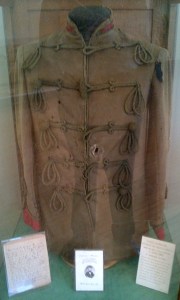
Tunic of Ensign Malcolm McEcheran, first casualty of the Queen's Own Rifles at the Battle of Ridgeway (or Limeridge) June, 1866
Tunic of Ensign Malcolm McEcheran, first casualty of the Queen’s Own Rifles at the Battle of Ridgeway (or Limeridge) June, 1866

Is there one object in the collection that really excites you or that you think people should know about?

The tunic of Ensign Malcolm McEachren is particularly significant, as he was the first casualty of the QOR at the Battle of Ridgeway in 1866. What makes this more fascinating is that the bullet hole is still clearly visible.  The D-Day landing craft fragment is a close second.

Why do you think a museum like this is important?

It allows visitors to get a greater understanding not only of Canada’s military role from 1860 to the present day through the oldest serving regiment but also how many local Torontonians impacted on that.

Would you recommend volunteering to others and if so why?

Absolutely, being a part of the museum is a rewarding experience and there are always a wide range of jobs and tasks to keep you interested.

If you’d like to help volunteer at the museum, check out our Volunteer page for information and an application.
Volunteer Profile: Cheryl Copson

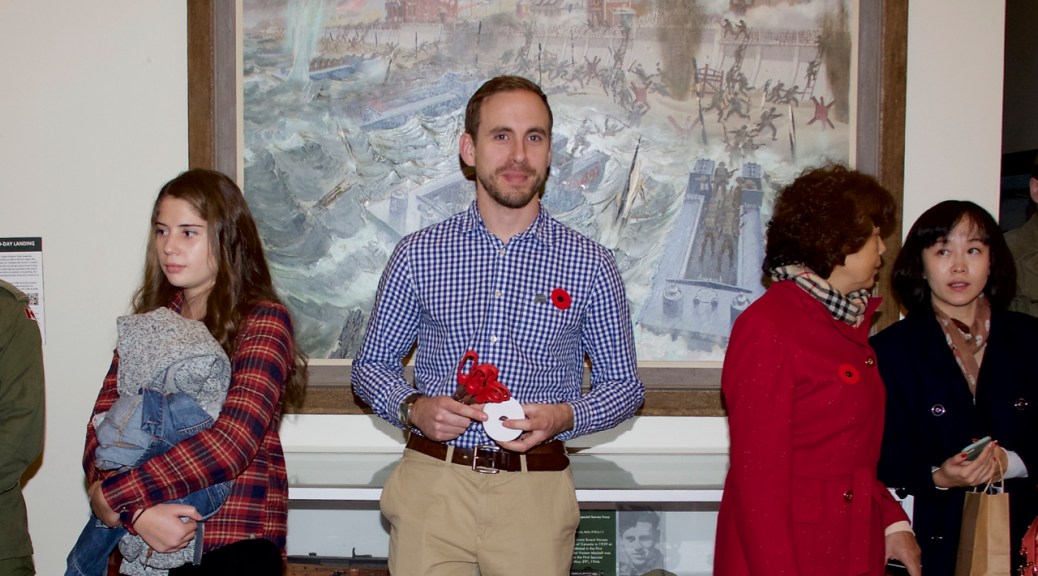
Cheryl (at right above) has been volunteering at our museum since February 2013 and has given us over 350 hours of her time. Her background in museum studies has been extremely useful to us as we’ve worked hard to bring our museum into the 21st century. And of course her cheerful and positive outlook and willingness to pitch in where ever she’s needed, are greatly appreciated!

How did you end up volunteering at the museum?

I have always had a passion for museums and history. While completing my Master’s degree, I did an internship at the Fort Erie Historical Museum. During an event for the Anniversary of the Battle of Ridgeway, I was introduced to John, who was quite interested in getting some volunteers from the Museum program. From there my interest in both history and museum lead me to start volunteering with the QOR.

What background do you bring with you that you think helps you contribute in this role?

I bring experience from working at several different museums. This has given me knowledge of best practice and techniques that assist with the proper cataloguing and storing of the objects and archives. This will help to ensure that the objects entrusted to the museum will be available to generations to come.

What do you enjoy most about volunteering at the museum?

I enjoy being a part of the transformations the museum has made. It is exciting to see the improvements to the exhibits, which are apparent to the public, and to the systems in place to protect the objects. Each week the museum takes steps to better itself, and it’s exciting to be a part of that.

What aspect or content of the museum are you most passionate about and why?

As a true “museum nerd”, I am passionate about the proper tracking of objects and their provenance. I think that this information forms the basis for creating new exhibits, and allowing members of the regiment or public to research and find information they may be interested in.

Tunic of Ensign Malcolm McEcheran, first casualty of the Queen's Own Rifles at the Battle of Ridgeway (or Limeridge) June, 1866
Tunic of Ensign Malcolm McEcheran, first casualty of the Queen’s Own Rifles at the Battle of Ridgeway (or Limeridge) June, 1866

Is there one object in the collection that really excites you or that you think people should know about?

Ensign Malcom McEachren’s Tunic. This object is one of a kind AND incredibly important in Canadian history. McEachren was the first soldier to fall during the Battle of Ridgeway on June 2, 1866. The Battle of Ridgeway (or Limeridge) was Canada’s first battle fought exclusively by Canadian soldiers and led by Canadian officers.  This made McEachren the first Canadian Soldier to fall in battle on Canadian soil. This battle was an important factor in the path towards confederation.

Why do you think a museum like this is important?

Merely the fact that the Queen’s Own Rifles of Canada is Canada’s longest continuously-serving regiment is reason enough to justify the museum’s importance. The QOR has been a part of every major war in history since its inception, which provides a unique opportunity to showcase Canadian history through the eyes of the Queen’s Own soldiers. It also means that many people are tied to the QOR and its history. Telling the story of the QOR is therefore telling the stories of many Canadians and their families.

Would you recommend volunteering to others and if so why?

YES! There are so many different aspects to the museum, and therefore many different things that need to be done to keep improving it. I think that anyone with an interest in history, research, museums, or administration would find enjoyment in volunteering with the museum.

Any other thoughts you’d like to:

Before coming to the QOR my background did not include Military history. I’ve truly enjoyed both being able to add my skills to the mix of volunteers, but I think more than that, I’ve enjoyed learning about the QOR and the military in Canada.

If you’d like to help volunteer at the museum, check out our Volunteer page for information and an application.

Volunteer Profile: Larry Hicks

Captain (Ret’d) Larry Hicks (in centre above with wife Lee) served for over 40 years with The Queen’s Own Rifles of Canada and was also employed with the Toronto Police Services. Retirement from both gave him time to volunteer at the Regimental Museum and since then he has been photographing literally thousands of artifacts for our collection database, creating images for our exhibits, and capturing museum events. His sense of humour, willingness to pitch in where ever needed, and plethora of QOR memories, make him a much appreciated member of the team!

How did you end up volunteering at the museum?

I was at the annual Officers’ Mess Christmas Luncheon when I struck up a conversation with John Stephens. I knew him socially from past mess functions. He asked me what I was doing since I retired and I replied that I was pursuing hobbies that I never had time for, photography in particular. That’s what retired people do.

He paused for a sec, his expression changed and he smiled. He knew he had me. He needed a photographer at the museum, and I wanted a way to stay involved with the regiment.. And, who doesn’t like castles!

So, for the past 3 years, I’ve been photographing, copying and displaying the many exhibits we have at the museum.

What background do you bring with you that you think helps you contribute in this role?

My last 15 years with the Toronto Police Service were spent as a crime scene Detective. It was a challenging job, and a rewarding way to cap a 37 year police career. My job was to collect evidence at major crime scenes, but I also had to present that evidence in a courtroom and reproduce the scene for judges, juries and the media. TV only shows half the job.

The camera was my main tool and I loved that I was getting paid to practice my hobby.

It was an easy transition to museum photography. Similar product but a different audience, and a lot less stress.

What do you enjoy most about volunteering at the museum?

I have a pleasant time with the people I work with. Only half have a military background, but we all love history and we all care about the regiment. We go to the pub for a pint and a chat after work.

Casa Loma is a cool place. Every time I go there I find something else that fascinates me. The summer concerts. The movie shoots. Christmas music on the Wurlitzer. It’s good that they don’t pay me, sometimes I don’t get much work done.

What aspect or content of the museum are you most passionate about and why?

Take a look at our product. The displays. This website. Facebook. We have over 5,000 photos on Flickr alone. Then look at other museum sites. We put on a good show and were proud of it.

South African Ration tin (lead)

Is there one object in the collection that really excites you or that you think people should know about?

Some people are into uniforms. Others are into weapons. I want to tell the story of the grunt, the guy who put his butt on the line for his country, and what he had to endure.

There is a can of field rations in the South Africa exhibit. Something all soldiers can relate to. It’s a can of mystery meat sealed with lead. LEAD! No wonder they’re all smiling in the old photos.

Why do you think a museum like this is important?

A nasty little word I kept hearing throughout my military career was “restructuring”. Regiments come and go. No one knows what the army will look like in another 155 years, but we can show the world what it looked like 155 years ago.

Would you recommend volunteering to others and if so why?

Absolutely. It’s a way to give back. If not to the regiment, do it for history. And, it’s a good group of people to hang out with.

Update: In February 2018 Larry was presented with the Commanding Officer Certificate of Commendation and a Command Team Coin in recognition of over 800 hours of service to the museum, and to his efforts on behalf of RHQ in photographing regimental events. Sadly Larry passed away 23 March 2018. You can read more of his service on his profile page.


If you’d like to help volunteer at the museum, check out our Volunteer page for information and an application.

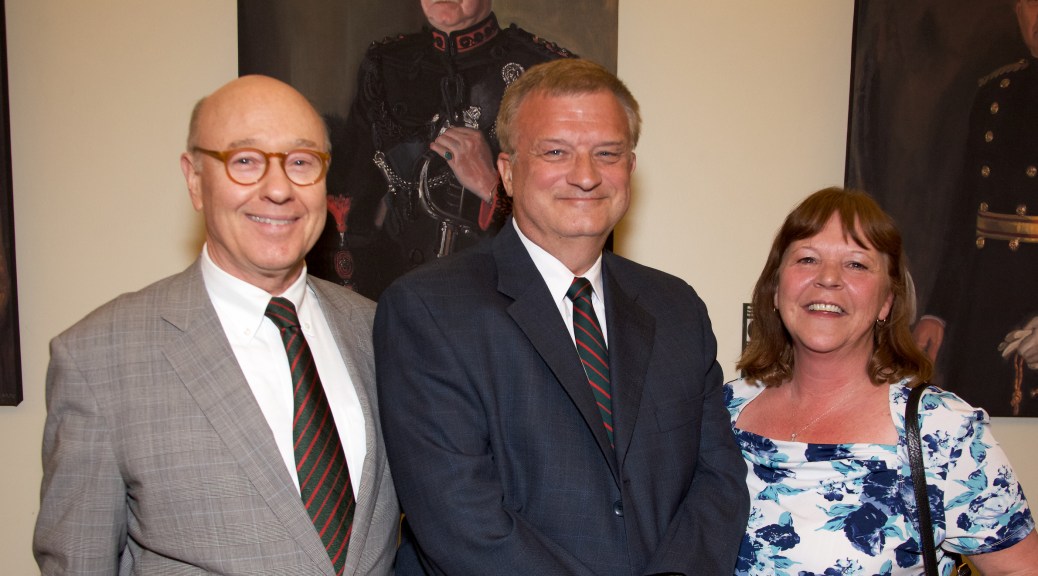
Volunteer Profile: Shaun Kelly

CWO (Ret’d) Shaun Kelly (at right above) has volunteered at the museum since 2012 in the much appreciated role of Assistant Curator. Through some very challenging times he’s brought his hard work ethic, positive outlook and strong organizational skills to help us keep the museum moving forward. In 2014 Shaun was presented the Commanding Officer’s Commendation for his work with the museum.

After retiring as Regimental Sergeant Major, Shaun began work as a civilian with the Department of National Defence in the position of 4th Division Safety Officer.

How did you end up volunteering at the museum?

I was recruited by Lieutenant Colonel (Ret) Rob Zeidler as part of a “team” when former Curator Captain Peter Simundson retired. After 33 years of full and part-time service I was still interested in serving the Regiment in some form and my wife said I should get out of the house a least once a week.

What background do you bring with you that you think helps you contribute in this role?

As a former RSM and a member of the Regiment for 33 years I had a good idea of its history, accomplishments, and stories. I have a particular interest in our history before 1900 as I don’t think we know or share enough about that time period considering it includes the Battle of Ridgeway, the Northwest Canada Campaign and South Africa which have been somewhat overshadowed by the huge accomplishments of WWI and WWII.

What do you enjoy most about volunteering at the museum?

I enjoy the research I have done on our Regimental Sergeant Majors since unlike the Commanding Officers, no formal records had been kept so finding names and dates has been a real challenge. This research continues when I’m not putting up pictures, building shelving units or cleaning-out storage closets.

What aspect or content of the museum are you most passionate about and why?

As above but including learning more about the soldiers who served during the first 50 years, what they did, where they lived and what may have motivated them to join the militia.

Is there one object in the collection that really excites you or that you think people should know about?

The photos of the different Companies that were taken after the Battle of Ridgway in 1866 I find fascinating. Firstly, photography was in its infancy so to take the time to carefully document who was there must have taken a good amount of effort. Secondly, you can see real character in the faces of the men, they looked like a real tough bunch that certainly could have done some damage to the Fenians had the battle gone differently and they had the chance to close with the enemy.

Number 10 Company June 1866
Number 10 (Highland) Company June 1866

Why do you think a museum like this is important?

Countless thousands of soldiers have served under the Queen’s Own Cap badge over the past 155 years, 1700 of them have died, many others have been decorated for acts of courage and bravery, we have an obligation to remember and share their stories. The museum is an important way to preserve their memory but also to share the Regiment’s history with our serving soldiers and the public in general.

Would you recommend volunteering to others and if so why?

Our volunteers are a diverse group: serving and former members of the Regt, civilians  with a museum background and people with an interest in military history, some help at the museum and some help virtually via the internet, some come in every week and others only come by for specific tasks, all have one thing in common that is the betterment of our museum to become a multimedia resource to share our history and heritage, everyone has something to offer.

If you’d like to help volunteer at the museum, check out our Volunteer page for information and an application.