Canada’s forgotten heroes of the Nevada atomic tests
Publisher’s Preface by Shannon Peace
This story describes Canadian soldier Arnie Clay’s remarkable experiences in the Nevada desert in 1957. It was written by my dad, Oren Robison, and published in the The Nipawin Bridge magazine in 1994, then updated and republished in 2007.
To Canada’s shame, the “Atomic Veterans” and their survivors were unacknowledged and uncompensated for decades.
Atomic Veteran: Arnie Clay’s Story
By Oren Robison
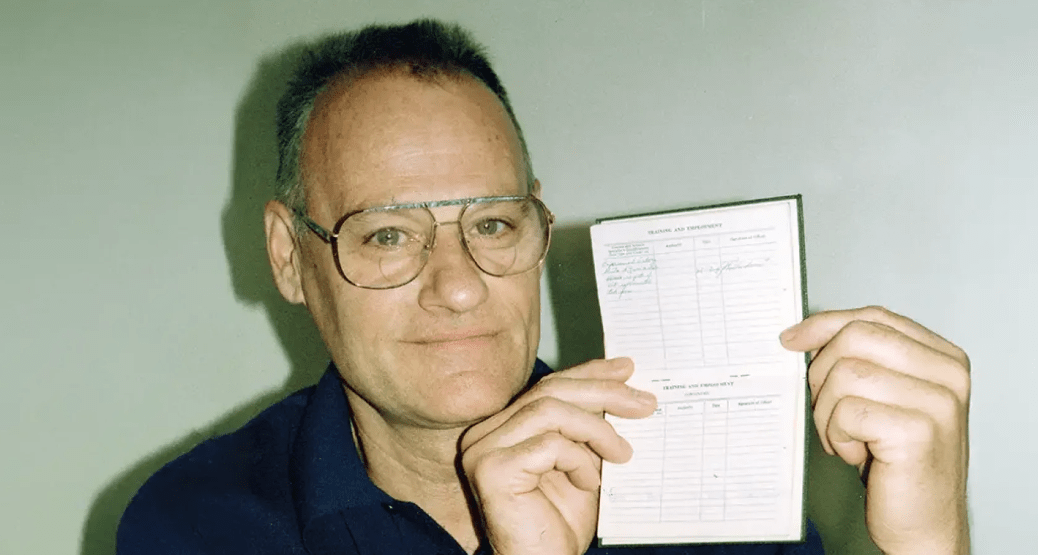
“Experienced five atomic blasts at Yucca Flats, Nevada, as part of U.S.A. experimental task force.” That entry was made in a small, hardbound booklet and signed by a U.S. army doctor, J.T. Richardson. It is in the Canadian Army service, pay and medical record book of Arnold (Arnie) Clay, formerly of Nipawin, Sask., and now retired in Calgary.
Arnie has experienced — and survived — what generations of Canadians have been taught to fear — direct exposure to nuclear explosions, and their aftermath.
Born Nov. 5, 1936, the son of Albert and Ella Clay was raised with his brothers, Ken and Keith, in a tiny house in Nipawin. Their dad was a veteran of the Second World War, a baker by trade, and later a municipal policeman.
By 1956, Arnie was ready to see more of the world. In February that year he went to Regina and enlisted in the army. He was sent to Calgary to join the Queen’s Own Rifles of Canada.
Before long he was among a contingent of men to undergo special training at Wainwright, Alta. “I can’t remember if we volunteered, or if they volunteered us,” he says. It was rigorous training, including river crossings and assault tactics.
“We would raid camps, do things other soldiers wouldn’t do” — some of the men couldn’t take it and were returned to their regular duties. So it was an elite group that left Canada in the summer of 1957, bound for the Nevada desert.
“We knew we were going to Nevada to see some atomic blasts, but I don’t remember ever being told that there was any particular danger,” Arnie says. “Besides, when you’re 20 years old you don’t believe anything can hurt you.”
At the first atomic blast witnessed by his contingent, “We observed it just as spectators. We were about a mile-and-a-half from it [ground zero]. It was a small bomb. We had no shelter, and we could feel a bit of the heat.
“I was at the back of the ranks, because I was one of the tall guys. When they said the blast was coming toward us I couldn’t see it, so I started jumping up and down [to see over the men in front of him]. Then the blast arrived and we were picking ourselves up off the ground.”
At the second explosion, the Canadian soldiers “just turned our backs to it. “Then we went on manoeuvres [war games], skirting the ‘hot zone’ because in the initial blast area nothing lives, nothing survives, nothing grows; there’s just too much radiation to enter it.”
For the third experiment, the troops were ordered to dig trenches in the desert soil. This time they would be less than a mile from the bomb’s detonation point.
“We were told to kneel in the trenches and put our rubber ponchos over our heads. When the flash came, the ground started shaking and the trenches started to cave in, so we had to stand, so we wouldn’t get buried. Some guys had to be dug out, because they didn’t stand fast enough.”
“When we stood, we could see the blast coming across the desert, rolling everything in front of it. Later, we could see that in the trenches that hadn’t collapsed, the earth was burnt at least a foot down.”
Arnie had only vague recollections of the fourth blast, “Except getting on the trucks to go to the test area. There was equipment in the field, for testing, and the loudspeakers were blaring the countdown — but that’s all I remember of that one.”
The fifth was the biggest of this test series, a bomb more powerful than those dropped on Hiroshima or Nagasaki. “We were 10 miles from it. We had to evacuate our original position and move, because of a wind change.”
At the new position, “We were behind a hill, with American troops. The Canadian group went and stood at the top of the hill, to watch. Just before zero hour, a warning came over the loudspeaker and we turned our backs, put our ponchos over our heads, and our arms over our eyes.”
When the detonation flash came, “I could see right through my arm, like it wasn’t even there — that’s how bright it was. We could feel the heat on our backs.
“When the flash was over we took our ponchos off and turned to watch. The blast came, rolling things in front of it. We could see it, and we stood to face it. It took a few minutes to come across the desert.”
Armoured tanks and heavy trucks left parked on the desert were tossed like toys. “We braced ourselves for the hit, but it didn’t do much good — it threw us all over the place.”
As on the previous four occasions, the Canadian soldiers were completely exposed to the radioactive nuclear explosions — no shelter, no protective equipment. On each occasion, they were advised to protect their eyes from the flash by averting their gaze and covering their eyes with their arms. On each occasion, they had nothing more than the standard-issue rubber ponchos to protect their bodies.
After each explosion and the subsequent field manoeuvres, they were given whisk brooms to sweep the radioactive dust from one another. Each soldier wore a special badge-like device that measured how much radiation he had taken.
“The badge would change colour, depending on the amount of radiation. Once it got to a certain colour, the guy would be taken away. I don’t know what happened to them — I never saw them again, and my badge never got to that colour,” Arnie said.
That might have been because some of the “badges” were later found to be defective. This series of tests was conducted in July and August 1957.

Now retired from Safeway, Arnie suffers from deteriorating vertebrae in his back and from pain in his knees and neck — “all my joints. But I’m one of the lucky ones,” he says.
He has remained active and with Marj has roamed the length and breadth of Canada and the United States in their motor home. Meanwhile, many of his comrades-in-arms were already in premature graves.
Others were striving, with virtually no success, to have the Canadian government recognize the so-called “Nuclear Veterans” and to provide compensation where appropriate.
At one time, there were six men from Arnie’s outfit living in Calgary. “The last time I saw three of them, they were in wheelchairs. Their arms and legs were twisted. A lot of the guys have some form of cancer,” he said.
Since 1988, the United States government has recognized that thousands of American troops suffering from at least 15 types of cancers are victims of the nuclear tests. They, and their families, can apply for cash compensation.
In Canada, however, the policy of the Department of Veterans Affairs has been to examine individual cases. Few applicants made any headway. According to the Calgary Herald, nuclear veteran Jim Huntley was turned down for a pension several times — and was finally told not to bother applying anymore.
Although Canadian authorities at one time displayed some apparent interest in testing their human guinea pigs to learn about the effects of atomic radiation on unprotected human beings, even that ceased many years ago.
There never has been interest shown in acknowledging the atomic veterans or for looking after any special needs of the men or their descendants.
On Nov. 11, 2007, at a Remembrance Day banquet at the Nipawin Legion, Conservative MP Brian Fitzpatrick proudly presented a framed copy of the new Veterans Bill of Rights, for permanent display. Among its provisions is the right to be treated with respect, dignity, fairness and courtesy.
Arnie’s earlier comment on Canada’s indifference did not reflect a sense of betrayal — quite. “Well, I’m one of the lucky ones so, for me, no — but for some of the guys, and for their families … ”
His closing thoughts:
“We were 10 miles from the blast on the fifth test — the column that went up after the explosion might have been a mile high, I really don’t know — but it was just like it was right there. I saw it tower up, like a cylinder of deep, pure red — and then it got like a mushroom, this huge, black cloud. It was beautiful.”
“They’re nice to see — but you want to hope you never see one.”
The Long Road to Justice for Canada’s Nuclear Survivors
Publisher’s closing by Shannon Peace
Canada’s atomic veterans waited more than 50 years for the federal government to recognize their service and sacrifice. Between 1946 and 1963, these soldiers were subjected to nuclear testing, enduring extraordinary circumstances and exposure to deadly radiation. They did as ordered, including keeping the atomic trials secret.
Class-action lawsuit
For decades, the Canadian Atomic Veterans Association, an advocacy group for affected soldiers and their families, sought formal acknowledgement of their service and compensation for illnesses and deaths attributed to radiation exposure.
In February 2008, the association filed a class-action lawsuit against the federal government. Legal counsel Tony Merchant alleged that Canadian soldiers were not informed of the known health risks of nuclear exposure. He sought $150,000 per veteran, an amount based on inflation-adjusted compensation of up to $75,000 paid to American atomic soldiers who were similarly uninformed of the health risks.
With no public record of a settlement found through online searches, it seems the suit did not have a favourable outcome for the veterans. Arnie Clay has no knowledge of the lawsuit.
Paltry compensation
Fast forward to September 2008 when then Defence Minister Peter MacKay announced an ex-gratia payment of $24,000 for eligible atomic veterans, including estates of the deceased. The timing of the Calgary press conference was suspect, with the compensation laid out just ahead of a federal election call.
“We simply felt that now was the time to deliver on this commitment to see a form of financial recognition but, more importantly, public acknowledgement of the tremendous contribution that atomic veterans made to the security of our country. And made with really, little choice. They were given an order, which they obeyed valiantly,” the minister told reporters.
An archived press release closes with, “All those who serve their country, past or present, deserve the respect, admiration and care of a grateful nation.”
Last man standing
Arnie Clay turned 88 on Nov. 5, 2024. He is in good health and continues to enjoy road tripping with his wife, Marj.
In 1957, Arnie was one of 42 soldiers exposed to nuclear testing in the Nevada desert. Now, he is the last man standing. “I’m the only one left,” he says. “There were 1,200 Americans and they’re all gone also.”
While he counts himself lucky, Arnie isn’t defined by that long-ago summer in the desert. After years of silence, Arnie says he has forgotten everything. “For so long, we couldn’t talk about it, so I just let it all go,” he says. “It’s something that I’ve done and I’ve got lots of other things left to do.”
Thank you, Arnie, for your service and for sharing your story.

 The Queen's Own Rifles of Canada Regimental Museum and Archive