
Twenty-five Canadian soldiers were executed during the First World War: twenty-two for desertion, one for cowardice, and two for murder.
In 2001, the Canadian government added the names of those executed for desertion and cowardice during the war to the Book of Remembrance at Parliament Hill. (See full speech by the Minister of Veteran Affairs below.)
In 2006, the British parliament granted an official pardon to all soldiers of the British and Dominion forces.
Two executed soldiers served with the 3rd Battalion, Canadian Expeditionary Force which The Queen’s Own Rifles of Canada perpetuates.
Pte. Côme Laliberté
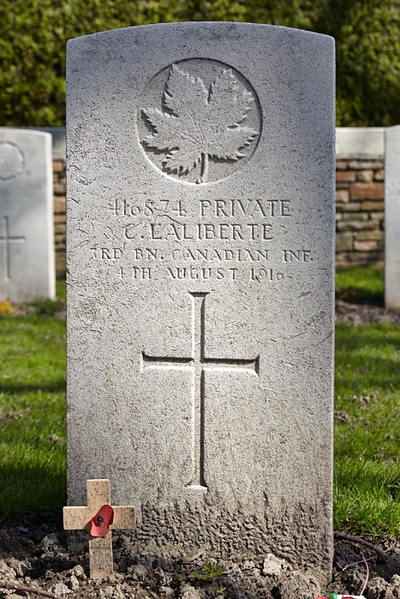
Côme Laliberté was born on 24 March 1893 in Lotbinière Quebec, the son of Ludger Laliberté (deceased in 1907) and Eugénie Hamel, of Montréal, Québec.
He served with the 22e Battalion (service number 61703) from October 24, 1914, to March 3, 1915, and was released due to his conduct.
Three days later in March, he re-enlisted in the 41st Battalion (stating being born in Lotbinière in 1893), travelling with them to England in June 1915.
Before the end of 1915, Laliberté already had several entries on his conduct sheet.
-
Date Offence Punishment 29 June 1915 Drunkenness Fined 2 days’ pay 5 August 1915 Absent Without Leave (AWOL) Fined 2 days’ pay 10 September 1915 Out of barracks with a pass and improperly dressed 7 days Field Punishment No. 1
On moving up to the trenches during the Summer of 1916, as part of the 3rd Battalion’s contribution to the battles around Mount Sorrel, Laliberté left the ranks and refused to go forward. He was tried for desertion, found guilty and sentenced to death by shooting.
On 4 August 1916, Laliberté (aged 23) was executed by firing squad. His remains are now located in Poperinghe New Military Cemetery, Plot II, Row H, Grave 3.
Pte. Edward James Reynolds

Edward James Reynolds was born on 2 January 1896 in Toronto. In April 1915, Reynolds enlisted in the 35th Battalion. By November 1915, Reynolds was a member of the 3rd Battalion in the line near Ploegsteert.
On 25 July 1916, the Germans exploded a mine under a portion of the front line called “The Bluff”. The 3rd Battalion was ordered forward to plug the resulting gap in the front line. However, Reynolds fell out from his platoon only to be found 2 days later at his battalion’s transport lines. Reynolds claimed that he had been ordered back and got lost. This excuse was accepted.
During the following night (26 July 1916), Reynolds was ordered to accompany a ration party up to the front line. Again Reynolds fell out and went back to his battalion’s transport lines. This time Reynolds was arrested and charged with desertion. He was found guilty by a court-martial and sentenced to death.
At 05:27 on 23 August 1916, Reynolds (aged 20) was executed by firing squad. His remains are now located in Longuenesse Souvenir Cemetery, Plot IV, Row A, Grave 39.
It is of interest that both the Toronto Star and the Toronto Telegram reported at the time that Reynolds had been killed in action.
Speech by the Hon. Ronal Duhamel, December 11th, 2001:
Mr. Speaker, hon. colleagues, I rise in the Chamber to speak about the First World War and the fate of some Canadian soldiers, a fate that has been essentially forgotten in the pages of history.
For the young nation of Canada, the promise and optimism that infused the dawning 20th century was abruptly cut short by the First World War. No one anticipated such carnage, or that we would soon be sending young citizens into a war that would see 65 million people from 30 nations take up arms, where 10 million people would lose their lives and 29 million more would be wounded, captured or missing.
Never before had there been such a war, neither in the number of lives taken, nor in the manner of their taking. New weapons would turn fields of battle into slaughter grounds, while the rigours of life in the trenches would kill many of those who escaped bullet or bayonet.
This “war to end all wars” challenged our small country of 8 million to its limits. Almost 650,000 served in the Canadian Forces in the Great War. Over 68,000—more than one in ten who fought—did not return. Total casualties amounted to more than one third of those who were in uniform. Thousands came home broken in body, mind, and spirit.
The service of Canadians in uniform was as remarkable as it was distinguished. History records their sacrifice in places whose names resonate even to the present day. Battle names such as Ypres, The Somme, Vimy Ridge, Passchendaele and Amiens.
Those who lived then and the historians who followed would declare that Canada came of age because of its actions and ingenuity during World War I.
But where history speaks of national sacrifice and achievement, it is too often silent on the individual stories of triumph, tragedy and terror of those who fought and died on the terrible killing fields of France and Belgium.
Those who went to war at the request of their nation could not know the fate that lay in store for them. This was a war of such overwhelming sound, fury and unrelenting horror that few combatants could remain unaffected.
For the majority of the Canadians who took up arms and paid the ultimate sacrifice, we know little of their final moments, except that they died in defence of freedom.
Today I want to talk about 23 of our fallen. I would like to tell the House about these soldiers because these circumstances were quite extraordinary. These 23 soldiers of the Canadian Expeditionary Force occupy an unusual position in our military history. They were lawfully executed for military offences such as desertion and, in one case, cowardice.
We can revisit the past but we cannot recreate it. We cannot relive those awful years of a nation at peril in total war, and the culture of that time is subsequently too distant for us to comprehend fully.
We can, however, do something in the present, in a solemn way, aware now, better than before, that people may lose control of their emotions, have a breakdown for reasons over which they have little control. For some it would have been known today perhaps as post-traumatic stress disorder.
To give these 23 soldiers a dignity that is their due and to provide a closure for their families, as the Minister of Veterans Affairs on behalf of the Government of Canada, I wish to express my deep sorrow at their loss of life, not because of what they did or did not do but because they too lie in foreign fields where poppies blow amid the crosses row on row.
While they came from different regions of Canada, they all volunteered to serve their country in its citizen-army, and that service and the hardships they endured prior to their offences will be recorded and unremembered no more.
Allow me to enter their names into the record of the House: Quartermaster Sergeant William Alexander, Bombadier Frederick Arnold, Private Fortunat Auger, Private Harold Carter, Private Gustave Comte, Private Arthur Dagesse, Private Leopold Délisle, Private Edward Fairburn, Private Stephen Fowles, Private John Higgins, Private Henry Kerr, Private Joseph La Lalancette, Private Come Laliberté, Private W. Norman Ling, Private Harold Lodge, Private Thomas Moles, Private Eugene Perry, Private Edward Reynolds, Private John Roberts, Private Dimitro Sinizki, Private Charles Welsh, Private James Wilson and Private Elsworth Young.
We remember those who have been largely forgotten. For over 80 years, they have laid side by side with their fallen comrades in the cemeteries of France and Belgium.
I am announcing today in the Chamber that the names of these 23 volunteers will be entered into The First World War Book of Remembrance along with those of their colleagues. Adding the names of these citizen soldiers to the pages of this sacred book, which lies in the Memorial Chamber not far from here, will be a fair and just testament to their service, their sacrifice and our gratitude forevermore.
Lest we forget.
With info from Wikipedia, the Canadian War Museum and OpenParliament.ca

 The Queen's Own Rifles of Canada Regimental Museum and Archive