by Major Ronald R. Lilley, CD
This article was the second of two found in our collection. The date or purpose for which is was written is unknown. The first article can be found here. Lilley left the Loyal Edmonton Regiment to join the 1st Battalion QOR in March 1954.
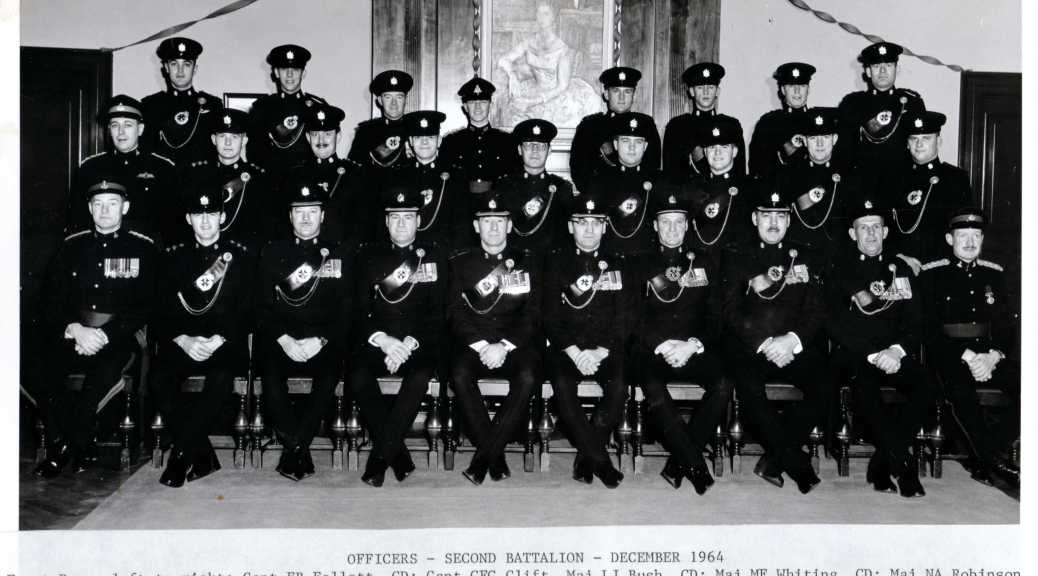
In ‘62 I returned to Regimental duty and once again was posted to a unit which had just returned from Germany – the Second Battalion, led by its gravel voiced Commanding Officer, Lieutenant Colonel Dan Osborne.
On a bright sunny spring day I found myself in command of one of the battalion’s 100 man guards, paying homage to the General Officer Commanding Western Command. I had spent most of the night writing up a bn exercise and consequently was more dazed than usual. The guard was approaching the yellow marker and I shouted out the cautionary words, “No. 2 guard will advance” (the guard number is immaterial to the event). All would have been perfect except that the executive words of command “Left, Turn” followed in rapid order. That was the day I introduced the new drill movement “left foot over right foot”, a major drill not previously practised to my knowledge. I had missed the marker by not less than 15 paces or 100 miles whichever was closer on that eventful day. The movement was carried out in the best Rifles tradition and by the time we reached the saluting base flag the guard was lined up with the lead coy. After the parade and at the dispersal area I called CSM George Stolzenberg (I believe it was Stolzenberg) forward, congratulated the guard on its excellence in the face of adversity and bought a libation to prove I was serious. Never before had I witnessed such steadiness and I only hope my successors never have the same nerve shattering experience.
The glorious day finally came when I took over command of B Coy in the Fall of 62. Captain Larry Diebel, at my instigation, started all rank Coy Mess Dinners. Sgt “The Bandit” Friedt the Officers’ Mess Sgt, and a member of B Coy, provided the candelabra, silver and wine glasses. We developed a mess dinner procedure with appropriate toasts, etc. They were very popular, as could be attested to by the attendance (smiles and attendance were both compulsory). The dress standard set for the first dinner was based on a tie and shirt. We did not alter the dress standard but with each succeeding dinner it was interesting to note the increase in subdued tone ties, blazers and sports coats and the vast improvement in the rifleman’s walking out dress.
The Coy went through its usual pre-Exercise Snow Chinthe drills during the Christmas holidays and learned to live outdoors in the cold and pull toboggans over simulated snow (gravel and grass). 2/Lt Dave Montgomery and Sgt Bill Hamburgh’s platoon learned to live with frogs and cope with soggy tent floors during an unseasonable warm spell in Wainwright prior to the exercise beginning. During the work-up training and on the actual exercise CSM Noble wee a tower of strength and on numerous occasions placed the fear of the hereafter on any idle rifleman or NCOs.
On my return from a course in England 10 days prior to leaving for Wainwright, I met the new CO, LCol Ed Price (expected). Capt Diebel, CSM Noble and many familiar NCOs and men were serving elsewhere in the bn (unexpected). The Coy’s training pace in Wainwright of a mile to two-mile run before breakfast, section tactics every morning, platoon tactics every afternoon and coy tactics every evening was slowed down when B Coy was honoured by being selected to enter the Forced March Competition on July first. This honour was duly passed on to 2/Lt Dave Montgomery and Sgt Jewel.
(For a fuller account see page 79 of the 1963 Powder Horn edition). It is now old hat that Dave’s pl won. But I’ll never forget the look of surprise on Brigadier Macdonald’s face when Dave’s pl doubled on in full battle order, then broke into quick time, advanced, halted and presented arms to the Bde Commander. This was not part of the usual ceremony but was added to show what stern stuff we riflemen are made of. In marching off Sgt Jewell’s order to the platoon was: “Run over them lads, if they don’t get out of the way!” He of course was referring to the spectators. At a suitable distance from the spectators, the plantoon was photographed with their trophy. This platoon also returned several pieces of equipment dropped by 2 PPCLI which were turned over to that unit’s CO by Colonel Ed Price.
We were soon concentrated as a Company and training started again in earnest. Dave Montgomery’s scalded feet required that I employ him as the OC of the Special Weapons elements attached to the Coy and in this capacity he assisted the Company Operations Officer, Capt Harry Williams-Freeman in the Command Post. Staff Sgt Don Wilson, as CSM, provided the spark which kept the Coy HQ on its toes. He did a tremendous job of organizing a very successful coy all ranks bash during our last days in the battalion bivouac area. Greased poles, bucking horses (45 gallon oil drums), log chopping and sawing contests were all entered into with great gusto. Cpl Miller, the Coy cook, outdid himself in providing deluxe hamburgers and Staff Lottridge ensured that an abundance of beer and soft drinks were always available. One LdSH(RC) [Lord Strathcona’s Horse] trooper was heard to say, “what a party!” “Why can’t our blank, blank squadron get organized?” A gunner from D Battery replied, “When you’re part of B Company who blank, blank cares?” and with that they rejoined the mob at the camp fire to sing their hearts out.
He operated a Company multiple radio net, an experiment which was reluctantly bIessed by the CO. It was an excellent training device and section commanders soon learned the worth of their radio, as can be testified to by LCpl Standen, whose radio ceased operating during a Brigade exercise. He claimed he knew nothing about the overall progress being made by the Company and consequently had no idea what to expect next. He felt that he and his section were completely insulated until they were committed to action by the Platoon Commander.
1964 saw the emergence of a cross country ski team, equipped with modified army skis which hampered any chances they had to win, and a Down Hill team that struck gold, or should I say silver plate, in their first Western Command Championship. Many will remember that the 1964 Exercise Snow Chinthe was almost cancelled because of the conflict with General Rockingham’s Western Command Ski Championship. In those days, channels of communication with all superior HQs were well established and woe to any individual who tried to short circuit the system. Unfortunately, Superior Headquarters did not always follow the established channels. I had been ordered to establish and direct the Command Ski Off and at one stage found myself working for General Rockingham, Brigadier Macdonald and LCol Price on conflicting requirements. As is not too unusual, the General won and my other tasks were deferred to after duty hours. Capt Dick Graham’s experience provided the necessary continuity in organizing the meet so that I could get some coy work done during normal working hours.
During the 1964 Bde Commanders Conference I was called to one side by Colonel Ed Price and told I was posted to the RCS of I [Royal Canadian School of Infantry] and would become DC Tactics Division. Once again, it was time to say farewell to Regimental life.





 The Queen's Own Rifles of Canada Regimental Museum and Archive