Tag Archives: 1st Battalion

One Soldier’s Life: From Korean War to the Pulpit

From Summer/Fall 2008 Issue of Powder Horn

Lieutenant Colonel T.M.C. “Boom” Marsaw

(Lieutenant Colonel “Boom” Marsaw, commissioned 2/Lt in The Queen’s Own Rifles, was posted to Korea in 1954 where he commanded the Machine Gun Platoon and a platoon of ROK Army soldiers and later served as Liaison Officer to the ROK Army. He also served in Germany, Cyprus, India, Pakistan, Norway and Alaska. In April 1969, then Maj Marsaw serving with 1 Br Corps, he was recalled to take command of the 1st Battalion QOR of C, serving until it was rebadged as the 3rd Battalion PPCLI. In 1977 LCol Marsaw retired to begin his service as a Baptist pastor.)

When I first met LCol “Wild Bill” Matthews, he was sporting the badge of The Queen’s Own Rifles. He had been awarded not one but two Military Crosses, for bravery during WWII and he proved to be some CO! What an impact he was to have on my life, my career. As I see it, one of the true measures of greatness in this world is the capacity to inspire others to reach for — and achieve — excellence. That’s how Bill influenced me. It was he who launched me on the way to Regimental Command. There is just no doubt about it.

Colonel Bill was no stranger to his officers, especially junior officers. I had only been briefly at my new post before I was ushered into his office. “Where are you from, Boom?” he asked. “London, sir,” I answered. “Hey you’re practically home. (Camp Ipperwash was just an hour’s drive away.) They call this part of the province Western Ontario, don’t they? That’s great because we need some good westerners in this outfit. You’re going to command a platoon in D Company. It is made up of fellows from The Regina Rifles, a fine Regiment. They (and The Queen’s Own) were the only guys in the whole of the Allied D-Day landing force to achieve their objective. They even went beyond and had to be hauled back. They’ve got a great reputation.” He added that, “Oh, by the way we’ve got a track and field meet on this afternoon so you’d better unpack your running shoes. I’m sure the Company will be able to use you.” And they did. That afternoon I won the 100, 220, and 440. All the practice I had keeping out of Mom’s reach really paid off. It didn’t hurt either in the matter of winning the respect of those in my new command. There is something about working for the fastest guy in the Regiment. It was a great beginning for a relationship that lasted a lifetime.

From my earliest days with the Regiment it had always been my aspiration to achieve command. That opportunity came far sooner than I had anticipated when a posting to the British 1st Corps in 1970 was cut short and I was whisked back home to take over the 1st Battalion, The Queen’s Own Rifles of Canada. I was 38 years old and for a moment the youngest Battalion Commander in the Canadian Forces. Immediately after the handover parade, I had the RSM assemble the troops in the mess hall. I don’t remember much of what I said that day, hopefully all the right things, but most significantly I addressed the issue of faith. I realized that there were some who were concerned about “the old Bible thumper” taking command. I acknowledged that fact and suggested that they might be just a little concerned that there would be a church parade every Sunday. I assured them that would not happen. They all cheered. “Every other Sunday,” I said. And they all booed. With that I assured them that I wasn’t there to push my faith down their throats, but I simply hoped to prove that having the likes of me in command would make an encouraging difference.

I knew that I had very big shoes to fill. The Regiment was turning out some really fine leaders. The last two Commanding Officers were nothing short of outstanding and both went on to become Generals. (Kip Kirby and Herb Pitts MC). Not only did I inherit a fine unit, but also some really encouraging operational roles — that of the Canadian Forces Mountain Warfare and Arctic Operations Battalion. The Queen’s Own was Canada’s contribution to Ace Mobile Force Land (AMFL). In practical terms that meant we were assigned to the defence of Norway.

In WWII Norway had very quickly fallen to Hitler’s Germany. AMFL was NATO’s attempt at preventing it from happening again should the Russian war machine start to roll. The Alliance had committed itself to putting a Brigade on the ground in Norway at the first sign of a serious threat by the Warsaw Pact Nations. Canada’s role was to have a Company there in 24 hours and an entire Battle Group in seven days. The Queen’s Own were the major component of the Canadian contribution and I was in command. The overall size of the force was a Brigade Group. The other two Battalions were provided by Britain and Italy, the Germans supplied the Armoured Regiment, each Battalion brought its own Artillery and the Americans added a lot of the bits and pieces that make a force of this size work.

There were about 1200 in my command including a flight of six Huey helicopters. We had enough Skidoos to move one whole company, Armoured Personnel Carriers (M113s) sufficient for another and snowshoes for all. The choppers could do a pretty good job of moving a Rifle Company in two lifts and the better part of a battery of light guns in one. This entire Force was airlifted to Norway by the RCAF Transport Command.

It is important to realize that the Norwegian venture was only one of the many things an Infantry Battalion may face in the passing year. Life in a Regiment is an unending chain of adventures. For instance, the unit already knew it was going to Cyprus for a six-month tour of duty the following year. Preparation for that was already in the back of our minds. But, between now and then it was train, train, train.

THE END OF AN ERA

On April 26th, 1970, we celebrated our Regiment’s 110th birthday and on the next, paraded as the Third Battalion of the Princess Patricia’s Canadian Light Infantry (PPCLI), The Princess Pats. The cartoon on the local newspaper’s editorial page pictured the Officers’Mess bar with a collection of its distraught members. It was captioned, “Cut to ribbons…Wiped out…Totally annihilated…By our own side.” The only consolation was that we were exchanging membership in the most decorated Regiment in Canadian history for membership in another wonderfully storied Unit.

________________________________________________________

If you’d like to support the Regimental Museum and Archive with our goal of “Telling Their Stories,” you can find more information on how you can make a sustaining or one-time financial donation on our Donation page.

Reg Force Reminiscences: “WUN BUN DAZE”

by Major Ronald R. Lilley, CD

This article was the first of two found in our collection. The date or purpose for which is was written is unknown. The second article will be posted in two week. Lilley left the Loyal Edmonton Regiment to join the 1st Battalion QOR in March 1954.

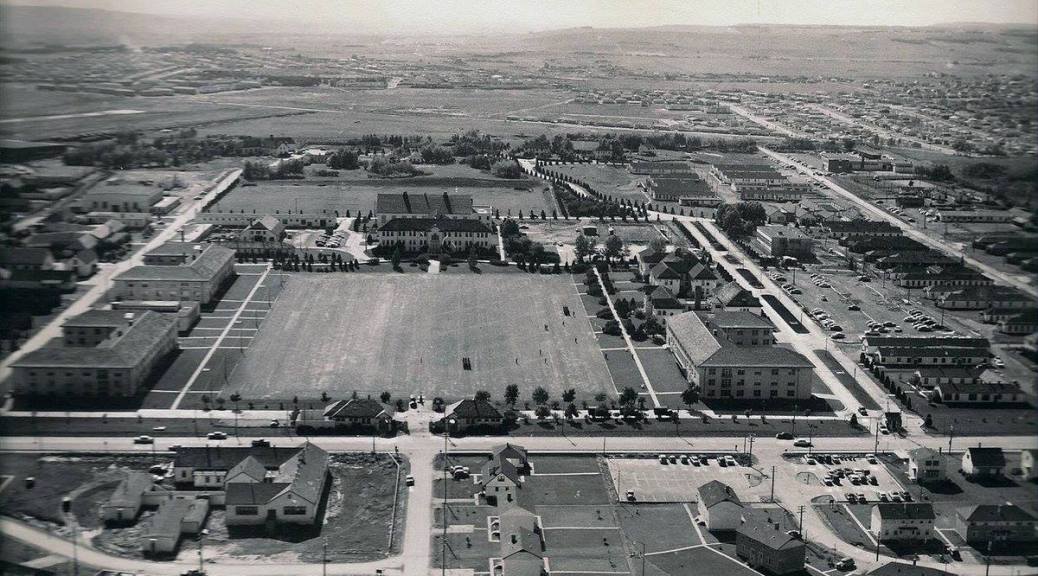
Back in the Spring of 54 (1954), not 1854, as many of my more recent associates would claim, the formation of 1 QOR of C was in progress at Currie Barracks, Calgary. Major C.P. McPherson (CP), acting by authority of Lieutenant-Colonel John Delamere’s absence, was the Supreme Commander of a handful of riflemen, NCOs, WOs and officers. The term “motley” may be an unkind term to use in describing this crew, but motley it was. The Adjutant, Captain Frank Moad and RSM Rusty Rowbotham completed the Bn HQ triumvirate. Lieutenant Fred Sargent (the QM) and I, at the time of my reporting in, were the only two First Lieutenants. Our association increased in size when Lieutenants Lloyd Cornett, Herb Pitts and Bob Munson reported for duty. At that time the PPCLI still reigned supreme in the permanent Mess on the hill while the LdSH (RC) were located adjacent to them in the temporary wartime buildings. Our Mess was located in an old Air Force H-Hut located adjacent to the Northeast corner of the parade square.

“Tea” was an informal “parade” where the CO determined the progress made on the state of the union and made or rescinded his various pronounce­ments, such as “ALL officers will wear moustaches.” Parties “spontaneous or otherwise” always ended up with “Grease the Tube”. After every shot, the Mess Secretary, while he was capable of doing so, gathered up and placed in an appropriately labelled bag, mainsprings, crystals, cog wheels, etc., of the individual’s wristwatch. The equivalent of a Timex was soon worn by all officers, and issue watches were in great demand.

Inevitably, Wainwright was upon us and Major Don Creighton became acting 2IC, relinquishing the command of HQ Coy to Lieutenant Lilly. The Coy was in the best shape possible considering the paucity of equip­ment and personnel. At the time, I was corresponding with Captain “Honest John” Mitchell, who was the Sigs Officer designate. “Honest John” took over his platoon several weeks after we were in Wainwright and it he had been prone to heart seizures we would have lost him on day two of his service with the unit. CO’s briefings were held daily, with the officers assembled around a campfire pit. Young 2/Lt Mike Newell ([later] Deputy Commander 12 RBC – Valcartier) commanding one of the sp wpns pls, was scorched by the CO’s wrath when, after receiving a direct order for events to take place the following day, he said: “I won’t do it.” Mike was suffering from an abscessed tooth, as I recall, and had a dental appoint­ment for the next day. CP’s fury provided an unexpected anaesthetic. Incidentally, Mike did have the tooth extracted and not by CP.

My turn came at the end of one of the Bde exercises. The Bn was granted 24 hours in the built-up area for R&R. I had checked over the officers’ quarters and had allocated the rooms by placing the officer’s name on the appropriate door. Unfortunately for me, I had to return to the Men’s area because their quarters allocation had been halved and I had to make up a new plan. In my absence the Straths advance party over­ruled our representatives and re-allocated the CO’s suite and most of the choice rooms to their CO and officers. On my return to the Officers’ Mess I felt righteous indignation for the treatment to which I was subjected.

By this time, we had all learned to keep our mouths shut and not to raise the subject of our undoing until another officer fell into the excreta, or for at least 48 hours. My saviour had already been earmarked by fate, Lt Ivor MacLeod by name. Those were the days of “NO shortages.” A smouldering mattress heaved from a second storey window (still open) was discovered the next day by CP. Poor Ivor had fallen asleep with a lit cigarette; feeling extremely warm, he had taken the aforementioned action which caused the inevitable chain reaction.

That same summer, then, in an effort to increase the mobility, started the first post-war experiment which eventually led to the procuring of the M113A1 APC. 2/Lt Spike Vanier, with a fleet of tired bren gun carriers, streaked around the training area on a preconceived battle plan. Experiments the next summer included transporting troops in 3/4 ton trucks and trailers. We must have been blessed by either CP or the Almighty, because we never lost a man.

Individual training began once again after the leave period and we were soon introduced to a new Capt Adjutant in the personage of George Hall. George, the nemesis of CP, was noted for using his Christian name on part one orders, green tinted glasses, a moustache and his wife Bunty. George and Bunty were also noted for their after-duty escapades. George continually tried to widen the entrance to Currie Barracks, was usually successful, much to the chagrin of the Garrison Commander. Bunty became infamous at a Strath Mess Dinner involving CP, Kurt Greenleaf (CO LdSH (RC) and General Vokes (GOC Western Command) . I eventually replaced George as adjutant and Lloyd Cornett in time replaced me . By accident or design, all the adjutants (Frank Moad, myself and Lloyd Cornett) with the exception of George Hall, were to meet Rod MacKay, the former Bn 2IC, in Vietnam.

After a sojourn in Vietnam, I returned to the unit in Sep 56 and after a relatively short but peaceful existence. “Rapid Step” was upon the unit in its full fury. I was relegated to be OC Rear Party and missed out on all the fun in Halifax, much to my dismay but to the eternal joy of my wife. Rehearsals for the Feu de Joie were held on the RCAF tarmac at Lincoln Park. This always caused a minor problem because the Air Force stenos had tender ears and objected profusely to their Station Commander about the air pollution which followed the unit in the form of a blue haze. Needless to say that RSM Rusty Rowbotham was the main contributor with minor contributions being made by various CSMs. Officers received sword drill from CSM Ken MacLeod in Scott Hall. We in those days carried the famous Wilkinson Sword made in Japan. Trying to balance it was like holding a 6-pounder Atk gun in the vertical position by the muzzle. Young Ken using the best techniques of instruction of that day, continued to practise us in sword drill by numbers and by numerous demonstrations to inculcate the finer points in our rather erratic movements. In due course, we were able to do the whole drill. Wishing to sharpen us up, he prepared to give us one more demonstration using his own words of command. “Draw Swords”, shouted CSM MacLeod, and with a flourish, his hand went through the motions. To his dismay and to our amusement, the blade never left the scabbard and momentarily basket, sword knot and handle were held in a gloved hand with the blade parallel to the ground, elbow at the side, then in slow motion the basket, complete with knot, did a barrel roll to the concrete floor. Sword drill was suspended for the rest of that day in a gale of laughter.

Wainwright 57 saw the unit in bivouac at Border Lake and once again I was casting covetous glances at our mates in our rifle coys and at those officers in the rifle coys of the ad hoc bn formed under Major Ron Wilkinson, our Bn 21C. We went through the various rounds of inspections of the HQ Coy Bivouac area. On one occasion, LCol Chuck Lithgow accompanied by the Comd MO and Food Services Officer, commented on the completeness of amenities in our area and jokingly said “Where’s your deep freeze?” To his amazement, I said to Staff “Zump the Pump” Zumprelle, “Show them our deep freeze.” Zump showed them our ice cream cooler suitably concealed in a bush near the kitchen.

The next summer saw us located in the Westgate area. That was the summer I learned to tactically employ helicopters. My most important task, brought on by the introduction of helicopters, was to race around the whole bn area ensuring that crapper lids were closed. The Bde Commander, Brigadier Wrinch, had a fetish for hovering over bivouac areas and peering into open crappers.

The incident I remember best and will undoubtedly be reported on more adequately by others, involved the OC and 2IC of a rifle coy which shall remain nameless. On a dark and probably stormy night the 21C Capt John Probyn (1 had to use a web belt on the old grouch to make him human when he was adjutant) was returning from a recce of a coy crossing site. The coy was to launch an attack across the Battle River. Time being of the essence, the coy Comd Major Hank Elliot had decided to move the coy forward. In ground mist obscured depression, the 2IC and Coy Comd encountered each other and locked radiators.

Pte McAteer, the outstanding batman in the unit, was ordered during an emergency move of HQ Coy to look after our stock of ammunition (blank of course) by CSM George Collings. While establishing our new position the CSM yelled several times for McAteer to bring forward the ammuni­tion for redistribution. McAteer had disposed of the ammo by burying it in the old location.