
 B131997 Rifleman Hector William Wilson was born on 19 July 1924 in Renfrew, Ontario, to Scottish parents, Liford William Wilson and Annie Mae McNevin. His father, a farmer, served in the Veterans Guards in Canada during the Second World War. Liford Wilson also served in World War One with the 148th Battalion. He participated in Vimy Ridge, Passchendaele, Mons and Ypres. He was wounded on two occasions and gassed once. The family consisted of Betty Mae, Christina Evelyn and Glen Duncan.
In his hometown, Hector attended public school until Grade 7 when he quit to work at the O’Brien Woollen Mill in Renfrew and help the family. He was accepted for military service on 3 July 1939, close to his 15th birthday, with the Lanark and Renfrew Scottish Regiment in its pipe band. In his paybook, he listed service in the “42nd Black Watch” Regiment from “1938-1940“.
With the war declared in September, he attended annual training in August 1940. But military authorities discovered he was “underage” and discharged him from the army on 19 June 1941.
 Seeking work in Canada’s industrial towns, Hector worked as a steelworker for United Steel Company in Welland, Ontario, when he enlisted on 27 August 1942 in nearby Hamilton. His enlistment document described him as “small and slight build” standing 5 foot 5 inches and weighing 122 pounds as well as being “young and immature”. The year 1942 was also when his mother died of tuberculosis on 10 January at age 44 back home in Renfrew.
During his basic training at the Niagara Camp in Ontario, Hector married Helen Martha Grey Selkirk on 30 April 1943. They had dated for the previous 11 months when she lived in Brantford, Ontario. During this period, he also was treated for tonsillitis and mumps and recovered in military hospitals in Hamilton and Niagara-on-the-Lake in Ontario.
In a military assessment in November 1943, he was reported to be a “first-class shot, suitable for sniper.”
He was shipped overseas to the United Kingdom on 24 February 1944. Initially, he was assigned to the Highland Light Infantry Regiment but he was transferred to The Queen’s Own Rifles after arriving in Normandy, France, on 7 July 1944. This regiment fought from France, Belgium, the Netherlands and then Germany.
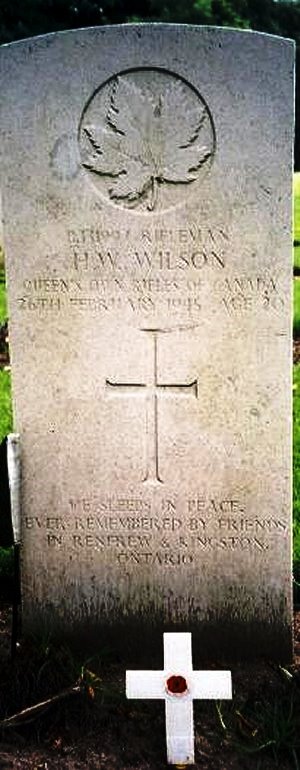
Rifleman Wilson was killed on 26 February 1945, age 20, in Germany as the Canadian Army launched Operation Blockbuster as part of the Rhineland campaign. His unit had the task of seizing enemy positions astride the road from Calcar to Udem immediately north of Keppeln.
He was buried at the temporary military cemetery at Bedburg, Germany, near Calcar. His remains were removed in 1946 and buried in Groesbeek Canadian War Cemetery, grave reference VIII. B. 16. His epitaph reads:
WE REST IN PEACE
EVER REMEMBERED BY FRIENDS
IN RENFREW & KINGSTON
ONTARIO
From Faces To Graves, courtesy of Kurt Johnson.

 The Queen's Own Rifles of Canada Regimental Museum and Archive