
Around 1911/12 he enlisted with The Queen’s Own Rifles militia battalion and rose to the rank of Sergeant.
With his fellow sergeants, he enlisted with the 3rd Battalion, CEF on 22 September 1914. He was treated in May 1915 for influenza and as a result, may have been saved from the fate of his brothers-in-arms who died or were taken prisoner that month. After further training, he was commissioned as a Lieutenant and posted to the 5th Battalion, CEF on 6 November 1916. That same month he was awarded the Military Cross for his actions while with the 5th Bn.
By the month’s end, he was posted as an orderly officer in the 12th Brigade Headquarters. In January 1918, he was seconded to the British War Office for a “secret mission” of some sort, the only clue being his being struck off the strength of “McCarthy’s Irregulars” of “D Force” in October 1918. This referred to the Dunsterforce in the Caucasus.
“Dunsterforce was an Allied military force, established in December 1917 and named after its commander, Major-General Lionel Dunsterville. The force comprised fewer than 350 Australian, New Zealand, British and Canadian officers and NCOs, who were drawn from the Western and Mesopotamian fronts. The force was intended to organize local units in northern Iran (Persia) and South Caucasus, to replace the Tsarist army that had fought the Ottoman armies in Armenia.”
The Canadians sent 15 officers and 26 NCOs of
... strong character, adventurous spirit, especially good stamina, capable of organizing, training, and eventually leading irregular troops.
— G. W. L. Nicholson
Until the “Hush-Hush Party” sailed for the Middle East on 29 January, the War Office kept the men incognito at the Tower of London, with no knowledge of their destination. It’s not completely clear if McCarthy’s Irregulars were part of Dunsterforce or a subsequent unit which absorbed many of the D Force survivors – but likely the latter.
His service record indicates he may have been in hospital in November 1919 at the Jelus Refugee Camp in Baqubah, Persia (now Iraq.)
(For more on the complicated efforts of Dunsterforce, see the Wikipedia entry.)
Roberts now a Captain, returned to England, ceased to be attached to the War Office, and was finally discharged on demobilization.
On June 18, 1927, he married Beatrice Kathleen Hillary in Aurora, Ontario.
After the war, he went to New York and worked as an interior decorator for prominent firms including Wannemakers. In 1939 he joined his father in operating the Roberts Gallery in Toronto established in 1870 by his grandfather, Samuel Roberts. He continued to run the family business after his father’s retirement and until his own.
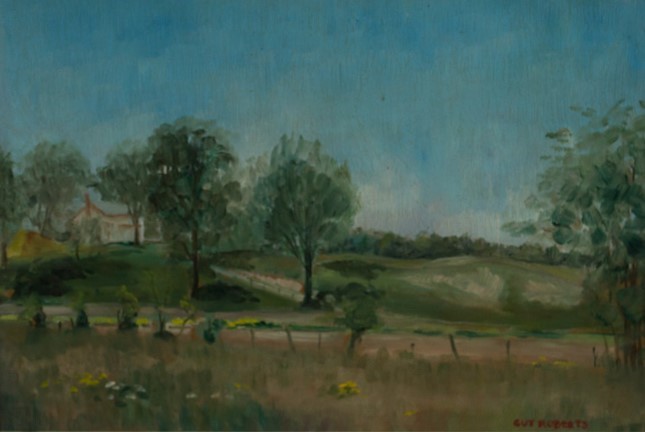
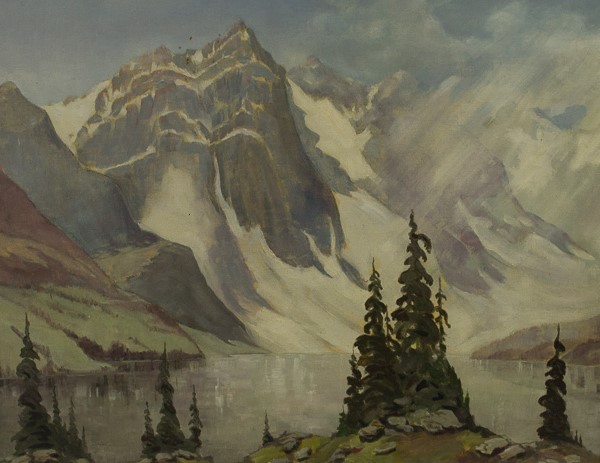
Roberts then moved to British Columbia and settled in the Port Alberni area in 1948. On five acres of land, he built a home at Sproat Lake. With his wife, he developed a beautiful garden. He painted scenes in oils of the local countryside and studied with Arnold Burrell. He went on to develop his own style of painting and also worked restoring old paintings in Victoria. He is listed in the Canadian Government’s directory of Canadian artists.
Captain Roberts died in hospital on 5 January 1969, in Port Alberni, British Columbia. He is buried in the Greenwood Cemetery, Port Alberni in Section P Field of Honour.
Service Record:
- circa 1911 – Enlisted with QOR militia
- 22 Sep 1914 – Enlisted with 3rd Battalion, CEF as a Lance Sergeant CQMS
- May 1915 – Contracted influenza
- 6 Nov 1915 – Granted a commission as temporary Lieutenant
- 6 Nov 1915 – Taken on strength with 5th Battalion CEF
- 14 Nov 1916 – Awarded Military Cross
- 27 Nov 1916 – Attached to 12th Brigade Headquarters as an Orderly Officer
- 15 Jan 1918 – Seconded to War Office for “secret mission”
- 27 Oct 1918 – Struck off strength of “McCarthy’s Irregulars”, “D Force”
- 16 Sep 1919 – Ceased to be attached to War Office
- 26 Nov 1919 – Discharged on demobilization
Military Cross Citation:
“For conspicuous gallantry in action. He established posts, making his reconnaissance and posting the men himself, and crossing 250 yards of fire-swept ground three times. He displayed great courage and initiative throughout.”
London Gazette No. 29824, pg. 11080
See also A Wooden Mallett and Six Sergeants.

 The Queen's Own Rifles of Canada Regimental Museum and Archive