
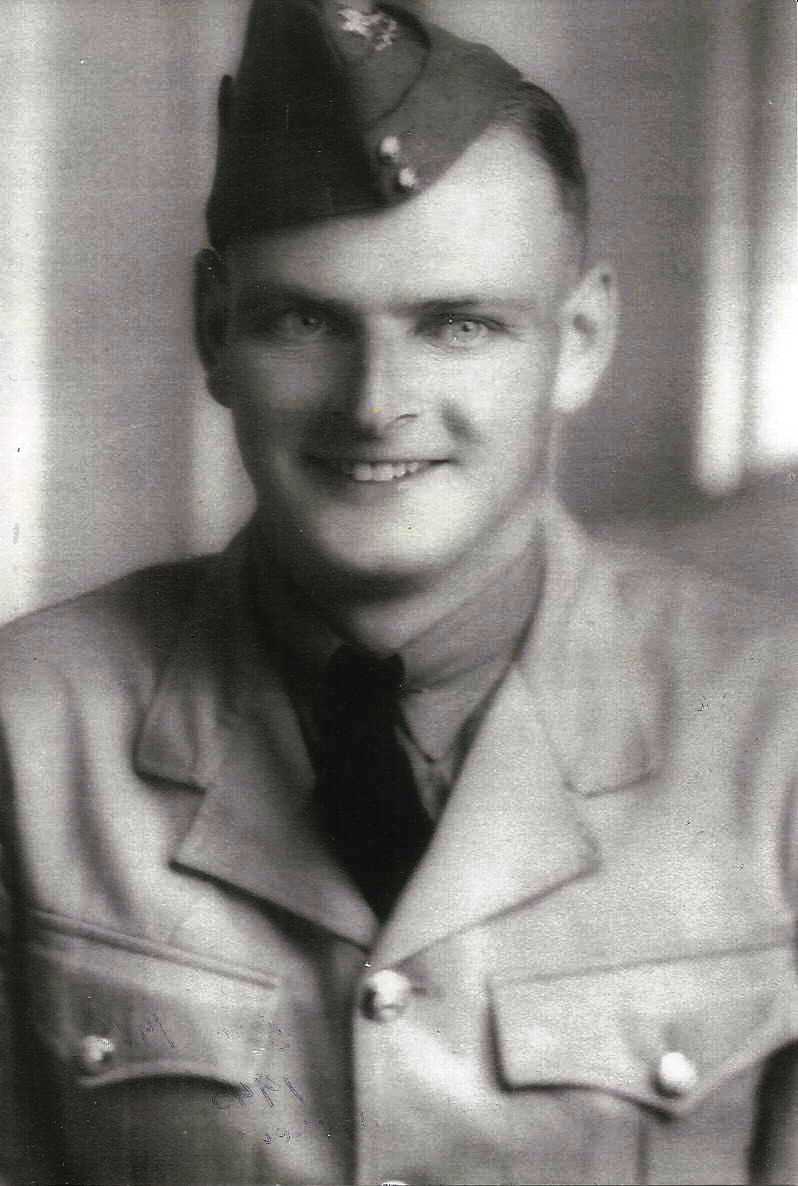
H/69947 Rifleman Robert “Bob” James McDonald was born on a farm in Lakeland, Manitoba, Canada on Thursday, February 28, 1918. He was the son of James McDonald and Lilian Laura McDonald-Bourdell. They got married in Westbourne, Manitoba on November 30, 1904. He had six sisters: Helen, Sadie, Viola, Ruby, Verna, and Bertha. James had two sons from a previous marriage: Bert (who died in World War I) and George. The family belonged to the Church of England.
Bob, as he was known among his friends and neighbours, was very quiet by nature, willing and kind, easy-going and a good-natured man.
He went to North Lakeland School #754, which was a school which had one classroom, built in 1910, for grades 1 to 8 and with only one teacher. It was the community artery, a place of entertainment after the lessons. The annual picnic was a highlight. Races, baseball matches and tug-of-war events were held there and a lot of food was served and a lot of entertainment. Dance parties with local musicians were common.
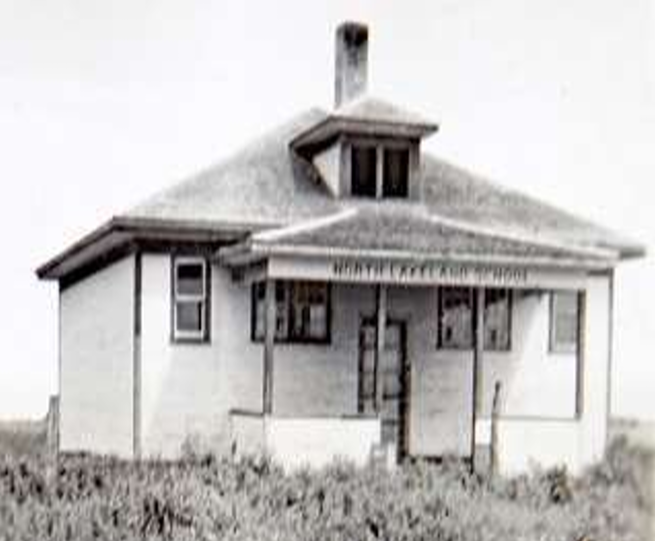
In winter the nearby lake would freeze, so that skating and ice-hockey events could take place there, but also on the nearby water holes. At weekends a lot of dance evenings for the community were held there.
At the end of the school year a sports day used to be held in Langruth or another town where remote schools were competing in marching and sports matches. Each school made their own banner with their school’s name on it.
Bob stayed at North Lakeland School up to Grade 7 and left school at the age of 14 because he had to help on his father’s farm. They had horses, but also kept other animals.
Robert James ‘Bob’ had blue eyes and light-brown hair, weighed 172 lbs and was 5 ft 10.5 tall. He had a wart on his left shoulder and had suffered from rheumatism in his knees, which kept him from working for a week.
In 1940 there was a mobilization in Canada and from January 10 until February 8, 1941, Robert James ‘Bob’ McDonald had thirty days of military training with the Queen’s Own Cameron Highlanders of Canada, in the 100th Canadian Army Basic Training Centre in Portage La Prairie, Manitoba.
On June 10, 1942, he signed up in Winnipeg with No. 10 District Depot and was assigned to the Royal Canadian Artillery in Fort William, Ontario, on June 25, 1942, in the rank of Gunner.
Here he had his basic eight-week training. On August 24 he took additional training with the 24th Royal Canadian Artillery Field Regiment at Camp Shilo, situated on the western border of Spruce Woods Provincial Forest in Manitoba, 120 miles west of Winnipeg and 16 miles east of Brandon. He remained in hospital for forty-one days, from May 26 until July 6, 1943.
From July 7 until September 1, 1943, he stayed with the 24th Royal Canadian Artillery Field Regiment in Kiska which belongs to the Aleutian Islands, a chain of small islands together forming an Arc of islands, which stretched out for a distance of nearly 1,200 miles from Alaska Peninsula as far as the Kamchatka Peninsula. These islands were secured with the help of American troops after the Japanese had occupied them and left them on July 28. The Japanese Empire occupied Kiska and nearby Attu to protect the northern flank of the Japanese Empire. In Alaska Robert James ‘Bob ‘ was again admitted to an American military hospital from August 1 to 7, 1943.
During an interview, he indicated that he did not speak French and that he had great difficulty understanding commands in the French language. He very much wanted to join an English-speaking unit. Robert James ‘Bob ‘ was a ‘batman’, which meant he was an orderly or personal assistant to a commissioned officer. It was the Batman’s duty to maintain his officer’s equipment, clothes, quarters and sometimes even furniture. In combat he also served as the officer’s runner or messenger.
He also indicated that he had had little training at the Artillery, so he went to No 11 District Depot for further training in December 1943. From December 19 until 27 he enjoyed Christmas leave. On April 10, 1944, Bob was assigned to the 1st Battalion, The Royal Highland Fusiliers of Canada, Canadian Infantry Corps. On May 13, he was given ten days of leave before embarking on May 25 for his voyage overseas to England, where he set foot ashore on June 2, 1944.
On July 27, 1944, he was assigned to the Queen’s Own Rifles of Canada, a regiment that at that time was located in Bourguébus in the vicinity of Caen, Normandy, France.
 During the night he experienced the atrocities of war and at 00.30 hours it was reported that ‘Something must have upset ‘Jerry’, as they are firing a heavy barrage of shells at precisely the positions of BHQ and ‘C’ Company, which has led to a few casualties.’
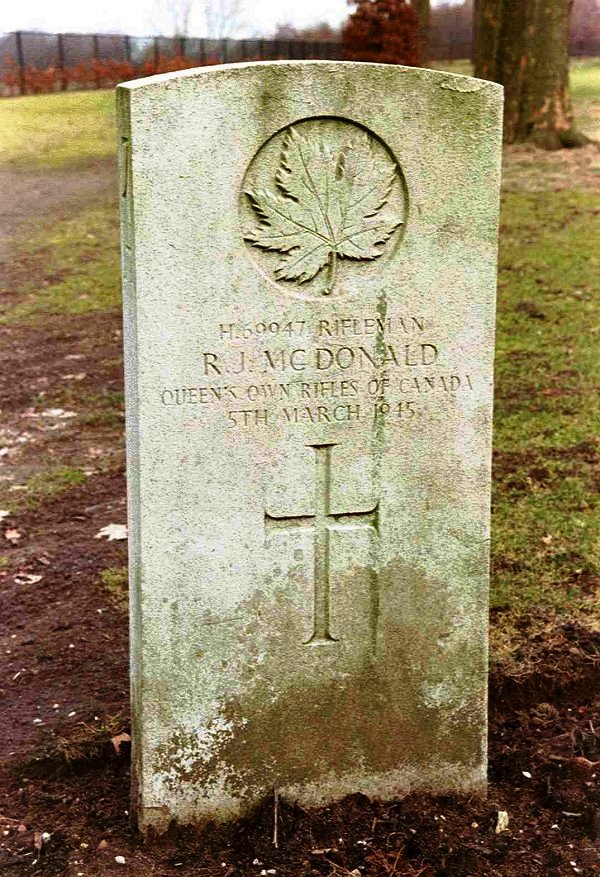
They continued to fight through Northern France Belgium, Germany and the Netherlands. During the night of March 5, 1945, heavy enemy shelling on their positions took place. In the morning these kept going on when the Queen’s Own Rifles of Canada were ordered to go to the Bogel area. During this shelling, Robert James ‘Bob’ McDonald was killed at the age of 27 – the same day that his father had died in Portage Hospital.
On March 7, Robert James ‘Bob’ McDonald was temporarily buried in Bedburg at the Canadian military cemetery in Bedburg, plot 1, row 19, grave 9. On September 7, 1945, he was reburied at Groesbeek Canadian War Cemetery, grave reference VII. H. 1.
McDonald Island (64 H/4) in Gauer Lake, Manitoba, was named after him in 1995.
From Gijs Krist – Research Team Faces To Graves.

 The Queen's Own Rifles of Canada Regimental Museum and Archive