
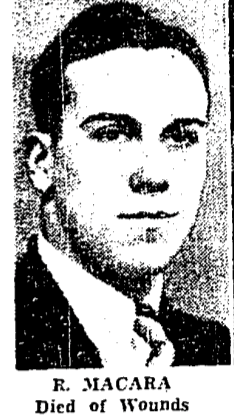
 B/162039 Ronald Macara was born on 18 July 1918 in Durham, Gateshead-on-Tyne, England. His Scottish father William Horsfall Macara married his English mother Gertrude Lingworth there in 1917. William emigrated to Canada in 1923, a few months ahead of his wife and son. He found work and prepaid their passage on the vessel Montrose, arriving in their new country when Ronald was five years old. They first lived in Orillia, Ontario and then moved to Toronto. Their next child Edna was born soon after landing in Canada, and their second son James came along almost a decade later in 1932.
The Presbyterian family attended the College Street United Church in Toronto. Ronald attended the nearby King Edward School and learned to play the piano well. He developed a photography hobby and completed three years of a Commercial Arts program at Central Technical School in Toronto. Ronald’s first job as a drug store delivery boy paid $5 weekly.
Ronald worked for two years clerking at the Adelaide Flower Shop before finding employment with Robert Elder Carriage Works in Toronto. He was a motor truck body builder in the woodworking section. After World War II broke out, Ronald enlisted with the Non-Permanent Active Militia in October 1940 and completed 30 days of training at Long Branch near Toronto. He was posted to the Royal Regiment of Canada and remained in their home-based reserve unit. Ronald had been working for seven years at Robert Elder Carriage and was earning $25 weekly when he was called up for active duty.
Ronald attested for active service on 1 Jun 1944 at Toronto, age 25. His medical examination recorded him as being a short man at 5’3” tall, weighing 134 lbs. Ronald had a fallen arch on his right foot which gave him trouble on long marches. His interviewing officer remarked of Ronald: “He impresses with his intelligence and alertness. These qualities plus high M score indicate good N.C.O. (Non-Commissioned Officer) material”. Ronald was sent to Brantford for basic training and given embarkation leave in August before being sent to the transit station in Windsor, Nova Scotia.
Ronald disembarked in the U.K. on 7 September 1944 and was assigned to the Canadian Infantry Training Regiment. He had acquired his Ontario Chauffeurs driving licence in 1943 and qualified as an Infantry Carrier (tracked vehicle) Driver on 28 October 1944 while in the U.K. Ronald crossed the English Channel three months later, disembarking in Northwest Europe 31 January 1945 and was taken on strength as a replacement Rifleman by the Queen’s Own Rifles of Canada, (QOR), 2 February 1945.
The QOR was part of the 8th Brigade, along with Le Regiment de la Chaudière and the North Shore (New Brunswick) Regiment, 3rd Canadian Division. They had been among the Commonwealth units attacking Normandy beaches in France on D-Day, 6 June 1944. They helped drive the Germans out of Normandy and clear the Channel ports before engaging in the Battle of the Scheldt at Breskens Pocket in Belgium. 8th Brigade was then stationed near Nijmegen, Netherlands for static operations in November.
 After wintering around Nijmegen, the 3rd Canadian Division was on the move in February 1945 as part of the Allied Operation VERITABLE. 8th Brigade was held in reserve around Cleve, Germany for the first and second phases of the Rhineland offensive. Shortly before going into battle, Ronald signed an affidavit on 26 March 1945 while in Germany giving Power of Attorney over his affairs to his father William, having already named his mother Gertrude as his next of kin and estate beneficiary.
The QOR and 8th Brigade crossed the Rhine on a pontoon bridge in late March 1945 and were involved in mop-up operations following the 7th Brigade’s capture of Emmerich, Germany. Their advance began on the night of 30-31 March with little opposition beyond the few surviving German mortar and artillery pieces.
The QOR participated in the liberation of Bergh on 1 April 1945, and during the fighting at Wehl the next day, Ronald Macara received a grievous chest wound. He was evacuated to a Military Hospital in s’Heerenberg and died of his wound two days later on 4 April 1945, at age 26.
Rifleman Macara was temporarily buried at s’Heerenberg Cemetery and later relocated to Groesbeek Canadian War Cemetery near Nijmegen, Netherlands, grave reference XVII. F. 3.
His epitaph reads:
MAY THE JOYS
YOU MISSED IN LIFE’S HIGHWAY
BE FOUND
IN GOD’S GARDEN OF REST
From biography by Jim Little, Research Team Faces to Graves.

 The Queen's Own Rifles of Canada Regimental Museum and Archive