
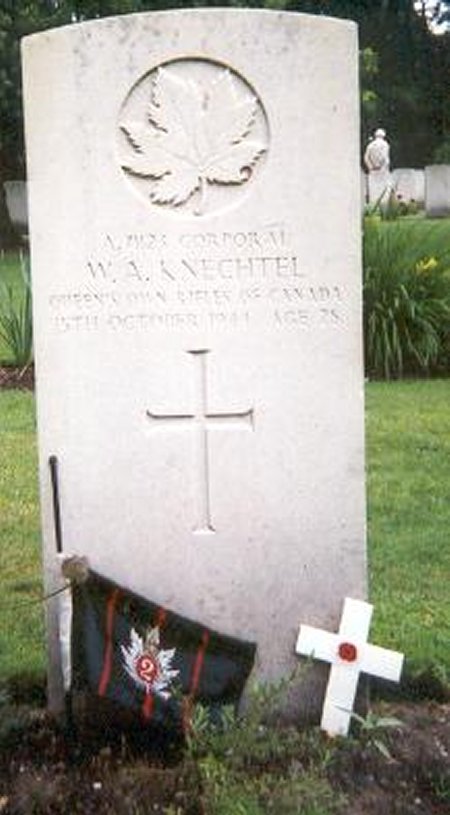
 A71123 Corporal Wilson Abel Knechtel was born on 12 September 1917 in Amulree, Ontario, the son of William and Elizabeth Knechtel. He had four brothers (one served with the 24th Field Ambulance) and one sister.
Knechtel was working as a carpenter when he enlisted with the Perth (Machine Gun) Regiment Militia on 22 November 1940, for thirty days of compulsory training. After working as a prison guard he enlisted again on 19 February 1942 with Militia Training Centre No. 10. and was posted to the Canadian Fusiliers Militia on 11 March and transferred to the Active Service Battalion on 10 April 1942. He trained in Listowel, Ontario; Camp Niagara, Ontario; and Vernon and Nanaimo, British Columbia; and was appointed Acting Lance Corporal.
Knechtel was then attached to the Vancouver Coast Regiment (Artillery) and appointed Acting Sergeant. A month later he returns to the Fusiliers and continues training. On 28 June 1943 he reverts to Acting Corporal at his own request and on 14 July is given permission to marry Miss Elizabeth Hanna Legge which he does in Vancouver, BC on 5 July. Later that month he’s again confirmed with the rank of Corporal.
From 12 July 1943 to 18 January 1944 he was on special duty along with 5,300 other Canadians attached to a large US force, to retake Kiska Island in Alaska from the Japanese. (The Japanese actually evacuated their forces before the US/Can attack so there were few casualties.) During this time he was appointed Lance Sergeant.
Knechtel then returns to Canada and attends a Mountain War Course, before heading overseas and arriving in the UK on 2 June 1944. On 26 July he is transferred from the Fusiliers to The Queen’s Own Rifles of Canada Reinforcement List, reverting to Corporal again at his own request. He joins the QOR on 14 August 1944.
Corporal Knechtel was killed in action in The Netherlands between Beirvliet and Ijzendijke on 15 October 1944 and is buried in Adegem Canadian War Cemetery, Belgium, grave reference II. E. 8.
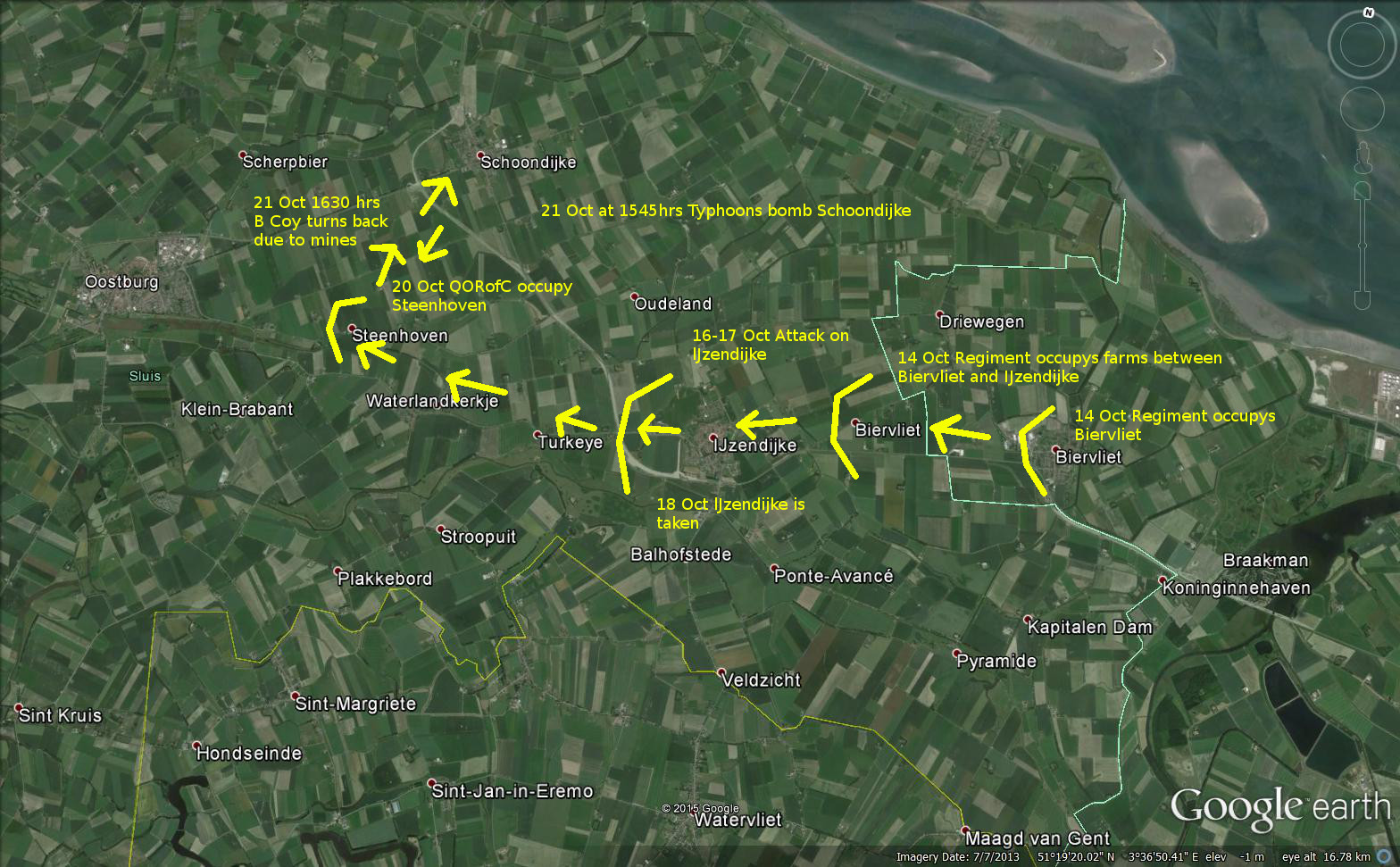
“In the last week of September 1944, the Allies held the city of Antwerp, but the Germans held both shores of the Scheldt estuary so that the port of Antwerp could not be used. The task of clearing the southern shore of the estuary was allotted to the 3rd Canadian Division, aided by the 4th Canadian Armoured Division and the 52nd Division. Their operations lasted from October until the beginning of November 1944. By 3rd November the Germans had been cleared from the north-west corner of Belgium and the south shore of the Scheldt was free. There had been fierce fighting for two weeks for the crossing of the Leopold Canal. The majority of the men buried at Adegem died during the operations for the clearance of the south bank of the Scheldt; but many Canadians who lost their lives elsewhere in Belgium were also brought here for burial.”
From the Canadian Virtual War Memorial Page

 The Queen's Own Rifles of Canada Regimental Museum and Archive