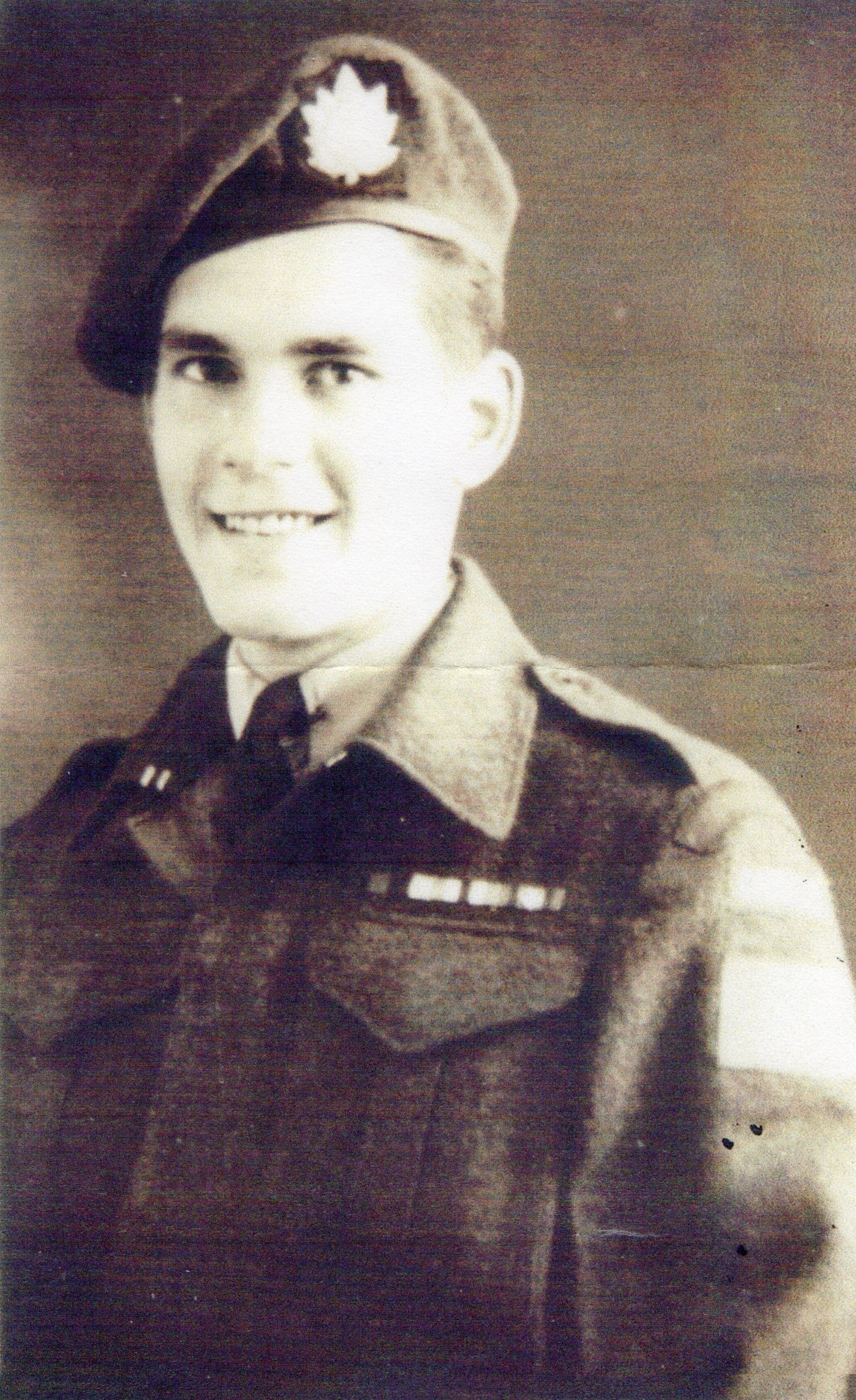
Rifleman Guelph Allan George Kemp was born in Toronto on 31 October 1925, the son of George Kemp who had served in The Queen’s Own Rifles in 1915 before enlisting with the 35th Battalion CEF followed by posting to the 58th Battalion.
George Jr. found himself in The Queen’s Own Rifles as a teen-aged replacement shortly before D-Day. He had transferred to the Canadian Army from the RCAF “because I wanted to fly and the fact I was colourblind
prevented that, so I was sent for training as an aircraft mechanic, which didn’t appeal to me much.” His father had been in The Queen’s Own in World War One and his luck was in when he became a member of 16 platoon of Dog Company, with Captain Ben Dunkelman as company commander. That was [Sergeant] Aubrey Cosens‘ [VC] company and, although I didn’t know him well I was in that fight where he was shot by a sniper, although, to be frank, by the time he was killed, unless he was somebody we knew well and had palled around with, it basically just registered as being one more down and we were thankful it wasn’t us. We had lost a lot of Queen’s Own by the time we got into Germany and when Aubrey was killed in late February there were only about a couple of months left before VE-Day.”
Kemp had been wounded the previous November when struck by a stray piece of shrapnel. “I believe we were there to relieve the U.S. 82nd Airborne, that put me out of action for a while. I was very lucky. I didn’t know what had hit me, but it turned out to be non-life-threatening and I only spent three weeks in hospital. I met a lot of Canadians who had been seriously wounded and I knew they were going home rather than returning to the front lines. I had a bed between two German prisoners and when I left to rejoin the
regiment in Emmerich, Germany, I thought, `I could get killed tomorrow but those guys are out of it. That’s life, I guess,” he said, remembering that his brother had been killed in Italy serving with the Toronto Scottish.
As the war in Europe came close to its end soldiers were being given advice on what they’d face when they got home and how the government would help them, Kemp says he has no recollection of that, but he remembered being asked if we would volunteer to go fight in the Pacific, “and I was one of large a number who said we would. We were in Doom, in Holland, at the time and were involved in minor cleanup operations because there were still pockets of German resistance, but shortly after V-E Day, we were en route to a troopship that would take us to the U.S. and from there, who knew where? The trip to New York was
aborted with the news the war was over and the ship docked in Halifax.
At loose ends, with no real idea of what he wanted to do, he went to see his former company commander, Ben Dunkelman, at the family business Top Top Tailors. “He offered me a job there, and I took it,” Kemp said. “I then went to Canada Bread making deliveries with a horse-drawn wagon. I tried to get into the fire department but didn’t weigh enough. I tried to get onto the police department but I wasn’t tall enough.” By that time, “tired of winter,” in 1954 he enrolled in a course at a university in California which taught hospital administration and this became his career.
As a volunteer, he counselled children in his new hometown, which is where he met his wife, Dorothy – or Bunny, as she was always known. They were together until her death in 2009.
Kemp passed away on 23 June 2022 age 96 in Novato, California.

 The Queen's Own Rifles of Canada Regimental Museum and Archive