
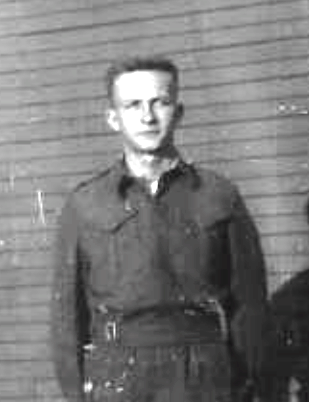
B149901 Rifleman Glenn Morton Cross was born in Toronto, Ontario, on 30 July 1925, the son of William Henry Cross and Sinia Beatrice Kaiser. His father was a veteran of the First World War. Glenn was the youngest of three children: Clifford Donald “Billy” Cross and Betty Yvonne Cross. The family were members of the Church of England.
Glenn attended Gledhill Junior Public School and continued his education for two years at Malvern Collegiate High School in Toronto, Ontario, then joined the Dunlop Tire & Rubber Co., also in Toronto, Ontario, as a machinist (maintenance).
On July 30, 1943, Glenn enlisted in the army in Brantford, Ontario, and was assigned to the Queen’s Own Rifles of Canada (QOR) as a Rifleman. He received his training at Camp Borden and Long Branch, both in Ontario. His physique was described as brown eyes and brown hair, height 1.79 m, and weight 69 kg. He had two small scars on his forehead and a scar on his left shin.
On 29 November 1945, Glenn boarded a ship for departure to England, where a lot of training took place. He was then shipped to Northwest Europe and on 31 January 1945, was attached to A Company of the QOR, located near Ubbergen, the Netherlands, at the time.
The weather conditions were terrible: cold, melting snow, and foggy. On February 3, 1945, Field Marshal Montgomery was spotted in Berg en Dal. The QOR commanders were informed of the upcoming Operation Veritable four days later. This operation was part of an Allied tank movement aimed at driving German troops out of the area between the Rhine and Ruhr rivers.
On the afternoon of February 4, 1945, A-Coy arrived in Millingen. Here, the Germans had blown up dikes, flooding the area. The next day, A-Coy was in nearby Bimmen. From there, the QOR entered Germany via Groesbeek on February 22, 1945, and headed for Bedburg beyond Kleve. The next day, Field Marshal Montgomery visited the area.
Operation Blockbuster started on February 26, 1945, to enable the 3rd Canadian Infantry Division to capture the German town of Uedem and clear the way for the 11th Armored Division’s advance eastward. To do this, the QOR passed below the hamlet of Louisendorf just south of Kalkar.
The QOR’s A-, B-, C-, and D-Coy were under heavy fire in this area, especially by the 116 Panzer-Division and the Panzer-Lehr-Division. During one of the heavy battles there,
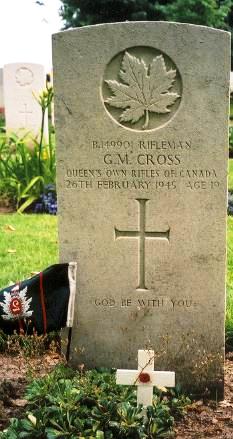 Rifleman Cross was killed in action on 26 February 1945, at the age of 19. Glenn was buried on 3 March 1945, at the Canadian Military Cemetery in Bedburg (near Kalkar). He lay in a temporary grave, plot I, row 15, grave no. 8. Glenn was reburied at the Canadian War Cemetery in Groesbeek on September 10, 1945, Grave VIII. D. 3.
His personal belongings included a gold ring with a red stone, miniature wooden clogs, and a red “I” disk. His will stated that these should be transferred to his father.
Two days after Glenn was killed, his brother also died as a result of a tragic airplane accident in April 1944. Billy was a Flight Lieutenant (F/L) and instructor in the RCAF’s 411 Squadron, and his aircraft, a Spitfire MJ140, was shot down over the English Channel after an attack on a railway bridge at Granville, France, on 27 April 1944. He was seriously injured, suffered a fractured skull, and broke both legs. A corvette of the English Navy picked him up. After several months in an English hospital, Billy returned to Toronto in the fall, where he committed suicide on 28 February 1945—a gunshot wound to the chest.
From Henk Mostert, Research Team Faces to Graves.

 The Queen's Own Rifles of Canada Regimental Museum and Archive