
 C64183 Corporal Harold Bernard was born in Perth, Lanark County, Ontario on 23 March 1915, son of James Henry Clyne and Ella Jane Doyle. He had eleven brothers and sisters.
Harold Clyne was raised on the family farm which had been owned by the Clynes for two centuries. The Bathurst Township farm went back to the 1819 military settlement of the Perth area with land grants to former soldiers. His great-great-great-grandfather, Pierre Klein of Flanders had fought in the Napoleonic wars as a Sergeant with the de Meuron’s Foot Regiment but upon his capture, he volunteered to serve Britain in the War of 1812 with the United States. He later changed his name to Peter Clyne. Harold would have inherited the family farm if he had returned from the war.
Clyne obtained one year of high school before leaving to work up north at MacLeod-Cockshutt Gold Mine in Geraldton, Ont. When he enlisted on June 20, 1940, he stood five feet ten inches and weighed 146 pounds. He trained in Camp Borden, Ontario and Sussex, New Brunswick. He was shipped out on July 19, 1941 and disembarked at Gourock, Scotland.
He started out with the Queen’s Own Rifles Regiment, then transferred to the Winnipeg Grenadiers and the Royal Regiment of Canada before he rejoined the Queen’s Own Rifles Regiment. He was appointed an acting Lance-Corporal in March of 1944.
Lance-Corporal Clyne landed on 6 June 1944, in France as part of the D-Day invasion. On 18 July he was wounded in action during the Battle of Normandy and treated for his injuries back in Britain at the Park Prewitt Hospital.
 In his published memoirs, the “A” Company Sergeant-Major Charles Martin wrote:
“Harold Clyne was another good, tough, all-round man and a great friend.”
After his convalescence, Clyne was sent back on 31 December 1944, to Northwest Europe and met his death on 26 February 1945, aged 30, near Mooshof in Germany.
The Queen’s Own soldiers were trying to clear the enemy from heavily fortified houses in the hamlet of Mooshof.
“The Germans contested every foot. They put up a hell of a fight. They threw everything at us. We did the same to them. For a solid two hours it was sheer madness,” stated Major Dick Medland, the A Company’s Commander. “No. 7 Platoon encountered fierce fighting losing many men. Lance Sergeant Harold Clyne took over (from a wounded Sergeant) and led two men in a fight for a second building sheltering another 88-millimetre gun. They won the place at 07.30, but Clyne was dead.” (Clyne’s rank of Sergeant was a field promotion which likely didn’t get filed.)
Like many casualties in battle, he was buried in a temporary cemetery at Bedburg, Germany. After the war, his remains were moved to the Groesbeek Canadian War Cemetery, grave reference VIII. H. 14.
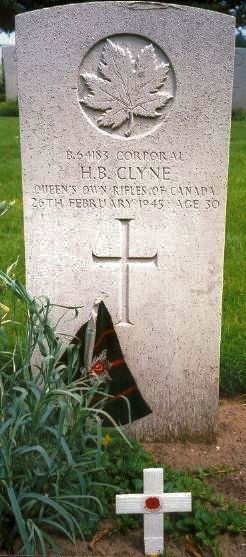
From Kurt Johnson for Faces to Graves.

 The Queen's Own Rifles of Canada Regimental Museum and Archive