
 B116330 Rifleman Herbert Cuthbertson Calbert was born on 12 March, 1926 in Toronto, the son of William Cuthbertson, and Annie Rosina, both of whom were born in Scotland. William had fought in the First World War and spent five years in the army; he was wounded several times before returning to Canada, where he married in 1919.
Herbert had six brothers, Alfred, William (Bill), Thomas, Robert (Bob), James and Donald; he had one sister, Catherine Margaret (Kay). The family belonged to the United Church.
Herbert was brought up in Locust Hill, York County, Ontario, where his father had a farm. He attended the local school and completed grade 7. He then worked on Roy Carter‘s farm for two years in Green River, also in the Toronto area. In his army record, he said that he was a farmer but did not want to return to Green River, preferring to settle permanently in Locust Hill.
On 9 September, 1943, at the age of 17, Herbert enlisted in Toronto where he had preliminary interviews and a medical examination. He was 5ft. 5ins. tall and weighed 123 lbs. with blue eyes and brown hair. His health was good and he was rated A1.
After a month he was moved to Brantford and then Borden for infantry training. In January 1944 he was placed with the 1st Battalion of the Midland Regiment. In March he was transferred to Prince Rupert in British Columbia where a few weeks later he was given leave for 21 days. On return, more training followed and on 1 June he was given 16 days of embarkation leave. He sailed to the UK arriving on 8 July and only ten days later he was already in France.
While still in Canada, Herbert had been attached to the Queen’s Own Rifles which had taken part in the D-day landings with a heavy loss of life. Herbert probably travelled with a group of reinforcements to join them. The 1st Battalion at this point was involved in the heavy fighting around Caen until at the end of July they were given a short rest period in Fontaine Henry where the ‘new boys’ were given extra training.
The QOR then continued through northern France to Abbeville and the important ports of Boulogne and Calais which they reached at the end of September. In October, the Battles of the Schelde river took place in Belgium and Zeeuwse Vlanders in the Netherlands in which the QOR was involved.
On 3 November, they went back to Ghent for a week’s well-earned rest, receiving a tremendous welcome from the people there. The battalion was then transported some 200 kilometres north-eastwards to the Nijmegen area, situated close to the Dutch-German border. The next three months were a kind of waiting period before the immense Operation Veritable began in February 1945. It was by no means free of enemy activity but Nijmegen had been liberated and there was more opportunity for the troops to enjoy various activities and have a cleanup when not on duty.
The QOR was stationed at different points near the border, moving every week or ten days. After they arrived in Berg and Dal, they were in Erlecom near the Waal River and Wylerberg, where there was frequent enemy activity with shells and mortar fire, sometimes resulting in casualties. Both sides infiltrated across the lines at times; an enemy prisoner could provide valuable information.
Whenever possible, daily activities could include battle drill training and route marches. It was winter and flooding became a serious problem in low-lying areas, leading to the use of amphibious vehicles and boats. In the first weeks of January, near Groesbeek, the QOR faced increased enemy activity necessitating more patrol duties. In Mook and then Ubbergen, conditions were more congenial and there was time for intensive training. With the massing of equipment and armour in the area, it was becoming obvious that a big operation was imminent.
Operation Veritable began on 8 February, 1945 and the next day, the QOR moved to an assembly area in the shipyards near Millingen, remaining there for ten days. There was severe flooding to a depth of more than two feet because the dikes had been blown up.
 Boats had to be used to move around, on 20 February, the battalion moved back to Beek in the amphibious Buffalo vehicles and two days later was transported into Germany, through the Reichswald and Kleve to Bedburg Hau.
On 23 February there was a relaxation period and a chance for a cleanup in preparation for Operation Blockbuster. In the evening of the 25th, the Battalion travelled to an area north of Uedem, preparing for battle in the early morning of 26 February. It was a day of heavy fighting. The Canadians were savagely counter-attacked by enemy paratroopers but the Germans were eventually unsuccessful and suffered hundreds of casualties.
There were around 100 casualties on 26 February in the Queen’s Own and one of those killed was Herbert Calbert, two weeks before his 19th birthday. He was buried five days later in Bedburg Hau, near Kleve. On 9 July, 1946 he was reburied in the Canadian Military Cemetery, Groesbeek in the Netherlands. Plot VIII. H. 1.
Herbert‘s oldest brother, Alfred served in the army in Europe and returned to Canada after the end of the war.
His elder brother, William Cuthbertson Calbert (Bill), B 66122 also served in the Queen‘s Own Rifles and was married to Mary Alice of Locust Hill, Ontario. He was killed as he landed on Juno Beach, Normandy on D-day, 6 June, 1944 and buried in the Bény-sur-Mer Canadian Military Cemetery near Reviers. William was 22 years old.
An Berben-Schreven of Groesbeek adopted the grave as a young girl.
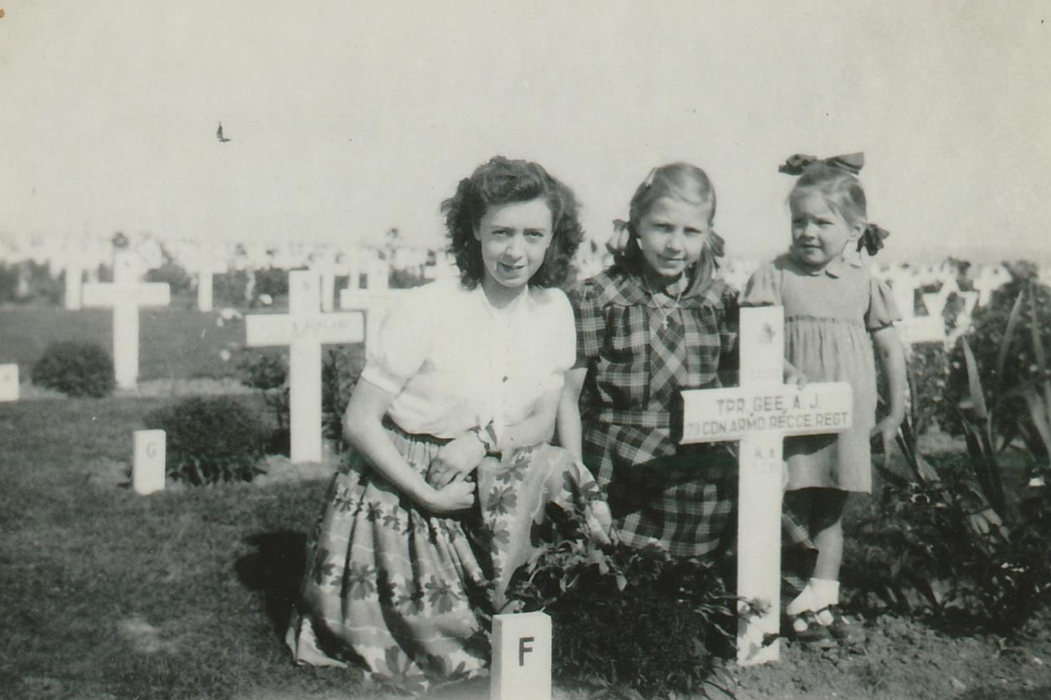
From Gwyn de Jong, Research Team Faces to Graves.

 The Queen's Own Rifles of Canada Regimental Museum and Archive