
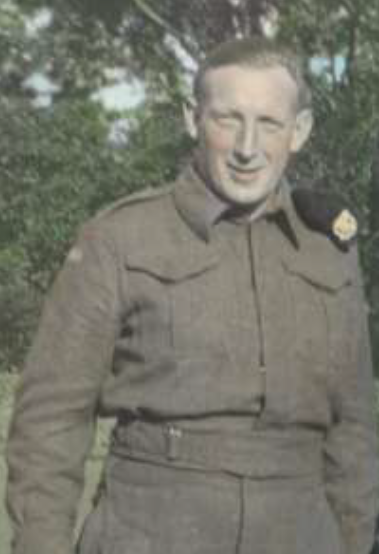
B/157584 Rifleman George Armstrong Bell was born on July 3, 1909, in Hamilton, Ont., to Walter Armstrong Bell and Sarah Jane Berryman. He moved with the family to Round Plains, near Waterford, when he was a boy.
He grew up on a farm and, after leaving school at age 13, worked on the farm, drove a truck on milk collection and eventually took a job at the Steel Company of Canada Limited in Hamilton where he worked for 13 years. He was earning $12 a day as a “rougher of steel” when he enlisted.
George married Florence Bernice Sovereign on April 2, 1932, in Aldershot, Ont. They owned a house at 127 Fairfield Ave. N. in Hamilton and at the time he enlisted they had four children under the age of 10: Marilyn, 8, Carole, 5, George Jr., 3, and David, 7 months. He also had two sisters, Clara Edythe Smith (Fred), of Vanessa, and Marjorie Alma Smith (Arthur), of Hamilton.
George’s military records show he planned to return to farm work after the war and echoed that wish in a letter home three weeks before his death: “I think before long we will all be back to help with the chores.”
George was eager to serve his country in the Second World War. In 1944, he followed in the footsteps of his brother, Corporal Walter Bell, who was serving overseas in the Royal Canadian Air Force and two brothers-in-law in service.
George enlisted on Jan. 5, 1944, in the armoured corps, trained in Brampton and at Camp Borden and went overseas in July 1944.
An assessment by his training officer stated:
“This volunteer expressed a desire to join the Armoured Corps. His mechanical aptitude, employment in the steel industry, intelligence, amiability, strength and stamina suggest his suitability for service in that arm.”
He got along well with his fellow servicemen, was a member of two recreational clubs, played in a pipe and drum band, and enjoyed fishing, hunting and sports.
Once overseas, George was transferred to an infantry regiment, The Queen’s Own Rifles of Canada.
“He ended up in a field, sleeping on the hard ground at night and being drilled hard during the day.” (Simcoe Reformer)
“Almost exactly three weeks before he died, he talks about killing idle time between battles – of winning a loaf of bread and a can of cheese in a game of checkers. ‘Boy did we ever have a lot of fun. You wouldn’t think you could have fun around here with so many shells flying around. But you get so you never even notice them. When I come home I’ll have to get up in the middle of the night and shoot my shotgun off. So I can sleep. Ha. Ha.’ ” (Simcoe Reformer)
George did not come home but he played a part in the Battle of the Rhineland, a key offensive effort just over the German border that cleared the territory between the Maas and the Rhine rivers in February and March 1945 and secured the banks of the Rhine River from Strasbourg, France, to Nijmegen, Netherlands. This victory made it easier for future divisions to move forward and capture enemy territory.
The Commonwealth War Graves Commission describes the Allies’ activities leading up to the battle:
“In the months leading up to the action, on Sept. 12, 1944, Allied forces entered the Netherlands. Airborne operations later that month established a bridgehead at Nijmegen, and in the following months, coastal areas and ports were cleared and secured, but it was not until the German-initiated offensive in the Ardennes had been repulsed that the drive into Germany could begin.”
The battle stretched on and in February 1945, B and D companies of George’s regiment led a series of attacks on German strongholds. They advanced on abandoned German villages, taking cover in barns and damaged houses where Germans had once lived.
Entries in the Queen’s Own Rifles’ war diaries describe difficult operations at Mooshof, a village in Germany. During Objective Queer, the Canadians were “counter-attacked savagely by enemy paratroops,” and although the enemy attack was unsuccessful, “fighting in the darkness was very vicious, and also confusing.”
During this hard-won operation, George was wounded, taken to a regimental aid post, tended to by doctors and moved to a field ambulance station where he died the next day, Feb. 26. He died in or near Mooshof (official details are sparse).
A letter to George’s widow, Bernice, from Andrew J. Mowatt, honorary Captain and Chaplain of the Queen’s Own Rifles, provides this moving account of the early morning attack:
“On Feb. 25th we moved up after dark to a position just a few hundred yards from the enemy. The men took shelter in barns, wrecked houses and dugouts. Shortly after midnight, our artillery fired a very heavy barrage of shells upon the well-dug in German positions. Sharp at 4:30 on the morning of Mon. Feb. 26th our lads attacked across more or less open fields. The enemy reacted much more vigorously than usual since we were fighting on his own soil, in his best-defended area.
They threw back a lot of shells and mortar bombs and actually counter-attacked in some sectors. As they were well entrenched their own artillery was able to fire on their own positions and thus hit a few of their own men while our men had to attack in the open. There were many machine gun nests also, so it was a difficult and dangerous attack.
Our lads captured their objective in a few hours and thus broke the best-held enemy positions. The result was that other battalions raced through and captured important towns and villages with comparative ease. . . . You will know at least that your husband died for his country and in his death made the way easier for others to go through to our final victory.”
Thirty-four other men were killed in action in that operation. One of those men, Sergeant Aubrey Cosens, of Latchford, Ont., was killed by a sniper after killing 20 Germans and capturing 20 others, and awarded the Victoria Cross posthumously.
Of the nearly 23,000 Allied casualties, some 5,300 Canadians (accounts vary) died during the battle. However, the Germans lost approximately 90,000 men, of whom some 52,000 were taken prisoner.
 Maj.-General A.E. Walford wrote in a letter to Bernice,
“It was with deep regret that I learned of the death of your husband, B157584, Private George Armstrong Bell, who gave his life in the Service of his Country in the Western European Theatre of War on the 26th day of February 1945. We pay tribute to the sacrifice he so bravely made.”
Rifleman Bell was first buried in a grave (931526) in a temporary burial ground in Bedburg, Germany, before being moved to the Groesbeek Canadian War Cemetery, near Nijmegen, Netherlands, grave reference X. H. 16.
The epitaph on his grave marker reads:
CHRIST ALSO HATH LOVED US
AND HATH GIVEN HIMSELF
FOR US.
After George’s death, Bernice moved the family to Waterford. Daughters Marilyn and Carole helped care for their brother, George Jr., who died of leukemia in 1950. Bernice died in 2000. Looking back, Carole (now Logan) said life was hard in those days but she remembers being comforted by neighbours offering the family help. Choosing to find the positive in the sacrifice her father made, she said, “We’ve had a good life.”
George’s QOR Coin of Remembrance is held by Corporal (Ret’d) Lee Harrison.

Biography by Colleen Cross of Norfolk Remembers made available to Faces to Graves.

 The Queen's Own Rifles of Canada Regimental Museum and Archive