
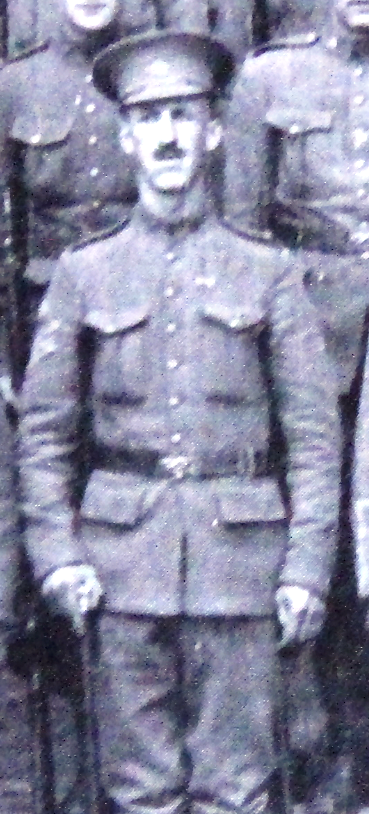
404751 Private Frank Gibson Addison was born in Toronto, Ontario, on 28 June 1880, the son of William Francis Addison and Agnes Isabella Gibson and had two sisters – Agnes Maude and Lara Ethel.
On 28 June 1904, he married Irene Harrison Kemp . They had one son, Robert Munroe and a daughter, Arline Agnes.
Addison, a printer by trade, was quite the sportsman. He played for the Parkdale Canoe Club football team, which appeared in the first Grey Cup game in 1909. He was thirty when he joined the Argos the next season, and played scrim (or prop) on the senior team, which appeared in back-to-back Grey Cup games in 1911 and 1912. He also rowed with the Argonaut Rowing Club, including on their “eights” which went to the 1912 Stockholm Olympics, and kept goal for their OHA hockey team.
Service Record:
- 3 years with 9th Field Battery
- 1906 – Rifleman
- 1907 – Rifleman
- 1908 – Rifleman
- 1910 – Rifleman in H Company on the trip to England
- 1911 – Rifleman with the contingent to England for the coronation of King George V
- 13 Sep 1911 – Appointed Acting Corporal with K Company
- 12 Mar 1912 -Promoted Sergeant
- 31 Mar 1913 – Promoted Colour Sergeant
WWI
- 9 Apr 1915 – Enlisted with the A Company, 35th Battalion, CEF
- 16 Oct 1915 – Promoted Warrant Officer Class 2
- 24 Jun 1916 – Attached as Drill Instructor
- 4 Sep 1916 – Reverted to Private from Acting Company Quartermaster Sergeant to go to France
- 25 Sep 1916 – Proceeded to France
- 2 Oct 1916 – Reported back from France with injury
- 4 Jan 1917 – Transferred to 4th Reserve Battalion
- 2 Feb 1917 – Appointed Battalion Quartermaster Sergeant
- 7 Apr 1917 – Appointed Acting Company Sergeant Major with 4th Reserve Battalion
- 23 Aug 1918 – Returned to France and reverted to the rank of private at his own request.
- 7 Sep 1918 – Returned to 1st Battalion CEF
Private Addison was killed in action, aged 38, on 1 October 1918, the last day of the Battle of the Canal du Nord west of Cambrai, while advancing on the French village of Abancourt. He was one of twenty-nine men reported missing after the encounter and later presumed killed in action. As his body was never recovered, he is commemorated on the Vimy Memorial.


 The Queen's Own Rifles of Canada Regimental Museum and Archive