Category Archives: Cadets

One Colonel Hagarty, two Lieutenants D.G. Hagarty, and the 201st CEF Battalion

By Major Adam Saunders, CD (Ret’d) for the Maple Leaf magazine of the Central Ontario Branch of the Western Front Association.


One Colonel Hagarty, two Lieutenants D.G. Hagarty, and the 201st CEF Battalion

It seems straightforward and practical that CEF non-commissioned officers (NCOs) were assigned service numbers upon attestation to avoid confusion among the 650,000 soldiers in uniform during the First World War. Officers, however, were generally not assigned service numbers, which did not entirely prevent confusion. There were exceptions to this rule, such as when an officer attested as an NCO and was later commissioned.

There are 690 individuals named “John Smith” in the Archives Canada Canadian Expeditionary Force (CEF) attestation database, and 7,002 instances of the surname “Smith,” with most having their own service numbers. When researching a soldier of the Great War, obtaining a service number can save significant time and reduce confusion, especially if you’re searching for a friend’s great-uncle named Private “Smith.

One might be intrigued to learn that two individuals named “Lt. D. L. Hagarty” served in the CEF at the same time. Both were from Toronto, both stood 5′ 11 ½” (taller than the average height of 5′ 9″ in the CEF), and both served with The Queen’s Own Rifles at one point. One of the Lt. D.G. Hagartys was 36 years old upon attestation in 1914, while the other was only 21 years old when he attested in 1915. It is not difficult to imagine how their service files could have crossed paths, leading to confusion.

Dudley George Hagarty
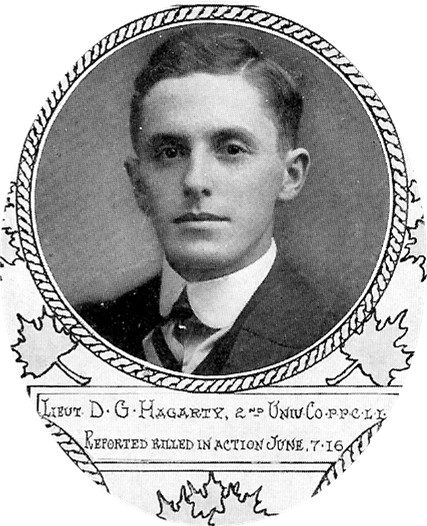
Lieutenant Dudley George Hagarty

Dudley George Hagarty attested as a lieutenant with the 3rd Battalion CEF at Valcartier on 22 September 1914. A member of The Queen’s Own Rifles, he was 36 years old and had spent nine years with the regiment. He had attended both Toronto’s Upper Canada College and Trinity College School in Port Hope, and may have been a member of their respective cadet corps. In civilian life, he sold real estate and insurance and lived with his mother at 41 Foxbar Road, Toronto. After completing his training in Salisbury, England, with the 3rd Battalion, he joined the 1st Division in France in February 1915, and witnessed the 2nd Battle of Ypres in late April 1915, serving with B Company (Coy) under Captain Muntz, who was killed early on in the battle.

Daniel Galer Hagarty
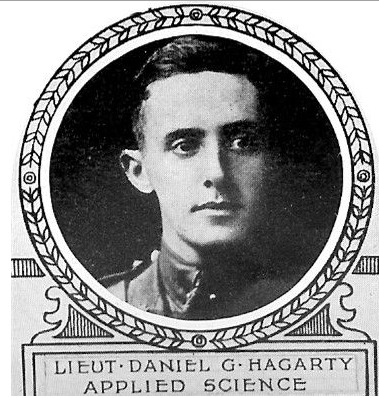
Lieutenant Daniel Galer Hagarty

Daniel Galer Hagarty, 21 years old, attested with the 2nd University Training Company in Montreal on 26 June 1915, despite being an engineering student at the University of Toronto. He had spent two years with The Queen’s Own Rifles, following in the footsteps of his father, Lieutenant Colonel Edward William Hagarty. Daniel lived with his parents at 662 Euclid Avenue, Toronto, and had attended Harbord Collegiate, where he also competed with cadets from around the world at the Bisley Shooting Competition.

An interesting and somewhat confusing detail in Daniel’s file is a “medical card” listing him as having been in No. 3 General Hospital in Le Treport, France, between 30 May and 7 June 1915. However, Daniel had only attested on 28 June 1915, meaning it was Dudley who was in the hospital at that time, despite the correction on the card. The correction was incorrect.

Both Hagartys were in England between July 1915 and January 1916. Daniel was with the 11th Reserve Battalion, awaiting assignment to a battalion overseas, while Dudley was with the 23rd Reserve Battalion, awaiting his next medical board. This period marked the first and predictable mix-ups involving pay.

Mix-ups and Consequences
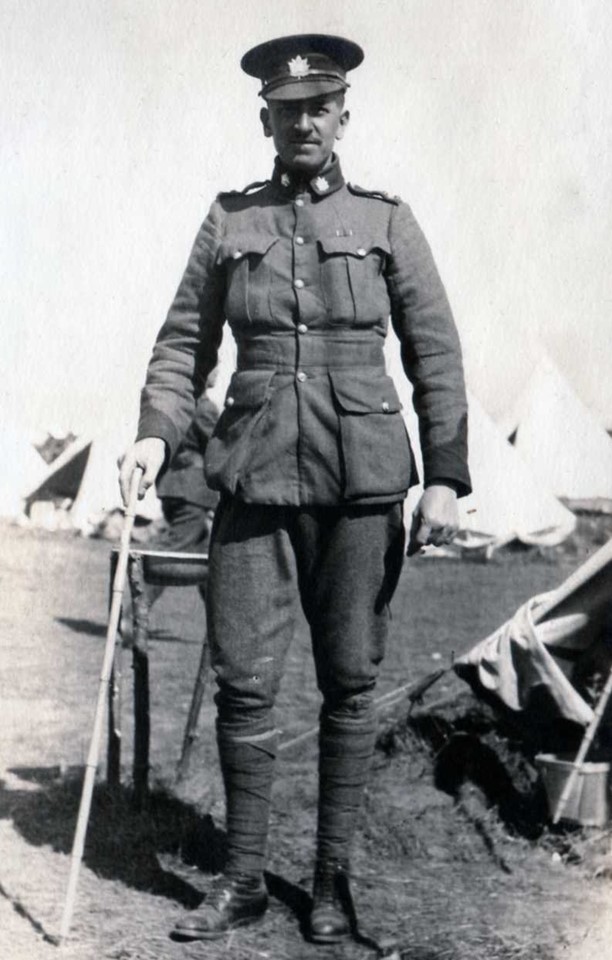
Lieutenant Dudley George Hagarty

A notable mix-up in Dudley Hagarty’s file occurs on a “promotion and appointment” form (R150), where he was to be sent to the Princess Patricia’s Canadian Light Infantry (PPCLI) on 29 January 1916. This entry was later crossed out with a note saying, “Refers to D.G. Hagarty PPCLI.” However, at that time, Dudley had already been deemed unfit for general service due to illness. This suggests that pages from the service files of the two Hagartys were actively mixed up, rather than being simple filing errors.

Dudley spent the rest of the war undergoing regular medical evaluations due to his condition (neurasthenia). He was eventually transferred to the Canadian Army Pay Corps in England, where he was promoted to captain in April 1917. Dudley returned to Canada in July 1918, deemed “surplus to requirements,” and was assigned to Militia District No. 2 in Toronto until his release in September 1919.

In Daniel’s file, several pay ledger sheets from Dudley’s file can be found, including one indicating that he was to return to Canada at his own expense aboard the SS Olympic on 5 September 1916 and had been granted leave between 8 November and 8 December 1916. The problem, of course, was that Daniel had been killed in action six months earlier. Furthermore, Daniel’s service card indicated he had been promoted to captain on 9 January 1917, despite having died six months prior.

Daniel’s Last Moments
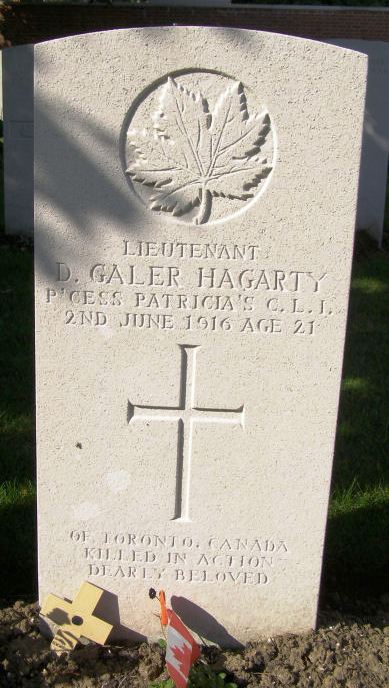
Lieutenant Daniel Galer Hagarty

On 2 June 1916, two days after returning from leave, Daniel was killed while leading No. 7 Platoon in No. 2 Company of the PPCLI. His platoon was positioned in the front line of the left sector at Sanctuary Wood, which was subjected to an intense bombardment by high-explosive shells and trench mortars, followed by an assault on the shelled position. Despite suffering heavy casualties, No. 2 Coy held their position (PPCLI War Diary, 2 June 1916). Daniel’s remains were recovered, so he was eventually buried at the Hooge Crater Cemetery.

On Dudley’s regimental card, it is noted that he passed through the 3rd, 9th, 17th, and 11th Bns. It was Daniel who was in the 11th while he was training in England, in anticipation of being assigned to the Patricia’s in France and Belgium. Between the two D. G. Hagartys, I am uncertain who passed through the 9th or 17th. Dudley did spend time in the 23rd Reserve Battalion while being shuffled to various commands. Along the way, he may have encountered the 9th and/or the 17th Reserve Bns, both located at Bramshott, en route to his position with the Canadian Army Pay Corps.

There were many more mixed-up pages from Dudley’s file in Daniel’s than vice versa.

The Legacy of Edward William Hagarty and the 201st

To some degree, this is now where the story begins.

The 201st CEF Battalion, otherwise known as the “Toronto Light Infantry Battalion,” was to be raised in Toronto. Lieutenant Colonel Edward William Hagarty was offered the provisional rank of lieutenant colonel to raise and command the battalion.
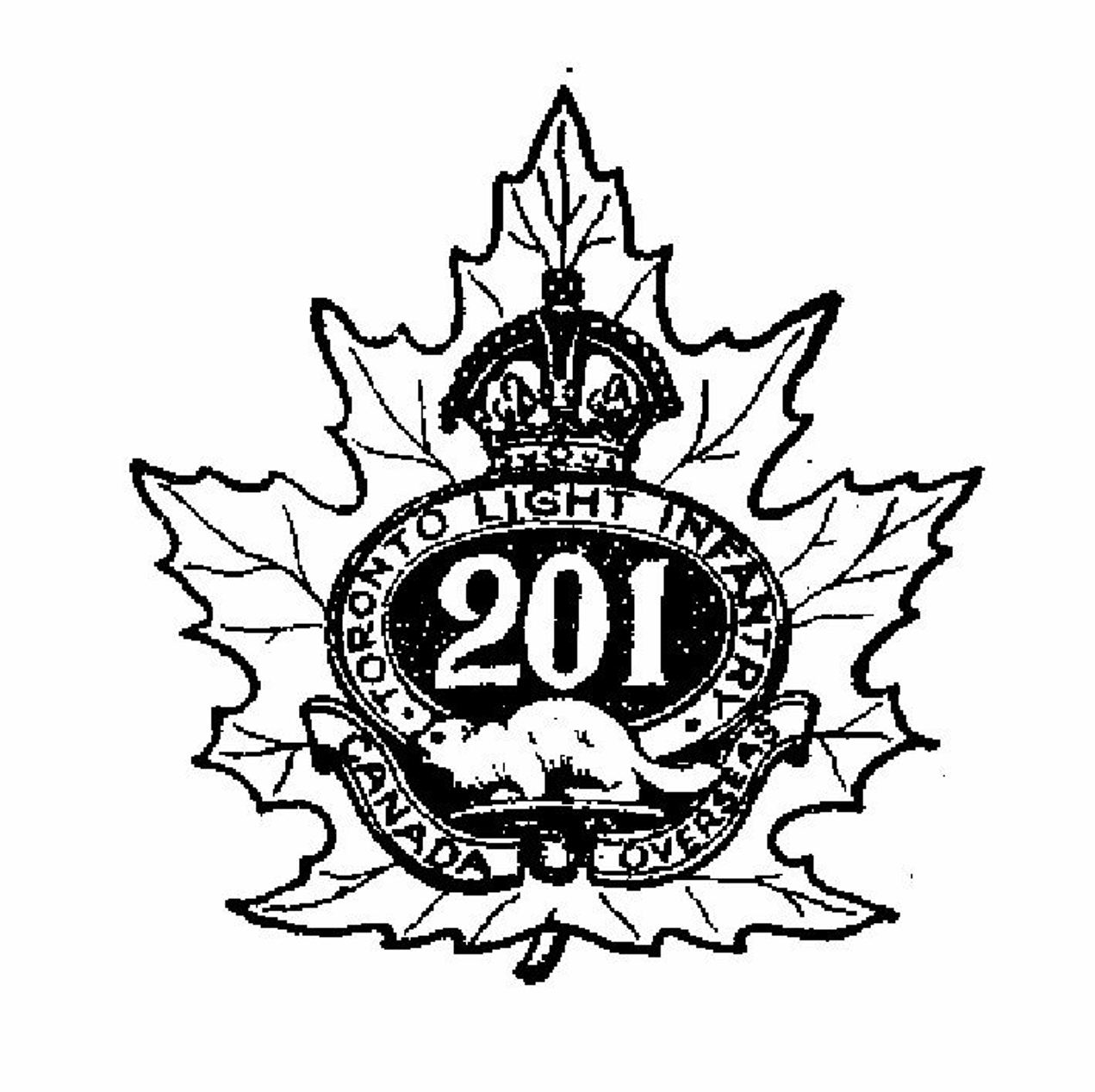
Competition to fill new battalions being formed for overseas service was intense, as casualties in France and Belgium were significant. Many of the Toronto-area units being raised were closely affiliated with militia units that had recruiters in place since 1914. Battalion commanders worked tirelessly to recruit a full battalion, aiming to send them overseas as a complete unit rather than dismantling them to provide reinforcements to other battalions. Many Canadian commanding officers faced disappointment as their units were often broken up, and they were relegated to staff duties in England, or worse.

LCol Hagarty enlisted in the still-to-be-formed 201st Battalion on 9 February 1916, at the age of 48. He resided at 662 Euclid Avenue with his wife, Charlotte, and son Daniel Galer Hagarty, who had left his studies eight months earlier to join the Princess Patricia’s Canadian Light Infantry (PPCLI) in France. LCol Hagarty was born on 7 September 1862.

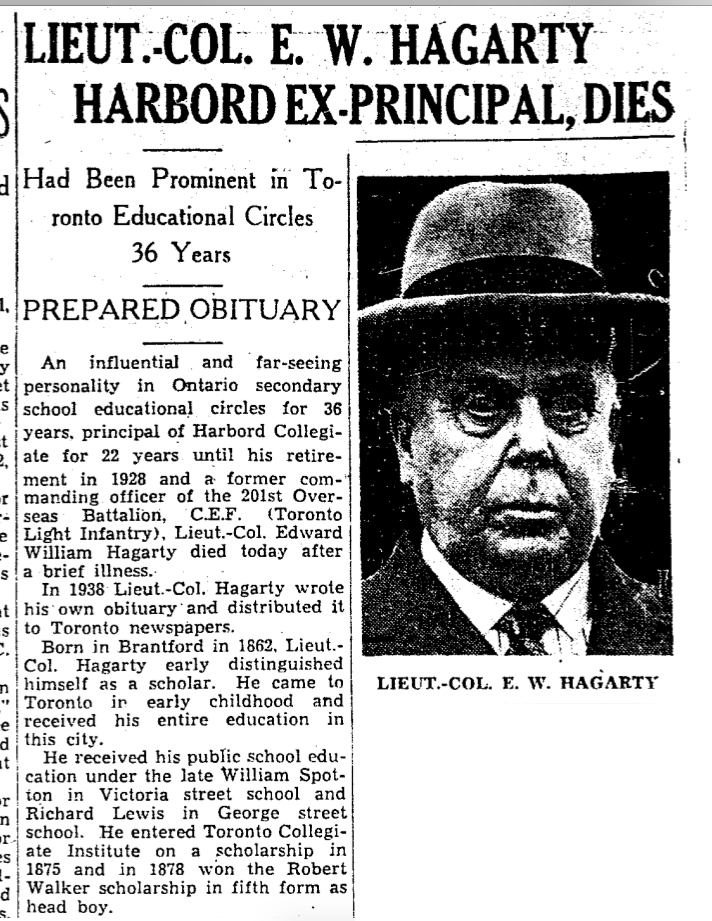
Edward Hagarty was the principal of Harbord Collegiate from 1906 to 1928. His previous military experience was limited—he had served four years with The Queen’s Own Rifles (QOR) and one year as a lieutenant with the 25th (Militia) Elgin Regiment. Most of his 25 years of military experience had been spent instructing cadets in communities and high schools, and he was actively involved in various cadet organizations, including Rifle Associations. In early 1913, he was a cadet battalion commander for the Toronto Collegiate Institutes. In January 1914, he was awarded the honorary rank of lieutenant colonel in the Corps of School Cadet Instructors (CSCI). On 19 January 1916, he received a certificate confirming his provisional appointment as an honorary lieutenant colonel for the purpose of commanding a CEF battalion. He was also issued a “Certificate of Military Qualification” dated 3 June 1916 from Ottawa, endorsed by Lieutenant Colonel R. Labatt of Military District 2. This qualification appeared just as General Order 69 of 15 July 1916 was issued, authorizing the raising of several new battalions, including the 170th, 201st, and 204th.
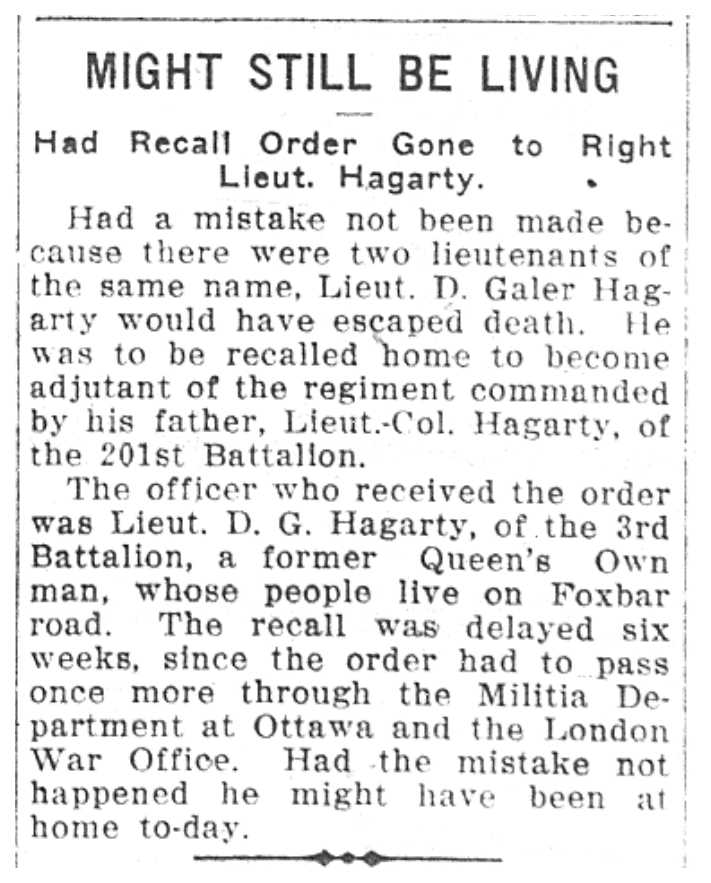
Part of LCol Hagarty’s plan was to have his son, Lt. Daniel Galer Hagarty, brought back from service overseas to become his adjutant. At this time, Daniel was completing training in England as a platoon commander with the PPCLI. Bureaucratic procedures were set in motion, and a tasking message was sent through various layers of command, according to various sources, including a newspaper article.

However, LCol Hagarty was devastated to learn that his son had been killed in action. He believed the military bureaucracy had mistakenly sent the order for his son to return to Canada and serve as his adjutant to the wrong person—Lt. Dudley George Hagarty, his son’s namesake. LCol Hagarty felt that had the message been sent to his son, Daniel, he would have “escaped death.” The loss of his son, combined with the inability to recruit sufficient soldiers from the cadet programs he had nurtured for years, led to the 201st Battalion being broken up while still in Canada. The soldiers were reassigned to the 170th Mississauga Horse (10th Royal Grenadiers) Battalion and the 198th Canadian Buffs (QOR) Battalion. It did not help that LCol Hagarty had declared his battalion the “temperance battalion,” which may have hindered recruiting efforts somewhat.

While I have not yet found a nominal roll for the 201st Battalion, the allocated block of service numbers (228001–231000) presented themselves. Unfortunately, the 201st did not attract enough recruits, especially when compared to other Toronto-area battalions. LCol Hagarty’s resignation was likely the final blow to any future the battalion might have had. It is not hard to imagine the sense of personal disappointment LCol Hagarty must have felt. Resigning under such circumstances would have been a very public statement of his frustration.

LCol Edward William Hagarty resigned from command of the 201st Battalion on 4 September 1916, just three months after the death of his son. Even if he had managed to take the 201st Battalion to England, his military experience at the senior officer level was nonexistent. On LCol Hagarty’s “Last Pay Certificate,” it was clearly noted that his “provisional appointment was cancelled.”

In late July 1919, LCol Hagarty and his wife Charlotte visited the battlefield in Belgium where their son fell. They found his grave at the Hooge Crater Cemetery before returning to Canada aboard the SS Savoie.

Legacy
Edward and Charlotte left a lasting legacy in Toronto with the establishment of the imposing Memorial at Harbord Collegiate Institute, which was dedicated in 1921 to “These former pupils who died for humanity in the Great War of 1914-1919.” Sadly, 20 years later, 52 more names would be added to the memorial.

Another lasting tribute is from the University of Toronto website as “the Reginald & Galer Hagarty Scholarship established by LCol E.W. Hagarty and Charlotte Ellen Hagarty in memory of their sons, Reginald and Galer. The scholarship is awarded to students entering their first year of any undergraduate program at the University of Toronto, based on academic achievement. The recipient must be a graduate of Harbord Collegiate.”

Edward passed away on 2 March 1943 and is buried in the family plot at St. James Cemetery in Toronto, alongside his wife Charlotte, who passed away two months later. Both of their sons are commemorated on the memorial at Harbord Collegiate.

National Cadet Week

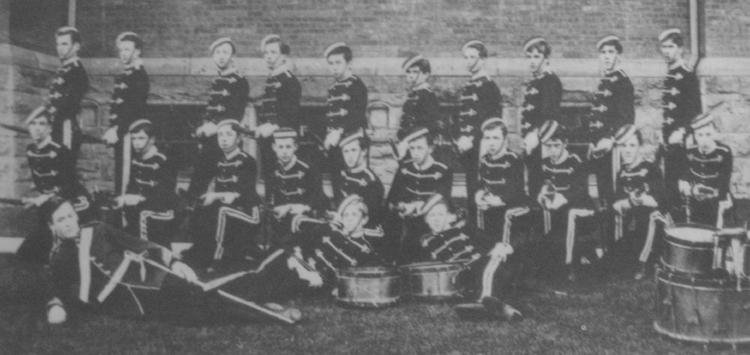
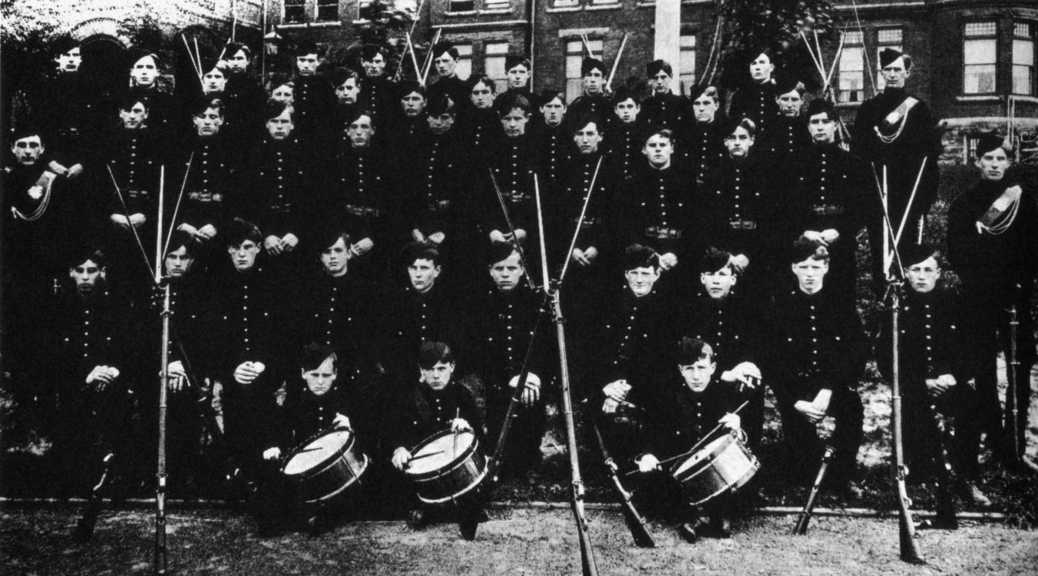
Above: Upper Canada College Cadets, 1899 – QOR Museum Collection.

Did you know this is National Cadet Week in Canada? Over the years, The Queen’s Own Rifles of Canada has had a number of affiliated army cadet corps – more than you might expect!

You can read about many of them here.

Access to Archival Materials

One of our goals is to provide access to archival materials that may have potential interest to researchers. We have been doing some of this through pages on this website.

In the past year, however, our collections management database has been upgraded to allow us to add documents such as pdfs which can also be made available in the Public Access view – the one any visitor can see. So where we have scanned certain documents, we can now provide the scans to researchers rather than just describe that record.

We recently scanned the seventy-three issues of the “Regimental Newsletter” (talk about monotonous!) which were published by the Regimental Depot between 25 November 1959 and 30 June 1970.  These varied in size from the first issue of 2 pages to the last which was 88 pages. They cover more than half of the cold war period when the regiment consisted of a regular force training depot, two regular force battalions, and a militia battalion. These supplemented the annual “Powder Horn” publications (1960-1970) and provided information about and often letters from officers deployed or posted externally to the battalions, various postings, promotions, obituaries, cadet corps updates, museum reports, cartoons, and a host of other tidbits.

Another example of recently scanned material is several scrapbooks of news clippings of the 1910 Trip to England which have recently proved valuable to a researcher writing a book on the trip:

From a 1910 Trip Scrapbook

In addition, we can also add URLs to the record and again make them available in the Public Access View. That means if we’ve already uploaded scans to our website, we can just link to that from the collection record. We’ll be working on updating those links in the future.

In the meantime, you can find a variety of materials on our Research and our Archives page with past issues of the annual Rifleman Magazine and the Powder Horn newsletters (not the annual publication from 1960-1970 yet), nominal rolls, 19th Century Regimental Orders, diaries and memoirs, etc.

We hope you’ll find these useful and/or at least interesting reads!

National Cadet Week

Above: Upper Canada College Cadets, 1899 – QOR Museum Collection.

Did you know this is National Cadet Week in Canada? Over the years, The Queen’s Own Rifles of Canada has had a number of affiliated army cadet corps – more than you might expect!

You can read about many of them here.

“The College Rifle Company”

Reprinted from “A History of Upper Canada College 1829-1892” compiled and edited by George Dickson, M.A. and G. Mercer Adam and published in Toronto in 1893. Accessed via Google Books.

———————————————————————

BY THE REV. T. F. FOTHERINGHAM[1], M.A., ST. JOHN’S, N.B.

As far back as 1863, when I entered Upper Canada College, and I do not know how long before, the older boys were assembled weekly for drill under the instruction of Major Goodwin. They were supplied with rifles and bayonets, waist belts and pouches. The room next the lavatory was set apart as an armoury. Out of this drill class the Rifle Company was evolved under the influence of vitality and environment. The presiding genius under whose auspices this took place was the gallant old soldier in command. What boy of that day does not remember him with affection? A strict disciplinarian, yet liking better to silence a frolicsome private with a harmless witticism that held him up to ridicule, than to bid him “fall out.” This was the severest penalty he ever inflicted, and it was much more keenly felt as a disgrace than the hundred lines of Virgil which the Principal immediately imposed by way of ratifying the sentence. The kindhearted old Major always seemed sorry the moment after, for in the next breath he would temper his rebuke with a cheery word and good-natured apology for the offender. He was bluff* and boyish, although his shoulders stooped and his head was grey. He loved the boys with all his heart, and they fully returned his affection. His quarters in the old Bathurst Street barracks were always free to them, and his happiest moments seemed to be when reciting his favourite “Tam o’ Shanter” to an admiring crowd, who never wearied of applauding the really splendid elocution.

The activity of the Fenian brotherhood in 1865 awakened much uneasiness in Canada. Large numbers of volunteers were enrolled, and the Military Schools were crowded with cadets. As in 1837, College boys were not behind in offering their services. Three of us, Fuller, Wilson, and myself, had obtained second-class certificates, and the idea was mooted of transforming our drill association into a company of the “Queen’s Own.”  The consent of the Principal having been obtained, Major Goodwin entered heartily into our plans. The boys met in the Prayer room one afternoon in December, 1865, and amid great enthusiasm elected Frank C. Draper, an old College boy and ex-officer of the “Queen’s Own,” as Captain, Valancey E. Fuller, Lieutenant, and M. Wilson, Ensign. William M. Richards, ______ Watson, and myself, were chosen Sergeants. I cannot remember the names of the other non-commissioned officers, if there were any. Enrolment went briskly on. The cubits of our stature were measured against the wall of the Principal’s room. What heroes we were in the eyes of those whose heads could not touch the ruler held at the standard height! The company was duly gazetted in General Orders of the 12th January, 1866, and attached to the 2nd Battalion, “Queen’s Own Rifles.”

On March the 8th, some volunteers were called out, and amongst others, the “Queen’s Own.” The College Company was not mentioned in the General Order, but the boys would not be suppressed. With the consent of Major (now Lieut-Col.) Gillmor, then in command, the boys appeared at every parade and march-out, — drilling as faithfully as others, but without any pay. This latter was a consideration to which our knightly souls were utterly oblivious.  Class work was sadly interrupted. Every week there were evening drills and a Saturday afternoon march-out.  Not one of the company was twenty years old, yet all tramped through the mud with the endurance and light-heartedness of veterans. Woe to the boy who stepped around a puddle instead of marching through it, or grumbled when an unlucky step filled his boot with ice-water. He was the butt of ironical sympathy for days afterwards. Our youthful appearance won us a somewhat patronizing regard from the rest of the battalion, and, in their paternal affection, they nicknamed us “the babies.” So far from being offended, the boys shewed the genuine stuff they were made of by accepting the soubriquet, and trying to make the name an honoured one. When, at the close of that period of active service. Major Gillmor complimented the company in his address at the final parade, and three cheers were generously given for “the babies,” we felt that the respect of the other corps had been completely won.

At that time many companies had their own marching songs. The College boys, in view of the juvenile position assigned to them, adopted as theirs the nursery hymn “Joyful,” fitting to its tune nonsensical words such as —

“He that hath plenty of spondulics
And giveth his neighbour none,
He shan’t have any of my spondulics
When his spondulics are done.

Chorus : “0, that will be joyful,
Joyful, joyful,
that will be joyful, when his
Spondulics are done.”

Other verses followed ad lib, “He that hath plenty of sauerkraut, peanuts,” &c., &c., until invention was exhausted. The ethics of the song were unimpeachable, and there was not the slightest thought of irreverence towards sacred associations. Anything of that kind would have been treated with scorn as utterly “low.” It was simply a boyish response to good-natured chaffing.

Few members of the corps will forget the excitement of St. Patrick’s Day, March 17th, 1866. Some days previous a rumour spread to the effect that bodies of men, marching in military order and armed with pikes, had been seen parading the streets after midnight. A guard of citizens was organized and a night patrol instituted. Fears were expressed that the usual St. Patrick’s Day procession would be the occasion of an outbreak on one side or the other. In Montreal and Quebec these parades were abandoned, but the Toronto societies determined to display their green banners as usual. Although no one believed that local Fenians would give any trouble, yet there was then, as now, an excitable element of the opposite party who might attack a procession, and those marching in it, fearing such an interruption, might carry concealed weapons. The throwing of a single stone might start a sanguinary conflict. The “Queen’s Own ” and the *’ Tenth Royals ” were assembled at the drill shed early in the forenoon and k^t there until towards evening. The College Company was with the rest of the battalion. Rations were served about noon. Drill and frolic filled up the quickly passing hours, and not a few voted it the jolliest pic-nic they had ever attended. Yet, beneath all the merriment, there were serious thoughts, for we had ball cartridges in our pouches, and many of us remembered the standing order never to fire over the heads of a riotous crowd. It was with feelings of intense relief that the citizens saw the volunteers returning to their homes peacefully that evening.

Although relieved from active service on Good Friday, March 30th, the “Queen’s Own” continued battalion drills at least weekly, sometimes  oftener. At all of these the College Company was present. There was a lull in the excitement. The O’Mahony wing of the Fenians was making a demonstration at Eastport, Maine, and the Roberts faction was temporarily inactive. The volunteers were recalled from the frontier. A grand concert in the drillshed, which held 10,000 people comfortably, on the evening of the Queen’s Birthday, seemed a fitting mode of celebrating the re-establishment of public confidence. Meantime “General” Sweeney had succeeded in effecting a reconciliation of rival factions, and on May 30th was announced as on his way to Canada at the head of the Fenian “army.” Fuller despatches arrived next day, and that night the militia of Canada were again called to arms. In March the Government asked for 10,000 volunteers and were offered 180,000 — now the response was no less enthusiastic.

When we assembled in the Prayer room on the morning of Friday, June 1st, Mr. Cockburn announced that the Fenians had crossed the Niagara River and were in possession of Fort Erie, and that the “Queen’s Own” had been ordered to meet them. The College Company was also called out, and members would report at once in uniform at the armoury. After a few words regarding the gravity of the occasion, the Principal dismissed the school for the day. The company mustered in full strength within an hour afterwards, only to find to its chagrin that, by special orders of General Napier, it was to remain in garrison and furnish the necessary guards for the armouries and military stores. It was with difficulty that the boys could be restrained from deserting to join the battalion. Many refused to wear their uniform when off duty. The order was an eminently wise and considerate one, but the boys felt that it carried the reproach of “babyhood” a little too far. They resented such an implication of juvenility. One admires their spirit and is not surprised that they failed to appreciate the responsibility resting upon their elders. It was quite true that they were too young for the hardships of service in the field ; most of them had been sent to school to study and not to play the amateur soldier, and their parents would have justly blamed the Principal for having permitted the formation of the corps; besides this the duty laid upon .them was a necessary and honourable one, and fell most fittingly upon the junior company of the battalion.

For two days the College Rifles were the only troops in the city, and furnished the guard on the Friday and Saturday nights succeeding the departure of the volunteers. I need not describe the excitement of those days. College boys helped to swell the crowds around the bulletin boards and added their voices to the cheers that rang out to the accompaniment of the Cathedral chimes when news of the rout of the invaders arrived.  About three o’clock on Sunday morning the volunteers from the country began to arrive. They were marched up from the railway station in companies and dismissed to ‘billets for breakfast. To me, the arrival of these raw troops was a deeply interesting sight. They came evidently from the farm and the workshop. It might be that the first gun of a great war had been fired at Ridgeway, — we did not know. If it was so, every one of these men was ready. There was no noisy frolic or loud laughter among them. Every word of command was heard with painful distinctness in the quiet of that Sabbath morning. When dismissed, one group after another struck up old-fashioned Psalm tunes, and set off singing them to their new quarters. One would have thought that Cromwell’s army or a regiment of Covenanters had reappeared among us. With such defenders, we did not fear should Lundy’s Lane or Queenston Heights come to be fought over again. Few Churches held service that evening, for nearly every person crowded towards the Yonge Street Wharf to meet the “City of Toronto” with its precious freight of dead and wounded. With another member of the company, like myself just off guard duty, I joined the crowd and was near the wharf when the steamer came in. To my surprise I heard the familiar voice of Lieut. Fuller in command of an escort composed of the College Company. It accompanied the five hearses to their destinations through thronged streets, amid a silence only broken by exclamations of sympathy and sorrow. Every head was uncovered as the dead heroes passed by.

On the Tuesday following a public funeral was held, and the bodies of Ensign McEachern and Privates Defries, Smith, Alderson, and Tempest lay in state in the drill shed. The gallery erected for the concert so recently held afforded a suitable elevation for the caskets. Ranged around these, the boys of our corps stood as a guard of honour, resting on their arms reversed, from eleven a.m. to one p.m. The company took part in all the military funerals of that sad time, and on one occasion, I think the one just referred to, furnished the firing party.

During the fortnight following the raid Toronto swarmed with volunteers, most of whom remained only a few days until formed into provisional battalions. Whilst these were in town, the College Company was released from the duty of furnishing guards. But there was the possibility that a sudden order from Ottawa might remove the guard on duty, and it was accordingly agreed that should the College bell ring at any time out of class hours, the members of the company would understand it as a signal to assemble at the armoury. One night as I was just about to retire I heard the well-known sound. It took very few seconds to resume my uniform, but, before I reached the street, every bell in the city was ringing the “general alarm.” The din was enough to warrant the conclusion that the Gael was indeed at our gates. I lived about a mile from the College, and only arrived in time to take my place at the head of the company as coverer and lead the way to the drill shed, then situated between Front and Wellington Streets, at the east end of the Parliament Buildings. A dense crowd was already assembled at the corner of Simcoe and Wellington Streets, and, as we drew near, I heard some one call out: “It’s the College boys, let’s give them three cheers !” This they did with a heartiness that made us feel modestly embarrassed. Acknowledging the honour in military fashion, we entered the drill shed, discovering then the cause of the ovation with which we had just been honoured. We were the first company to report itself in obedience to the summons. It was found shortly afterwards that we were not needed. A few companies had been ordered to Prescott, but enough remained for guard duty. In about an hour we were dismissed with not undeserved compliments. On the return of the “Queen’s Own” from Stratford, after the engagement at Ridgeway, the College Rifles met the battalion at the railway station and accompanied it in its march through the streets. Although they did not hear bullets whistle, the College boys felt that they had won some slight share in the magnificent welcome the regiment received.

During the summer following the Fenian raid a military camp was formed at Thorold, and the Upper Canada College Rifles united with the University Company to form one corps. The battalion was landed at Port Dalhousie, and marched through St. Catharines to the breezy field on the top of the mountain where the Tenth Royals and the Thirteenth from Hamilton were already pitching their tents. Here the boys again distinguished themselves by their light-hearted endurance of discomforts that would have well-nigh caused a mutiny amongst regulars. The ground was rough and hard — cattle had evidently roamed freely over it when the soil was moist. One had to select carefully for his couch the precise spot whose physical geography was most nearly complementary to the angularities of the human anatomy. The last duty every evening was a field study of the relations between geology and osteology. When it rained, the clay betrayed a most tenacious attachment to boots often ill-suited to such rough usage. The camp arrangements were of the most imperfect character. Plain rations, however, were abundant. One of our number betrayed extraordinary talents in the culinary line, and no “Irish” or “Boston ” stew can ever obliterate the memory of his achievements. No coffee and butterless bread ever tasted sweeter than that partaken around our tent pole every morning. The air was pure and bracing, and the drill just enough to make us forget all our discomforts in dreamless sleep. Every one heard with regret the orders to break up camp. To this day pleasant memories linger around the old camp ground. As illustrating the spirit of the boys, I may mention that it leaked out one evening that a general alarm was to be sounded during the night in order to test the promptitude with which the volunteers could respond. We determined that, for the honour of our corps, we should be the first on parade. Not one removed his uniform that night when he lay down. The covering sergeant slept in his boots and cross-belt, with his rifle by his side. To our great astonishment and chagrin the sun was shining brightly when the bugles awoke us at reveille.

The home march was not uneventful. As we left the camp, and when we marched through the streets of St Catharines, fair faces smiled from sidewalk and windows, and the battalion sang popular songs, accompanied by the band. We had scarcely left the town behind us when a thunder-storm came on. The “Queen’s Own” had proved its ability to “stand fire,” but water was another affair and retreat was no cowardice. We quickly found refuge under the grand stand of the race course. On a break occurring in the storm we set out again and arrived betimes at Port Dalhousie, where the “City” awaited us, but alas quantum mutati ab illis[2] who one short hour before spread their plumes and tuned their manly throats before the admiring civilians of the *’ City of the Saints!” Scarcely had we left the friendly shelter of the race course when the storm burst out afresh. The mire of the road was ankle deep and the ditches were brimful of water. Some took to the fields and others picked a careful but tedious path along the fences, while the bolder tramped along as much indifferent to pouring rain and adhesive mud as plucky College boys ought to be. No company in the battalion straggled less than the beardless youths in No. 10. When we arrived at Toronto, our sergeant was the first to spring ashore in response to the bugle call for “coverers,” and none marched up Yonge Street with jauntier step than the rain-soaked and mud-bespattered veterans of the rear company.

On the 26th June, 1868, Lieut. George D. Dawson, late of H. M. 47th Regiment, and now Col. Dawson, of the “Grenadiers” was gazetted Captain, vice F. C. Draper, who retired with the rank of Brevet Major. The Company re-enlisted under the Militia Act of 1868, but its name does not appear in the General Order of 6th February, 1869, in which the corps who constitute the active militia are named. It seems to have been silently dropped, along with others, which it was not judged advisable to continue in existence. The College Rifles never formed an integral part of the “Queen’s Own” but was merely attached to the battalion for administrative purposes. During its brief existence it left a record of which it need not be ashamed, one worthy of an institution which has supplied so many able officers to the various branches of the Imperial service. General Napier did not forget to give us honourable mention in his report.

[1] Thomas Francis Fotheringham attended Upper Canada College from 1863 to 1867.

[2]changed much from them

QOR Padre leads UCC chapel service

Former QOR Honorary Lieutenant Colonel and UCC Old Boy Brendan Caldwell with QOR Chaplain Captain John Niles after the UCC chapel service on 3 February 2016.
Former QOR Honorary Lieutenant Colonel and UCC Old Boy Brendan Caldwell with QOR Chaplain Captain John Niles after the UCC chapel service on 3 February 2016. His sermon reflected on the 150 year connection between UCC and the QOR.

QOR and Upper Canada College: 150th Anniversary of Affiliation

Major Francis Collier Draper

On 12 January 1866 No 11 Company “Upper Canada College” of The Queen’s Own Rifles of Canada (QOR) was formed under the command of Captain Frank C. Draper.

Draper seems like an excellent choice to fill this role as he was both a UCC Old Boy (1844-52) and had been a QOR officer since 1863. In 1874 he would resign his commission and become Toronto’s Chief Constable (i.e. Police Chief).

Creation of Upper Canada College Company of the Queen's Own Rifles of Canada (Gazette)
Creation of Upper Canada College Company of the Queen’s Own Rifles of Canada (Gazette)

The following article is excerpted from “COLBORNE’S LEGACY: Upper Canada College 1829-1979″ by Richard B. Howard

“It is Difficult to Establish a Date on which the College Rifle  Company, alias the Rifle Corps, later the Cadet Battalion, held its first official parade…..

The first hint of any military enthusiasm at UCC is mentioned earlier, when during the 1837 Rebellion, a troop of boys offered their services to the Lieutenant-Governor. …..

Early in Principal Cockburn’s regime, military drill was the subject of much attention in schools in England, Canada, and the United States. Ways were sought to promote what was thought of as a patriotic  spirit. The aim was to foster love of country along with a disposition to defend it, and to develop obedience and discipline. The important habit of prompt obedience could then be carried over into the classroom. By 1865 drill had been introduced into schools in many Ontario centres, including Toronto, London, and Port Hope. The College was probably one of the earliest participants; it is known that in 1863 the older boys paraded weekly under a Major [Henry] Goodwin, a strict disciplinarian but “kind-hearted” and “cheery.”

In 1865 Fenian troubles were creating much unease in Canada, and several Upper Canada College students asked Principal Cockburn’s permission to transform the recently formed cadets into a company of the Queen’s Own Rifles.

In December of that year an unknown number of pupils were enrolled, and in January 1866 the company was attached to the 2nd Battalion, Queen’s Own Rifles.

Thus , Upper Canada College was possibly the second Canadian school to have an “official” cadet corps, following Bishop’s College School in Lennoxville, Quebec, whose corps was organized in 1861.
……………….

The Queen’s Own were called out on March 8, 1866 , and though the College boys were not specifically mentioned, they appeared at every parade and march anyway (they even had their own marching song).

On St. Patrick’s Day the company waited for any trouble arising
out of the parade, but nothing happened . When the Fenians actually struck at Fort Erie on June 1 , the Queen’s Own were ordered out to meet them.  School was dismissed for the day and the College company reported for duty only to find that, by orders of General Napier, they must “…. remain in garrison to guard the armouries and official stores. Some students wanted to “desert” to join the battalion at the front, but evidently no one did.

“They performed the duty which was given them. ” After the raid there were plenty of volunteers in Toronto, and so the College company was released; but, just in case, it was “agreed that should the College bell ring at any time out of class hours, the members of the Company would . . . assemble at the Armoury.” The bell did, in fact, ring once, and the College boys were the first to report to the armoury, but it was a false alarm. A dense crowd gave them three cheers.

It has been thought that the Upper Canada College Rifle Company received “battle honours” for its passive though honourable role in the Raid. Not so. The Queen’s Own Rifles did not receive such honour; neither did the College. However, General Napier did give them honourable mention in his report, and it is true that they were called out for service (along with Bishop’s College School) — apparently the only time in Canadian military history this has happened.

Over thirty years later, the government decided to present medals to those who were engaged on active service in the Fenian Raid: the College Rifle Company, though denied the privilege of fighting, had performed some important functions, and all the members of the company still living received a medal.”

As of October 22, 1886, the Rifle Company officially became a Cadet Corps (#17) affiliated with The Queen’s Own Rifles of Canada. During the First World War, the Cadets’ association with the Queen’s Own had lapsed, and by 1923 two regiments, the Toronto Regiment (now the Royal Regiment of Canada) and QOR were requesting that the Corps affiliate itself with them. After some dispute between the three parties, the College settled on the Queen’s Own again by 1927.

In 1976 the compulsory “Battalion” was disbanded to be replaced the following year by a voluntary Cadet Corps. This lasted until 1988 when it was officially disbanded as of April 15th.

Over most of these 144 years, the connection between UCC and the QOR remained very strong. Many Old Boys went on to serve with the QOR – some even becoming Commanding Officer. Even today, the Regiment values this long and distinguished relationship between one of Canada’s oldest continuously operating schools and Canada’s longest continuously serving infantry regiment.

You can read more:

04271

UCC Old Boys who served in the QOR – Correction

Sorry for the confusion – you can find the list of Upper Canada College Old Boys who served in The Queen’s Own Rifles here.

Upper Canada College Cadets

Excepted from Upper Canada College, 1829-1979: Colborne’s Legacy; Howard, Richard; Macmillan Company of Canada, 1979

There is no fixed date for the formation of the Upper Canada College (UCC) Cadets, though beginnings can be traced to a willingness of students to participate in the defence against the 1837 rebellion. Later in the 1800s, in schools throughout England, Canada and the United States, involvement in a military body was thought of to inspire patriotism in young men, as well as being a good method of teaching discipline and obedience. By 1863, UCC students were paraded weekly, in an amateur fashion, under someone known as Major Goodwin, but with the beginning of Fenian troubles in Upper Canada by 1865, UCC students requested that the Cadets form into a company of the Queen’s Own Rifles. By 1866, the request was fulfilled, making UCC possibly the second school in Canada to have a proper Cadet Corps (the first being Bishop’s College School in Lennoxville, Quebec).

When the Fenians did attack Fort Erie, Ontario, on June 1, 1866 (see Fenian Raids), the UCC Cadets, along with the Bishop’s College Cadets (Quebec), were called to duty, but were instructed only to guard the armouries and official stores. None-the-less, this was the only time in Canadian military history where student Cadet Corps were called to duty.

Upper Canada College Cadets 1893
Upper Canada College Cadets 1899

By the 1890s, there was a lack of enthusiasm for the Cadets. It was an extra expense for a student’s family to cover the costs of uniform, weapons, and even their drill instructor. As well, drill and practice time was beyond the commitment to scholastics and sport. Enrolment fluctuated over the next few decades, at one point the school’s administration turning its eyes to the school the College had been modeled on, Eton, as well as Harrow, where Cadet participation was compulsory. No real action was taken by UCC in regards to the Cadets, however, by 1910 the population of the company had increased to 63, and in 1912 a Sergeant Carpenter was approached to act as instructor. He was not to last long, as by 1914 he was in Europe as Sergeant-Major in the 9th Battalion of the 1st Canadian Overseas Contingent. Numbers in the UCC Cadets still stayed high during the First World War.

Upper Canada College Cadets 1909

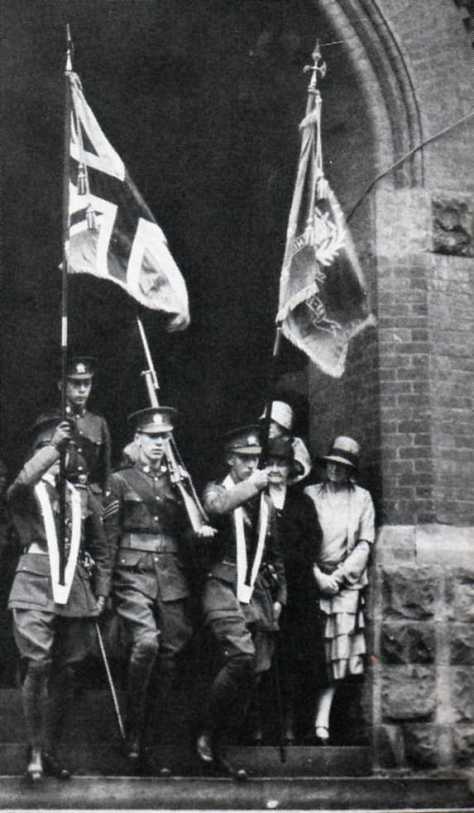
By around 1919, the UCC Cadets finally became compulsory, and principal Grant asked the army district headquarters if the Corps could be presented with Colours, both the King’s Colour and College Colour.  [Now Regimental Sergeant Major Carpenter also returned in 1919.] The College Colour was given by Elanor Gooderham in 1921.

During the First World War, the Cadets’ association with the Queen’s Own Rifles had lapsed, and by 1923 two regiments, the Toronto Regiment and Queen’s Own Rifles were requesting that the Corps affiliate itself with them. After some dispute between the three parties, the College settled on the Queen’s Own again by 1927.

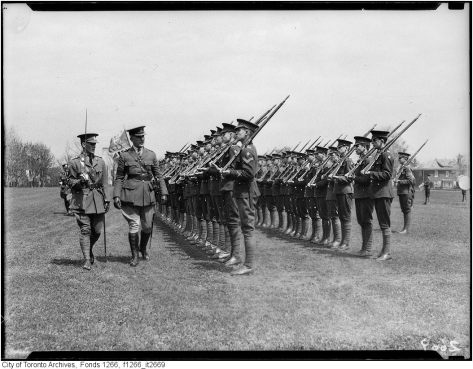
Lieutenant Colonel W.A. McCrimmon inspecting cadets at Upper Canada College 1924
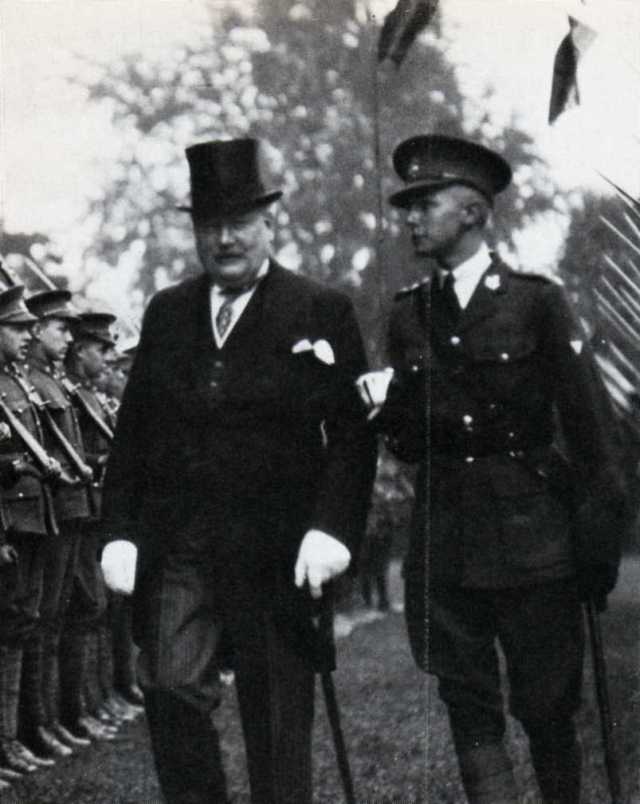
Inspecting the Cadet Guard of Honour for the Upper Canada College Centenary Celebrations, September 1929. Lieutenant Governor W.E. Ross and Captain Frank Shipp, Officer Commanding the cadet corps.

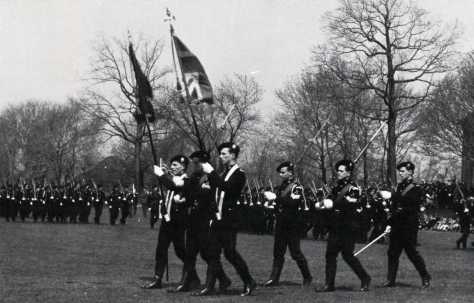
Cadet Colour Party for the Upper Canada College Centenary Celebrations, September 1929

For thirty following years, the Cadets remained an integral part of College life, and by the middle of the Second World War boys were practicing not only drills, but also spent time on lectures, map reading, military law, and signalling.

Upper Canada College Cadets Corps Annual Inspection, May 1940

Still, by the 1960s, due to broader shifts in social paradigms, belief in the Cadets was faltering; religion and patriotism were not held in such high regard by youth, and rebellion was the more accepted behaviour for teenagers. Minutes of the Board of Governors meeting in 1965 recorded, for the first time in sixty years, poor discipline at the battalion parade.

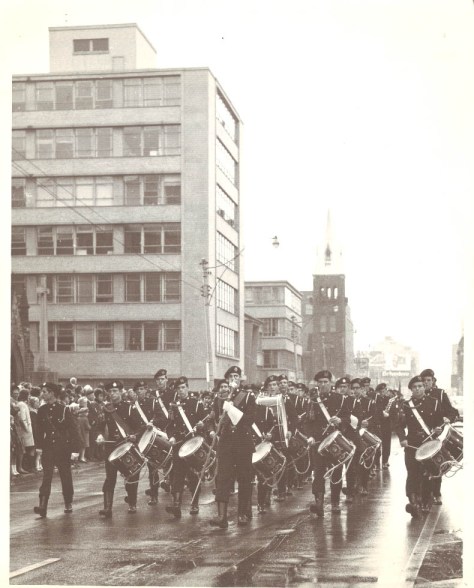
Upper Canada College Cadet Corps Band on parade November, 1967

Principal Richard Sadlier finally disbanded the Cadet Battalion as a compulsory body in 1976. He noted: “The Battalion has been left with little beyond its ceremonial drill which is a pretty irrelevant exercise to many people today and difficult to defend when it becomes the be-all and end-all of a program.”

In 1977, the voluntary Royal Canadian Army Cadets helped organize a course in military science at UCC, which also included battle drill, field craft, weapons training, and some parade-square drill. But, by the mid 1980s, interest in this programme had fallen to a bare minimum, and today UCC provides no formal military training.

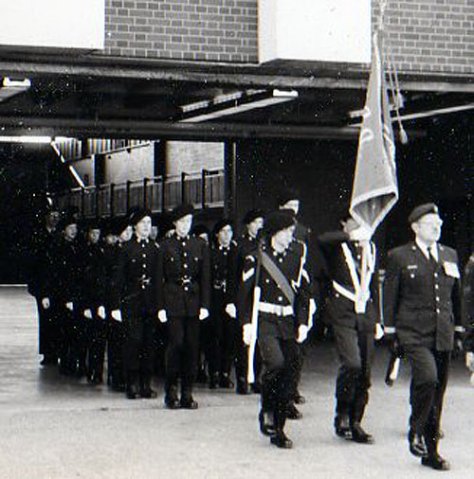
17 Upper Canada College Cadet Corps marching out of Moss Park Armoury circa 1979 led by Captain Walter Belfontaine, CD

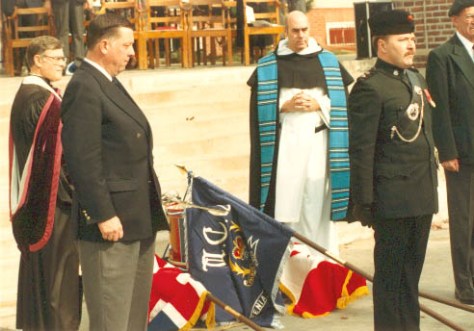
The voluntary corps was officially disbanded April 15, 1988, although new colours were dedicated and presented to the College by Old Boys in 1989.

New colours dedicated and presented to the College by old boys in 1989.